Showing posts with label illusion. Show all posts

Monday, June 23, 2025

face camouflage / sidestep the flu by growing a beard

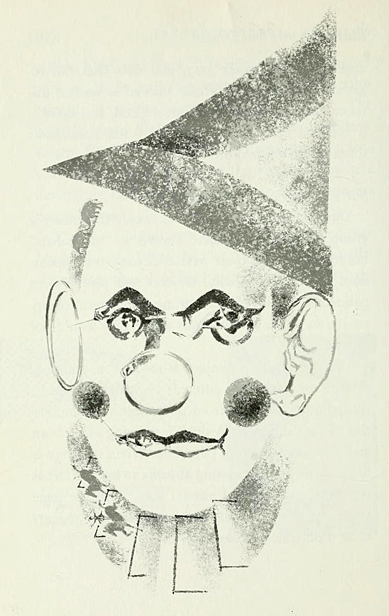
Above Rex Whistler, comic portrait (repeated five times) of a bearded man whose identity changes when positioned upsidedown (c1930).

•••

Anon, HIRSUTE VEIL CAMOUFLAGE IS FLU GERM DUPE, in Salt Lake Herald Republican, December 15, 1918, p. 48—

Further hint to the flu dodger—masquerade behind nature’s mask, the moustache. Or, as a further safeguard, raise whiskers.

’Tis thus some of the health authorities advise. A fuzzy growth, whether on lip or jowl, they explain, is a germ strainer. The burglarious bacillus, trying to break in, has about as much chance as a camel at the needle’s eye or a carrot in a colandar.

If the moustahe or whiskers prove to be real preventatives, lots of Salt Lake men who pine to retire from an ailing world will take the hirsute veil. Faces which would have been displayed merely as faces may take on the aspect of sylvan retreats and bosky dells. Razor and scythe will be laid away and phizes will be allowed to sprout in all their wild carefree abandon. Familiar countenances will be concealed behind an impenetrable camouflage and the only recognizable features when friend meets friend will be a pair of eyes, a twinkling nose and two untrammeled ears.

The local Adonis, whose finely-chiseled beauty won the hearts of all feminine beholders, will appear in his bewhiskered role as plain as a welcome mat. The homely citizen will resemble a discarded Christmas tree, which has reached a sere and yellow past. It will be a sad day for the barbers, but the hedge trimmers and landscape gardeners may build up a profitable business.

If Salt Lake men decide to go in for moustaches and whiskers, the caravan-series may become strangely quiet. For not a one of them will have the hardihood to order soup.

RELATED LINKS    

Dazzle Camouflage: What is it and how did it work? /  Nature, Art, and Camouflage / Art, Women's Rights, and Camouflage /  Embedded Figures, Art, and Camouflage / Art, Gestalt, and Camouflage /  Optical science meets visual art /  Disruption versus dazzle / Chicanery and conspicuousness /  Under the big top at Sims' circus

Sale-priced books on camouflage / free shipping

Saturday, September 21, 2024

Camoufleur Donates Materials to Brooklyn Museum

US Navy photograph of ship camoufleur Everett L. Warner
Brooklyn Museum. Report Upon the Conditions and Progress of the Museums for the Year Ending 1919, p. 16—

Mr. Everett L. Warner, the etcher, gave to the Library a quantity of material on camouflage consisting of photographs, diagrams, postcards, etc., which was a welcome addition to our file of such material.

RELATED LINK

Disruption versus dazzle

Wednesday, September 18, 2024

B.J.O. Nordfeldt's connection to WWI ship camouflage

Portrait of B.J.O. Nordfeldt
Above This image is cited on Wikipedia Commons as a portrait of Swedish-American artist Bror Julius Olsson Nordfeldt. An etching dated 1935, it is presumably a self-portrait since he is also listed as having made it (yet, oddly the signature seems to read Schneider). It is in the collection of the Smithsonian American Art Museum, Gift of Chicago Society of Etchers.

We have blogged about Nordfeldt before, and with good reason. As we noted in an earlier post in 2019, Nordfeldt designed ship camouflage for the US Shipping Board during World War I in San Francisco. He was a fascinating character, with an all but unbelievable breadth of interests and capabilities. In addition to his involvement in ship camouflage, he was also an early participant in the art colony at Provincetown MA (he designed sets for the Provincetown Players) and eventually settled in New Mexico, where he was associated with the Taos Society of Artists.

Recently we ran across a news article about an exhibition of his artwork, titled “Nordfeldt Shows Interesting Work” in the Oakland Tribune, November 10, 1918, p. 6. That review concludes with this curious note:

Mr. Nordfeldt is in San Francisco at the rquest of the government, in charge of the camouflage department of the shipyards.

Would he tell us, if we cross our hearts not to tell, what the plan is that he and his conferes are following with the ships that go down to the sea?

There are those among us—good Americans at that—who are wondering “Who’s looney now?”


The USS Western Spirit (shown below) was most likely one of the ships whose dazzle camouflage Nordfeldt was responsible for.

USS Western Spirit c1918 (digital coloring)

RELATED LINKS    

 Dazzle Camouflage: What is it and how did it work?

 Nature, Art, and Camouflage

 Art, Women's Rights, and Camouflage

 Embedded Figures, Art, and Camouflage

 Art, Gestalt, and Camouflage

 Optical science meets visual art

 Disruption versus dazzle

 Chicanery and conspicuousness

 Under the big top at Sims' circus

Saturday, September 14, 2024

World War I marine camouflage exhibited in Brooklyn

Above An official US Navy photograph (digital coloring) of Lieutenant Harold Van Buskirk, who was head of the Camouflage Section (comprised of two sub-sections) in the Navy's Bureau of Construction and Repair during World War I. He is applying the finishing touches on the "dazzle" camouflage pattern on a scale model of an American ship. Notice the completed models on the background storage shelf.

Once the model was completed, it was taken to a testing theatre, equipped with a periscopic viewing device and changeable seascape backgrounds. The viewer was challenged to estimate the angle of the model as it was positioned on an adjustable platform (as shown in a photograph of Navy camoufleurs Van Buskirk and Kenneth MacIntire ).

•••

Exhibit of Marine Camouflage in Science, Vol 50 No 1287, c1919, p. 205—

The Brooklyn Museum Quarterly describes a special exhibit held at the museum of models, design. and other objects illustrating the practice and some of the principles of marine camouflage. The exhibition was arranged by the curator of the department of natural science, and was made possible through the interest and cooperation of Mr. William A. Mackay, of the United States Shipping Board, camoufleur of the Second Naval District, and Lieutenants Harold Van Buskirk and Everett L. Warner, of the Camouflage Section, Bureau of Construction and Repair, United States Navy. Numerous other naval officers, members of the American Society of Marine Camoufleurs, and others, also contributed to the success of the exhibit by lending illustrative material.

A aeries of photographs made in the naval laboratories at Washington DC, and Rochester NY, showed successive stages of the experimental work by means of which the colors and patterns employed in the camouflage designs had been arrived at. These illustrations included views of the elaborate periscopic theater at Rochester, in which painted models of ships were tested under conditions which simulated, in all essential respects, the open ocean. The history of marine camouflage was briefly traced by means of labels and colored models, while approved as well as experimental designs of the "low-visibility" type, the British and American "dazzles," and the French system, were shown by means of models, photographs and colored lithographs issued by the Navy Department.

A case in the center of the exhibition room contained a miniature convoy of transports in charge of a cruiser and a flotilla of destroyers, each camouflaged model an exact replica of its namesake, or, rather, the original working model from which the transport or war vessel had been camouflaged. A simple, illuminated theater, equipped with a periscope, enabled visitors to observe a model as if from a submarine point of view, and moreover, demonstrated surprisingly well the distortion and other types of illusion produced by the camoufleur's design. 

Wednesday, July 31, 2024

Edoardo Dotto / on camouflage & mimicry as duplicity

online link
Recently I became acquainted with the writings of a professor of architecture, named Edoardo Dotto, at the University of Catania in Italy. I am especially drawn to his articles because they are cross-disciplinary. While his essays may originate with architecture and drawing, he reaches out in deliberate ways to adjacent concerns, such as art and vision, pictorial representation, camouflage, humor, and so on. 

I am particularly interested in two of his conference papers, both of which can be accessed online in English. They are “Drawing Hands: The themes of representation in Steinberg and Escher’s Images” (2017); and “Lying to the eye: the mimicry between art and science” (2022), which pertains to art and camouflage. 

edoardo dotto 


Thursday, October 26, 2023

as styles evolve, no need to camouflage chunky feet

Above This is strange. It’s a news article from the Boston Sunday Globe, dated July 2, 1939, page 2 (only weeks before the outbreak in Europe of World War II). It’s a discussion of women’s shoe styles in relation to foot size. It claims, in essence, that women are no longer insistent on having small-sized, “dainty” feet. In buying shoes, they are choosing comfort over pain. But then, by means of a curious seque, the author credits this change of attitude to the use of ship camouflage in WWI. Here is the reasoning—

Women have never had an active desire to have dainty feet. Twenty years ago, however, they felt that large feet made them conspicuous; in those days the cartoonists frequently used to jeer at them, call them gunboats and similar names. So dainty feet became the style. Now shoe stores keep sizes 10 and 11 on hand for women who are not ashamed to ask for them.


Shoe manufacturers have contributed more than their bit to this change in point of view. The styles of the last decade have provided for what used to be called gunboats much the same sort of camouflage that the navy paints on battleships in wartime. Color combinations make the large shoe less conspicuous. The sandal type of shoe, with the toe and heel cut out, aimed to make the foot look smaller.

Thursday, December 8, 2022

is crime not to be depended upon / who can we trust?

Above A pictorial advertisement for a Victorian-era British illusionist, T[homas] Elder Hearn.

•••

Alas! This is An Age of Ingenious Camouflage, in Salina Journal (Salina KS), January 17, 1920—

New York—This is an age of camouflage. Yes; of course the word has been overworked. Maybe it isn't used any more in our best journalistic circles. But it's an age of camouflage just the same. Now take the case of John Smith of the East end, up for examination in a case of assault and battery. He did not deny that Emil Emilson hired him to beat up Joe Lansky or that he got $5 from Emil for beating up Joe. But he strongly denied that he did beat up Joe. Finally they got the truth out of John, who thus explained the seeming inconsistencies of his statement:

“When a fellow is hired to do up another guy he goes and tells him about it. Then they get together and they stick court plaster all over the guy's face and tie a bandage around his head with a little beef blood showing through and put his arm in a sling. The guy who wants him done up looks him over and thinks he got his money's worth.”

Now this is art, but is it honest? Is crime not to be depended upon to be what it seems? We know that our leather chairs are not made of hide, but of old rubber boots and condensed milk. We know that chicken salad is frequently made of veal. We understand that our sealskin coats are made from the fur of the muskrat and that our linen is cotton. Knowing, nobody cares. But it had been supposed that crime was above substitution. Here we have a detailed description of camouflage assault.

When thugs become too ingenious to kick in the ribs of the persons they are paid to assault and resort to camouflage to make the patron think he is getting something just as good, whither are we drifting? 

Sunday, October 30, 2022

Abbott Thayer and Concealing Coloration / Dublin NH

Above Abbott Handerson Thayer, Charcoal drawing for ship camouflage experiment, c1915. From Abbott Handerson Thayer Family Collection. 

•••

Excerpted from L.W. Leonard and J.L. Seward, The History of Dublin NH. Published by the Town of Dublin, 1920, pp. 684-686—

Throughout the world the word “camouflage” has become familiar during the war. Although this word is of French origin, the thing itself is primarily an American creation, the work neither of warriors nor army experts, but of a distinguished artist, a well-known Dublin resident, Abbott H. Thayer, who has permanently lived here for more than twenty-five years.

In 1896, an essay by Mr. Thayer on “The Law Which Underlies Protective Coloration,” was published in The Auk, and shortly afterwards reprinted in the Year Book of the  Smithsonian Institution. In 1909, the Macmillans published Concealing-coloration in the Animal Kingdom, written by Abbott H. Thayer’s son, Gerald H. Thayer, and illustrated by father and son.

Protective coloration, as set forth in this book, was one of the main starting points of camouflage, and to a considerable extent has guided its development. Assurance of these facts were given Mr. Thayer in England and Scotland in the winter of 1915-16, when he went abroad to tender the Allies’ more direct help in this matter.

Professor [Sir William Abbott] Herdman of the University of Liverpool, suggested that the naturalists of Great Britain ought to sign a joint statement to the effect that they believed Mr. Thayer’s unique knowledge of protective coloration could be made of the greatest use to the War Department. It proved, however, that, owing to the efforts of several other British scientists, notably Professor J. Graham Kerr of Cambridge and the University of Glasgow, who had even urged that the government create a special bureau for the adoption of Thayer’s discoveries, “concealing coloration” was already doing war service of various kinds, both on land and sea.
 
Camouflage has carried the principles of visual deception to hitherto undreamed-of lengths of application, and to manifold and divergent new developments.

But the latest military camouflage was mainly a matter of masking batteries and guns for airplane detection. Standardized materials, wire netting, colored shreds of burlap, etc., manufactured in vast quantities behind the lines were the main dependence for this roofing-over and screening of guns. The latest marine camouflage, again, sought not concealment of ships, but effects of distortion of outline and perspective which would puzzle the U-boat observers looking through the periscope, as to the vessel’s speed, distance, exact form, and especially her course, or direction of movement.
 
Professor E. B. Poulton, F. R. S., etc., President of the Linnean Society of London, the distinguished English evolutionist, writes as follows:

“During the sixty years which have elapsed since the historic day [of the reading before the Linnean Society of Darwin’s and Wallace’s joint essay on Natural Selection], English-speaking workers—among the foremost the American artist-naturalist, Abbott H. Thayer, and his son Gerald H. Thayer—have studied this principle [protective coloration], continually extending it by the discovery of fresh applications, and analysing it into a whole group of cooperating principles; but inspite of all these naturalists have done, it required the Great War and a misused French word in order to arrest the attention of their fellow-countrymen…

We may, however, forgive the inccurate use of a new word which the war has bought into our language because of the attention which has now been focused upon a most interesting subject—attention which rightly demands a new and widely accessible edition of this work [Thayers’ Concealing Coloration]. Here are clearly explained and illustrated the principles underlying the art of camouflage, practiced by nature from time immemorial but in some of its main lines only made known to man by the discoveries of Abbott H. Thayer.”

Saturday, October 29, 2022

Thayer's camouflage of William James' Norfolk jacket

Above A comparison of two photographs, the one on the far left identified as Abbott H. Thayer, attired in a Norfolk hunting jacket that had previously been owned by philosopher William James. When James, a friend of Thayer, died, the jacket was given to Thayer by James' two sons, Aleck and Billy, both of whom were artists and had studied with Thayer. 

Later, early in World War I, Thayer used that same jacket as a way to demonstrate how fabric scraps (rags) and his wife's discarded stockings might be attached to its surface, to break the continuity of the figure. By superimposing the one photograph on top of the other, I am trying to "prove" that the person in the photograph in the center and on the right (unidentified when published) is in fact Abbott Thayer himself, with a painted face, wearing that Norfolk jacket.

•••

Be warned that the story below is full of inaccuracies. Thayer submitted a ship camouflage proposal (based on countershading) to the US Government during the Spanish-American War (not WWI), but asked for too much money. I have never seen any indication that he was asked, during WWI, “to guide a Navy program.” He did attempt (ineptly) to persuade the British to adopt disruptively patterned infantry uniforms—but his prototype was literally made (as shown above) partly of rags and worn-out womens' hose.

•••

Ernest Henderson, The World of “Mr. Sheraton.” New York: Popular Library, 1962, p. 83—

When World War I was raging, deceptive markings to disguise merchant ships falling prey to German torpedoes became a matter of national necessity. To meet this grave emergency, Dublin’s [NH] great naturalist [artist Abbott H. Thayer] was offered an impressive financial inducement to guide a Navy program for confusing the enemy with camouflage. Despite a threatening spector of poverty, Thayer flatly declined. It would mean a military role, and this his conscience would not then permit.

Subsequently, as the fever of war increased, realizing that human lives were involved, Thayer offered the British a new type of uniform designed to render soldiers partially invisible. This the British promptly rejected, concluding, no doubt, that fitting their men with unbecoming rags could injure national morale even more than could a mere reduction in the deadliness of approaching German bullets.

Abbott Handerson Thayer / the master at his very best

Abbott H. Thayer (c1915)
Above Abbott Handerson Thayer, Study of Alma Wollerman, oil on canvas, c1915. From Abbott Handerson Thayer Family Collection. Thayer made a number of paintings of Alma Wollerman Thayer (his daughter-in-law as of 1911, wife of Gerald H. Thayer), but surely this must be the finest. This is the elder Thayer at his best.

•••

Ernest Henderson, The World of “Mr. Sheraton.” New York: Popular Library, 1962, pp. 82-83—

Another Dublin [NH] resident was the artist and naturalist Abbott H. Thayer, considered by many the discoverer of protective coloration. While still in my teens, I saw a demonstration of his skill. He had produced a piece of stone carved to resemble a duck. Painted to match the roadway, the object had a dark brown back, with much lighter colors on its belly.

In broad daylight Thayer placed the duck, supported by a stiff wire, in the roadway and led me twenty paces away. Turning, I was sure the object had vanished; nothing was visible at all. A few paces nearer, and the wire could be seen—absolutely nothing else. Another few paces, and the duck began to take form. Yes, Abbott Thayer had indeed mastered nature’s private secret for deceiving the human eye.

Saturday, October 8, 2022

Part 03 has been posted / Ames and Anamorphosis

Unbelievable! At last I have completed it. Earlier this afternoon, I finished and posted on YouTube at <https://youtu.be/mxOEx2JLQBA> the third and final segment of a documentary trilogy on the life and work of Adelbert Ames II (known as Del Ames) (1880-1955), an American artist, lawyer, optical physiologist, and psychologist, best-known for having devised the Ames Demonstrations in Perception.

This part primarily focuses on Ames' influence on others, among them scientists, filmmakers, and artists, especially by his targeted use of anamorphosis (aka "forced perspective") in his well-known laboratory set-ups. It reveals the little-known links between Ames' experiments, Vorticism, and avant-garde filmmaking (Ballet Mécanique), as well as in popular culture, such as cinematic special effects and roadside tourist attractions.

In conclusion, it also provides a close-up look at the recent works of three contemporary visual artists, who, in one way or another, make astonishing use of perspective. They are Jan Beutener (Amsterdam), Richard Koenig (Kalamazoo MI), and Patrick Hughes (London).

All three parts of the trilogy (about 90 minutes in combined length) can be accessed online free at my YouTube channel at <https://www.youtube.com/channel/UCzYrUfsAvkZur5cBv6xlhSg>.  Of course, I am eager for others to see this. Do not hesitate to share it with anyone and everyone who might find it of value or interest.

Friday, September 9, 2022

Ames Demonstrations / replications of some of those

Fifty years ago, as a means of learning about the role of vision in art and design, I replicated a small number of the so-called Ames Demonstrations in Perception (as well as Dürer's drawing machines, Van Gogh's grid-based drawing frame, Alberti's perspective veil, stereo viewers and cameras, et al.). As shown above, I am looking into the back window of a small-sized Ames Distorted Room. Below is a much earlier newspaper article on this and other experiments by its originator, artist and psychologist Adelbert Ames II. Having published a number of articles on Ames and aspects of his life, I am now producing a three-part series of video talks, the first of which can now be viewed on YouTube.


an upright clown but a circus when turned clockwise

Above Viewed upright, it is a portrait of a clown. Rotate one turn clockwise, and it becomes a circus scene. Ambiguity. Double image. Puzzle picture. Hidden figure. For more on embedded figures and camouflage, go here. Artist unknown, from Larry Kettelkamp, Tricks of Eye and Mind: The Story of Optical Illusions, 1974.

Sunday, July 17, 2022

lowly looking car made quite snappy by paint & brush

AUTO GOSSIP in The Times (Munster IN), February 2, 1920, p. 6—

Old Man Snodgrass, of the Auto Customs Shop, is the adeptest camouflage artist you ever saw. Not boasting at all, but says Art: “People have the doggonest time telling my work from new cars, but the difference is so little few people can tell.” What do you charge, Mr. Snodgrass, for painting a 1914 Lizzie that’s only “went” 211,999 miles? Will she look like new when you get through?

•••

Anon, CAMOUFLAGE USED ON CAR: Lowly Looking Car Made Quite Snappy By Use of Paint and Brush: Wartime Treatment of Shipping Used to Improve Motor’s Appearance, in The Daily Colorist, June 1929—

Does your car look too fat, too tall, too short, or just generally antique?

Cheer up. Just study a few good camouflage methods and you can with paint endow it with the lines of the finest racer. The dress principle that makes stout ladies look thin through vertical-lined clothes works for cars, too.

Camouflag[ing] autos to make them look larger, lower, more luxurious is the job of Captain H. Ledyard Towle, alumnus of Adelphi Academy and Pratt Institute of Brooklyn.

Before the war nothing was known of Captain Towle’s new kind of art. Now he has applied the principles of camouflage…to the painting of automobiles.

“Tommyrot,” the auto manufacturers told him when he first submitted his ideas. “A car is a car. You can’t improve its engine or even its appearance through camouflage.”

But they gave him a chance. He went quietly to work and repainted one model. Its sales increased with astounding rapidity. Now he supervises the painting of millions of them.

He got his ideas during the war. Before that he was a portrait painter. Previous to the age of thirty he had done the portraits of Captain Eddie Rickenbacker and other distinguished persons. Then during the war he acquired a more humble idea of art.

He learned that love of beauty and symmetry is not confined to the upper crust. The ordinary run of soldiers, the small farmer, the street cleaner, everyone, in fact, knows when something beautiful has been set before him.…

One of his experiments affecting the neatness of a car’s appearance consisted of taking a dark-colored car and painting a light strip along its entire length on a level with the top of the radiator.


Friday, February 18, 2022

WWI-era Scenic Film Camouflage at Lasky Studios

Above Photograph of Hollywood scenic designer Glen Dunaway (1895-1923), manager at the Lasky Studio in 1920, as published in THE SCENIC ART IN MOTION PICTURES: Glen Dunaway, Chief Scenic Artist, Explains Colorful Phase of Important Studio Work in Muncie Evening Press (Muncie IN). November 20, 1920. “Mr. Dunaway,” (not to be confused with Glenn Dunaway, a possible relative, who was a race car driver) the article states, “is a camouflage expert…” (not literally) in view of the highly deceptive effects that he creates for filmmaking purposes. Unfortunately, he died of carbon monoxide poisoning (adjudged accidental), as the result of a defective room heater, at the Lasky Studios on April 23, 1923.

Pictured in the same article is a scenic artist named Hans Ledeboer (1874-1962), described as “the most prominent” artist on Dunaway’s staff. He “was born in Holland of Dutch and French parentage and studied art and decoration in Rotterdam and The Hague. Twelve years ago [c1908] he came to America because of the wider opportunities offered by this country for his work… Since coming to America he had achieved considerable fame. In Chicago, he was commissioned to paint Holland scenes for the Onndaga Hotel in Syracuse NY, and later he also did the mural decorations for the San Francisco Exposition, and for that work [he] was awarded a gold medal. For the past three years he has decorated, each year, the great auto show room at the Pacific Auditorium in San Francisco, where the auto show is held annually.”

•••

Anon, MOVIE FACTS AND FANCIES in The Boston Globe. October 1, 1921, p. 12. Extended portions of this text were published (with attribution to Marvin M. Riddle) in The Photodramatist, with the title "From Pen to Silversheet." January (pp. 35-37) and February 1922—

The studio scenic artist of today is a high-class interior decorator.

In addltlon to this he is an expert camouflage artist and a perfect copyist. The controlling principal in his work, however, is the photographic value of colors. Under the eye of the camera colors are often very deceptive, and often a color which seems lighter to the eye than another color might on the screen register a darker shade of gray than that color.

Often two colors which seem to form a most artistic and beautiful combination to the human eye, will, when photographed, present a most inharmonious, discordant color scheme, which is very ugly to look upon. Only by a careful study and a perfect knowledge of the photographic values of color does the scenic artist avoid such color clashes.

The art of camouflage also is a very important phase of the studio scene painter’s art. He must make the imitation appear exactly like the real. Some of the commonest of such problems are included in the following examples: The camouflage of compo[sition] board square[s] and the proper laying of them so that when photographed they resemble a tile or stone floor; the painting of surfaces so that the photographic result[s] [are indistinguishable from] bronze, gold or other metals.

The artist can, with a few well-placed strokes of his brush, dipped in the right kind of paint, make a new brick wall like the side of a dingy tenement house. He can give to a new redwood panelled wall the effect of an oak panel, hundreds of years old.

Monday, November 1, 2021

Jan Koenderink / to see is to sneeze—in this respect

Jan Koenderink, “Vision as a User Interface” in Proceedings SPIE 7865, Human Vision and Electronic Imaging XVI, 786504 (February 4, 2011)—

Visual awareness is proto-mind stuff. Here I am thinking of the Gestalts or the classical illusions, which are cognitively inpenetrable. Even if you are an expert on a certain illusion, you still see it, cognition doesn’t make it go away. Likewise, a Gestalt like the famous Kanizsa triangle [as shown above] is stubbornly there—in your visual awareness, even though you know that “there is no triangle.” Visual awareness is presentation in the sense that it simply happens to you. Nothing you can do about it, nor are you responsible for the presentations you have. It is much like sneezing in this respect.

Also see Art, Gestalt, and Camouflage (28 min. video talk)

Tuesday, June 8, 2021

talking to children about illusions at the Hearst Center

I had a great time this morning at the Hearst Center for the Arts, in Cedar Falls, Iowa, where I talked to a group of about 15 children about "illusions." I'm the big kid on the left, properly masked. I shared two of the Ames Demonstrations (that's a Rotating Trapezoid Window on a table in the front), red/green 3-D stereograms (which they loved), and ended by showing examples of World War I dazzle ship camouflage. 

The children asked some excellent questions, and the adult staff at the center were on their best behavior. I had a blast, and I think the young ones liked it too. It was not unlike a flashback, since more than 50 years ago, I began my career in the classroom as a teacher of 7th graders.

There are more posted photographs and a video clip on the Hearst Center's Instagram page.

Saturday, December 12, 2020

mechanic and dairyman listed as camouflage artist

RECRUIT OF DRAFT AGE HAS EIGHTY SIX YEARS EXPERIENCE: Personnel Section of Mustering Office Finds a Man Who’s Done Many Things: Dairyman Finally Listed as Camouflage Artist, in Washington Standard (Olympia WA), August 2, 1918, p. 5—

Embedded Cow
Men in the personnel section of the mustering office have rare opportunities for the study of human nature. They interview all styles and conditions of men in filling out the personnel question cards. Many of the replies to their questions are numerous, while the stories that some of the new recruits tell them would find a place among the best of Ananias’ tales.

When the card of one dairyman was filled out it was found that although he was 28 years of age, he had already had 86 years of experience in various lines of work. Besides being a mechanical engineer, he had been a mechanic in several lines, was a poet and artist. The interviewer listed him as a camouflage artist.…

RELATED POSTS

Embedded Figures 

Hypothetical Camouflage

Sunday, November 29, 2020

a ruler proves / are you bow-legged or knock-kneed?

Anon, DO YOU BELIEVE ALL YOU SEE? Source unknown—

Which one of these figures has bowlegs and which knock-knees? Easy to see that the knees of the one on the right incline toward each other, while the other gentleman carries his legs on a gentle outward curve?

Easy, is it?

Well, it so happens that neither of them is knock-kneed or bow-legged. In fact the legs of both of them are perfectly straight. Take a ruler and prove it. It's just simply a case of the eyes being deceived. An optical illusion and a very common one.

There are a lot of things like that. No two persons see the same thing alike and when a thing is made with intent to deceive, as this was, it would take an expert to discover the deception.

Actors take advantage of this fact in their make-up on the stage, and dressmakers are known to use it. For instance, a short, stout woman wearing a dress with horizontal stripes will look still shorter and fatter with horizontal stripes will look still shorter and fatter and a tall, thin woman wearing a dress with perpendicular stripes will look taller and thinner.

Thursday, November 26, 2020

camouflage and the ames demonstrations in vision

Above Photograph of the author and a colleague in an Ames Distorted Room, a demonstration in perceptual psychology in which people seem to shrink and grow. It was first constructed in the 1930s by American artist, psychologist and optical physiologist Adelbert Ames Jr, at Dartmouth College. It has been replicated innumerable times, for a variety of purposes. This particular model was built in 1975, as one component in a participatory children's exhibit, co-designed by Roy R. Behrens (wearing dark jacket in photos above) and John Volker (not shown), and installed at the Waterloo Center for the Arts in Waterloo IA.

•••

To Make a Room Look Larger, in Ladies’ Mirror. Vol 5 No 4, October 1, 1926—

It is something of an art into which camouflage may be said to enter, that of creating the sense of space in a small room. 

RELATED LINKS

Ames, Heider and the Chair Demonstration

Wikipedia biography / Adelbert Ames Jr

Eyed Awry: The Ingenuity of Del Ames

The Artistic and Scientific Collaboration of  Blanche Ames Ames and Adelbert Ames II