Showing posts with label visual pun. Show all posts

Friday, June 7, 2024

surrealism / metamorphic shape-shifting in chalk talks

Chalk talk panel sequence
When I spoke recently at the Hearst Center for the Arts about Salvador Dali’s visit to Iowa in 1952, I noted the resemblance between the Surrealists’ use of metamorphic shape-shifting, in which a familiar form is made to look like something else, and the use of visual puns in cartooning and other popular art.

Long before the Surrealists, visual wit was commonly used by artists, illustrators, cartoonists, and countless others. This may be of particular interest because the faculty committee who arranged for Dali’s visit was headed by a University of Northern Iowa faculty member (theatre and radio) named Herbert (Herb) Hake.

In addition to his well-known work as a theatre set designer and founder of the campus radio station, Hake gave comic cartoon talks on aspects of Iowa history. He did this through “chalk talks,” a traditional stage presentation that used metamorphic picture sequences in which a thing's identity evolves from one panel to the next. An excellent example is reproduced above.

In Hake’s presentations (from A Cartoon History of Iowa) as shown below, he begins by talking about one thing (on the left), then adds to that drawing to make it into something else (on the right). In other contexts, this “trick” of concealing one thing in another is also commonly known as an “embedded figure” or a “camouflaged figure.”

Herb Hake, chalk talk drawings


Saturday, May 13, 2023

snake-like sinuous piping / Mark Booth camouflage art

Tgrit © Mark Booth 2016
Recently I ran across the artwork of an Australian artist named Mark Booth. In 2021, he completed the research requirements for a Master of Fine Arts degree at The University of New South Wales. His thesis, titled Sculpture as Artifice: Mimetic Form in the Environment, can be found at his website along with detailed images of related projects.

Among the works you’ll find online is the one reproduced above, a sculpture titled Tigrit (2016). It was made from PVC pipe (commonly used for plumbing) which was covered with a camouflage-patterned vinyl wrap, then mounted on a wall, on a background that consists of a flat version of the same disruption scheme.

In his thesis, Booth refers to this and comparable works as “snake-like sinuous piping.” Many of us—presumably most—have a degree of aversion to snakes, and yet they are also astonishing, in part because their complicated patterns interfere effectively with the challenge of tracking their movements.

When I saw this initially, I thought of online images of a venomous gaboon viper reclining on a forest floor in sub-Saharan Africa. I wouldn’t like to step on that. Or, in the ranks of the nonvenomous, one cannot help but be impressed by the bewildering surface designs on ball pythons (called that because, when threatened, they coil up into a tight ball for protection).

But there are other things that also quickly spring to mind when confrontlng Mark Booth’s sculpture. After all, PVC is plumbing pipe, so it hardly surprising to think of the large intestines or the bowels. At that point scatology raises its head, and who knows where that path might lead.

This work also caught my eye because a few years ago, while making a series of digital montages, I inavertently ended up with Wind Instrument (reproduced below), that was probably inspired by the vagaries of bathroom jokes. Alimentary, my dear Watson.

For a closer look at Mark Booth’s work, visit his Instagram account. There is also online a selection of short, informative videos here.

In the meantime, given that this item originates from Australia, perhaps it would be fitting to mention Tasmania, the famed Australian island state. Here is an newspaper clipping, titled "Artists and Camouflage," as published in the Advocate (Burnie, Tasmania), on July 21, 1937—

“The problem of camouflage in war can only be solved with your help,” said Air Chief Marshall Sir Cyril Newall in addressing the painters at the Royal Academy banquet. “It is notable, however, that it is the academic and orthodox artist who is helping. At first glance we should have expected more help from the unorthodox—the surrealists, super-modernists, post-post-impressionists, post-mortem impressionists, or whatever you call them. These artists appear to me, as a layman, to misrepresent rather than represent the subjects they work upon.” 

Wind Instrument © Roy R. Behrens 2022


Thursday, December 8, 2022

is crime not to be depended upon / who can we trust?

Above A pictorial advertisement for a Victorian-era British illusionist, T[homas] Elder Hearn.

•••

Alas! This is An Age of Ingenious Camouflage, in Salina Journal (Salina KS), January 17, 1920—

New York—This is an age of camouflage. Yes; of course the word has been overworked. Maybe it isn't used any more in our best journalistic circles. But it's an age of camouflage just the same. Now take the case of John Smith of the East end, up for examination in a case of assault and battery. He did not deny that Emil Emilson hired him to beat up Joe Lansky or that he got $5 from Emil for beating up Joe. But he strongly denied that he did beat up Joe. Finally they got the truth out of John, who thus explained the seeming inconsistencies of his statement:

“When a fellow is hired to do up another guy he goes and tells him about it. Then they get together and they stick court plaster all over the guy's face and tie a bandage around his head with a little beef blood showing through and put his arm in a sling. The guy who wants him done up looks him over and thinks he got his money's worth.”

Now this is art, but is it honest? Is crime not to be depended upon to be what it seems? We know that our leather chairs are not made of hide, but of old rubber boots and condensed milk. We know that chicken salad is frequently made of veal. We understand that our sealskin coats are made from the fur of the muskrat and that our linen is cotton. Knowing, nobody cares. But it had been supposed that crime was above substitution. Here we have a detailed description of camouflage assault.

When thugs become too ingenious to kick in the ribs of the persons they are paid to assault and resort to camouflage to make the patron think he is getting something just as good, whither are we drifting? 

Sunday, June 19, 2022

Arcimboldo, Grandville and William Charles Morris


William Charles Morris
Aha, I have recently run across the work of an American political cartoonist named William Charles Morris (1874-1940). I don’t know if he had any interest or involvement in camouflage per se, but there are examples of his work in which he used visual puns, visual metamorphosis (in the manner of Grandville), and spelled out words with figures.

Given the era he lived in, one of his favorite subjects was US President Theodore Roosevelt. TR had squinty eyes, an arched moustache, and prominent teeth, and Morris made a portrait of him (as he was seeking a third term in office) in which his face becomes the White House, his teeth having “evolved” into pillars. In a cartoon titled “Rabbit Hunting,” the slogan SQUARE DEAL is spelled out by rabbits in the background. 

Rabbit Hunting

Morris also made a drawing, titled “Hi$ Late$t Picture: The Northwe$tern Farmer,” in which he used shape substitutions and visual puns, like those of Arcimboldo.

To my mind, Morris was at his finest when he created a pun-laden portrait of railroad executive E.H. Harriman (as shown above), titled “The Colossus of ‘Roads.’” From our earlier years, we clearly remember Harriman’s son, New York statesman Averell Harriman.

See also the well-known “living photographs” of Arthur Mole and John Thomas at, and a short film discussion of embedded figures.

Prosperity Personified

Tuesday, March 22, 2022

the face of dread / when deception is too much to bear

Above Agricultural Instruments of Human Sustenance [a visual pun]. Historic engraving detail.

•••

Maurice Browne, Too Late to Lament: An Autobiography. Bloomington: Indiana University Press, 1956, p. 30—

Mr. Pickford was one of the finest Sanskrit scholars of his day. He was very poor; he had sacrificed his life to Sanskrit and his sister. His sister kept house for him in a little village where he was rector, a few miles outside Ipswich; a dour, bitter, selfish woman whom no one liked. So, for his sister's sake, he had put aside marriage, advancement, happiness, and had taken that obscure living in a poky village in a backward county, to make her a home where were few to hate her.

One day a letter came addressed to Mr. Pickford. Through several weeks he had been hoping for it; if it came, it might offer him an academic position where he could carry to fruition his life's work in Sanskrit. Every morning his sister went downstairs to meet the postman and see whether the letter had come: “No, John, it has not come today; perhaps it will come tomorrow.”

Long afterwards the Vice-Chancellor in whose gift that position lay, meeting Mr. Pickford accidentally in the streets of Ipswich, greeted him coldly: “I considered it discourteous of you not even to have acknowledged the offer which I made you.” Mr. Pickford made no comment. But, when he got back to the ugly, lonely, village rectory, he spoke to his sister. “Yes,” she said defiantly, “of course the letter  came; I read and burned it. I’m very happy where I am, and you’re much better off in a place suited to you.”

A little later Horrid Old Pickford killed himself. My father preached his funeral sermon. There was no mention of, no hint of reference to, that story in it; but the Stoic view of self-murder was upheld by the Anglican preacher.

NOTE There is a short video that pertains to visual puns as embedded figures at this online link.

Wednesday, March 16, 2022

a yankee doodle dante—we crave your condescension

camouflaged figures

Louis Untermeyer, Bygones: The Recollections of Louis Untermeyer. New York: Harcourt Brace and World, 1965. Excerpts from various pages as noted—

[Untermeyer’s father] was a trouble-evader and a peacemaker; it was easy to take advantage of him, which everyone did, especially his children. He was not a talker; he relied on the stereotypes of conversation, and even there he fell into malapropisms. Something cheap was not worth “a hell of beans” and a pitiful occurrence was “heartrendering.” He was never sure whether the first line of his favorite Harrigan and Hart [musical comedy writing team] song was “We crave your kind attention” or “We crave your condescension” (p. 7).

Influenced by the sprightly British journalist-essayist-novelist-poet G.K. Chesterton, I was much given to a style that employed epigrammatic checks and balances, appositions, paradoxes, and puns. I remember dismissing a rather commonplace collection of Gaelic poetry as “A Child’s Garden of Erse” and characterizing the author of an abortive American epic as “A Yankee Doodle Dante.” I referred to a Dowson-Beardsley pastiche as being “less erotic than Pierrotic.” I inquired, since much of the Restoration comedy took place in elegant country houses, was it not a comedy of manors? (p. 44).

It is as a poet that I most resent those resentful of puns, for the pun is, per se, a poetic device. Poetry is essentially a form of play, a play of metaphor, a play of rhyme. The pun is another form of syllabic playfulness, a matching of sounds that, like rhyme, are similar yet not quite the same—a matchng and shifting of vowels and consonants, an adroit assonance sometimes derided as jackassonance. Whatever form it takes, searching or silly, the pun springs spontaneously from the same combination of wit and imagination which speeds the poetic impulse (p. 45).

T.S. Eliot and I have our similarities and our differences,” he [poet Robert Frost] wrote to me, “We are both poets and we both like to play. That’s the similarity. The difference in this: I like to play euchre; he likes to play Eurcharist” (p. 46).

When an interviewer, pointing to a world constantly at war, asked [G.K.] Chesterton whether Christianity had failed, Chesterton replied, “No, it has not failed. Christianity has not yet been tried” (p. 72). 

•••

NOTE  Embedded figures are discussed in this posted short video.

Friday, September 3, 2021

visual ambiguity / metaphors, camouflage, visual puns

Anon, French postcard, portrait of Bismarck
Today, I ran across an online essay (it's been online since 2017, and I've only just now found it) by American designer/illustrator  Catherine A. Moore, titled Seriously Funny: Metaphor and the Visual Pun. It is a well-written overview of ambiguity, especially puns and metaphors, both word- and image-based. 

The term ambiguity is commonly misunderstood. It doesn't imply a lack of meaning, but refers instead to the potential of multiple meanings. It comes from the same etymological root (ambi, meaning "both" or "on both sides") as ambidextrous, ambivalence, ambitious, ambience, amphitheater, and so on. In practice, it has lots to do with embedded figures (such as the pun-embellished portrait of Otto, Prince of Bismarck, shown above), with metaphors, and, by extension, camouflage.

Moore's essay is a wonderfully wide-ranging discussion of various kinds of word play, from which she moves on to examples of extraordinary visual puns (dare we call them image play) by such masterful practitioners as Christoph Niemann, Guy Billout, and, of course, René Magritte.

Wednesday, April 29, 2020

Giraffic Park | Periscope bathing when sub submerged

Ralph Hershberger (1942)
Ralph Hershberger, Funny Business cartoon In The Sacramento Bee, October 19, 1942. The caption reads: “My new camouflage periscope, sir—when we submerge the enemy will think it’s a giraffe taking a bath!”

•••

SEES 14 TRANSPORTS LEAVE NEW YORK in Mexico Weekly Ledger (Mexico MO), September 5, 1918, p. 3—

The transports are all camouflaged, painted like water and waves and rocks until they look all chopped up and one can’t guess at their enormous size from a distance. They are painted in grays, blues, and blacks and mottled as only the artist hand of the expert camouflager can do.

As Miss Jurgensen’s party neared the transports, they seemed to be empty and without life. Very soon, however, there appeared thousands and thousands of khaki-colored spots, which soon covered the decks in a mass of brown. In an instant these khaki-colored objects became live beings, shouting and waving white and red handkerchiefs. The sightseers cheered until they were hoarse and the soldier boys did not stop for breath. They were “going over,” and were glad of it.

Monday, April 13, 2020

Enlisting our amateur poets for wartime camouflage

SS Perfection (c1918)
Above Dazzle camouflage applied to the SS Perfection, Emergency Fleet Corporation. Digital coloring.

•••

WANT OUR POETS, UNCLE? in The Des Moines News (Des Moines IA), August 22, 1917, p. 4—

Uncle Sam is getting up some “camouflage” units of amateur artists. To “camouflage” you fool the enemy aviators by painting a cannon so that it looks like a log or a log to look like a cannon; or you make a munitions train look like a roadway; and so on—the more you make things look like what they ain’t, the more of a “camouflager” you are.

The American amateur artist is sure the boy for this job, and we’re hot for “camouflage” to the hilt.

We’d like to ask Uncle Sam is he has any war space for amateur poets. If he has, we know where he can get a fair-sized cohort.

Putting our amateur poets beside our amateur landscapists in Europe mightn’t do much for the universal brotherhood vision, but it would create a strong desire for peace!


•••

Anon, “Impossible” [cartoon caption], c1913—

Four times the politician posed,
The cubist artist in despair,
Then said, “The task I must resign.
I find I cannot paint you square.”

Friday, February 14, 2020

Dust to dust / Dali, skulls, and reminders of death

C. Allen Gilbert, All Is Vanity
Ten years ago, we blogged about an American illustrator named C. Allan Gilbert (1873-1929), who was also an early contributor to animated films. Unfortunately, if and when he is remembered, it is inevitably because of the continuing popularity of one of his illustrations, a memento mori (reminder of mortality) titled All is Vanity (1892). It is a double image or visual pun in which the scene of a woman admiring herself in a mirror appears instead to be a skull when viewed from a greater distance. During World War I, Gilbert was also among a number of US artists who worked for the US Shipping Board (the Emergency Fleet Corporation) in applying dazzle camouflage to US merchant ships.

Gilbert's skull illusion is skillfully made and undoubtedly deserving of its popularity. But it is somewhat less than original. Throughout history, there have been repeated attempts at designing scenes of daily life that, from a distance, change into icons of death. Below is an example of one made by a German artist in 1866, in which two young people take on the shape of a skull when viewed from a distance. When translated, the label beneath the image reads "blood and decay." The Spanish surrealist Salvador Dali alluded to the same symbolism when he devised a "double image" (in a 1940 painting called Slave Market with the Disappearing Bust of Voltaire) that at first appears to be a bust of the French philosopher Voltaire, and then, at other times, perhaps an image of two nuns.

Anon, Blood and Decay

And at last, below is another example, also German, from the 19th century.


Sunday, August 4, 2019

Chicago camouflage artist's wife held for shoplifting

Above World War I-era embedded figure puzzle as published in the St Joseph Daily Press (St Joseph MO), April 16, 1915. Artist unknown.

•••

FINDS MISSING WIFE IS HELD AS SHOPLIFTER in Sioux City Journal (Sioux City IA), April 25, 1922—

Chicago, April 24—A three days' search for a missing wife ended when her husband discovered her in the house of correction serving a 10 days' sentence as a shoplifter.

The women is Mrs. Lilian Norman, 22. Her husband, Frank, is well known as a professional skater, having appeared in the College Inn and other places of entertainment. He is also a commercial painter and during the war was a camouflage artist.

They were married a year and a half ago, and until a month ago they resided in Kansas, which state was the birthplace and home of Mrs. Norman. Four weeks ago they came to Chicago. 

Norman believes his wife innocent of the charge of taking a piece of cloth. He says some professional shoplifter, near capture, thrust it in her handbag.

Sunday, May 5, 2019

Cave Canem | How To Camouflage Your Dog

How to camouflage your dog
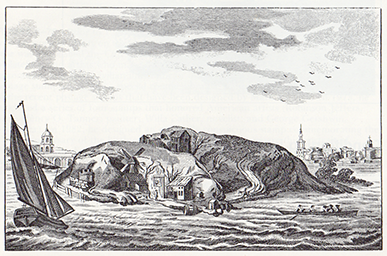
Artist unknown. Catchpenny print, 18th century "puzzle picture" titled The Isle of Dogs.

•••

Anon, THE MAGIC OF CAMOUFLAGE in Edmonton Journal (Edmonton, Alberta, Canada), September 19, 1918, p. 6—

An American artist has discovered a new use of camouflage. He has a favorite dog which his neighbors have been kicking out of their way whenever the animal chanced to stray there.

He had been admiring the great camouflaged battleships on the Hudson River and reading of eminent members of the British Royal Academy, garbed as colonels, directing painters on the Western Front how to camouflage a gun emplacement into a village school or a poultry run.

A happy idea struck him: he would camouflage his dog—all but the tip of his tail. So he has, with the result that the dog now looks like something else, and enjoys complete immunity from the attentions of his neighbors, for he moves about as a beautiful cloud effect.

Tuesday, March 19, 2019

Women's Rights and Wedlocked Camouflage

The years prior to World War I, the war itself, and afterwards, were volatile to say the least. The Armory Show. Women's Suffrage. The most disgusting level of racism. Prohibition, and so on. What do any of these have to do with camouflage? Everything, as all these issues were entwined. Above, for example, is a newspaper cartoon (haven't located the artist's name) that was published in the Boston Globe on May 11, 1918. It's a rare, insightful comment about a certain camouflage technique. At the same time, it is also offensive to women, and plays up the pervasive subject of strife within marriage ("wedlock"). In August of the year before, an equally clever but even more virulent column appeared (as reprinted below) about the meaning of "camouflage" in relation to women's behavior toward men. Who wrote the column? In this case, we know the author's name. It was Arthur (Bugs) Baer, a prominent American humorist (it was he who referred to Babe Ruth as the "Sultan of Swat") who wrote in a style that reminds us of free association, automatic writing, with even a hint of connection to the experimental writings of Gertrude Stein.

•••

 Arthur (“Bugs”) Baer, CAMOUFLAGE. Evening World (New York). August 18, 1917, p. 3—

THIS WAR is being fought on words that ain’t in the dictionary. Old man Noah Webster knew a few spoonfuls, but he didn’t know anymore about camouflage than a hog does about Sunday. You can lamp his dictionary until you sprain an eye, but you won’t apprehend anything about camouflage in his unabridged word garage. Camouflage is a bilking industry with the libretto and music written by the French. The theory is to swindle the German’s eyes. The Frenchmen cover ‘emselves with a lot of leaves. They got the theory from Adam and Eve, but ain’t paying royalities.

After he is camouflaged up in a set of form fitting leaves, the Frenchman ankles off for a short vegetarian stroll toward the Kasier’s trenches. Some husky Boche tosses his optic toward him, but figures him out for a rhododendren bush rehearsing for a tableau vivant. First thing he knows, the rhododendron bush goes Democratic and poor old Hans is listed among the slightly killed, totally wounded or partially missing.

THE IDEA of camouflage is to gyp the enemy. Give him one five for two tens. You heard about the cowboy who called on his best girl and found her bivouacking in another cowboy’s lap. He pulled out his .45 calibre revolver to shoot the beauty spot off her false, deceiving chin, when she looks at him like page 254 of Ouida’s novels.

  
“Do you believe your dearie, or do you believe your eyes?” she piped.
 

The poor fish believed his dearie, and they got married and lived snappily ever after. She had that fool cowboy all camouflaged up with her metropolitan tongue and city ways.
 

Still, camouflage is no novelty among the unfair sex. A flapper will high heel along the macadamized turf, all ambushed up in a swarm of Djer Kiss [the flying kisses of fairies]. She will have a gang of summer furs lurking on her shoulders and a mob of paint, powder and other beauty utensils loitering on her face. She will have a complexion fairer than a Supreme Court decision. But when she gets home and starts to uncamouflage, she puts on ten years for everything she takes off. She has one of those removable complexions. By the time that she has moulted her blonde hair, shed her automatic teeth and discarded her mechanical eye, she is older than hieroglyphics, and gains every lap.
 

She has one of those folding complexions that you can carry in your handbag. The French have no monopoly on that camouflage institution. Yea bo.

UNDER THE modern regime of beauty camouflage, everything about a woman complexion is detachable except her ears.
  
There are different branches of study in the camouflage curriculum. In Washington, the Senators have oratorical camouflage down to a science. Their speciality is painting word pictures, using their chin as a brush. There isn’t a battle that the Senate can’t win with a few maxillary calisthenics. Rhetorical camouflage is great stuff, but you can’t bridge the ocean with a pontoon of words. Any union Senator with his vocal camouflagers on can build a fleet in three paragraphs or raise an army with a few chin excursions. Aesop’s jackass had the camouflage idea when he attended the zoo bal masque wearing the lion’s coat and vest, but a few chirps of his fool mule tongue gummed his camouflage.
  
The gent who disguises himself behind a camouflage of women’s skirts in order to escape military service is smaller than the Republican vote in Alabama. A guy that little can ambush himself behind a cancelled postage stamp. The slackers are utilizing a camouflage of women’s skirts, dependent relatives, conscientious objections, flat feet, weak heart and weaker knees. Which is a camouflage that fails to camouflage by quite a few flages. And a culprit who tries to hide behind a woman’s petticoats would have to pass his career in a bureau drawer. That’s where the ladies are wearing their pettiskirts. Nope, we ain’t married, but we read The Delineator [a women’s magazine at the time].

THE PARAMOUNT idea of camouflage is to create an aura of low visibility which will enable you to ramble around in safety. The chameleon has the right idea, and one that might be elaborated. For instance, a bill collector would never find you if you were camouflaged as a waste basket. All the props you need for this ambush is a loose wicker basket and a hat made of old newspapers, vacant letters and unraveled souvenir postcards. You can circumvent the heat by camouflaging yourself as a mint julep. With enough practice you can become a perfect julep. Even your wife will be unable to detect the difference on your breath.
  
By camouflaging yourself as a porcupine with a flat wheel, you can secure enough elbow space in the subway to draw in a breath edgeways once in a while. Bat as drawing in a subway breath is suicide at a nickel a ticket, this camouflage is rather intricate.
  
Peace hath her camouflages as well as war. With a lttle cranial dexterity and a few cerebral gymnastics, camouflaging can be utilized to alleviate the inconvenience of civilization.
  
There will be a camouflage for every ill.
  
Of course, in the case of the poor henpecked husband, we can paint no disguise with a brush.
  
The only camouflage will be distance. And you will have to paint that with your heels.


Below (updated 24Mar2019): Moments ago while browsing the "free photo website" of Gratisography, we ran across this photograph by Ryan McGuire which, by fortunate coincidence, uses much the same trickery as the "wedlocked" cartoon from 1918.

Photo by Ryan McGuire

Saturday, July 5, 2014

Braque's Camouflaged Squirrel

Camouflaged Squirrel © Karl Frey
Above Karl Frey, Camouflaged Squirrel (c2009). Digital media. Available for online purchase. Courtesy of the artist.

•••

H.W. Janson, "Chance Images" in Philip P. Wiener, ed., Dictionary of the History of Ideas (New York: Charles Scribner's Sons, 1973)—

During the most austere phase of Analytical Cubism, when he and [Georges] Braque were working in closely related styles, [Pablo] Picasso one day went to look at his friend's latest work. Suddenly he became aware that there was a squirrel in the picture, and pointed it out to Braque, who was rather abashed at this discovery. The next day Braque showed him the picture again, after reworking it to get rid of the squirrel, but Picasso insisted that he still saw it, and it took another reworking to banish the animal for good.

Note There is also a longer, second version of the same story.

•••

Anon—

The squirrel is the monkey of Iowa.

•••

Georges Braque, quoted in Alexander Lieberman, The Artist in His Studio (New York: Vintage, 1961)—

I was happy when, in 1914, I realized that the army had used the principles of my Cubist paintings for camouflage.

•••

Joel Agee (remembering his father, writer James Agee), Twelve Tears: An American Boyhood in East Germany (New York: Farrar Straus Giroux, 1981), p. 90—

One day a squirrel bit my finger. I was hurt, more by the feeling that the squirrel had been mean to me than by the sudden little pinch. Jim [his father] squatted down next to me and kissed the hurt finger and explained that the squirrel hadn't meant to hurt me, that it thought my finger was a peanut. That didn't make sense to me at first, but then Jim held up the tip of my finger and said, "Doesn't it look like a peanut?" and it did.

•••

Robert M. Purcell, Merle Armitage Was Here! (referring to the book designer's alleged licentiousness). (Morongo Valley CA: Sagebrush Press, 1981)—

In the world of lust, [President Jimmy] Carter was a peanut compared to Merle Armitage.

Wednesday, August 21, 2013

Australian Radio Interview | Roy R. Behrens

Click here to access podcast
Above An interview of Roy R. Behrens by Margaret Throsby, broadcast live on Midday on ABC Classic FM on August 13, 2013, in Sydney, Australia. Among the topics of conversation were music, improvisation, Eric Satie, Billie Holiday, Keith Jarrett, Eden Ahbez, Gertrude Stein, William Cook, Le Corbusier, Buffalo Bill, ventriloquism, Iowa—and camouflage.

Friday, June 7, 2013

Abbott Thayer's Bald Head

Above Recently we ran across this photograph from a 19th-century stereograph of an artist in his studio, entertaining his children (more likely, he has fallen asleep at the easel). The little boy is painting a face on his father's bald head. It may have been a common amusement, because it also occurs in the story below.

••

Nelson C. White, Abbott H. Thayer: Painter and Naturalist. Hartford CT: Connecticut Printers, 1951, p. 99—

Although Thayer's prevailing mood was intensely serious when absorbed with his painting, he liked to relax and share their amusements with his children. Indeed he sometimes excelled them in the invention of fanciful nonsense, as when his daughter Gladys painted the face of an Irishman on the back of Thayer's bald head, the scant dark fringe of his remaining hair serving for the beard. When he entered the room walking backwards and giving life to this grotesque apparition by flexing the muscles of his scalp it was startlingly effective. He also made small sculpted animals out of bread at the table by way of showing the cook good-naturedly that her bread was doughy. With [his student] Louis Fuertes and [Thayer's son] Gerald, he drew composite portraits of imaginary birds and animals by combining the assorted heads and tails of pelicans, alligators, and other unrelated species at random and giving them pseudo-scientific names.

Friday, January 1, 2010

Camouflage Artist | C. Allan Gilbert

In his own lifetime, C. Allan Gilbert (1873-1929) was a widely published American illustrator, as well as an early contributor to animated films. Today, he would probably not be remembered at all were it not for the continued popularity of one of his illustrations, a momento mori titled All is Vanity (1892). It is a double image or visual pun in which the scene of a woman admiring herself in a mirror appears instead to be a skull, when viewed from a distance. During World War I, he was among a number of US artists who worked for the US Shipping Board (the Emergency Fleet Corporation) in applying dazzle camouflage to US merchant ships.

In 1918, in Nauticus: A Journal of Shipping, Insurance, Investments and Engineering (Vol 1 No 2, June 8), there is a note about the role of the US Navy in relation to the work of Gilbert and other civilian camoufleurs:

Supervision of all camouflaging of merchant vessels for the Shipping Board will be exercised by the Navy Department in the future…"The Navy Department will prepare the types and designs of camouflage painting for general use and, where practicable, design of camouflage painting applicable to particular ships. These design will be furnished the district camoufleurs through the Camouflage Section, Division of Steel Ship Construction of the Emergency Fleet Corporation. The district camoufleur will use the design most applicable to the form and type of ship to be camouflage painted. The district camoufleur shall not change the principle of the design furnished by the Navy Department, but may adopt such design to suit the particular ship which is being camouflage painted."