Showing posts with label hollywood. Show all posts

Tuesday, July 28, 2026

Seymour Reit / cartoonist, animator, writer, camoufleur


Since early childhood, I have known about Casper the Friendly Ghost, a cartoon character who first appeared in comic books in the late 1940s. But it may have been forty years later that I learned about Seymour Reit (1918-2001), the American animator and children's book author who may (or may not, since there has long been some dispute) have been the person who came up with Casper's character.

As an adult, although Reit was short (he was five foot four), he was larger than life in terms of all his accomplishments. He began his career as an animator for the famous Fleischer Brothers, and in his final decades he was a prolific contributor to MAD Magazine. But that is the tip of the iceberg: as a writer or cartoonist, he was also affiliated with Will Eisner, Archie, Little Lulu, Gulliver's Travels, Popeye, Betty Boop, and Captain Kangaroo.

But he also had two wartime links: First, he was born in New York on Armistice Day on November 11, 1918, the day that marked the ending of World War One, with the result that his parents named him Seymour Victory Reit. And then, when the US entered World War Two, he enlisted in the Army Air Force as a lieutenant, and served as a camoufleur.

I suspect that I first heard about Reit in 1978, when I ran across a copy of a book that he had written, titled Masquerade: the amazing camouflage deceptions of World War II (New York: Hawthorn Books). At the time, I had been researching and writing about art and camouflage for about a decade, and his book was enormously helpful in learning about the varieties of deception in World War Two. It is still of considerable value, even though quite a few other volumes on the same subject have more recently been produced.

Saturday, December 20, 2025

khaki-colored dash down the boulevard in Hollywood

Hollywood actor Wallace Reid
Anon, in Picture Magazine (March-July 1918)—

[Hollywood film star] Wallace Reid is busily engaged in studying the art of camouflage so he can paint his new khaki-colored speed demon in such a manner that he can dash down the boulevard without being seen by the ever-watchful eye of the speed cop.

Tuesday, September 2, 2025

Actor James Cagney trained as camoufleur in WWI

James Cagney (1932), film lobby card

Joann Rhetts, A LOOK AT A LEGEND, in The News and Courier (Charleston SC) April 5, 1986, p. 7—

The young James [Cagney, Hollywood film star] had a notion of becoming an artist, even entered Columbia University during World War I under an ROTC-type program as an artist assigned to a military camouflage unit.

RELATED LINKS 

Dazzle Camouflage: What is it and how did it work? /  Nature, Art, and Camouflage / Art, Women's Rights, and Camouflage /  Embedded Figures, Art, and Camouflage / Art, Gestalt, and Camouflage /  Optical science meets visual art /  Disruption versus dazzle / Chicanery and conspicuousness /  Under the big top at Sims' circus

Saturday, August 30, 2025

Glen Gano / US actor, cinematographer, camoufleur

Actor and Hollywood cameraman Glen Gano (1892-1973), born in Kokomo IN, was the cinematographer for four Three Stooges productions: Booby Dupes, Micro-Phonies, Idiots Dulux, and The Yoke’s on Me. But, prior to that, he was also a US Army camoufleur. On January 11, 1918, the Corvallis [OR] Gazette Times included an article titled CAMOUFLAGERS DUE FOR FRANCE VISIT HERE BEFORE DEPARTURE.

Gano, according to the article, “came here from Camp American University [Washington DC] with John F. Byrne… Both soldiers beong to a camouflage corps, Company F of the Twenty-fourth Engineers, who are about to go to France. Private Byrne is a former Carnegie Institute of Technology student and last night entertained [students from that school] at his home…

Showing that psychologists are at work in assigning young men to the positions they are best fitted, Private Byrne…being a [scene] decorator, was assigned to camouflage.

For a wholly different reason, Mr. Gano, who enlisted at Los Angeles, was detailed for camouflage because he was familiar with outdoor photograpy, and was competent to arrange scenes which might easily deceive the German and Austrian expert scouts in the air.

Mr. Gano, in speaking of the reasons impelling him to enlist, said that war could not be more hazardous than going over cliffs in automobiles, lassoing moving locomotives and the like [as he has done as an actor in Hollywood films]. “As a class we want to show the nation that screen actors have more enduring qualities than curly locks, and ‘looking pretty’ in close-ups,” Mr. Gano said. 

According to Wikipedia: “On December 6, 1915, during the filming of an episode of the serial The Hazards of Helen, Gano, reportedly acting as a stunt double for the film's star, suffered what, over the next few days, would be described variously as ‘a fatal fall,’ ‘tragic death,’ ‘injuries from which he will probably die,’ (aka ‘probably fatal injuries’), making an ill-fated leap from the 4th Street Bridge in Los Angeles. Thankfully, reports of his demise proved premature.”

RELATED LINKS

Dazzle Camouflage: What is it and how did it work? /  Nature, Art, and Camouflage / Art, Women's Rights, and Camouflage /  Embedded Figures, Art, and Camouflage / Art, Gestalt, and Camouflage /  Optical science meets visual art /  Disruption versus dazzle / Chicanery and conspicuousness /  Under the big top at Sims' circus


Wednesday, July 16, 2025

hollywood leg enhancer is biting the legs that feed him

Hazel Canning, EXPERTS ON FEMININE LEGS PUT CHARACTER ABOVE BEAUTY in Boston Sunday Post, April 29, 1945, p. 5—

Willy of Hollywood [dba Willy's of Hollywood] launched the topic of legs.

Willy is a stocking maker and leg camouflage expert in the movie city.

In fact, it is said that Willy can make stockings to give insoucient slenderness to the stumpy legs: a saucy challenge to the leg rather blocky and unshaped; whimsy, appeal and charm to the toughest, the stodgiest, the stiffest of feminine appurtenance which connects a shapely or otherwise ankle to the knee.

Recently Willy studied Miss Greer Garson as she was photographed in her kilt costume for the dance in Random Harvest.

These words he spoke more as a connoisseur than a critic, but nevertheless, the man whose speciality is reshaping feminine legs was not exactly pleased with Greer Garson’s. His comment sped across the ocean and into the London Mail. Garson read it, then she spoke.

“I,” said she, “have no need of a leg camouflager. My legs are my own; the ones with which I dance in Random Harvest. My paying customers have never complained about my legs. Now if this Willy is really a leg camouflager, I think he is rash. By advertising his trade, is he not, rather, biting the legs that feed him?”…

RELATED LINKS 

Dazzle Camouflage: What is it and how did it work? /  Nature, Art, and Camouflage / Art, Women's Rights, and Camouflage /  Embedded Figures, Art, and Camouflage / Art, Gestalt, and Camouflage /  Optical science meets visual art /  Disruption versus dazzle / Chicanery and conspicuousness /  Under the big top at Sims' circus

Sale-priced books on camouflage / free shipping

Saturday, July 12, 2025

I can transform anyone into whatever they want to be

Above Cartoon by W.K. Haselden in The Daily Mirror, January 14, 1918.

•••

EDITH HEAD (Hollywood costume designer), as interviewed in The Daily Mirror, November 2, 1970—

Well, I can go back to Mae West or right forward to Paul Newman. I was the first one to put clothes on Mae.

I remember she said to me: “Fit it tight, honey, I want them all to know I’m a girl from every angle.” But it didn’t work with Anita Eckberg.

There was so much of her that kept falling out.

I’m a camouflager. I can transform anyone into anything they want to be.…


•••

camouflage research site map

RELATED LINKS    

Dazzle Camouflage: What is it and how did it work? /  Nature, Art, and Camouflage / Art, Women's Rights, and Camouflage /  Embedded Figures, Art, and Camouflage / Art, Gestalt, and Camouflage /  Optical science meets visual art /  Disruption versus dazzle / Chicanery and conspicuousness /  Under the big top at Sims' circus

Sunday, April 20, 2025

architects / they have an eye for the looks of things

Above Photograph of Homer Saint-Gaudens, by De Witt Clinton Ward.

•••

HOLLYWOOD PROP MEN ABLE AT WAR CAMOUFLAGE in The Boston Globe, January 15, 1942, p. 12—

WASHINGTON January 15 (AP)—Hollywood “prop” men—the chaps who design the stage sets for the movie stars—make the best prospects for military camouflage work, an Army expert on strategic concealment asserted today.

Lieut. Col. Homer Saint-Gaudens, Harvard-educated head of the camouflage branch of the Office of the Chief of Engineers, said in an article in the Military Engineer:

"Our best men are moving picture property men. They not only have camouflage ideas, but they understand the application of those ideas. They are resourceful; they are disciplined; they have an eye for the looks of things: they can build you the answer."

The colonel, who was himself stage director for actress Maude Adams. and is director of fine arts, Carnegie Institute, says that when a would-be camouflage worker comes to his desk and declares he is a marvellous painter, he (Saint-Gaudens) makes this reply:

"That's okay. But let me have a look at your hands. How are your feet? Can you lug 60 pounds 20 miles and do it again the next day?

"Yes, I remember that set where Robert Taylor makes love to Hedy Lamarr. You say you designed it and helped build it, too? You are just the young man we are looking for."

Saint-Gaudens, who received numerous decorations for his camouflage work during the first World War, said the best camouflage officers, the ones who direct the workers, are young erst-while architects."

Such men, he declared, have "already learned to cope with the builders of new houses who insist on having the stairs and the clothes closet in the same place.”

•••

Below Page spread from an article by Edwin Schallert, Trick Photography in the Gold Rush, in Science and Invention (December 1925), pp. 714-715, showing various special effects and scenic props used in the filming of the Charlie Chaplin comedy The Gold Rush.

  RELATED LINKS    

Dazzle Camouflage: What is it and how did it work? /  Nature, Art, and Camouflage / Art, Women's Rights, and Camouflage /  Embedded Figures, Art, and Camouflage / Art, Gestalt, and Camouflage /  Optical science meets visual art /  Disruption versus dazzle / Chicanery and conspicuousness /  Under the big top at Sims' circus

Thursday, March 13, 2025

celebrated Hollywood art director was US camoufleur

To my surprise, I have known about Richard Day for years. I simply hadn’t realized that a camoufleur named Richard Day was the same person whom I was aware of for other reasons. As a graphic designer, I have long been interested in the book designs of Merle Armitage, and I knew that one of the books he designed was The Lithographs of Richard Day. Foreword by Carl Zigrosser. New York: E. Weyhe, 1932. While I have sometimes collected Armitage books, I’ve never owned this particular one (it’s not among his finest designs), and in truth I haven’t had much interest in Richard Day’s lithographs (or at least the ones in this volume).

But my interest has been reenlivened—for other reasons. This same Richard Day, as it turns out, was one of Hollywood’s most famous art directors. He was a Canadian whose full name was Richard Welsted Day (1896-1972). He didn’t settle in the US until c1918. Prior to that, he served in World War I as a captain in the Canadian Expeditionary Force, which may or may not have included experience with camouflage.

Following the war, having worked as a commercial artist in Victoria BC, he moved to Hollywood, in the hope that he might find work in the motion picture industry. By good fortune, he apprenticed with Eric von Stroheim, worked as a scene painter, and was soon appointed art director of the film Foolish Wives. As his career progressed, he moved on to other opportunites as a Supervising Art Director. In addition to von Stroheim, he also worked with Tod Browning, Samuel Goldwyn, and Elia Kazan.

Day’s work on hundreds of Hollywood films resulted in his nomination for forty Academy Awards, as well as earning Oscars for Dark Angel, How Green Was My Valley, This Above All, My Gal Sal, A Streetcar Named Desire, On the Waterfront, and Dodsworth. By the mid-1930s, as a motion picture art director, he was the highest-paid in Hollywood.

When the US joined the Allies in WWII, Day became an American citizen and joined the US Marine Corps, during which he specialized in “camouflage designs and relief mapping techniques.” His final film, produced in 1970, was Tora! Tora! Tora!, which included his reenactment of the attack on Pearl Harbor, which (according to the New York Times) cost the film’s producers “more money than the Japanese had [spent] on the original attack in 1941.”

RELATED LINKS    

Dazzle Camouflage: What is it and how did it work? /  Nature, Art, and Camouflage / Art, Women's Rights, and Camouflage /  Embedded Figures, Art, and Camouflage / Art, Gestalt, and Camouflage /  Optical science meets visual art /  Disruption versus dazzle / Chicanery and conspicuousness /  Under the big top at Sims' circus

Sunday, March 3, 2024

Wiard Boppo Ihnen / so why a duck why-ah no chicken

In 1933, the art director for the Marx Brothers film Duck Soup was a man named Wiard Boppo Ihnen (1897-1979). His German given name was pronounced as “weird,” and throughout his life he was usually known as William or Bill Ihnen.

He was born in Jersey City NJ, where his father was an architect and artist. He too practiced architecture, but he also studied painting at the Ecole des Beaux-Arts in Paris, as well as in Mexico City. On two occasions, he won an Academy Award for art direction, but he is also remembered for other well-known productions, including two of Mae West’s films (Go West, Young Man and Every Day’s a Holiday), and John Ford’s Stagecoach.

In 1940, he married Edith Head, the acclaimed costume designer (he was 5’6”, she was 4’11”). Years earlier, in October 1918 (at the close of World War I), he had enlisted in the US Army, for which he served in camouflage until his discharge in February 1919. According to an obituary in the Los Angeles Times (June 26, 1979, p. 30) he served “in the army” during both World Wars, “as a camouflage expert.”

Update According to an additional source (TILFORD ACTIVITIES ARE EXPANDING in Modern Studios and Laboratories, Vol 10 No 14 (September 3, 1921, p. 1)), Ihnen served not only in the US Army during WWI, but apparently also as a civilian ship camoufleur. The article states: "During the war he earned considerable commendation for himself for his camouflage work with the United States Shipping Board."


Tuesday, October 3, 2023

contributions of Hollywood to WWI ground camouflage

Above Camouflage pattern (digitally-colorized, thus historically unreliable) on World War I huge long-range artillery, mounted for railway transport, c1918, unknown source.

•••

G.P. Harleman, News of Los Angeles and Vicinity in The Moving Picture World, December 1, 1917—

Lawson Organizes Camouflage Artists
Lee Lawson, [Hollywood] technical expert, has received from the Adjutant General authorization to form a company of two hundred and fifty men of the [motion picture] studio plants for the camouflage department to be incorporated in the Twenty-Fourth Engineers.

Lawson has been engaged at his trade locally for the past twelve years. He recently asked for authority to organize a company of camouflage artists. His appointment was made by Secretary of War [Newton] Baker.

All the ingenuity of “trick stuff” manifested in motion pictures will be transplanted to the camouflage activities in France. Scene painters, artists, sculptors, property men and numerous other classes of employees in studios will comprise the company.

Lawson already has sixty-four men enrolled. These will leave in a few days for American Lake [near Lakewood], Washington, where they will receive instruction in the most advanced methods of camouflage work.


•••

G.P. Harleman, News of Los Angeles and Vicinity in The Moving Picture World, December 15, 1917, page 1637—

Camouflage Artists Leave for Training
The greatest camouflage company in the world, according to Major George P. Robinson, United States Engineers Corps, left Los Angeles November 24, for an eastern training camp. There wre sixty-five men in the part, headed by Lee Lawson of the Universal. The personnel were recruited almost exclusively from the leading motion picture studios of Los Angeles.

“Nowhere else in the world could a company of men of similar qualifications have been recruited,” said Major Robinson. “The best scenic artists and men of kindred trades in the motion picture industry are here.”

Just before the train pulled out of the station Lee Lawson made a short speech to the crowd. “Friends, we’re going over there to fool the Kaiser, and if Yankee genius counts for anything we’ll be there with the goods,” he said.

The leave taking was different from any farewells given any party of soldiers leaving Los Angeles heretofore. Sixty-five young men, all of them known personally to the five hundred or more persons who bade them goodbye, caused everybody to cry goodbye to everybody else. It was a scene not easily forgotten.


•••

News of Cinema and Film Gossip in The New York Sun, February 2, 1919, p. 39—

Lieutenant Lee Lawson, former technical director, Sergeant Clarence DeWitt and Sergeant H. Divver, formerly of Universal City, for over nine months members of a camouflage regiment in France, has returned to the studio. When America entered the war Lieutenant Lee [sic] assembled scenic artists, sculptors, directors and property men in a camouflage platoon. He was wounded twice, Sergeant DeWitt gassed, and Sergeant Divver wounded twice.

RELATED LINKS    

Dazzle Camouflage: What is it and how did it work?

 Nature, Art, and Camouflage

 Art, Women's Rights, and Camouflage

 Embedded Figures, Art, and Camouflage

 Art, Gestalt, and Camouflage

 Optical science meets visual art

 Disruption versus dazzle

 Chicanery and conspicuousness

 Under the big top at Sims' circus

Tuesday, August 1, 2023

Perkins Harnly / artist and cross-dressing camoufleur

Poster, Index of American Design
Few people will have heard of Perkins Harnly (1901-1986), an obscure American artist who grew up in Nebraska, lived in New York for a number of years, and ended up in Hollywood. I first became aware of him while researching a Depression-era art program called the Index of American Design. In a book edited by Francis V. O’Connor, The New Deal Art Projects: An Anthology of Memoirs (Washington DC: Smithsonian Institution, 1972), there is an essay by Lincoln Rothschild in which it is mentioned that “a specially gifted artist” named Perkins Harnley [sic] had provided that agency with “amusing views of a Pullman diner and an ornate stable as well as more ordinary interiors” (p. 184).

If people know about the New Deal Art Projects, it is most likely because they’re familiar with the Works Progress Administration or WPA (see poster above), in which the US Government commissioned unemployed American artists to create public murals for permanent installation in post office lobbies throughout the country. A surprising number of these have survived, and some of them remain on view in local post offices throughout the country.

What is less well-known is the Index of American Design (1953-1942), in which other unemployed artists (not studio "fine artists" but men and women who had previously worked as designers and illustrators, commonly disparaged as “commercial artists”) were hired not to make “creative” murals but to document examples of vintage American crafts (including folk art), through precise, detailed renderings. Among the things included in the Index of American Design were historic children’s rocking horses, carved ship figureheads, folk pottery, handmade clothing and fabrics, cast iron toy banks, antique furniture, weather vanes and other architectural ornaments, and so on. 

These were all beautifully documented in watercolor renderings, in exacting detail and in color. Miraculously, 18,257 of these have been preserved, and are housed at the National Gallery of Art in Washington DC. These images are in public domain, and can be accessed online here. To commemorate that archive (as well as the graphic designers who made them), earlier this year, I designed and posted online a series of posters about  a few of the items it features. 

Among the artists commissioned to make Index of American Design renderings was Perkins Harnly. In addition, he also served briefly as a wartime camouflage instructor. While working for the Index of American Design, Harnly’s supervisor had been a Harvard-trained art museum administrator named Lloyd LaPage Rollins (1890-1970), who had also been director of the DeYoung Museum in San Francisco. According to Harnley, Rollins was gay and was an avid collector of outlandish Victorian-era artifacts, which today would be regarded as “camp.” His housemate and associate was, as Harnly described him, “an attractive pet Scotsman.”

Interestingly, as revealed by Harnly’s biographer Sarah Burns, Harnly himself was gay and would later become notorious for cross-dressing and related misbehavior. Rollins was (in Harnly’s words) “my WPA Projects boss.” It was apparently through Rollins that Harnly was commissioned to make illustrations for the Index of American Design, some of which were rather large, measuring twenty-two by thirty-one inches. Harnly greatly enjoyed this assignment, in which he apparently had few restrictions. In an interview many years later, the artist recalled the freedom he had in completing this project that continued for years:

On the WPA I had all the time in the world. Every plate took four weeks at fourteen hours a day seven days a week to paint…just one took four hundred hours to render so meticulously and none took less than two hundred hours.

These fact-based yet fanciful renderings of Victorian interiors were well-received by government administrators, and that success was underscored when they were later exhibited publicly (twice at the Metropolitan Museum of Art) and reproduced and written about in magazines. Two examples are posted here.

Perkins Harnly, Index of American Design

Perkins Harnly, Index of American Design


From the little that is known about Harnly’s involvement in camouflage, it appears to have been minor in comparison to the work he did for the Index of American Design. When America entered World War II, as Harnly later remembered in a Smithsonian interview, “we were put on defense projects…” He was assigned to camouflage as a civilian instructor, and sent to Fort Belvoir VA. There, he taught camouflage to officers, among them William Pahlmann, a well-known interior designer, and Gene Davis, the art director at Good Housekeeping magazine. The person in charge of camouflage at Fort Belvoir was Homer Saint-Gaudens, the son of Augustus Saint-Gaudens, the famous American sculptor. 

When that assignment ended, Harnly was sent back to California, where his supervisor was once again Lloyd Rollins, his former “WPA boss,” but this time he “taught a class on camouflage in the attic of a midtown fire station.” Soon however, that class abruptly crashed and burned when Harnly had a falling out with Rollins’ associate (his so-called “pet Scotsman”), who stormed out in the middle of a work session, whereupon the course was cancelled.

Harnly lived for 85 years. He was colorful, to say the least. Sarah Burns’ recent book about his life is titled The Emphatically Queer Career of Artist Perkins Harnly and His Bohemian Friends (Port Townsend WA: Process Media, 2021). Be prepared for some scandalous content. It is a highly detailed account of the life of a person who grew up in a setting of what he himself described as “trashy Tobacco Road types” in the dregs of rural Nebraska. When interviewed at age 80, he claimed that his birth was premature, by seven months, when he was born in a “pauper’s farmhouse.” With no access to medical care, much less an incubator, he was wrapped in cotton, placed in a shoe box, and kept warm inside an oven.

When he was four or five years old, the family moved to Lincoln NE, where they lived adjacent to the Lyric Theatre. Over the years, his proximity to that stage led to his fascination with linear perspective, painting, and set design. His interest in art had begun as a child, but he did not pursue it intently until he was hired by the WPA for their New Deal art program. It was that opportunity, Harnly recalled, that gave him “the reason, the encouragement, the research, the material, and I really went to town.” In the end, he completed a total of eighty-one renderings of Victorian interiors for the Index of American Design.

There is much more to this story of course, far too much to include in a blog post. But two other aspects of Harnly’s life are of particular interest. First, his paternal grandfather, a Nebraska farmer named Benjamin Harnly, enjoyed considerable success in building elaborate Queen Anne residences in Lincoln. He constructed at least sixteen, the most famous of which was the Bryan House, which he built for William Jennings Bryan. 

Second, Harnly worked temporarily for MGM in Hollywood. This resulted from a showing in New York of twenty-two of his Victorian interior renderings for the Index of American Design. In an exhibition titled “I Remember That,” they were displayed on the mezzanine at the Metropolitan Museum of Art from October 1942 to April 1943. Among the people who viewed them there was an MGM film director named Albert Lewin. He was just then preparing to produce a film version of Oscar Wilde’s novel, The Picture of Dorian Gray. In that story, circumstances are such that a painted portrait of its youthful, handsome protagonist, Dorian Gray, is reduced to putrefaction—as if by otherworldly means—as the physical man himself decays.

Based on his reaction to Harnly’s renderings of Victorian room interiors, Lewin persuaded him to relocate to Hollywood and to contribute to the film as a set design consultant. At the same time, Lewin also contracted two painters, who were brothers from Chicago, named Ivan Le Lorraine Albright, and his identical twin Malvin Marr Albright. They too were brought to Hollywood to work on site on the film. 

The original agreement was that Malvin would complete a portrait of Dorian Gray (looking both handsome and youthful), to be used at the film’s beginning, while Ivan would provide a comparable portrait of the same anti-hero, in a disturbing state of decay, at the end of the film. Ivan Albright’s (now-famous) painting (reproduced below) was used in the finished film, but the painting by his brother was eventually omitted, and replaced by an alternate portrait by a Portuguese artist, Henrique Medina. The paintings by the Albright twins upstaged Harnly’s achievements as a "sketch artist" and set designer. Ivan Albright’s painting was widely publicized, while Harnly is not even mentioned in the film credits.

RELATED LINKS    

Dazzle Camouflage: What is it and how did it work? /  Nature, Art, and Camouflage / Art, Women's Rights, and Camouflage /  Embedded Figures, Art, and Camouflage / Art, Gestalt, and Camouflage /  Optical science meets visual art /  Disruption versus dazzle / Chicanery and conspicuousness /  Under the big top at Sims' circus

Ivan Albright, The Picture of Dorian Gray (1943)


Wednesday, June 21, 2023

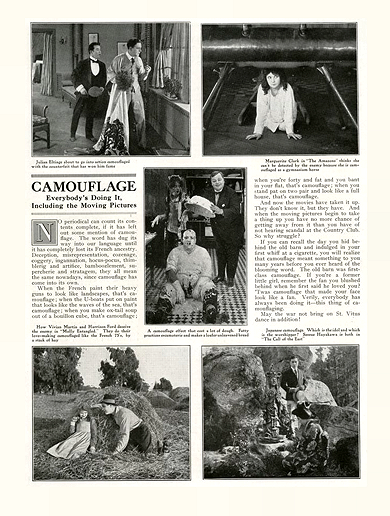
camouflage / everyone's doing it, including hollywood

Above A page from Photo-Play Journal, December 1917, p. 25, featuring an article called CAMOUFLAGE: Everyone’s Doing It, Including the Moving Pictures. In an earlier blog post, we reproduced the article’s text, but not this image of the page.

SEE ALSO

Nature, Art, and Camouflage (35 min. video talk)

Art, Women’s Rights, and Camouflage (29 min. video talk)

Embedded Figures, Art, and Camouflage (26 min. video talk)

Art, Gestalt, and Camouflage (28 min. video talk)

Sunday, October 23, 2022

camouflage tricks behind the scenes in hollywood

Boston Globe, June 15, 1921
Anon, Movie Facts and Fancies, Boston Globe, October 1, 1921, p. 12—

The studio scenic artist of today…is an expert camouflage artist and a perfect copyist. The controlling principal in his work, however, is the photographic value of colors. Under the eye of the camera colors are often very deceptive, and often a color, which seems lighter to the eye than another color, might on the screen register a darker shade of gray than that color.

Often two colors which seem to form a most artistic and beautiful combination to the human eye, will, when photographed, present a most inharmonious, discordant color scheme, which is very ugly to look upon. Only by a careful study and a perfect knowledge of the photographic values of colors does the scenic artist avoid such color clashes.

The art of camouflage also is a very important phase of the studio scene painter’s art. He must make the imitation appear exactly like the real. Some of the commonest of such problems are included in the following examples: The camouflage of compo[sition] board squares and the proper laying of them so that when photographed they resemble a tile or stone floor; the painting of surfaces so that the result photographs like bronze, gold or other metals.

The artist can, with a well-placed strokes of his brush, dipped in the right kind of paint, make a new brick wall like the side of a dingy tenement house. He can give to a new redwood panelled wall the effect of an oak panel, hundreds of years old.

Friday, February 18, 2022

WWI-era Scenic Film Camouflage at Lasky Studios

Above Photograph of Hollywood scenic designer Glen Dunaway (1895-1923), manager at the Lasky Studio in 1920, as published in THE SCENIC ART IN MOTION PICTURES: Glen Dunaway, Chief Scenic Artist, Explains Colorful Phase of Important Studio Work in Muncie Evening Press (Muncie IN). November 20, 1920. “Mr. Dunaway,” (not to be confused with Glenn Dunaway, a possible relative, who was a race car driver) the article states, “is a camouflage expert…” (not literally) in view of the highly deceptive effects that he creates for filmmaking purposes. Unfortunately, he died of carbon monoxide poisoning (adjudged accidental), as the result of a defective room heater, at the Lasky Studios on April 23, 1923.

Pictured in the same article is a scenic artist named Hans Ledeboer (1874-1962), described as “the most prominent” artist on Dunaway’s staff. He “was born in Holland of Dutch and French parentage and studied art and decoration in Rotterdam and The Hague. Twelve years ago [c1908] he came to America because of the wider opportunities offered by this country for his work… Since coming to America he had achieved considerable fame. In Chicago, he was commissioned to paint Holland scenes for the Onndaga Hotel in Syracuse NY, and later he also did the mural decorations for the San Francisco Exposition, and for that work [he] was awarded a gold medal. For the past three years he has decorated, each year, the great auto show room at the Pacific Auditorium in San Francisco, where the auto show is held annually.”

•••

Anon, MOVIE FACTS AND FANCIES in The Boston Globe. October 1, 1921, p. 12. Extended portions of this text were published (with attribution to Marvin M. Riddle) in The Photodramatist, with the title "From Pen to Silversheet." January (pp. 35-37) and February 1922—

The studio scenic artist of today is a high-class interior decorator.

In addltlon to this he is an expert camouflage artist and a perfect copyist. The controlling principal in his work, however, is the photographic value of colors. Under the eye of the camera colors are often very deceptive, and often a color which seems lighter to the eye than another color might on the screen register a darker shade of gray than that color.

Often two colors which seem to form a most artistic and beautiful combination to the human eye, will, when photographed, present a most inharmonious, discordant color scheme, which is very ugly to look upon. Only by a careful study and a perfect knowledge of the photographic values of color does the scenic artist avoid such color clashes.

The art of camouflage also is a very important phase of the studio scene painter’s art. He must make the imitation appear exactly like the real. Some of the commonest of such problems are included in the following examples: The camouflage of compo[sition] board square[s] and the proper laying of them so that when photographed they resemble a tile or stone floor; the painting of surfaces so that the photographic result[s] [are indistinguishable from] bronze, gold or other metals.

The artist can, with a few well-placed strokes of his brush, dipped in the right kind of paint, make a new brick wall like the side of a dingy tenement house. He can give to a new redwood panelled wall the effect of an oak panel, hundreds of years old.

Saturday, December 26, 2020

hollywood trompe l'oeil / catastrophic film tomfoolery

MOVIE CAMOUFLAGE DRIVES CAT CRAZY in Pittsburgh Post Gazette (Pittsburgh PA), February 24, 1944—

Camouflage experts of the cinema industry had an alley cat going crazy recently.

They had constructed a backing for a set being used in Paramount’s Ministry of Fear… The garden depicted a garden scene with a wall painted at one end.

Into the scene strayed one of the cats which has made Paramount its home. Frightened by the sudden booming voice of C[ecil] B. DeMille over a public address systems, the cat took off, intending to clear the wall in a mighty jump. Instead, he banged into the painted background above the wall. Unhurt, he scrambled to his feet, gave one belligerent “meow,” and took off in another direction.