Showing posts with label US Navy. Show all posts

Saturday, May 9, 2026

jackies removing ship camouflage paint / documented

painting over camouflage at war's end
It is not easy to find historic photographs of ships in the process of having their camouflage applied. They do exist and I have found about ten. But an even greater challenge is to find photographs of ships (at the end of the war) having their wartime camouflage painted over. There cannot be many photographs of that, since it was a far less dramatic event than the application of camouflage

Earlier today, when I first put up this blog post, I illustrated it with a newspaper photograph from 1919. But it was of such poor quality that I decided to take it down, and am now replacing it with the above photograph, which shows the overpainting of a ship's camouflage at the end of WWI. I regret that I have not located the source. 

As for the earlier deleted photograph, it was an illustration for a brief article in The Reno Gazette Journal (Reno NV) on April 16, 1919. The headline for that article was TAKING OFF THE WAR PAINT, and the accompanying text was as follows—

When Kaiser Bill told us we should stripe our ships like a barber pole and sail them where he ordered, we said we wouldn't. We put on our war paint instead and jumped into the fight. It's over, and here are the jackies [sailors] removing the camouflage and putting the steel grey and white of peace on the sides of a battle cruiser.

Wednesday, July 2, 2025

camouflaging ships to look like clouds on the horizon

WWI ship camouflage painters
The Observer in The Milford Cabinet and Wilton Journal (Nashua NH), May 15, 1919, p, 2—

…The Observer knows he isn’t an artist, but he had a notion he could take a 3-inch brush and a can of paint and somehow get it spread around. He had watched house painters and it looked easy. Also he has a friend who never knew anything about painting. At least nobody ever suspected he did. But when the war came along and war jobs cropped up, this chap attached himself to Uncle Sam’s payroll, somewhere near the top, and got himself appointed to a shipyard as Chief Camouflager or General of Camoufluers, and bossed the job of painting ships to look like clouds on the horizon. He got away with it. His pay checks were large and regular.

So the Observer bought a brush for $1.50 and a small pot of paint for $2.20 and proceeded to take some of the conceit out of himself. He still thinks he could paint a house so it would fool a submarine commander into thinking it was a school of whales or a grove of pine trees; but painting it so it looks like a house is something different yet. When the job is done the Observer wants his house to look like a human habitation not like a spotted cow or an aurora borealis with streaks running up and down.

RELATED LINKS    

Dazzle Camouflage: What is it and how did it work?Nature, Art, and Camouflage / Art, Women's Rights, and CamouflageEmbedded Figures, Art, and Camouflage / Art, Gestalt, and Camouflage /  Optical science meets visual artDisruption versus dazzle / Chicanery and conspicuousness /  Under the big top at Sims' circus

Sale-priced books on camouflage / free shipping

Tuesday, July 1, 2025

eyewitness sightings of dazzle camouflaged vessels

USS George Washington in camouflage (1918)
John Johnston [from La Crosse WI] in a letter quoted in JOHNSTON TELLS OF BEING UNDER THE AMERICAN MILLION DOLLAR BARRAGE PRECEDING GALLANT YANK ATTACK AND CAPTURE OF CANTIGNY STRONGHOLD in La Crosse Tribune and Leader-Press, March 2, 1918, p. 9—

It was a happy bunch of fellows—a most happy bunch, I might say—who were in the thing to the last drop of the hat. There were nine transports in the group. Among our convoys was the South Carolina and an old captured German raider which was called “The Barber Pole,” because its camouflage made it look like a barber’s sign. One of our ships was the George Washington, which President Wilson sailed to France in.

Everything was fine until we reached the war zone. Then we experienced our first touch of war. Everyone had been given the “stand to” drill, with life preservers. We had our own regimental band with us, and things were gay. I was standing with a group of the men on the deck singing “It’s Easy to Lick the Kaiser.” Every fellow on board was anxious for a look at a submarine, and everybody had his eyes peeled. There were no lights on board.

You couldn’t smoke a cigarette, because the penalty for lighting a match was death. The flare of a match could be seen for two miles out at sea. I was looking over the rail of the Covington at the camouflaged South Carolina. With her silver paint, it seemed as though one could almost look through her.…

US Navy camoufleurs with plans and model of USS George Washington

RELATED LINKS    

Dazzle Camouflage: What is it and how did it work?Nature, Art, and Camouflage / Art, Women's Rights, and CamouflageEmbedded Figures, Art, and Camouflage / Art, Gestalt, and Camouflage /  Optical science meets visual artDisruption versus dazzle / Chicanery and conspicuousness /  Under the big top at Sims' circus

Monday, June 30, 2025

dazzle camouflaged ship used as advertising space

Above FUNNY BUSINESS cartoon with caption “I think the camouflager sold some advertising space!” by Ralph A. Hershberger, in The Pittsburgh Press, July 23, 1945.

•••

Raymond A. Tolbert, HOBART MAN WRITES OF OCEAN VOYAGE: Young Attorney Enroute to Front as YMCA Secretary Tells His Experiences, in The Times-Democrat (Altus OK), January 17, 1918—

Yesterday we received quite a thrill when a ship passed us in the distance. I looked at it through a kindly Frenchman’s binoculars but it looked more like a zebra than anything else, it was so camouflaged. The art of the camouflager is quite unique. As we left the harbor. we passed a large number of ships spotted and daubed up in much the same way that a small boy paints a barn.

RELATED LINKS    

Dazzle Camouflage: What is it and how did it work?Nature, Art, and Camouflage / Art, Women's Rights, and CamouflageEmbedded Figures, Art, and Camouflage / Art, Gestalt, and Camouflage /  Optical science meets visual artDisruption versus dazzle / Chicanery and conspicuousness /  Under the big top at Sims' circus

Sale-priced books on camouflage / free shipping

Saturday, February 8, 2025

John Downes Whiting / American ship camoufleur

For years I’ve been trying to find out about an American artist, author and book illustrator named John Downes Whiting (1884-1977). I’ve been looking for information about his activities as a ship camouflage designer during World War I. One complication is that he is often cited as John D. Whiting, so it’s easy to confuse him with another person named John David Whiting (1882-1951), who belonged to a religious sect in Jerusalem called The American Colony.

In contrast, John Downes Whiting (known as Jack Whiting) was, as he described himself, a “Connecticut Yankee” and a graduate of the Yale School of Fine Arts (BFA 1915). Born in Ridgefield CT, he was named after his uncle, John Ireland Howe Downes (1861-1933), who was also an artist, a Yale graduate, and the librarian for the art school there for 23 years.

As an artist, Jack Whiting’s own profession was that of a book and magazine illustrator, but he wrote books as well. In 1920, he published Practical Illustration: A Guide for Artists (see cover above), and in 1928, he wrote and illustrated a semi-fictionalized account of his experience during WWI, titled Convoy: A Story of the War at Sea.

On his draft registration form, dated September 5, 1918, he lists his occupation as a “camoufleur” with the US Shipping Board, at 345 East 33rd Street in New York. That is the street address of the studio of a prominent muralist and interior designer named William Andrew Mackay, whom I’ve been writing about for years. We have blogged about Mackay’s contribution to ship camouflage, and have also published an essay on Mackay, his ship camouflage proposals, and his school for camoufleurs, headquartered at his studio, which he called the Mackay School of Camouflage.

According to biographical entries, Whiting joined the Connecticut National Guard in 1917, where he served in Company F of the 2nd Regiment for one year. From June through December of 1918, he was affiliated with Mackay’s team of camouflage artists, who were assigned to develop so-called “dazzle camouflage” schemes for US merchant ships. They were not strictly a part of the US Navy, but were affiliated with the civilian Shipping Board, which was responsible for applying the schemes to merchant ships in the harbors.

As Mackay himself described it, it was at his Manhattan studio—

that the first work of camouflage was developed. In all, 749 vessels were camouflaged, and sixty men, artists, architects and designers, made this shop their headquarters, under direction of the United States Shipping Board, working over designs, testing colors, peering through the periscope at the wooden models, and then dashing off to try out some few effect on the vessels that, in a few days, would be depending upon our skill in the art of disguise to save them from the U-boats.


I have a list of the names of sixty-four (not sixty) of Mackay’s camouflage school affiliates. All this is more or less confirmed by a review of John Downes Whiting’s book on Practical Illustration that appeared in The Daily Northwestern (Evanston IL) on January 22, 1921, p. 7. The book’s author, the reviewer states—

…served in the camouflage department of the navy during the war. One of Mr. Whiting’s assignments was to find out just what lines and colors did in reducing the visibility of ships. The results of his experiments, conducted at sea and on the coast, formed the basis of many of the weird but efficacious desgns which camouflaged our transports. William Andrew Mackay, the mural painter, with whom Mr. Whiting worked for the navy, says that Whiting’s book is written in the same thorough manner in which the author tackled his war work.

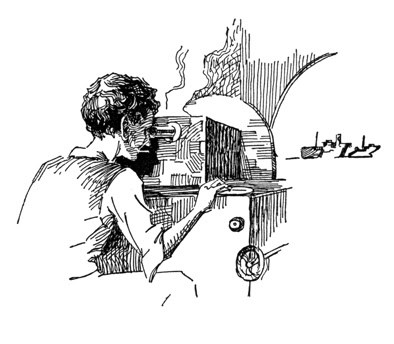
In 1928, when Whiting wrote a semi-fictionalized account of his wartime experience in Convoy: A Story of the War at Sea, it included an entire chapter about Mackay and his camouflage school. It also features a pen-and-ink drawing by Whiting (reproduced above) of a ship camoufleur looking at a camouflaged ship model in a testing theatre. In a different later source (from a 1932 issue of The Literary Digest), Whiting states that during the war he designed “camouflage for Army transports and supply ships.” In that case, it seems likely that he also worked with Frederick A. Pawla (1876-1964), who, as the head camouflage for the AEF Embarkation Service, oversaw the camouflage of “many of the army transports, particularly cargo carriers.” We have previously blogged about Pawla here and here.


On page 242 of Whiting’s book titled Convoy, there is an offhand reference to ship camouflage which may be relevant, or maybe not. The sentence reads: “The Monodoc, looking, in her camouflage, like an intoxicated snake, lay at anchor in the river.” The book’s text, as mentioned earlier is a book of fiction, based on fact. So perhaps we shouldn’t surprised that there doesn’t seem to have been a WWI American ship named Monodoc (altought there were ships named Monadnock). Maybe he simply invented the name.

In the same book, on page 80, Whiting provides some insight into an on-going conflict between Mackay’s camouflage team (affilidated with the US Shipping Board) and the US Navy’s own official Camouflage Section, which had been given the authority to originate all ship camouflage schemes, both Navy and civilian, which was greatly resented by those who were loyal to Mackay.

As Whiting alludes to in his book, Mackay’s camouflage school may not have been unauthorized by the Navy, and was thus conducted “quietly.” But, as he also implies, Mackay’s men also side-stepped strict compliance with the Navy’s regulations by claiming that the schemes that they were given required alteration to make them fit the vessels they were required to apply them to.


Here is the dialogue from Whiting’s book—

“I thought these [ship camouflage] designs were made in Washington, under the Navy Department.”

“Yep, that’s the theory. Those Johnnies think we only put their patterns on the steamers, but, b-bless you, the plans we get from there only fit half the shapes in this town. We have to camouflage every darned thing from a tanker to a barge.”

“And so your chief [William Andrew Mackay] is quietly evolving his own school for camoufleurs?”

“That’s it. The queerist lot of wights are working here, scraped up from the corners of Bohemia. But they work; Mackay is a hustler.”

“Drives you, does he?”

“No, he innoculates us; he has more ideas than all your admirals put together. And the boys are simply nuts about him.”


A small selection of other illustrations by Whiting, including book covers and an interior illustrations, are also featured in this post.

RELATED LINKS    

Dazzle Camouflage: What is it and how did it work?Nature, Art, and Camouflage / Art, Women's Rights, and CamouflageEmbedded Figures, Art, and Camouflage / Art, Gestalt, and Camouflage /  Optical science meets visual artDisruption versus dazzle / Chicanery and conspicuousness /  Under the big top at Sims' circus

Saturday, September 21, 2024

Camoufleur Donates Materials to Brooklyn Museum

US Navy photograph of ship camoufleur Everett L. Warner
Brooklyn Museum. Report Upon the Conditions and Progress of the Museums for the Year Ending 1919, p. 16—

Mr. Everett L. Warner, the etcher, gave to the Library a quantity of material on camouflage consisting of photographs, diagrams, postcards, etc., which was a welcome addition to our file of such material.

RELATED LINK

Disruption versus dazzle

Wednesday, September 18, 2024

B.J.O. Nordfeldt's connection to WWI ship camouflage

Portrait of B.J.O. Nordfeldt
Above This image is cited on Wikipedia Commons as a portrait of Swedish-American artist Bror Julius Olsson Nordfeldt. An etching dated 1935, it is presumably a self-portrait since he is also listed as having made it (yet, oddly the signature seems to read Schneider). It is in the collection of the Smithsonian American Art Museum, Gift of Chicago Society of Etchers.

We have blogged about Nordfeldt before, and with good reason. As we noted in an earlier post in 2019, Nordfeldt designed ship camouflage for the US Shipping Board during World War I in San Francisco. He was a fascinating character, with an all but unbelievable breadth of interests and capabilities. In addition to his involvement in ship camouflage, he was also an early participant in the art colony at Provincetown MA (he designed sets for the Provincetown Players) and eventually settled in New Mexico, where he was associated with the Taos Society of Artists.

Recently we ran across a news article about an exhibition of his artwork, titled “Nordfeldt Shows Interesting Work” in the Oakland Tribune, November 10, 1918, p. 6. That review concludes with this curious note:

Mr. Nordfeldt is in San Francisco at the rquest of the government, in charge of the camouflage department of the shipyards.

Would he tell us, if we cross our hearts not to tell, what the plan is that he and his conferes are following with the ships that go down to the sea?

There are those among us—good Americans at that—who are wondering “Who’s looney now?”


The USS Western Spirit (shown below) was most likely one of the ships whose dazzle camouflage Nordfeldt was responsible for.

USS Western Spirit c1918 (digital coloring)

RELATED LINKS    

 Dazzle Camouflage: What is it and how did it work?

 Nature, Art, and Camouflage

 Art, Women's Rights, and Camouflage

 Embedded Figures, Art, and Camouflage

 Art, Gestalt, and Camouflage

 Optical science meets visual art

 Disruption versus dazzle

 Chicanery and conspicuousness

 Under the big top at Sims' circus

Saturday, September 14, 2024

World War I marine camouflage exhibited in Brooklyn

Above An official US Navy photograph (digital coloring) of Lieutenant Harold Van Buskirk, who was head of the Camouflage Section (comprised of two sub-sections) in the Navy's Bureau of Construction and Repair during World War I. He is applying the finishing touches on the "dazzle" camouflage pattern on a scale model of an American ship. Notice the completed models on the background storage shelf.

Once the model was completed, it was taken to a testing theatre, equipped with a periscopic viewing device and changeable seascape backgrounds. The viewer was challenged to estimate the angle of the model as it was positioned on an adjustable platform (as shown in a photograph of Navy camoufleurs Van Buskirk and Kenneth MacIntire ).

•••

Exhibit of Marine Camouflage in Science, Vol 50 No 1287, c1919, p. 205—

The Brooklyn Museum Quarterly describes a special exhibit held at the museum of models, design. and other objects illustrating the practice and some of the principles of marine camouflage. The exhibition was arranged by the curator of the department of natural science, and was made possible through the interest and cooperation of Mr. William A. Mackay, of the United States Shipping Board, camoufleur of the Second Naval District, and Lieutenants Harold Van Buskirk and Everett L. Warner, of the Camouflage Section, Bureau of Construction and Repair, United States Navy. Numerous other naval officers, members of the American Society of Marine Camoufleurs, and others, also contributed to the success of the exhibit by lending illustrative material.

A aeries of photographs made in the naval laboratories at Washington DC, and Rochester NY, showed successive stages of the experimental work by means of which the colors and patterns employed in the camouflage designs had been arrived at. These illustrations included views of the elaborate periscopic theater at Rochester, in which painted models of ships were tested under conditions which simulated, in all essential respects, the open ocean. The history of marine camouflage was briefly traced by means of labels and colored models, while approved as well as experimental designs of the "low-visibility" type, the British and American "dazzles," and the French system, were shown by means of models, photographs and colored lithographs issued by the Navy Department.

A case in the center of the exhibition room contained a miniature convoy of transports in charge of a cruiser and a flotilla of destroyers, each camouflaged model an exact replica of its namesake, or, rather, the original working model from which the transport or war vessel had been camouflaged. A simple, illuminated theater, equipped with a periscope, enabled visitors to observe a model as if from a submarine point of view, and moreover, demonstrated surprisingly well the distortion and other types of illusion produced by the camoufleur's design. 

Friday, July 19, 2024

Thomas Casilear Cole / WWI ship camouflage artist

Thomas Casilear Cole
In the mid-19th century, there was a prominent trend in painting called the Hudson River School, which consisted of a cluster of landscape artists whose work was typically focused on the Hudson River Valley. The style’s founding artist was Thomas Cole (1801-1848), while another prominent member was John William Casilear (1811-1893).

Near the close of the century, when Thomas Casilear Cole (1888-1976) was born in Staatsburg-on-Hudson, he was named in honor of those two well-known painters. He initially studied at Harvard University, but eventually turned to art, in the course of which he studied at the School of the Museum of Fine Arts and Boston, where among his teachers were Edmund Tarbell, Frank Benson, and Philip Hale. In 1912, he studied with Jean Paul Laurens at the Académie Julian in Paris. Over the course of his life, he was primarily known for his portraits.

Of particular interest for the moment is that Cole was a designer of ship camouflage during World War I. An article in the Art Digest (January 15, 1931, p. 13) states that he “served two years in the navy during the World War, designing many of the camouflage patterns that protected American ships.” A biographical entry in Who’s Who in New York (1924 ed.) claims that he was among the “original, and one of the principal designers of naval camouflage in that service.” Elsewhere, he is cited as having been a student at William Andrew Mackay’s camouflage school that had been established in Manhattan during World War I.

In contrast to the prestige of the name(s) with which he was christened, his work has a lack of distinction. So it may not be surprising how little is said of him (two brief sentences) in the Benezit Dictionary of Artists, with no mention of camouflage.

Friday, July 5, 2024

a claim about the origin of WWI US ship camouflage

Lake Pachuta duing WWI
Above Photograph of USS Lake Pachuta of Saginaw from an advertisement for Saginaw Shipbuilding Co. in International Marine Engineering (June 1919), p. 95—
•••

Until recently, I had never heard the name of Michael V. Dailey. While searching for leads in my research of the involvement of artists and others in the design of camouflage, I came across an article on a person with that name.

He was born in Massachusetts in 1872, and died at the Veterans Administration Hospital in Jamaica Plain, in Boston, February 2, 1959. He was a veteran of the Spanish-American War, but he evidently played some role in World War I. The article headline makes the claim that M.V. DAILEY DEVISED CAMOUFLAGE OF SHIPS DURING WORLD WAR I (The Boston Globe, February 3, 1959). Really? How interesting, since I have never run across his name in more than fifty years of researching the subject, during which my focus has frequently been on WWI ship camouflage.

But the article goes further. At two locations in the text, it appears to claim that not only did Mr. Dailey contribute to ship camouflage, it states that he was the “originator of ship camouflage during World War I.” A few lines later, more details are provided, as follow—

He was a special aide to the Secretary of War [which presumably refers to Newton Baker] in World War I when he received a special citation for his camouflage origination.

And so, I don’t know what to think. Is this true? Why haven’t I heard about it before? One has to wonder if there’s been some odd misunderstanding, inadvertent or otherwise. I suspect this sometimes happens, as when stories about one’s family’s past are repeated but not verified.

Monday, June 24, 2024

or is this outlandish camouflage story so much bull?

Wild West bull fight poster
Despite our enormous dislike of killing animals for sport (so-called game hunting included), we have decided to post a story about camouflage and bull fighting. It is the text of a news article from The Boston Globe (March 24, 1921, p. 13), with the headline BULL HAD ‘EM GUESSING UNTIL HE SAW HIMSELF: How Camouflage Artists Injected Yankee Pep Into Mexico’s National Sport. It reads like this—

NEW YORK—Here’s the story of a bull fight in Mexico City that you can take or leave, according to Miss Hilda Moreno, an 18-year Spanish dancer [actually Cuban-born] who arrived here today from Vera Cruz on the steamship Antonio Lopez. She vouched for the bull story, saying she sat next to three participants in it. Officers of the liner also heard about it at the Mexican seaport. 

The trio she referred to were formerly American sailors, who served in the navy during the war [WWI].

Juan Martinez, famed bull artist, had engaged to slay five bulls for the entertainment of the populace. Miss Moreno had never seen a bull fight; neither had the sailors.

Three bulls were killed with great ease, when the American voiced their disapproval, declaring the animals had no chance. The manager of the show heard their remarks and inquired sarcastically if they could propose anything to add to the excitement. They put their heads together and asked permission to handle a bull. The fifth one was assigned to them, while the fourth went to its death.

In the Navy the sailors had been detailed to the camouflage division and had become proficent in that art. They got paint and went to work on the bull. They painted a face and horns on the wrong end, so that it was difficult to tell which way the animal was heading. When it entered the arena on the run, matadors and toreador were up against it. The bull was all over the place, so far as they could see. The audience howled its approval.

But the bull had a bush of hair as the end of its tail which the sailors had painted red. On one of the turns the animal spied the red and went after it. The result was it spun around until it dropped, to the relief of its antagonists.

Miss Moreno is not going to appear here and has no press agent. She is going to Spain to fill a contract at the Queen’s Theatre in Madrid.

Tuesday, October 3, 2023

US ship camouflage as an exact science / 1919 WWI

This article appeared in the Boston Sunday Globe on June 1, 1919, p. 112. It is unsigned, but the information would suggest that the writer had obtained firsthand information from Everett Longley Warner, who was in charge of the Design Subsection of the US Navy's Camouflage Section during World War I. Most articles on the subject then were replete with errors, but this one is an exception to that.

RELATED LINKS    

Dazzle Camouflage: What is it and how did it work?

 Nature, Art, and Camouflage

 Art, Women's Rights, and Camouflage

 Embedded Figures, Art, and Camouflage

 Art, Gestalt, and Camouflage

 Optical science meets visual art

 Disruption versus dazzle

 Chicanery and conspicuousness

 Under the big top at Sims' circus

Wednesday, May 24, 2023

fires in American camouflage section buildings in WWI

Moulin de la Galette, Paris
GASOLINE EXPLODES IN CAMOUFLAGE SCHOOL in Seward Gateway Daily Edition (Seward AK), February 2, 1918, p. 4—

PARIS, Feb. 2—A gasoline can exploded this morning as some American soldiers were filling an automobile tank at the famous Moulin de la Galette dancing hall [as pictured above], now used as a camouflage school for the American army. The tank also exploded and two American soldiers were seriously wounded.

•••

OFFICIAL PAPERS BURNED Mice and Matches Blamed for Fire in Washington, in Indianapolis News (Indianapolis IN), April 6, 1918, p. 9—

WASHINGTON, April 6—Fire of unknown origin last night destroyed the upper floor of a building near the great State, War and Navy Building [as pictured below], occupied by the Navy Bureau of Construction and Repair and the Camouflage Section. Some supplies and papers were burned, but the damage is said to be insignificant.

No one was in the building except a watchman, who thought the flames started in a piles of papers beneath a stairway, and that mice and matches probably were responsible.

State, War and Navy Building, Washington DC

Sunday, November 29, 2020

using a periscope to view camouflage-painted models

The US Secretary of the Navy during World War I was Josephus Daniels (1862-1948), a prominent North Carolina newspaper editor. He was appointed by President Woodrow Wilson, while Franklin D. Roosevelt served as Assistant Secretary of the Navy.

There are various photographs of Daniels in connection with his wartime duties, both army and navy. In the government photo above, for example, he is shown while on a visit to the US Navy’s Camouflage Section in Washington DC. He is peering through a submarine periscope (positioned upsidedown) to view dazzle-painted wooden ship models (like those on shelves behind him) that had been set up for testing in an adjoining room. 

In a second (poor quality) news photograph (above), he is in the same facility, probably on the same day, where (according to the caption) he is examining the model for the USS George Washington (as published in UNCLE SAM HAS CAMOUFLAGE FOR SHIPS IN PEACE in The Brooklyn Daily Eagle (New York), on April 27, 1919, p. 9). According to Everett Warner (who oversaw the artists who designed ship camouflage) this was one of the largest ship models, measuring twenty-two and a half inches in length.

There is a surviving photograph of the camouflaged model for the same ship (below), but it shows only the opposite side (the port side), while the starboard side is visible in the photograph of Secretary Daniels.

It is of additional interest to note that this camouflage scheme was apparently never applied to the USS George Washington. According to an article by Robert Skerret (1919), at the close of the war, when that same vessel was selected to transport President Wilson to Europe, the ship and its fleet of escorts were not dazzle-painted, but instead were covered in “Omega Gray,” a monotone developed not by US Navy camoufleurs but by the Submarine Defense Association

[OOPS I seem to have made a mistake. I forgot that in an earlier post, I published photographs of the USS George Washington painted in this same dazzle camouflage scheme, and quoted from texts that described it. It appears to have been repainted at a later date in monotone gray.]

In a third photograph (below), Daniels is shown out of doors, presumably in an army training field, talking to an infantryman who is camouflaged to blend in with the surrounding foliage.


Daniels is commonly credited with being a supporter of women’s suffrage. And, while serving as Secretary of the Navy, it was he who first enabled women to be employed by and serve in the US Navy.

There is more information about his support of women's service in a news article in the Poughkeepsie Eagle News (LIFE HAD ITS PROBLEMS FOR SAILOR GIRLS OF 1917), on September 29, 1942—

"Is there any law that says a yeoman must be a man?" Secretary Daniels asked his legal advisors. The answer was no but only men had been enlisted up to then. The law did not say "male."

"Then enroll women in the Naval Reserve as Yeomen," Secretary Daniels said, "and we will have the best clerical assistance the country can provide."

The Navy got a total of 11,000 yeomen (F) by calling women to the Naval Reserve, mostly to take care of clerical work at the Navy Department in Washington. Some Yeomen (F) were translators, some were draughtsmen, fingerprinters, camouflage designers [assigned to the Camouflage Section], recruiting agents, or workers in the Bureau of Medicine and Surgery or in Naval Intelligence."

According to Aryeh Wetherhorn in The Easter Egg Fleet (2020), among the American women who held camouflage-related positions in the Office of Naval Intelligence (ONI) were Sara Elizabeth Carles [sister of artist Arthur Beecher Carles, who also worked as a ship camoufleur], Ruth Prentice Thompson, Lilian A. Jones, Jean Knox, Sara Scott, and Florence Dorothea Fischer.

•••

That given, there are deeply troubling aspects of Daniels’ actions and beliefs. He has been described as a “vehement white supremicist and segregationist,” and a supporter of the Ku Klux Klan. It is especially disturbing to read about his connection with the Wilmington Massacre of 1898, in Wilmington NC.

Friday, October 23, 2020

Dazzle camouflage | plan and photographs compared

In an earlier post, we talked about the ship camouflage diagrams of Washington DC designer Steve Morris. He continues to produce striking, exact interpretations of World War I “dazzle” ship camouflage plans. They are irresistable to the eye, as witnessed by those that are posted online. Easily, one of my favorites is the Type 2 Lake Class Design, the two sides of which (port and starboard) are shown below.

A few days ago, while nosing on the internet, I ran across two WWI-era photographs of a particular American ship to which this pattern was applied. Shown below are two different views of the port side of the ship, the USS Lake Harney (c1918). I have yet to find photographs of the starboard side.

RELATED LINKS    

Dazzle Camouflage: What is it and how did it work?Nature, Art, and Camouflage / Art, Women's Rights, and CamouflageEmbedded Figures, Art, and Camouflage / Art, Gestalt, and Camouflage /  Optical science meets visual artDisruption versus dazzle / Chicanery and conspicuousness /  Under the big top at Sims' circus