Showing posts with label US Army. Show all posts

Wednesday, September 2, 2026

WWI mishap / making a cast of the carcass of a horse

WWI magazine illustration
The American artist Charles Burchfield (1893-1967) served briefly as a US Army camoufleur near the end of World War I. In his journals, he recalled a wartime incident that involved an attempt to build a hollowed-out papier maché replica of a dead horse (in which to conceal an observer).

Charles Burchfield, Charles Burchfield's Journals: The Poetry of Place. Albany NY: State University of New York Press, 1993—

It was Capt [William] Yarrow's (the camouflage commander) idea to model a dead horse, which being hollow would be used for a periscope outlet over a dugout, an ingenious idea. Pearson was given the job, as he was a budding sculptor. He thought it would be simpler and more realistic to make a cast from a dead horse itself. Dead horses were not easily procured, and so after a two weeks wait, they had to content themselves with a dead mule secured from a nearby farm. The mule was already two days on the way toward disintegration; nevertheless, Pearson and his helpers, who had requisitioned a truck for the errand, sat on the mule as they went thru the camp, and sang ribald songs, at the tops of their voices, much to the amazement of lookers on.

Pearson's work proceeded slowly, and the odor of the mule grew more frightful with each passing hour (Eskridge & I were sure that Pearson brought it to the barracks with him, and treated him accordingly)—One afternoon, Pearson said—he and his helper Peck, were busily working, when all at once, as one will often do, he realized that for some time someone had been calling him, but it had not completely penetrated his consciousness. Turning he beheld this major (his name eludes me, but he was some rich man's spoiled brat) at some distance, on his horse, gesticulating wildly with one hand, and holding his nose with the other—Pearson hurried over and saluted—

"What the [hell] have you got over there" the major roared—

"A dead mule, sir" was Pearson's reply, with as much sang froid as he could muster—

"A dead mule—You know it's against the regulations to allow a dead animal to lie in the camp—Who gave you permission to bring it here?"

"Capt Yarrow sir?"

"Where the hell is he?"

"I presume over in the woods there, sir" (some of the camouflage work took place in a pine grove near at hand)—

"Well, I'll show him whether he can bring dead mules into the camp," and putting spurs to his horse, he rode furiously off, only, a few minutes later, to plunge thru the artificial [camouflaged] hill, which had been so skillfully constructed that few would know it was not real, unless they had been told. It threw him from his horse, and by the time, with the aid of whatever soldiers were around, he had extricated himself, he was speechless with rage.

•••

Friday, February 6, 2026

Ghost Army Legacy group funds camouflage research

More than a dozen years ago, Rick Beyer came out with a documentary film, titled The Ghost Army, which premiered on PBS. It provided a vivid account of a once top secret World War II American Army unit (known as The Ghost Army), the mission of which was battlefield deception, using sonic and radio confusion, visual camouflage, inflatable decoys, and all sorts of persuasive deceptive events. 

Two years later, Beyer and Elizabeth Sayles (whose father belonged to the unit), produced an equally wonderful book titled The Ghost Army of World War II (New York: Princeton Architectural Press, 2015).

Beyer's Ghost Army efforts have enjoyed enormous success. It has enabled him to establish a Ghost Army Legacy Project, and to unearth further details about two WWII tactical units, the US Army's 23rd Headquarters Special Troops and the 3133rd Signal Service Company.

Now, it has just been announced that the Ghost Army organization has established a Research and Creative Grant Program, open to those who might have an interest in "supporting and expanding the public's understanding of the unique contributions and legacy" of the two Ghost Army units.

Proposals are due May 15, 2026, with an awards notification date of August 15, 2026. Complete information can be found online at this link.

•••

Sunday, January 11, 2026

artist, designers, architects in World War II camouflage

Above
World War II US Army public relations photograph of a course in ground camouflage at Mitchel Field on Long Island NY. The photograph was issued to news vendors in December 1943. The caption read in part as follows—

At "camouflage college" at Mitchel Field, aviation engineers learn everything that is known about the art of camouflage. There is camouflage for every land and clime and in a global war such as this, the camouflage wardrobe is as extensive as that of any lady of fashion.

•••

Philip Gerard, Secret soldiers: how a troupe of American artists, designers, and sonic wizards won World War II's battles of deception against the Germans. NYC: Plume, 2003, pp. 7-8—

America has a habit of forgetting the lessons of war during peacetime. Though the US Army had fielded a talented camouflage corps in World War I and learned critical lessons from its British and French counterparts about the practical value of deception on the battlefield, by the time the United States declared war on Germany and Japan, it had all but forgotten them. The whole theory of deception had to be reinvented, and a new generation of men trained to put it into effect in a cataclysmic war.

Saturday, August 30, 2025

Glen Gano / US actor, cinematographer, camoufleur

Actor and Hollywood cameraman Glen Gano (1892-1973), born in Kokomo IN, was the cinematographer for four Three Stooges productions: Booby Dupes, Micro-Phonies, Idiots Dulux, and The Yoke’s on Me. But, prior to that, he was also a US Army camoufleur. On January 11, 1918, the Corvallis [OR] Gazette Times included an article titled CAMOUFLAGERS DUE FOR FRANCE VISIT HERE BEFORE DEPARTURE.

Gano, according to the article, “came here from Camp American University [Washington DC] with John F. Byrne… Both soldiers beong to a camouflage corps, Company F of the Twenty-fourth Engineers, who are about to go to France. Private Byrne is a former Carnegie Institute of Technology student and last night entertained [students from that school] at his home…

Showing that psychologists are at work in assigning young men to the positions they are best fitted, Private Byrne…being a [scene] decorator, was assigned to camouflage.

For a wholly different reason, Mr. Gano, who enlisted at Los Angeles, was detailed for camouflage because he was familiar with outdoor photograpy, and was competent to arrange scenes which might easily deceive the German and Austrian expert scouts in the air.

Mr. Gano, in speaking of the reasons impelling him to enlist, said that war could not be more hazardous than going over cliffs in automobiles, lassoing moving locomotives and the like [as he has done as an actor in Hollywood films]. “As a class we want to show the nation that screen actors have more enduring qualities than curly locks, and ‘looking pretty’ in close-ups,” Mr. Gano said. 

According to Wikipedia: “On December 6, 1915, during the filming of an episode of the serial The Hazards of Helen, Gano, reportedly acting as a stunt double for the film's star, suffered what, over the next few days, would be described variously as ‘a fatal fall,’ ‘tragic death,’ ‘injuries from which he will probably die,’ (aka ‘probably fatal injuries’), making an ill-fated leap from the 4th Street Bridge in Los Angeles. Thankfully, reports of his demise proved premature.”

RELATED LINKS

Dazzle Camouflage: What is it and how did it work? /  Nature, Art, and Camouflage / Art, Women's Rights, and Camouflage /  Embedded Figures, Art, and Camouflage / Art, Gestalt, and Camouflage /  Optical science meets visual art /  Disruption versus dazzle / Chicanery and conspicuousness /  Under the big top at Sims' circus


Saturday, August 9, 2025

a bowl of grapenuts made to taste just like a steak

Above World War I camouflaged lorry at Langley Field VA. School of Aerial Photography, c1918. Public domain.

•••

As Oscar Wilde famously said, “All bad poetry springs from genuine feeling.” It has yet to be determined what inspires bad camouflage music and lyrics —

WE ARE THE CAMOUFLEURS.
Words and Music by Arthur M. Fournier. Los Angeles, c1918.

This great big fight of nations, has pressed the wits of men.
The way they spring sensations, gets thrilling now and then.
So architects and stagehands, with artists started in.
At the game of camouflaging, hear their battle cry to win. For—

CHORUS
We are the camoufleurs with our pots and pails of paint,
We are boys so bold who make things what they ain’t.
We pull the wool right o’er their eyes.
Our middle name is disguise.
We are the Camoufleurs, the canny, cammy Camoufleurs.
We are the Camoufleurs.

Now orders came from Hoover—a hurry call to fake.
To make a wad of grapenuts, looks like a juicy steak.
Put cream into the milk cans, make hardtack into cake.
Ev’ry time they sprung a new one, they would sing for Wilhelm’s sake. For—

CHORUS
We are the camoufleurs with our pots and pails of paint,
We are boys so bold who make things what they ain’t.
We pull the wool right o’er their eyes.
Our middle name is disguise.
We are the Camoufleurs, the canny, cammy Camoufleurs.
We are the Camoufleurs.

Now way back there in our town, sit Tom and Al and Bill.
Those same old phoney soldiers, they’re playing poker still.
They’re passing round the pasteboards, and looking mighty wise.
But we’ve got that bunch a-guessing, us camouflaging guys. For—

CHORUS
We are the camoufleurs with our pots and pails of paint,
We are boys so bold who make things what they ain’t.
We pull the wool right o’er their eyes.
Our middle name is disguise.
We are the Camoufleurs, the canny, cammy Camoufleurs.
We are the Camoufleurs.


•••


RELATED LINKS

Dazzle Camouflage: What is it and how did it work? /  Nature, Art, and Camouflage / Art, Women's Rights, and Camouflage /  Embedded Figures, Art, and Camouflage / Art, Gestalt, and Camouflage /  Optical science meets visual art /  Disruption versus dazzle / Chicanery and conspicuousness /  Under the big top at Sims' circus

Wednesday, February 19, 2025

John M. Goodwin / WWI railway artillery camoufleur

Here’s a puzzle: I haven’t been able to ascertain if the John Goodwin who authored a book in 2016 on Railway Guns (see cover above) is the same World War I American artist who developed railway artillery during that war. Of course, it can't be (unless that book was a reprint), but they may be related. The full name of the earlier person was John M. Goodwin. But I know almost nothing beyond that. What I do know comes from searching archival newspapers. Below are two items I’ve recently found— 

ANON, The Washington Times (Washington DC), April 25, 1919, p. 9—

John M. Goodwin, of the artillery division, Ordinance Department, and in charge of the camouflage of railway artillery, will give an illustrated talk on “Camouflage” at the United Service Club of America, Dupont Circle, tonight at 8:15.

•••

J.M. GOODWIN TO LECTURE. Will Give Course in Art at Research University, in The Washington Post, February 5, 1921, p. 7—

John M. Goodwin, Civil Engineer, has been named professor of art at Research University. The appintment was announced yesterday by President L.W. Rapeer, of the university.

Mr, Goodwin developed the dual complementary system for concealing big railway mounts during the World War, making his studies amid observations from airplanes. He later delivered lectures for the government on “Scientific Color Camouflage.” His studies have been pursued in the United States, Italy and France…

RELATED LINKS    

Dazzle Camouflage: What is it and how did it work? /  Nature, Art, and Camouflage / Art, Women's Rights, and Camouflage /  Embedded Figures, Art, and Camouflage / Art, Gestalt, and Camouflage /  Optical science meets visual art /  Disruption versus dazzle / Chicanery and conspicuousness /  Under the big top at Sims' circus

Saturday, December 28, 2024

from art to camouflage to the demolition of his home

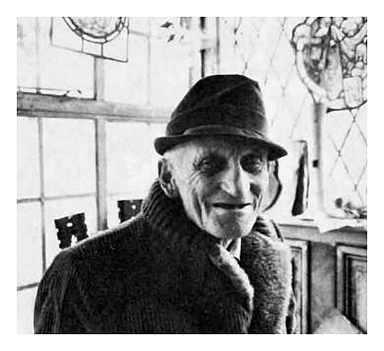
Walter K. Pleuthner at age 82
Walter Pleuthner's WWI ship camouflage scheme

When Walter Karl Pleuthner registered for the draft in White Plains NY on September 12, 1918, he was officially listed—and signed the verification—as Walter Charles Pleuthner. That’s odd. Elsewhere, I’ve seen him listed as Walter Carl Pleuthner. There is no reason to assume that these were different people, because his birthdate is cited correctly as January 24, 1885. He was 33 years old at the time of his draft registration, and was self-employed as an artist and architect, living on Scarsdale Avenue, in Scarsdale NY.

Pleuthner was born in Buffalo NY. When as young as five years old, he began to take art lessons at what is now the Buffalo AKG Art Museum. His watercolors were first exhibited in New York City in 1903. Three years later he moved to New York, where he worked in his uncle’s law firm, while taking art courses at the Art Students League and the Academy of Design. Among the instructors he studied with were Frank DuMond and F. Luis Mora. When the Armory Show (the infamous International Exhibition of Modern Art) took place in New York in 1913, he was the youngest artist to have his work included.

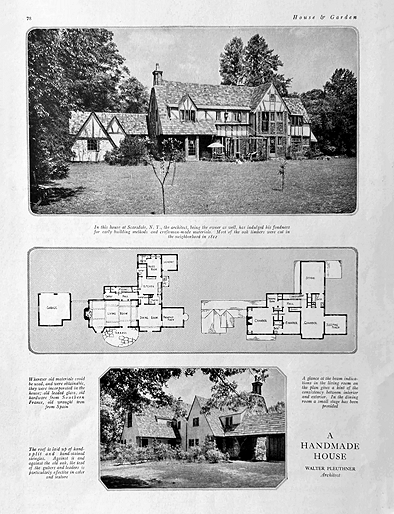
Later, as an architect, he was primarily known for designing homes for wealthy clients. In 1909, he married Clara Riopel Von Bott, a concert singer, and designed a spacious stately Tudor home for them in Scarsdale. It was of sufficient distinction that his full color painting of the property’s entrance gate, with a view of the home in the background, was featured on the cover of a 1909 issue of American Homes and Gardens magazine. In the magazine’s interior pages was a full page feature on the home, with exterior photographs, floor plans, and marginal notes.

Magazine Cover / Walter Pleuther / 1909
Magazine interior featuring Pleuthner home / 1909


Pleuthner is listed as having been a member of the Society of Independent Artists, as well as of a New York group called American Camouflage, organized by Barry Faulkner and Sherry Edmundson Fry (for the purpose of becoming proficient at army camouflage) in anticipation of the US declaration of war in 1917.

At some point, as a civilian, he also became involved in ship camouflage. We know this because there is a photograph of a painted wooden ship silhouette, credited to him, that was published in March 1918 (in black and white only) as part of a lengthy research report by the Submarine Defense Association. After his scheme was tested by camouflage researchers at Eastman Kodak Laboratories in Rochester NY, his camouflage proposal was not selected for actual use.

Pleuthner’s wife died from a heart ailment in 1957. He lived for thirteen additional years. His newspaper obituary reads: “His techniques ranged from American impressionism to the unusual use of found objects. He wrote humorous anecdotes and philosophical essays. An architect by profession, he created many of the Gothic and Tudor style homes in Scarsdale and neighboring towns.” He died on December 2, 1970.

The Pleuthners had no children. After his wife’s death, he continued to live alone in their large residence in Scarsdale (although it isn’t entirely clear if this was the original house from 1909, or perhaps a later equivalent from 1920). What is certain is that he had difficulty in maintaining the house. In 1963, it caught on fire, but was not structurally damaged. Soon after, it caught on fire on two other occasions, followed by vandalism and thefts. Concerns were increasingly voiced by area residents, fire safety officials and the village board. Some people urged that the house be condemned and dismantled “as a danger.” This debate provoked a longtime Pleuthner friend and former neighbor to publish an objection in the Scarsdale Inquirer on November 22, 1967.

“We all know Walter’s eccentricities,” the letter to the editor said, “and it is easy to criticize them. With less formal education than some, Walter, through his own efforts, became an excellent architect. He built expensive and admirable houses as far away as Pennsylvania and several in Westchester County…”

The request to raze the Pluethner’s home should be denied, the writer urged. “Walter has suffered several serious misfortunes and since Mrs. Pleuthner’s death, he has mostly lived alone with his paintings and sculpture. His house has suffered damage from fires but appears structurally sound. He is now an old man.”

One cannot help but wonder why Pleuthner was regarded as “eccentric,” even among his defenders and friends. One early indication may be a 1941 news article titled “Tipsy House” in the American Builder magazine. 
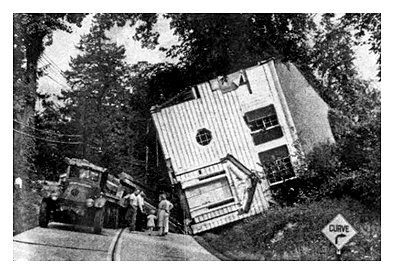
Tipsy House: No hurricane; just a bad spill


Pleuthner ran into unforessen difficulties, the article reported, “with a model house he bought, cut into two sections and tried to move to another site. After a lot of figuring, he started out at dawn one morning with the first section on a big trailer. Things went all right until they rounded a sharp curve on a hill. At that point the house got tipsy, rolled off the trailer and landed on its side. The house wasn’t damaged, but it got Architect Pleuthner into all sorts of trouble with various people, including the Traffic Department, who objected to having a main highway blocked. Thousands of people who had inspected the house [earlier] when it was known as the ‘Home for Better Living,’ sponsored by Westchester Lighting Company, were intrigued by the sight ot the house, complete with shutters, slate roof and equipment, laying on its side by the road, where it stayed for several days.”

But the straw that eventually broke the authorities’ back was the increasingly disheveled state of his large self-built Tudor home. At the time he built the house, we are told in an article in Progressive Architecture magazine, it “was no more pixyish than many another in the high Eclectic period, and was distinguished only by having true half-timber construction, a massive braced frame with brick nogging. Loving handmade things and solid workmanship, he had the house put together by craftsmen who used a minimal amount of millwork and ready-sawn lumber. One of the timbers in the living room is a heavy stick from the privateer Hornet of War of 1812 fame. Originally, the house reflected in a conventional way Pleuthner’s triple artistic role as architect, painter…and sculptor, as fragments of old ironwork and woodwork and paintings accumulated on the walls. The great living room was the rehearsal room of the Wayside Players, an amateur group that included Robert Benchley, Dorothy Parker, and the cartoonist Rollin Kirby. At some point, the cultured clutter to be expected in an artist’s house passed over into whimsy, and Pleuthner decided to work on the walls, ceilings, floors, and furnishings of the various interiors. The kitchen at one period was transformed into an Italian garden. Floorboards were painted to imitate polychromed tiles. Other floors were carved out and inlaid with mosaic. A bathroom scale had the outlines of two feet painted on the platform, while the dial became a screaming baby face. Unpleasant book bindings were painted white, with code words daubed on the spines in red. An automobile hood became a canopy over the entrance to a summer house. And more and more odds and ends were added inside and out. In 1963, the house caught fire, but its substantial construction saved it. …the house is now in sad shape. The authorities claim that it is unsafe, and want to tear it down, but Pleuthner is confident that he can restore it. This winter, the house was leaky, drafty, and uninhabitable, but Pleuthner is already experimenting with the textural effects created on the floor by the latest fire.”
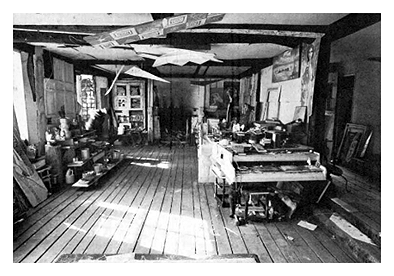
Pleuthner home interior in 1968


When that article appeared in 1968, Walter Pleuthner was 82 years old. His home was condemned and soon after demolished near the end of that year. When he died two years later, he was listed as residing at a nursing home in White Plains.

SOURCES

• Cover and “A Handmade House, Walter Pleuthner, Architect,” in American Homes and Gardens. Vol IV No 6, June 1909, p. 78.
• “Tipsy House” in American Builder 1941-09: Vol 63 Issue 9, p. 87.
• Letters to the Editor, Harold A. Herriet, “Defends Walter Pleuthner” in Scarsdale Inquirer, Vol XLIV No 47, November 22, 1967.
• “Dwellings: The Rationales in their Design” in Progressive Architecture, May 1968.
• “Walter K. Pleuthner” [obituary], in Scarsdale Inquirer. Vol 52 No 49, December 10, 1970.

Saturday, November 4, 2023

WWII US Army camouflage experiments at Fort Belvoir

For years I have searched vintage newspapers, looking for little-known articles on art and camouflage, with the intention of restoring them to a readable state, and sharing them with others who are interested in the subject.

Above is one from the Boston Sunday Post, Your World Section, March 16, 1941 (larger-sized scans with readable text can be found through online searches of newspaper archives). 

Written by James Miller, the title of this feature is The Army Prepares to Disguise the Nation. The article is an overview of wartime camouflage experiments at Fort Belvoir VA, twenty miles outside of Washington DC. Note the large scale illustration of two soldiers concealed in a background of foliage, and, below that, two men demonstrating camouflage-patterned uniforms.

RELATED VIDEO SERIES

Dazzle Camouflage: What is it and how did it work?

 Nature, Art, and Camouflage

 Art, Women's Rights, and Camouflage

 Embedded Figures, Art, and Camouflage

 Art, Gestalt, and Camouflage

Monday, September 25, 2023

Dr. George Washington Carver and WWII camouflage

CARVER WORKS TO BEFUDDLE AXIS ENEMIES: Paint Formulae For Camouflage New Project in Jackson Advocate (Jackson MS), August 22, 1942, p 1—

Tuskegee, Ala., August 20—Students of Tuskegee Institute may soon be walking to their classes over the tops of luxuriant forests and eating their morning cereal under the blue waters of a picturesque lake. The Institute’s purebred Holsteins may be a bit surprised to find that what appears to be murky swamp crosses their familiar lush of kudzu pasture. And the herd of milk goats—oh well, goats are supposed to be silly enough to eat anything, ersatz or otherwise.

President F.D. Patterson has recently turned over a portion of the Tuskegee campus to Austin W. Curtis, assistant to Dr. George W. Carver, internationally famous scientist, as an outdoor testing field for application of camouflage paints to various types of surfaces.

Mr. Curtis is working night and day at the Carver Laboratories at Tuskegee Institute on paint formulae to be used by the War Department for camouflage activities by the US armed forces.

Mr. Curtis recently returned from Detroit, Mich., where he spent much time with the research chemists in the laboratories of the Ford plant, testing various products for use in the war effort.

Previous to the Detroit visit Mr. Curtis went to Fort Belvoir, Va., for conferences with army officials relative to the use of Carver paints for camouflage purposes.  

RELATED VIDEO SERIES

Dazzle Camouflage: What is it and how did it work?

 Nature, Art, and Camouflage

 Art, Women's Rights, and Camouflage

 Embedded Figures, Art, and Camouflage

 Art, Gestalt, and Camouflage

Wednesday, May 24, 2023

lamb[l]ast / a lone wolf in snow-covered surroundings

WWII Finnish troops in snow-covered surrounding
There is a wartime Boston news report (December 1944) which features an American artist named Nathaniel J[udah] Jacobson (1916-1996), who was a US Army camoufleur. Originally from Boston, he had studied painting at the School of the Boston Museum of Fine Arts, MIT, and at Yale University, where he earned a BFA degree in 1941.

When the US entered World War II at the end of 1941, Jacobson enlisted. In 1944, while stationed in Europe, he was a contributor to the development of white cape coverings for infantry in snow-covered surroundings on the border of Belgium and Germany.

His involvement in all this was reported in the Boston Globe on December 14, 1944, in an article with the headline BOSTON ARTIST AIDS IN SAVING GIS BY SLICK CAMOUFLAGE WORK (pp. 1-2), in which Jacobson is described as being the “boss of fifty Belgian girls as a factory supervisor in a First Army camouflage unit.”

While encamped in the Hurtgen Forest, the American infantry was unprepared for the sudden first snowfall, which left them “unduly exposed to enemy fire against the white background…” As a result, "camouflage engineers were called and given seven days to produce. It meant seven days in which to design, obtain materials, obtain labor and manufacture concealing [white] snow capes for all frontline troops.” Within 24 hours, a factory had been set up, laborers had been hired, and thread and muslin were flown in. “Within 36 hours the first snow cape was rattled off the production line.”

As for Private Jacobson, his “part of the job was training the help, mostly Belgian girls, ironing out the production bottlenecks, and [in] general speeding up” the process. “He did this job with such good effect that by the end of the fifth day—two days ahead of schedule—the much-needed capes were on their way to the boys whose lives depended on them.”

…”Factory jobs are curiously incongruous for many of the men of this battalion, which comprises in addition to the Boston artist [Jacobsen], landscape artisans, cameramen, advertising layout men and former movie directors. Incidently, they camouflaged [the insulated clothing of this correspondent (reporter Iris Carpenter)] against pneumonia—she hopes—a sheepskin coat which they have spotched brown and olive on the skin side. If snow falls she will wear the wool side out and risk observation by nothing more dangerous than the GIs.“

•••

One week after that article was published, a second news report (written by Hal Boyle) appeared in the Times-Mirror (Warren PA), in which Private First Class Jacobson (apparently newly promoted) is described as “discontented” with his job, and is quoted very candidly. According to him, “I got this job—which I don’t like—because I had picked up some French out of a phrase book and was able to tell the girls what we wanted done.”

“I never even worked in a clothing factory before—never wanted to,” he adds. “…And here I am running one. You sure do strange things in the Army.”

The young Belgian women he supervises, he continued, “…are just like American girls. They never stop talking. And the way they spend their money! One girls just paid 900 francs for a pair of shoes—three weeks salary for one pair of shoes!

They have been going to some American army dances. That’s what they talk about most all day long. They are envious of American girls because they heard American girls could go to dances alone. Here, even if she is 25 years old, a girl can’t go to a dance unless her parents come along, too.”

Looking “moodily” at “the happy humming girls” in his workforce, Jacobson explains: “I am a happily married man—this is no place for me. They should put a single man on this job. But I guess that’s why they put me here—because I am an old married man—and not a wolf.”

In contrast, his asistant and co-worker, Private Donavan Mccomber from Radcliff OH, glanced over the factory workroom, whistled cheerfully, and said:

“Well, so we got to work in a roomful of girls. It ain’t so bad. I can think of a lot worse ways to win the war.”

•••

Following the war, Jacobson returned to the Boston area, became a research associate at MIT, and embarked on long-term art-and-science color research, including responses to color, and computer modeling. He continued to paint and exhibit, and, in 1975, published a book on color, titled The Sense of Color: A Portfolio in Visuals (Van Nostrand Reinhold).

Friday, May 19, 2023

Everett C. Hammond / WWI Boston-area camoufleur

Until a few days ago, I had never heard of a Boston-area artist named Everett C. Hammond, who served as a camoufleur during World War I. While described in newspapers at the time as a “portrait painter” and “well-known local artist,” his artistic expertise seems questionable if judged by the lackluster quality of the single drawing found so far. Reproduced above, it was made while he was serving as a US Army camoufleur in France, and was included as part of a letter to his sister in Boston (as described below in this post). At the time he made this drawing, he appears to have had little training in art—it is amateur at best.

•••

CORP HAMMOND TELLS OF CAMOUFLAGE WORK, in Boston Evening Globe, February 12, 1919, p. 9—

Corp. Everett C. Hammond, 1st Army Camouflage Service, a Cambridge man and well-known local artist, called at the local army headquarters today for final orders and to pay his respects to [Major] General [Clarence Ransom] Edwards [ranked last in his class at West Point in 1883].

Corp. Hammond went over seas with the 101st Engineers. He was a member of the old 1st Corps of Cadets when it changed to the engineer regiment. When he was overseas a short time, some one in authority learned that he was quite an artist, or rather “that he could paint” and he was shifted to the Camouflage School for further training in natural colors, etc. Then he was assigned to active duty on the fighting fronts, and went through every campaign. He, with others, would lay long stripes of burlap on the ground and paint them so that it would appear like grass or a natural science, when it was stretched over a battery of artillery that was hammering away at the enemy.

He was in every battle of the famed 26th Division [known as the Yankee Division, as commanded by General Edwards], although his official headquarters at all times was at Dijon. He declared that it quite an exploit, and certainly a dangerous and thrilling one, to first paint and then erect the disguises for the guns in the most active sectors.

He is the first of the camouflage men to report to the local offices, and his flaming yellow sleeve designation [a chameleon emblem], underneath a big blue A, excited curiosity.


•••

BOSTON ARTIST AS CAMOUFLEUR / E.C. Hammond Had Narrow Escape While Hiding Guns With Brush, in Boston Sunday Advertiser and American, March 1919, p. W-7—

More camouflage!

If the war has taught us anything, it has certainly acquainted us thoroughly with the art of camouflage. First it was used In concealing batteries, then to foil the U-boats, and finally came to peaceful pursuits, such as making certain things appear in a somewhat different light than might be otherwise construed—especially the truth.

Our story deals entirely with the first phase of the art—making raging, destructive batteries appear like harmless and aesthetic spots of nature. Something like the demon behind the man with the smiling face.

But now hear a real camouflage artist tell of bona fide camouflage. Listen to descriptions of this art in its original element, and incidentally a few other experiences of this expert camoufeur.

Boston Portrait Painter
By way of introduction, our artist is Corporal Everett C. Hammond. A Boston portrait painter. The war afforded him an opportunity to transfer his peaceful activity to a more fiery environment and he was quick to take advantage of it—enlisting two days after this country declared war. He has just returned to his home in Cambridge—with a thorough training in camouflage, but with an utter ignorance of "Camouflage."

His dally duties perfected him in the former art, but his schooling in the latter has been sadly neglected owing to the association with many clean, manly fellows, whose knowledge on that subject was meagre.

Hammond was among the first camoufleurs to be chosen by the government for this important work abroad. His highly developed training in done colors and natural features of landscapes qualified him for this branch of service with such men as [Homer] Saint-Gaudens, [F. Earl] Christy and [Barry] Faulkner, modern artists of wide popularity.

Was at Seicheprey
He was first with the 101st Engineers, with whom he served at the battle of Seicheprey [on April 20, 1918] and later with the 40th Engineers. Shortly before the battle of Seicheprey his company was engaged in constructing a camouflaged machine gun emplacement which they had half completed when the Boche shelling began. They were forced to abandon this work hurriedly, but not before two of their number had been killed and several wounded. After returning they found this position had been effectively shelled.

Hammond was later placed in charge of the camouflage work of the 130th Field Artillery, which used 75’s and 135mm guns. This unit was particularly active in the Toul sector between Gezencourt and Martincourt.

700 Women Helpers
About 700 French women were engaged during the war in making camouflage materials for the American government. This was done in Nancy and Dijon. Burlap was used principally and was prepared by a coloring process in which numerous natural colors were used. After being dried it was cut into uneven pieces and tied on chicken wire, having the appearance of the vibration and natural color of a grass field.

The colors were selected according to the particular environment, and when the structure was erected about a battery the blend served to conceal it from the enemy.

Each battery occupied an area about 100 feet long and 25 feet wide. This was entirely covered with camouflage raised to a height of twenty feet from the ground. It was done by means of posts surrounding the area at a distance of ten feet apart. These in turn were covered by the vast stretch of burlap colored according to the fields. At a distance this looked like a natural bank. The same was true from above and was indiscernible to the aviator's eye.

Camouflage While You Wait
The extensive operations were not carried on during a quick drive. In such case all guns carried forward their network consisting of burlap and fishnet. The latter was often covered with branches, leaves, etc. In quick drives a gun could be camouflaged in about thirty minutes. Along the established lines it required weeks and often months to construct the camouflage shelter.

The position of batteries were determined by the amount of natural protection, particularly near banks. They were often placed near brush, the effect of the shrubbery being carried out.

Hammond had several narrow escapes, among which was an incident when returning from the inspection of a camouflaged battery. Enemy guns wore searching out the territory, and as he crossed a barren field that section suddenly became the center of the foe's fire. He quickly sprang to a shell hole and was astonished when a dog, evidently a company mascot, came close to his heels. Both remained there until the guns ceased firing.

Another Narrow Escape
Later while he was discussing the camouflage of a certain battery with a comrade a large fragment of shell whizzed by his ear.


•••

SENDS PENCIL SKETCH OF CHAPLAIN EDWARDS, in Boston Post, April 21 1918, p. 12—

Miss Gladys E. Hammond of 241 Upham Road, Cambridge, received a letter yesterday from her brother, Everett C. Hammond of A Company, 101st Engineers, which contained a pencil sketch of Chaplain Edwards• addressing the men of the regiment before their departure for the front.

“My brother wrote,” said Miss Hammond, “that the engineers have been busy building miles of barbed wire entanglements, doing the work at night. He said that the work would keep the men busy for a long time. This letter was written March 12.”

The sketch shows Chaplain Edwards at the front of the colors, addressing the men. A line under the sketch, quoted as Chaplain Edwards’ words, reads: “I am going to commence the service this morning by reading a poem.”

•This appears to be an error, since I have yet to find any reference to a chaplain named Edwards in the Yankee Division, whereas the unit’s commander was Major General C.R. Edwards. Perhaps the two have been confused.