Showing posts with label artillery. Show all posts

Saturday, April 11, 2026

Grant Wood's camouflage service during World War I

WWI French artillery camouflage
It is by now common knowledge that when Iowa artist Grant Wood served in the US Army during World War I, he was assigned to field camouflage. When someone contacted me recently to ask what I might know about that, I replied that the best source might be Darrell Garwood's biography titled Artist in Iowa: A Life of Grant Wood (New York: Norton, 1944). Wood's involvement in camouflage is mentioned in other biographies as well, but they tend to be brief and less than strictly factual.

Here's what Garwood's biography says—

Since his [Wood's] mother and sister were dependent on him, he had been placed in Class 3C in the draft and was passed over in the first draft call in September. Later, other family arrangements were made for the very little money Mrs. Wood needed to keep house, and Grant enlisted as a private in the army. He was sent to Camp Dodge, outside Des Moines, where he spent a good part of his training period making pencil portraits of his comrades and officers. He charged privates twenty-five cents and officers one dollar for the portraits—at least these were his prices when anyone offered to pay him. He didn't ask for payment, and the officer didn't think to offer it, when he made a portrait of his company commander, Captain George E. Proud.

Captain Proud was getting ready to go into town when a sergeant came in to say there was a man outside who wanted to make a sketch of him. The captain was in a hurry, but told the sergeant to bring him in. It didn't take Grant more than ten or fifteen minutes to make the sketch. Proud scarcely looked at it at the time, and afterward didn't remember Grant's name; he only remembered that Grant had said he was a mural painter. When he was back practicing law at Arapahoe, Nebraska, however, Proud found the sketch among his things, liked it and had it framed. It hung on his office wall for fifteen years before someone happened to notice it was a Grant Wood portrait.

Grant's stay at Camp Dodge promised to be pleasant. He was excused from the more onerous military duties, given a sidecar motorcycle, and told to go about making historic records. Then he contracted anthrax, and nearly died. When he recovered, he was sent to Washington to do camouflage work. He served as a private in Company B, Regiment 97, United States Engineers, and was in charge of the paint tent. He made clay models of field gun positions and helped camouflage artillery pieces. Before-and-after photographs of a cannon he helped camouflage were on display for several years at the Smithsonian Institution.

He was still in Washington when the war ended, and was transferred back to Camp Dodge. He arrived home on Christmas Eve, 1918.…


Like Norman Rockwell and other artists who served in the military, Wood was often asked (or offered) to make portraits of his fellow soldiers, including officers. The Nebraska attorney who was Wood's company commander was George C. Proud, not George E. Proud. Other artists in the infantry (Walt Disney being one) were able to earn extra money by painting camouflage or other designs on the helmets of other soldiers.

It’s interesting that in Wood’s WWI draft registration, he lists himself as a "contractor and builder” not as an artist. After regaining his health at Camp Dodge, he was presumably transferred to Camp American University in Washington DC, where, as Garwood notes, he camouflaged artillery (field guns or cannon).

A different Wood biography claims that he painted the artillery for the purposes of making it "blend in" with its surroundings. But that may be misleading, since by 1918 it was common practice to camouflage nearly anything not by blending but by applying “disruptive” (high difference) patterns. The goal was less to blend in than to break apart the shape, making it harder to see as a “thing.”  

Some of these guns were genuine functioning cannon, while others may have been non-firing dummies, made of logs and wagon wheels (known as Quaker guns), that looked like cannon from the air, and were used to divert enemy fire. These might also be camouflaged, to make them more convincing. By that time in the war, when field guns were manufactured in the US, the disruptive camouflage patterns (all the same) were automatically applied at the factory during production, so it is somewhat surprising that the patterns would have to be painted.

WWI camouflage applied during production process


The war ended before Wood was sent overseas. He was never stationed in Europe. Two artists who served with him as camoufleurs were Orrin White and Charles P. Killgore, with whom (long after the war) he later exhibited artwork at Younkers in Des Moines. See details here.

It seems to me that all of this misses the point somewhat of Wood's connection to camouflage. The most important convergence is that camouflage relies on the same "grouping principles" that artists and designers use. I've explained all this in an online video talk.


•••

Anon, in ART CIRCLES, in Long Beach Independent (Long Beach CA), March 27, 1949, p. 10—

[A retired oil-field worker turned artist Carl R. Walline’s] interest in painting dates back to the first world war, when he drummed up a lively business on a returning troop ship painting camouflage on the helmets of soldiers at a dollar a helmet.

With this leftover camouflage paint he did his first landscape.

Tuesday, March 10, 2026

WWI hogshead on a tip-cart / deceptive artillery mimic

Above
Two-part illustration that accompanied the article printed below. The signed pen-and-ink illustration in the background appears to be the work of American artist Edith Magonigle (1877-1949), whose interesting life deserves full recognition.•• To start, see "Edith Magonigle and the Art War Relief" by Tal Nadan, New York Public Library. Her husband was the architect Harold Van Buren Magonigle, in whose Wikipedia article, she is simply cited as Edith and her maiden name, Edith Marion Day. 

The photograph of a German soldier has been restored from a poor quality newspaper photograph using AI software. We might also mention that René Bache, author of the article, was a prolific news journalist and author during WWI. He was also the Great-Great-Great-Great Grandson of Benjamin Franklin. Despite his family distinction, his articles on camouflage should be read with caution, as they may not always be fully accurate.

•••

René Bache, POPULAR SCIENCE: Camouflage—The Art of Deceit in Warfare, in The Catholic Press (Hartford CT), November 19, 1917—

To deceive the eye of the enemy is no new thing in warfare, but in the present conflict it has become for the first time an important and even vital element of tactics. The new war word "camouflage" covers a wide range, from optical illusions to expedients for obtaining invisibility.

An example of the former is shown in the accompanying photograph, which represents a "fake" German forty-two-centimeter mortar in the Argonne forest. It is a hogshead mounted on a tip-cart; but an enemy aviator flying overhead would almost certainly mistake it for a big gun.

On the sea "camouflage" is of not less importance than on land. Some of the German U-boats disguise themselves as sailing vessels. As for ourselves, particularly with the object of defeating the Hun submarines, we are using all of our famous Yankee ingenuity in developing this new and curious art.

The Government is requiring all American merchantmen to carry apparatus with which to make a defensive smoke-screen, in case of submarine attack. To the imagination, such a screen figures itself as a cloud of dense black smoke. The fact is quite different. The so-called "smoke" is white.

It is the smoke of burning phosphorus, set afire on the vessel's deck in so-called "funnels"—contrivances of small size, but resembling in shape the ordinary, wide-mouthed ship's ventilator. Each funnel is provided with a draft opening, to make combustion rapid, and it gives out enormous volumes of what looks like white fog.

Were you ever in a thick fog at sea? If so, you will understand that, at a distance of only a few yards, it makes an object absolutely invisible. The white phosphorus fog, indeed, is much better for "camouflage" purposes than a screen of black smoke because in itself It has no visibility. It is simply obscuration.

This, however, is not the only method utilizable for the purpose. If preferred, the ship captain may take along with him a number of wooden boxes, each a foot high and two feet square, perforated with holes. These boxes contain a certain compound, a principal ingredient of which is common black gun powder.

Suppose an attack by a U-boat. Several of the boxes are at once thrown overboard. The seawater admitted through the holes, sets the stuff on fire (by chemical action), and dense clouds of a yellowish-gray smoke are thereby liberated, concealing the ship from the enemy's view while she steams away.

There can be no question of the fact that this smoke-screen defense is destined importantly to minimize the destruction of American cargo carriers from this time on. It is bound to prove immensely useful for the protection of our troop transports and supply ships.

But another requirement imposed by the Government is that our merchant ships shall be painted in such fashion as to render them invisible. This problem has already been solved in a really marvelous way by the adoption of certain methods based on familiarly known optical principles—one of several schemes being to paint the vessel with a series of longitudinal stripes of the various colors of the rainbow. The stripes are rather narrow and of wavy form. At a distance of a mile, a ship thus adorned literally fades out of sight.

Thursday, February 19, 2026

Troccoli's involvement in artillery camouflage in WWI

Giovanni Battista Troccoli (1882-1940) was an Italian-American painter who came to the US at age 11 in 1893. He began his career in Boston, where he worked as a wood carver at age 14, and soon after as a modeler for a well-known Boston sculptor, Hugh Cairns.

WWI artillery camouflage (Watertown Arsenal) AI Colorized

He turned from sculpture to painting, and in the process studied with Denman Ross (author of A Theory of Pure Design: Harmony, Balance, Rhythm), and with artist and frame designer Hermann Dudley Murphy, both of whom were associated with Harvard University. The latter, as explained in earlier posts, supervised the application of ship camouflage during World War I.

Troccoli also studied painting in Paris, Amsterdam and Spain, and seems to have been primarily known as a portrait painter. Of greater interest at the moment is his little-known involvement in wartime camouflage. During WWI, perhaps as a civilian, he was involved in developing camouflage patterns for American field artillery at the Watertown Arsenal, in Watertown MA. It is unconfirmed but he may have contributed to the camouflage of the field guns that are shown above and below in this post, all of which were apparently processed at Watertown.

Thursday, January 1, 2026

German soldiers unseen except when surrendering

WWI German artillery camouflage using overhead netting
Clair Kenamore
, From Vauquois Hill to Exermont; a history of the thirty-fifth division of the United States. St Louis MO: Guard Publishing 1919, p. 111—

The invisibility of the Germans was one of their strong points. Their camouflage was good, and they took advantage of every possibility for concealment. Some of our men never saw a German except those who had surrendered. A typical experience was that of Sergeant C.G. McCorkle of E Company, of the 138th, who fought from the "jumping off" day up to the 29th, when he was wounded, but in all that time he never saw a German with a rifle in his hands. All he saw either had their hands high in the air, surrendering, or were using them to work a machine gun.

Friday, December 12, 2025

countershading and disruption in artillery camouflage

The three photographs in this blog post were originally published in black and white in Scientific American during World War I. 

As posted here, they have been restored and AI colorized. They are excellent examples of attempts to camouflage artillery by applying countershading (as proposed by American artist Abbott H. Thayer) and by breaking up the cannon's shape by applying high contrast disruptive patterns, such as stripes. 


It is interesting to look at these in comparison to a series of five hand-drawn illustrations (as shown below) by WWII British army camoufleur and eminent zoologist, Hugh B. Cott, in Adaptive Coloration in Animals, which we have blogged about before.


Monday, August 25, 2025

sudden death of a WWI cannon camoufleur in Ohio

Above Interior view of Morgan Engineering plant (1915). Note camouflaged cannon in left foreground.

•••

CANNON CAMOUFLAGER SUCCUMBS SUDDENLY in Pittsburgh Press, September 11, 1919—

Lisbon OH—The body of A. W. Taylor, aged 50, who died suddenly in a hotel here yesterday, is being held in an effort to find relatives. Taylor during the war was employed at the Morgan Engineering plant at Alliance. He was a painter and camouflaged many cannon sent to the war zone. 

RELATED LINKS

Dazzle Camouflage: What is it and how did it work?Nature, Art, and Camouflage / Art, Women's Rights, and CamouflageEmbedded Figures, Art, and Camouflage / Art, Gestalt, and Camouflage /  Optical science meets visual artDisruption versus dazzle / Chicanery and conspicuousness /  Under the big top at Sims' circus

Saturday, August 2, 2025

WWII camoufleur as much use as fridge at North Pole

Above WWI camouflaged-painted tank-like vehicle with rotating turret gun.

•••

Hugh B. Cott, “Camouflage” in The Advancement of Science. Vol 4 No 16, January 1948, pp 308-309—

[At the beginning of World War II] the possible methods, scope and usefulness of camouflage were by no means generally appreciated. Perhaps you will allow me to give a single example. When early in 1941 I took up my first service appointment, the Brigadier to whom I reported for duty welcomed me with these words—he said: “A camouflage officer is as much use to me as a refrigerator at the North Pole.” It happened that we were no where near the North Pole, but in tropical Africa, where a refrigerator would have been a very useful piece of equipment. However, I was not unduly discouraged by this somewhat chilly reception.

RELATED LINKS

Dazzle Camouflage: What is it and how did it work?Nature, Art, and Camouflage / Art, Women's Rights, and CamouflageEmbedded Figures, Art, and Camouflage / Art, Gestalt, and Camouflage /  Optical science meets visual artDisruption versus dazzle / Chicanery and conspicuousness /  Under the big top at Sims' circus

Sale-priced books on camouflage / free shipping

Saturday, April 5, 2025

the role of taxidermy in World War I field camouflage

Above The headline for this photograph was WITH AID OF TAXIDERMIST, FRENCH HID BATTERY IN PASTORAL SCENE BY CAMOUFLAGE. It appeared in the Bourbon News (October 2, 1917) with the following caption—

How artfully have the French concealed a battery in this bucolic spot on the Western Front by placing there a crudely fashioned cow, the product of a field taxidermist. It is in this country that the German airmen have made some of their most effective attacks of late. In order to hide from piercing enemy eyes that look from the skies, the French have contrived this form of camouflage. The battery is entirely hidden by a green cloth, draping over which is tattered leaves and boughs. The artificial cow (its tail wags and its head moves) has been set up on stilts from below. During an attack the drapery is withdrawn and the guns brought into action.  

RELATED LINKS    

Dazzle Camouflage: What is it and how did it work?Nature, Art, and Camouflage / Art, Women's Rights, and CamouflageEmbedded Figures, Art, and Camouflage / Art, Gestalt, and Camouflage /  Optical science meets visual artDisruption versus dazzle / Chicanery and conspicuousness /  Under the big top at Sims' circus

Wednesday, February 19, 2025

John M. Goodwin / WWI railway artillery camoufleur

Here’s a puzzle: I haven’t been able to ascertain if the John Goodwin who authored a book in 2016 on Railway Guns (see cover above) is the same World War I American artist who developed railway artillery during that war. Of course, it can't be (unless that book was a reprint), but they may be related. The full name of the earlier person was John M. Goodwin. But I know almost nothing beyond that. What I do know comes from searching archival newspapers. Below are two items I’ve recently found— 

ANON, The Washington Times (Washington DC), April 25, 1919, p. 9—

John M. Goodwin, of the artillery division, Ordinance Department, and in charge of the camouflage of railway artillery, will give an illustrated talk on “Camouflage” at the United Service Club of America, Dupont Circle, tonight at 8:15.

•••

J.M. GOODWIN TO LECTURE. Will Give Course in Art at Research University, in The Washington Post, February 5, 1921, p. 7—

John M. Goodwin, Civil Engineer, has been named professor of art at Research University. The appintment was announced yesterday by President L.W. Rapeer, of the university.

Mr, Goodwin developed the dual complementary system for concealing big railway mounts during the World War, making his studies amid observations from airplanes. He later delivered lectures for the government on “Scientific Color Camouflage.” His studies have been pursued in the United States, Italy and France…

RELATED LINKS    

Dazzle Camouflage: What is it and how did it work?Nature, Art, and Camouflage / Art, Women's Rights, and CamouflageEmbedded Figures, Art, and Camouflage / Art, Gestalt, and Camouflage /  Optical science meets visual artDisruption versus dazzle / Chicanery and conspicuousness /  Under the big top at Sims' circus

Saturday, June 22, 2024

germ strainer, natural mask & checkered camouflage

Above World War I railway mounted artillery, with checkerboard-patterned camouflage. Source unknown.

•••

It was in 1918 that the great “Spanish flu” epidemic arrived. As with our own recent experience, there were frenzied efforts to find a cure, or at least to find reliable ways of preventing it from spreading. In the article that follows, it was recommended that one way to protect oneself (at least for men) was to grow a moustache, which might then partly function as a germ strainer, a natural mask and camouflage.

HIRSUTE VEIL CAMOUFLAGE IS FLU GERM DUPE in Salt Lake Herald-Republican, December 125, 1918, p. 48.

Further hint to the flu dodger—masquerade behind nature’s mask, the moustache. Or, as a further safeguard, raise whiskers.

Tis thus some of the health authorities advise. A fuzzy growth, whether on lip or jowl, they explain, is a germ strainer. The burglarious bacillus, trying to break in, has about as much chance as a camel at the needle’s eye or a carrot in a colendar.

If the moustache or whiskers prove to be real preventives, lots of Salt Lake men who pine to retire from an ailing world will take the hirsute veil. Faces which have been displayed merely as faces may take on the display of sylvan retreats and bosky dells. Razor and scythe will be laid away and phizes will be allowed to sprout in all their wild carefree abandon. Familiar countenances will be concealed behind an impenetrable camouflage and the only recognizable features when friend meets friend will be a pair of eyes, a twinkling nose and two untrammeled ears.

The local Adonis, whose finely-chiseled beauty won the hearts of all feminine beholders, will appear in his bewhiskered role as plain as a welcome mat. The homely citizen will resemble a discarded Christmas tree, which has reached a sere and yellow pass. It will be a sad day for the barbers, but the hedge trimmers and landscape gardeners may build up a profitable business.

If Salt Lake men decide to go in for moustaches and whiskers, the caravansarles may become strangely quiet. For not a one of them will have the hardihood to order soup.

RELATED LINKS    

 Dazzle Camouflage: What is it and how did it work?

 Nature, Art, and Camouflage

 Art, Women's Rights, and Camouflage

 Embedded Figures, Art, and Camouflage

 Art, Gestalt, and Camouflage

 Optical science meets visual art

 Disruption versus dazzle

 Chicanery and conspicuousness

 Under the big top at Sims' circus

Tuesday, October 3, 2023

contributions of Hollywood to WWI ground camouflage

Above Camouflage pattern (digitally-colorized, thus historically unreliable) on World War I huge long-range artillery, mounted for railway transport, c1918, unknown source.

•••

G.P. Harleman, News of Los Angeles and Vicinity in The Moving Picture World, December 1, 1917—

Lawson Organizes Camouflage Artists
Lee Lawson, [Hollywood] technical expert, has received from the Adjutant General authorization to form a company of two hundred and fifty men of the [motion picture] studio plants for the camouflage department to be incorporated in the Twenty-Fourth Engineers.

Lawson has been engaged at his trade locally for the past twelve years. He recently asked for authority to organize a company of camouflage artists. His appointment was made by Secretary of War [Newton] Baker.

All the ingenuity of “trick stuff” manifested in motion pictures will be transplanted to the camouflage activities in France. Scene painters, artists, sculptors, property men and numerous other classes of employees in studios will comprise the company.

Lawson already has sixty-four men enrolled. These will leave in a few days for American Lake [near Lakewood], Washington, where they will receive instruction in the most advanced methods of camouflage work.


•••

G.P. Harleman, News of Los Angeles and Vicinity in The Moving Picture World, December 15, 1917, page 1637—

Camouflage Artists Leave for Training
The greatest camouflage company in the world, according to Major George P. Robinson, United States Engineers Corps, left Los Angeles November 24, for an eastern training camp. There wre sixty-five men in the part, headed by Lee Lawson of the Universal. The personnel were recruited almost exclusively from the leading motion picture studios of Los Angeles.

“Nowhere else in the world could a company of men of similar qualifications have been recruited,” said Major Robinson. “The best scenic artists and men of kindred trades in the motion picture industry are here.”

Just before the train pulled out of the station Lee Lawson made a short speech to the crowd. “Friends, we’re going over there to fool the Kaiser, and if Yankee genius counts for anything we’ll be there with the goods,” he said.

The leave taking was different from any farewells given any party of soldiers leaving Los Angeles heretofore. Sixty-five young men, all of them known personally to the five hundred or more persons who bade them goodbye, caused everybody to cry goodbye to everybody else. It was a scene not easily forgotten.


•••

News of Cinema and Film Gossip in The New York Sun, February 2, 1919, p. 39—

Lieutenant Lee Lawson, former technical director, Sergeant Clarence DeWitt and Sergeant H. Divver, formerly of Universal City, for over nine months members of a camouflage regiment in France, has returned to the studio. When America entered the war Lieutenant Lee [sic] assembled scenic artists, sculptors, directors and property men in a camouflage platoon. He was wounded twice, Sergeant DeWitt gassed, and Sergeant Divver wounded twice.

RELATED LINKS    

Dazzle Camouflage: What is it and how did it work?

 Nature, Art, and Camouflage

 Art, Women's Rights, and Camouflage

 Embedded Figures, Art, and Camouflage

 Art, Gestalt, and Camouflage

 Optical science meets visual art

 Disruption versus dazzle

 Chicanery and conspicuousness

 Under the big top at Sims' circus

Tuesday, July 4, 2023

artist Alan Collier / whose training was on civvy street

Above Alan Caswell Collier (1911-1990), All Is Green and Gold, 1974, oil on canvas. Collier was a Canadian landscape artist. Born in Toronto, he studied at the Ontario College of Art and the Art Students League, New York. During the final years of World War II, he served in the Canadian Army. The statement below is from an interview of Collier by Paul Bennett, conducted in an exhibition catalog, Retrospective. Oshawa, Ontario CA: Robert McLaughlin Gallery, 1971, pp. 14-15—

When I was drafted into the army they asked me, when they saw my background if I wanted to go into camouflage. I decided that if I wasn't going to be a war artist, with a commission and so on, to hell with it; my training was on Civvy Street and I wasn't going to go in and be a private in the army and do art work as a private. I felt that I wanted something better than that, so I just said no, I did not want to go in the camouflage; I don't regret that I went into artillery survey. 

Wednesday, June 28, 2023

elegant patterns / allied with deplorable wartime death

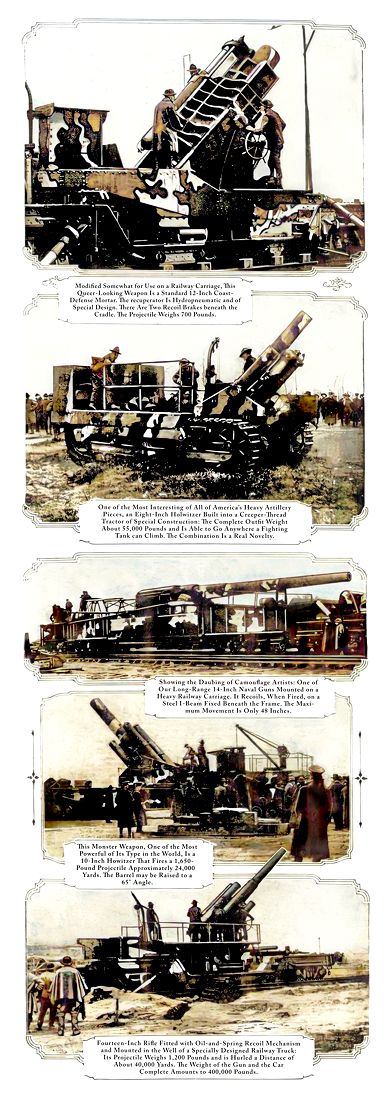
Above A sequence of magazine photographs (black-and-white originally, but cleaned-up and AI colorized here) from an issue of Popular Mechanics, Vol 31 Issue 2 (1919), published with the title Some of America’s Big Artillery Batteries on Mobile Mountings Seen at Close Range. The destruction caused by high tech guns and other killing machines will always be deplorable (as happened earlier this week in Ukraine, when a Russian rocket hit a pizzeria, killing ten civilians, including children). It is a cruel irony that these retouched World War I photographs, enlivened with camouflage patterns, are nonetheless strikingly beautiful as images.

RELATED VIDEO SERIES

Dazzle Camouflage: What is it and how did it work?

 Nature, Art, and Camouflage

 Art, Women's Rights, and Camouflage

 Embedded Figures, Art, and Camouflage

 Art, Gestalt, and Camouflage

Friday, June 23, 2023

Tuesday, June 6, 2023

new camouflage method devised by french lieutenant

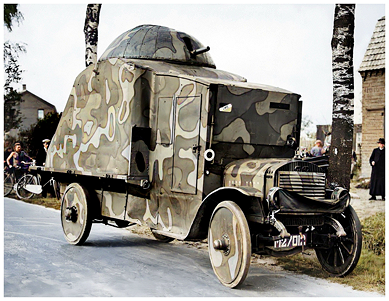
Above French camouflaged auto cannon (Peugeot 1915), c1916. Wikimedia Commons.

•••

Below I have no idea what this cryptic news article is talking about. It sounds fascinating—if it were only true.

NEW CAMOUFLAGE INVENTED in Greensburg Daily Tribune (Greensburg IN), April 13, 1932—

PARIS (UP)—A French lieutenant who served through the World War [WWI] has just demonstrated the advantages of his new camouflage invention whereby in a short time, a pedestrian or soldier can be transformed into a shock of grain, heap of leaves, a bunch of newspapers, tree stump or what not while walking. His names is George [probably Georges] Félix, and his invention consists of a kind of net that weighs less than a pound, and when not used for camouflage purposes can be employed in numerous other ways.

Wednesday, May 24, 2023

lamb[l]ast / a lone wolf in snow-covered surroundings

WWII Finnish troops in snow-covered surrounding
There is a wartime Boston news report (December 1944) which features an American artist named Nathaniel J[udah] Jacobson (1916-1996), who was a US Army camoufleur. Originally from Boston, he had studied painting at the School of the Boston Museum of Fine Arts, MIT, and at Yale University, where he earned a BFA degree in 1941.

When the US entered World War II at the end of 1941, Jacobson enlisted. In 1944, while stationed in Europe, he was a contributor to the development of white cape coverings for infantry in snow-covered surroundings on the border of Belgium and Germany.

His involvement in all this was reported in the Boston Globe on December 14, 1944, in an article with the headline BOSTON ARTIST AIDS IN SAVING GIS BY SLICK CAMOUFLAGE WORK (pp. 1-2), in which Jacobson is described as being the “boss of fifty Belgian girls as a factory supervisor in a First Army camouflage unit.”

While encamped in the Hurtgen Forest, the American infantry was unprepared for the sudden first snowfall, which left them “unduly exposed to enemy fire against the white background…” As a result, "camouflage engineers were called and given seven days to produce. It meant seven days in which to design, obtain materials, obtain labor and manufacture concealing [white] snow capes for all frontline troops.” Within 24 hours, a factory had been set up, laborers had been hired, and thread and muslin were flown in. “Within 36 hours the first snow cape was rattled off the production line.”

As for Private Jacobson, his “part of the job was training the help, mostly Belgian girls, ironing out the production bottlenecks, and [in] general speeding up” the process. “He did this job with such good effect that by the end of the fifth day—two days ahead of schedule—the much-needed capes were on their way to the boys whose lives depended on them.”

…”Factory jobs are curiously incongruous for many of the men of this battalion, which comprises in addition to the Boston artist [Jacobsen], landscape artisans, cameramen, advertising layout men and former movie directors. Incidently, they camouflaged [the insulated clothing of this correspondent (reporter Iris Carpenter)] against pneumonia—she hopes—a sheepskin coat which they have spotched brown and olive on the skin side. If snow falls she will wear the wool side out and risk observation by nothing more dangerous than the GIs.“

•••

One week after that article was published, a second news report (written by Hal Boyle) appeared in the Times-Mirror (Warren PA), in which Private First Class Jacobson (apparently newly promoted) is described as “discontented” with his job, and is quoted very candidly. According to him, “I got this job—which I don’t like—because I had picked up some French out of a phrase book and was able to tell the girls what we wanted done.”

“I never even worked in a clothing factory before—never wanted to,” he adds. “…And here I am running one. You sure do strange things in the Army.”

The young Belgian women he supervises, he continued, “…are just like American girls. They never stop talking. And the way they spend their money! One girls just paid 900 francs for a pair of shoes—three weeks salary for one pair of shoes!

They have been going to some American army dances. That’s what they talk about most all day long. They are envious of American girls because they heard American girls could go to dances alone. Here, even if she is 25 years old, a girl can’t go to a dance unless her parents come along, too.”

Looking “moodily” at “the happy humming girls” in his workforce, Jacobson explains: “I am a happily married man—this is no place for me. They should put a single man on this job. But I guess that’s why they put me here—because I am an old married man—and not a wolf.”

In contrast, his asistant and co-worker, Private Donavan Mccomber from Radcliff OH, glanced over the factory workroom, whistled cheerfully, and said:

“Well, so we got to work in a roomful of girls. It ain’t so bad. I can think of a lot worse ways to win the war.”

•••

Following the war, Jacobson returned to the Boston area, became a research associate at MIT, and embarked on long-term art-and-science color research, including responses to color, and computer modeling. He continued to paint and exhibit, and, in 1975, published a book on color, titled The Sense of Color: A Portfolio in Visuals (Van Nostrand Reinhold).

Saturday, October 23, 2021

the debate about who originated WWI camouflage

Above World War I photograph (c1914) of four members of the French camouflage squad described in the news article below. They are (l to r) Èugene Jean-Baptiste Corbin, Louis Guingot, Henri Royer, and (seated in front) Henri Ronsin. If this article is accurate, Corbin may have been the first of the French camoufleurs to experiment not only with field camouflage, but with naval camouflage as well. Confusingly, it is often said that the originator of French camouflage was Lucien-Victor Guirand de Scévola who apparently arrived at the same idea, independently of Corbin. Combining their findings, they became a single team, but it was Guirand de Scévola who managed the first camouflage workshop at Toule, and who persuaded the French command to establish a section de camouflage.

•••

HONOR INVENTOR OF CAMOUFLAGE: French Officials Recognize Genius of Eugene Corbin Who Aided World War in The Portsmouth Times (Portsmouth OH), October 6, 1935, p. 12—

Paris, Oct. 5—Eugene Corbin, inventor of the system of camouflage used in the World War, finally has received recognition from the French government for his work.

In August 1914, Corbin, now 65 years old and the weathy director of a big department store chain, was mobilized as a noncommissioned officer. Three days after he reached the front the idea of putting war materials in “disguise” came to him. It was later adopted by all the allied and enemy armies and became one of the most striking characteristics of the World War.

One day, as Corbin tells it, he learned that three of his friends were blown to pieces by an airplane bomb while manning a field gun. He remembered that years before he had experimented with many-colored costumes while hunting so as not to scare away animals. He thought the scheme might work to disguise field guns from enemy planes and his colonel gave him permission to experiment.

Corbin first rounded up a squad to help him. Louis Guingot, a prominent portrait painter, and Henri Ronsin, decorator of the Paris Opera were his first aids. Together they painted the first canvas to hide a field gun and its gunners from German planes. They were given an automobile and complete painting equipment plus the use of a vacant department store in Toul. Soon their staff grew and idle factories throughout France were opened to pratictioners in the new science of camouflage. The first design never varied throughout the war.

Corbin directed painting of the first warship and first transport, examples of camouflage which were to become familiar to American citizens throughout the war. His invention was applied to everything used in army and navy life, from guns, hangars, tanks to armored cars, trucks and railroad cars.

Corbin has been active throughout his life in the interests of what he calls “real art,” apart from the crude system of painting that he originated. For some years he has supported a colony of artists and sculptors in his native Lorraine and his private art collection numbers more than 10,000 objects which he has collected for 35 years.

Èugene Jean-Baptiste Corbin