Showing posts with label posters. Show all posts

Tuesday, June 3, 2025

Noel Martin, Ralston Crawford as WWII Camoufleurs

Noel Martin exhibition poster
Canadian-born American artist Ralston Crawford (1906-1978) is usually said to have been a Precisionist, with the result that his paintings (and photographs) are typically grouped with those of Joseph Stella, Charles Demuth and Charles Sheeler. Until recently, I hadn’t realized that, early in his career, Crawford worked as an illustrator at the Walt Disney Studio. Later, in the 1930s to early 1940s, he taught at the Art Academy of Cincinnati.

In 1942, at age 36, Crawford received a World War II draft notice. As an experienced photographer, he asked to be assigned to photography for the US Navy. But when he failed to meet the Navy’s requirements, he applied for the camouflage division of the US Engineers Corps. He despised basic training, so much so that he later said that “the enemy was not Hitler, or Mussolini” but what he described as those “those miserable, stupid and sometimes vicious people” who trained recruits “in modern assasination techniques.” As a result, he asked to be assigned to the Weather Division of the Visual Presentation Unit (producing training materials, such as instructional drawings, models, and filmstrips).

While teaching in Cincinnati, one of Crawford students had been a young man named Noel Martin (1922-2009). From 1942-45, Martin served in the US Army as a specialist in camouflage and information. After the war, Martin was asked to design various information brochures for the Cincinnati Art Museum. He learned about the printing process from a craftsman at the museum, and then gradually taught himself the rudiments of graphic design, a profession not then taught in art schools because (in Martin’s words) of “art school snobbery.” Other prominent graphic designers and illustrators who were associated with the Art Academy of Cincinnati at about the same time were Malcolm Grear and Charley Harper.

Beginning in 1986, I taught illustration and graphic design at the Art Academy of Cincinnati until 1990. Noel Martin had more or less retired as the museum's designer, but he was still in the area. 

By that time, I had published a number of articles and one book on art and camouflage. When I learned that Martin had been a WWII camoufleur, I arranged to meet with him for lunch. We talked about his camouflage service, and I jotted down some cryptic notes. I no longer know their whereabouts (although I have them somewhere), but one thing that I do recall is that he mentioned several others whom he knew who had also served as camoufleurs. Of those I clearly remember, one was Victor Christ-Janer (1915-2008). 

•••

RELATED LINKS    

Dazzle Camouflage: What is it and how did it work? /  Nature, Art, and Camouflage / Art, Women's Rights, and Camouflage /  Embedded Figures, Art, and Camouflage / Art, Gestalt, and Camouflage /  Optical science meets visual art /  Disruption versus dazzle / Chicanery and conspicuousness /  Under the big top at Sims' circus

Thursday, April 24, 2025

WPA artists / engineers also worked on camouflage

Recently, while preparing a talk about the Depression-era WPA (Works Progress Administration), I was surprised to find how many American camouflage artists were also involved in various WPA public art projects. Below is one example of that—

WPA SEEKING OKAY ON ROAD CAMOUFLAGE in Greensburg Daily Tribune (Greensburg PA), October 18, 1940—

Traverse City MI—WPA engineers at a conference here disclosed plans are under consideration for a camouflage project to conceal highways and gun emplacements.

The project, discussed at a conference of national, regional and state WPA engineers, would be undertaken by Michigan artists. Huge camouflage nets would be spread over strategic defense spaces and military objectives, it was disclosed.

Approval of the project was awaited from Washington.

RELATED LINKS    

Dazzle Camouflage: What is it and how did it work? /  Nature, Art, and Camouflage / Art, Women's Rights, and Camouflage /  Embedded Figures, Art, and Camouflage / Art, Gestalt, and Camouflage /  Optical science meets visual art /  Disruption versus dazzle / Chicanery and conspicuousness /  Under the big top at Sims' circus

Tuesday, April 22, 2025

camouflage / war work training for art school students

Ad, The Boston Post, June 8, 1941
WAR WORK FEATURE FOR ART STUDENTS in Trenton Evening Times (Trenton NJ), September 18, 1918—

All classes at the [Trenton] School of Industrial Arts this year are being conducted with the special aim of making them worthwhile to the student for war purposes. At present there are many former students engaged in war service, some in camouflage work, and others in poster making. Much more poster work will be done this year than usually, notwithstanding that this has always been an important field of activity.

Emphasis is being laid also on the classes in fine art, as it is felt that students in this branch will have unusual opportunities when the war ceases. In the industrial revival which will sweep over the country, designers will be needed in almost unlimited numbers, and this is an ideal time for them to prepare.…

RELATED LINKS    

Dazzle Camouflage: What is it and how did it work? /  Nature, Art, and Camouflage / Art, Women's Rights, and Camouflage /  Embedded Figures, Art, and Camouflage / Art, Gestalt, and Camouflage /  Optical science meets visual art /  Disruption versus dazzle / Chicanery and conspicuousness /  Under the big top at Sims' circus

Sunday, March 3, 2024

Wiard Boppo Ihnen / so why a duck why-ah no chicken

In 1933, the art director for the Marx Brothers film Duck Soup was a man named Wiard Boppo Ihnen (1897-1979). His German given name was pronounced as “weird,” and throughout his life he was usually known as William or Bill Ihnen.

He was born in Jersey City NJ, where his father was an architect and artist. He too practiced architecture, but he also studied painting at the Ecole des Beaux-Arts in Paris, as well as in Mexico City. On two occasions, he won an Academy Award for art direction, but he is also remembered for other well-known productions, including two of Mae West’s films (Go West, Young Man and Every Day’s a Holiday), and John Ford’s Stagecoach.

In 1940, he married Edith Head, the acclaimed costume designer (he was 5’6”, she was 4’11”). Years earlier, in October 1918 (at the close of World War I), he had enlisted in the US Army, for which he served in camouflage until his discharge in February 1919. According to an obituary in the Los Angeles Times (June 26, 1979, p. 30) he served “in the army” during both World Wars, “as a camouflage expert.”

Update According to an additional source (TILFORD ACTIVITIES ARE EXPANDING in Modern Studios and Laboratories, Vol 10 No 14 (September 3, 1921, p. 1)), Ihnen served not only in the US Army during WWI, but apparently also as a civilian ship camoufleur. The article states: "During the war he earned considerable commendation for himself for his camouflage work with the United States Shipping Board."


Thursday, February 2, 2023

cubism and camouflage / oscillation of appearances

Above Simay Imre, Subscribe to the Liberty Loan (World War I French poster), 1918. University of Illinois Archives, Public Domain.

•••

Wylie Sypher, Rococo to Cubism in Art and Literature. New York: Vintage Books, 1960—

To prove that art and life intersect, that thought enters things, that appearance and reality collide, or coincide, at the points we call objects, the cubist relied on certain technical devices: a breaking of contours, the passage, so that a form merges with the space about it or with other forms; planes or tones that bleed into other planes and tones; outlines that coincide with other outlines, then suddenly reappear in new relations; surfaces that simultaneously recede and advance in relation to other surfaces; parts of objects shifted away, displaced, or changed in tone until forms disappear behind themselves. This deliberate “oscillation of appearances” gives cubist art its high “iridescence” [p. 270].

It has been said that the great cubist achievement was camouflage [p. 299].

RELATED LINKS

 Cubism and Camouflage

Cook: The Man Who Taught Gertrude Stein to Drive

Art, Design and Gestalt Theory: The Film Version

Wednesday, December 29, 2021

the scintillations of your wit, lambent but innoucous

Above This strikingly-costumed figure (pre-camouflage, but visually “dazzling” nevertheless) is extracted from a theatrical poster from 1897. It was an advertisement for Wang, a comic operetta first performed in New York City. 

The title role, as shown here, was played by Broadway actor William DeWolf Hopper (1858-1935), an outsized personality and—at 6 foot 5 inches and 230 pounds—an outsized physical presence as well. He had a powerful booming voice, and a boundless sense of humor. 

His celebrity was due in part to the popularity of his on-stage recitations of the widely known baseball poem by Ernest Thayer, titled “Casey at the Bat.” Having married and divorced with unusual frequency (not to mention reputed affairs), he was sometimes said to have been the “husband of his country.” 

His fifth wife was the famous gossip columnist, Hedda Hopper, and their son was the actor William Hopper (William DeWolf Hopper, Jr.), who played a detective named Paul Drake in the Perry Mason televison series.

•••

Guiseppe Garibaldi—

Bacchus has drowned more men than Neptune.

•••

A.D. Godley—

What is this that roareth thus?
Can it be a Motor Bus?
Yes, the smell and hideous hum
Indicat Motorem Bum!
How shall wretches live like us
Cincti Bis Motoribus?
Domine, defende nos
Contra hos Motores Bos!


•••

Edward Meyrick Goulburn—

Let the scintillations of your wit be like the coruscations of summer lightning, lambent but innoucuous.

Saturday, October 9, 2021

skilled cosmetic camouflage / disguised injured optics

James Montgomery Flagg (1905)
Above James Montgomery Flagg (best-known for his I Want You Uncle Sam poster), Cover illustration (with embedded figure or visual pun) for Life magazine, March 23, 1905.

•••

Abel Warshawsky, The memories of an American Impressionist. Kent OH: Kent State University Press, 1980, p. 30—

One Sunday, when as usual we were on our way to dine at the Kroll’s house, Leon Kroll surprised us by revealing an unsuspected side of his character. We were passing through a tough neighborhood after a heavy fall of snow, when we came upon a band of young roughs mercilessly pelting an old man with snowballs. When we tried to interfere, the band of hooligans turned on us, and we were obliged to make a fight for it. Kroll, who was of small physioque, was our first casualty. An old shoe, hitting him on the head, bowled him over down the area steps where we had taken our stand. In a moment, he was back, blazing with the lust of battle, a veritable David ready to slay his tens of thousands. His onset was so terrific that the enemy was soon put to flight. But there were several black eyes among us to tell the tale of the Sunday battle, and that evening we were to attend a concert! How to save our telltale faces! It was then we remembered the lower Bowery expert who painted out black eyes, and we proceeded to do likewise, so successfully that no one that evening or the next day noticed the traces of our combat.


Above Anon, detail from a cartoon from The Ogden Standard (Ogden UT), December 3, 1917, p. 11.


George Ross, BLACK EYE CAMOUFLAGE ARTIST TELLS MR. ROSS TWO OUT OF TEN ‘PATIENTS’ ARE WOMEN, in Times Daily (Florence AL), September 21, 1939—

NEW YORK, September 22, 1939—“Doctor” Edward Xiques, an amiable Greek who plies his practice amidst the flop houses on the Bowery, hums “Ch’ chonya” with amusement in his voice. “Ch” chonya” is Russian for “dark eyes” and the song, there, is a musical trademark for Dr. Xiques’ craft. He happens to be the only healer and camouflager of black eyes in the city. Or as his own business card promises, “Black eyes painted natural!”

And business has been rather good lately, As you might surmise, not the bulk of Dr. Xiqies’ trade stems from the flop houses in the nondescript Bowery, but from uptown where vanity is fancied.

He speaks smugly of the folk who have come down in expensive cars from Park Avenue to have shiners camouflaged, and he likes to tell about the silk-sheathed beauties who sneak down to his atelier to have a few bruises and a wounded optic well disguised.

As a matter of fact, two out of ten patients are women. That will give you some idea of the status of chivalry in Manhattan. In a specialized occupation like Dr. Xiques,’ discretion is the better part of valor. For example, he has never smiled when the patient explained that the bedpost, the doorknob or the phone receiver hit him. And he is resigned to the slamming taxi door, also. For save in the cases of unabashed pugilists, none of his patients have ever confessed to being the receiving end of a bare fist.

Disguising a black eye is anart with an orthodox background; the secret has been in Dr. Xiques’ family for three generations—but he is the last, probably, who ever will pursue it. After he bows out, folks will have to go back to raw beefsteaks, through Dr. Xiqus frowns upon a prime cut as an effective curative. He says you may as well decorate a black eye with a filet mignon or entrecote!

Tuesday, July 21, 2020

1918 pandemic spitting image | deja flu all over again

Above A poster issued by the United States Shipping Board Emergency Fleet Corporation (Philadelphia), as a means of controlling the spread of the “Spanish Flu” in late 1918. Source: Free Library of Philadelphia.•

The narrative at that weblink describes conditions that are disturbingly parallel to those of the current spread of COVID-19—

[The flu epidemic] reached Philadelphia by early September 1918, after infected sailors from Boston came to the Philadelphia Navy Yard. Once patients began appearing, it became apparent how ill-informed and ill-prepared the City was. World War I created demands for increased labor at home and doctors abroad. This resulted in overcrowding in the city, and critical shortages of the doctors, hospital space, morgues, and burial services necessary to handle an out-of-control crisis. Accelerating the devastation was the City’s refusal (against the advice of the medical experts) to cancel a rally for the Fourth Liberty Loan Campaign, which brought 200,000 Philadelphians together on Broad Street, on September 28. Within three days (the incubation period of the virus), the number of cases skyrocketed. The epidemic in Philadelphia claimed 16,000 lives altogether, with 12,000 of those deaths occurring in the five-week period immediately following that war bonds rally.

•••

Here is more information about that pandemic from the Wikipedia article on the Spanish Flu—

The Spanish flu, also known as the 1918 flu pandemic, was an unusually deadly influenza pandemic caused by the H1N1 influenza A virus. Lasting from February 1918 to April 1920, it infected 500 million people–about a third of the world's population at the time–in four successive waves. The death toll is typically estimated to have been somewhere between 17 million and 50 million, making it one of the deadliest pandemics in human history.…

While systems for alerting public health authorities of infectious spread did exist in 1918, they did not generally include influenza, leading to a delayed response. Nevertheless, actions were taken. Maritime quarantines were declared on islands such as Iceland, Australia, and American Samoa, saving many lives. 


Social distancing measures were introduced, for example closing schools, theatres, and places of worship, limiting public transportation, and banning mass gatherings. Wearing face masks became common in some places, such as Japan, though there were debates over their efficacy. There was also some resistance to their use, as exemplified by the Anti-Mask League of San Francisco.

Vaccines were also developed, but as these were based on bacteria and not the actual virus, they could only help with secondary infections. The actual enforcement of various restrictions varied.…


• Thanks to Claudia Covert for alerting us to this image.

Saturday, April 18, 2020

To camouflage the starkness of man-dealt horrors

WWI camouflaged troop ship loading (c1918)
Bertram Wolfe, The Fabulous Life of Diego Rivera. New York: Stein and Day, 1963, pp. 95-96—

Cubist disputes were at the flood in Paris in 1914. The gabble was rising higher and higher, when it was stilled by the cannon’s roar. All at once, M. Bourgeois recognized that M. Artiste might be useful after all: to draw recruiting posters; to use his power of accenting and distorting and concentrating reality to make war's horrors (as the enemy waged it, of course) more vivid and, if possible, more horrible; to use brush and paint and optics to make solid forms like trucks and cannon merge with their background; to camouflage the starkness and irrevocability of unnatural man-dealt death by adorning it with laurel leaves; at the very least, he might find a lowest common denominator with all able-bodied males of proper age and exchange brush for gun, thereby becoming, at last, a “useful” member of society. Art, in one form or another, enlisted or was drafted for the duration, and reintegrated into a disintegrating society.

Diego Rivera (1910)

Wednesday, March 25, 2020

Architect Harold Sterner documented ship camouflage

American architect Harold Sterner
Albert Sterner (1863-1946) was a prominent American painter and illustrator. His brother was an architect, Frederick Sterner (1862-1931), whose commissions included the Denver Athletic Club (1889), and Antlers Hotel in Colorado Springs CO (1901).

In 1888, Albert Sterner moved to Paris, where he studied at the Académie Julian. He returned to the US in 1918, to teach at the Art Students League in New York. As shown in the photograph below, he also designed war posters.

Albert Sterner creating war poster (1918)


Albert Sterner’s son was an architect named Harold Sterner (1895-1976), who later designed the Helena Rubenstein beauty spa at 715 Fifth Avenue in New York. Harold Sterner’s mother was Marie Walther Sterner, founder and director of the Marie Sterner Gallery (1920-1950).

Harold Sterner attended St George’s School in Newport RI, then studied architecture at MIT, where he graduated in 1917. That same year, he enlisted in the US Navy, where he was assigned to the camouflage department, in the Third Naval District. During his wartime service (according to a listing of MIT graduates), he “kept records of types of camouflage on vessels entering New York Harbor, sending drawings to Washington to be checked with original designs.”

He opened his own architectural firm in 1932. While never formally trained as a painter, he produced a substantial number of drawings and paintings of ships, some of which were given to the South Street Seaport Museum in New York.

Monday, March 16, 2020

Camouflage used as film theatre entrance advertising

Theatre entrance for The Geezer of Berlin (1918), NYC
In a wartime issue of Motography (November 10, 1917, p. 975), a brief article appeared in which it was asserted by a Hollywood advertising executive that “There is absolutely no excuse…for making motion picture posters deceptive.” In the article, titled Camouflage Has No Place in Poster Making, the executive goes on to say that ”Camouflage has its uses but it does not lend itself to the theatre lobby.”

Almost a year later, this was contradicted by a full-page article in Motion Picture News (October 5, 1918, p. 2189) titled Lobby Display Gets Laughs and Pulls in Crowds to See “The Geezer of Berlin.” It describes a successful advertising ploy devised M. Kashin, theatre manager of The Broadway Theatre in New York.

In an effort to increase attendance at the showing of a propaganda film (the “geezer” in the title, of course, is Kaiser Wilhelm II), Kashin transformed the theatre entrance, as well as the inside lobby, by installing "dazzle camouflage" designs, cartoons, and humorous posters.

The “vivid colors” of the “real camouflage” on the facade, the article states, “are enough to stop anyone in their tracks,” and in turn to lead the audience to a cut-out of “Der Geezer,” as well as satirical posters about “The Clown Prince,” “Gott of Germany,” “Hindebug,” and “Turpentine.”

Reproduced above is a photograph of Kashin’s design for the entrance. In an article published elsewhere (titled Inexpensive Lobby Displays), Kashin discussed his methods for devising this and other advertising novelties. He wrote: “I have found that the lobby display, worked out to its finest detail, will bring more results than any other form of advertising…”

Sunday, February 16, 2020

Hollywood camoufleur | Shotgun wedding in reverse

Poster for Tummell's award-winning film (1933)
William F. Tummell (1892-1977) was an award-winning Hollywood film director, who served as a camouflage artist during World War I.

Born in Kansas City MO, he grew up there, and in Muskogee OK. He attended Muskogee Central High School, where one of his classmates was Viola Kobler. Around 1913, they eloped and were married without her parents’ consent in Wagoner OK.

When they returned to Muskogee, they were confronted by the bride’s father, who “took the bride home with him and made her stay there and warned the youthful husband away with a shotgun.” Following unsuccessful “attempts at reconciliation,” the parents sent their daughter to Iowa.

In the fall of 1913, unable to locate the bride, Tummell filed a lawsuit in Superior Court for $20,000 in damages against her parents. When he learned her whereabouts, he “went after her and finally brought her home with him.” The following year, Tummell (apparently without his wife) moved to Los Angeles to work as a technical director for film companies. Whatever the circumstances, their marriage ended in divorce in 1917.

Earlier, while living in Missouri, Tummell had been a member of the Missouri National Guard. In 1917, he joined Company F of the 24th Engineers, an army camouflage unit. He passed through Kansas City on November 27, on his way to training at Camp American University in Washington DC. According to an article in the Muskogee Times-Democrat on the following day—

The company will be composed entirely of men recruited from the motion picture industry and its business will be to render [American] batteries, billets and other war instruments invisible to [enemy eyes]. After three months of intensive training in Washington [DC] the movie fighters will embark for the war zone.

Following the war, Tummell returned to his film career in Hollywood. Between 1925 and 1977, he contributed to 59 films. In 1933, he received an Academy Award as Best Assistant Director for his work on Cavalcade. He died in Los Angeles in 1977 at age 85.

While looking for information about William Tummell, we discovered that the US Army photograph that we used on the cover (below) of False Colors: Art, Design and Modern Camouflage (2002) is that of a camouflaged soldier from Tummell's unit, Company F of the 24th Engineers, taken at Camp American University in November 1917.


Friday, February 14, 2020

Dust to dust / Dali, skulls, and reminders of death

C. Allen Gilbert, All Is Vanity
Ten years ago, we blogged about an American illustrator named C. Allan Gilbert (1873-1929), who was also an early contributor to animated films. Unfortunately, if and when he is remembered, it is inevitably because of the continuing popularity of one of his illustrations, a memento mori (reminder of mortality) titled All is Vanity (1892). It is a double image or visual pun in which the scene of a woman admiring herself in a mirror appears instead to be a skull when viewed from a greater distance. During World War I, Gilbert was also among a number of US artists who worked for the US Shipping Board (the Emergency Fleet Corporation) in applying dazzle camouflage to US merchant ships.

Gilbert's skull illusion is skillfully made and undoubtedly deserving of its popularity. But it is somewhat less than original. Throughout history, there have been repeated attempts at designing scenes of daily life that, from a distance, change into icons of death. Below is an example of one made by a German artist in 1866, in which two young people take on the shape of a skull when viewed from a distance. When translated, the label beneath the image reads "blood and decay." The Spanish surrealist Salvador Dali alluded to the same symbolism when he devised a "double image" (in a 1940 painting called Slave Market with the Disappearing Bust of Voltaire) that at first appears to be a bust of the French philosopher Voltaire, and then, at other times, perhaps an image of two nuns.

Anon, Blood and Decay

And at last, below is another example, also German, from the 19th century.


Sunday, November 10, 2019

Ship camouflage poster | A visual syntax masterpiece

Dazzle ship camouflage (1942), designer unknown
Above This image of a dazzle-camouflaged ship dates from 1942, during World War II. It is most likely British, but it's unclear if it was a poster, the cover of a government publication, or what. One wonders who devised it because it is simply astounding in terms of the rightness of how it's arranged. I know of very few posters (if that's what it is) that are so complex, yet so precise. It really is breathtaking, a masterpiece of graphic design.

Saturday, May 4, 2019

Explaining Camouflage to Welsh Cub Scouts in 1919

Poster © Roy R. Behrens 2019
Above and below Posters designed by Roy R. Behrens to advertise events at the Hartman Reserve Nature Center, Cedar Falls IA (2009). From a series of twenty-five posters, all of which can be viewed online.

•••

Milford Haven Cub [Scout] Notes in Haverfordwest and Milford Haven Telegraph (Wales), July 9, 1919—

A Talk about Camouflage
I suppose a good number of you Cubs have heard the word “Camouflage”? These big words puzzle some of the older folk sometimes, and when they see a word which they do not understand, they go and look for a book called a “dictionary” which explains the meaning.

Deceiving the Enemy
When the word “camouflage” was first brought to the public notice, people wondered what it meant.

We people who live near the coast soon found out what “camouflage” meant. At first we saw most peculiar painted ships, and as you looked at them, you could imagine they represented all kinds of wild animals. To look at them in the distance, they did not look like ships, and really it was puzzling, and when we turned to our neighbor and said, “look at that funny ship,” they said she is “camouflaged.”

Now I wonder if you Cubs understand why those ships were painted in this way? Why was the ship “camouflaged”?

It was to deceive the enemy.

Nature’s Camouflage
You little Cubs have little gardens at school, you learn to grow all kinds of flowers and things. When your flowers grow and bear nice green leaves, sometimes you wonder why they don’t grow much nicer, the petals of the flowers are all eaten away, and scarcely a green leaf on them. Now, if you look very, very closely and very, very hard, you will find tiny little flies, slugs, and insects creeping round the flowers.

Do you know why it is you never can see those little pests? If is because nature has “camouflaged” them to protect them from their enemy. Nature has made them the same color as the plants they live upon or at least a similar color, and they are in this peculiar color to deceive the enemy.


Poster © Roy R. Behrens 2019
 

Friday, December 28, 2018

Charles Pears | Dazzle Camouflage Magazine Cover

Magazine Cover (1918)
The Independent was a prominent, influential American magazine that began in New York in 1848 and continued publication until 1928. It was especially contributive to the struggle to end slavery and the fight for women's rights.

Reproduced above is the restored cover of an issue of the magazine dated October 12, 1918. The image on the cover is a detail of a painting of a dazzle-camouflaged ship by British artist and illustrator Charles Pears (1873-1958). Titled A Dazzled Merchantman, the original painting is now in the collection of the Imperial War Museum in London.

Friday, December 14, 2018

Anne Lemanski Animal Posters Now Available Online

Online Selection of Posters
In recent weeks, we've been posting on this blog a selection of posters designed this semester by graphic design students at the University of Northern Iowa. This is the last post in that series. Instead, we've now designed a website (see screen grab above) which showcases about forty of the final posters, amounting to about a half of all the posters the students designed. Twenty-five of the actual printed posters will continue to be on exhibit through December 31, 2018, at the interpretive building at the Hartman Reserve Nature Center in Cedar Falls IA. Coincident with my retirement after 46 years of university teaching, it was a pleasurable way to go out. More>>>

Sunday, November 25, 2018

Hartman Poster Exhibit about Anne Lemanski's Art

Poster by Sabrina Wiebold (2018)

Here are a few more examples of various posters that were made by graphic design students at the University of Northern Iowa. They celebrate the animal-themed artwork of Anne Lemanski, an artist from North Carolina.
Poster by Amelia Duax (2018)


Twenty-five of the posters are currently on exhibit at the interpretive center at the Hartman Reserve Nature Center in Cedar Falls IA, where they'll remain up until the end of December.
Poster by Aimee Luksan (2018)
Poster by Hayden Klemme (2018)

Saturday, November 17, 2018

Hartman Poster Exhibit about Anne Lemanski's Art

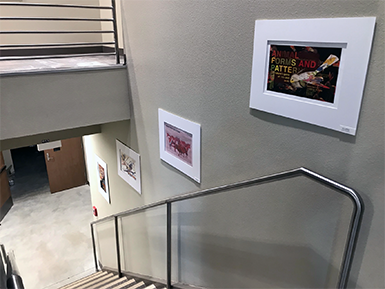
Animal Poster Exhibit (2018)
Very soon I will retire from university teaching. My final semester is nearly over, about four more weeks to go. It's been a pleasurable opportunity for me, as well as for my students, to design a series of posters having to do with the animal sculptures of a North Carolina-based artist named Anne Lemanski. We've blogged about her once before. At her website, you can see lots of examples of her current work. She also makes wonderfully colorful collages based on natural images.

Animal Poster Exhibit (2018)

The students designed about 90 posters. There isn't space to exhibit them all. At the moment, 25 are on display at the interpretive center at the Hartman Reserve Nature Center in Cedar Falls IA, where they'll remain up until the end of December.

On this blogpost are several installation views, showing some (not all) of the posters. Another fifteen are also on exhibit on the second floor of the north wing of the Kamerick Art Building on the campus of the University of Northern Iowa. I'm hoping to post those and others on this blog in the coming weeks.

Animal Poster Exhibit (2018)

Poster by Wren Kress (2018)
Poster by Emily Schroeder (2018)

Saturday, November 3, 2018

Lemanski Animal Posters | Julia Sippola 2018

Poster by Julia Sippola 2018
The animal sculptures featured in these three posters are the work of a North Carolina-based artist named Anne Lemanski. We've blogged about her once before. At her website, you can see lots of examples of her current work. She also makes wonderfully colorful collages based on natural images.

Poster by Julia Sippola 2018


The three posters were designed by Julia Sippola, a graphic design student at the University of Northern Iowa (she is actually from Finland and is studying at our school as a visitor). She designed these in response to a problem in which 30 students (this was their first course in graphic design) designed a series of three posters about Lemanski's animals. Of the resulting 90 posters, 25 of them (including all three of Julia's) are being exhibited at the interpretive building of the Hartman Reserve Nature Center in Cedar Falls IA. The exhibit (curated by Roy Behrens) begins officially on Monday, November 5 and continues through December 31, 2018. It is free and open to the public. We will be sharing more of these on this blog in the days and weeks ahead.

Poster by Julia Sippola 2018


By fortunate coincidence, this poster exhibition will open in the same week (November 7-9) as the annual gathering of the Iowa Association of Naturalists, which means that these works will be viewed by a substantial number of wildlife and conservation advocates. The schedule of events and registration materials are available online.

Artworks shown are copyright © the artist, and the posters are copyright © by their designer. Our thanks to Katie Shelton and Anne Lemanski for enabling this project to happen. It has been entirely enjoyable.

RELATED LINKS    

Dazzle Camouflage: What is it and how did it work? /  Nature, Art, and Camouflage / Art, Women's Rights, and Camouflage /  Embedded Figures, Art, and Camouflage / Art, Gestalt, and Camouflage /  Optical science meets visual art /  Disruption versus dazzle / Chicanery and conspicuousness /  Under the big top at Sims' circus