Showing posts with label kaleidoscope. Show all posts

Tuesday, March 19, 2024

Frederick Pawla / an unknown artist and camoufleur

Pawla, the surname of British-born American artist Frederick Alexander Pawla (1876-1964), rhymes with Paula. Not surprisingly, it is often incorrectly spelled. That is probably one of the reasons why his contributions to ship camouflage during World War I are largely unacknowledged, although they were considerable.

As one source claims, Pawla was a “highly important” ship camoufleur for the US during World War I, but his name is now “largely forgotten.” There are US government documents in which Pawla is credited with having produced the “dazzle camouflage” designs for various ships, but the credit is all but deflected because he is mistakenly listed as Paula, not Pawla. More>>>

RELATED LINKS    

Dazzle Camouflage: What is it and how did it work?

 Nature, Art, and Camouflage

 Art, Women's Rights, and Camouflage

 Embedded Figures, Art, and Camouflage

 Art, Gestalt, and Camouflage

 Optical science meets visual art

 Disruption versus dazzle

 Chicanery and conspicuousness

 Under the big top at Sims' circus

Juan Gris / World War One has been kind to the cubist

Above I have long believed that the truly great practitioner of Cubism was neither Pablo Picasso nor Georges Braque, but rather the all-but-neglected Juan Gris (1887-1927). Above is his remarkable Portrait of Pablo Picasso (oil on canvas, 1912, Art Institute of Chicago). In this painting, the liquidity of the background pretends to threaten the figure, but it always backs off without doing serious damage. Gris must have been prolific because he seems to have produced so much artwork of such heightened quality, and yet he died at forty.

•••

THE CUBISTS’ CHANCE in Ardmore Daily Ardmoreite (Ardmore OK). August 31, 1918, p. 4—

The war has been kind to the cubist artist. He has his day at last. Timid souls who dared neither to scorn nor praise the sylvan views and staircase scenes of the cubist can now burst forth in unstinted praise of these same designs when painted upon gun timbers, freight car doors and ships, to hide them from the enemy.

Camouflage would seem by divine right to be the cubist’s field. As he once successfully disguised the scenes he claimed to depict, he may now conceal the very surface on which he lays his paint. And the entrancing thing is that the layman can appreciate and enjoy the work quite as much as the artist, which he could not do in the glorious days of cubism recently passed.

RELATED LINKS    

Dazzle Camouflage: What is it and how did it work?

 Nature, Art, and Camouflage

 Art, Women's Rights, and Camouflage

 Embedded Figures, Art, and Camouflage

 Art, Gestalt, and Camouflage

 Optical science meets visual art

 Disruption versus dazzle

 Chicanery and conspicuousness

 Under the big top at Sims' circus

Monday, March 4, 2024

camouflaged ship jokingly said to be the work of scabs

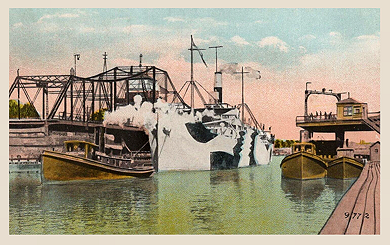
Above This is a wonderfully elegant postcard from World War I. It was presumably published near the war's end or shortly after, c1919. The dazzle-painted American ship is unidentified, but the caption states that it was built in Lorain OH, which is on Lake Erie. Public domain.

•••

CAMOUFLAGE: A Strange Device in The Bega Southern Star (Bega, New South Wales, AU), February 16, 1918, p. 4—

Many people visiting Sydney have no doubt noticed the peculiar manner in which some of the overseas vessels are painted, their appearance much resembling the results of the labors of a one-year-old baby to paint a summer sunset in 12 colors. The entire vessel resembles a kaleidoscope, as if a giant had thrown handfuls of various colored mud on the ship, and they had been darkened the sun, blotches of different color being painted all over the ship. The object of this strange method of painting is to deceive submarines, it being claimed that the ships adopting it are able to considerably lessen their chances of being observed by prowling U-boats. As one of the boats came up the Harbor recently, looking at it sideways on, it appeared like two rocks with a passage of water between them. The vessel has naturally created a good deal of controversy and interest, and has afforded many openings for cartoonists in a well-known Sydney satirical weekly, such as a cartoon showing a unionist and his sweetheart observing such a ship, and the girl inquiring the purpose of what she termed the “funny painting.” “Huh!” grunted the unionist, “that ship was painted by ‘scabs!’ They didn’t know how to mix the colors properly.”

RELATED LINKS    

Dazzle Camouflage: What is it and how did it work?

 Nature, Art, and Camouflage

 Art, Women's Rights, and Camouflage

 Embedded Figures, Art, and Camouflage

 Art, Gestalt, and Camouflage

 Optical science meets visual art

 Disruption versus dazzle

 Chicanery and conspicuousness

 Under the big top at Sims' circus