
Showing posts with label naturalists. Show all posts
Showing posts with label naturalists. Show all posts
Tuesday, April 14, 2026
a timeline of developments in camouflage research


Tuesday, July 25, 2023
now you see ‘em, now you don’t / Alexander Sprunt Jr

•••
Alexander Sprunt Jr, Now You See ‘Em, Now You Don’t. American Legion Monthly, June 1932, pp. 14ff—
During the World War much attention was directed to what was commonly called “camouflage.” Guns, munition dumps, airdromes, roads and ships were decked out in astounding color schemes of broken lines, circles and angles. It was not always the aim to render the camouflaged object inconspicuous, but rather to break up its actual shape and outline as to thoroughly confuse the observer. This was particularly true of marine camouflage. It was not possible to make such a huge vessel as the Leviathan inconspicuous at sea, but it was possible to render it so confusing an object in a combination of angles and tangents that a submarine observer could not be certain of its direction and vital parts. It might appear shorter or longer than it actually way; it might appear to be taking a course varying from the real one followed. At any rate, camouflaged ships so frequently misled the enemy that the firing of a torpedo could very well result in a miss and often did, whereas, without the weird color combinations employed, a hit would have been the case.
RELATED VIDEO SERIES
Dazzle Camouflage: What is it and how did it work?
Art, Women's Rights, and Camouflage
Tuesday, June 20, 2023
patterns in nature as sources of camouflage design
Jean-Philippe Lenclos, as interviewed in Supergraphics: transforming space: graphic design for walls, buildings and spaces. London: Unit Editions, 2010, p. 293—
Crazy Lace Agate (Pixabay)
Q: Your work has alway encompassed strong graphic elements, where does this interest come from?
A: From the start of my studies at the École Boulle, I was fascinated by the graphic elements I found in the urban landscape, such as signs and road markings on the street. The broad stripes used in road markings, for example, are graphical elements that I admired: despite their extreme simplification, I liked their strength of expression. Furthermore, we would go to the aquariums in Paris to draw all sorts of strange fish, which, by their colors and their fabulous “graphism,” made me aware of the extreme freedom of patterns on their bodies. Similarly, the rhythms and forms found on the surfaces of minerals and plants have always inspired artistic creation. | have always observed my surroundings. This brings us also to camouflage used in military hardware. All these observations are at the source of my own research and contribute to a visual mythology that has fed my work.

Bark mimic moth (Pixabay)
Sunday, September 19, 2021
sex on an iowa farm / it is praying mantis party time
 |
| Photograph © Mary Snyder Behrens |
At nearly the same time, the hummingbirds have also been passing through in their usual abundant numbers, each of them fighting off the others for sole possession of an entire feeder, even if there are multiple feeding stations. They are unrelenting as they dive at one another, using their long, thin beaks as if they were fencing swords. Unheard of until this year, we found a dead hummingbird on the porch deck. It appeared to have a broken neck. It was adjacent to a feeding station, and may have crashed into a porch railing as it was being attacked. Holding its body in our hand, we were amazed to find that it was literally "as light as a feather." Regrettably, we didn't think of photographing it, and very soon it (apparently) blew away.
As if those events were not enough, even greater commotion was caused last week when Mary came running in from the garden to say that she had spotted a large female praying mantis. We both rushed out to see it (each year, we encounter at least one on our property, probably as a result of ordering a few egg cases many years ago from a garden supply catalog). But this time, we were even more fortunate. We watched her for a couple of days, as she grazed on grasshoppers. And then, about two days ago, when we went out to visit, we discovered that a male partner had discovered her, and we photographed them in the process of mating (see detail above, and full image below). Viewer discretion advised.
In the photograph at bottom, you may notice that the female is looking toward the camera (mantids have a curious human look because they can turn their heads like humans). She is not easily disturbed by observers, so perhaps she was looking at the tasty grasshopper at the right edge of the photograph. To find her (which is not always easy), we sometimes look for the discarded body parts of grasshoppers.
As we were observing all this, we began to wonder if the male mantid would be eaten by the female after having mated. It is rumored to happen, but apparently only about one in forty times. Or, in some instances, the male may kill the female. In this case, when we went out to observe them again that same afternoon, the party had ended. The male had left the female, and had returned to routine activities at a safe distance. Now, we will be on the lookout for an egg case.
 |
| Photograph © Mary Snyder Behrens 2021 |
Tuesday, April 21, 2020
Thayer painting with a broom | Let there be a rock!
 |
| Abbott H. Thayer, Stevenson Memorial (1903) |
One day, during the progress of his work on the memorial painting to Robert Louis Stevenson, Thayer called me into his studio. “Look at that rock,” he said, indicating the huge rock on which the winged figure sat. “What’s wrong with it?”
With not too much conviction I offered my criticism. “Good!” said Thayer. “Now I’ll go out. You take my brushes and paint the rock the way you think it ought to be. And call me when you’ve finished.” For once a critic had been served exactly right.
So I went to work. And when I had done the best I could, I called Thayer back. Thayer was generous. “Yes,” he said, “I think you’ve helped it.” Suddenly he cried, “Look! We’re both wrong—building it up little by little like that! God said: ‘Let there be a rock!’—and there it was.” And picking up a broom he swept it right and left across the painting. It did the trick. “That’s it,” said Thayer, “that’s it!” And so it stayed.
Tuesday, April 14, 2020
Harrison S. Morris | His memories of Abbott H. Thayer
 |
| Harrison S. Morris |
•••
Harrison S. Morris, Confessions in Art. New York: Sears Publishing, 1930, pp. 142-144—
It was he [Abbott H. Thayer] and George de Forest Brush who, I believe, first thought of camouflage for ships at sea. They had pondered much and experimented much over the scientific problems of light and color, even outside the uses of pigment. They were among those to whom art brings ripened intellect, like Morse and Fulton, inventors who revolutionized the world's methods of contact.
So when we were in the war with Spain, Brush and Thayer disinterestedly went to Washington and offered their services and discoveries to the Secretary of the Navy. Of course, he was skeptical, as official life always is of change. He wanted to know, you know, and all that sort of thing. But while he was deliberating, and telling perhaps why the scheme was no good, one of the painters stuck in the ground a slender stick which he held in his hand, painted after their theory of protective coloration. Then Brush alluded and pointed in the course of conversation to the stick before them. To the Secretary of the Navy, there was no stick in sight. He went on speaking his conventional thought. But quietly and as if accidentally one of the painters turned the slender stick around in its place, so that the sun touched it another way, and, would you believe it, there was the stick which the Secretary could not see.
I rather think nothing came of the offer in the day of the Spanish War. But we know vividly enough what came of it later, and what ships and lives were saved by the wisdom of the two incomparable artists who thus could coordinate their art to the uses of life.
 |
| Thayer holding one of his duck decoys upsidedown |
And another time, so Brush tells me, Thayer was invited to lecture on his theories of color before a Royal Institution of Science in London. He had before him on the platform a table on which was visible a decoy duck of wood such as sportsmen use in gunning. In his address, he alluded much to these ducks before him, and as well before the audience. At last, the patience of one of the English pundits could stand this no longer. He got up in some irritation at the offense to his intellect of speaking of ducks when there was only one duck in view. Would the learned gentleman be pleased to explain why he referred to ducks, thus plural, when there was only one duck in sight? He sat down well satisfied with exposing an American impostor who didn't know how to use the English language.
Thayer then gave a quick twist to a wooden duck, made invisible by his coloring, and the second bird was exposed in all its solidity. So was the English skeptic.
Saturday, April 11, 2020
Randolph Bourne, Abbott Thayer, and pandemic flu
 |
| Randolph Bourne |
In my lifetime, I have either known personally or have heard the stories about children who were orphaned when their parents died in that pandemic. Two of those children, for example, were the writer Mary McCarthy (author of The Group and Memories of a Catholic Girlhood) and her brother Kevin McCarthy, who became a Hollywood actor.
Another prominent person who died in that pandemic was a radical American writer and intellectual named Randolph Bourne (1886-1918). Bourne was well-known for his provocative essays about societal reform. But, in advance of that, he himself was socially conspicuous because of his physical deformity, part of which occurred at birth. During his delivery, forceps were used improperly and the umbilical cord was wrapped around his left ear, leaving that ear jutting out and that side of his profile distorted. Tragically, four years later, he was struck by tuberculosis of the spine, which stunted his growth, leaving him hunchbacked and dwarfish for life.
Despite such disabilities, Bourne went on to study at Columbia University, where he earned both undergraduate and graduate degrees, and where he was greatly influenced by philosopher John Dewey. He then spent time in Europe but returned in 1914 just as World War I began. In the remaining few years of his life, he was a contributing writer to various progressive magazines, including The New Republic and The Seven Arts.
At some point, perhaps in the summer of 1915, he asked a friend if she knew of “any attractive place in New England where one might go with the expectation of meeting somebody interesting?” She suggested Dublin NH, and arranged for a cabin in which he could stay. Once there, Bourne reported that he’d found “people of quick roving intelligence who carry their learning lightly,” and even better, those “who use their learning as fuel to warm them into sympathy with all sorts and conditions of men.” Among those he befriended were the families of Abbott Handerson Thayer (the “father of camouflage,” George de Forest Brush, and Raphael Pumpelly (whose daughters were the models for some of Thayer’s finest paintings).
 |
| Dublin NH (1906) |
He also met Amy Lowell, who often spent summers in Dublin. According to Van Wyck Brooks (in Fenollosa and His Circle, With Other Essays in Biography), when Bourne dined at Lowell’s home, she “walked up to him as one of the oldest of friends and they had a truly grand gossip. She was surprisingly fair-minded and a lover of all sorts of queer and little people whom she touched off inimitably…” But she later had a change of mind, and, after a subsequent meeting, she told a friend that Bourne was a “weakling” whose physical deformity was evident in his “twisted mentality and tortured [writing] style.” “Everything he writes,” she said, “shows he is a cripple.”
Bourne was especially drawn to Abbott Thayer, whom he described as “a winsome and Emersonian old person.” About the artist’s family, he described how they live “in the woods, in a romantic warren of studios and big low rough rooms, with great fireplaces, and windows that frame delicious pictures of pine trees and mountain and sunset. [The Thayer family, he wrote] are all such charming, simple wistful, unworldly people, with whom you can sit silently before the fire and know you understand them.”
As reported by Brooks, during the summer that Bourne lived in Dublin, Thayer was (inevitably) preoccupied with Concealing Coloration in the Animal Kingdom, the book that he and his son Gerald H. Thayer had first produced in 1909 (it would later be reissued in 1919) “on protective coloration, which was so useful in the war, and he showed Randolph and [his friend] Fergus his color diagrams and demonstrations and told a great many stories.” The US had not yet entered the war, but Thayer was determined to share his wartime proposals on camouflage with the British.
Music was central to the Thayers’ daily life, and on one summer evening, Abbott brought out from storage an antique German piano (probably the one that had been shipped in the "piano box" that we described in an earlier posting) and combining that with a violin, the family and their guests enjoyed singing lieder songs by Schubert for an hour. As Bourne himself later described it:
Mr. Thayer’s appreciation was almost embarrassingly ecstatic, and he proferred sketches and dinners and thanks if we would come two or three times a week and do it again. I liked his simple emotional ways and his telling us we had “watered his soul.” He took us down to the road with the quaintest of lanterns and spoke constantly of the music.
Still, Thayer’s focus on camouflage, and his efforts to convince the world of the rightness of his theories was always at the forefront. As Bourne wrote to one of his friends—
Mr. Thayer’s head was so full of piebald warships and the conversion of college presidents to protective coloration that he couldn’t any longer let his emotional nature be stirred by our Schubert and Bach.
For whatever reason, the Thayer friendship did not last. While Bourne considered the option of buying a house in Dublin, and becoming a permanent resident there, Thayer stopped short of suggesting even another summer visit. Bourne’s visits, recalled Van Wyck Brooks, “were too exciting for Abbott Thayer, and, as Randolph said, ‘I talk too much.’”
Nevertheless, some distant contact still remained, and—
…when Mr. Thayer’s daughter Gladys came to New York, Rudolph offered to find a studio for her. She had just marched in a suffrage parade in Boston, led by what she called "a hag-like lady in regal dress of brocade, riding on a black steed just in front of us…Seeing the prim red-nosed antis with their unbearably smug and pampered demeanor I felt once and for all which was the great and human side and the lines of progress.”
In December 1918, Bourne fell victim to the flu epidemic and died that month. He was only thirty-two. He was buried in Bloomfield NJ (his birthplace) on—
a dreary day with a cold rain falling. The Abbott Thayers came to the funeral with others of his older friends; and Norman Thomas,* at the time a clergyman, conducted the service. Lewis Mumford wrote, a little later, "Randolph Bourne was precious to us because of what he was rather than because of what he had actually written."
•••
* One of the most memorable events of my life took place on May 17, 1967, when (as a student) I attended a talk by American Socialist Norman Thomas in the Auditorium at the University of Northern Iowa (then the State College of Iowa). What a courageous man and a powerful speaker. He was 83 when he spoke, and would die at the close of the following year.
Sunday, April 5, 2020
Theatrical special effects | Thayer's disappearing man
 |
| Abbott H. Thayer holding one of his duck decoys (upsidedown) |
A Harvard graduate, MacKaye traveled and lived in Europe from 1897 to 1900, then returned to the US to teach at a private school in New York. In 1904, he moved to Cornish NH (ten miles from Plainfield), where he was allied with the Cornish Art Colony, which included such prominent artists as Augustus Saint-Gaudens, Maxfield Parrish, Daniel Chester French, Paul Manship, George de Forest Brush, and Barry Faulkner.
Sixty-five miles southeast of Cornish is Dublin NH, at the foot of Mount Monadnock. At the time, there was considerable contact between the artists in Cornish and Dublin, in part because the latter was the location of the disheveled home and studio of artist-naturalist Abbott Handerson Thayer (the so-called “father of camouflage”). Faulkner was Thayer’s cousin, Brush was his closest friend, and some of the artists mentioned above were his long-time associates.
Only lately have I learned that Thayer and Percy MacKaye were also acquainted, possibly well-acquainted, and, in 1906, they made an attempt to collaborate on the “special effects” for the staging of Edward H. Sothern and Julia Marlowe’s 1907 production of MacKaye’s play about Joan of Arc, titled Jeanne d’Arc. The playscript was dedicated to Augustus Saint-Gaudens.
In the script, Jeanne d’Arc reveals that she has been visited by St Michael the Archangel. In a couple of scenes, “the glorified form of St Michael” appears as an apparition, then disappears. At a certain point, the ghostly form of Charles the Great (aka Charlemagne) appears within a stained glass surface, then speaks with the voice of St Michael. Obviously, anyone producing the play would need to decide how to handle these ethereal appearances (and vanishing acts) of Jeanne's visions of St Michael.
As early as the mid-1890s, Abbott Thayer had been researching, writing about, and devising demonstrations of a natural form of camouflage called countershading (essentially inverse shading). He claimed that it accounted for the prevalence of “white undersides” in the coloration of animals.
 |
| Thayer's disappearing duck (as recreated by Fuertes) |
Using wooden duck decoys, as seen in the photographs above (or even raw sweet potatoes), he could make solid forms all but vanish in a natural ground surrounding. (In these two photographs, made by Thayer's student, Louis Agassiz Fuertes, a white sheet of paper has been placed behind the duck decoys to make the counter-shaded one visible, on the right.) Scientific audiences were astonished by his outdoor demonstrations of this. He published articles about countershading in scientific journals, and it led to his being invited to European universities to demonstrate and to install exhibitions of the same phenomenon.
Thayer was inept at managing money. But when his discovery of countershading (sometimes known as Thayer’s law) was received so laudably, he began to imagine practical ways by which he and his family could profit. One of his options had to do with theatrical stage effects. Instead of vanishing duck decoys, could countershading be applied to an actor’s skin-toned leotards, and then, by a simple switch of the lights, might the actor disappear?
We know that Thayer actually carried this out because two photographs of the effect have survived (as reproduced below). They are before-and-after photographs of a male artist’s model (a Boston man named Dutton) wearing counter-shaded tights, in the setting of a lighted box. In one, the light is coming from the bottom (contrary to natural lighting), in which case the figure is easily seen. In the other photograph, the light is coming from the top, and the model all but disappears.
 |
| Thayer's vanishing actor in counter-shaded leotards |
In 1906, as Percy MacKaye was preparing for the premiere of Jeanne d’Arc, he may have reached out to Thayer—more likely Thayer appealed to him—about the possibility of using on-stage countershading as a way to bring about the appearance and disappearance of St Michael. We know this in part because MacKaye described it in Percy MacKaye: A Sketch of His Life with Bibliography of His Works (Cambridge MA: Harvard University, 1922). Here is the passage—
Midwinter, in the little town hall of Dublin NH: a man-model against a dusky curtain: Abbott Thayer, the artist-inventor, intent, excited, testing (in 1906!) his new “camouflage” principles to create a stained-glass vision of Charlemagne for the Sothern-Marlowe production of my play Jeanne d’Arc.
But did their collaborative efforts succeed? The answer is no: In the end, their project came to naught. There are letters from Thayer to MacKaye in the Archives of American Art that record his frantic if genuine efforts to locate appropriate lanterns and to photograph the model in tights. On March 26, 1906, he sent photographs to MacKaye (perhaps the same two reproduced here), saying: “When Dutton got his suit on again, and took his place, the effect was almost as perfect as ever, quite enough without a single retouch (but the lantern’s the thing!)” A full month later, on April 26, he assured MacKaye that he has made “progress, but only that,” and is awaiting a shipment of new and better lanterns, which, he hopefully asserts, “will make a true total invisibility.”
There is apparently more to the story, but the details remain rather murky. In the files of the Archives of American Art, there is another letter to MacKaye (dated May 25), written by Emma Thayer, on behalf of Abbott, her husband. She reveals that Thayer is overwhelmed, and instead—
he has got that gifted young man [his student] Rockwell Kent (whom Abbott wanted before and could not) to do the thing. Abbott has had him up here, and Abbott says he will do it superbly. But to make sure Abbott is having him do the only complicated thing, the St Michael, first and if he has any difficulty he is to telegraph Abbott, and Abbott will go down.
Rockwell Kent is swiftness itself—and having more endurance can do the thing quicker than Abbott, and is masterly and precise in the way he does everything.
Despite such good intentions, Thayer and Kent were not able to provide a final prototype for the Sothern and Marlowe production. “Unable to get [it] together in time,” according to Thayer’s biographer, Nelson C. White, the collaborative experiment concluded “in complete failure.”
Soon after, Thayer came to realize the futility of making a fortune by inventing practical things. As he wrote to his patron, Charles L. Freer (as quoted by White)—
My failure to make my cursed invention suit itself to Sothern’s immediate needs was the eye-opener I need. I had gone on thinking the Thayer family must have the thousands I was to scoop so easily so as to set me free to work. My eyes opened for good and all and although the thing got into such perfected shape that it seems both to me and my patent lawyer destined for success, nothing will divert another thought from my own work [as an artist], which envelops me like the arms of a beloved again…
…P.P.S. The theatre invention is all ready for someone to take up, patent applied for and covered already in four foreign lands. If the right man looms up within a year or two he shall have it. Otherwise, it can go to hell. I am safe cured!
•••
Updates
The above was posted only three days ago, but I've just found two updates, including one that's especially surprising: (1) From a news article about a talk that Gerald H. Thayer gave in 1921 in Lowell MA (Lowell Sun, January 20) it appears that he showed the lantern slides of the model who vanished in his leotards. In the article, the space in which the man is posed is described as a "piano box" (a box for shipping pianos), set up in the Dublin NH town hall. (2) Today, I found out that the autobiography of psychologist Michael Wertheimer, the son of Gestalt psychologist Max Wertheimer, has been published in Europe. I couldn't resist buying a digital copy, as expensive as it was. When I paged through it, I was completely aghast to discover that Michael's first wife's grandfather (her mother's father) was—you guessed it—Percy MacKaye. See photo below—I do love these hidden links.
 |
| Percy MacKaye |
RELATED LINKS
Dazzle Camouflage: What is it and how did it work? / Nature, Art, and Camouflage / Art, Women's Rights, and Camouflage / Embedded Figures, Art, and Camouflage / Art, Gestalt, and Camouflage / Optical science meets visual art / Disruption versus dazzle / Chicanery and conspicuousness / Under the big top at Sims' circus

SALE book bundle / free shipping
Saturday, March 28, 2020
Only spurious resemblance—or is it natural mimicry


It is widely claimed, for example, that monarch butterflies are unpalatable to birds, which learn to avoid them. As a consequence, there are other monarch look-alikes, non-toxic and otherwise harmless, that are also avoided by birds. American artist Abbott Handerson Thayer, who collaborated with his artist-naturalist son, Gerald Thayer, in 1909 on a major book about animal coloration, was doubtful of Batesian mimicry. Although the concept is mentioned more than thirty times in the Thayers’ 260-page opus, their references differ considerably from the meaning that Bates had intended. Thayer’s skepticism about the link between unpalatability and mimicry was sufficient that he took a trip to the West Indies, where various mimics of monarchs are found. “He actually tasted them,” recalled his daughter Gladys, who traveled with him, “and could find no difference in the flavor.”
In the case of the lantern fly or peanut bug, it is thought to make use of mimetic resemblance in two ways: One is that, if startled, it responds by unfurling its bottom wings, revealing large, conspicuous eyespots or ocelli (as seen in the top illustration), and emitting a “foul-smelling substance.” The other, less convincing way in which it may benefit from mimicry is found in the puzzling shape of its snout (as shown in the photograph above), which certainly looks like a peanut, but which some scientists also claim might easily be mistaken for the head of a snake, a lizard, or even an alligator.
Examples like these inevitably bring up the question of which instances of “mimicry” are not mimicry at all, but are merely the result of projections on the part of the viewer, such as occurs in our sightings of Rohrschach ink-blots, images in the clouds, or pictures of Christ on tortillas. Arthur Koestler spoke of this in The Act of Creation (pp. 375-376)—
Pliny recounted the anecdote of an artist who tried in vain to paint the foam at a dog’s mouth until, in exasperation, he threw a spongeful of paint at the canvas—and there was the foam. The story reappears in Leonardo’s Treatise on Paintings—where he makes “our Botticelli” say that if you just throw a sponge at a wall, it will “leave a blot where one sees a fine landscape.”
Tuesday, March 24, 2020
Robert Baden-Powell's camouflaged spy diagrams

If anyone recalls the name of Lieutenant-General Sir Robert Baden-Powell, most likely it's because he was the founder of the Boy Scouts (and co-founder of the Girl Scouts). But he also worked as a spy for the British Secret Intelligence Service, as described and illustrated in his book My Adventures as a Spy (London: C. Arthur Pearson, 1915). No longer under copyright, it is available online to download as a pdf.
In one instance, he pretended to be a lepidopterist in what was then Dalmatia (now Croatia). Walking along with a net and sketchbook, he positioned himself on hills overlooking strategic fortresses and appeared to make drawings of butterflies, one of which is shown above. In truth, within those drawings, he was concealing cryptic diagrams (camouflaged or embedded figures) of the structures and their armaments.
He recommended such activities. Indeed, as he states in his book, "…for anyone who's tired of life, the thrilling life of a spy should be the very finest recuperator!"
RELATED LINKS
Dazzle Camouflage: What is it and how did it work? / Nature, Art, and Camouflage / Art, Women's Rights, and Camouflage / Embedded Figures, Art, and Camouflage / Art, Gestalt, and Camouflage / Optical science meets visual art / Disruption versus dazzle / Chicanery and conspicuousness / Under the big top at Sims' circus
Friday, September 27, 2019
Rockwell Kent | ship camouflage cover reconstructed
 |
| Rockwell Kent (1918), magazine cover (restored) |
I had seen all three before, but the one of particular interest to me was the cover of the December 1918 issue of Everybody’s Magazine. Near the lower-right corner is the artist’s printed signature “Kent.” The cover artist was Rockwell Kent (1882-1971), the well-known American artist, illustrator, and author (see his edition of Melville’s Moby Dick, and his illustrated autobiography, It’s Me, O Lord).
I first saw his camouflage-themed magazine cover (as I recall) in the late 1990s, when an art historian named Jake Wien (who has written about Kent and others) shared a small-size, low-resolution photograph of a copy he had found. It appeared to be in poor shape, with major surface damage and tattered edges. I later found that its color was substantially different from the one that Schiller reproduced. The color cast of Wien’s copy (as shown below, on left) is emphatically green, while the one in Schiller’s post (below, right) was blue. The other colors are consistent, which may suggest that the printing ink used for the background was fugitive and that one of the copies had been altered by years of exposure to light. If so, the question remains: Was the original background blue or green? Given the well-worn condition of the one that Jake Wien shared, I would guess the original color was blue.
 |
| Rockwell Kent magazine cover (two copies, same issue) |
Whatever it must be a very rare item. It is possible that no other copies have survived. Over the years, I’ve looked for the issue repeatedly on online vintage magazine sites, in searchable archives, and in library holdings. Probably one of the reasons for its scarcity is that university libraries (maybe most of them) tended to discard the covers of magazine issues before they were bound as a volume. So, in the library that I mostly use, the inside pages of Everybody’s Magazine are intact, but the covers of all of the issues are gone. Fortunately, I recently found a black-and-white scan of the cover and was able to use that as a point of departure in an attempt to digitally reconstruct the full-color cover (as shown above). I chose to use blue as the background. Note that the title in the masthead is restored from the original, but the issue date and price (and Kent's signature) have been replaced with a new, if appropriate, typeface.
That Rockwell Kent would have created an illustration of ship camouflage is of particular interest because (as I’ve discussed in earlier posts), he had been a student of Abbott Handerson Thayer, and a close friend of Thayer’s son, artist and naturalist Gerald Handerson Thayer, both of whom are credited with important early findings about protective coloration in nature. In 1909, the Thayers co-produced (with Gerald as the author of record) a major book on the subject, titled Concealing Coloration in the Animal Kingdom. It had an abundance of illustrations, including collaborative paintings by a handful of Thayers’ family members, students, and friends, one of whom was Rockwell Kent.
Saturday, May 4, 2019
Explaining Camouflage to Welsh Cub Scouts in 1919
 |
| Poster © Roy R. Behrens 2019 |
•••
Milford Haven Cub [Scout] Notes in Haverfordwest and Milford Haven Telegraph (Wales), July 9, 1919—
A Talk about Camouflage
I suppose a good number of you Cubs have heard the word “Camouflage”? These big words puzzle some of the older folk sometimes, and when they see a word which they do not understand, they go and look for a book called a “dictionary” which explains the meaning.
Deceiving the Enemy
When the word “camouflage” was first brought to the public notice, people wondered what it meant.
We people who live near the coast soon found out what “camouflage” meant. At first we saw most peculiar painted ships, and as you looked at them, you could imagine they represented all kinds of wild animals. To look at them in the distance, they did not look like ships, and really it was puzzling, and when we turned to our neighbor and said, “look at that funny ship,” they said she is “camouflaged.”
Now I wonder if you Cubs understand why those ships were painted in this way? Why was the ship “camouflaged”?
It was to deceive the enemy.
Nature’s Camouflage
You little Cubs have little gardens at school, you learn to grow all kinds of flowers and things. When your flowers grow and bear nice green leaves, sometimes you wonder why they don’t grow much nicer, the petals of the flowers are all eaten away, and scarcely a green leaf on them. Now, if you look very, very closely and very, very hard, you will find tiny little flies, slugs, and insects creeping round the flowers.
Do you know why it is you never can see those little pests? If is because nature has “camouflaged” them to protect them from their enemy. Nature has made them the same color as the plants they live upon or at least a similar color, and they are in this peculiar color to deceive the enemy.
 |
| Poster © Roy R. Behrens 2019 |
Friday, December 14, 2018
Anne Lemanski Animal Posters Now Available Online
 |
| Online Selection of Posters |
Sunday, November 25, 2018
Hartman Poster Exhibit about Anne Lemanski's Art
 |
| Poster by Sabrina Wiebold (2018) |
Here are a few more examples of various posters that were made by graphic design students at the University of Northern Iowa. They celebrate the animal-themed artwork of Anne Lemanski, an artist from North Carolina.
 |
| Poster by Amelia Duax (2018) |
Twenty-five of the posters are currently on exhibit at the interpretive center at the Hartman Reserve Nature Center in Cedar Falls IA, where they'll remain up until the end of December.
 |
| Poster by Aimee Luksan (2018) |
 |
| Poster by Hayden Klemme (2018) |
Saturday, November 17, 2018
Hartman Poster Exhibit about Anne Lemanski's Art
 |
| Animal Poster Exhibit (2018) |
 |
| Animal Poster Exhibit (2018) |
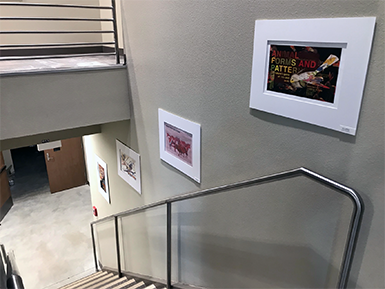
The students designed about 90 posters. There isn't space to exhibit them all. At the moment, 25 are on display at the interpretive center at the Hartman Reserve Nature Center in Cedar Falls IA, where they'll remain up until the end of December.
On this blogpost are several installation views, showing some (not all) of the posters. Another fifteen are also on exhibit on the second floor of the north wing of the Kamerick Art Building on the campus of the University of Northern Iowa. I'm hoping to post those and others on this blog in the coming weeks.
 |
| Animal Poster Exhibit (2018) |
 |
| Poster by Wren Kress (2018) |
 |
| Poster by Emily Schroeder (2018) |
Saturday, November 3, 2018
Lemanski Animal Posters | Julia Sippola 2018
 |
| Poster by Julia Sippola 2018 |
 |
| Poster by Julia Sippola 2018 |
The three posters were designed by Julia Sippola, a graphic design student at the University of Northern Iowa (she is actually from Finland and is studying at our school as a visitor). She designed these in response to a problem in which 30 students (this was their first course in graphic design) designed a series of three posters about Lemanski's animals. Of the resulting 90 posters, 25 of them (including all three of Julia's) are being exhibited at the interpretive building of the Hartman Reserve Nature Center in Cedar Falls IA. The exhibit (curated by Roy Behrens) begins officially on Monday, November 5 and continues through December 31, 2018. It is free and open to the public. We will be sharing more of these on this blog in the days and weeks ahead.
 |
| Poster by Julia Sippola 2018 |
By fortunate coincidence, this poster exhibition will open in the same week (November 7-9) as the annual gathering of the Iowa Association of Naturalists,
which means that these works will be viewed by a substantial number of
wildlife and conservation advocates. The schedule of events and
registration materials are available online.
Artworks shown are copyright © the
artist, and the posters are copyright © by their designer. Our thanks
to Katie Shelton and Anne Lemanski for enabling this project to happen.
It has been entirely enjoyable.
RELATED LINKS
Dazzle Camouflage: What is it and how did it work? / Nature, Art, and Camouflage / Art, Women's Rights, and Camouflage / Embedded Figures, Art, and Camouflage / Art, Gestalt, and Camouflage / Optical science meets visual art / Disruption versus dazzle / Chicanery and conspicuousness / Under the big top at Sims' circus
Lemanski Animal Posters | Hartman Nature Center
 |
| Poster by Erica Scherer (2018) |
The poster itself was designed by Erica Scherer, a graphic design student at the University of Northern Iowa. She designed it as part of a problem in which each of 30 students (this was their first course in graphic design) designed three different posters about Lemanski's animals. Of the resulting 90 posters, 25 of them are being exhibited at the interpretive building of the Hartman Reserve Nature Center in Cedar Falls IA. The exhibit (curated by Roy Behrens) begins officially on Monday, November 5 and continues through December 31, 2018. It is free and open to the public.
Below is a second poster, designed by Kailie Hesner, that resulted from the same class project. We will be sharing more of these in the days and weeks ahead.
 |
| Poster by Kailie Hesner (2018) |
By fortunate coincidence, the exhibition will open in the same week (November 7-9) as the annual gathering of the Iowa Association of Naturalists, which means that these works will be viewed by a substantial number of wildlife and conservation advocates. The schedule of events and registration materials are available online.
Artworks shown are copyright © the artist, and the posters are copyright © by their designers. Our thanks to Katie Shelton and Anne Lemanski for enabling this project to happen. It has been enjoyable.
Subscribe to:
Posts (Atom)