Showing posts with label hidden figure. Show all posts

Thursday, December 8, 2022

is crime not to be depended upon / who can we trust?

Above A pictorial advertisement for a Victorian-era British illusionist, T[homas] Elder Hearn.

•••

Alas! This is An Age of Ingenious Camouflage, in Salina Journal (Salina KS), January 17, 1920—

New York—This is an age of camouflage. Yes; of course the word has been overworked. Maybe it isn't used any more in our best journalistic circles. But it's an age of camouflage just the same. Now take the case of John Smith of the East end, up for examination in a case of assault and battery. He did not deny that Emil Emilson hired him to beat up Joe Lansky or that he got $5 from Emil for beating up Joe. But he strongly denied that he did beat up Joe. Finally they got the truth out of John, who thus explained the seeming inconsistencies of his statement:

“When a fellow is hired to do up another guy he goes and tells him about it. Then they get together and they stick court plaster all over the guy's face and tie a bandage around his head with a little beef blood showing through and put his arm in a sling. The guy who wants him done up looks him over and thinks he got his money's worth.”

Now this is art, but is it honest? Is crime not to be depended upon to be what it seems? We know that our leather chairs are not made of hide, but of old rubber boots and condensed milk. We know that chicken salad is frequently made of veal. We understand that our sealskin coats are made from the fur of the muskrat and that our linen is cotton. Knowing, nobody cares. But it had been supposed that crime was above substitution. Here we have a detailed description of camouflage assault.

When thugs become too ingenious to kick in the ribs of the persons they are paid to assault and resort to camouflage to make the patron think he is getting something just as good, whither are we drifting? 

Wednesday, November 23, 2022

hidden horse / caw said crows are calling his name

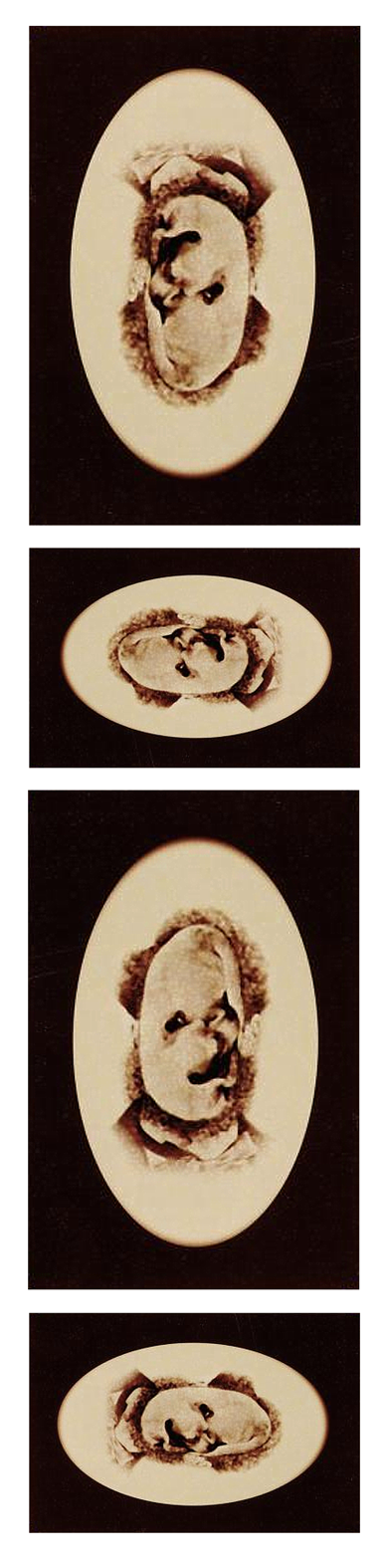
We have all heard of a cowbird, and a horsefly. But might this image qualify as a froghorse, because a closer look reveals that there is indeed a hidden horse in this vintage picture puzzle. Can you find it?

vintage picture puzzle / harmless sleeping puppy dog

Reproduced above (the same image four times, but repositioned and resized) is a Victorian-era “puzzle picture” that was printed on an advertising card in Liverpool UK in the 1870s. The caption read “What is it?” 

Beginning at the top, the first two images are somewhat suggestive (not unlike an inkblot) but require some work to interpret. The third one is more likely to be seen as a human face, albeit greatly distorted. 

But the puzzle is solved at the bottom, when a closer look reveals that all four have resulted from a single photograph of a harmless sleeping puppy dog. For more on embedded figures and picture puzzles, see this brief video, articles on Clemens Gretter, Gobolinks, and camouflage.

Tuesday, September 27, 2022

upsidedown reversible embedded and hidden figures

Above A reversible upsidedown drawing with embedded figures, in which George Washington is hidden in the space between his wife and himself. Artist, date and source unknown.

•••

Robertson Davies in New York Times Book Review, May 12, 1991—

About sixty years ago, I said to my father, “Old Mr. Senex is showing his age; he sometimes talks quite stupidly.” My father replied, “That isn’t age. He’s always been stupid. He’s just losing his ability to conceal it.”

Related Links

Embedded Figures, Art and Camouflage

Revisiting Gottschaldt: Embedded Figures in Art, Architecture and Design

Friday, September 9, 2022

an upright clown but a circus when turned clockwise

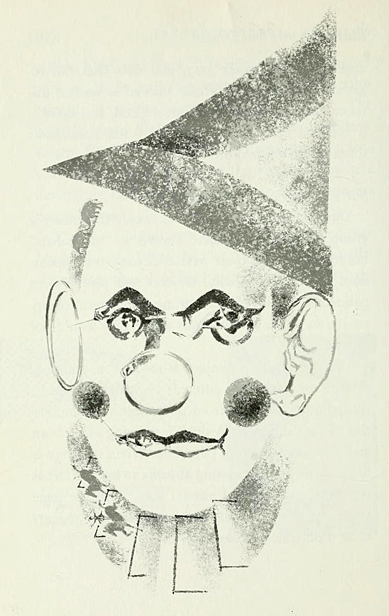
Above Viewed upright, it is a portrait of a clown. Rotate one turn clockwise, and it becomes a circus scene. Ambiguity. Double image. Puzzle picture. Hidden figure. For more on embedded figures and camouflage, go here. Artist unknown, from Larry Kettelkamp, Tricks of Eye and Mind: The Story of Optical Illusions, 1974.

Wednesday, March 16, 2022

a yankee doodle dante—we crave your condescension

camouflaged figures

Louis Untermeyer, Bygones: The Recollections of Louis Untermeyer. New York: Harcourt Brace and World, 1965. Excerpts from various pages as noted—

[Untermeyer’s father] was a trouble-evader and a peacemaker; it was easy to take advantage of him, which everyone did, especially his children. He was not a talker; he relied on the stereotypes of conversation, and even there he fell into malapropisms. Something cheap was not worth “a hell of beans” and a pitiful occurrence was “heartrendering.” He was never sure whether the first line of his favorite Harrigan and Hart [musical comedy writing team] song was “We crave your kind attention” or “We crave your condescension” (p. 7).

Influenced by the sprightly British journalist-essayist-novelist-poet G.K. Chesterton, I was much given to a style that employed epigrammatic checks and balances, appositions, paradoxes, and puns. I remember dismissing a rather commonplace collection of Gaelic poetry as “A Child’s Garden of Erse” and characterizing the author of an abortive American epic as “A Yankee Doodle Dante.” I referred to a Dowson-Beardsley pastiche as being “less erotic than Pierrotic.” I inquired, since much of the Restoration comedy took place in elegant country houses, was it not a comedy of manors? (p. 44).

It is as a poet that I most resent those resentful of puns, for the pun is, per se, a poetic device. Poetry is essentially a form of play, a play of metaphor, a play of rhyme. The pun is another form of syllabic playfulness, a matching of sounds that, like rhyme, are similar yet not quite the same—a matchng and shifting of vowels and consonants, an adroit assonance sometimes derided as jackassonance. Whatever form it takes, searching or silly, the pun springs spontaneously from the same combination of wit and imagination which speeds the poetic impulse (p. 45).

T.S. Eliot and I have our similarities and our differences,” he [poet Robert Frost] wrote to me, “We are both poets and we both like to play. That’s the similarity. The difference in this: I like to play euchre; he likes to play Eurcharist” (p. 46).

When an interviewer, pointing to a world constantly at war, asked [G.K.] Chesterton whether Christianity had failed, Chesterton replied, “No, it has not failed. Christianity has not yet been tried” (p. 72). 

•••

NOTE  Embedded figures are discussed in this posted short video.

Sunday, October 10, 2021

cut-out silhouettes of skunks / embedded figures

Cut-out silhouettes of skunks
Above In a recently posted video on Embedded Figures, Art, and Camouflage (2021) I demonstrate the use of cut-out silhouettes by American artist and naturalist Abbott H. Thayer, who worked in collaboration with his son, Gerald H. Thayer, in the study of protective coloration in nature. 

[During World War I] Thayer objected to the use of field service uniforms of plain, one-color fabric. He thought it was better to break it up, to counter the shading from overhead light, and to generally make it confusing.

At some point, he announced that he had come up with a simple method by which any soldier, in any setting, could determine his own best camouflage pattern. This too made use of cut-out silhouettes. All a soldier needed to do, Thayer proposed, is to cut out a silhouette of his own figure (or the generic shape of a man), and to study the colors and patterns that appeared in the hole of the figure when observed in his surroundings. He had already explored this photographically to recreate the patterns of, for example, birds and skunks [as shown above]
more>>>

• Nature, Art, and Camouflage (35 min. video talk) at <https://www.youtube.com/watch?v=ZLX5YQF-H3k>
• Art, Women’s Rights, and Camouflage (29 min. video talk) <https://www.youtube.com/watch?v=hiSWNYCNRcM>
• Embedded Figures, Art, and Camouflage (26 min. video talk) <https://www.youtube.com/watch?v=3asynn24nD4>
• Art, Gestalt, and Camouflage (28 min. video talk) <https://www.youtube.com/watch?v=nS2ZwYyxy1Y>

Thursday, September 30, 2021

Poet William Carlos Williams meets Gerald H. Thayer

Above Gerald H. Thayer, Male ruffed grouse in the forest (1907-08). Watercolor on paper. 19.75 inches high x 20 inches wide. First published as an illustration in his book, Concealing coloration in the animal kingdom, New York: Macmillan, 1909. Plate II, 38 (public domain). The original painting is in the Metropolitan Museum of Art.

Roy R. Behrens, “Khaki to khaki (dust to dust): the ubiquity of camouflage in human experience” in Ann Elias, Ross Hartley and Nicholas Tsoutas, eds., Camouflage Cultures: Beyond the art of disappearance. AU: Sydney University Press, 2015—

The grouse [in Thayer’s painting] is completely motionless (a common means of defence among animals) for the same reason that the Ames distorted room [one of the Ames Demonstrations in psychology] works best from a rigid, “frozen” one-eyed view. Motion is a great spoiler of camouflage, and if the grouse moves even a muscle, it will be quickly given away.…

•••

Halter Peter, The revolution in the visual arts and the poetry of William Carlos Williams. Cambridge University Press, 1994, pp. 125-126—

[From an analysis of a William Carlos Williams poem]…the last lines [of the poem]—“a / partridge / from dry leaves”—contain a reference to the painting Male Ruffed Grouse in the Forest by Gerald H. Thayer…Thayer’s watercolor of a partridge merging with dry leaves and winter trees behind it is related to the Audubon tradition of accurate and loving observation of the American fauna which Wlliams so highly valued…

Moreover, Thayer’s painting is a kind of picture puzzle: Based on the systematic exploration of mimicry in animals, it depicts a partridge that is indeed difficult tell “from dry leaves.’…Williams may well have singled out Thayer’s painting as a work of art that, not unlike his own poem, explores ambiguty and foregrounds the problem of figure and ground. Both painting and poem are about what has to be “figured out”; both contain, in other words, the hide-and-seek dimension that asks for the viewer’s or reader’s active participation.

VIDEO LINKS

Nature, Art, and Camouflage  

Art, Women's Rights, and Camouflage

 Embedded Figures, Art, and Camouflage

 Art, Gestalt, and Camouflage

Saturday, September 25, 2021

two boys beneath a coat become a circus elephant

Above Page with text for children from Clarence F. Carroll and Sarah C. Brooks, The Brooks Primer. New York: Appleton, 1906. Public domain.

•••

John Lewis, Heath Robinson: artist and comic genius. New York: Harper and Row, 1973, p. 192—

The repeated use of the camouflage theme in [William] Heath Robinson's Second World War cartoons may have had something to do with the fact that his eldest son Oliver was a Camouflage officer in the British Army. 

•••

VIDEO LINKS

Nature, Art, and Camouflage  

Art, Women's Rights, and Camouflage

 Embedded Figures, Art, and Camouflage

 Art, Gestalt, and Camouflage

Friday, September 24, 2021

Monday, August 30, 2021

video / a dazzle advertisement of a dazzling discovery

Above A damaged, 19th century Swiss photograph of a small child in a white hat (just left of center) seated on her father's lap, with her mother standing at the right. Circumstances are such that, at first glance, some viewers interpret the child's face as the eye of a profile of Christ, facing left. 

Like the man in the moon, or a face in the clouds, this is an example of seeing apparently meaningful forms in random or accidental formations, called pareidolia. Unless of course (as might well be), the photograph has been altered, to increase the likelihood of seeing the figure. 

As I discuss in a new online 25-minute video talk, titled Art, Embedded Figures, and Camouflage, there is a long tradition of the purposeful insertion of embedded figures (or, as they are sometimes called, camouflaged figures), in picture puzzles and works of art. Here's a brief excerpt from the video narration, followed by the two advertising diagrams that it describes—

Not surprisingly, embedded figures have also been used in advertising. During World War I, for example, at the height of the public’s interest in dazzle-painted ship camouflage, this unidentified diagram was published in a British magazine, repeatedly—on the same page, in the same location—for several weeks. It simply read: A dazzle advertisement of a dazzling discovery. That was all that anyone knew. 

And then, suddenly, in the last week of the ad campaign, an “embedded figure” solution appeared, also on the same page, same place. Camouflage has its uses, it said, but Firth’s Stainless Steel needs no protective covering.