Showing posts with label tank. Show all posts

Wednesday, August 27, 2025

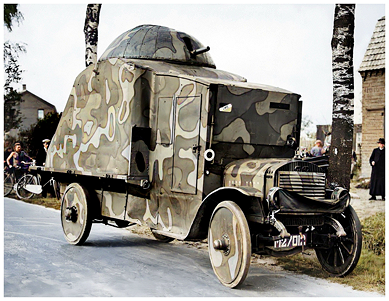
camouflaged armored car devised in Massachusetts

Capt Renwick with camouflaged armored car (1917)
FORMER BAY STATE OFFICER OFFERS US ARMY NEW TYPE OF ARMORED CAR: Invention of Capt William G. Renwick Given Tryout by Officers of Northeastern Department in The Boston Globe, September 2, 1917—

The Department of the Northeast has been offered for inspection and adoption an armored car designed by and manufactured under the inspection of a New England officer, Captain William G. Renwick, formerly of the 8th Massachusetts Regiment.…

A striking feature of the car as it stood on the avenue this morning was the fact that it is painted in “camouflage,” which at a distance renders it practically invisible. Those who did not understand this fact, expressed their opinion that the car “looked as if it had been through hard service and he ought to paint it over again.” The car is covered with a mixture of gray, green and pink coloring irregularly placed and is not as attractive as it is efficient. Entrance to the car is at the top though a manhole in the protective covering. The occupants are completely hidden from sight, with only openings in the armor for the machine guns.…” 

RELATED LINKS

Dazzle Camouflage: What is it and how did it work? /  Nature, Art, and Camouflage / Art, Women's Rights, and Camouflage /  Embedded Figures, Art, and Camouflage / Art, Gestalt, and Camouflage /  Optical science meets visual art /  Disruption versus dazzle / Chicanery and conspicuousness /  Under the big top at Sims' circus

Saturday, August 2, 2025

WWII camoufleur as much use as fridge at North Pole

Above WWI camouflaged-painted tank-like vehicle with rotating turret gun.

•••

Hugh B. Cott, “Camouflage” in The Advancement of Science. Vol 4 No 16, January 1948, pp 308-309—

[At the beginning of World War II] the possible methods, scope and usefulness of camouflage were by no means generally appreciated. Perhaps you will allow me to give a single example. When early in 1941 I took up my first service appointment, the Brigadier to whom I reported for duty welcomed me with these words—he said: “A camouflage officer is as much use to me as a refrigerator at the North Pole.” It happened that we were no where near the North Pole, but in tropical Africa, where a refrigerator would have been a very useful piece of equipment. However, I was not unduly discouraged by this somewhat chilly reception.

RELATED LINKS

Dazzle Camouflage: What is it and how did it work? /  Nature, Art, and Camouflage / Art, Women's Rights, and Camouflage /  Embedded Figures, Art, and Camouflage / Art, Gestalt, and Camouflage /  Optical science meets visual art /  Disruption versus dazzle / Chicanery and conspicuousness /  Under the big top at Sims' circus

Sale-priced books on camouflage / free shipping

Sunday, February 23, 2025

construction of a WWI dummy tank by british in france

Above Dummy tank being constructed in France by British forces, 1916.

•••

SWANSEA'S TANK in The Cambria Daily Leader (Wales), October 23, 1919, p. 8—

Somebody at the War Office is evidently deeply concerned that towns' war savings presentation tanks shall be properly maintained and prevented from deterioration into rust and desuetude. Swansea's unattended and unapproachable. because of the trivial paling round it, evidently would not please him, to judge from the following note from the W.O. Publicity Department on tank presentation:—"Each city and town so honored should arrange for proper care and attention to be bestowed upon its charge, so as to keep it always a proud and fitting memorial to an arm of the Service which did so much to save the lives of many thousands of citizen soldiers. The tank should rest upon a firm concrete foundation of ample area, so that on wet days visitors may not carry mud into the interior. The exterior of the hull and the roof should be well cleaned and thoroughly painted at regular intervals, and the wonderful 'dazzle' and 'Futurist camouflage effects may be used with advantage. But if camouflage is not possible, a good serviceable brown color may be used without departing from realism, as, indeed, many tanks went into action plainly painted and with no attempt at cunning disguise. The tracks or road chains should be very thoroughly treated, else they will soon show signs of rust and decay and, as it is not practicable to keep them bright, they should be painted a color as near the natural steel as possible. A tank crew dearly loved to have all the inside of the machine white in color, and it is doubtful if their choice can be improved upon, with a dull black for the engine. For the rest, brass work and steel rods should be kept bright and. clean, and this duty could well be included in the daily routine of an employee of the local council. In wet weather, and at night, the roof of the machine should be covered with a tarpaulin." All this, emanating evidently from a man who knows his tank well, contrasts strangely with talk of using the presentation for scrap iron. It is a counsel of perfection, of course, but Swansea ought to get some useful tips from it.

RELATED LINKS    

Dazzle Camouflage: What is it and how did it work? /  Nature, Art, and Camouflage / Art, Women's Rights, and Camouflage /  Embedded Figures, Art, and Camouflage / Art, Gestalt, and Camouflage /  Optical science meets visual art /  Disruption versus dazzle / Chicanery and conspicuousness /  Under the big top at Sims' circus

tacoma builds phony tank for WWI liberty loan parade

Above WWI American dummy tank in Liberty Loan parade, 1918

•••

CITY TANK IN LOAN PARADE in Tacoma Times (Tacoma WA) April 06, 1918, p. 8—

One of the novel features of Saturday’s Liberty parade was a miniature “tank” furnished by the city streets department. The tank was built from a new caterpillar tractor just purchased by the city. Although the caterpillar tread of the city machine does not go over the top of the body, as it does in the battle tanks, the machine was camouflaged by scenic artists so that it bore a startling resemblance to the new war terrors. It was armed with a half dozen fierce-looking guns. Commissioner Atkins announced that he would guide the city tank through the streets.

RELATED LINKS    

Dazzle Camouflage: What is it and how did it work? /  Nature, Art, and Camouflage / Art, Women's Rights, and Camouflage /  Embedded Figures, Art, and Camouflage / Art, Gestalt, and Camouflage /  Optical science meets visual art /  Disruption versus dazzle / Chicanery and conspicuousness /  Under the big top at Sims' circus

Sunday, December 17, 2023

Diary of British camouflage artist Solomon J. Solomon

Solomon tank camouflage scheme
There is an article from the Boston Sunday Post, dated December 24, 1922 (p. B3), titled WAR ‘CAMOUFLAGE ARTIST’ COMPLETES PORTRAIT OF BRITISH ROYAL FAMILY. It tells the story of the delayed completion of a painting of  the Coronation Luncheon at Guildhall, an event that had taken place in 1911. Its culmination was put off by World War I. The artist assigned to complete it was Solomon J. Solomon, who is described in the article as “the most famous portrait painter in Europe today.”

When the war began, Solomon assumed that it would not greatly interfere with his artistic career, but it “interrupted him absolutely” because the government soon discovered [by way of his own prompting] that he was the one man in England familiar with the art of camouflage.” He was sent to France, to learn about that country’s section de camouflage, which was under the command of Lucien-Victor Guirand de Scevola. For a time, Solomon was the head of British Army camouflage, during which he oversaw the construction of imitation dead tree observation posts, advocated the use of overhead garnished nets (the shadows of which broke up the shapes of things below), aka "umbrella camouflage," and proposed designs for tank camouflage.

Solomon was the author of one of the first books on wartime deception, titled Strategic Camouflage (London: John Murray, 1920). Earlier, he had also published The Practice of Oil Painting and Drawing (London: Seeley, 1910).

Until recently, I had not realized that there is another book about him which contains extensive excerpts from his wartime diaries. That source is Olga Somech Phillips, Solomon J. Solomon: A Memoir of Peace and War (London: Herbert Joseph, 1933). Quoted below are a few passages (pertaining to camouflage mostly) from Solomon’s diary.

[p. 127] The French observation post trees were round; I made mine oval, so that that part of them facing the Germans should appear too small for a man to ascend; this was later adopted by the French.…

It was proposed in my report that I should need the assistance of three painters. I had made up my mind about these—two scene painters about whom I would consult Mr. Joseph Harker—and a theatrical property maker…

Harker had recommended to me Oliver Bernard—a small man, very deaf, who staged the operas at Covent Garden—a good organizer. He, on his return from New York, was on the Lusitania when she was torpedoed. He was rescued from the sea. He couldn’t swim a stroke and attributed his luck to a mascot he always wore, and which—in his opinion—would safeguard him throughout the war.

[p. 134] B—— spoke of his admiration for Giron[sic] de Scevola, the head of the French camouflage, who had, after much difficulty from the French Army people, to accept the idea of camouflage…

Scevola would only accept the rank of lieutenant, but stipulated that no one should be above him. He was—and is—a fashionable Parisian portrait painter, dressed very smartly, and invariably wore white kid gloves…

[p. 143] Who says the painter can’t organize? This seemed to be a military prejudice. When an artist is composing an imaginative picture his organizing faculties are at full stretch.

[p. 149] 11th March—…Major Alexander wanted some dummy heads—these dummies were made to attract fire, so that German snipers could be located—the line of fire would be indicated by putting a small stick through the back and front holes made by the sniper’s bullet.

Hitherto, adopting the French plan, we had mounted these heads on round sticks, and Major Alexander told me that often these would tend to turn in the hand, so that the exact direction was lost. In future I mounted the heads on square sticks fitted with a square sheath with cross feet; ths could be kept firmly in place. I had modeled several heads from our men who sat for them and I became quite a decent sculptor. The clay model was cast in plaster from which moulds were taken, and the pressing of successive sheets of paper saturated with flour paste into the moulds produced a sort of Guy Fawkes mask. We turned out quite large numbers of these papier mache “Tommies” which I colored from life.

…the Secretary of the French Camouflage Corps, asked me to model him, which I did, he wanted to send a paper mache reproduction of himself to his wife at Bordeaux. This added to our stock of types.


[p. 155] Wednesday, 22nd March—Giron[sic] de Scevola invited us all to dine with him at our little hotel at Wimereux, and an excellent meal it was for so small an inn. The Frenchmen sang and made witty speeches and kept it up till quite late. I was looking forward to returning the compliment when next de Scevola came our way, but that was not to be. We artists got on well with our French confreres.

Thursday, February 2, 2023

cubism and camouflage / oscillation of appearances

Above Simay Imre, Subscribe to the Liberty Loan (World War I French poster), 1918. University of Illinois Archives, Public Domain.

•••

Wylie Sypher, Rococo to Cubism in Art and Literature. New York: Vintage Books, 1960—

To prove that art and life intersect, that thought enters things, that appearance and reality collide, or coincide, at the points we call objects, the cubist relied on certain technical devices: a breaking of contours, the passage, so that a form merges with the space about it or with other forms; planes or tones that bleed into other planes and tones; outlines that coincide with other outlines, then suddenly reappear in new relations; surfaces that simultaneously recede and advance in relation to other surfaces; parts of objects shifted away, displaced, or changed in tone until forms disappear behind themselves. This deliberate “oscillation of appearances” gives cubist art its high “iridescence” [p. 270].

It has been said that the great cubist achievement was camouflage [p. 299].

RELATED LINKS

 Cubism and Camouflage

Cook: The Man Who Taught Gertrude Stein to Drive

Art, Design and Gestalt Theory: The Film Version

Monday, November 14, 2022

a modern bus like noah's ark with 12 pygmies inside

Tudor Hart's WWI tank camouflage
Above A couple of years ago, we blogged about the World War I camouflage innovations of a Canadian artist named Percyval Tudor Hart (1873-1954). It was a detailed, fairly lengthy blog, and may merit being revisited here. He proposed a style of camouflage in whch he covered the surfaces of a ship, tank and sniper's cloves with multi-colored, high-density zigzags. I actually saw the camouflaged gloves many years ago in an exhibition in Ontario. Above is an AI-colorized photograph of his tank camouflage proposal.

•••

Ilya Ehrenburg, People and Life: memoirs of 1891-1917. London: MacGibbon and Kee, 1961, p. 184—

Here is how in 1916, I described the first tank I had seen: “There is about it something majestic and nauseating. It may be that once there existed a breed of gigantic insects; the tank is like them. It has been brightly decorated for camouflage; the flanks resemble the paintings of the Futurists. It creeps along slowly, like a caterpillar; trenches, bushes, barbed wire, nothing can stop it. Its feelers twitch: they are guns and machine guns. In it, the archaic is combined with the ultra-American, Noah’s Ark with a twenty-first century bus. Inside there are men, twelve pygmies, who innocently believe that they are the tank’s masters.”

Sunday, September 18, 2022

disruptive tank camouflage and amazing landscapes

WWI French tank camouflage
Edgar Ansel Mowrer, FRENCH ‘INCHING’ FORWARD, Alternatives Before Hitler in Argus (Melbourne, Victoria, Australia), October 11, 1939, p. 8—

I am looking through a gun barrel in the turret of an almost subterranean fort on the Maginot Line. It is one of the most amazing landscapes in the world…

The whole section is camouflaged like an autumn landscape—France put their camouflage in the hands of painters like Picasso and de Segonzac, and what they do not know about color values is not worth knowing.

Tuesday, December 26, 2017

Camouflaged War Relic Train in Burlington, Iowa

Above Lloyd Harrison. WWI-era poster, c1917. Courtesy Library of Congress Prints and Photographs.

•••

BIG GUN HAD SOME KICK. War Relic Train With Whippet and Camouflage Disguise in Burlington. The Burlington Gazette (Burlington IA), April 22, 1919, p. 6—

…A war relic train consisting of three flat cars and a baggage car disguised in blue, white and yellow camouflage arrived in Burlington yesterdayat 5 o'clock. The train also carried two coaches for the soldiers who guarded the trophies.

The flat cars were loaded with war relics of all kinds and descriptions. A partially destroyed French fighting plane, minus the wings, an unexploded areo bomb, a twelve-inch cannon and several smaller fire arms were on one car. The other two flat cars were loaded with two camouflaged German Whiz-bang cannons which were captured by the Yankees before the close of the war, machine guns and other fighting periphernalia, used by the Huns.

A small but effective Whippet tank very artistically disguised in blue and yellow paint was also an attraction to the crowd of about fifty people who gathered at the Union station to see the relics….


Above World War I camouflaged French tank. Courtesy Library of Congress Prints and Photographs. Hypothetical color scheme added.