Showing posts with label Abbott H. Thayer. Show all posts

Wednesday, March 4, 2026

warships resemble chameleons / are nearly invisible

available online
Anon, CHAMELEON WARSHIPS. Question of Color. The Worker (Brisbane, Queensland, Australia), June 8, 1916, p. 15—

Persons who have been watching the results of attempts to disguise the outward appearance of warships have become convinced (says the Coast Seaman's Journal) that the destroyer fleet, lately the subject of the ship painter's efforts, has become practically invisible at sea, not only to the naked eye, but to strong binoculars as well. "Battleship gray" has had its day. It was better than the glaring ultra-prominent white that once made the American Navy the marksman's favorite target, but it was far from the last word in invisibility, for it has recently been proved that:

A solid color of any kind can be distinguished at sea, whereas a mottled surface, like the surrounding water itself, breaking up into lights and shades, will make almost any bulk invisible at a distance proportionate to size. Abbott H. Thayer, an Englishman [sic], who studied the colorations of wild animals, and particularly water-fowl, noting at what distance their color enabled them to become invisible to the naked eye and under glass, and who is said to have taught Theodore Roosevelt much that he knows on the subject of invisible animals, is largely responsible for the Navy's taking up the problem. Thayer conducted a series of experiments in the Navy Department a year ago and demonstrated that under certain conditions the model of a torpedo-boat painted by him could not be seen while a similar vessel painted battle-gray was plainly visible.


At Newport the destroyers have been painted in numerous ways to test their visibility. Some of them have been painted like checker-boards, in alternate squares of black and white, but the most elusive combination discovered to date consists of horizontal, irregular, serpentine lines of black paint along the sides of the destroyers with a background of battle-gray. The serpentine curves correspond substantially to the waves of the sea, and the mixed colors conform in part to the mottled surface of the water. The funnels, on the other hand, are painted in irregular spirals, and it is said the destroyers painted in this way are more nearly invisible close at hand than at a greater distance.


As soon as the problem is solved to the satisfaction of the naval authorities a scheme for painting the battleships will be worked out for use in time of war. It is already reported in this country that the British Navy has ships painted in all sorts of colors on patrol duty in and around the North Sea, and that the plan has worked with great success. Thayer evolved a plan of covering up funnels and fighting tops with a series of planes intended to reflect the color of the sky, but the plan has not been found entirely practicable, for the reason that the roll of the ship destroyed the reflection intended and at times made the vessels more prominent to the eye than before, and also because the winds frequently made their use impossible altogether.

Another experiment being conducted by the Navy is one intended to make periscopes invisible. While they are practically so now, the wake they leave behind them can always be detected because it runs in a straight line of foam.

Tuesday, March 3, 2026

sausage works / playing wartime havoc with the eye

Above
A rendering by J. André Smith (American camoufleur and war artist) of an installment of tents in which half have been broken up with disruptive patterns, while half still need completion, as described in the article below. In that article, the two wooden ducks (flannel covered) described as being on display in a London museum were demonstrations of countershading, made by American artist Abbott Handerson Thayer, and given to the museum after he had spoken there.

•••

Roger Pocock, The Art of Concealment: Devices on Land and Sea. The Mercury (Hobart, Tasmania) January 3, 1918, p. 6—

On the permanent staff of the Natural History Museum in London there are two little wooden ducks. They are dressed in gray flannel, and each housed in a glass case, with a grey flannel background. No. 1 duck is dressed in plain gray flannel and you can see her plainly at a hundred yards, because of the dark shadow cast by her neck and body, as well as by the brightness of her back. No. 2 duck to slightly whitened underneath to counteract the shadows, and slightly bronzed on top to counteract the light. Even at six feet the showcase appears to be empty. There is not a sign of duck. No hawk, no fox, no sportsman with a scatter-gun and a small dog could possibly discover or kill the invisible duck unless she moved, or made foolish quacks to guide her enemies. A great many years ago I wrote to the Lords of the Admiralty, imploring them to go and see the invisible duck, who could teach them priceless lessons in the art of concealing battleships and cruisers. They promised faithfully, so l have no doubt they called and left their card.

Am I giving away a secret, or letting cats out of bags? From all I hear the British navy of today can show the invisible duck that she in a mere beginner in the art of camouflage. In the current number of Punch you may see a tramp steamer impersonating a German sausage works. That's a joke, but the British fleet delights in playing practical jokes on the Germans. You may have noticed, for example, that the U-boat campaign is not a complete success, and that the British Lion does not as yet sit up to beg for mercy.

If you would study camouflage by land go look at the wild animals. See how the tawny lion and striped tiger are painted to resemble the tall yellow bunch grass at the jungle. The giraffe is painted with a quaint diamond-pattern exactly like the flickering lights among the acacias trees on which he feeds. The leopard, the jaguar, and all spotted cats, the spotted deer, and the dappled horse are painted to imitate the dappled light under a shady tree. The pig is patched pink and brown like the sunlight, and shadow of the denser woods, The elephant is painted a hazy brown, exactly like the great trees at the deepest forest. So all the wild beasts are colored for concealment in their natural landscape, while many of them change their clothes with the seasons. wearing white for the snowy winters, brown for the torrid summer. In exactly the same way our British armies are clothed in tawny dun for the tropics, and in khaki—a Hindu word for dung color—for warfare in temperate regions.

The khaki blends exactly with the cranes and timbers of North Western Europe. As for the German field-grey, it is a capital imitation of the shadows cast by woods or entrenchments on a sunny day, and blends very nicely either with rain or fog. The horizon blue of the French armies tones well into average landscape. All are useful colors. In the early part of the war the British made one mistake. The service cap was kept taut and smart with a wire hoop inside the rim of its flat top. So stretched, the cloth reflected sunlight, and presented a fine target for enemy marksmen, until we found out what was wrong. Then we moved the wire, and the cap was no longer a target. When, during air raids, our men get the order "to stand fast," the army is almost altogether invisible at 2,500 feet.

In the old days our bell tents made excellent targets for heavy artillery, being visible at a distance of many miles. Now all of them are painted with a special sort of distemper, and the bolder the patches, the stronger the colors, the better. Strong painting breaks the contours of any sheet, and so not only tents, but guns, timbers, wagon covers and huts are made to look just like the patched and broken ground of camps and roadways. Beyond such elementary trifles in camouflage the writer may not go with discretion. But the thing is certainly a wonderful and complete art today.

At the present time Fritz [the German military] is surely puzzled, he even, when we let his airplane observers enjoy a peep at our lines, the things that they see are not really there at all, while the guns, which they can neither see nor photograph, are playing havoc with the fond ambitions of the super-man.

One must own that Fritz is artful himself, but the British army, like the navy, has many a merry jest at the expense of the bewildered enemy.


•••

Friday, December 12, 2025

countershading and disruption in artillery camouflage

The three photographs in this blog post were originally published in black and white in Scientific American during World War I. 

As posted here, they have been restored and AI colorized. They are excellent examples of attempts to camouflage artillery by applying countershading (as proposed by American artist Abbott H. Thayer) and by breaking up the cannon's shape by applying high contrast disruptive patterns, such as stripes. 


It is interesting to look at these in comparison to a series of five hand-drawn illustrations (as shown below) by WWII British army camoufleur and eminent zoologist, Hugh B. Cott, in Adaptive Coloration in Animals, which we have blogged about before.


Sunday, November 2, 2025

a fascinating visit to the home of Aldo Leopold in Iowa

Leopold home in Burlington IA

For ten years I lived in Wisconsin. It was during that time that I became aware of the writings of the American conservationist Aldo Leopold, who was for years on the faculty at the University of Wisconsin at Madison. I have always thought of him in connection to Wisconsin, no doubt in part because of his famous book, A Sand County Almanac (1949). 

It was only in recent years that I realized that he was born and raised in Iowa. His family's tandem Victorian homes in Burlington are beautifully maintained by the Leopold Landscape Alliance, which works to promote his ideas.

Mary and I were in Burlington because I was invited to speak about animal camouflage. The talk went well, and was more than a little enriched by stories and observations from an alert and lively audience. We were especially pleased to meet Steve and Kathy Brower, who have been instrumental in sharing Leopold's beliefs about ecology, wildlife conservation, and environmental ethics. Their work is reassuring at a time when so many good efforts are threatened.

Among the various efforts initiated by the Leopold Landscape Legacy is a PowerPoint program called Aldo Leopold and the Roots of the Land Ethic, which is available for classes and conservation groups. But they also offer a program (funded by the Kenneth J. Branch Memorial College Fund) in which free resident field trips are available to classes ("all types of classes are welcome"), including such components as tours of the houses and grounds, field trips of Leopold's favorite nature locations, a screening of the award-winning film Greenfire, book discussions, and so on. 

Anyone interested in learning more about these educational opportunities should contact Steve Brower at the Leopold Landscape Alliance at brower406[at]aol[dot]com. It all sounds fascinating. I don't doubt for a minute that your experience will be as pleasurable as ours.

RELATED LINKS 

Dazzle Camouflage: What is it and how did it work? /  Nature, Art, and Camouflage / Art, Women's Rights, and Camouflage /  Embedded Figures, Art, and Camouflage / Art, Gestalt, and Camouflage /  Optical science meets visual art /  Disruption versus dazzle / Chicanery and conspicuousness /  Under the big top at Sims' circus

Sunday, September 21, 2025

Gerald Handerson Thayer / an enigmatic life unsolved

Gerald Handerson Thayer
The American painter and ornithologist Gerald Handerson Thayer (see portrait photograph above) remains a mystery. 

Over the years, I've written quite a lot about his collaborative work with his father, Abbott Handerson Thayer, who is sometimes also known as "the father of camouflage." The father blinds us to the son. Below are portions from a news article, reporting on a public talk that Gerald presented in Rochester NY two years before his father died. He is a great unknown. At some point he needs to be written about.

•••

CAMOUFLAGE AND PROTECTIVE COLORATION: Man Who Shares with Father Credit for Discovery, Gives Interesting Lecture at Memorial Gallery in The Post Express (Rochester NY), March 17, 1919—

A lecture on “Camouflage and Protective Coloration” was delivered yesterday afternoon by Gerald H[anderson] Thayer at the Memorial Art Gallery. Dr. [Benjamin] Rush Rhees introduced the speaker as “the illustrious son of an illustrious father, to both of whom belongs the credit for the discovery of the principles of camouflage and protective coloration.”

Excerpts from Thayer’s [slide illustrated] presentation are as follows—

Just how much of the camouflage used in the war is the result of the work of my father, Abbott [Handerson] Thayer, and myself is not certain. We did not have any influence on the dazzle system eventually used at sea, which was planned to deceive the man at the periscope, so much as on the early marine system or the method employed on land.

•••

Our book published before the war [Concealing Coloration in the Animal Kingdom, 1909] was used in England, France and Germany. At first everything was fantastically camouflaged, and not very effectively, but later the only method used was to prop up on poles nets of cord or wire to which were fastened bits of colored burlap. This was made in great quantities in factories behind the lines, and at the front was used to cover guns, earthworks, anything that was to be concealed from airplane cameras. Sticks and dirt from the vincinity would then be thrown on top, and whenever possible the result was tested by asking a friendly plane to take a picture of it.

•••

Darwin’s father was the first to notice that protective coloration was a wild animal trait. My father and I found that there were certain well defined principles. The figure of a pure white duck stands out conspiciously against a pure white backgound. The shadows about the figure give it away. The same figure, with a gray back but with a light underneath is invisible against a gray background. The under parts must be lighter in color to offset the shadow. That is the first principle, called “countershading.” It is very common in North America.

The second is “concealment.” Strangely enough the gourgeous plumage of tropical birds is the best example of this. They are hard to find in their brilliant surroundings.

The third principle is that of “disguise,” when an animal pretends to be what it is not or not to be what it is. The pattern of the coat is like the surroundings. A zebra, for instance, is practically invisible standing against the sky in reeds or a clump of bushes. The woodcock is another only it is like the ground on which it builds its nest. Disguise is found all the way from butterflies to skunks.

Many animals combine two of these principles in their coloration.

RELATED LINKS

Dazzle Camouflage: What is it and how did it work?Nature, Art, and Camouflage / Art, Women's Rights, and CamouflageEmbedded Figures, Art, and Camouflage / Art, Gestalt, and Camouflage /  Optical science meets visual artDisruption versus dazzle / Chicanery and conspicuousness /  Under the big top at Sims' circus

Wednesday, April 9, 2025

Homer St. Gaudens as drawn by Gordon Stevenson

Above Cover of TIME magazine (May 12, 1924), featuring a portrait of Homer St. Gaudens (son of the celebrated sculptor Augustus St. Gaudens), who was in charge of US Army camouflage during both World Wars. It is of additional interest that this pencil-drawn portrait of St Gaudens was made by artist Gordon Stevenson, who served as a ship camoufleur with the US Navy during WWI.

•••

War diary of John Lee McElroy, 1st Lieut. 315th Field Artillery, 155th Brigade. Camden, N.J: Haddon Press, c1929, p. 8—

This afternoon I had fallen asleep while studying a map. My head had sunk down on my arms on the table, and I was aroused by someone shaking me by the shoulder. He was a very good looking Major, and said I evidently had not been to sleep for some time. I admitted it. Said he wanted to inspect my camouflage, as he was camouflage officer for the sector. His name is Homer St. Gaudens

RELATED LINKS    

Dazzle Camouflage: What is it and how did it work?Nature, Art, and Camouflage / Art, Women's Rights, and CamouflageEmbedded Figures, Art, and Camouflage / Art, Gestalt, and Camouflage /  Optical science meets visual artDisruption versus dazzle / Chicanery and conspicuousness /  Under the big top at Sims' circus

Wednesday, July 31, 2024

Edoardo Dotto / on camouflage & mimicry as duplicity

online link
Recently I became acquainted with the writings of a professor of architecture, named Edoardo Dotto, at the University of Catania in Italy. I am especially drawn to his articles because they are cross-disciplinary. While his essays may originate with architecture and drawing, he reaches out in deliberate ways to adjacent concerns, such as art and vision, pictorial representation, camouflage, humor, and so on. 

I am particularly interested in two of his conference papers, both of which can be accessed online in English. They are “Drawing Hands: The themes of representation in Steinberg and Escher’s Images” (2017); and “Lying to the eye: the mimicry between art and science” (2022), which pertains to art and camouflage

edoardo dotto 


Friday, September 8, 2023

Joakim Derlow camouflage exhibition in Stockholm

Derlow Exhibition (Stockholm)
Joakim Derlow describes himself as an “artist from Sweden with outposts in Amsterdam and Stockholm.” I think he first contacted me very early this year, because of his great interest in camouflage and especially (myself as well) in art and camouflage compared. Since then we have batted emails back and forth, along with images, research references and quotes. During most of the year, he has been preparing for an exhibition on the subject, as well as a publication in which he collects and assesses a medley of historical finds.

I have just last evening received from him an email with photographs of his on-going exhibition. Two of them are included here. They show the installed exhibition in Stockholm. As he states in his message, and as is clearly evident in the photographs—

Central in the space is a camouflage net made together with Ukrainian refugees living in Poland. The net manifests the artistic quality of camouflage in the art space before it is sent to the frontlines by the end of the exhibition. An object that passes between the decorative and the utilitarian depending on what side of the border it finds itself. Other works are uniforms mounted on stretcher frames to once again become paintings like the artists that made these camouflage patterns in the first place.

If you browse around the visible space in the photographs, you can see quite a few art and camouflage icons. Among my favorites is the elongated black rectangular panel on the wall, very nearly ceiling height. It is a cut-out silhouette of a bird (no doubt a pheasant), like those that Abbott H. Thayer proposed (another bird flies over the top).

Also, among my favorite features is the wall-mounted moulding on the right wall, from which book-like clusters of pages are hung from wooden pegs. I applaud the otherall color scheme. But this moulding with things suspended from pegs reminds me of comparable racks on which the Shakers hung their chairs, to suspend them while they swept the floor.

It is so encouraging to see that Joakim has succeeded in bringing all this together. You may be able to follow his work at <https://derlow.net/>. It’s my understanding that he plans to take this further, to an even more ambitious stage, and perhaps it will become a book.

By wonderful coincidence, last evening, as I was reading Joakim’s email, my wife Mary came in from the garden to tell me that while she was picking beans, she touched what was not a bean but a beautiful praying mantis—same size, shape and color, of course. Now, this morning, she has taken me out to the garden, and we have been able to find the praying mantis again—it is still hanging about in the beans.

Derlow Exhibition (Stockholm)


Sunday, October 30, 2022

Abbott Thayer and Concealing Coloration / Dublin NH

Above Abbott Handerson Thayer, Charcoal drawing for ship camouflage experiment, c1915. From Abbott Handerson Thayer Family Collection

•••

Excerpted from L.W. Leonard and J.L. Seward, The History of Dublin NH. Published by the Town of Dublin, 1920, pp. 684-686—

Throughout the world the word “camouflage” has become familiar during the war. Although this word is of French origin, the thing itself is primarily an American creation, the work neither of warriors nor army experts, but of a distinguished artist, a well-known Dublin resident, Abbott H. Thayer, who has permanently lived here for more than twenty-five years.

In 1896, an essay by Mr. Thayer on “The Law Which Underlies Protective Coloration,” was published in The Auk, and shortly afterwards reprinted in the Year Book of the  Smithsonian Institution. In 1909, the Macmillans published Concealing-coloration in the Animal Kingdom, written by Abbott H. Thayer’s son, Gerald H. Thayer, and illustrated by father and son.

Protective coloration, as set forth in this book, was one of the main starting points of camouflage, and to a considerable extent has guided its development. Assurance of these facts were given Mr. Thayer in England and Scotland in the winter of 1915-16, when he went abroad to tender the Allies’ more direct help in this matter.

Professor [Sir William Abbott] Herdman of the University of Liverpool, suggested that the naturalists of Great Britain ought to sign a joint statement to the effect that they believed Mr. Thayer’s unique knowledge of protective coloration could be made of the greatest use to the War Department. It proved, however, that, owing to the efforts of several other British scientists, notably Professor J. Graham Kerr of Cambridge and the University of Glasgow, who had even urged that the government create a special bureau for the adoption of Thayer’s discoveries, “concealing coloration” was already doing war service of various kinds, both on land and sea.
 
Camouflage has carried the principles of visual deception to hitherto undreamed-of lengths of application, and to manifold and divergent new developments.

But the latest military camouflage was mainly a matter of masking batteries and guns for airplane detection. Standardized materials, wire netting, colored shreds of burlap, etc., manufactured in vast quantities behind the lines were the main dependence for this roofing-over and screening of guns. The latest marine camouflage, again, sought not concealment of ships, but effects of distortion of outline and perspective which would puzzle the U-boat observers looking through the periscope, as to the vessel’s speed, distance, exact form, and especially her course, or direction of movement.
 
Professor E. B. Poulton, F. R. S., etc., President of the Linnean Society of London, the distinguished English evolutionist, writes as follows:

“During the sixty years which have elapsed since the historic day [of the reading before the Linnean Society of Darwin’s and Wallace’s joint essay on Natural Selection], English-speaking workers—among the foremost the American artist-naturalist, Abbott H. Thayer, and his son Gerald H. Thayer—have studied this principle [protective coloration], continually extending it by the discovery of fresh applications, and analysing it into a whole group of cooperating principles; but inspite of all these naturalists have done, it required the Great War and a misused French word in order to arrest the attention of their fellow-countrymen…

We may, however, forgive the inccurate use of a new word which the war has bought into our language because of the attention which has now been focused upon a most interesting subject—attention which rightly demands a new and widely accessible edition of this work [Thayers’ Concealing Coloration]. Here are clearly explained and illustrated the principles underlying the art of camouflage, practiced by nature from time immemorial but in some of its main lines only made known to man by the discoveries of Abbott H. Thayer.”

Saturday, October 29, 2022

Thayer's camouflage of William James' Norfolk jacket

Above A comparison of two photographs, the one on the far left identified as Abbott H. Thayer, attired in a Norfolk hunting jacket that had previously been owned by philosopher William James. When James, a friend of Thayer, died, the jacket was given to Thayer by James' two sons, Aleck and Billy, both of whom were artists and had studied with Thayer. 

Later, early in World War I, Thayer used that same jacket as a way to demonstrate how fabric scraps (rags) and his wife's discarded stockings might be attached to its surface, to break the continuity of the figure. By superimposing the one photograph on top of the other, I am trying to "prove" that the person in the photograph in the center and on the right (unidentified when published) is in fact Abbott Thayer himself, with a painted face, wearing that Norfolk jacket.

•••

Be warned that the story below is full of inaccuracies. Thayer submitted a ship camouflage proposal (based on countershading) to the US Government during the Spanish-American War (not WWI), but asked for too much money. I have never seen any indication that he was asked, during WWI, “to guide a Navy program.” He did attempt (ineptly) to persuade the British to adopt disruptively patterned infantry uniforms—but his prototype was literally made (as shown above) partly of rags and worn-out womens' hose.

•••

Ernest Henderson, The World of “Mr. Sheraton.” New York: Popular Library, 1962, p. 83—

When World War I was raging, deceptive markings to disguise merchant ships falling prey to German torpedoes became a matter of national necessity. To meet this grave emergency, Dublin’s [NH] great naturalist [artist Abbott H. Thayer] was offered an impressive financial inducement to guide a Navy program for confusing the enemy with camouflage. Despite a threatening spector of poverty, Thayer flatly declined. It would mean a military role, and this his conscience would not then permit.

Subsequently, as the fever of war increased, realizing that human lives were involved, Thayer offered the British a new type of uniform designed to render soldiers partially invisible. This the British promptly rejected, concluding, no doubt, that fitting their men with unbecoming rags could injure national morale even more than could a mere reduction in the deadliness of approaching German bullets.

Abbott Handerson Thayer / the master at his very best

Abbott H. Thayer (c1915)
Above Abbott Handerson Thayer, Study of Alma Wollerman, oil on canvas, c1915. From Abbott Handerson Thayer Family Collection. Thayer made a number of paintings of Alma Wollerman Thayer (his daughter-in-law as of 1911, wife of Gerald H. Thayer), but surely this must be the finest. This is the elder Thayer at his best.

•••

Ernest Henderson, The World of “Mr. Sheraton.” New York: Popular Library, 1962, pp. 82-83—

Another Dublin [NH] resident was the artist and naturalist Abbott H. Thayer, considered by many the discoverer of protective coloration. While still in my teens, I saw a demonstration of his skill. He had produced a piece of stone carved to resemble a duck. Painted to match the roadway, the object had a dark brown back, with much lighter colors on its belly.

In broad daylight Thayer placed the duck, supported by a stiff wire, in the roadway and led me twenty paces away. Turning, I was sure the object had vanished; nothing was visible at all. A few paces nearer, and the wire could be seen—absolutely nothing else. Another few paces, and the duck began to take form. Yes, Abbott Thayer had indeed mastered nature’s private secret for deceiving the human eye.

Sunday, October 23, 2022

Abbott Handerson Thayer / family collection website

Not until today did we realize that there is now a major website, titled Abbott Handerson Thayer that features a large number of Thayer’s paintings, drawings, demonstrations, and photographs, many of which pertain to his research of camouflage, both natural and military. What a welcome, rich resource!

Also posted is a list of recent Thayer exhibitions, and a free downloadable pdf of the full-color, 68-page exhibition catalog, edited by Ari Post, titled Abbott Handerson Thayer: A Beautiful Law of Nature (2013), which includes three essays, by William Kloss, Martin Stevens, and myself. See also my recent 30-minute video talk on the same subject.

Sunday, July 10, 2022

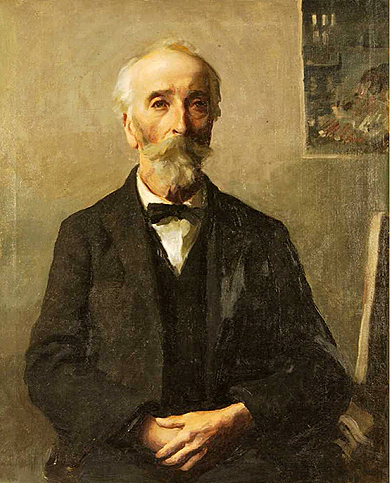
standing behind and above, painting faces on his head

Painting by Frederick Rhodes Sisson (c1920-21)
There is a brief article in The Art Digest (February 15, 1943, p. 26) titled Sisson on Camouflage, which reads as follows—

Amherst College is to hear lectures on camouflage in the Plant Protection School. Frederick R. Sisson, instructor of drawing and painting at the Rhode Island School of Design, who has been conducting a course in camouflage there, to which students of Brown University are admitted, has been chosen for the task. Mr. Sisson acts also as critic of the Providence RI Journal.

We have mentioned Frederick Rhodes Sisson (1893-1962) in two earlier blog posts, here and here, in connection with his role as a studio assistant (one of three) to the well-known American painter Abbott Handerson Thayer. The other two assistants, in the last years of Thayer’s life, were Henry O’Connor, and David O. Reasoner, who would later become Thayer’s son in law, and who was a civilian ship camoufleur during WWI.

It is of particular interest to learn that Sisson lectured on camouflage at Amherst and RISD, since Thayer is regarded as a pioneering expert on protective coloration and natural camouflage, and is commonly referred to as the “father of camouflage.”

Sisson had two connections with RISD. Having grown up in Providence, he was a student at RISD prior to World War I, and then returned to teach there from 1924-1952. He was also an art critic for the Providence Journal from 1932-1950. When he retired in 1952, he moved to Falmouth MA, where he died ten years later.

RISD is at the center of this for another reason, as we have discussed in earlier posts. The Fleet Library at RISD is among the leading archival resources for the research of ship camouflage. One of the WWI American ship camoufleurs, who oversaw the painting of ships in the harbor, was an artist named Maurice L. Freedman. When the war ended in 1919, Freedman entered RISD as a student, and while there, he gave the art school his set of 450 color lithographic plans for American ship camouflage. It is a rare and remarkable resource. More information about it is here.

We also bring this up because, in recent years, there was an online notice about the sale of a painting attributed to Sisson (reproduced above), unsigned and undated, but stamped as part of his estate. It was labeled on the online post as a “3/4 portrait of Abbott Thayer in his later years.” I myself find it hard to believe that this is a portrait of Thayer. Sisson was presumably a capable painter. Indeed, among his responsibilities while working in Thayer’s studio was that of being able to make accurate copies of paintings that Thayer had started. This would then enable Thayer to complete his original painting, as well as apprentices’ copies, in differing ways, without spoiling the original effort.

Knowing that, one would expect a Sisson portrait of Thayer to be a convincing likeness of its aging sitter—which it is to a certain extent. What then is wrong with this picture? The most glaring problem is the hair. Thayer had begun to grow bald at a fairly early age. He had no hair on the top of his head, which prompted his children to refer to him as Shakespeare. Indeed, his bald pate was so hairless at top that his children amused themselves (and him) by standing behind and above him and painting faces on his head. So, one is led to wonder about the indentity of the sitter. The elderly man in the portrait has a receding hairline—that’s for certain—but he is far from bald on top and back.

Thursday, December 23, 2021

Zoologist Hugh B. Cott and WWII camouflaged cannon

In the past we've often blogged about a variety of camouflage called countershading, which was first discussed at length by Abbott H. Thayer, c1897. Later, it was also featured in a famous book by British zoologist and camoufleur Hugh B. Cott, titled Adaptive Coloration in Animals (1940). Cott was also highly adept at scientific illustration, using a method called stippling, and his book is a rich resource of that. Above is a series of pen-and-ink drawings he made that are intended to show the effectiveness of the application of countershading to the barrel of a cannon.

Also shown here is a World War II photograph that documents a demonstration by Cott. It shows two camouflaged cannon, one of which is disruptively painted, while the second is countershaded. The disrupted cannon is easily seen. It is nearly dead center of the photograph, positioned on the railroad track, and pointing toward the upper left. By following the track toward the upper right, you can see the second (countershaded) cannon, the barrel of which is all but invisible.

•••

OTHER WAYS TO APPLY CAMOUFLAGE in The Des Moines News (Des Moines IA), August 15, 1918, p. 4—

Wouldn’t be a bad idea for gents to camouflage their eyes so they’ll look wide open for Sunday mornings in church.

•••

Try the Camouflage on These

On the piano next door that’s hopped every time you try to rest. Break in some time when they’re away and camouflage it to look like an umbrella stand, or a fireplace.

Too bad, too, there isn’t any way to camouflage the warbling of that oh, ho. ho, ha, ha, hee, hee, damsel who thinks she’s Mrs. Caruso.

And that bugle practicing kid across the street. The best way is to camouflage the bugle with an ax.

The auto that’s always kicking up a fuss and is always being repaired and tried out when you’re trying to get full weight on your sleep at night and in the morning. Sneak out some midnight, drag it in to alley and camouflage it to look like a pile of garbage, then push it next to the ash can so the garbage chauffeur will haul it away with the rest of the rubbish.

Wonders can be worked with the camouflage art.

•••

Camouflage Some More


What a merry bunch of camouflagers we are. The first of the month when bills come and collectors knuckle the front door, some of us are camouflage so that we are out to the collector.

Some camouflage themselves so that the other people just envy their easy sailing and wish they could afford a car and a maid, but most of the time the car isn’t paid for and the house is mortgaged to get it and they just have their head out of the water when it’s calm. Great stuff, this camouflage.

Restaurant hash is another gag that gets camouflaged to a frazzle.

Gristle, leftover meat from uneaten orders, etc., come under the nom de plume of “choice bits.” Water is another article that’s camouflaged muchly, as milk, oyster stew, circus leomade, and many other fine works.

For a video introduction to countershading, see <https://www.youtube.com/watch?v=ZLX5YQF-H3k>

Friday, November 12, 2021

pioneering aviator and camoufleur Mittie Taylor Brush

Above Group photograph of Mary (Mittie) Taylor Brush, with her children. Both she and her artist-husband, George De Forest Brush, were pioneering contributors to the study of camouflage, both natural and military. In some of their efforts, they collaborated with their Dublin NH neighbor, Abbott H. Thayer, as did their son, Gerome Brush, a sculptor (standing on the left in this photograph). Public domain, Archives of American Art. In 2016, we featured an earlier blogpost about Mittie Brush, but only recently have we found a substantial news feature about her invisible ariplane, the full text of which is found below.

•••

Earl Murphy, WIFE OF NOTED N[ew] E[ngland] ARTIST INVENTS INVISIBLE AIRPLANE—CARRIES IT OWN LANDING LIGHTS, in Boston Sunday Post, July 22, 1923, p. A4—

Here is an airplane that is invisible by day, that travels through the heavens at night like a giant firefly, lighting its own way to the landing field.

It is the invention of Mrs. Mittie Taylor Brush, wife of George De Forest Brush, the noted painter.

Mrs. Brush became deeply interested in aviation during the war [WWI] and has practically completed the experiments which resulted in a plane that sees without being seen.

•••

Thanks to Mrs. Mittie Taylor Brush, it will soon be unnecessary for you to get kinks in your neck from gazing at the airplanes that float overhead.

Pretty soon you won’t be able to see the contraptions at all and goodness knows, few of us are foolish enough to waste our time looking at something we can’t see.

Mrs. Brush, who is now at her summer home in Dublin NH, has an invention which makes airplanes invisible. Like the small boy, they will continue to be heard, but, unlike the small boy, they will not be seen.

Mrs. Brush is the wife of George De Forest Brush. And he is one of the world’s greatest living artists. That is why it seems strange that Mrs. Brush should be an inventor, that she should live in a world of stresses and strains and angles of refraction. The wife of an artist is expected to be somewhat of an artist herself. It is difficult to think of her as an extremely practical person, interested in mechanical things.

Flyer’s Bugaboo
To Mr. Brush, however, it is all very simple and natural.

“Art,” he has said, “is the purgation of the superfluous.”

And that is the answer.

Mrs. Brush is an artist. She is engaged in purging aviation of some of its superfluous difficulties.

The first is the matter of visibility. The second is that bugaboo of all fliers, the problem of selecting a safe landing place at night.

Why, you may ask, need an airplane be invisible?

It doesn’t need to be—at present.

But there were times during the war, when our aviators were flying over the battlefields in France, that an invisible plane would have been a handy thing.

It was during the war that Mr. Brush became interested in inventions for the development of the airplane. Mrs. Brush shared his interest. An artists who has devoted his life to his art naturally knows very little of carburators and valves and the intricate doohickies that make up a high-powered airplane engine. But he does know color. He has used color to give bodies to his ideals. Certainly he can use his colors to make material things as invisible as ideals. That is called camouflage.

Battleships were painted in weird streaks and patterns which made it hard for the enemy to see them. Trucks and tanks and guns were so treated that they would melt into the landscape.

The planes presented an entirely different problem.

It is very easy to see an airplane flying against the clear sky. Paint it what color you will, the drumming of its motor advertises its presence and its wings and body stand out in silhouette. With all his artistry and knowledge of color, Mr. Brush could not camouflage an airplane.

But Mrs. Brush could—and did.

Seated in an enormous living room of her farmhouses in Dublin, she told of it modestly enough. That living room is a wonderful place for the discussion of aviation. The ceiling is the roof. The rafters are bare. There is a huge fireplace, showshoes hang on the wall, and in a corner, an old-fashioned spinning wheel.

“It struck me,” said Mrs. Brush from the shelter of her wide-brimmed straw, “that if we couldn’t make a plane invisible with color, we might do it without color. After all, color is the only thing we see. If a thing has no color we cannot see it. We do not see a clean window. We look through it, as if it were not there at all. An airplane that has no color cannot be seen.

“The problem reduced itself to a matter of finding a transparent material to use for covering the wings in place of the ordinary linen. Glass would not due. It was too heavy. Experimenting was a dangerous business. I have never piloted a plane, but I have frequently gone up as a passenger. In flying, as in everything else, the only way to determine the value of an innovation is to try it out. That means flying and the risk of crashing if your scheme fails.

“We tried several things until I hit upon this celluloid composition. It is transparent, has the thickness and strength of linen and built on a base of course copper wire mesh, but the stuff ripped and split. When this material is used for wing covering, it is difficult to see a plane even at such a low altitude as 300 feet. The government took my invention, but the war ended before it could used extensively.

“We had a Bieriot plane down at Mineola [NY] in which we made several flights. It was covered with this material, which is called Chrystal. When we went up at night, it was necessary to build fires all around the field so that we could find our way to the landing place and avoid rough spots on the ground. This difficulty in landing is the great obstacle in the way of night flying.

“My success with the transparent wing covering encouraged me to go farther. If a plane can carry its own light it is independent of landing fields and guide lights on the earth. The automobile has the headlights and the driver picks out the road as he goes. The flyer has no such advantage.

Giant Firefly Soon
“A plane cannot carry powerful searchlights. The machinery required to generate sufficient power for the operation of such light is too heavy. In flying, every ounce counts. I set myself to work on developing reflectors that would use a 32-candle-power lamp—small enough to be lighted without the addition of any heavy apparatus. The reflector is the main thing. The light must be gathered and directed so as to give the effect of a large searchlight.

“As yet I have not obtained the results I want. We equipped a Chrystal plane with the lights, strung them out on the wings and around the body. We went up. The plane made a pretty sight with its lights glowing and the dark sky for a background—but when we tried to land we didn’t have enough light.

“This is my vacation time,” Mrs. Brush laughed, “but I’ll be back at work pretty soon and I’m sure I can make a success of the landing lights.”

When you read the report of some poor astronomer who has seen a gigantic firefly gleaming in the heavens, you will know that Mrs. Brush has succeeded. 

Gravestone of Mittie Taylor Brush


Sunday, October 10, 2021

cut-out silhouettes of skunks / embedded figures

Cut-out silhouettes of skunks
Above In a recently posted video on Embedded Figures, Art, and Camouflage (2021) I demonstrate the use of cut-out silhouettes by American artist and naturalist Abbott H. Thayer, who worked in collaboration with his son, Gerald H. Thayer, in the study of protective coloration in nature. 

[During World War I] Thayer objected to the use of field service uniforms of plain, one-color fabric. He thought it was better to break it up, to counter the shading from overhead light, and to generally make it confusing.

At some point, he announced that he had come up with a simple method by which any soldier, in any setting, could determine his own best camouflage pattern. This too made use of cut-out silhouettes. All a soldier needed to do, Thayer proposed, is to cut out a silhouette of his own figure (or the generic shape of a man), and to study the colors and patterns that appeared in the hole of the figure when observed in his surroundings. He had already explored this photographically to recreate the patterns of, for example, birds and skunks [as shown above]
more>>>

• Nature, Art, and Camouflage (35 min. video talk) at <https://www.youtube.com/watch?v=ZLX5YQF-H3k>
• Art, Women’s Rights, and Camouflage (29 min. video talk) <https://www.youtube.com/watch?v=hiSWNYCNRcM>
• Embedded Figures, Art, and Camouflage (26 min. video talk) <https://www.youtube.com/watch?v=3asynn24nD4>
• Art, Gestalt, and Camouflage (28 min. video talk) <https://www.youtube.com/watch?v=nS2ZwYyxy1Y>