Showing posts with label camou. Show all posts

Monday, September 21, 2026

Picasso, Gestalt, Dazzle Camouflage / Missing Links

Above
World War I photograph of German dazzle-painted railway car. Unidentified. Restored, color may not be historically accurate.

•••

Pablo Picasso
has been credited with nearly everything, thanks in part to the efforts of his greatest publicist, Gertrude Stein. In her promotional efforts, he was second only to herself. She popularized the resemblance between Cubism and World War I camouflage, which others then embellished, among them French poet André Salmon. Below is a bit from an essay that Salmon wrote in 1929, in which he asserted that Picasso was an "influence" on the dazzle camouflage on ships, as well as disruptive patterning on field service uniforms.

•••

André Salmon
, “Letter from Paris” in Apollo: A Journal of the Arts. November 1929. Vol 10 No 59, p. 281—

The torpedo boat? It was Picasso who influenced the torpedo boat. To him is due the naval camouflage used during the war, and I remember a letter that my friend Picasso wrote to me at the front after a massacre of “red trousers,” in which he expressed the desire of seeing us all dressed like harlequins if there were any chance of finding us alive after the victory. It was not his fault that khaki won the day.…

•••

Fritz Heider, a prominent German-American psychologist, wrote about the possible link between Picasso's Cubist paintings and the vision research of Max Wertheimer, a co-founder of Gestalt psychology. Picasso and Wertheimer were contemporaries, born one year apart, and there are lookalike factors in their perception-based experiments. But it does not mean that Picasso invented Gestalt theory or that Wertheimer was a Cubist. I wrote an article on this many years ago (online here) and discussed it in a video talk about Art, Design and Gestalt Theory, also free to watch online.


Wednesday, September 9, 2026

Stevens and Merilaita book about Animal Camouflage

Publisher's synopsis (cover animation above) for Martin Stevens and Sami Merilaita, eds., Animal Camouflage: Mechanisms and Function. UK: Cambridge University Press, 2011—

In the last decade, research on the previously dormant field of camouflage has advanced rapidly, with numerous studies challenging traditional concepts, investigating previously untested theories and incorporating a greater appreciation of the visual and cognitive systems of the observer. Using studies of both real animals and artificial systems, this book synthesizes the current state of play in camouflage research and understanding. It introduces the different types of camouflage and how they work, including background matching [figure-ground blending], disruptive coloration [dazzle] and obliterative shading [countershading]. It also demonstrates the methodologies used to study them and discusses how camouflage relates to other subjects, particularly with regard to what it can tell us about visual perception. The mixture of primary research and reviews shows students and researchers where the field currently stands and where exciting and important problems remain to be solved, illustrating how the study of camouflage is likely to progress in the future.

•••

Wednesday, September 2, 2026

WWI mishap / making a cast of the carcass of a horse

WWI magazine illustration
The American artist Charles Burchfield (1893-1967) served briefly as a US Army camoufleur near the end of World War I. In his journals, he recalled a wartime incident that involved an attempt to build a hollowed-out papier maché replica of a dead horse (in which to conceal an observer).

Charles Burchfield, Charles Burchfield's Journals: The Poetry of Place. Albany NY: State University of New York Press, 1993—

It was Capt [William] Yarrow's (the camouflage commander) idea to model a dead horse, which being hollow would be used for a periscope outlet over a dugout, an ingenious idea. Pearson was given the job, as he was a budding sculptor. He thought it would be simpler and more realistic to make a cast from a dead horse itself. Dead horses were not easily procured, and so after a two weeks wait, they had to content themselves with a dead mule secured from a nearby farm. The mule was already two days on the way toward disintegration; nevertheless, Pearson and his helpers, who had requisitioned a truck for the errand, sat on the mule as they went thru the camp, and sang ribald songs, at the tops of their voices, much to the amazement of lookers on.

Pearson's work proceeded slowly, and the odor of the mule grew more frightful with each passing hour (Eskridge & I were sure that Pearson brought it to the barracks with him, and treated him accordingly)—One afternoon, Pearson said—he and his helper Peck, were busily working, when all at once, as one will often do, he realized that for some time someone had been calling him, but it had not completely penetrated his consciousness. Turning he beheld this major (his name eludes me, but he was some rich man's spoiled brat) at some distance, on his horse, gesticulating wildly with one hand, and holding his nose with the other—Pearson hurried over and saluted—

"What the [hell] have you got over there" the major roared—

"A dead mule, sir" was Pearson's reply, with as much sang froid as he could muster—

"A dead mule—You know it's against the regulations to allow a dead animal to lie in the camp—Who gave you permission to bring it here?"

"Capt Yarrow sir?"

"Where the hell is he?"

"I presume over in the woods there, sir" (some of the camouflage work took place in a pine grove near at hand)—

"Well, I'll show him whether he can bring dead mules into the camp," and putting spurs to his horse, he rode furiously off, only, a few minutes later, to plunge thru the artificial [camouflaged] hill, which had been so skillfully constructed that few would know it was not real, unless they had been told. It threw him from his horse, and by the time, with the aid of whatever soldiers were around, he had extricated himself, he was speechless with rage.

•••

Wednesday, August 26, 2026

camouflaged American soldier emerges from stump


World War I American soldier (digital animation)

Henry Berry (American artist / camoufleur), in Make the Kaiser Dance. New York: Doubleday, 1978, p. 207—

I picked Harry Hull [Howard Hull], the brother of Henry Hull, the actor, as my [US Army camouflage] partner, and we went to work. We decided to put together a fake stump, the kind that you move around and hide just about anything in…First we took some real bark off a tree and wired it to a cage we had. When we actually planted it in an area that had a lot of other stumps—really, you couldn't tell the damn thing from the others. We even had a little trap door on the bottom that you could crawl in or out of.

•••

FALSE COLORS: Art, Design and Modern Camouflage

CAMOUPEDIA: A Compendium of Research in Art, Architecture and Camouflage


SHIP SHAPE: A Dazzle Camouflage Sourcebook


Lowest price / three book bundle with free shipping 


Tuesday, August 25, 2026

aimed to distort the lines and to warp the perspective


Above WWII American ship camouflage (unidentified), 1944

•••

Matthew Luckiesh, Visual illusions, their causes, characteristics and applications. New York: Van Nostrand, 1922, pp. 225-227—

Many optical illusions have been devised and studied by scientists. In fact, some of these tricks are well known to the general reader. Straight lines may appear broken, convergent, or divergent by providing certain patterns or lines intermingled with them. [Beginning in World War I] Many of these were applied to models in laboratory experiments and it has been shown that confusion results as to the course of the vessel. The application of these on vessels has resulted in the grotesque patterns to be seen on ships during the latter stage of the war. It is well known that these illusions are most effective when the greatest contrasts are used, hence black and white patterns are common. Color has not been utilized as definitely as pattern in confusibility, although there is a secondary aim of obtaining low visibility at a great distance by properly balancing the black, white, and other colors so that a blue-gray results at distances too great for the individual patterns to be resolved by the eye. Color could be used for the purpose of increasing the conclusion by apparently altering the perspective. For example, blue and red patterns on the same surface do not usually appear at the same distance, the red appearing closer than the blue.

Such apparently grotesque patterns aimed to distort the lines of the ship and to warp the perspective by which the course is estimated. This was the final type of marine camouflage at the close of the war. Besides relying upon these illusions, ships zigzagged on being attacked and aimed in other ways to confuse the enemy. No general attempt was made to disguise the bow, because the bow-wave was generally visible. However, attempts have been made to increase it apparently and even to provide one at the stern. In fact, ingenuity was heavily drawn upon and many expedients were tried.

Monday, August 24, 2026

ship camouflage / as dazzling as Frisco pousse-café

Herman Whitaker
, SIMS'S CIRCUS, A Cruise with Our Destroyers Over There in The Independent Vol 94—

Barred, striped, blotched, smudged, ring streaked with vivid pinks, arsenic greens, blowsy reds, violent blues, they looked like—like nothing in the world unless it be that most poisonous of drinks, a Frisco pousse-café. All of the giraffes, zebras, leopards and tigers ever assembled in the "World Greatest Aggregation" exhibit conventional patterns in comparison with this destroyer camouflage.

Germans more adept at using WWI camouflage tricks

TRICKS IN ALL TRADES: The War Game Has Its Share of Them, as the Pictures on This Page Bear Witness—The Germans Have Been the More Adept at Their Use, Even to a Replica of the Trojan Horse
in The Constitution (Atlanta GA), June 13, 1915.

Sunday, August 23, 2026

WWI oil camouflage with views of ship in harbor

USS Lake Pleasant (1918)
Above
Two views of the starboard side of the same ship, the USS Lake Pleasant (1918), showing its dazzle camouflage scheme. Not directly pertinent to the news story posted below.

•••

OIL CAMOUFLAGE OF U-BOAT CAPTAINS IS EXPOSED BY ALLIES, Instead of Sailing on, Destroyers Drop Many Depth Charges Near Floating Oil in The Tulsa Weekly Democrat (Tulsa OK) July 25, 1918—

Tricky German U-boat commanders have concelved a new plan destined to deceive crews of the Allled submarine destroyers in the game of hide and seek in European waters. When a depth bomb is discharged and does not cripple or destroy the German under-sea boat, as sometimes happens, a quantity of oil is released by some device of the submersible and quickly rises to the water's surface.

The hope of the German U-boat captain is that the commander of the destroyer will see the oil, believe that the submarine has been wrecked and drop no more depth charges. Meanwhile, the German is endeavoring to escape.

Amerlcan and British commanders of destroyers and submarine chasers discovered the scheme some time ago and since then have been dropping depth bombs in greater number-than previously, using the oil as a guide to the general location of their target.

"Oil camouflage" the Amerlcans and British navymen call this Iatest German submarine trick.


Thursday, August 20, 2026

British Army Tank Camouflage / WWI Strategic Testing

Above
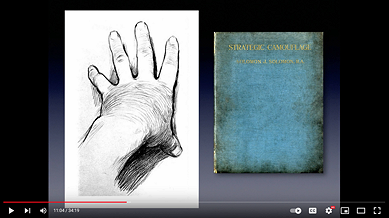
I recently ran across this book by Roger Pugh, titled THE MOST SECRET PLACE ON EARTH: The Story of the East Anglian Village of Elveden and the Birth of the World's First Tanks. Larks Press, 2014. It is an account of the village of Elveden during World War I, during which it secretly functioned as a development and testing site for the British Army's tanks.

I haven't yet seen the actual book, although copies are for sale online. I was initially pulled in by the image on the cover. In a further search, I found a website sponsored by St Edmundsbury, titled The Great War of 1914 to 1918 Picture Gallery of Bury St Edmunds and Surrounds. There is a caption on that site that provides more information about the image on the cover. It reads as follows:

The artist Solomon J Solomon was enlisted to design camouflage for the new weapons. He visited Elveden and also went to France to study the soil and vegetation there. In June 1916 Solomon began painting the first tanks in a mixture of pink, grey, green and brown blotches. This picture shows a modern attempt to reproduce this camouflage, which was soon replaced by a uniform khaki brown once in the field in France.

Those who follow this blog will most likely recognize the name of Solomon J. Solomon, who was the first commander of the British Army's camouflage section, and who wrote one of the earliest books (perhaps the first) on infantry camouflage, titled Strategic Camouflage. He is also featured in a free, online video talk I made several years ago (see link below).

Wednesday, May 20, 2026

deformed ships like papier-maché caves of polar bears

Until recently I had no idea that the architect Le Corbusier had ever mentioned camouflage in his published writings, albeit he was interested in various aspects of Cubism. But I have now run across an excerpt from the book that he and the artist Ozenfant wrote in 1918, called Apres le cubism, in which they talk about camouflaged ships. 

Above is a public domain photograph of him by an unknown photographer, titled Le Corbusier at Shodhan House in India, 1955. I also used it recently on the opening page of an essay titled "Occupant of a House by Le Corbusier" in my recent book of essays, Dreams of Fields: Memory Traces of Iowa's Past (Ice Cube Press, 2025).

•••

Amédée Ozenfant
and Charles-Edouard Jeanneret [birthname of Le Corbusier], Apres le cubism. Paris: Edition des Commentaires, 1918, p. 30.

…There is an organic beauty in the structure of a transatlantic ship; we are indifferent to it; but here comes the war, suddenly bringing us camouflaged ships, which instantly become the unexpected theme of the "renewal of the subject" and "originality of vision"! Poor magnificent ships, with wonderfully balanced structures, with vast architecture, gleaming and pristine under their pure varnish, they are admired because of their camouflage, deformed, hilarious, collapsed in the surrounding landscape, unrecognizable, resembling the papier-mâché cave of the polar bears at Hagenbeck, like stage sets for shooting galleries; we find ourselves in Parade; from there we draw easy entertainment, easy decor, easy arabesques, everything that cancels beauty!

The novelty of the subjects does not renew painting; there is only a known variation on a new theme, something to distinguish oneself through the apparent oddity of the subject.

This is not progress; it is only a modality of naturalism or impressionism, under cubist camouflage.

Saturday, May 9, 2026

swimmingly attired / a dazzling disguise at the beach

Above
Dazzle-patterned beach attire, which became a fashion craze near the end of World War I. Digital coloring.

•••

News item in the San Francisco Examiner, October 8, 1917—

"Camouflage" was the subject of the Rev. Robert N. Powers in the Parkside Presbyterian Church Sunday evening. He said, in part:

War has lost its glory and chivalry and has gone back to the tactics of Bushmen and Indians. The artists of Europe have been called away from the great masters and the realms of ideal beauty to paint in disguising colors, ships, flying-machines, roads, horses and cannon.

There is a moral camouflage also. Business is streaked with it; politics is painted thick with it and society is too often camouflage itself. All our tricks of excusing and deceiving, of posing and pretending are a species of camouflage that in the long run deceives no one but ourselves.

jackies removing ship camouflage paint / documented

painting over camouflage at war's end
It is not easy to find historic photographs of ships in the process of having their camouflage applied. They do exist and I have found about ten. But an even greater challenge is to find photographs of ships (at the end of the war) having their wartime camouflage painted over. There cannot be many photographs of that, since it was a far less dramatic event than the application of camouflage. 

Earlier today, when I first put up this blog post, I illustrated it with a newspaper photograph from 1919. But it was of such poor quality that I decided to take it down, and am now replacing it with the above photograph, which shows the overpainting of a ship's camouflage at the end of WWI. I regret that I have not located the source. 

As for the earlier deleted photograph, it was an illustration for a brief article in The Reno Gazette Journal (Reno NV) on April 16, 1919. The headline for that article was TAKING OFF THE WAR PAINT, and the accompanying text was as follows—

When Kaiser Bill told us we should stripe our ships like a barber pole and sail them where he ordered, we said we wouldn't. We put on our war paint instead and jumped into the fight. It's over, and here are the jackies [sailors] removing the camouflage and putting the steel grey and white of peace on the sides of a battle cruiser.

Friday, May 1, 2026

preparing models for testing WWI dazzle camouflage

This is such an interesting photograph. The caption reads "Making models for testing World War I ship camouflage." The original is dated on the back as February 10, 1919, but that's absurd. It must have been made in 1918 (or even late 1917). Nor is the location a certainty. None of these people appear in other photographs of the staff members of the US Navy's Washington DC camouflage lab, nor is this the same room as in those photographs. It's also puzzling that one of them is a woman, most likely a civilian (all three appear to be in civilian clothing). 

They are making ship models out of wood, using woodworking tools, such as the jigsaw on the left. In the center in the very back is a shelving unit on which finished, painted models are stored, and on the far right there is a suspended chart that shows various ship designs. Clearly evident also are the water sprinkler system pipes, which reminds us of a newspaper item from early 1918, reporting that the ship camouflage workshop had been damaged by fire. Based on a public domain government photograph at the Naval History and Heritage Command NH 41721 / digital coloring.

A grayscale print of this photograph was featured in an exhibition at the Hearst Center for the Arts (Cedar Falls IA) in 2018, for which the caption read—

During World War I, the process of designing ship camouflage began with the construction of unpainted wooden ship models, built to scale. These were then given to artist/designers, who devised different camouflage schemes for each of the two sides of the models, in preparation for testing them in a periscope-equipped observation theatre.

Friday, April 24, 2026

this weekend / public slide presentation on camouflage

On Sunday April 26 at 2 pm, I will be speaking at the English Valleys History Center at 108 North Main in North English IA. It's free and open to the public. IOWA'S CAMOUFLAGE EXPERTS is a 60-minute slide talk about Iowa artists, designers, scientist and others who served as camouflage advisors during both world wars, especially during WWI. An informal, fast-paced presentation, enriched by scores of rare historic photographs and other image artifacts. Shown here are three of the slides from the program.

Saturday, April 11, 2026

Grant Wood's camouflage service during World War I

WWI French artillery camouflage
It is by now common knowledge that when Iowa artist Grant Wood served in the US Army during World War I, he was assigned to field camouflage. When someone contacted me recently to ask what I might know about that, I replied that the best source might be Darrell Garwood's biography titled Artist in Iowa: A Life of Grant Wood (New York: Norton, 1944). Wood's involvement in camouflage is mentioned in other biographies as well, but they tend to be brief and less than strictly factual.

Here's what Garwood's biography says—

Since his [Wood's] mother and sister were dependent on him, he had been placed in Class 3C in the draft and was passed over in the first draft call in September. Later, other family arrangements were made for the very little money Mrs. Wood needed to keep house, and Grant enlisted as a private in the army. He was sent to Camp Dodge, outside Des Moines, where he spent a good part of his training period making pencil portraits of his comrades and officers. He charged privates twenty-five cents and officers one dollar for the portraits—at least these were his prices when anyone offered to pay him. He didn't ask for payment, and the officer didn't think to offer it, when he made a portrait of his company commander, Captain George E. Proud.

Captain Proud was getting ready to go into town when a sergeant came in to say there was a man outside who wanted to make a sketch of him. The captain was in a hurry, but told the sergeant to bring him in. It didn't take Grant more than ten or fifteen minutes to make the sketch. Proud scarcely looked at it at the time, and afterward didn't remember Grant's name; he only remembered that Grant had said he was a mural painter. When he was back practicing law at Arapahoe, Nebraska, however, Proud found the sketch among his things, liked it and had it framed. It hung on his office wall for fifteen years before someone happened to notice it was a Grant Wood portrait.

Grant's stay at Camp Dodge promised to be pleasant. He was excused from the more onerous military duties, given a sidecar motorcycle, and told to go about making historic records. Then he contracted anthrax, and nearly died. When he recovered, he was sent to Washington to do camouflage work. He served as a private in Company B, Regiment 97, United States Engineers, and was in charge of the paint tent. He made clay models of field gun positions and helped camouflage artillery pieces. Before-and-after photographs of a cannon he helped camouflage were on display for several years at the Smithsonian Institution.

He was still in Washington when the war ended, and was transferred back to Camp Dodge. He arrived home on Christmas Eve, 1918.…


Like Norman Rockwell and other artists who served in the military, Wood was often asked (or offered) to make portraits of his fellow soldiers, including officers. The Nebraska attorney who was Wood's company commander was George C. Proud, not George E. Proud. Other artists in the infantry (Walt Disney being one) were able to earn extra money by painting camouflage or other designs on the helmets of other soldiers.

It’s interesting that in Wood’s WWI draft registration, he lists himself as a "contractor and builder” not as an artist. After regaining his health at Camp Dodge, he was presumably transferred to Camp American University in Washington DC, where, as Garwood notes, he camouflaged artillery (field guns or cannon).

A different Wood biography claims that he painted the artillery for the purposes of making it "blend in" with its surroundings. But that may be misleading, since by 1918 it was common practice to camouflage nearly anything not by blending but by applying “disruptive” (high difference) patterns. The goal was less to blend in than to break apart the shape, making it harder to see as a “thing.”  

Some of these guns were genuine functioning cannon, while others may have been non-firing dummies, made of logs and wagon wheels (known as Quaker guns), that looked like cannon from the air, and were used to divert enemy fire. These might also be camouflaged, to make them more convincing. By that time in the war, when field guns were manufactured in the US, the disruptive camouflage patterns (all the same) were automatically applied at the factory during production, so it is somewhat surprising that the patterns would have to be painted.

WWI camouflage applied during production process


The war ended before Wood was sent overseas. He was never stationed in Europe. Two artists who served with him as camoufleurs were Orrin White and Charles P. Killgore, with whom (long after the war) he later exhibited artwork at Younkers in Des Moines. See details here.

It seems to me that all of this misses the point somewhat of Wood's connection to camouflage. The most important convergence is that camouflage relies on the same "grouping principles" that artists and designers use. I've explained all this in an online video talk.


•••

Anon, in ART CIRCLES, in Long Beach Independent (Long Beach CA), March 27, 1949, p. 10—

[A retired oil-field worker turned artist Carl R. Walline’s] interest in painting dates back to the first world war, when he drummed up a lively business on a returning troop ship painting camouflage on the helmets of soldiers at a dollar a helmet.

With this leftover camouflage paint he did his first landscape.