Showing posts with label Frederick Waugh. Show all posts

Saturday, February 15, 2025

women's contributions to wartime camouflage / WWI

It is difficult to know to what extent American women contributed directly to the design of wartime camouflage. A case in point is the artist Constance Cochrane (1888-1952), whose father and grandfather were career military officers. As a painter, she had a lifelong interest in seascapes and coastal views. In one source it is said that “she joined the navy during both the first and second World Wars to design camouflage for ships.” Another claims that “during World War I she, like Frederick Waugh [a prominent seascape artist], designed camouflage for navy battleships.” A graduate of the Philadelphia School of Design for Women (Moore College of Art), she was associated with an alliance of women artists known as The Ten or The Philadelphia Ten. During WWI, she was a member of the Women’s Reserve Camouflage Corps, whose activities we’ve discussed at length in earlier posts and in an online video talk.

RELATED LINKS    

Dazzle Camouflage: What is it and how did it work? /  Nature, Art, and Camouflage / Art, Women's Rights, and Camouflage /  Embedded Figures, Art, and Camouflage / Art, Gestalt, and Camouflage /  Optical science meets visual art /  Disruption versus dazzle / Chicanery and conspicuousness /  Under the big top at Sims' circus

Wednesday, May 22, 2019

Camouflage Artifacts at Spencer Museum of Art

Above Photograph of the interior of a World War I British submarine under construction. The intense exterior lighting is casting shadows on the workers inside, and providing an apt demonstration of the disruption of shapes using shadows. This photograph was published in France in Le Miroir magazine on February 10, 1918, with the following caption—

The British fleet, which was by far the most powerful in the world during peacetime, has increased its superiority since the beginning of the war thanks to the strengthening of its ordnance. It is not possible, of course, to offer precise information on this subject. The fact that the German fleet remains in the port indicates that our enemies are not fooled by the results of naval combat. Our allies have launched many submarines. Here is one of them under construction.

•••

On March 2, 2019, an exhibition opened at the Spencer Museum of Art on the campus of the University of Kansas in Lawrence. It continues through June 9, but unfortunately I found out about it only recently and won't be able to see it. Titled Camouflage and Other Hidden Treasures, it includes a selection of artifacts from the Eric Gustav Carlson WWI Collection, which includes nearly 4,000 items from the Great War. The current exhibition includes only about 1/60th of the full collection.

Over the years, Kansas and Missouri have increasingly become prime locations for research pertaining to art, architecture and design in connection with camouflage. In Kansas City MO (as we mentioned in an earlier blog), there is the National WWI Museum (formerly the Liberty Memorial), which features what remains of a huge WWI diorama, called the Pantheon de la Guerre. Completed by French artists in 1918, it originally included about five thousand full-length figures, including identifiable images of some of the French army's camoufleurs.

Also of significance is the Missouri State Capitol Building in Jefferson City MO. It was designed by New York architects  Evarts Tracy and Egerton Swartwout in 1917. When the US entered WWI that year, Tracy was among the first officers in the American Camouflage Corps. Prior to that, one of the co-founders of a civilian forerunner to that unit was Iowa-born sculptor Sherry Edmundson Fry, who was commissioned to create the figure of Ceres that stands on top of the building's dome. Inside the building, in the House Lounge, are the famous Missouri history murals by Thomas Hart Benton, who was a US Navy camoufleur during WWI. Also inside is a mural (with two camouflaged ships in the background) titled The Navy Guarded the Road to France. It was painted in 1921 by US naval camoufleur Henry Reuterdahl, whom we've often blogged about.

There's yet another option: The Ulrich Museum of Art at Wichita State University in Wichita KS owns what may be the largest collection of paintings and other artworks by Frederick Judd Waugh, who was a prominent American ship camoufleur during WWI.

Sunday, November 6, 2016

Warner, Waugh and Camouflaged Ship Model

Everett L. Warner with ship model (c1918). Courtesy NARA.
More than two years ago, in a blog post about World War I American artist Frederick Judd Waugh (1861-1940), we reported on his camouflage plan for the USS Proteus, a cargo ship for carrying coal. We included two photographs at the time, one showing the painted wooden ship model (reproduced below), as prepared by Waugh, the other a view of the actual ship after the scheme had been applied.

More recently, we have located another photograph of Waugh's model (above). It shows Everett Longley Warner (Waugh's immediate supervisor) standing beside an observation theatre, used for testing ship camouflage plans. The ship model has been placed on a circular turntable that can be angled at any degree. Also evident is a painted backdrop on a roll of canvas, which allows the background to be changed, to simulate various weather effects.

Close-up view of same ship model

Sunday, June 22, 2014

Frederick Waugh, Camouflage and Dickie Dare

Coulton Waugh, Dickie Dare (1943)
Above (detail) Coulton Waugh, portion of the comic strip Dickie Dare (showing "dazzle camouflage" on the right), from the Harrisburg Telegraph (Harrisburg PA), December 27, 1943.

•••

Ray Goulding of the Bob & Ray radio comedy team was a high school classmate of beatnik novelist Jack Kerouac. Film actress Anne Baxter was the granddaughter of architect Frank Lloyd Wright, who was also related by marriage to New York urban planner Robert Moses. Western gunfighter Wild Bill Hickok (James Butler Hickok) was related to Civil War general and politician Benjamin F. Butler, as well as to Adelbert Ames II (inventor of the Ames Distorted Room) and to writer George Plimpton. Humorist S.J. Perelman was the brother-in-law of novelist Nathaniel West. And finally (this is the punchline) American artist and ship camoufleur Frederick Judd Waugh (whom we have blogged about before) was the father of cartoonist (Frederick) Coulton Waugh (1896-1973), best-known for the comic strips Dickie Dare and Hank.

The elder Waugh died in 1940. In browsing through various panels of the younger Waugh's Dickie Dare, we've found several references to camouflage, including indirect homages to his father's designs for WWI-era "dazzle camouflage" (see example above).

The F. Coulton Waugh Papers are housed at Syracuse University, while other Waugh Family Papers are in the collection of the Archives of American Art. Among the folders in the latter is one described as "World War I Material, circa 1914. Likely Coulton Waugh's, possibly Frederick Judd Waugh's." Since it was the father (not the son) who served in the war, our suspicion is that this may be his material. It may even pertain to ship camouflage.

See also: Roy R. Behrens, FRANK LLOYD WRIGHT and Mason City: Architectural Heart of the Prairie (2016). 

Thursday, May 15, 2014

More on Camoufleur Frederick J. Waugh

Frederick J. Waugh, SS West Mahomet (ship and model) (c1919)
Above (top) More persuasive evidence of the ingenuity of American ship camouflage artist Frederick Judd Waugh. This is his design for the camouflage of the starboard side of the SS West Mahomet, and below that is Waugh's hand-painted model. Note how improvisational the model is, making use of nails and other cast-off scraps.

•••

Anon, CAMOUFLAGE in the Wanganui Chronicle (New Zealand), February 7, 1918, p. 4—

…Visitors to Wellington—or even Castlecliff during the past few days—may have seen excellent examples of the art of camouflage, big liners looking extremely weird with extraordinary markings. These are designed to make the ships poor targets for submarine gunners, the markings deceiving the eye to such an extent that it is difficult to distinguish ship from water. Wonderful are the uses of camouflage, not in the sphere of war alone, but in all phases of life! For, after all, does not camouflage play a very large part in the daily round? We see it everywhere. We laugh at our neighbor's little deceit—which after all only deceives himself—quite oblivious of our neighbor's chuckle regarding our own little tricks. Some uses of camouflage are amusing; some pathetic. The ass which donned the lion's skin was not so stupid as the man or woman who, by means of powder, hair, or clothes, tries to make the world believe Time has treated him or her as it does the ocean. The middle-aged woman cannot become a young girl by donning the dress of a young girl; and the middle-aged man cannot become a boy by trundling a hoop in the street. They may—and often do—deceive some people for a time, but sooner or later the camouflage is penetrated and the truth stands revealed. Is the deception worthwhile? Nobody—least of all those who practice it—will say so. Then, in the commercial and social sphere, camouflage plays its part, the users fondly believing that they are deceiving the world at large regarding their position and prospects. And, be it admitted, very often their belief is well grounded! But there is always the fear that some accident may break down the camouflage, and the constant guard against that disaster keeps the user on the rack.

Frederick J. Waugh painting a ship model (c1919)


Anon, RED RAIN FALLS IN SALE: Curious Effect on Countryside, in Gippsland Times (Gippsland, Victoria AU), November 16, 1944, p. 1—

During Sunday night and the early part of Monday, dust-impregnated rain [called "red rain" or "blood rain"] fell throughout the whole district. Residents were amazed on emerging from their homes to discover that everything which came within range of vision, appeared to have changed color overnight.

…The effect was incongruous. Where the rain has missed, dry dust lay. Where the rain had fallen, splotchy marks were left. The entire effect was as though some crazy camouflage artist had executed an ultra futuristic design.

other sources

Wednesday, May 14, 2014

Camouflage Artist | Frederick J. Waugh

Camouflage of USS Proteus by Frederick J. Waugh (c1918)
In earlier posts, we've talked about American painter Frederick Judd Waugh (1861-1940), a World War 1 ship camoufleur who worked with Everett L. Warner. As Warner describes in the notes he used for a postwar slide talk on ship camouflage, the 57-year-old marine artist Waugh was the team's most resourceful designer. As evidence, Warner in his notes describes Waugh's solution for "dazzle-painting" the collier USS Proteus, a cargo ship for carrying coal. Above (top) is a photograph of the starboard side of the painted wooden model of the plan proposed by Waugh, while below that is a 1918 photograph of the actual painted ship, as seen from the bow and the port side. Here is what Warner recalled in his notes about the process of designing it—

The eye is so accustomed to the normal operation of the laws of perspective that if you were to see a group of telegraph poles, and they had been so graded in height that the nearest one was much the shortest, you would be likely to think that the tall one in the distance was the nearest. I remember this design well because it cost me a box of cigars. When the model came in (a collier looks like an unfinished skyscraper afloat) it looked like such a difficult problem that I offered a box of cigars if any one of the designers could fool me with a design. Mr. [Frederick] Waugh won the box of cigars, but the joke was on him as he does not smoke. [It was] An effective design, but one belonging to [the] early period before we had entered the realm of solid geometry.

•••

Cecelia Van Auken, COLLECTOR'S LONG-TIME LOVE AFFAIR WITH PAINTINGS OF FREDERICK WAUGH. Bridgeport Sunday Post (Bridgeport CT), July 19, 1970 , pp. 3 and 12—

The Waughs' idyllic life in Kent [CT] was interrupted in 1918, where they had moved four years previously, when Waugh, because of his extraordinary knowledge of the sea, was asked [by Everett Warner] to take part in the important work of marine camouflage being carried on by the Navy department. He went to Washington [DC] for the duration.

•••

Anon, HAD TO FALL BACK ON LUNCH: Seemed the Only Thing Left to Which Host Could Invite His Artistic Friends. Dakota County Herald (Dakota City NE), January 19, 1922, p.2—

Mr. Heming tells an amusing little incident to disprove the general belief that artists are temperamental, dissipated creatures who thrive on the white lights. In the ancient days before prohibition Mr. Heming was in New York to invite American artists to exhibit in the Canadian national exhibit in Toronto. Gardner Symons, the well-known American artist, invited Heming and Frederick Waugh, another leading artist, to dinner at the National Arts club. "Let's go down and have a cocktail before lunch," said Symons. "I never take anything," said Heming. "Neither do I," said Waugh. Symons laughed. "That's funny," he said. "Neither do I, but anyway we'll have some cigars." "I don't smoke," said Waugh. "And I don't smoke," said Heming. "Well, this is a great joke," said Symons. "I don't smoke either, but I thought you fellows would at least take a cigar. Say, you eat, don't you?—because I've ordered lunch."

•••

Anon, VISUAL THERAPY in Morning Herald (Hagerstown MD), March 10, 1953, p. 8—

Fine paintings on a hospital wall constitute a "visual therapy" and are helpful to the sick, New York hospital workers say…We think this very probable and are sure the routine paintings and prints on such walls up to now retard recovery…(A still-life showing a faded apple, a couple of green pears and a slice of melon once kept us laid up at least a week longer than was necessary.)…We remain a little skeptical about the masters…We want no doctor to prescribe a Picasso when we can get a good Frederick Waugh or Winslow Homer…A lot of widely heralded moderns make us sick…

•••

Anon, MAKES UNIQUE PICTURES FROM BITS OF DRIFTWOOD: Many-Sided Waugh, Known to Milwaukee Through Marine Paintings, Expresses Inspiration in Diverse Forms, in the Milwaukee Sentinel, January 15, 1922 [announcing an exhibition of Waugh's driftwood artwork at the Milwaukee Art Institute]—

…When the Boer War was on and [Frederick] Waugh was painting in London  he even temporarily gave up the game of chance as to an artist's livelihood to rehandle sketches sent back to the London Graphic by officers and artists at the front. When no sketches came in, telegraphic description was all the data he needed for his series of spirited battle pictures.

His knowledge of sea-craft and ready enthusiasm made him a most valuable assistant in the bureau of camouflage during the late war.

…From his home in Mount Clair NJ, Waugh often went down to wander along the beach of his always bel0ved sea. The usual driftwood, remnants of ruined craft, bits of tree roots and gnarled branches from only the waves know where, have always fascinated him. He often gathered them up. Their curious shapes kindled his imagination. His creative desire wound itself around their blanched, smooth surfaces and he set about to make them beautiful, to incorporate them into art.

With knives and paints, brush and ingenious vision he worked these bits of driftwood into designs, pictures if you will, charming things, delicately colored.…

Twenty-eight drawings by Waugh, derived in part from gnarled wood shapes, were used as illustrations for a children's book titled The Clan of Munes (New York: Charles Scribner's Sons, 1916). The original book illustrations were recently exhibited at the Ulrich Museum of Art at Wichita State University (Wichita KS) from January 25 through April 13, 2014. The same museum owns a large collection of more than 300 artworks by Waugh, donated in 1974 by Edwin A. Ulrich.

•••

See also an earlier mention of Waugh in Vladimir Nabokov's scandalous novel, Lolita (New York: Knopf, 1992). Below A portrait of Waugh (1929) in Peter A. Juley and Son Collection, Smithsonian American Art Museum.

Peter A. Juley & Son, Portrait of Frederick Judd Waugh (1929)

Tuesday, January 21, 2014

Camouflage Artist | Raymond J. Richardson

US Navy camoufleurs (1918)
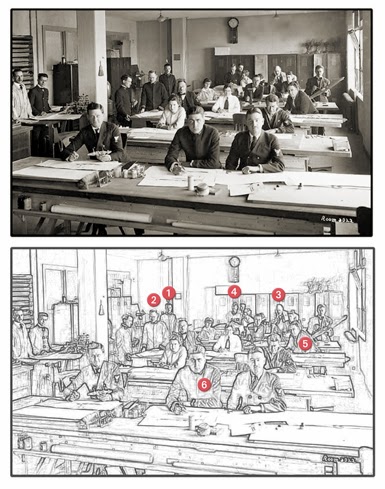
Above This is a rare World War 1-era photograph (c1918) of the drafting room at the Design Subsection of the US Navy's Camouflage Section. This art-centered subsection (under the direction of artist Everett L. Warner) was located in Washington DC, while a second science-centered Research Subsection (under the direction of optical physiologist Loyd A. Jones) was at the Eastman Kodak research facility in Rochester NY. The executive officer in charge of the combined subsections (the Camouflage Section per se) was architect (and Olympic fencing champion) Harold Van Buskirk. Through extensive searches (in part thanks to notes received from the descendants of the camoufleurs), we've been able to identify more of these individuals and to learn about their lives. In this photograph, as indicated by numbers, we have identified Harold Van Buskirk (1), Everett Warner (2), painter Frederick J. Waugh (3) (seated to the right of him is sculptor John Gregory), painter Gordon Stevenson (4), painter Manley K. Nash (5) (standing behind and right of him, holding a large ship model, is Kenneth Stevens MacIntire), and architect Raymond J. Richardson (6), who was in charge of the drafting room. It is not surprising that two of the supervisory personnel (Van Buskirk and Richardson) were architects, because it was often claimed that the best camouflage officers were not artists but architects, because of their experience in working collaboratively. Note also the inclusion of women (an innovation at the time), four or five of whom are in this group.

Richardson (left) and Van Buskirk, looking at model and ship plans

Richardson (?) and Van Buskirk in model storage room

Below is more information about Raymond J. Richardson, with details regarding this unit. It is of additional interest that in 1922 Richardson was appointed Assistant Professor in the Department of Architecture at Carnegie Institute of Technology in Pittsburgh. The head of that school's Department of Art was Homer Saint-Gaudens, who had commanded the US Army's Camouflage Corps during WW1, and in 1924, Everett Warner also joined the faculty there.

•••

Anon, from SERVED IN CAMOUFLAGE SECTION OF U.S. NAVY. READING MAN UNDER WATER, ON LAND AND IN THE AIR in the Reading Eagle (Reading PA), April 11, 1919—

Ensign Raymond J. Richardson, of Reading, who, as a member of the US naval reserve forces, had been serving in the camouflage section of the navy, has been placed on inactive list and has returned to this home town to again take up architecture, the profession which he had been following when he left civilian life to answer the call to the colors. Ensign Richardson enlisted on July 10, 1917, at Newport RI, and was sent from that station to New York City, where he trained under William A. Mackay, considered the dean of naval camouflage in America. Mr. Mackay was at that time engaged in working out camouflage designs for the shipping board.

Later Ensign Richardson was transferred to the League Island Navy Yard, Philadelphia, and had charge of the camouflage work there. On February 25, 1918, he was sent to Washington, where he helped to organize the camouflage section of the navy. At first the designing department consisted of only three men [Van Buskirk, Warner and Richardson, presumably]. This finally grew until there were between 50 and 60 men.

Lieutenant Harold Van Buskirk, a well-known architect, was the executive head of the department, and Lieutenant Everett L. Warner, one of America's best landscape painters, was the head designer. Ensign Richardson served as assistant to these two men and had charge of the drafting room.

The work of this department was to design the type of camouflage which was to be used on the various vessels, both of the transport and combatant type. Models of the vessels were made in wood and these models were studied at various angles and ranges through periscopes and in this way the most effective type of camouflage was determined. Plans and blueprints were then prepared and these were used by the men in applying the camouflage.*

During the time that he was in the service, Ensign Richardson had occasion to make short cruises in submarines and also to make flights in airplanes in order to determine the effectiveness of the work of the camoufleurs. So he served under water, on land and in the air.

Among the men attached to Ensign Richardson's department at Washington was Earl Bankes* * , a brother of C.W. Bankes, of this city. Bankes was a warrant officer.

Ensign Richardson is a graduate of Reading High School, class of 1910, and of the University of Pennsylvania, class of 1913. He took a post graduate course at the latter institution and was awarded the degree of master of science in architecture in 1915.

After graduation Ensign Richardson worked in the offices of some of America's most prominent architects, principally in and about New York City. At present he is with E.Z. Scholl, a Reading architect.

Ensign Richardson is a son of Mr. and Mrs. Fred H. Richardson, 1324 Pricetown Road. His father is a member of the firm of Richardson and Early, wholesale confectioners.

* There were about 450 of these ship painting plans (reproduced in multiples as color lithographs), but apparently only two sets of the plans have survived. The most complete set is in the collection of Fleet Library at the Rhode Island School of Design (RISD), while a second set is housed at the National Archives and Record Administration (NARA).

** Through various online newspaper archives, we've located a number of articles on an Earl Bankes from Reading PA who had resettled in Miami FL, where his paintings were included in various art exhibitions.

Friday, September 20, 2013

Same Camouflage on Two Ships

Two dazzle-painted US ships (c1918) with the same camouflage
When dazzle ship camouflage was first adopted by the British Royal Navy in 1917 (and later by the US), the original plan was that no two ships should be painted with the same design. But it soon became apparent that this could never be accomplished, so a single design was often applied to multiple ships, with modifications as needed. In an earlier post, as an example of this, we featured photographs of two dazzle-painted British ships, the SS Empress Russia and the SS Osterley. Pictured above is another example, as seen in two American ships, the USS Congaree (top) and the USS Lake Borgne (bottom). According to a note made by US Navy camoufleur Everett L. Warner, the camouflage for the American ships was designed by a well-known marine painter named Frederick Judd Waugh (a student of Thomas Eakins), who is shown below in the process of painting a "victory mural" at the conclusion of World War I. Three hundred works by Waugh are in the collection of the Ulrich Museum of Art at Wichita State University in Wichita KS.

WWI ship camoufleur Frederick J. Waugh
Waugh's Victory Mural (c1919)

Wednesday, May 29, 2013

Jonnie Morris Film on Dazzle Camouflage

Jonnie Morris | Dazzle Camouflage Documentary

Above I've known about this documentary film project since the fall of 2011, when I was interviewed for it. But until today I hadn't realized that this "trailer" is available online at Vimeo. I'm not sure when the film is coming out, but it promises to be one of the richest, most comprehensive documentaries on the subject, and especially on high difference disruption, sometimes known as dazzle camouflage or (more fashionably now) razzle dazzle. As nearly everyone knows by now, it came into widespread use during World War I, initially as a means of throwing off the calculations of German U-boat torpedo gunners.

Spurious claims on websites state that it didn't actually work, but scientific testing at MIT (c1919) confirmed that it did (more about that in a forthcoming post). It is also commonly said that, with the introduction of radar, the practice died out during World War II. But that doesn't seem to be the case, and indeed, on the basis of contemporaneous photographs, some of the most puzzling dazzle designs were produced during WWII, by both sides of the conflict.

This photograph (from WWI) was first published in a magazine article by American artist (and a prominent US Navy camoufleur during both wars) Everett L. Warner. It shows the dazzle-painted SS Congaree (the photo is dated December 9, 1918), looking like a conglomerate of pyramids. This, like many of the best dazzle plans from that time period, was devised by marine artist (and camoufleur) Frederick Judd Waugh. If this photograph looks retouched, it's because it is. It was scanned from a black-and-white lantern slide in Warner's collection (following WWII, he gave slide talks on the subject), on which he had attempted to add translucent color tinting (not very successfully). It has always reminded me of the stage sets from the German silent horror film, The Cabinet of Dr. Caligari (1920), which it predates by a couple of years.

Filmmaker Jonnie Morris will be among the speakers (along with Ann Elias, myself and others) at the Sydney College of the Arts (August 8 through August 11, 2013) at an international conference called Camouflage Cultures: Surveillance, Communities, Aesthetics, Animals.

Sunday, April 8, 2012

Camouflage Artist | Ezra Winter

The Ezra Winter Project (online)
American artist Ezra Winter (1886-1949) was born near Traverse City MI. He attended Olivet College (in Michigan), then studied in Chicago at the School of the Art Institute, where he graduated in 1911. In the same year, he won the prestigious Prix de Rome, by which he was able to study for three years at the American Academy in Rome. Winter's prize was in the category of painting, for what was described in a news story at the time as "a large canvas called The Arts, a beautiful and graceful work." A young Denver architect, George Simpson Keyl , received the same prize in that category, while the Prix de Rome in sculpture that year was awarded to Harry Dickinson Thrasher.

Thrasher had grown up in Plainfield NH, where he had been a student of the most famous American sculptor at the turn of the century, Augustus Saint-Gaudens. As Thrasher was growing up, among his friends were Saint-Gaudens' son, named Homer (a theatre designer and, later, an arts administrator), and a young painter from Dublin NH named Barry Faulkner (he was a cousin and student of Abbott Handerson Thayer, the so-called "father of camouflage," and had studied with Augustus Saint-Gaudens as well). Later, Faulkner became a prominent muralist, and a friend of Ezra Winter, with whom he collaborated on several major projects.

When the US entered World War I, a unit for camouflage artists was formed by the US Army. One of the officers in charge of that unit was Homer Saint-Gaudens, while among the very first artists to join were Barry Faulkner and Harry Dickinson Thrasher. After a period of training on the grounds of the American University near Washington DC, their unit was deployed to France at the end of 1917. Of the camoufleurs, there were only two who didn't return—Everett A. Herter (the brother of US diplomat Christian Herter) and Harry Thrasher, both of whom were killed in France in 1918. Faulkner delivered the eulogy at Thrasher's funeral.

At the same time, Ezra Winter was in New York, where, as a civilian, he worked for the US Shipping Board, as a member of one of thirteen teams of camouflage artists (stationed at various ports around the country) who supervised the painting of dazzle camouflage schemes on thousands of commercial ships (called merchant ships). In charge of the unit that Winter was in was another prominent muralist, William Andrew Mackay. According to official policy, the artists assigned to ship painting were not responsible for the design of the camouflage plans, only for applying them.

Instead, the initial camouflage plans were designed by another team of artists at the Navy's Camouflage Section in Washington DC (there was another research group, largely made up of scientists, at the Eastman Kodak Laboratories in Rochester NY). The DC team of artists made wooden scale models of merchant ships, applied experimental patterns to them, and tested their effectiveness in an observation theatre. The patterns that worked the best were then drawn up, printed in multiples as color lithographs, and sent out to the various harbors, where they served as a "blueprint" while painting the ships.

One of the artists in the Navy's DC camouflage team (the group that actually designed the camouflage patterns) was a British-born American sculptor named John Gregory. There are photographs of him, seated in a room with other camouflage artists (Everett L. Warner, Frederick Waugh, Gordon Stevenson, and others), painting camouflage patterns on miniature ships.

Ezra Winter is not in these photos of course, because he was attached to Mackay's unit in New York. But he is in other photographs (taken shortly after the war) when, as he worked on commissions (one of which was the interior of the Cunard Building in New York), he was photographed with two of his collaborators—his fellow wartime camoufleurs Barry Faulkner and John Gregory.

...

For more on Ezra Winter, see The Ezra Winter Project by Jessica Helfand, who is co-founder of a Connecticut-based design studio called Winterhouse—located in Ezra Winter's former home and studio in Falls Village CT. As of this posting, three Winter-related installments have been issued, the most recent two at here and here.

Sunday, April 18, 2010

Camouflage in Lolita


Believe it or not, there are references to two World War I camouflage artists in Vladimir Nabokov's famous novel, Lolita (New York: Knopf 1992), which was later made into a Hollywood film by Stanley Kubrick (reproduced here is  the film poster from 1997). On page 199, in a lament about Lolita's pictorial taste, the character Humbert Humbert mentions Iowa painter Grant Wood (an US Army camoufleur in WWI) and New England seascape painter Frederick Waugh (who was most likely the finest of the US naval camoufleurs). Here is what Humbert concludes about them—

For her birthday I bought her [Lolita] a bicycle, the doe-like and altogether charming machine already mentioned—and added to this a History of Modern American Painting…but my attempt to refine her pictorial taste was a failure; she wanted to know if the guy noon-napping on Doris Lee's hay was the father of the pseudo-voluptuous hoyden in the foreground, and could not understand why I said Grant Wood or Peter Hurd was good, and Reginald Marsh or Frederick Waugh awful.

Sunday, March 21, 2010

Vaterland | Leviathan

Above are matching photos of a German ship initially called the SS Vaterland, until it was captured by the US and converted to a giant troopship called the SS Leviathan. Depending on the source, the design of its dazzle camouflage is sometimes attributed to British camoufleur Norman Wilkinson (who originated dazzle-painting) or to American artist Frederick J. Waugh (under the direction of Everett L. Warner). It may be that both statements are accurate, since it's likely that Waugh was among a team of artists who worked with Wilkinson when he was "loaned" by the British to the US Navy for the purpose of helping the US set up its own dazzle-painting unit. Whatever, the Leviathan was among the most famous examples of World War I ship camouflage. There is a reference to it at the end of this lengthy excerpt from Frederick Augustus Sherwood, Glimpses of South America. New York: The Century Company, 1920, pp. 18-19—

[During World War I, the steamers of the United Fruit Company, which were usually painted white and referred to in advertising as "the great white fleet," had instead been painted] gray, or impressionistic mixtures of black, blue, green, and yellow. Wonderful geometric patterns shot clear up their masts and funnels, and completely erased all such things as portholes.

Speaking of camouflage reminds me of a number of unusual effects we saw during the course of our travels. One of these was a house and garden painted on the side of the vessel, with a broad gravel walk leading down to the waterline. This was very striking. Evidently the idea was to lead the undersea pirates [German U-boats] to believe they were nearing home, so that they would come up and be captured. The scenic artist who was responsible had done well—but I am still rather skeptical.

Reversed vessels, that is ships made up to appear as though they were going in the opposite direction to their real course, were common. Some of them were remarkably well done. It requires considerable ingenuity to secure this effect, necessitating as it did the versing of the angle of the funnel and other parts of the superstructure that usually slope slightly towards the real stern. We passed one such ship in the Panama Canal that was so well done that it could hardly be detected, even at that close range.
We also passed a ship in the Canal that looked from a little distance as though it was being convoyed by a torpedo boat. The smaller boat painted on the side of the larger one was perfect in every detail, even to the bone that it carried in its teeth.

The more general kaleidoscopic effects, great splotches of brilliant colors, seemed at first glance to attract attention instead of concealing. It was surprising how quickly such ships lost their identity after passing. You can't actually hide a vessel on the high seas very well, but apparently you can easily change it into a haystack, a mountain, or an intermediate mass of nothing at all. This, of course, is the main purpose of all such camouflage.

One of the most remarkable specimens of this type that we collected appeared at a little distance to be two separate masses of wreckage, with considerable clear water between. It was not until we were directly abreast of it, and only a few hundred yards away, that it turned out to be one of the new standardized freighters on its way to Chile for nitrate. There were only three colors used on this vessel, black, pearl gray, and a sort of dirty pink. Apparently there was no method whatever in the mass of triangles, parallelograms and stripes of these colors, but they had certainly been most scientifically designed to secure the effect sought for. How they divided the boat into two seemingly unattached sections was most remarkable.

Camouflage has served its purpose—and has served other purposes also. It has made prosaic steamships picturesque, and they have enjoyed a favor among artists that has always previously been denied them. Innumerable sketches and paintings of ships in phantasmagorical designs and every color of the rainbow have resulted. Some of these are works of art. All are excellent records of a monstrous period. But camouflage, while increasing picturesqueness and artistic value, takes away much of the sense of power and strength that we have always been accustomed to associate with steamships in their normal dress.

The Leviathan in black, blue, and white checkers, and with long diagonal streaks of yellow, looks puerile in comparison.