Showing posts with label puzzles. Show all posts

Sunday, February 25, 2024

walking man camouflaged by the omission of clothes

Above John Walker Harrington, humorous incomplete drawing (n.d.)

•••

John Walker Harrington, HART, THE RELENTLESS SCRUTINIZER OF AMERICAN PORTRAITS. He Destroyed Some Illusions, but He Helped to Increase The Fame of Our Early Artists, in the New York Sun, 8 August 1918—

…As one who knew him [Charles Henry Hart], I am venturing to write these lines about him because nobody misunderstood him, and therefore, taken all in all, he was a most unpopular man. There is danger, owing to his decided personality, and also because in these days art has given way to dazzle and camouflage, that the great service which this man did for American art will be forgotten for a time.…

Wednesday, November 23, 2022

hidden horse / caw said crows are calling his name

We have all heard of a cowbird, and a horsefly. But might this image qualify as a froghorse, because a closer look reveals that there is indeed a hidden horse in this vintage picture puzzle. Can you find it?

vintage picture puzzle / harmless sleeping puppy dog

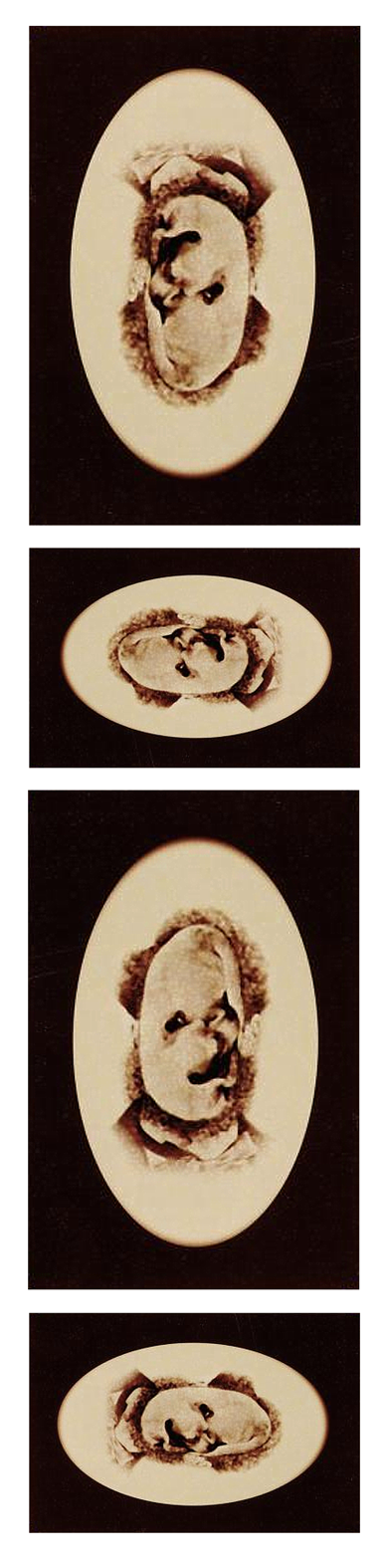
Reproduced above (the same image four times, but repositioned and resized) is a Victorian-era “puzzle picture” that was printed on an advertising card in Liverpool UK in the 1870s. The caption read “What is it?” 

Beginning at the top, the first two images are somewhat suggestive (not unlike an inkblot) but require some work to interpret. The third one is more likely to be seen as a human face, albeit greatly distorted. 

But the puzzle is solved at the bottom, when a closer look reveals that all four have resulted from a single photograph of a harmless sleeping puppy dog. For more on embedded figures and picture puzzles, see this brief video, articles on Clemens Gretter, Gobolinks, and camouflage.

Friday, September 9, 2022

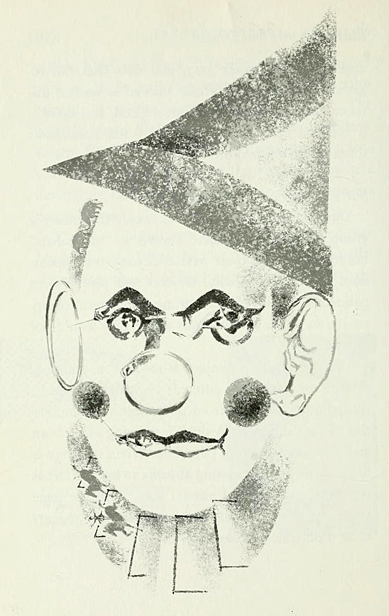
an upright clown but a circus when turned clockwise

Above Viewed upright, it is a portrait of a clown. Rotate one turn clockwise, and it becomes a circus scene. Ambiguity. Double image. Puzzle picture. Hidden figure. For more on embedded figures and camouflage, go here. Artist unknown, from Larry Kettelkamp, Tricks of Eye and Mind: The Story of Optical Illusions, 1974.

Sunday, June 19, 2022

Arcimboldo, Grandville and William Charles Morris


William Charles Morris
Aha, I have recently run across the work of an American political cartoonist named William Charles Morris (1874-1940). I don’t know if he had any interest or involvement in camouflage per se, but there are examples of his work in which he used visual puns, visual metamorphosis (in the manner of Grandville), and spelled out words with figures.

Given the era he lived in, one of his favorite subjects was US President Theodore Roosevelt. TR had squinty eyes, an arched moustache, and prominent teeth, and Morris made a portrait of him (as he was seeking a third term in office) in which his face becomes the White House, his teeth having “evolved” into pillars. In a cartoon titled “Rabbit Hunting,” the slogan SQUARE DEAL is spelled out by rabbits in the background. 

Rabbit Hunting

Morris also made a drawing, titled “Hi$ Late$t Picture: The Northwe$tern Farmer,” in which he used shape substitutions and visual puns, like those of Arcimboldo.

To my mind, Morris was at his finest when he created a pun-laden portrait of railroad executive E.H. Harriman (as shown above), titled “The Colossus of ‘Roads.’” From our earlier years, we clearly remember Harriman’s son, New York statesman Averell Harriman.

See also the well-known “living photographs” of Arthur Mole and John Thomas at, and a short film discussion of embedded figures.

Prosperity Personified

Wednesday, March 16, 2022

a yankee doodle dante—we crave your condescension

camouflaged figures

Louis Untermeyer, Bygones: The Recollections of Louis Untermeyer. New York: Harcourt Brace and World, 1965. Excerpts from various pages as noted—

[Untermeyer’s father] was a trouble-evader and a peacemaker; it was easy to take advantage of him, which everyone did, especially his children. He was not a talker; he relied on the stereotypes of conversation, and even there he fell into malapropisms. Something cheap was not worth “a hell of beans” and a pitiful occurrence was “heartrendering.” He was never sure whether the first line of his favorite Harrigan and Hart [musical comedy writing team] song was “We crave your kind attention” or “We crave your condescension” (p. 7).

Influenced by the sprightly British journalist-essayist-novelist-poet G.K. Chesterton, I was much given to a style that employed epigrammatic checks and balances, appositions, paradoxes, and puns. I remember dismissing a rather commonplace collection of Gaelic poetry as “A Child’s Garden of Erse” and characterizing the author of an abortive American epic as “A Yankee Doodle Dante.” I referred to a Dowson-Beardsley pastiche as being “less erotic than Pierrotic.” I inquired, since much of the Restoration comedy took place in elegant country houses, was it not a comedy of manors? (p. 44).

It is as a poet that I most resent those resentful of puns, for the pun is, per se, a poetic device. Poetry is essentially a form of play, a play of metaphor, a play of rhyme. The pun is another form of syllabic playfulness, a matching of sounds that, like rhyme, are similar yet not quite the same—a matchng and shifting of vowels and consonants, an adroit assonance sometimes derided as jackassonance. Whatever form it takes, searching or silly, the pun springs spontaneously from the same combination of wit and imagination which speeds the poetic impulse (p. 45).

“T.S. Eliot and I have our similarities and our differences,” he [poet Robert Frost] wrote to me, “We are both poets and we both like to play. That’s the similarity. The difference in this: I like to play euchre; he likes to play Eurcharist” (p. 46).

When an interviewer, pointing to a world constantly at war, asked [G.K.] Chesterton whether Christianity had failed, Chesterton replied, “No, it has not failed. Christianity has not yet been tried” (p. 72). 

•••

NOTE  Embedded figures are discussed in this posted short video.

Monday, August 30, 2021

video / a dazzle advertisement of a dazzling discovery

Above A damaged, 19th century Swiss photograph of a small child in a white hat (just left of center) seated on her father's lap, with her mother standing at the right. Circumstances are such that, at first glance, some viewers interpret the child's face as the eye of a profile of Christ, facing left. 

Like the man in the moon, or a face in the clouds, this is an example of seeing apparently meaningful forms in random or accidental formations, called pareidolia. Unless of course (as might well be), the photograph has been altered, to increase the likelihood of seeing the figure. 

As I discuss in a new online 25-minute video talk, titled Art, Embedded Figures, and Camouflage, there is a long tradition of the purposeful insertion of embedded figures (or, as they are sometimes called, camouflaged figures), in picture puzzles and works of art. Here's a brief excerpt from the video narration, followed by the two advertising diagrams that it describes—

Not surprisingly, embedded figures have also been used in advertising. During World War I, for example, at the height of the public’s interest in dazzle-painted ship camouflage, this unidentified diagram was published in a British magazine, repeatedly—on the same page, in the same location—for several weeks. It simply read: A dazzle advertisement of a dazzling discovery. That was all that anyone knew. 

And then, suddenly, in the last week of the ad campaign, an “embedded figure” solution appeared, also on the same page, same place. Camouflage has its uses, it said, but Firth’s Stainless Steel needs no protective covering.


Saturday, December 12, 2020

mechanic and dairyman listed as camouflage artist

RECRUIT OF DRAFT AGE HAS EIGHTY SIX YEARS EXPERIENCE: Personnel Section of Mustering Office Finds a Man Who’s Done Many Things: Dairyman Finally Listed as Camouflage Artist, in Washington Standard (Olympia WA), August 2, 1918, p. 5—

Embedded Cow
Men in the personnel section of the mustering office have rare opportunities for the study of human nature. They interview all styles and conditions of men in filling out the personnel question cards. Many of the replies to their questions are numerous, while the stories that some of the new recruits tell them would find a place among the best of Ananias’ tales.

When the card of one dairyman was filled out it was found that although he was 28 years of age, he had already had 86 years of experience in various lines of work. Besides being a mechanical engineer, he had been a mechanic in several lines, was a poet and artist. The interviewer listed him as a camouflage artist.…

RELATED POSTS

Embedded Figures 

Hypothetical Camouflage

Friday, February 14, 2020

Dust to dust / Dali, skulls, and reminders of death

C. Allen Gilbert, All Is Vanity
Ten years ago, we blogged about an American illustrator named C. Allan Gilbert (1873-1929), who was also an early contributor to animated films. Unfortunately, if and when he is remembered, it is inevitably because of the continuing popularity of one of his illustrations, a memento mori (reminder of mortality) titled All is Vanity (1892). It is a double image or visual pun in which the scene of a woman admiring herself in a mirror appears instead to be a skull when viewed from a greater distance. During World War I, Gilbert was also among a number of US artists who worked for the US Shipping Board (the Emergency Fleet Corporation) in applying dazzle camouflage to US merchant ships.

Gilbert's skull illusion is skillfully made and undoubtedly deserving of its popularity. But it is somewhat less than original. Throughout history, there have been repeated attempts at designing scenes of daily life that, from a distance, change into icons of death. Below is an example of one made by a German artist in 1866, in which two young people take on the shape of a skull when viewed from a distance. When translated, the label beneath the image reads "blood and decay." The Spanish surrealist Salvador Dali alluded to the same symbolism when he devised a "double image" (in a 1940 painting called Slave Market with the Disappearing Bust of Voltaire) that at first appears to be a bust of the French philosopher Voltaire, and then, at other times, perhaps an image of two nuns.

Anon, Blood and Decay

And at last, below is another example, also German, from the 19th century.


Set Design: Camouflage is as old as show business

Above Here are the sheep. But what has become of the shepherd? Can you find him?

•••

Daniel Dillon, STAGE SETTERS IN US FORCE in World War History (New York), August 11, 1917—

Indicative of the thoroughness and extent of preparation the American troops are now undergoing in occupying the trenches, is the fact that a large number of “stage setters” and “scenic painters,” architects, constructive engineers, etc., are now on the French and British fronts, learning the art of camouflage, that is, screening the artillery and concealing the observation points.…

•••

ART OF CAMOUFLAGE OLD AS SHOW BUSINESS in Cincinnati Commercial Tribune (Cincinnati OH), June 16, 1918, p. 17—

The art of camouflage, which has recently received widespread publicity because of its application to military operations in Europe, is really as old as show business, according to Blanche Evans, one of the pretty girls on the summer vaudeville bill at Keith’s [a major theatre at the current location of Fountain Square on Walnut Street] this week.

According to Miss Evans, theatre folks deserve full credit for developing and nursing this art of deceiving the eye through the ages, and of perfecting it to such a degree that it has become one of the important factors in modern warfare.

“Why, the very spirit of the stage is that of camouflage,” declared Miss Evans recently. “This stage makes believe, makes things appear what they are not, and that is camouflage in spirit and reality. Stage scenic artists are expert camoufleurs. They take a bit of canvas and with brush and paint transform it into a parlor, woods, or palace with ease. A series of costumes can change a single actor into a king, a beggar, a policeman, or a man of society. What is that but camouflage?…

The real relation between stage camouflage and military camouflage is perhaps best emphasized by the fact that hundreds of former theatre scenic artists are now engaged on the European battlefronts in creating illusions to deceive the observations of the enemy. American scenic artists are beginning to serve their country in the same way and before long we will have contributed hundreds to the same cause. Military camouflage is saving the lives of hundreds of soldiers every day and the theatre should be given full military credit for its patient and untiring development of the art.”


•••

Melvin M. Riddle, CAMOUFLAGE! Concerning one of the Major Arts of Motion Pictures. Atlanta Constitution (Atlanta GA), October 24, 1920—

…camouflage is an art without a knowledge of which, one of the greatest industries of today—the motion picture industry—could hardly exist.

The art of camouflage is a vital factor—in fact, it might be said, almost a prime factor in the production of motion pictures…

It is the general impression, perhaps, that the war first developed the art of camouflage. This impression, however, is erroneous. For long before the war began, the art had been developed to a high degree by the industry of motion picture production, but as developed by the industry, it was an unidentified art because it was an art without a name. The truth of this assertion is proven by the fact that when America entered the war, men from the motion picture studios, who had gained a knowledge of the art of scenic deception, formed an important part of the ranks of special camouflage corps which were sent over there. This was because these men had already a practical knowledge of this great study and had only to adapt this knowledge to the particular requirements of defense in war.

The one great difference between camouflage as practiced in motion pictures and as practiced in war is that war camouflage, although deceiving to the human optics, is readily detected by the camera, while in motion pictures the camouflage is especially arranged and prepared to deceive the eye of the camera, although it sometimes also deceives the human eye, unless a very close-up view is obtained. Primarily, it is the camera lens upon which the deception is practiced, however, for the eye of the camera is ultimately the eyes of the motion picture audience.

Motion pictures, before the beginning of the war, did more and are doing more to develop the art of camouflage on a large scale than any other industry or even possibly could do. Camouflage is the very life of a motion picture—a vital necessity. Of course, the art has been employed from time immemorial in the theatrical profession—in the dressing of stage settings for legitimate productions, but camouflage, as used on a stage, is very limited in its scope, and is admittedly camouflage, and for this reason loses its very effectiveness. It is when camouflage is mistaken for the genuine and the delusion is unquestioned, that it really serves the purpose for which it is intended.…


•••

See also theatre designer

Camouflage used to conceal moonshine stills

Above Someone has fallen asleep in church (probably drinking the night before) and is snoring loudly. Can you find the culprit?

•••

CAMOUFLAGE USED TO COVER STILLS in Centralia Evening Sentinel (Centralia IL), November 12, 1923, p. 2—

Helena MT—Montana prohibition officers are searching for a war veteran who saw service overseas with a camouflage outfit. According to George Costello, dry agent of Glasgow MT, bootleggers are believed to be employing the returned veteran to conceal their moonshine stills on Montana farms.

Costello said a still was recently discovered in a tent near Bozeman MT after many weeks search. The moonshine-making outfit had been hidden in a tent, painted green, and pitched in a clump of willows. Several times the dry officers came within a few feet of the hidden still but were unable to locate it because of the successful camouflage. A large number of barrels, hidden in the willows nearby, were painted green.

Three hundred gallons of whiskey, 1,200 pounds of sugar, 1,000 pounds of corn, and 18 barrels of mash, ready for distilling were found in the cache.

Evidence of the work of the veteran has been uncovered in other parts of the state, it was said. In a northern Montana grain field, a still was discovered hidden under a tent, which was covered with bunches of grain, tied together, and ready for harvesting. For some days dry agents thought the disguised tent was a mound of grain.

Near Havre MT, a still was found on a mountain. The still was made of canvas and was located on the edge of a cliff. Painted to resemble rocks, it was many weeks before the moonshiners’ outfit was discovered.

At Great Falls a still was recently found on the banks of the Missouri River. Here the still was located in a cave. Painted canvas trees were used to disguise a door, which formed the entrance to the cave.

Saturday, November 2, 2019

Portrait of Woodrow Wilson | Grouping during WWI

One reason for the effectiveness of camouflage, of various kinds, is our innate tendency to perceive similar components as "belonging together" (called unit-forming) and to see dissimilar components as "belonging apart" (unit-breaking). There was widespread interest in this and related aspects of vision, among artists and scientists, prior to and during World War I. Here are two wartime examples of the playful use of grouping.

Above is a photograph that appears to be an image of US President Woodrow Wilson. It was made by carefully arranging more than twenty thousand soldiers at Camp Chilocothe in Ohio. By wearing certain clothing and standing in designated locations, the soldiers were able "to produce all the lines and shading in a likeness of the face…The lighter portions of the picture were made by soldiers who wore no coats or hats, while in the darker sections, the men were in full uniform. Nearly 50 men were required to represent one lens of the president's eyeglasses. There were 21,000 men in the picture."

Below is President Wilson's image again. It was produced in 1917 by Harvey Parsons, a cartoonist for a Kansas newspaper, and a typesetter named O.W. Kelly. The portrait is made entirely of metal letters, produced on a linotype machine. The letters can also be read as the text of a statement that Wilson had written to Pope Benedictus. As explained at the time, "light-faced type composes the high lights of the picture, and black or bold-faced, the half-tones and darker portions. The proper spacing of the letters is not destroyed, and the reply to the Pope is legible in spite of the underlying likeness." This second method of portraiture can today, of course, be easily made on a computer with an app that is made for the purpose.


Sunday, August 4, 2019

Chicago camouflage artist's wife held for shoplifting

Above World War I-era embedded figure puzzle as published in the St Joseph Daily Press (St Joseph MO), April 16, 1915. Artist unknown.

•••

FINDS MISSING WIFE IS HELD AS SHOPLIFTER in Sioux City Journal (Sioux City IA), April 25, 1922—

Chicago, April 24—A three days' search for a missing wife ended when her husband discovered her in the house of correction serving a 10 days' sentence as a shoplifter.

The women is Mrs. Lilian Norman, 22. Her husband, Frank, is well known as a professional skater, having appeared in the College Inn and other places of entertainment. He is also a commercial painter and during the war was a camouflage artist.

They were married a year and a half ago, and until a month ago they resided in Kansas, which state was the birthplace and home of Mrs. Norman. Four weeks ago they came to Chicago. 

Norman believes his wife innocent of the charge of taking a piece of cloth. He says some professional shoplifter, near capture, thrust it in her handbag.

Sunday, July 7, 2019

Achtung! Beware of another camouflaged dog!

Above This is the cover page of the inaugural issue of a German satirical magazine called Kladderadatsch. It was founded 1848 in Berlin by David Kalisch and Albert Hofmann. There is a story (true or not) that Kalisch and the magazine's staff were having dinner one evening, in part to reach an agreement about the name for the magazine.

During dinner, a dog knocked over a stack of plates, at the sound of which someone at the table said "Kladderadatsch!" which is the German sound for "Crash!" Kalisch loved it (one wonders if he was inspired by the French magazine Le Charivari, meaning "street noise" and/or The London Charivari) and decided to use that expression as the magazine's name.

In the top center of the cover is a drawing of a smiling boy (see below) by Wilhelm Scholz, in which, in tribute to the noisy dog, there is a drawing of the dog hidden (camouflaged, embedded) in the boy's cheek to the left of his nose. That same drawing continued to be on the cover for forty years.

Find the hidden dog
See also: Bevis Hillier, Cartoons and Caricatures. London: Studio Vista, 1970.

Monday, June 24, 2019

Canine Stealth | Can you find the cubidachshund?

Can you find the cubist dog?
Above This is one of a series of cubist-themed puzzles that were published in the San Francisco Sunday Call during 1913. This network of lines was published on the entertainment page on May 26, with a challenge to the readers to "find the cubidog" and, more specifically, to "find a cubidachshund" by filling in a certain number of shapes. The solution (posted below) was revealed the following Sunday. This is an embedded figure puzzle, of course, a variant of camouflage. But this example predates World War I, and "camouflage" was not yet an English word. Instead, this is a spin-off from the famous Armory Show which opened in New York in early 1913. It was the American public's first introduction to Cubism. More>>>


Tuesday, June 11, 2019

Connecting the Dots Somewhere in Dijon, France

the puzzle
Above A "connect the dots" puzzle titled DOTS "SOMEWHERE IN FRANCE" by Clifford Leon Sherman, as published in  The Anaconda Standard (Anaconda MT), August 31, 1917. The text beneath the puzzle reads—

DEAR FOLKS: We had a lot of fun today watching one of the men in the camouflage department ["somewhere in France"] matching up his paints and decorating the ambulances and ammunition wagons, so they could not be seen easily against the background. One of the boys in my company asked him why he didn't paint himself so as to be invisible. He replied in a joking way, "My dear friend, I don't want to waste any time on myself. And there is no use wasting any time on you, for I can't help it if you look naturally like a ________" [the missing word is in the completed drawing below].

•••

We live in Iowa, not far from an architectural firm called StruXture Architects. It was founded in 1934 by David B. Toenjes, who was the first person to earn an architectural degree at Iowa State University in Ames. He also served in France during World War I, where he was stationed at Dijon ("somewhere in France"), which was also the location of a major American camouflage production facility.

We recently found this brief news article, titled TEN YEARS AGO IN THE SERVICE, in The Waterloo Courier, September 8, 1928—

"I was stationed at Dijon, France, 10 years ago," said David B. Toenjes [of Waterloo IA]. "Our company had charge of getting supplies up to the front from Dijon base." Toenjes was first sergeant of Company C, 309th machine shop repair unit, MTC. 

"At Dijon there was a camouflage park, where papier mache goats, cows and everything else were made. I went over one day to look around. Everything looked natural, but when I sat on a log, things weren't so natural. It was made of paper.

Armistice Day the boys put on a big celebration. The last one trailed in four days later with a woman's fur around his neck." 

the answer

Sunday, May 5, 2019

Cave Canem | How To Camouflage Your Dog

How to camouflage your dog
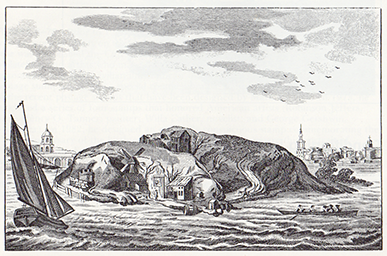
Artist unknown. Catchpenny print, 18th century "puzzle picture" titled The Isle of Dogs.

•••

Anon, THE MAGIC OF CAMOUFLAGE in Edmonton Journal (Edmonton, Alberta, Canada), September 19, 1918, p. 6—

An American artist has discovered a new use of camouflage. He has a favorite dog which his neighbors have been kicking out of their way whenever the animal chanced to stray there.

He had been admiring the great camouflaged battleships on the Hudson River and reading of eminent members of the British Royal Academy, garbed as colonels, directing painters on the Western Front how to camouflage a gun emplacement into a village school or a poultry run.

A happy idea struck him: he would camouflage his dog—all but the tip of his tail. So he has, with the result that the dog now looks like something else, and enjoys complete immunity from the attentions of his neighbors, for he moves about as a beautiful cloud effect.