Showing posts with label British camouflage. Show all posts

Thursday, August 28, 2025

Ezra Pound / on vorticism and WWI ship camouflage

Above John Everett, SS Sardinian (Allan Line) discharging 6-in Shells made in Canada, c1918, as published in Canadian War Records Office, ART & WAR: Canadian War Memorials. London, c1920.

•••

Ezra Pound, “The Death of Vorticism” in The Little Review, February / March 1919, pp. 45 and 48—

It may be said that after all kinds of naval camouflage without satisfaction the government has at last put a Vorticist lieutenant [Edward Wadsworth] in charge of the biggest port in England [at Liverpool]; that the French aesthetic camouflagists working on theory and at a distance from the sea-bord, are unsatisfactory and that their work has to be corrected.

RELATED LINKS

Dazzle Camouflage: What is it and how did it work? /  Nature, Art, and Camouflage / Art, Women's Rights, and Camouflage /  Embedded Figures, Art, and Camouflage / Art, Gestalt, and Camouflage /  Optical science meets visual art /  Disruption versus dazzle / Chicanery and conspicuousness /  Under the big top at Sims' circus

Saturday, August 16, 2025

Norman Wilkinson / UK dazzle camoufleur lives again

British artist / camoufleur Norman Wilkinson
Now here’s an odd discovery: The British artist Norman Wilkinson (we've blogged about him numerous times) is credited as the innovator of what is now commonly known as “dazzle painting,” the use of disruptive geometric designs during World War I for ship camouflage. His usual biographical dates are 1878-1971. Shown above is a portrait photograph from 1911 (restored and AI colorized), in advance of the war, at which time he was working for the Illustrated London News.

Here’s the oddity: On February 16, 1934, an article in the Glasgow Herald stated that—

Mr. Norman Wilkinson, the well-known scenic and poster artist, who died yesterday at his home in London, is perhaps best remembered as the inventor of naval camouflage during the war. For the sake of distinction, it was called “dazzle” painting, and its object was to so distort the normal appearance of a vessel that her actual course became a matter of doubt to an enemy submarine officer intending to torpedo the ship. Earlier forms of camouflage had proved much less successful than “dazzle” painting.…

That announcement of course does not comply with later accounts of Wilkinson’s life, which state that he died in 1971. Fortunately, in a subsequent issue (February 23), the Glasgow Herald said this instead—

We very much regret that in our issue of February 16 we published a paragraph announcing the death in London of Mr. Norman Wilkinson, “the scenic artist,” and remembering the versatility of the celebrated inventor of marine camouflage we assumed from the brief notice of information that it was he who had died. We therefore offer full apology to Mr.Wilkinson for the erroneous report unwittingly circulated and for the confusion and embarrassment inseparable from the addition of his name to the now considerable list of distinguished men who have lived to read their own obituary notices.

Wilkinson, Dazzle Scheme Components (c1917)

RELATED LINKS

Dazzle Camouflage: What is it and how did it work? /  Nature, Art, and Camouflage / Art, Women's Rights, and Camouflage /  Embedded Figures, Art, and Camouflage / Art, Gestalt, and Camouflage /  Optical science meets visual art /  Disruption versus dazzle / Chicanery and conspicuousness /  Under the big top at Sims' circus

Thursday, July 3, 2025

have lent a beauty and color to ocean-going vessels

John Everett
In years past, we have posted images of and articles about the World War I-era paintings of dazzle-camouflaged ships by British artist (Herbert Barnard) John Everett. Those earlier blog posts can be accessed online here. A number of his artworks were exhibited in New York in 1918, as is described in a lengthy article and interview in the Atlanta Constitution, the full text of which is quoted below. It was apparently written by Anne Morton Lane (London correspondent for the New York Mail and Express) and appeared in other newspapers as well. The paintings by Everett in this post are in the collection of the Royal Museums in Greenwich UK, and are not the same as those reproduced in earlier posts.

•••

"DAZZLE ARTIST" TO EXHIBIT HERE Outcome of Naval Camouflage, Work of English Painter, Is Unique in Its Interest and Beauty, in Atlanta Constitution (Atlanta GA), December 22, 1918—

London, December 9—Toward the middle of December there will be an exhibition in New York of pictures which have received the sanction of the British government to be shown outside Great Britain. They are the work of John Everett, a highly interesting and distinguished English artist, who has made a specialty of seascapes, and pictures of ships on the high seas, and at rest in docks.

Early in the war when the use of camouflage as applied to shipping became a special and practical portion of defense at sea, as the camouflage of guns, airplanes, munition sheds and other machinery of battles became a component part of war on land, Mr. Everett saw the wonderful possibilities that might accrue from a record of the commerce afloat as a pictorial history in color. As we all know, now that hostilities have ceased, the mystery that surrounded all ports and shipping in the allied countries was as necessary as it was dense. Therefore it was only after many weary months that Mr. Everett through personal persuasion, practical influence and genuine hard work was accorded the privilege by his majesty's government of visiting the great docks of London and Liverpool in order that he might make pictures of the amazing transformations wrought by paint and scientific knowledge upon the units of the fleet.


John Everett


John Everett

Submarines at Rest
And now that the U-boats have ceased from troubling and the submarines are at rest within British waters. by permission of his majesty's government Mr. Everett will shortly be able to display the fruit of his two or three years' work in dockyards, at exhibitions to be held in London and New York.

I went to see Mr. Everett the other day in his interesting and remarkable studio, which is situated off the beaten track of general traffic in a sort of side-tracked field in St. John's Wood—a well-known artists' quarter of suburban London. This studio of Mr. Everett's is a converted barn of great size and with unusual lighting qualifications. Its walls are lined, and a large portion of its floor space filled with pictures of ships. All these ships display camouflage designs, and they represent many vessels that have plied their way between England and America in war-time, and survived the lurking dangers of enemy attacks. Others have succumbed to the perils of U-boats. These pictures form a remarkable record that must be of extreme interest not only to those people who have crossed the Atlantic in war-time, but also to many thousands who have heard of the strange masquerading of ships on the high seas.

In England the painting and designing of sea-going vessels has been carried on under the direction of a department known colloquially as the "dazzle office," and Mr. Everett was appointed as its illustrator.

Curtain Is Lifted
Now that the curtain is being lifted from some of the amazing secrets of the admiralty and war office. Mr. Everett has many interesting things to relate concerning the art of "dazzle-painting" at sea, and the possibility of its continuation after the war.

"Although the word camouflage is an excellent one that has been adopted by the Anglo-Saxon tongue since its uses in war-time have been discovered," said Mr. Everett, "I think that the descriptive 'dazzle-ships' is a more descriptive title when applied to the use of this art at sea. And after all, it is not a very new idea, because we are told that the ancient Greeks painted their ships with big eyes and cheeks upon their bows to give them a terrifying expression of wisdom that might serve to confound their enemies. But we moderns did better than this in war-time; we had our ships painted in ways such that their strange colorings and curious stripings and curves would puzzle the enemy and serve to give rise to uncertainty by dazzling the eyes of the watchful foe. In fact, as I very early discovered in my work as official artist to the dazzle department, the object of ship painting in war-time has really very little to do with the real meaning of the French word camouflage, which means the dissimulation of natural objects with the landscape by protective coloring. Dazzle-painting was invented by the well-known sea painter, Lieutenant Commander Norman WIlkinson, RNVR, and it is the only system which has practically solved the problem of the variation of light, and which attains its object not by eluding the submarine by invisibility, but by confusing its observers.

Limitations of Paint
By recognizing the limitations of paint, the art of dazzle as applied to ocean-going ships pushes these limitations as far as possible, and makes the object of its being not invisibility, but distortion; it makes the problem of calculating the course of vessel extremely difficult.

"Each design, as you will notice in the many pictures I have painted of ships, is entirely different from the other entirely different from the other. No two dazzle-ships are alike in detail, either in color or design; the success of Commander Wilkinson's inventions were so marked during all the weary war-time months that they were adopted by every entente nation with a marine service. I think that this is one of the reasons why my pictures when they are seen in New York will be of extreme interest Americans. They will then be able to see exactly the source from which came all those wonder ships that braved the perils of the sea during the past four years. I have shown my portraits of these masquerading voyagers in English waters, and British docks—settings that perhaps will be better appreciated nowadays in the new world, because it is so closely linked in these days with the old."

Among the pictures which will be seen in New York next month by permission of the British government are "HMS Victorian Bringing a Convoy of American Troops Into London." Mr. Everett told me that this ship was afterwards torpedoed. She was hit amidships, but by some miracle she was brought into port and no lives were lost. Another picture is of the steamship Shuma discharging timber.

Dazzled Flour Ship
"This," explained Mr. Everett, "in a ship with an interesting dazzle showing a great deal of light sky blue picked out with black and white." Another picture shows a dazzled flour ship, and another the conversion of the Cunard steamship Nanerig into an armored cruiser. These and many other pictures of a like kind display with extraordinary clearness something of the practical side of what those who have "gone down to the sea in ships" have had to do in order to confound the enemy.

There is something very dramatic about these pictures of Mr. Everett's. They give the story of the life of the sea, and the traffic across that great grim stretch of water between England and America with wonderful vividness. The artist confesses that these pictures, painted under circumstances both difficult and dangerous, are the most fascinating work he has ever undertaken.

"The painting of these pictures, which I regard as a sort of diary of the merchant service at sea during war-time," he said, "has given me an immense belief in and admiration for this dazzle theory; the whole point of it has been the deception of the submarine as to the course of a ship, thus causing miscalculation of her distance. You ask me if the dazzled-ships will die with war-time; I suppose for practical purposes they will do so. But it seems to me a pity, for undoubtedly they have lent a beauty and color to ocean-going vessels and have transformed dirty old tramp steamers into objects of remarkable harmony of shape and hue."

Certainly amongst the strange records which the war leaves behind it these paintings of "dazzle-ships" by John Everett will not be among the least curious. It has been suggested that the dazzled colors might still be used in peace time, not to distort, but to emphasize shipping. As Mr. Everett himself suggests, it certainly might be diverted from its past uses to the purpose of making a ship's course more clear and thus bringing about an avoidance of collisions.

John Everett


RELATED LINKS 

Dazzle Camouflage: What is it and how did it work? /  Nature, Art, and Camouflage / Art, Women's Rights, and Camouflage /  Embedded Figures, Art, and Camouflage / Art, Gestalt, and Camouflage /  Optical science meets visual art /  Disruption versus dazzle / Chicanery and conspicuousness / 

Saturday, May 3, 2025

Wol I thought you was part of the camouflage scheme

Above Charles Grave, cartoon from Punch, January 23, 1918: Docker (to Jack, who has been silently regarding him). “Wot yer starin’ at, Nosey?” Jack: “You shouldn’t have spoke, mate. I thought you was part of the cammyflage scheme.”

•••

CAP’N CALEB’S CAMOUFLAGE in Punch, June 12, 1918, p. 374.

He was an object of interest in the bar of “The Sloop,” for he was one of the crew of a vessel which had been torpedoed off the headland during the night, and he had been landed with other survivors at the fishing village that morning.

“Yes, it gives yer a shock being torpedoed,” he said in answer to a question; “but I'm orlright now, and I'll be better when I've 'ad some more beer. I ain't lost my thirst, not that you could notice, though I was blown up in the air when the torpedo 'it us, and came down in the sea.”

The questioner took the hint and ordered another pint of beer, which the shipwrecked mariner drank deliberately with the air of a connoisseur.

“It ain't bad beer that, boss," he remarked politely to the landlord; "but I reckon a man would get waterlogged before 'e could get drunk on it.”

The landlord smiled and discreetly turned the oonversation back to the subject of the submarine menace.

“No, I ain't afraid o’ submarines, but my missus is;” said the mariner; ”that's why I'm 'ere. I’ve been torpedoed twice this year, and my missus is to blame. But it serves me right for listening to ‘er and leavin’ the old Saucy Anne.”

“It all comes o’ this cammyflage ideas,” he went on with a heavy sigh. "If it ‘adn't been for old Cap'n Caleb's a-cammyflagin‘ the Saucy Anne the missus'd never've got the wind up about submarines and I'd never've been torpedoed. And I wouldn't be standin’ ‘ere now with an empty glass in me ‘and."

It was the landlord who took the hint this time end hastened to remedy the defect.

It was like this, y'see," resumed the victim of camouflage when he had again refreshed himself. "I was third mate on the Saucy Anne—not that third mate meant much, 'cos the crew was only four all told and the Saucy Anne was a little old steamer o' two hundred ton gross. But she was a nice little craft, and old Cap'n Caleb Collins, what was master and owner, was one o' the best—treated us more like pals! than a crew, 'e did.

”Five year I'd been third mate on the Saucy Anne when the War started, bringin' coal from Cardiff to Port Carbis, and home regular every ten days. Cap’n Caleb ’ad been doin’ that for twenty year, and he jest went on doin' it and never worried hisself about the, War.

“Then the German submarines started their dirty work and sunk a Port Carbis boat; but our old man took no notice and kep' on sailin' reg’lar—said he'd like to see any blinkin' German tryin' to sink 'im. Well, two more Port Carbis vessels was sunk, and some o' the other skippers starts what they calls ‘protectin’ themselves'; but Cap'n Caleb never did nothin'. Then a chap in uniform comes down to Port Carbis and he starts explainin' this 'ere cammy-flagin' idea to the owners.”

He paused to empty his glass once more, wiped his mouth with the back of his hairy hand and proceeded with his story.

"The officer, or whatever he was, tells Cap'n Caleb about paintin' the Saucy Anne to cammyflage 'er, and the old man listens attentive. ‘Yes,' says 'e, I sees the notion, Sir. The old ship could do with a coat o' paint, 'er not 'aving 'ad much this seven year, and I'll see about cammyflagin’ 'er myself. We've got some artist chaps 'ere in Port Carbis,' says the Cap'n, and I'll 'are the Saucy Anne cammyflaged proper,' 'e says.

"So Cap'n Caleb 'e lays the old ship up for a week, runs 'er inter a boat-builder's yard and gets an artist and a sign-painter from the town to come and 'ave a go at cammyflagin' the Saucy Anne. He never let none o’ the crew nor nobody see 'er, and when the painters was done 'e 'as 'er refloated, but with big tarpaulins 'anging down 'er sides to protect the new cammyflage paint, 'e says. Not till we was loaded and casting off from the quay does 'e let us reef them tarpaulins.

"I knowed there was something funny about as as soon as the Saucy Anne starts steamin’ out o' the 'arbour,' 'cos the crowd on the jetty starts runnin' along to watch us, and some of 'em cheered and waved their 'ats. So I takes a good squint overside to see wind our now caummyflage looks like—and I nearly fell overboard with the shock when I sees what Cap'n Caleb 'ad 'ad done.

"There was a big Union Jack painted right down the bows o' the Saucy Anne; 'er sides was painted bright blue; and in white letters on 'em—big white letters you could have read a mile away almost—right along from the bows to the stern, there was painted:—

‘BRITISH—AND DAMN YOUR SUBMARINES!'”

The listeners in the bar of “The Sloop" gasped, restrained an inclination to cheer, and some of them almost struggled for the privilege of buying the shipwrecked mariner more beer.

“Surprised? You're right," he resumed with a reminiscent grin. "I was surprised, so was the rest of the crew, and so was everybody in Port Carbis. When the bloke at the Admiralty station on the point outside the bay saw us 'o nearly 'ad 'ysterics and starts wagging flags at us; but Cap’n Caleb takes no notice. ‘I'il give 'em cammyllage’ he says, looking as proud as punch.”

“Well, we gets to Cardiff, and a fine how-d'-ye-do there was there, I can tell yer. ‘I reckon they think the Saucy Anne is the Royal yacht,' says the Cap’n solemn-like, when they starts cheerin’ us from other ships and blowin' sirens, and a crowd comes down to the wharf to welcome us. We all had plenty o' free beer that night—all 'cept the Cap'n, ‘im being a teetotaler end never drinkin' nothin' but gin.

In the morning down comes an old chap with gold braid and brass buttons to the wharf, just as Cap'n Caleb was standin' admirin' the Saucy Anne. 'E takes a look at our ship, then 'e goes red in the face.

“‘Wot does this moan, Cap’n?’ ‘e says.

“'That's my cammyflage, Sir,' says Cap'n Caleb, 'aud that’s my motter on the ship's side.’

“The old bloke in the gold braid starts argyfyin', but I could see 'e was laughin’ inside, and presently he shakes 'ands with our old man, gives ‘im a cigar and goes away.

"Well, to cut a lomg story short, we sails back to Port Carbis, and there's a crowd to meet us, cheerin' like billyoh; but when I gets ashore them's my missus on the quay, cryin’ ‘er eyes out. Said she'd never expected to see me again, and begged an’ prayed too not to make another voyage in the Saucy Anne. She said it was temptin' Providence to sail in a vessel painted like that, and we'd get torpedoed next trip as sure as sure.

I argues with 'er till I was nearly black in the face, then I gives way and does what she asks for the sake of peace and quiet. Cap'n Caleb 'o said it was like deserting in face of the enemy, but I left ‘im for the sake of the missus and got another ship."

He gazed into his glass and mournfully shook his head.  

"Yes, it's all the fault of the missus," he concluded with a sigh. "I tried another ship, and got torpedoed first voyage, and now 'ere I am torpedoed again. It's almost enough to make a man turn teetotal. The Saucy Anne’s still runnin’ and never been touched; but I did ‘ear as the Admiralty made Cap'n Caleb put some other kind o' cammyflage on her." 

RELATED LINKS    

Dazzle Camouflage: What is it and how did it work? /  Nature, Art, and Camouflage / Art, Women's Rights, and Camouflage /  Embedded Figures, Art, and Camouflage / Art, Gestalt, and Camouflage /  Optical science meets visual art /  Disruption versus dazzle / Chicanery and conspicuousness /  Under the big top at Sims' circus

Sunday, February 23, 2025

a dazzling pair of scarecrows—or tailors' dummies

Cover / Dazzle News Online
 

CAMOUFLAGED SKIRTS in Thames Star (New Zealand), Vol 52 No 13729, June 22, 1918, p. 4—

The latest concerning camouflage comes from "Lady Kitty," a Melbourne writer, who says:—The "camouflage" skirt! It is here. Oh! Oh! Oh! The cretonne skirt was bad enough; but the camouflage skirt is a sartorial disaster. There is not an article in the whole of one's wardrobe that could possibly "go" with the skirt. It made its first appearance in Sydney, where six and eight guineas are being asked—and given—for these camouflage skirts. They are of silk, but such silk! It is most suitably called "crazy." This demented silk starts at being a wonderful pattern in colors which absolutely pale the gorgeousness of all Eastern color magnificence, when suddenly, it is camouflaged with great patches of dullish background. Most weird! Camouflage, you know, is to make things appear other than what they really are—to disguise them, in fact, so that the crazy silk sets out to be a very striking fabric when it is suddenly camouflaged by broad strips of plain color which quite disguise its original identity, but really make it more striking still. Camouflage parties, at which people wear camouflaged fancy dress, have become quite a rage for fund-raising purposes; and if guests are ingenious enough the result is screamingly tunny. From start to finish nothing is what it seems. Even the host and hostess are represented by a couple of scarecrows, or a pair of tailors' dummies; and the supper table laden with what is apparently a delicious repast, is found to be but a faked delightfulness. Camouflage parties can be immensely entertaining when worked out by clever brains.

RELATED LINKS    

Dazzle Camouflage: What is it and how did it work? /  Nature, Art, and Camouflage / Art, Women's Rights, and Camouflage /  Embedded Figures, Art, and Camouflage / Art, Gestalt, and Camouflage /  Optical science meets visual art /  Disruption versus dazzle / Chicanery and conspicuousness /  Under the big top at Sims' circus

Monday, November 18, 2024

british dazzle plane is mostly black and jazzy yellow

DAZZLE PLANE IS ENGLAND’S LATEST in Times Daily, March 3, 1925—

LONDON, England (UP)—Airplanes “like flying zebras” have joined the British air navy.


Officially, they are known as “dazzle planes.” They [are] splashed with color in an extension of camouflage so that even a short distance away, while in flight, it is impossible to tell what kind of machine it is.


Tests with several of these airplanes were made at one of the Royal Air Force stations.


Witnesses said that the “dazzle planes” seemed “all out of proportion,” with the fuselage in some places apparently badly bent. It looked, said one, as if the wings were about to fall off.


The colors chosen were mostly black and also jazzy yellow.


•••


Image credit: Animated version of print from David Versluis and Roy R. Behrens, Iowa Insect Series (2012)

Sunday, January 7, 2024

WWI horse striped like a zebra to hoodwink the enemy

Above Photograph from The Illustrated News (London), April 7, 1915, p. 48, with the following caption: STRIPED TO ELUDE THE ENEMY: A PONY DISGUISED AS A ZEBRA, ON THE GERMAN EAST AFRICAN BORDER. This photograph of an officer on active service in East Africa, mounted on a pony which has been dyed with permanganate of potash to resemble a zebra, must surely be the last word in war coloration and the mimicry of natural surroundings, for purposes of invisibility. The tawny tinge of khaki—very much the tint of a lion’s skin, by the way—sufficiently serves for the rider’s concealment amidst the forest shadows. The dying of light-colored and piebald and white horses has become a regulation practice among the cavalry in Europe in particular, as it has been stated, some of the German regiments at the front. In much the same way, heavy artillery guns and wagons are sometimes painted over with broad patches and daubs of the primary colors.

•••

Roe Fulkerson, “An Old Man in His Dotage” in Crescent Magazine: Ancient Arabic Order of the Nobles of the Mystic Shrine. Vol 12 No 3 (May 1921), p. 22—

[A Shriner] came into our village the other day…There was no place to take him so I took him to a lunch club I belong to and there we heard a navy man tell the story of what the Navy did in the war. The man was a good talker and he laid particular stress on the wonderful science of camouflgae and how marvelous it was that they had discovered that by painting a war ship in alternating black and white stripes it completely destroyed the form of it and made it invisible at a comparatively short distance. He expatiated at great length on this. Keep that point in mind.

Then as I had no other addresses worthwhile I took my visiting Noble for a ride out to the zoo so he could look at the camels and sympathize with their lack of grace and explain to them how he, too, in other days had established records for going without water.

While we were looking at the camels we looked in the next yard and there were a lot of zebras with those same black and white stripes that the Navy man was just telling us about and we recalled that a zebra lives out on the vast plains of Africa and that the Almighty had for ages been camouflaging him with black and white stripes to break up his form so his enemies could not see him at a distance! Then we went for a ride in the country and passed over a bridge and were stopped by a gate and a bridge at a grade crossing and how do you suppose they had painted that railroad gate and that bridge so I would be sure to see from a distance and not run into them?

They had striped them in black and white like a zebra!


•••

Below WWI photograph of British soldiers in France. At the right is a captured German sentry box, marked by alternating stripes. 

RELATED LINKS    

Dazzle Camouflage: What is it and how did it work? /  Nature, Art, and Camouflage / Art, Women's Rights, and Camouflage /  Embedded Figures, Art, and Camouflage / Art, Gestalt, and Camouflage /  Optical science meets visual art /  Disruption versus dazzle / Chicanery and conspicuousness /  Under the big top at Sims' circus

Sunday, November 5, 2023

Norman Wilkinson / use railway stations as galleries

Above Norman Wilkinson (1884-1934), A FEW CARELESS WORDS MAY END IN THIS, lithographic poster, c.1940.

•••

KMD, Listening in on the World, in Fayetteville Democrat (Fayetteville AR) January 14, 1926, p. 2—

There is an interesting movement on foot in England at the present time. Its aim is to convert the great "railway stations" into art centers for the people. Norman Wilkinson, marine painter of great distinction, is the leader of the group, who are working out this idea.

Norman Wilkinson is a man of many gifts. His name is well-known in the navy for it was he who invented "dazzle-painting." It will be remembered that the introduction of this method of camouflaging ships was one of the turning-points of the war. Along with his charming young wife, Mr. Wilkinson visited Washington in 1918 by invitation of the naval authorities, to whom he explained his system.

In an unusual manner Norman Wilkinson combines the qualities of an artist with those of a business man. When not engaged on his large canvases, one of which sells for many thousands of dollars, he has never been too proud to put some fine work into poster for a shipping company. These posters are naturally much better than the average, and it has been noticed that the crowds in the waiting rooms where they hang, are not, as might have been expected, indifferent to their superiority. On the contrary, the beauty of these marine subjects seems to be much appreciated by "the man in the street." Now artists of the first note are engaged in making the former dingy waiting-rooms into homes of beauty and cheer. Listening In American depots, being large and well-designed, would lend themselves admirably to a similar purpose. They are indeed far more suited to it than those in Great Britain. We are in correspondence with Norman Wilkinson and hope soon to let the readers hear more about his ideas.

SEE ALSO

Camilla Wilkinson article on dazzle camouflage

Embedded Figures, Art, and Camouflage (26 min. video talk)

Wednesday, October 11, 2023

mouse catcher shaped like harmless paper clip / 1929

Above  RMS Aquitania, showing dazzle camouflage design, in harbor at Halifax, Nova Scotia, c1918.

•••

Camouflage for Mice in Earlville Review (Earlville IA) November 28, 1929, p. 9— 

Camouflage, which helped to win the World War, is being employed in Europe to catch mice. On the theory that rodents of today know their traps, inventors have produced, for use In office desks, a mouse-catcher shaped like a harmless paper clip. Another, for general use, resembles an old tin can whose top closes suddenly. Still another resets itself automatically to catch mice all night and dump them into a vat of water.

Tuesday, July 25, 2023

dazzle-camouflaged corporate interior in West London

The headquarters of the British Broadcasting Corporation (BBC) is located in White City, West London, in a cluster of buildings commonly known as the BBC Media Village. Near the inside entrance of the Broadcast Center is an “art wall” that, in part, is a reminder of World War I-era dazzle-camouflaged ships. Designed by British artist Simon Patterson, its disruptive black and white stripes (as shown here) also includes the names of various people who have worked “behind the scenes” at that corporation.  For more information, see Karen Dale and Gibson Burrell, The spaces of organization and the organization of space. London: Bloomsbury, 2008.

Monday, July 3, 2023

ship camouflage artist remembers Norman Wilkinson

Rogers' ship camouflage proposal
Good news!  A long-lost camoufleur has now been rediscovered. I have only now unearthed a British-American writer and illustrator, named Stanley R.H. Rogers (1887-1961), who wrote about thirty books (a differing source says fifty), many of which are his illustrated accounts of maritime history and exploration. 

Of further interest is the fact that he contributed to ship camouflage, American and British, in both world wars. I discovered this in one of his books, Freak Ships (New York: Greenberg Publishers, 1936), a book about odd aspects of maritime history. In that book, he includes three of his drawings of WWI-era ship camouflage, as reproduced in this blog post.

In the first drawing, he shows a plan for ship camouflage (above) that he himself submitted to the US Navy Department, early in the war (c1917-18). His proposal was turned down—he says thankfully—as being ineffective.

I was not sorry my designs were rejected [he states, because] they were based on the general rule that vessels show dark against the skyline, and by painting them in wavy horizontal dazzle bands of pale hues, the bands near the water being darker than those on the superstructure which tried to effect a compromise with the tone of the sky. Obviously a compromise, since the changing light of the sky makes it impossible for a ship to meet every condition. Thus a pearl-gray ship against a hazy bright sky would be practically invisible, but with a dark cloud behind her she would stand out a clear white silhouette. Likewise a dark gray hull against a black storm cloud is practically invisible, but against the skyline of a normal day her presence would be advertised for twenty miles. Youthfully, and erroneously, I thought a working compromise could be reached. The initial mistake was to imagine that a vessel could be made invisible or nearly so under most conditions.

Wilkinson's ship camouflage proposal (approximate)
Instead, the American Navy adopted an approach to ship camouflage that had earlier been proposed by a British artist, Lieutenant Commander Norman Wikinson, called “dazzle-painting,” as portrayed (if not exactly) in Rogers’ second and third illustrations. The second is the profile of the starboard side of a Wilkinson dazzle-style design; while the third is a very rough rendering of the camouflaged ship’s appearance through a U-boat periscope. Wilkinson saw how futile it was, Rogers notes, to stress low visibility, 

and concerned himself with perfecting a camouflage that, while making no claim to rendering a ship invisible, did however so break up its familiar shape that a distant observer, especially at the eye-piece of a submarine’s periscope, could not accurately estimate its course or speed. 

He goes on to say quite a bit more about the development of ship camouflage, especially during WWI, when the dazzle system was first adapted—

Naval camouflage was not new in 1914…In 1917 when the German submarine menace made it imperative to find more efficient protection to British shipping, both naval and mercantile, Norman Wilkinson, the famous marine painter, with temporary quarter-deck rank in the RNVR, put forward a set of designs for ship camouflage that was later adopted by all the Allied navies. I have already indicated the nature of this plan. The scheme was something entirely new and became known to the public as camouflage and to the Admiralty as dazzle painting. The inventor’s sole claim was to distort the shape of a vessel sufficiently to confuse the enemy as to her course, though it also disguised her type and size to a great extent. A submarine commander, peering through the watery lens of a periscope, found it almost impossible to judge the victim’s course accurately enough to justify his risking a costly torpedo on her. The illustration is handicapped by the limitations of black and white, but may convey an idea of how this deception was achieved. It will be noticed that the violently contrasting patterns and colors immediately break up the lines of the vessel, making it difficult, even in a drawing, to decide exactly the ship’s orientation. The laws of perspective are set at naught. As soon as the virtues of the artist’s scheme were thoroughly grasped by some of its more conservative objectors in the Admiralty an emergency act was passed making it obligatory for all British ships to be so painted.

Rogers' drawing of periscope view
There was nothing haphazard about the plan or the method of carrying out the dazzle-painting. For purposes of camouflage, merchant ships were divided into thirty-seven different types, and a model of each type was studied through a periscope set up in a prepared workshop. Each model was set up on a turntable and revolved again painted sky backgrounds, while the artist studied them to decide on the maximum design for distortion. The Admiralty, from lukewarm indifference, came to regard dazzle-painting sufficiently important to send representatives to all the principal ports to instruct the American, French, Belgian, Italian and Japanese admiralities on this new art of dazzle-painting, to so disguise 4,000 merchant steamers and nearly 400 warships and spend over two and a half million pounds carrying it out.

A dazzle-painted ship looked like nothing on sea or land. The distortion, a better word than disguise, was almost perfect. To a new arrival from another world the sight of a dazzle-painted ship would give him reason to think terrestrial folk were crazy. For the essence of dazzle-painting is to follow no logical lines of pattern. Dazzle-painting, while being profoundly logical, owed its value to its apparently senseless chaos of lines. The art is to conceal the art. The adage might have been written especially for dazzle-painting.

title page of Rogers' book (1936)

Stanley R.H. Rogers was born in Nottingham, England, but his family moved to Olympia WA, when he was still an infant. He returned to England in advance of WWI, and studied art in London at Goldsmith’s College. At school he met his future wife, also an illustrator, named Franke (née Woodhouse) Rogers, who illustrated about 50 children’s books in her lifetime. The couple resided in England from 1920-1945, and during WWII, Stanley Rogers served as a Royal Navy camoufleur, as a civilian. After the war, the couple lived in the vicinity of New York, where Rogers died in 1916.

Also see this earlier post, in which Norman Wilkinson's granddaughter, British architect Camilla Wilkinson, is interviewed about ship camouflage.

Thursday, December 8, 2022

is crime not to be depended upon / who can we trust?

Above A pictorial advertisement for a Victorian-era British illusionist, T[homas] Elder Hearn.

•••

Alas! This is An Age of Ingenious Camouflage, in Salina Journal (Salina KS), January 17, 1920—

New York—This is an age of camouflage. Yes; of course the word has been overworked. Maybe it isn't used any more in our best journalistic circles. But it's an age of camouflage just the same. Now take the case of John Smith of the East end, up for examination in a case of assault and battery. He did not deny that Emil Emilson hired him to beat up Joe Lansky or that he got $5 from Emil for beating up Joe. But he strongly denied that he did beat up Joe. Finally they got the truth out of John, who thus explained the seeming inconsistencies of his statement:
“When a fellow is hired to do up another guy he goes and tells him about it. Then they get together and they stick court plaster all over the guy's face and tie a bandage around his head with a little beef blood showing through and put his arm in a sling. The guy who wants him done up looks him over and thinks he got his money's worth.”

Now this is art, but is it honest? Is crime not to be depended upon to be what it seems? We know that our leather chairs are not made of hide, but of old rubber boots and condensed milk. We know that chicken salad is frequently made of veal. We understand that our sealskin coats are made from the fur of the muskrat and that our linen is cotton. Knowing, nobody cares. But it had been supposed that crime was above substitution. Here we have a detailed description of camouflage assault.

When thugs become too ingenious to kick in the ribs of the persons they are paid to assault and resort to camouflage to make the patron think he is getting something just as good, whither are we drifting? 

Monday, November 14, 2022

a modern bus like noah's ark with 12 pygmies inside

Tudor Hart's WWI tank camouflage
Above A couple of years ago, we blogged about the World War I camouflage innovations of a Canadian artist named Percyval Tudor Hart (1873-1954). It was a detailed, fairly lengthy blog, and may merit being revisited here. He proposed a style of camouflage in whch he covered the surfaces of a ship, tank and sniper's cloves with multi-colored, high-density zigzags. I actually saw the camouflaged gloves many years ago in an exhibition in Ontario. Above is an AI-colorized photograph of his tank camouflage proposal.

•••

Ilya Ehrenburg, People and Life: memoirs of 1891-1917. London: MacGibbon and Kee, 1961, p. 184—

Here is how in 1916, I described the first tank I had seen: “There is about it something majestic and nauseating. It may be that once there existed a breed of gigantic insects; the tank is like them. It has been brightly decorated for camouflage; the flanks resemble the paintings of the Futurists. It creeps along slowly, like a caterpillar; trenches, bushes, barbed wire, nothing can stop it. Its feelers twitch: they are guns and machine guns. In it, the archaic is combined with the ultra-American, Noah’s Ark with a twenty-first century bus. Inside there are men, twelve pygmies, who innocently believe that they are the tank’s masters.”

Thursday, November 10, 2022

amazing how war finds use for anything—even artists

Gerard Woodward, Vanishing. London: Picador, 2014, p. 466—

Shortly after this, back at the barracks, I was called in to see the major. He said the following: "I've had a request for your transfer, Private Brill. It seems someone somewhere in the higher echelons of command thinks you might have a use. The army is forming a Camouflage Corps, and they have specifically asked for you to be part of it. How does it feel to be loved, eh? Well, I suppose they're looking for anyone with artistic credentials. You used to be an art teacher, didn't you? Amazing, isn't it, how war finds use for anything, even artists? Here's your travel warrant. You'll be leaving tomorrow."

Tuesday, July 12, 2022

taken round back the warehouse and painted brown

Above One of the slides from a talk I’ve given on the Pre-Raphaelite artists of the 19th century, showing how John Everett Millais made use of edge alignment, symbolism, and broken continuity (thereby triggering closure) in his painting titled Christ in the Carpenter’s Shop (1849-50).

•••

As described in a news article, Millais’ grandson was the portrait painter Heskith Raoul Lejarderay Millais, known as “Liony” Millais. His grandmother was of course Effie Gray (well-known for the annulment of her marriage to John Ruskin), and his father was the artist and travel writer John Guille Millais.

Raoul Millais was especially known for his paintings of horses, as was his friend and contemporary Alfred Munnings. Both were outspoken critics of the work of Picasso and other avant-garde Modernists. It is said of Munnings that “When his light grey Arab horse Maharajah was refused boarding to sail to the Boer War ‘for reasons of camouflage,’ he took it round the back of the warehouse and dyed it brown.”

Despite his age, and various physical injuries from hunting, Millais served in the Scots Guards during World War II, in the process of which he commanded the military unit that guarded Rudolf Hess—who “spoke very good English and seemed to be the most unlikely Nazi.”

•••

ARTIST WANTS TO CAMOUFLAGE in Sunday Times (Perth, Western Australia), January 28, 1940, p. 2—

London—One of the artists whose name has been submitted to the [British] War Office for camouflage work is Mr. Raoul Millais, grandson of Sir John Millais, the pre-Raphaelite painter who became president of the Royal Academy.

Mr. Millais has so far specialized in portraits of people and horses. A member of the Beaufort Hunt, Mr. Millais has painted several horses belonging to his fellow followers of the pack.

His most notable horse subject was Blandford, the sire of several Derby winners.

Monday, June 20, 2022

a strange, weird-looking, motley camouflaged convoy

Above SS Mona's Queen, a paddle steamer (wearing a dazzle camouflage scheme) at Weymouth, Dorset, UK, c1918 (not one of the ships described in the news report below). Public domain, colorized.

•••

Cruise with a Destroyer Escort, in La Gazette de Hollande, April 13, 1918—

We were in the harbor of a famous Southern port on board the leader of a destroyer flotilla ready to start on one of its ordinary cruises as escort to merchant convoys. It was a cold, bleak, stormy day, with a fine cross sea running in the Channel. One after the other the members of the flotilla cast off from the buoys, and slipped silently seaword. In the outer harbor were the huge merchantmen we were to escort into the comparative safety of the broad Atlantic. They were a strange, motley-looking crowd, with a camouflage appearance of the weirdest description, calculated to send Futurist artists into ecstasies. These weird-looking vessels followed the destroyers in single file out of harbor at slow speed until well out into the Channel. There they were formed up and made into as compact a crowd as possible. A destroyer in front and others on each flank constituted a protective screen. After we had got well out and had lined up our escort full speed ahead was ordered, but that was full speed for the convoy only. The destroyers were at about halfspeed, and this was partly expended in zig-zagging. To and fro, without a moment’s respite, the leader proceeded in front of the convoy, always about 500 to 600 yards ahead, as though showing to timid followers that it was perfectly safe to follow where we led. On the flanks other destroyers kept up the same zig-zag procedure, and astern yet another zigged and zagged and did her best to keep the rearmost ships up to the full convoy speed.

Monday, February 28, 2022

Solomon Solomon solemnized / two babies not one

Solomon J. Solomon, Self-Portrait
There were two British painters (unrelated) whose family name was Solomon. Both were well-known around the turn of the 19th century, but their reputations were distinct. Both were from Jewish families, and each faced challenges from the start.

The first, named Simeon Solomon (1840-1905) was associated with the Pre-Raphaelites. He was from a prominent family, and was an undoubtedly capable artist. But his life was ruined by a series of highly public scandals having to do with sexual licentiousness and alcoholism.

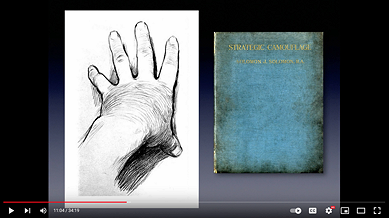
The second was Solomon J. Solomon (1860-1927), who was also an excellent painter, and one of the few Jewish artists to be elected to the Royal Academy. His personal reputation was beyond reproach, and indeed he became a hero of sorts during World War I when he was the first person to be placed in charge of British army camouflage. He was also the author of what may have been the first book on military camouflage, titled Strategic Camouflage.

Unfortunately, it was not uncommon for the public to confuse the two Solomons, so that “the good Solomon” was besmirched by being mistaken for “the bad Solomon.” There is a brief turnabout reference to this on page 103 of the autobiography of the Irish poet William Butler Yeats (The Autobiography of William Butler Yeats: Consisting of reveries over childhood and youth, the trembling of the veil, and dramatic personae. New York: Macmillan, 1953), in the following passage—

All [a certain group of artists] were pre-Raphaelite, and sometimes one might meet in the rooms of one or other a ragged figure, as of some fallen dynasty, Simeon Solomon the pre-Raphaelite painter, once the friend of [Dante Gabriel] Rossetti and of [Algernon Charles] Swinburne, but fresh now from some low public house. Condemned to a long term of imprisonment for a criminal offense, he had sunk into drunkenness and misery. Introduced one night, however, to some man who mistook him, in the dim candle light, for another Solomon, a successful academic painter and RA [Royal Academician], he started to his feet in a rage with, “Sir, do you dare to mistake me for that mountebank?”

Certain contributions made by Solomon J. Solomon in the development of military camouflage are explained in a new short video titled Nature, Art and Camouflage, free and accessible online here (see frame below).

Nature, Art and Camouflage (video)


Wednesday, October 20, 2021

WWI British camouflaged ship in Southhampton water

Geoffrey S. Allfree (1918)
On pages 88-89 of James Taylor’s book, Dazzle: Disguise and disruption in war and art (Pool of London, 2016), on a facing full-page spread, there is a striking reproduction of a painting of a dazzle-painted British ship, A dazzled oiler with escort (1918), by Geoffrey S. Allfree (1889-1918). He was not a camouflage artist per se, but was commissioned during World War I by the Imperial War Museum to document wartime subjects. 

Of those paintings, my own favorite is a watercolor on paper (shown above), titled Camouflaged ship in Southhampton water (1917). As can be skillfully achieved in watercolor, there is a freshness and immediacy that makes it seem to have come about with all but little effort.

During the war, Allfree was a Lieutenant in the Royal Naval Vounteer Reserve. He died at sea on September 29, 1918, at age 29. Earlier in the same year, he had been designated as the official painter for the Royal Navy. He is the grandfather of composer, musicologist, and scholar Joscelyn Godwin, Professor of Music Emeritus at Colgate University.

Friday, September 10, 2021

harlequin-patterned WWI dazzle ship camouflage

Above Photograph of a dazzle-camouflaged British troop ship, the RMS Mauretania, arriving in New York harbor, carrying infantry from Europe (December 1919). If compared with the 1914 theatrical photograph below, it is evident why the public commonly compared such checkerboard-patterned camouflage to a traditional harlequin’s costume. 


Friday, April 30, 2021

new camouflage schemes for Royal Navy vessels

Those who follow this blog will no doubt recognize the name of Steve Morris, a Washington DC designer whose precise recreations of World War I ship camouflage schemes we have featured in the past. More recently, he shared the link to an article by Thomas Newdick at The War Zone (shown above), with an announcement and photographs of the newly-adopted policy of the British Royal Navy of painting certain of its patrol vessels in geometric dazzle camouflage schemes.