Showing posts with label illusions. Show all posts

Tuesday, August 25, 2026

aimed to distort the lines and to warp the perspective


Above WWII American ship camouflage (unidentified), 1944

•••

Matthew Luckiesh, Visual illusions, their causes, characteristics and applications. New York: Van Nostrand, 1922, pp. 225-227—

Many optical illusions have been devised and studied by scientists. In fact, some of these tricks are well known to the general reader. Straight lines may appear broken, convergent, or divergent by providing certain patterns or lines intermingled with them. [Beginning in World War I] Many of these were applied to models in laboratory experiments and it has been shown that confusion results as to the course of the vessel. The application of these on vessels has resulted in the grotesque patterns to be seen on ships during the latter stage of the war. It is well known that these illusions are most effective when the greatest contrasts are used, hence black and white patterns are common. Color has not been utilized as definitely as pattern in confusibility, although there is a secondary aim of obtaining low visibility at a great distance by properly balancing the black, white, and other colors so that a blue-gray results at distances too great for the individual patterns to be resolved by the eye. Color could be used for the purpose of increasing the conclusion by apparently altering the perspective. For example, blue and red patterns on the same surface do not usually appear at the same distance, the red appearing closer than the blue.

Such apparently grotesque patterns aimed to distort the lines of the ship and to warp the perspective by which the course is estimated. This was the final type of marine camouflage at the close of the war. Besides relying upon these illusions, ships zigzagged on being attacked and aimed in other ways to confuse the enemy. No general attempt was made to disguise the bow, because the bow-wave was generally visible. However, attempts have been made to increase it apparently and even to provide one at the stern. In fact, ingenuity was heavily drawn upon and many expedients were tried.

Tuesday, March 10, 2026

WWI hogshead on a tip-cart / deceptive artillery mimic

Above
Two-part illustration that accompanied the article printed below. The signed pen-and-ink illustration in the background appears to be the work of American artist Edith Magonigle (1877-1949), whose interesting life deserves full recognition.•• To start, see "Edith Magonigle and the Art War Relief" by Tal Nadan, New York Public Library. Her husband was the architect Harold Van Buren Magonigle, in whose Wikipedia article, she is simply cited as Edith and her maiden name, Edith Marion Day. 

The photograph of a German soldier has been restored from a poor quality newspaper photograph using AI software. We might also mention that René Bache, author of the article, was a prolific news journalist and author during WWI. He was also the Great-Great-Great-Great Grandson of Benjamin Franklin. Despite his family distinction, his articles on camouflage should be read with caution, as they may not always be fully accurate.

•••

René Bache, POPULAR SCIENCE: Camouflage—The Art of Deceit in Warfare, in The Catholic Press (Hartford CT), November 19, 1917—

To deceive the eye of the enemy is no new thing in warfare, but in the present conflict it has become for the first time an important and even vital element of tactics. The new war word "camouflage" covers a wide range, from optical illusions to expedients for obtaining invisibility.

An example of the former is shown in the accompanying photograph, which represents a "fake" German forty-two-centimeter mortar in the Argonne forest. It is a hogshead mounted on a tip-cart; but an enemy aviator flying overhead would almost certainly mistake it for a big gun.

On the sea "camouflage" is of not less importance than on land. Some of the German U-boats disguise themselves as sailing vessels. As for ourselves, particularly with the object of defeating the Hun submarines, we are using all of our famous Yankee ingenuity in developing this new and curious art.

The Government is requiring all American merchantmen to carry apparatus with which to make a defensive smoke-screen, in case of submarine attack. To the imagination, such a screen figures itself as a cloud of dense black smoke. The fact is quite different. The so-called "smoke" is white.

It is the smoke of burning phosphorus, set afire on the vessel's deck in so-called "funnels"—contrivances of small size, but resembling in shape the ordinary, wide-mouthed ship's ventilator. Each funnel is provided with a draft opening, to make combustion rapid, and it gives out enormous volumes of what looks like white fog.

Were you ever in a thick fog at sea? If so, you will understand that, at a distance of only a few yards, it makes an object absolutely invisible. The white phosphorus fog, indeed, is much better for "camouflage" purposes than a screen of black smoke because in itself It has no visibility. It is simply obscuration.

This, however, is not the only method utilizable for the purpose. If preferred, the ship captain may take along with him a number of wooden boxes, each a foot high and two feet square, perforated with holes. These boxes contain a certain compound, a principal ingredient of which is common black gun powder.

Suppose an attack by a U-boat. Several of the boxes are at once thrown overboard. The seawater admitted through the holes, sets the stuff on fire (by chemical action), and dense clouds of a yellowish-gray smoke are thereby liberated, concealing the ship from the enemy's view while she steams away.

There can be no question of the fact that this smoke-screen defense is destined importantly to minimize the destruction of American cargo carriers from this time on. It is bound to prove immensely useful for the protection of our troop transports and supply ships.

But another requirement imposed by the Government is that our merchant ships shall be painted in such fashion as to render them invisible. This problem has already been solved in a really marvelous way by the adoption of certain methods based on familiarly known optical principles—one of several schemes being to paint the vessel with a series of longitudinal stripes of the various colors of the rainbow. The stripes are rather narrow and of wavy form. At a distance of a mile, a ship thus adorned literally fades out of sight.

Thursday, February 2, 2023

cubism and camouflage / oscillation of appearances

Above Simay Imre, Subscribe to the Liberty Loan (World War I French poster), 1918. University of Illinois Archives, Public Domain.

•••

Wylie Sypher, Rococo to Cubism in Art and Literature. New York: Vintage Books, 1960—

To prove that art and life intersect, that thought enters things, that appearance and reality collide, or coincide, at the points we call objects, the cubist relied on certain technical devices: a breaking of contours, the passage, so that a form merges with the space about it or with other forms; planes or tones that bleed into other planes and tones; outlines that coincide with other outlines, then suddenly reappear in new relations; surfaces that simultaneously recede and advance in relation to other surfaces; parts of objects shifted away, displaced, or changed in tone until forms disappear behind themselves. This deliberate “oscillation of appearances” gives cubist art its high “iridescence” [p. 270].

It has been said that the great cubist achievement was camouflage [p. 299].

RELATED LINKS

 Cubism and Camouflage

Cook: The Man Who Taught Gertrude Stein to Drive

Art, Design and Gestalt Theory: The Film Version

Art, Design and Gestalt Theory: The New Film Version

Recently completed: Our most popular video talk, titled Art, Design and Gestalt Theory: The Film Version (40 mins). It traces the emergence of Gestalt psychology (c1910), as well as its connections to holism, Taoism, yin and yang, displacements of attention, contrast illusions, color, camouflage, graphic design, and architecture. Ideal for classroom screenings, and library discussion events. Non-monetized, free full online access for anyone at YouTube.

Wednesday, November 23, 2022

hidden horse / caw said crows are calling his name

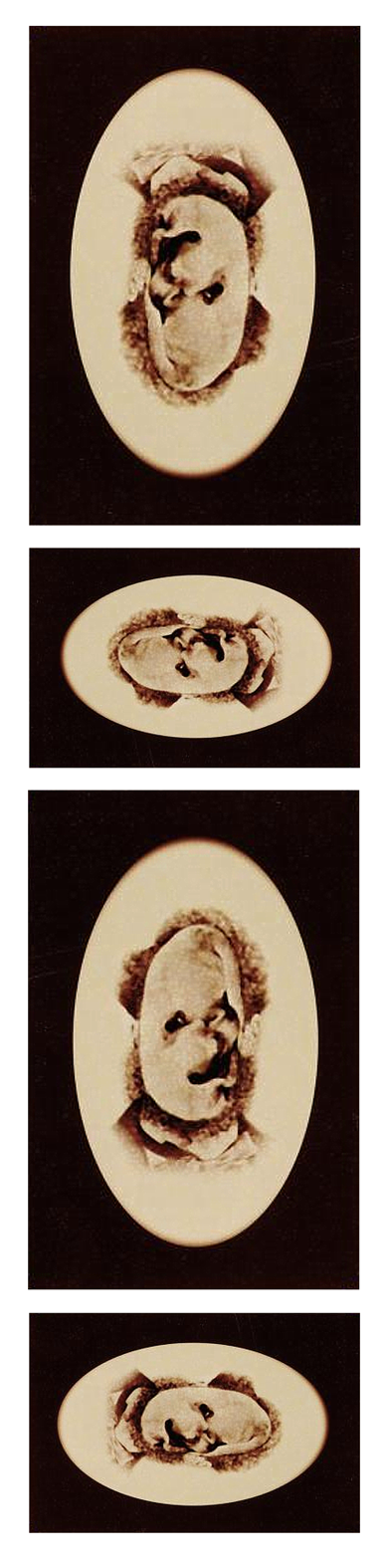
We have all heard of a cowbird, and a horsefly. But might this image qualify as a froghorse, because a closer look reveals that there is indeed a hidden horse in this vintage picture puzzle. Can you find it?

vintage picture puzzle / harmless sleeping puppy dog

Reproduced above (the same image four times, but repositioned and resized) is a Victorian-era “puzzle picture” that was printed on an advertising card in Liverpool UK in the 1870s. The caption read “What is it?” 

Beginning at the top, the first two images are somewhat suggestive (not unlike an inkblot) but require some work to interpret. The third one is more likely to be seen as a human face, albeit greatly distorted. 

But the puzzle is solved at the bottom, when a closer look reveals that all four have resulted from a single photograph of a harmless sleeping puppy dog. For more on embedded figures and picture puzzles, see this brief video, articles on Clemens Gretter, Gobolinks, and camouflage.

Sunday, October 16, 2022

Caligari, distorted film sets and WWI ship camouflage

Above
USS Nantahala
in dazzle camouflage scheme (1918).

•••

Herman George Scheffauer, “The Vivifying of Space” in The New Vision in German Arts. London: Ernest Benn, 1924—

[his description of The Cabinet of Dr. Caligari] Trees are resolved into conventionalized, constructed forms; foliage becomes a mass of light, dark and shaded crescents, rounds and silhouettes—brilliantly colored in the original scene. Floors and pavements are streaked, splashed and spotted, divided and decorated in bars, crosses, diagonals, serpentines and arrows. The walls become as banners or as transparencies, space fissued by age, or as slates upon which the lightning blazes strange hieroglyphs; or they become veils and vanish in a mosaic of scrambled forms and surfaces, like a liner in camouflage.

Gaunt chimneys rear and slant like masts in this city storm. Cunning lines of composition and the adroit use of diagonals drive the perspective into an invisible “vanishing point.”


For more on the Caligari film sets, forced perspective, and other early avant-garde cinema, see Part Three of my recently posted video trilogy on the Ames Demonstrations here.