Showing posts with label poetry. Show all posts

Friday, November 21, 2025

Dan Campion / camouflage, surrealism and satiric wit

Dan Campion, The Mirror Test
At a recent book reading, I was fortunate to meet an Iowa City-based writer named Dan Campion. We had an interesting conversation, and he kindly shared a copy of his recent book of poetry, The Mirror Test (MadHat Press, 2024).

As an artist and designer, I was immediately drawn to the cover (shown here, designed by Marc Vincenz, using an image credited to Vincenz, Jake Quart and Sonia Santos), which—like the poetry it illustrates—works by a finely hewn balancing act between clarity and confusion.

Ambiguity at its finest pervades Dan Campion's wonderful poems. I myself, as an addict of clarion vision, as well as its famous subversion in the varieties of camouflage, stopped abruptly in his book at Blaze Orange, a quietly elegant comment about the irony of vision, its enablement, yet also its prevention. Here is the complete text of that poem, reprinted with the permission of its author (copyright © Dan Campion)—

Blaze orange, the opposite of camouflage,

creates a bold, conspicuous mirage

of safety, as if iridescence could

not stain with hemoglobin red nor would

it disappear completely under snow

that rushes down with vicious undertow

nor fail to stop or slow a motorist

who'll flat refuse the breathalyzer test.

We bought my blaze orange T-shirt late one year

to spare me being taken for a deer

while walking through the woods. It's comical.

But even so, at least once every fall

I pull it from the bottom of the drawer

and put it on and venture out, secure.


Only recently, maybe ten days before I met Dan Campion, I had given a talk for a conservation group, about animal camouflage, in which one of the slides I showed was that of blaze orange hunter's garb. As for Dan Campion himself, I didn't recognize the name. Only later did I realize that in fact he was the author of a book I so enjoyed, years ago, about the humorous writings of Peter De Vries (1910-1993), titled Peter De Vries and Surrealism, a must read.

Saturday, August 9, 2025

a bowl of grapenuts made to taste just like a steak

Above World War I camouflaged lorry at Langley Field VA. School of Aerial Photography, c1918. Public domain.

•••

As Oscar Wilde famously said, “All bad poetry springs from genuine feeling.” It has yet to be determined what inspires bad camouflage music and lyrics —

WE ARE THE CAMOUFLEURS.
Words and Music by Arthur M. Fournier. Los Angeles, c1918.

This great big fight of nations, has pressed the wits of men.
The way they spring sensations, gets thrilling now and then.
So architects and stagehands, with artists started in.
At the game of camouflaging, hear their battle cry to win. For—

CHORUS
We are the camoufleurs with our pots and pails of paint,
We are boys so bold who make things what they ain’t.
We pull the wool right o’er their eyes.
Our middle name is disguise.
We are the Camoufleurs, the canny, cammy Camoufleurs.
We are the Camoufleurs.

Now orders came from Hoover—a hurry call to fake.
To make a wad of grapenuts, looks like a juicy steak.
Put cream into the milk cans, make hardtack into cake.
Ev’ry time they sprung a new one, they would sing for Wilhelm’s sake. For—

CHORUS
We are the camoufleurs with our pots and pails of paint,
We are boys so bold who make things what they ain’t.
We pull the wool right o’er their eyes.
Our middle name is disguise.
We are the Camoufleurs, the canny, cammy Camoufleurs.
We are the Camoufleurs.

Now way back there in our town, sit Tom and Al and Bill.
Those same old phoney soldiers, they’re playing poker still.
They’re passing round the pasteboards, and looking mighty wise.
But we’ve got that bunch a-guessing, us camouflaging guys. For—

CHORUS
We are the camoufleurs with our pots and pails of paint,
We are boys so bold who make things what they ain’t.
We pull the wool right o’er their eyes.
Our middle name is disguise.
We are the Camoufleurs, the canny, cammy Camoufleurs.
We are the Camoufleurs.


•••


RELATED LINKS

Dazzle Camouflage: What is it and how did it work? /  Nature, Art, and Camouflage / Art, Women's Rights, and Camouflage /  Embedded Figures, Art, and Camouflage / Art, Gestalt, and Camouflage /  Optical science meets visual art /  Disruption versus dazzle / Chicanery and conspicuousness /  Under the big top at Sims' circus

Monday, June 30, 2025

like artists, might poets also qualify as camoufleurs?

Bewilderness and James Joyce
WANT OUR POETS, UNCLE? in South Bend News-Times (South Bend IN). August 21, 1917—

Uncle Sam is getting up some “camouflage” units of amateur artists. To “camouflage” you fool the enemy aviators by painting a cannon so that it looks like a log, or a log to look like a cannon; or you make a munition train look like a roadway; and so on—the more you make things look like what they ain’t, the more of a “camouflager” you are. The American amateur artist is sure the boy for this job, and we’re hot for “camouflage” to the hilt.

We’d like to ask Uncle Sam if he has any war space for amateur poets. If he has, we know where he can get a fair-sized cohort. Putting our amateur poets beside our amateur landscapists in Europe mightn’t do much for the universal brotherhood vision, but it would create a strong desire for peace.

RELATED LINKS    

Dazzle Camouflage: What is it and how did it work? /  Nature, Art, and Camouflage / Art, Women's Rights, and Camouflage /  Embedded Figures, Art, and Camouflage / Art, Gestalt, and Camouflage /  Optical science meets visual art /  Disruption versus dazzle / Chicanery and conspicuousness /  Under the big top at Sims' circus

Sale-priced books on camouflage / free shipping

Saturday, July 13, 2024

he painted camouflage on the sides of trucks & trains

Eisenstein and others in Japan
Above Such an astonishing photograph. Taken in the 1920s in Japan, this is a detail of a photograph of a larger group of those associated with Russian Constructivism. Here are writer Boris Pasternak, filmmaker Sergei Eisenstein, socialite Lilya Brik (wife of Osip Brik), and poet Vladimir Mayakovsky. Such intense personalities, at an especially mournful time in modern history.

•••

Marie Seton, Sergei M. Eisenstein: a biography. NY: Grove Press, 1960, p. 146—

One day he [Sergei Eisenstein] sat for many hours in the small unpretentious Lyons’ teashop next to the Holborn Underground [in Central London] with Paul Rotha. He drank several cups of coffee and “smoked like hell.” Normally he never smoked. But he had been with Rotha to the museum of the Royal College of Surgeons [aka Hunterian Museum]. He talked about the Russian Revolution and drew incessantly upon the marble table-top to illustrate the camouflage ideas used by the Red Army during the Civil War. [According to Seton, Eisenstein had “painted camouflage and propaganda on the sides of cattle-trucks and trains.”] From the museum of the Royal College of Surgeons to the Russian Civil War…There was a psychological thread linking the sights he has seen at the front and the sights in the museum. As he had once tried to conceal his innocence from his Red Army comrades by Rabelasian talk, so now Sergei Mikhailovich camouflaged his frustrations by speaking of psychoanalysis and smoking endless cigarettes.

Monday, February 28, 2022

Solomon Solomon solemnized / two babies not one

Solomon J. Solomon, Self-Portrait
There were two British painters (unrelated) whose family name was Solomon. Both were well-known around the turn of the 19th century, but their reputations were distinct. Both were from Jewish families, and each faced challenges from the start.

The first, named Simeon Solomon (1840-1905) was associated with the Pre-Raphaelites. He was from a prominent family, and was an undoubtedly capable artist. But his life was ruined by a series of highly public scandals having to do with sexual licentiousness and alcoholism.

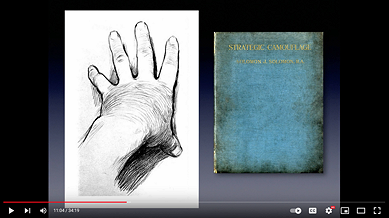
The second was Solomon J. Solomon (1860-1927), who was also an excellent painter, and one of the few Jewish artists to be elected to the Royal Academy. His personal reputation was beyond reproach, and indeed he became a hero of sorts during World War I when he was the first person to be placed in charge of British army camouflage. He was also the author of what may have been the first book on military camouflage, titled Strategic Camouflage.

Unfortunately, it was not uncommon for the public to confuse the two Solomons, so that “the good Solomon” was besmirched by being mistaken for “the bad Solomon.” There is a brief turnabout reference to this on page 103 of the autobiography of the Irish poet William Butler Yeats (The Autobiography of William Butler Yeats: Consisting of reveries over childhood and youth, the trembling of the veil, and dramatic personae. New York: Macmillan, 1953), in the following passage—

All [a certain group of artists] were pre-Raphaelite, and sometimes one might meet in the rooms of one or other a ragged figure, as of some fallen dynasty, Simeon Solomon the pre-Raphaelite painter, once the friend of [Dante Gabriel] Rossetti and of [Algernon Charles] Swinburne, but fresh now from some low public house. Condemned to a long term of imprisonment for a criminal offense, he had sunk into drunkenness and misery. Introduced one night, however, to some man who mistook him, in the dim candle light, for another Solomon, a successful academic painter and RA [Royal Academician], he started to his feet in a rage with, “Sir, do you dare to mistake me for that mountebank?”

Certain contributions made by Solomon J. Solomon in the development of military camouflage are explained in a new short video titled Nature, Art and Camouflage, free and accessible online here (see frame below).

Nature, Art and Camouflage (video)


Thursday, September 30, 2021

Poet William Carlos Williams meets Gerald H. Thayer

Above Gerald H. Thayer, Male ruffed grouse in the forest (1907-08). Watercolor on paper. 19.75 inches high x 20 inches wide. First published as an illustration in his book, Concealing coloration in the animal kingdom, New York: Macmillan, 1909. Plate II, 38 (public domain). The original painting is in the Metropolitan Museum of Art.

Roy R. Behrens, “Khaki to khaki (dust to dust): the ubiquity of camouflage in human experience” in Ann Elias, Ross Hartley and Nicholas Tsoutas, eds., Camouflage Cultures: Beyond the art of disappearance. AU: Sydney University Press, 2015—

The grouse [in Thayer’s painting] is completely motionless (a common means of defence among animals) for the same reason that the Ames distorted room [one of the Ames Demonstrations in psychology] works best from a rigid, “frozen” one-eyed view. Motion is a great spoiler of camouflage, and if the grouse moves even a muscle, it will be quickly given away.…

•••

Halter Peter, The revolution in the visual arts and the poetry of William Carlos Williams. Cambridge University Press, 1994, pp. 125-126—

[From an analysis of a William Carlos Williams poem]…the last lines [of the poem]—“a / partridge / from dry leaves”—contain a reference to the painting Male Ruffed Grouse in the Forest by Gerald H. Thayer…Thayer’s watercolor of a partridge merging with dry leaves and winter trees behind it is related to the Audubon tradition of accurate and loving observation of the American fauna which Wlliams so highly valued…

Moreover, Thayer’s painting is a kind of picture puzzle: Based on the systematic exploration of mimicry in animals, it depicts a partridge that is indeed difficult tell “from dry leaves.’…Williams may well have singled out Thayer’s painting as a work of art that, not unlike his own poem, explores ambiguty and foregrounds the problem of figure and ground. Both painting and poem are about what has to be “figured out”; both contain, in other words, the hide-and-seek dimension that asks for the viewer’s or reader’s active participation.

VIDEO LINKS

Nature, Art, and Camouflage  

Art, Women's Rights, and Camouflage

 Embedded Figures, Art, and Camouflage

 Art, Gestalt, and Camouflage

Friday, April 2, 2021

camouflage / a dance of beatings the boy endured

Above Roy R. Behrens, Papa's Waltz (© 2021). Digital montage.

•••

Yesterday, I put up this blog post and montage (above) on The Poetry of Sight, my more generic blog about vision, design, and the creative process. But it occurs to me that it might also be appropriate to repost it here, since Theodore Roethke's language has everything to do with camouflage, with concealed and embedded components.

•••

The title of the montage reproduced above (I sometimes call them “visual poems”) is intended as an homage to what some people regard as Theodore Roethke’s finest work, a sixteen-line autobiographical poem, titled “My Papa’s Waltz” (c1942). It is beautifully constructed, filled with engagement and gesture—and is yet at the same time disturbing in its beneath-the-surface suggestions.

Roethke, as a poet should, makes apt use of figures of speech, and we (the readers) are left to decide what to make of it. Does “papa’s waltz” simply describe an innocent dance, in which an inebriated father is engaged in ritualistic fun with his son, a small boy. Or, as certain components suggest, is it not a literal waltz, but instead a frightening memory of dance-like beatings the boy endured at the hands of a drunken parent?

You must read the entire poem, which is available online at the website of the Poetry Foundation. At the same, it also helps to read the article about this poem on Wikipedia, and to learn about the life of Theodore Roethke.

Monday, April 13, 2020

Enlisting our amateur poets for wartime camouflage

SS Perfection (c1918)
Above Dazzle camouflage applied to the SS Perfection, Emergency Fleet Corporation. Digital coloring.

•••

WANT OUR POETS, UNCLE? in The Des Moines News (Des Moines IA), August 22, 1917, p. 4—

Uncle Sam is getting up some “camouflage” units of amateur artists. To “camouflage” you fool the enemy aviators by painting a cannon so that it looks like a log or a log to look like a cannon; or you make a munitions train look like a roadway; and so on—the more you make things look like what they ain’t, the more of a “camouflager” you are.

The American amateur artist is sure the boy for this job, and we’re hot for “camouflage” to the hilt.

We’d like to ask Uncle Sam is he has any war space for amateur poets. If he has, we know where he can get a fair-sized cohort.

Putting our amateur poets beside our amateur landscapists in Europe mightn’t do much for the universal brotherhood vision, but it would create a strong desire for peace!


•••

Anon, “Impossible” [cartoon caption], c1913—

Four times the politician posed,
The cubist artist in despair,
Then said, “The task I must resign.
I find I cannot paint you square.”

Thursday, March 19, 2020

Oliver Percy Bernard | Camoufleur and Scenographer

Oliver Percy Bernard (c1915)
The RMS Lusitania was torpedoed by a German U-boat on May 7, 1915. It sank in 18 minutes, eleven miles off the southern coast of Ireland. Among the fatalities were 1,198 passengers and crew, including 128 American citizens. Among the survivors was a British architect and stage designer named Oliver Percy Bernard, who gained importance later as an Art Deco interior designer. But he also played a significant role in World War I British army camouflage. When the Lusitania sank, Bernard was moving back to London from Boston.

On May 8, there was an article in the Boston Post, with the headline ARTIST AMONG PASSENGERS: Oliver Bernard in Boston All Winter. It included a photograph of Bernard (above), accompanied by the following text—

Oliver Bernard, one of the passengers on the Lusitania, lived with Dr, and Mrs. Arial W. George of 38 Winchester Street, Brookline, from last October until he sailed for England.

Mr. Bernard was the director and resident artist of the Royal Opera House, London. He was also the business manager of the English Players, who were in Boston some weeks ago.


•••

About twenty years later, Bernard (known to friends as “Bunny”) published an autobiography, titled Cock Sparrow: A True Chronicle [WorldCat lists it as fiction] (London: Jonathan Cape, 1936). Bernard was small and terribly hard of hearing, and the title refers to the slanderous name that he had been given by bullies. We have searched for a copy of his autobiography for years, either to buy or to borrow. Interlibrary loan requests have not been successful. When it first came out, there was the following brief review in the Sydney Morning Herald (July 25, 1936), p. 12—

Mr. Oliver Bernard is now a successful interior decorator in London, but his training for that position is by no means like most others of his colleagues. For that reason, his autobiography makes fascinating reading. We see the successful decorator as a small and unhappy boy, as an assistant in a scenery painting studio, as a deck-hand on a Norwegian windjammer, as an American stage designer, and, finally, as a camouflage expert during the war. In the interval of following these various activities, Mr. Bernard also went down with the Lusitania, about which experience he writes illuminatingly, and formulated his own design for living. In revealing the stages of this mental growth he is not so successful as when chronicling the highlights of his adventures. It is, perhaps, those very adventures and their variety which have left him a little muddled, and, consequently, his literary method tends toward diffuseness. But as a camouflage expert reconciling the arts of war and the arts of painting, he has such an unusual and interesting topic that the book becomes really worthwhile. Indeed, he feels so himself, for he devotes most of his chapters to the war years, and leaves the chronicle of his life at that point.

•••

To date, the best, most detailed discussion of Bernard’s contributions as a British camoufleur (short of someday obtaining his memoir) is in Nicholas Rankin’s excellent book, A Genius for Deception: How Cunning Helped the British Win Two World Wars (UK: Oxford University Press, 2009).  See also War and Theatrical Innovation (2017).

To avoid confusion, it helps to know that Oliver Percy Bernard had a son who is also cited as Oliver Bernard, known for his translations of Arthur Rimbaud.

RELATED LINKS

Tuesday, January 8, 2019

Jabberwocky Meets Kaiserwocky | WWI Parody

Above John Tenniel's illustration of the Jabberwock.

•••

Aha! Now here's a great find. It's a terribly funny take-off on Lewis Carroll's famous nonsense poem titled "Jabberwocky," which he published in Through the Looking Glass and What Alice Found There (1872). For those who have never heard of Alice In Wonderland or Lewis Carroll, I haven't any comment. But, to appreciate the parody, you have to have read the original poem.  It goes as follows—

JABBERWOCKY  |  Lewis Carroll

’Twas brillig, and the slithy toves
Did gyre and gimble in the wabe:
All mimsy were the borogoves,
And the mome raths outgrabe.

'Beware the Jabberwock, my son!
The jaws that bite, the claws that catch!
Beware the Jubjub bird, and shun
The frumious Bandersnatch!'

He took his vorpal sword in hand:
Long time the manxome foe he sought --
So rested he by the Tumtum tree,
And stood a while in thought.

And, as in uffish thought he stood,
The Jabberwock, with eyes of flame,
Came whiffling through the tulgey wood,
And burbled as it came!

One two! One two! And through and through
The vorpal blade went snicker-snack!
He left it dead, and with its head
He went galumphing back.

'And hast thou slain the Jabberwock?
Come to my arms, my beamish boy!
Oh frabjous day! Callooh! Callay!'
He chortled in his joy.

'Twas brillig, and the slithy toves
Did gyre and gimble in the wabe:
All mimsy were the borogoves,
And the mome raths outgrabe.


And now on to the parody (author uncredited), called "Kaiserwocky," which was apparently published in the New York Evening Post, then reprinted in The Minneapolis Morning Star Tribune, May 16, 1918, p. 14, as follows—

KAISERWOCKY  |  Anon

'Twas Marnen, and the tommy ats
Did wyem secate in their trench;
All belgiumed with the tinny-hats,
And blank-blank potsdam french.

“Beware the Camouflage, my son!
The Cootie’s bite, the Barbwire’s scratch,
The Ausespiel’s place in the sun;
Verbote the redcrost patch!”

He took his kruppy in his hands:
Long time a blighty foe he sought,
Some scrappy papered Soixaute-quinze,
All poilued in its thought.

And as he kultured his moustache,
The Camouflage rheims through the wood.
And fraicaised o’er with rongetnoir,
Alsaced him where he stood.

Einzwei! Einzwei! And high and dry
He kieled that camouflage gun;
Then prussly monocled his eye
And taubel to Pop when done.

“And host thou kieled the Camouflage!
Come to my lefty arm, my boy!
Dertag is won—’tis au verdun!”
He vonklucked in his joy.

’Twas persching, and the tammy ats
Were numans landing from their tench;
All sammied were the tinney-hats,
The Kamrads deutschly blench.

Tuesday, June 19, 2018

Canada | Artists, Poets and Camoufleurs

Brochure [detail] for In Broad Daylight
Above and below Screen grabs from an online brochure in connection with an OpenStudio visiting artist exhibition, titled In Broad Daylight by Kathleen Ritter, at the Contemporary Printmaking Centre in Toronto CA, 2017. Also see her exhibition Camoufleurs.

Also featured in the brochure (as shown below) is a poem titled The Pickpocket and the Sloth by Ella Dawn McGeough.


Sunday, April 8, 2018

Our Tiger Saskia Just Died | Rest In Peace

RIP Saskia the Cat (2018)
Above Our cat Saskia just died. It's a quiet Sunday morning here, and she died peacefully at home about an hour ago. She lived with us (tolerated us really) for eighteen years, which is a pretty long time for a creature who began life as a forlorn feral farm kitten.

She never allowed us to tame her, although she surely loved her mom. She loved to be held and squeezed by her mom—whom she also liked to bite, without warning. She craved belly rubs as intensely as she despised having her nails clipped. An episode of nail clipping, the mere mention of the word "clippers," or leaving her home alone for a day, were unpardonable causes for not speaking to (or even looking at) her mom for hours afterwards. Her father didn't exist (unless she was hungry for tuna).

Saskia was a perfectly beautiful tiger, a walking haute couture "poster child" for the stipey optical elegance of animal camouflage. She was named after Saskia van Uylenburgh, the model and eventual wife of Rembrandt. Our Saskia spent a lot of time in Mom's studio.

•••

William Blake—

Tyger, tyger, burning bright / In the forests of the night / What immortal hand or eye / Could frame they fearful symmetry?

Saturday, February 20, 2016

Robert Williams Wood | Carrot in Camouflage

Robert W. Wood, How to Tell the Birds From the Flowers
Above One of the comparative illustrations in How To Tell the Birds from the Flowers: A Revised Manual of Flornithology for Beginners, with verses and illustrations by Robert Williams Wood (New York: Dodd, Mead, 1917). A later edition was published by Dover Publications in 1959. Wood (1868-1955) was a prominent American scientist. In his children's book, each comparative image is accompanied by a nonsense verse. This one reads as follows—

The Parrot and the Carrot one may easily confound,
They're very much alike in looks and similar in sound,
We recognize the Parrot by his clear articulation,
For carrots are unable to engage in conversation.

•••

Anon, The Versatile Carrot in the Urbana Daily Courier (Urbana IL), May 28, 1919—

There is nothing like a war to change the status of things. Look, for example, at the humble carrot. Before the war it was one of the lowliest of all the vegetables, seldom used except for stews or New England boiled dinners, but it certainly has been doing its bit in the culinary line recently. It has become a past master in the art of camouflage. Grated raw, it is said to be a very good substitute for eggs in certain things. Little slices dried become raisins and currants, and other bits, treated a little differently, masquerade as candied orange and lemon peel. Orange marmalade and certain kinds of jam are made of them, and large chances of them boiled and sugared make wonderful candied fruits of very kind—pineapples, pears, apricots, cherries—and are used by many caterers to give their war cakes and puddings a prosperous and festive look.

Saturday, November 22, 2014

Bittern Camouflage

Above An American Bittern in camouflage stance in the Myaka River State Park, Florida, as photographed by Sabine Rodens (2006), from Wikipedia Commons.

•••

Frederick C. Gould, "Camouflage" in The Sydney Stock and Station Journal [quoted from The Westminster Gazette] on Friday, April 11, 1919, p. 2—

The Bittern took Camouflage lessons,
For he wanted to look like a stick,
And a Futurist artist in khaki
Taught him the vanishing trick;
He painted his feathers with markings,
And drilled him to stand like a log,
Till he looked not a bit like a Bittern
But just like a bit of the Bog.

Tuesday, January 21, 2014

Abbott Thayer's Spartan Funeral

William Adair © 2013
Above In September 2013, William Adair (of Gold Leaf Studios in Washington DC) visited the environs of American painter (and "father of camouflage") Abbott Handerson Thayer in Dublin NH, in the shadow of Mount Monadnock. This is an on-site watercolor he made during that sojourn (and mountain climb), showing Dublin Pond, with Thayer's beloved mountain beyond.

•••

From Alice Frost Lord, SUNLIT TRAIL WITH MAINE FOLKS in the Lewiston Evening Journal (Lewiston ME), September 14, 1928—

Now Maine lovers of the beautiful in nature are being appealed to in behalf of another New Hampshire mountain, promoters of the Old Man of the Mountains' campaign having been encouraged by their success to undertake this new venture. The sum of $20,000 is the goal of today.

It is proposed to buy 1300 acres in two mountain townships which include Monadnock—a height famous in prose and poetry of New England, Emerson, Edna Dean Proctor, William Ellery Channing, Whittier, Thomas Wentworth Higginson, John White Chadwick, Richard Burton, Edwin Arlington Robinson, Rudyard Kipling and Lord Dunsany have lauded its beauty in immortal lines.

Abbott Thayer, the artist loved this mountain and spent many hours exploring its heights. His masterpiece of the eminence hangs in the Metropolitan Art Museum in New York today. So did he love the mountain that in acccordance with his wish his body was cremated after this death in 1921 and he was given a "clean Spartan funeral."

In the afternoon of a perfect June day, his son [Gerald Handerson Thayer], barefoot and alone, carried his ashes up the long climb of the great ridge of Monadnock to the open heights. Hermit thrushes, warblers, wrens, all the pensive choir of sundown, sang from the green spruce coverts below. The sun shone full upon the western slope of the mountain; and, overflowing, mantled the summits of the distant Peterborough hills. The gleaming lakes that gem the landscape caught and sent back the deepening colors of the sunset sky. A cool breeze was blowing from the northwest; and up there under the open sky, in the waiting majesty, royal fellowship, and perfect peace of Nature, the ashes of artist and friend were given to the wind and the mountain he loved. Something of his free spirit lingers there, and Monadnock will be forever a prouder and greater mountain because he lavished so richly upon it his genius and affection.

Postcard of Dublin NH in 1906

Sunday, June 23, 2013

Dazzle Camouflage in Obsolete! Magazine

Cover of Obsolete! Magazine Number 8 (2013)
In recent months, we were interviewed about dazzle camouflage by Iowa writer and editor Rich Dana, founder and publisher of Obsolete! Magazine: The Journal of DIY Analog Anarchy. The interview is featured in the magazine's eighth issue, which came out a few days ago. Above is a scan of the cover. Back issues are available online, and a sample copy of the current print issue can be requested free of charge from the magazine's blog. Using Kickstarter, the magazine has also launched an online fundraising effort in support of future issues.

Saturday, October 27, 2012

Camouflage Poster | Daniel O'Shea


Above One of ninety posters designed by graphic design students at the University of Northern Iowa, to advertise an upcoming talk on WWI ship camouflage by RISD scholar Claudia Covert. This is one of three posters designed by Daniel O'Shea. Copyright © 2012 by the designer. All rights reserved.

***

Wallace Stevens—

From time immemorial, the philosophers and other scene painters have daubed the sky with dazzle paint.

Wednesday, October 17, 2012

Camouflage Poster | Stephanie Mathena


Above One of ninety posters designed by graphic design students at the University of Northern Iowa, to advertise an upcoming talk on WWI ship camouflage by RISD scholar Claudia Covert. This is one of three posters designed by Stephanie Mathena. Copyright © 2012 by the designer. All rights reserved.

***

Arthur Guiterman, “Camouflage” published originally in Life magazine, then reprinted in the Iron Country Record (Cedar City UT), January 11, 1918, p. 2—

What’s Camouflage?—The juggler’s trade;
Delusion, glamour, masquerade;
The mummer’s artifice, designed
To make the Sense betray the Mind;
The tint of rouge, the scent that clings,
The curl that grew not where it swings,
The touch that thrills the blood of man,
The soft, shy glance behind the fan;
The sweet, low laugh of badinage—
That’s Camouflage.
What’s Camouflage?—A web for flies;
The mist that blinds the lover’s eyes;
The dainty scrap of this or that
Which ransoms yester-season’s hat;
The sauce that turns the humble stew
To some delectable ragout;
The motor-builder’s happy scheme
To make the humble chariot seem
A car from Croesus’s garage—
That’s Camouflage.
What’s Camouflage?—The printed lure
That promises the wondrous cure;
The caster’s fly of colors gay,
The mining stock, the smooth toupée,
The bluff that screens the empty purse
Or masks untidy prose as verse,
The veil of picturesque romance
That changes theft to High Finance
And treachery to Sabotage—
That’s Camouflage.
What’s Camouflage?—Oh, many things!
The pomp and pride of thrones and kings;
The gambler’s hope; the rosy wreath
That fades and leaves the thorns beneath;
A wrecker’s light; the phosphor glow
Some mocking star has cast below
To make the eye of men behold
Their gold as dross, their dross as gold;
The zealot’s vision, Fame’s mirage—
That’s Camouflage.


Thursday, October 11, 2012

Camouflage Poster | Megan Guldenpfennig


Above One of ninety posters designed by graphic design students at the University of Northern Iowa, to advertise an upcoming talk on WWI ship camouflage by RISD scholar Claudia Covert. This is one of three posters designed by Megan Guldenfennig. Copyright © 2012 by the designer. All rights reserved.

***

Anon, a poetic commentary on the reputed craziness of WWI dazzle ship camouflage, first published in The Independent. Vol 56 No 3645. October 12, 1918—

O blend of emerald wild and drunken amethyst,
O wild, hysteric nightmare of psychoanalyst,
O purple cow of Burgess, O blazing tiger of Blake,
O neo-impressionist lily, O super-Barnumcular fake,
What madman out of Potsdam, what loon from
    Blagovetschenskgeorgsrknlintvoff,
What Bolshevik or sideshow freak or Greenwich Village toff,
Told you that the way to hide was with vivid gobs of blue,
Cutting athwart green triangles and gray gridirons askew,
All done on a painted background of most unearthly hue,
Like a sunrise up at midnight dabbled with evening dew?

Saturday, May 26, 2012

Camouflage Poet | Marvin Bell

On the Fly, Marvin Bell


Many years ago (has it been that long ago?), we organized a non-funded one-day symposium on camouflage, called CAMOUFLAGE: Art, Science and Popular Culture (Saturday, April 22, 2006 at the Kamerick Art Building at the University of Northern Iowa). Although only a few of our colleagues were there from the Department of Art, other scholars came from departments across campus, from around the country, and even from throughout the world, each one speaking sans honorarium, and each one paying completely for his/her own expenses. What an unforgettable day it was. Three of those who spoke that day have since published important books on the subject (Maite Méndez Baiges, Camuflaje: Engano y Ocultación en El Arte Contemporáneo (2007); Henrietta Goodden, Camouflage and Art: Design for Deception in World War 2 (2007); and Ann Elias, Camouflage Australia: Art, Nature, Science and War (2011)), and a poem that was written by American poet Marvin Bell (see online interview above), as a keynote for the conference, has since been reprinted in his recent book, Vertigo: The Living Dead Man Poems (2011). Soon, it will also be featured online as the poem of the week on Narrative Magazine. Here it is in full—

...

Marvin Bell (©2006)
from The Book of the Dead Man

                  Live as if you were already dead.
                                             —Zen admonition

1. About the Dead Man and Camouflage

When the dead man wears his camouflage suit, he hides
     in plain sight.
The dead man, in plain sight, disrupts the scene but cannot
     be seen.
His chocolate-chip-cookie shirt mimics the leaves in a breeze.
His frog-skin dress, his bumpy earth nature, leave us lost and
     alone, his mottled apparel sends us in circles.
His displacements distract and disabuse us, he is a
     slick beguiler.
Everything the dead man does is a slight disruption
     of normality.
He is the optical trickster, the optimum space-saver, the one
     to watch for.
He is of a stripe that flusters convention, he is the one
     to watch out for.
That we thought him gone only proves his wily knowledge.
The dead man has lain unseen among the relics of
     embalmed time.
He was always here, always there, right in front of us, timely.
For it was not in the dead man’s future to be preserved.
It was his fate to blend in, to appear in the form of,
     to become...
Now he lives unseen among the lilies, the pines, the
     sweet corn.
It was the dead man’s native desire to appear not to be.


2. More About the Dead Man and Camouflage

The dead man knows that camouflage is all in the mind.
He has seen in the human need for shape the undoing
     of shape.
He has witnessed the displacement of up-and-down, across
     and slantwise.
He has curled the straight lines and unbent the curves, he has
     split the wishbone and painted outside the lines.
The dead man has undone the map by which to get there.
It is not what the dead man looks like, but what
     he no longer resembles.
For he hath reappeared in no disguise but as himself.
Call him disheveled, call him disposed, call him shiftless,
     he is.
For he hath been made and remade in the form of
     his surroundings.
He hath become all things that he looketh like.
Hence, he has been stepped on by those who could not
     see him.
He has been knelt upon by those who looked in vain.
The dead man bestirs in a background that looked inert.
The dead man is the ultimate camouflage.
He is everywhere, but where is he?

...

Those who attended the conference that day were given, as a memento, a signed broadside of the poem (see below).