Showing posts with label CIA. Show all posts

Saturday, November 19, 2022

Camoufleur John Wilde in Walter SH Hamady's books

Above Page spread from Reeve Lindberg, John's Apples (Perishable Press, 1995), a Walter Hamady letterpress book, with full-color paintings of apples by John Wilde [WILL-dee].

•••

John Wilde: Recent Work, April 10-May 3, 2003. New York: Spanierman Gallery, 2003, p. 4—

His [Wilde’s] art interests developed early, as he recalled in 1986: “I have always loved to draw and paint ever since junior high school in Milwaukee. I was particularly fond of drawing imaginary cities, which I then erased and re-created.” In 1938 Wilde enrolled in the art department at the University of Wisconsin-Madison, where he studied human anatomy with Roland Stebbins and drawing with American Scene painter James Watrous. Shortly after he graduated, in 1942, Wilde was drafted into the army and served four years drawing camouflage and modeling terrain maps for various units (including the Office of Strategic Services, or OSS [precursor to the CIA]), while also meticulously detailing his disgust and dismay with wartime in a 275-page sketchbook. 

•••

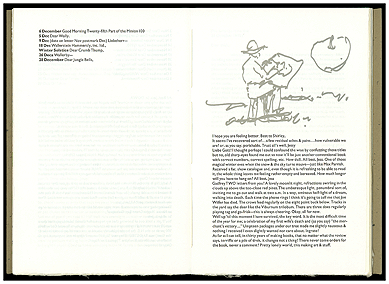
Below Page spread from Walter Hamady and John Wilde, A Hamady Wilde Sampler / Salutations 1995 (Perishable Press, 2001), including a self-portrait drawing by Wilde, presumably painting an apple. And below that, Roy R. Behrens, Mon Dieu. Collage in open-book form (1993). Hamady Collection.
Roy R. Behrens (1993)

Wednesday, December 23, 2020

Designer John Vassos / WWII Camouflage Consultant

John Vassos, c1932

Above
Art Deco-era turnstyle, designed by John Vassos, c1932. We blogged about Greek-American designer John Vassos a few years go in reference to his service as a camouflage consultant during World War II.

•••

CUBISM DOMINATES NEW PARIS SALON ARTISTS, in Bluefield Daily Telegraph (Bluefield WV), September 19, 1926, Section 2, Page 4—

Paris, Sept 18—Cubism completely dominates the new Paris Salon of decorative artists. The curve must only be used in case of grave necessity. Straight lines, angles and zigzags dominate tables, chairs, lighting, jewelry, clocks, and, above all, architecture. Even carpets and curtains have to fit octogonal rooms, and are cut up themselves into tee-squares and triangles.

Chairs look as though they were cut out of solid cubes of wood and then camouflaged with a medley of colors. Curtains are often painted by hand in vivid thunder and lightning effects. The edges are made of strips of different color, each of which is a littler shorter than the last, like the ABC of a diary. Clocks are made entirely of glass, but have square faces, and are supported by glass stands cut like a Chinese puzzle. Heading lamps are equally geometrical problems. Colors are almost as angular, consisting of vivid greens, purples, magnates, raw siennas, sometimes all mixed together. The new Decorative Salon is nothing if it is not revolutionary.

Sunday, February 28, 2016

Camouflage Artist | John Vassos

Cover of John Vassos biography (2016)
We are awaiting the release of the first book-length biography of the American book artist, designer, and camouflage artist John Vassos (1898-1985). Written by Danielle Shapiro, the biography is titled John Vassos: Industrial Design for Modern Life, and is slated for release in late March 2016 (see cover above).

If people have heard of Vassos, it is usually because of his innovative Art Deco-era graphic novels, of which the best known title is Phobia, which was initially published in 1931, then reprinted by Dover Publications in 2009, the cover of which is shown below.

Cover of Dover edition of Phobia (2009)


On the other hand, they may also know about his prolific contributions to American industrial design, including TV cabinets and various other devices, while a corporate designer at the RCA Corporation. His design for a RCA Victor Special Model K, Portable Electric Phonograph (c1935) is reproduced below.

It is generally less well-known that he served with the US Army Air Corps during World War II as a camouflage consultant. He also worked for the Office of Strategic Services (OSS), the precursor to the CIA in connection with efforts to support the underground resistance in Greece. In the process, he is said to have secretly parachuted into Greek territory on two occasions.

John Vassos, RCA phonograph design (c1936)