Showing posts with label prints. Show all posts

Tuesday, August 15, 2023

BOOK ART // remembering artist Walter SH Hamady

Shortly after I moved back to Iowa in 1990, I began to correspond with a prominent letterpress book artist, paper-maker, collagist, and assemblagist named Walter Hamady (1940-2019), who was well-known as a teacher at the University of Wisconsin at Madison. 

Having earlier taught in Milwaukee for ten years, I became aware of Hamady's work in the 1970s. Because of his liking for Ballast Quarterly Review (which I had founded in 1985), he and I began to exchange spirited letters (along with a mix of enclosures) once or twice or more a month. This led to collaborations of one kind or another, eventually resulting in exhibitions, published essays, and an archive of his artist’s books. I saved everything, even all the envelopes and mailing containers, in part because they were always addressed to mutilations of my name, such as Corps du Roy, Rhoidamoto, Trompe L’Roi at Labbast, Royatolla, and so on. This continued for more than a decade, no doubt to the postman’s amusement (I hope).

Among my favorite of Walter’s hijinks was the occasion on which, in the process of publishing one of his 131 handmade artist’s books, he turned a copy of my book on Art and Camouflage into confetti, combined that with paper pulp, and "camouflaged" my book in one of his own.

While looking back on what I have, I recently produced a twenty-minute video talk (a brief memoir-like tribute) titled BOOK ART: Walter Hamady’s Books, Collages and Assemblages, which can be accessed free online on my YouTube channel.

Monday, November 7, 2022

Ding Cong / camouflaged wit and humor from china

Above is his illustration of the following traditional story, as told by Chinese artist Ding Cong (who signed his work as Xiao Ding) (1916-2009).

•••

Ding Cong, Wit and Humor from Ancient China: One Hundred Cartoons. China Books and Periodicals, 1986—

92. Camouflage with Leaves—

A poor man from the state of Chu once read the following in a book: “A mantis camouflaged itself while waiting to pounce on a cicada.” The man then gathered some leaves under a tree and used them to camouflage himself. When he asked his wife if she could identify him she spoke truthfully and said, “Yes, I can.” The man then changed his posture and asked her several more times. Becoming annoyed by this practice, she finally told him that she was unable to identify him. The man was very glad.

Thus camouflaged with leaves the man went to the market and stole things from the open stalls. But he was caught and summoned to the magistrate’s court. After the man confessed, the magistrate burst into laughter and set him free. He found the man’s conduct so inane that he decided not to punish him.

Sunday, May 5, 2019

Cave Canem | How To Camouflage Your Dog

How to camouflage your dog
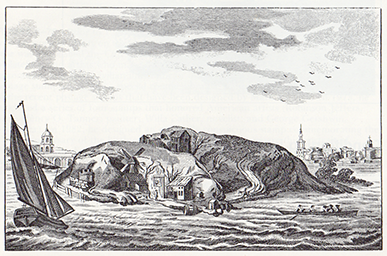
Artist unknown. Catchpenny print, 18th century "puzzle picture" titled The Isle of Dogs.

•••

Anon, THE MAGIC OF CAMOUFLAGE in Edmonton Journal (Edmonton, Alberta, Canada), September 19, 1918, p. 6—

An American artist has discovered a new use of camouflage. He has a favorite dog which his neighbors have been kicking out of their way whenever the animal chanced to stray there.

He had been admiring the great camouflaged battleships on the Hudson River and reading of eminent members of the British Royal Academy, garbed as colonels, directing painters on the Western Front how to camouflage a gun emplacement into a village school or a poultry run.

A happy idea struck him: he would camouflage his dog—all but the tip of his tail. So he has, with the result that the dog now looks like something else, and enjoys complete immunity from the attentions of his neighbors, for he moves about as a beautiful cloud effect.

Monday, December 24, 2018

Architect J. André Smith and WWI Camouflage

On-site colored drawing by J. André Smith (1918)
With luck, however belated, we have just discovered an on-going exhibition about J. André Smith and the Art of Camouflage. It is currently on view at the Maitland Art Center, a museum that Smith himself established (as the Research Studio) in 1937 in Maitland FL. Unfortunately, the exhibit will only continue through January 6, 2019. For more information, see this online information page. Above is a wonderful drawing Smith made of dazzle-camouflaged ships at the port of Saint-Nazaire in France, dated July 1918.

J. André Smith (left) and Walter Jack Duncan (c1918)


Earlier, we put up a post about J[ules] André Smith, an architect and printmaker who was a major contributor to US Army camouflage in World War I, until he was reassigned as an American war artist. He has a biographical article on Wikipedia, but the photograph accompanying it is a portrait of fellow war artist Walter Jack Duncan. There is also an article about Duncan on Wikipedia, but a portrait of Smith is mistakenly shown. The corrected heads are shown above, while posted below is a print by Duncan titled "Newly Arrived Troops Debarking at Brest," dated July 22, 1918. It also shows a camouflaged ship. Public domain images courtesy NARA.

Print by Walter Jack Duncan (1918)

Tuesday, June 19, 2018

Canada | Artists, Poets and Camoufleurs

Brochure [detail] for In Broad Daylight
Above and below Screen grabs from an online brochure in connection with an OpenStudio visiting artist exhibition, titled In Broad Daylight by Kathleen Ritter, at the Contemporary Printmaking Centre in Toronto CA, 2017. Also see her exhibition Camoufleurs.

Also featured in the brochure (as shown below) is a poem titled The Pickpocket and the Sloth by Ella Dawn McGeough.


Monday, September 5, 2016

Futurist Views: Nevinson, Bertram Park and Dazzle

C.R.W. Nevinson (1919)
Above Of the World War I British war artists (assigned not as combatants, but as eyewitness artistic observers) undoubtedly one of the finest was a so-called Futurist painter and printmaker named Christopher Richard Wynne Nevinson, who is nearly always listed as C.R.W. Nevinson (1889-1946). His dramatic portrayals of aerial flights are especially compelling, as in the colored lithograph above. Titled Banking at 4000 Feet, it was initially published as a colorplate in J.E. Crawford Flitch, The Great War: Fourth Year: Paintings by C.R.W. Nevinson (London: Grant Richards, 1918).

As striking as Nevinson's work may be, neither it nor he were ever immune to being satirized in the public press, who always had trouble accepting the use of disruption, distortion and abstraction in styles of Modernism (Cubism, Futurism, Vorticism). This attitude persisted (and still persists, to large extent) even after art defenders claimed that those were precisely the methods employed in the design of disruptive wartime camouflage, called dazzle-painting.

For example, reproduced below is an innovative photographic portrait of Nevinson, which appeared in The Sketch (May 21, 1919, p. 143), on a page that bears the headline A "CUBIST" CUBED—BY THE CAMERA. Beneath the photograph, there is a smaller heading that reads Nevinson—Reduced to His Own Artistic Formula.

Portrait of C.R.W. Nevinson by Bertram Park (1919)

As it turns out, this experimental photograph was made by none other than Bertram Park, a well-known British society photographer (somewhat avant-garde himself), whom we have previously blogged about in relation to his photographs of the outlandish costumes at the Chelsea Arts Club Dazzle Ball. Below the Park photograph, we are provided with the following caption—

Before the war, Mr. C.W.R. Nevinson was associated with the Futurist movement in art, but his peculiar style of cubism and realism combined was not developed until 1916, when he held his first War Exhibition, and was appointed an official war artist. He has painted pictures for the Canadian War Memorial, and many of his works have been bought by museums—at home and abroad. The above photograph of the Cubist artist by a camera converted to Cubist convention was taken recently, before Mr. Nevinson sailed for America. It is, to say the least, unconventional.

•••

That same year, in the August issue of Current Opinion, Park's photographic portrait of Nevinson was reprinted (as shown below) in a two-page feature on Nevinson's assertion that Cubists and Futurists Had a Presentiment of the Coming Conflicts. Appearing in the magazine's section on Literature and Art, the headline for the article was HOW THE WAR VINDICATED "MODERN" METHODS IN ART. 


As quoted from an interview in the Times, here is part of what Nevinson said—

This war did not take the modern artist by surprise—it only knocked the old fellows, who were tied up to old ideals of art, off their feet. I think it can be said that modern artists have been at war since 1912. Everything in art was a turmoil—everything was bursting—the whole talk among artists was of war. They were turning their attention to boxing and fighting of various sorts. They were in love with the glory of violence. There were dynamic, Bolshevistic, chaotic.

…Everything was being destroyed; canons of art were everywhere sacrificed. And when the war actually came, it found the modern artist equipped with a technique perfectly able to express war.

…Now that art has had its orgy of violence there has been an abrupt reaction. The effect of the war has been to create among artists an extraordinary longing to get static again. Having been dynamic ever since 1912, they are now utterly tired of chaos. Having lived among scrap heaps, having seen miles of destruction day after day, month after month, year and after year, they are longing for a complete change.

Friday, January 16, 2015

Hunters Masquerade as Cow (1578)

US Patent No. 586,145 (1897)
Above Patent drawings for US Patent No. 586,145, titled "Hunting Decoy," as devised by J. Sievers, Jr. (1897). Not a bad idea, but apparently nothing new. As evidenced by two 1578 Dutch engravings by Philips Galle (shown below on this page), as early as the 16th century European deer hunters were camouflaging themselves by masquerading as cows. In both prints, notice the telltale human feet apparent beneath the cow costumes. Both prints (out of rights and in public domain) are in the collection of the Rijksmuseum.

•••

Anon, from the Humeston New Era (Humeston IA), Wednesday, December 21, 1921—

How to stop certain Iowa druggists from making bootleg whisky under the camouflage of cologne and similar euphonious preparations is the problem which Prohibition Enforcement Officer Bronson finds himself up against. Some druggists are getting alcohol ostensibly for legitimate purposes and converting it into bootleg whisky, Mr. Bronson told Commissioner Haynes, and it is difficult to detect them. Before departing for Iowa from Washington he urged the commissioner to allow him six more field men and two officers who are druggists. Indications are the added force will be granted.

Engravings by Philips Galle (1578)