Showing posts with label UNI. Show all posts

Monday, December 25, 2023

John Brown fifty years ago / remembering a colleague

Painting by John Brown 1972
While sorting through our art collection, I’ve been looking at an acrylic painting dated 1972, purchased from the artist that year or shortly after. His name was John C. Brown (1934-2019), who for a few years in the 1970s was a faculty colleague at the University of Northern Iowa.

I don’t know the title of the painting, if it had one. But no doubt one reason I bought it is because it so strongly pertains to figure-ground blending or background matching, as is so commonly observed in camouflage, both natural and military.

John was originally from Cedar Falls. He majored in landscape architecture at Iowa State University (Ames), but dropped out in favor of studying art. He completed his BA in Art in 1956 at UNI, then worked for a number of years as a graphic designer and illustrator. He made "studio art" on the side, and was awarded various prizes for his innovative paintings.

At some point he joined the faculty as an instructor of painting. I graduated from the Rhode Island School of Design at the end of 1971, and was invited to teach at UNI in the following spring semester, and I think he was on the faculty then. In the years that followed, he and I (and others) were among the teachers in a highly unusual, untested approach to art foundations, called the Visual World Program.

That program had been launched in the fall semester of 1971 by a newly-hired department head from San Francisco, a man named Kenneth Lash, who had been the Head of Humanities at the San Francisco Art Institute. A rather odd aspect of this was that Lash was not a visual artist but a writer—a poet and an essayist, whom I had initially met in the summer of 1968 at the Aspen School of Contemporary Art in Colorado.

Given that the Visual World curriculum was a quasi-subversive departure from standard foundations courses, as detailed in textbooks at the time, it was controversial from the start. Some of the departmental faculty welcomed it, while others were wary, hesitant or confused. The latter complained they were clueless: What was the program all about? What was it supposed to accomplish? How could it be defined? As I recall, when Lash was approached with questions like that, he would typically reply that the program would eventually shape itself, over a year or two, in the process of trying to teach it.

Some of us reached out to other disciplines. We devised activities that stressed creativity (innovation, humor and problem-solving), perceptual psychology, and the interplay of usually disparate fields. We brought in a stage magician to demonstrate sleight of hand; worked with the physics faculty in making holograms; learned from biologists about the use by ethologists of behavioral dummies; explored stereoscopic vision (including random dot stereograms); constructed airborne works of art; recreated some of the Ames Demonstrations, while learning about their historical link to linear perspective; and so on.

There were deliberate efforts to teach as much through physical engagement as through attending lectures. On occasion, oddball contests were arranged, two of which I still remember vididly: the infamous Rube Goldberg Drawing Machine Contest, and the Groucho Marx Look-Alike Contest.

There were also eccentric exhibits, one of which was originated by John Brown. He partitioned off a section of the floor space in the gallery, then set free within that space an impressive selection of battery-powered motion toys, of the sort that, if collided with, they would adjust their course and continue to move. The full effect consisted of random collisions of various things, like non-stop vehicle mishaps—which continued for a couple of days, until at last the batteries died.

In 1975, Ken Lash and I co-authored an article that was published in Leonardo: Journal of the International Society of Arts, Sciences and Technology (published then by Pergamon Press, it was soon after acquired by MIT Press, and continues now as Leonardo). In that article, titled “The ‘Visual World’ Program at the University of Northern Iowa, USA,” we cited one of John Brown’s most memorable classroom assignments. Known as “the Lemon Experiment,” we described it in the article more or less as follows (although with substantial revison):

A class of twenty students is presented with a shopping bag containing fresh lemons. Each student then selects, randomly, any lemon from the bag. They are told: “Take your lemon with you. Look at it, feel it, smell it. Carry it with you wherever you go, even when you go to sleep. Get to know as much as you can about your lemon without marking, cutting or biting it. Then bring it to class with you when we meet again in two days.”

At the next class meeting, all the lemons are returned to the grocery bag, then spread out on a table top. The students are instructed to retrieve their particular lemons. They are inevitably amazed to find that, with little difficulty, they can indeed identify them. They mostly do this using sight. But some of them, even when blindfolded, can find their lemons by touch and smell. They are left with a new understanding of the rich range of attributes that can be observed and recognized in things that may initially look as if they were indistinguishable.

In a subsequent phase, the students are asked to draw maps of their lemons, which might enable someone else to identify their lemon. Or, in a “lemon substitution” phase, they are asked to create visual puns by purposely misplacing lemons in usually mistaken contexts, such as a “lemon dirigible” or a “lemon pencil sharpener.” They are also assigned to produce a “counterfeit lemon” from any mix of materials (sponges, stuffed socks, or whatever) to explore the possible links between vastly different types of things.


Around 1976, I moved on to another university. John Brown stayed on at UNI, but he too eventually left. Looking through old issues of the student newspaper, there is a story from 1975 which reports that his students had constructed a large “floating painting” which they launched on Prexy’s Pond, a pond near the center of campus. Another one, two years later, shows him with one of his classes. They had been asked to design a package in which a raw egg would survive undamaged when the package was dropped from a building.

John Brown with students
John died in 2019. According to his obituary, he had been living in the Florida Keys for forty years. Following his experience with the Visual World, he had married (to Pam Quegg) and moved to Colorado, had toured the West in a Volkswagen van, and had sailed down the Mississippi. Having finally settled in Florida, he made a living—or so I heard—by selling handmade teddy bears on the beach. “He lived mindfully,” the obituary says, “and savored each moment with passion.” And, consistent with my own memory, he will be “fondly remembered for his big smile and booming cheerful voice.”

Sunday, November 20, 2022

ScholarWorks / American Women Camouflage Exhibit

UNI ScholarWorks Exhibit
Five years ago, in 2017, I curated an exhibition of historic government photographs, having to do with the role of American women during World War I, in the development of camouflage. 

The exhibition, consisting of forty vintage photographs, and titled HIDDEN FIGURES, premiered in a multiple-month exhibit at the Betty Strong Encounter Center and Sioux City Lewis and Clark Interpretive Center, in Sioux City IA.

The photographs in the exhibition, supplemented by text captions, have recently been posted on the ScholarWorks website of the Rod Library at the University of Northern Iowa. 

The activities of these women camoufleurs, as well as their connections to the Womens’ Suffrage Movement, are also featured in a recently completed documentary video (free here online), called Art, Women’s Rights, and Camouflage, and in a scholarly essay titled Chicanery and Conspicuousness: Social Repercussions of World War I Ship Camouflage (available online also).

Friday, December 14, 2018

Anne Lemanski Animal Posters Now Available Online

Online Selection of Posters
In recent weeks, we've been posting on this blog a selection of posters designed this semester by graphic design students at the University of Northern Iowa. This is the last post in that series. Instead, we've now designed a website (see screen grab above) which showcases about forty of the final posters, amounting to about a half of all the posters the students designed. Twenty-five of the actual printed posters will continue to be on exhibit through December 31, 2018, at the interpretive building at the Hartman Reserve Nature Center in Cedar Falls IA. Coincident with my retirement after 46 years of university teaching, it was a pleasurable way to go out. More>>>

Sunday, November 25, 2018

Hartman Poster Exhibit about Anne Lemanski's Art

Poster by Sabrina Wiebold (2018)

Here are a few more examples of various posters that were made by graphic design students at the University of Northern Iowa. They celebrate the animal-themed artwork of Anne Lemanski, an artist from North Carolina.
Poster by Amelia Duax (2018)


Twenty-five of the posters are currently on exhibit at the interpretive center at the Hartman Reserve Nature Center in Cedar Falls IA, where they'll remain up until the end of December.
Poster by Aimee Luksan (2018)
Poster by Hayden Klemme (2018)

Saturday, November 17, 2018

Hartman Poster Exhibit about Anne Lemanski's Art

Animal Poster Exhibit (2018)
Very soon I will retire from university teaching. My final semester is nearly over, about four more weeks to go. It's been a pleasurable opportunity for me, as well as for my students, to design a series of posters having to do with the animal sculptures of a North Carolina-based artist named Anne Lemanski. We've blogged about her once before. At her website, you can see lots of examples of her current work. She also makes wonderfully colorful collages based on natural images.

Animal Poster Exhibit (2018)

The students designed about 90 posters. There isn't space to exhibit them all. At the moment, 25 are on display at the interpretive center at the Hartman Reserve Nature Center in Cedar Falls IA, where they'll remain up until the end of December.

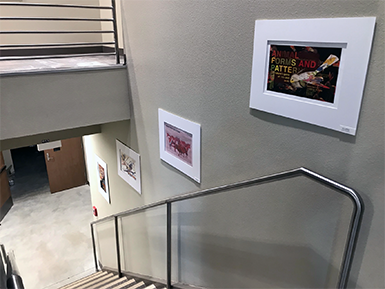
On this blogpost are several installation views, showing some (not all) of the posters. Another fifteen are also on exhibit on the second floor of the north wing of the Kamerick Art Building on the campus of the University of Northern Iowa. I'm hoping to post those and others on this blog in the coming weeks.

Animal Poster Exhibit (2018)

Poster by Wren Kress (2018)
Poster by Emily Schroeder (2018)

Making Dazzle Ships at the Tishman Auditorium

Public talk on ship camouflage (2018)
Above A guest presentation I gave on Thursday evening (November 15) at the Tishman Auditorium at The New School in New York City. The event, titled Making Dazzle Ships: Art, History and Design from WWI to Today, was focused on WWI dazzle ship camouflage in relation to that war's centenary (1914-1919). Of particular note has been the recent dazzle-painting of an historic fireboat, the John J. Harvey, which can be seen in New York harbor through May 1919.

Following my historical overview was a panel discussion, with insightful observations about that project (called Flow Separation) by Tauba Auerbach (the artist), Emma Enderby (project curator), and Jesse Hamerman (exhibitions director for The Public Art Fund), shown below in front of a detail of the vessel's dazzle design. It was a fascinating discussion, with new behind-the-scenes information about the challenges of designing the pattern, and the process of actually painting the ship. It was a great pleasure to be included.

It was also so gratifying to look out into the audience, and to see in attendance one of my favorite former graphic design students (at the University of Northern Iowa), NYC designer Amanda Chan. Less encouraging was the weather outside, a sloppy mix of snow and rain.

For more information about the historic context of WWI ship camouflage, here are links to two recently published online booklets here and here, as well as a wonderfully edited radio interview on 99% Invisible.

Panel discussion on ship painting project

Saturday, November 3, 2018

Lemanski Animal Posters | Julia Sippola 2018

Poster by Julia Sippola 2018
The animal sculptures featured in these three posters are the work of a North Carolina-based artist named Anne Lemanski. We've blogged about her once before. At her website, you can see lots of examples of her current work. She also makes wonderfully colorful collages based on natural images.

Poster by Julia Sippola 2018


The three posters were designed by Julia Sippola, a graphic design student at the University of Northern Iowa (she is actually from Finland and is studying at our school as a visitor). She designed these in response to a problem in which 30 students (this was their first course in graphic design) designed a series of three posters about Lemanski's animals. Of the resulting 90 posters, 25 of them (including all three of Julia's) are being exhibited at the interpretive building of the Hartman Reserve Nature Center in Cedar Falls IA. The exhibit (curated by Roy Behrens) begins officially on Monday, November 5 and continues through December 31, 2018. It is free and open to the public. We will be sharing more of these on this blog in the days and weeks ahead.

Poster by Julia Sippola 2018


By fortunate coincidence, this poster exhibition will open in the same week (November 7-9) as the annual gathering of the Iowa Association of Naturalists, which means that these works will be viewed by a substantial number of wildlife and conservation advocates. The schedule of events and registration materials are available online.

Artworks shown are copyright © the artist, and the posters are copyright © by their designer. Our thanks to Katie Shelton and Anne Lemanski for enabling this project to happen. It has been entirely enjoyable.

RELATED LINKS    

Dazzle Camouflage: What is it and how did it work?Nature, Art, and Camouflage / Art, Women's Rights, and CamouflageEmbedded Figures, Art, and Camouflage / Art, Gestalt, and Camouflage /  Optical science meets visual artDisruption versus dazzle / Chicanery and conspicuousness /  Under the big top at Sims' circus

Lemanski Animal Posters | Hartman Nature Center

Poster by Erica Scherer (2018)
The delightful bird sculpture in this poster is the work of a North Carolina-based artist named Anne Lemanski. We've blogged about her once before. At her website, you can see lots of examples of her current work. She also makes wonderfully colorful collages based on natural images.

The poster itself was designed by Erica Scherer, a graphic design student at the University of Northern Iowa. She designed it as part of a problem in which each of 30 students (this was their first course in graphic design) designed three different posters about Lemanski's animals. Of the resulting 90 posters, 25 of them are being exhibited at the interpretive building of the Hartman Reserve Nature Center in Cedar Falls IA. The exhibit (curated by Roy Behrens) begins officially on Monday, November 5 and continues through December 31, 2018. It is free and open to the public.

Below is a second poster, designed by Kailie Hesner, that resulted from the same class project. We will be sharing more of these in the days and weeks ahead.

Poster by Kailie Hesner (2018)


By fortunate coincidence, the exhibition will open in the same week (November 7-9) as the annual gathering of the Iowa Association of Naturalists, which means that these works will be viewed by a substantial number of wildlife and conservation advocates. The schedule of events and registration materials are available online.

Artworks shown are copyright © the artist, and the posters are copyright © by their designers. Our thanks to Katie Shelton and Anne Lemanski for enabling this project to happen. It has been enjoyable.

Tuesday, October 16, 2018

Assembly | The Work of Dazzle Camouflage

Above Details of the windows at the entrance of the Hearst Center for the Arts in Cedar Falls IA. Translated into large-scale vinyl are schematic dazzle camouflage plans for the two sides of a World War I American merchant ship (c1918).

It's a street-side advertisement for the center's current exhibition, titled ASSEMBLY: The Work of Dazzle Camouflage, on view from October 5 through November 25, 2018. So-called dazzle camouflage was widely used during WWI in an effort to throw off the calculations of German submarines (called U-boats) in their efforts to torpedo ships. The process is described in detail here and here, as well as on this multi-page website.

Using historic photographs, dazzle ship plans, and other artifacts from the collection of author and graphic designer Roy R. Behrens (UNI professor of art and distinguished scholar), the exhibition provides a look behind the scenes at the diversity of the people who enabled this odd approach to succeed. The exhibit is free and open to the public.


Below During WWI, the Navy Reserve officer who oversaw the ship camouflage work of a team of artists, designers and architects in Washington DC was Everett L. Warner, an American Impressionist painter who was originally from Vinton IA.

Friday, December 15, 2017

Grandson of John Everett Millais as Camoufleur

Millais, Christ in the Carpenter's Shop (c1850)
Above A slide from one of my lectures on the Pre-Raphaelite Brotherhood in a university course on the History of Design at the University of Northern Iowa. It is from a series of analyses of the symbolic and compositional systems in the paintings of John Everett Millais, in this case Christ in the Carpenter's Shop (1949-50). He was married to Effie Ruskin Millais (née Effie Gray), whose previous marriage to art critic John Ruskin had been annulled. While returning from London recently, I read a detailed account of this in Suzanne Fagence Cooper's Effie: The Passionate Lives of Effie Gray, John Ruskin and John Everett Millais.

•••

ARTISTS WANT TO CAMOUFLAGE in Sunday Times (Perth, Western Australia), January 28, 1940, p. 2—

LONDON—One of the artists whose name has been submitted to the War Office for camouflage work is Mr. Raoul Millais, grandson of Sir John Millais, the Pre-Raphaelite painter, who became president of the Royal Academy.

Mr. Millais has so far specialized in portraits of people and horses.

A member of the Beaufort Hunt, Mr. Millais has painted several horses belonging to his fellow followers of the pack.

His most notable horse subject was Blandford, the sire of several Derby winners.

Saturday, May 13, 2017

Cat's Pajamas Camouflage | Fontana Park in Iowa

Animal Camouflage talk (2017)
Above Opening slides for a talk we gave recently on animal camouflage, titled The Cat's Pajamas, at Fontana Park, a Buchanan County park near Hazelton IA.

We had a delightful time talking about the exotic coloration of pets and wildlife, to the widest age group possible, from preschool to retirement age. It's a beautiful park, with camping, fishing, hiking, picnicking, and an impressive Interpretive Nature Center. During our visit, we watched a thriving family of bison, including one just recently born.

Cat's Pajamas sheet music (c1920s)

Tuesday, April 4, 2017

Dazzle-Camouflaged Beverage Can

Above Des Moines-based graphic designer Kenny Miesner (former student of whom we have warm memories) shared with us this image and link to Focus Lab studio's concept (not actually used by the client) of a dazzle-camouflaged beer can. It reminded us of a reviewer's comment when the Chelsea Arts Club Dazzle Ball was held in London in 1919. The writer cautioned that the dazzle-patterned costumes might cause the dancers to collide. No doubt a couple of beers would help.

Tuesday, January 24, 2017

Smithsonian | World War I Ship Camouflage

Smithsonian article on WWI ship camouflage
Above and below World War I government photographs of two of the women camoufleurs, called Yeomen (F) to distinguish them from men, who served in the US Naval Reserve with the Design Subsection of the navy's Camouflage Section. In an attempt to find opportunities for women to participate meaningfully in the war, a small number were allowed to work on ship camouflage.

As shown here, women were only responsible for assembling small wooden ship models, on which camouflage schemes were painted by men, for testing in a periscope-equipped observation theatre. Only the men were allowed to design the actual schemes. Shown here are colorized versions of public domain black and white news photographs (c1918) in the collection of the National Archives and Records Administration.

•••

Linda Rodriquez McRobbie, from an excellent, detailed article on WWI dazzle ship camouflage online at Smithsonian.com

…In order for a U-boat gunner to fire and hit his target from as far as 1,900 meters away (and not closer than 300 meters, as torpedoes required at least that much running distance to arm), he had to accurately predict where the target would be based on informed guesses. Compounding the difficulty was the fact that he had typically less than 30 seconds to sight the target ship through the periscope, or risk the periscope’s wake being seen and giving away the submarine’s location. Typical U-boats could only carry 12 very expensive and very slow torpedoes at a time, so the gunner had to get it right the first time.

“If you’re hunting for ducks, right, all you have to do is lead the target and it’s a simple process. But if you’re a submarine aiming at a ship, you have to calculate how fast a ship is going, where is it going, and aim the torpedo so that they both get to the same spot at the same time,” says Roy R. Behrens, a professor at the University of Northern Iowa, author of several books on dazzle camouflage and the writer behind the camouflage resource blog Camoupedia

Wilkinson’s idea was to “dazzle” the gunner so that he would either be unable to take the shot with any confidence or spoil it if he did. “Wilkinson said you had to only be 8 to 10 degrees off for the torpedo to miss. And even if it were hit, if [the torpedo] didn’t hit the most vital part, that would be better than being hit directly.”… more>>>

WWI American woman camoufleur

Sunday, November 6, 2016

The History of Camouflage | YouTube Video

The Fine Print | History of Camouflage | Episode One
Above Forty-five years ago, when I first published articles on art and camouflage, no one was even remotely interested. Now it seems as if everyone is researching camouflage, even hip hop. It's been a long and often enlightening search.

Here's the lastest: A seven-minute online video, produced by Mountain Dew's Green Label, the first of three episodes, titled The Fine Print: The History of Camouflage. Enjoy.

Friday, April 3, 2015

Steganography, Camouflage and Eviatar Zerubavel

Cover of Hidden in Plain Sight (2015)
Above Cover of the latest camouflage-related book, titled Hidden in Plain Sight: The Social Structure of Irrelevance, just out from Oxford University Press. It's the latest achievement by Rutgers sociologist Eviatar Zerubavel, who is well-known for his earlier books, such as The Elephant in the Room: Silence and Denial in Everyday Life (2006) and (our favorite) The Fine Line: Making Distinctions in Everyday Life (1993).

•••

In Zerubavel's insightful and wide-ranging book, among the subjects introduced is a current encryption technique known as steganography. Now practiced in its digital form, the term was originated in 1499 (so says Wikipedia) by Johannes Trithemius in Steganographia, "a treatise on cryptography and steganography, disguised as a book on magic." We ourselves first learned about it in 2006 at an international conference at the University of Northern Iowa on Camouflage: Art, Science and Popular Culture, at which digital media scholar Eugene Wallingford (UNI Computer Science Professor) offered a wonderful overview of current uses of digital steganography.

Here is an excerpt from Zerubavel's text about steganography (pp. 35-36)—

There is a particular form of background-matching camouflage known as steganography, in which actual "signals" are purposely designed to be mistaken for mere "noise" and thereby effectively ignored. One can thus send a covert message in such a way that no one apart from oneself and one's intended audience (who are in fact usually alerted to expect it) even suspects its existence. Whereas in cryptography  only the content of the hidden is concealed, in steganography, its very existence is concealed as well.

Thursday, November 6, 2014

Dazzle Camouflage | Deception & Illusion

On Monday, November 17, 2014, UNI Professor and Distinguished Scholar Roy R. Behrens will talk about World War I ship camouflage in a program titled Deception & Visual Illusion: World War I Ship Camouflage. He will share historic photographs of various disruptive schemes known at the time as "dazzle camouflage." Designed by artists, graphic designers, architects, theatre set designers, and vision scientists, these were intended to throw off the calculations of torpedo gunners on German U-boats (submarines). The event is free and open to the public.