Showing posts with label bootlegging. Show all posts

Monday, August 4, 2025

boot leggings used literally in camouflaging bootleg

boot leg (1922)
BOOTLEGGERS CAMOUFLAGE TALK NO MORE in El Paso Herald (El Paso TX), August 12, 1922, p. 35—

It used to be that the bootleggers camouflaged their sales talks over the telephone.

They would inquire if the customer would like some fresh Scotch Salad, rye bread or Bourbon apples. Of late, they are growIng careless.

They speak rIght out and call a spade a spade—whiskey is whiskey and gin is gin.

The nerviest bootlegger, however, is one who called up a business man the other day and said he wanted to show a sample.

He carried the bottle, a portable little stand, a carafe of cracked ice and a glass, in a brief case.

And he presented his card, telephone number and address—with the price list printed plainly on the back.  

RELATED LINKS

Dazzle Camouflage: What is it and how did it work? /  Nature, Art, and Camouflage / Art, Women's Rights, and Camouflage /  Embedded Figures, Art, and Camouflage / Art, Gestalt, and Camouflage /  Optical science meets visual art /  Disruption versus dazzle / Chicanery and conspicuousness /  Under the big top at Sims' circus

camouflaging moonshine color to resemble bourbon

old bottle found at Gettysburg
CAMOUFLAGE ARTIST RUNS AFOUL DRY LAW in The Courier-Jounal (Louisville KY), February 15, 1922, p. 2—

Lexington KY—Sam Wilcox is an artist, the officers say, but his talent had gotten him into a peck of trouble.

Wilson’s art has been directed into “illegal” channels, according to the warrant issued by prohibition agents, who arrested him at his home at Corinth KY.

Some of his work will be exhibited to the Federal Commission at his examing trial February 20.

He is accused of having offered his services and a preparation for coloring moonshine whiskey to look like old Bourbon.

RELATED LINKS

Dazzle Camouflage: What is it and how did it work? /  Nature, Art, and Camouflage / Art, Women's Rights, and Camouflage /  Embedded Figures, Art, and Camouflage / Art, Gestalt, and Camouflage /  Optical science meets visual art /  Disruption versus dazzle / Chicanery and conspicuousness /  Under the big top at Sims' circus


online site links

Wednesday, December 22, 2021

metamorphosis / shape shifting from pitcher to pitcher

Above Anon, Evolution of a Pitcher (1889). Library of Congress.

•••

CAMOUFLAGE LIQUOR TO SOLDIERS AROUSES JUDGE NEW YORK, in Boston Globe, April 13, 1918, p. 15—

Discovery of camouflage in the disposal of liquor to soldiers and sailors in uniform Ied to the announcement by United States Judge Hand today that imprisonment and not fines would be the punishment hereafter of persons convicted of violating the Federal law forbidding the sale of intoxicants to Army and Navy men.

Stomachs of Teddy bears, paper bags left on mail boxes, taxicab rides around the block at $1.50 a ride, and cigar boxes passed over the counter at cigar stores are some of the methods through which service men here have been served with liquor recently, according to testimony in the Federal court at the arraignment of more than 300 persons, many of whom are now in prison.

Monday, June 15, 2020

hidden moonshine | teddy bear stomachs suspected

Camouflaged intoxicants
CAMOUFLAGE LIQUOR TO SOLDIERS AROUSES JUDGE in Boston Globe (April 14, 1918), p. 16—

NEW YORK—Discovery of camouflage in the disposal of liquor to soldiers and sailors in uniform led to the announcement by United States Judge Hand today that imprisonment and not fines would be the punishment hereafter of persons convicted of violating the Federal law forbidding the sale of intoxicants to Army and Navy men.

Stomachs of Teddy Bears, paper bags left on mailboxes, taxicab rides around the block at $1.50 a ride, and cigar boxes passed over the counter at cigar stores are some of the methods through which servicemen here have been served with liquor recently, according to testimony in the Federal court at the arraignment of more than 300 persons, many of whom are now in prison.

Wednesday, May 27, 2020

Veteran camoufleur sought for bootlegging expertise

Above Prohibition agents with a confiscated moonshine still. Library of Congress Prints and Photographs.

•••

CAMOUFLAGE USED TO COVER STILLS in Centralia Sentinel (Centralia IL), November 2, 1923, p. 2—

Montana prohibition officers are searching for a war veteran who saw service overseas in a camouflage outfit. According to [Montana law enforcement], bootleggers are believed to be employing the returned veteran to conceal their moonshine stills on Montana farms.

Costello said a still was recently discovered in a tent near Boseman MT after many weeks' search. The moonshine-making outfit had been hidden in a tent, painted green, and pitched in a clump of willows. Several times the dry officers came within a few feet of the hidden still but were unable to locate it because of the successful camouflage. A large number of barrels, hidden in the willows nearby, were painted green.

Three hundred gallons of whiskey, 1,244 pounds of sugar, 1,000 pounds of corn, and 15 barrels of mash, ready for distilling were found in the cache.

Evidence of the work of the veteran has been uncovered in other parts of the state, it was said. In a northern Montana grain field, a still was discovered hidden under a tent which was covered with bunches of grain, tied together, and ready for harvesting. For some days dry agents thought the disguised tent was a mound of grain.

Near Havre MT, a still was found on a mountain. The still was made of canvas and was located on the edge of a cliff. Painted to resemble rocks, it was many weeks before the moonshiners’ outfit was discovered.

At Great Falls a still was recently found on the banks of the Missouri River. Here the still was located in a cave. Painted canvas trees were used to disguise a door, which formed the entrance to the cave.

Friday, February 14, 2020

Camouflage used to conceal moonshine stills

Above Someone has fallen asleep in church (probably drinking the night before) and is snoring loudly. Can you find the culprit?

•••

CAMOUFLAGE USED TO COVER STILLS in Centralia Evening Sentinel (Centralia IL), November 12, 1923, p. 2—

Helena MT—Montana prohibition officers are searching for a war veteran who saw service overseas with a camouflage outfit. According to George Costello, dry agent of Glasgow MT, bootleggers are believed to be employing the returned veteran to conceal their moonshine stills on Montana farms.

Costello said a still was recently discovered in a tent near Bozeman MT after many weeks search. The moonshine-making outfit had been hidden in a tent, painted green, and pitched in a clump of willows. Several times the dry officers came within a few feet of the hidden still but were unable to locate it because of the successful camouflage. A large number of barrels, hidden in the willows nearby, were painted green.

Three hundred gallons of whiskey, 1,200 pounds of sugar, 1,000 pounds of corn, and 18 barrels of mash, ready for distilling were found in the cache.

Evidence of the work of the veteran has been uncovered in other parts of the state, it was said. In a northern Montana grain field, a still was discovered hidden under a tent, which was covered with bunches of grain, tied together, and ready for harvesting. For some days dry agents thought the disguised tent was a mound of grain.

Near Havre MT, a still was found on a mountain. The still was made of canvas and was located on the edge of a cliff. Painted to resemble rocks, it was many weeks before the moonshiners’ outfit was discovered.

At Great Falls a still was recently found on the banks of the Missouri River. Here the still was located in a cave. Painted canvas trees were used to disguise a door, which formed the entrance to the cave.

Wednesday, January 6, 2016

Duplicitous Roadsters Camouflaged and Otherwise

Advertising auto (c1919), Conover T. Silver
Above and below Views of World War I-era cleverly modified roadsters  designed by Conover T. Silver (C.T. Silver Motor Company, New York), for patriotic postcard use (below), and later, during Prohibition, as promotional advertising for “near beer” made by Anheuser-Busch (above).

Anon, AUTO THIEVES BUSY IN WEST: Iowa Suffering Worse Affliction Than in 1917 Through Camouflage Bandits, in The Standard (Springfield MO), July 6, 1918, p. 19—

Auto thieves are reaping a bountiful harvest all over the middle west this year. Over 2,000 cars were stolen in Iowa alone during 1917, and the operations of card bandits during the first half of this year indicate that their total steal for 1918 will far exceed last year’s record.…

According to the authorities, there are today half a dozen clever gangs operating in Iowa for the sole purpose of stealing autos. Their ingenuity in making away with machines, and then disguising them so that they cannot be recognized, is said to be almost beyond belief.

One pair of bandits, still at large, has a trick of getting away with a car that is real camouflage. The pair drive up in greasy mechanics' overalls, approach a car, parked in front of a building or garage, and commence to tinker with the engine. For several minutes they work industriously at their apparent task. Then they jump in the machine and ride away. Even the most suspicious person would mistake the pair for a couple of mechanics assigned to look over the auto in question.

…After the pair get out of town with the machine they usually take it some place to have it repainted. The license number is changed, and the stenciled number on the engine block ground off, and a new number put on.


Patriotic postcard (c1917), Conover T. Silver

Anon, AUTO THIEVES WORK BOLDLY, in Wichita Daily Eagle (Wichita KS), December 9, 1918—

The up-to-date [auto] thieves operating in Rochester NY drive their loot out into unfrequented parts of the country, run the car in a field and camouflage it to resemble a broken down shed, hay stack or pile of brush. The police have recovered a number of these camouflaged cars since the scheme was discovered through a confession.…

John G. Williams, an Omaha NE pioneer, at a meeting of the Nebraska Roads Association, called to discuss the passage of the anti-auto-theft law, “with teeth in it,” recommended hanging as a punishment for auto stealing. “If we string up a few of them it will discourage the others,” he said. “It discouraged the horse thieves in the old days,” he said.

Friday, January 16, 2015

Hunters Masquerade as Cow (1578)

US Patent No. 586,145 (1897)
Above Patent drawings for US Patent No. 586,145, titled "Hunting Decoy," as devised by J. Sievers, Jr. (1897). Not a bad idea, but apparently nothing new. As evidenced by two 1578 Dutch engravings by Philips Galle (shown below on this page), as early as the 16th century European deer hunters were camouflaging themselves by masquerading as cows. In both prints, notice the telltale human feet apparent beneath the cow costumes. Both prints (out of rights and in public domain) are in the collection of the Rijksmuseum.

•••

Anon, from the Humeston New Era (Humeston IA), Wednesday, December 21, 1921—

How to stop certain Iowa druggists from making bootleg whisky under the camouflage of cologne and similar euphonious preparations is the problem which Prohibition Enforcement Officer Bronson finds himself up against. Some druggists are getting alcohol ostensibly for legitimate purposes and converting it into bootleg whisky, Mr. Bronson told Commissioner Haynes, and it is difficult to detect them. Before departing for Iowa from Washington he urged the commissioner to allow him six more field men and two officers who are druggists. Indications are the added force will be granted.

Engravings by Philips Galle (1578)

Wednesday, December 24, 2014

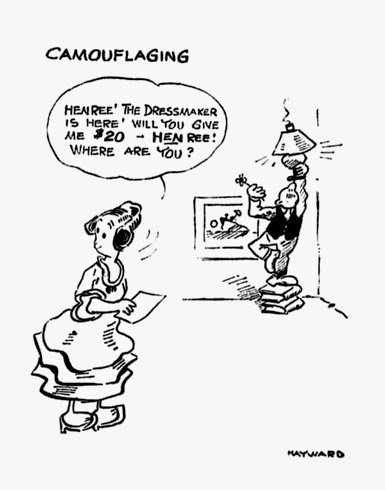
More A.E. Hayward Camouflage Cartoons

A.E. Hayward, September 27, 1917, p. 22
In an earlier post, we talked about American cartoonist  A.E. (Alfred Earl) Hayward (1884-1939), and reproduced one of his "camouflage cartoons" that appeared in 1917 in his daily series “The Padded Cell,” in the Philadelphia Public Ledger. Here (above and below) are more from that same series (restored and modified somewhat) from other issues of the same newspaper.

•••

Anon, BOOZE CAMOUFLAGED BY BREAD in The Brockport Republic (Brockport NY), February 21, 1918, p. 7—

The vigilance of a local post office clerk deprived a Camp Funston infantryman of two pints of whiskey and revealed a novel method transmitting through the mails. A compact package handled by a clerk, who noted it was damp. He opened the package and discovered two loaves of bread. A closer examination disclosed the inside of each loaf had been removed and a pint of whiskey inserted.

•••

Anon, The Plattsburgh Sentinel (Plattsburgh NY), Julu 1, 1921, p. 4—

Two loads of Canadian whiskey were captured in the vicinity of Malone during the past week. One car was cleverly camouflaged and booze skillfully hidden in the rear.

A.E. Hayward, October 5, 1917
Anon, INNOCENT LOOKING CADILLAC HAD 18 CASES OF WET GOODS in Essex County Republican (Keeseville NY), October 27, 1922, p. 1—

A neatly camouflaged booze car was captured [by police] near Keeseville. The troppers found that so far as appearances went there was nothing contraband in the car. An examination proved, however, that there were enough false compartments in the Cadillac 1922 touring car to conceal eighteen cases of Scotch and Canadian rye whiskey.


A.E. Hayward, September 18, 1917, p 18


A.E. Hayward, October 2, 1917, p 20
A.E. Hayward, October 3, 1917, p 22
A.E. Hayward, September 18, 1917
A.E. Hayward, September 28, 1917, p. 22

Friday, December 12, 2014

Teddy Bear Camouflage

US Patent No 285,951
Above One of several drawings submitted for US Patent No. 285,951, titled "Stuffed Toy Bear," invented by Sarah J. Raymo (1986).

•••

Rian James, "Protective Coloring" in Brooklyn Daily Eagle, February 3, 1932, p. 21—

I love the snob's bold camouflage,
Which is a personal mirage
To clothe the timid man inside,
A primal creature's way to hide.
Confused and groping consternation,
Against veneered civilization.

I love the snob's cold camouflage;
I'd seek to make my own barrage,
Oh, cutting glance, oh, chilling leer,
A snob's effective, bright veneer.
I'd like to be a snob, and see
Just what a first rate ass I'D be!

•••

Associate Press, INTEMPERATE BREATH in Plattsburgh Sentinel, May 14, 1920, p. 1—

NEW YORK, May 13—A teddy bear whose mouth gave forth a strong and intemperate odor aroused the curiosity of customs inspectors searching the crew's quarters aboard the steamship Morro Castle. They ripped off the head and found a canister full of whiskey where only sawdust should be.

Three hot water bottles in the room of a husky chef also [raised] suspicion and they were found to contain whiskey.

It was reported that the inspectors found 200 bottles altogether.