Showing posts with label comic strip. Show all posts

Sunday, November 15, 2020

immense saw teeth and cubistic stripes that were not

Louis Biedermann (1918)
Above I was so pleased to find this. It is a very rare full size two-page illustration spread having to do with World War I ship camouflage. Drawn by a phenomenal (if largely unknown) illustrator named Louis Biedermann (1874-1957), it was published as a center spread in the Los Angeles Evening Express, on Sunday, August 18, 1918, perhaps in an entertainment section. This is not its original color (I've colorized it), since presumably it was printed by a four-color halftone process (more or less equivalent to CMYK). Of the very few copies that may still exist, the colors have most likely faded by now, and the newsprint on which it was printed has degraded.

In an online posting by Geographicus, an antique maps dealer in New York, the Illinois Daily Free Express (no date) is quoted as having said—

[Louis] Biedermann is panoramic. He is panoramic in his thinking. His mental as well as his optical perspective presents a complete and extended view of all directions. The breadth of his understanding is more panoramic, perhaps, than his art.

Too bad this illustration cannot be seen more clearly here. It is fantastic and highly detailed, so does not do well at a very small size. See magnified detail below.

In the bottom left corner of the illustration is an explanatory box that reads—

CAMOUFLAGED! How the Erstwhile Merchant Fleet Looks in Its War Paint.

“Oh, what a tangled web we weave
When we practice to deceive

—especially when the web is woven of shuttling ships, and the destined victim of the deception is some U-boat skipper squinting through a hastily protruded periscope and vainly trying to get the range of a moving target from which most of the horizontal and vertical bearing points have been eliminated, while whorls, saw-teeth and triangles of black, white, gray, blue, green and pink blend dizzily into the shifting wave outlines of the seascape. We are well past the practice stage, though, and there are days when the results of ship camouflage turn New York Harbor, for instance, into a floating nightmare. For the benefit of the hundreds of thousands of other readers who never see the waterfront, Mr. Biedermann has indicated here the general effect of the “motley rout,” though purposely avoiding any approach to a portrait of any actual ship.


•••

HOW NEW YORK HARBOR IS PROTECTED FROM U-BOATS: Every Agency of Naval War Seen: Painted Ships and Weird Effects on Every Hand, but the Business of Getting Men and Supplies “Over There” Goes on as Though There Were No New Menace at Hand, in St Louis Post Dispatch (St Louis MO), January 23, 1918 [from an article published earlier in the Springfield Republican (Springfield MA), no date]—

It was in the lower harbor, below the Liberty Statue, that New York began to show as a port on a war basis. Here were the camouflaged ships at anchor. There were hundreds of them, steamers, schooners, tankers, all ages, shape and sizes. Blue, black and white, all shades of gray, occasionally green, the stripes ran up and down their sides. There were wildly zig-zagging stripes, stripes that spread outward and upward from the center of the ship’s side like a fan, stripes that curved upward, terminating in a superstructure of the bridge in lines like those of the bow; horizontal stripes jagged on their upper edge with immense saw teeth; cubistic stripes that were not, strictly speaking, stripes at all, but like the patterns of a crazy quilt.

But camouflage does not show to best advantage on gray mornings. It does not dazzle at near view, and at the first sight of the ships, coming among them suddenly from around the end of Governor’s Island, the definiteness of outline was a mild shock to preconceived notions. Nevertheless, the purring of the airplane motor overhead was not plainly audible. To the right of the course, off Staten Island, lay a group of old warships at anchor, but with steam up, lookouts posted and guns trained. Far down the harbor, between the anchored shipping and the Narrows, a squadron of patrol boats, lean of bow, square of stern and built for speed, passed leisurely back and forth across the water, one of them dragging with it a captive balloon of the sausage type which perked along with peculiar and rather ridiculous motions, as though resenting each tug of the rope. On nearer view the lookouts on these smaller craft were also seen to be posted, and at their neat little three-inch stern guns, a group of husky sailors invariably “stood by.” Whatever camouflage might be worth at that short range, it was plain that other precautions were all being taken.

A Hole in the Ship
By the time these details of the protecting fleet were visible, the virtue of the camouflage was apparent also. First a ship with a broad blue-gray band zig-zagging up its center through the smokestack seemed suddenly, at a range of perhaps half a mile, to have developed a hole in its middle. One seemed to be looking through it at sky, and, to ocular appearances, except under the closest scrutiny, it ceased to be a ship at all, but some naval monstrosity split in two. At about the same distance another ship which lay with its bow pointed toward us, suddenly appeared to have turned about and to confront us with its stern. So marked was the illusion in this case that no among of scrutiny could separate the real from the illusion. This was the case, too, of another ship whose stern suddenly began to appear as a broadside.

The ship with the bow curve painted on the superstructure demonstrated a unique merit. Instead of one big ship. it gave the illusion of being two smaller ones, the bow of the first—the real one—seeming to be crossing the bow of the second—a fake one—at a narrow angle. Across even this slightly choppy water the saw-tooth design seemed to sink the ship in the wave motion until only the masts and the superstructure had anything like definite form. Only the fan-shaped camouflage and the distinctly cubist patterns retained at a mile, still a very fair torpedo range—anything like their actual outline, and it was easy to believe that with the fan it would be different when the spray was flying, that the crazy-quilt pattern would puzzle the eye of the keenest observer when the sea was a dazzle of bright sunlight and wave shadows. On the whole, right in the harbor, lying at anchor, these ships would form no perfect target at anything like a sportsman’s range.

Monday, October 26, 2020

a sea-serpent with red and yellow camouflage stripes

SEEING SEA-SERPENTS in the Honolulu Star-Bulletin (Oahu, Hawaii) June 29, 1928—

Not one hawk-eyed person has seen a sea-serpent off the shore of any Hawaiian island for so long that we've forgotten just when the last time was whereas they're seeing them daily up and down the Atlantic coast.

Such a situation has no reason for being. As one of the most important pleasure resorts on earth, and growing more so, we can't afford to neglect the thrill of real old-fashioned sea-serpents.

In Florida, for instance, there are many persons who can see ocean monsters practically at will, and recently passengers on the liner Laconia, docking at Boston, declared they had glimpsed one with green eyes and a coarse, flowing mane.
 
To be sure, there was a fellow at Waikiki the other day who reported seeing a giraffe marked with red and yellow zig-zag camouflage stripes against a base color of bright green, wearing a little gold bell tied with a pink ribbon about its neck, but there were reasons in this case for doubting the substance of the vision, while reporters describing the spectacle of the Laconia passengers averred earnestly that all of them were apparently sober.

We can't afford to have the ancient custom of seeing sea-serpents done away with here, especially if visitors to Atlantic resorts persist in keeping it up.

Our sea-serpents are every bit as good as those on the east coast, if we will only buckle down to the job of seeing them.

Bud Fisher, Mutt and Jeff (October 14, 1953)


Thursday, June 25, 2020

The wizard of oz becomes schooled on camouflage

Walt McDougall (1904), Land of Oz comic page
There is no denying that American artist Walt McDougall (1858-1938) was an extraordinary cartoonist. His work is funny and beautifully drawn. Above is a single full-color newspaper page (1904) for L. Frank Baum's Land of Oz. And at the bottom of this blog post is another full-page comic (1897), amazingly structured, in which works by a number of cartoonists are featured—McDougall's work is inside the triangle on the left of the page. Both of these cartoons are in public domain, and can be accessed as image files on McDougall's Wikipedia page.

McDougall was also interested in camouflage, and he wrote a long newspaper account about that subject during World War I. I've republished the entire text below. But I haven't republished the illustrations he made for it. None of those drawings are of the quality of his cartoons, and one of them is blatantly offensive: it shows military brass having drinks at the Army and Navy Club (where I once lectured—on the subject of camouflage) in Washington DC. An African-American waiter is shown as a clueless black-faced minstrel, as was thought to be funny back then. It brings up painful memories of my own childhood when, as recently as the early 1950s, the movie theatre in the small Iowa community in which I grew up was still featuring "minstrel shows" in which white musicians (there were no black residents at the time) would perform in blackface. With that as a timely disclaimer, here is the text of McDougall's article—

Walt M’Dougall, TRAILING THE CAMOUFLAGE IN WASHINGTON JUNGLES: Certain Adventures of a Patriot Who Endeavored to Do His Bit for Our Newest Art: An “Inside Story” of the Incident That Gave Birth to Camouflage, Written and Illustrated by the Man Who Hereby Sets Forth His Claim to Rank as the Original “Camouflager,” in The Washington Post, June 10, 1917, p. 3—

Camouflage is pronounced as it is spelled, with the “g” soft and mushy, as in “garage,” and with the accent on the “cam.” The art and mystery of concealing batteries, roads and large, important officials by means of artificial scenery was given this name by the French, who knew that it would be a long time before people could determine whether it was a new kind of cheese or a bit of feminine wearing apparel.

Some time ago I became possessed of certain reliable information regarding camouflage through a returned Canadian officer and promptly addressed the War Department a fervent appeal to send me to the French front to gather further information, models, data, and insect parasites for the instruction of our own army. I realized that the task required the imagination of a playwright, the art of a scene painter, the skill of a stage carpenter, the strength of a blacksmith, the nerve of a literary agent, the stomach of a hyena, and the nerve of a motion picture substitute.

Nobody knows what became of that appeal.

New York Got the Edge
Two weeks ago I arrived in Florida in response to a suggestion from a high official to present my plea in person, and almost immediately discovered that while I had been dreaming under the orange blossoms a national camouflage division had been organized in New York, with units in various other cities, and that a number of able-bodied artists already were drilling at night in vacant lots. It was even said that they were wearing uniforms. Now, New York usually tumbles to a new thing only after all the rest of the country has tried it out, and then it starts it off as a new and original fad, but in this case, it seems to have got there first.

Somewhat startled and nervous, I devoted my initial efforts to ascertaining just how far the movement had progressed. Hastily seeking the aforesaid prominent official I was guided to the War Department, where we consulted a bland and amiable Major Blank, who, after candidly admitting that he had never heard of camouflage, said that from what I had revealed to him he didn’t think it quite fair to pester the department about such piffle when it was so busy with really important matters.

“Major, on my word of honor as a gentleman,” I repeated, “I assure you that while camouflage is a new war game, it isn’t piffle. It is saving thousands of lives and guns and military material in France.”

Patting me soothingly on the shoulder, he suggested: “Why not go over on your own account as a private citizen and study it?”

When I asked him, rather testily, I admit, how long he thought I’d last gumshoeing around the French front with a camera, a sketchbook, and a tape measure, picking centimeters and calories off the big guns, he appeared a trifle hurt, but when he got his breath he said that the War Department couldn’t bother with “frills” at this time and that perhaps I might manage to get away with the second or third division of troops going over.

I asked the next man who was consulted, point-blank, if he had ever heard of camouflage.

Thought It a New Insect Powder
“Yes,” said he in a flash; “It is the new insect powder they’re getting from the Phillippines.” However, he was only a civilian.

I began to see, dimly, that my task was going to difficult. We went to the Cosmos Club to dine, where I met an African explorer, who wanted to bet me that camouflage was a subspecies of the dingo family. Late at night, reduced to a sort of dumb despair, I went to the Press Club, where I encountered artist Felix Mahoney, [a cartoonist as well] who proved to have at his finger-ends all the knowledge there is about “Who’s Who and Where” in camouflaging. He formed the local unit and invited me to witness the evening drill the following night. I was surprised to learn that they were not drilling with paintbrushes, but actually learning the military manual under the instruction of a real army officer. This looked like something really tangible.

I also learned that evening that among other things it is supposed that “the camouflage artist is like any other soldier. He goes where he is sent, and, in addition to his arms, he carries a 6-inch sketch box, which is his palette, one-half of the box fitting on his thumb in true palette fashion, while the other half holds his little sketch boards and colors. The scene to be ‘camouflaged’ is sketched exactly as it appears in colors that match the true ones. This sketch is conveyed to the base of operations, where other artists copy it upon a large canvas. The framework, if there is any, is designed and the finished ‘scene’ is rushed to the spot it is intended to conceal.”

When I pointed out that if the scenery was already there in situ it scarcely needed to be disguised by an artificial creation precisely imitating its details to conceal it from the enemy, I was regarded with pity.

He Is the Original Camouflager
Now, I need to explain, perhaps, my interest in this matter. Long before the famous bank robbery where the burglars painted a fake safe and robbed the genuine one behind it, in my boyhood days, in fact, I cleverly painted a life-size effigy of my slight and skinny self and set it up in the cornfield where I was supposed to be watching the crows, and while mother thought I was on the job, I was lying under a willow by the creek fishing for perch. While I expose past duplicity with regret, my mother being long dead, I feel it needful to establish my claim as the original camouflager.

Well, I had already begun to suspect that I stood a swell chance of getting to the front, but I persisted. The next day I met a man in another department who confessed that he had heard that the French used artists in the army to “stimulate scenery” in deceiving the enemy. Needless to say, he meant “simulate.” I saw the young and enthusiastic artists drill that evening and conferred with them. They expected, every one of them, to be sent to the front, but they were rather misty as to how they were to be instructed, and where, in their special form of military art.  I took occasion to explain that I deserved to be sent over in order to qualify as an instructor for just such lads back here at home. None of these boys wanted to be generals or even captains—they wanted to camouflage.

After three days I got so that I found myself in the Army and Navy Club ordering camouflage cocktails for an aged major general and I realized that I had reached a critical stage. I proceeded to obtain a new slant on the subject. Armed with a note from Mr. Tumulty I sought the Assistant Secretary of War, but his private secretary, an alert and observing young fellow, seeing the wild, haunted look in my eyes, the hectic four-flush mantling my cheeks and my ill-concealed impatience, steered me up against some husky colonels in a remote part of the building. These officers, kindly and genial, humored me by listening to my ravings, and finally Mr. McKenna sent me by the department bus to the War College, having previously telephoned General Kuhn that I was coming.

They Treated Him Kindly
Right here I want to express my appreciation of the unfailing kindness, cheerful patience and delightful good humor of every official whose valuable time I monopolized during the week. Although they uniformly refused to take me seriously, they took me in and made me at home in every case. I lunched with the general staff on Friday, after walking many miles across country to the War College, a point usually reached only by airplane and wireless, and although I had neither guide, compass or chart, I got there before everything was eaten.

Here I received another shock. I found that General Kuhn actually knew all about camouflage! I mean, all that is known in the United States. That is nearly nothing, but the general had heard about what had been revealed. His delightful personality eased the pain I felt when I saw that he also regarded camouflage as frillery and military lingeries, as it were, but when he kindly enlightened me as to the number (something like 76,000) of eager, earnest souls who ardently desired to sail for France this week in order to study gas-bombing, trench ventilation, painless starvation, cathedral reconstruction, explosive frankfurters, dog training, the German system of converting their dead into toilet soaps, smokeless tobacco and the like on the battlefield, I saw a great light. I now perceive why departmental business proceeds slowly and painfully. If officials are as invariably polite, courteous, and obliging to every crank, bug, and jobseeker as they were to me it is wonderful that anything is accomplished, and it follows that camouflaging the departments is as necessary as anything else.

He Gave Up the Quest
The last man I interviewed on the subject was the celebrated sculptor, Mr. Paul Barlett, chairman of the executive committee of the Washington camouflage division. He assured me that a small army of artists, eminent and otherwise, was preparing to go to France, where they were to take up this pursuit.

“Do you mean that the government will send this division over as an actual organization of artists?” I asked.

He intimated that such was his understanding.

“And when this army, well-drilled and qualified as soldiers, arrives at the front, will it be marched somewhere and proceed to become students of camouflage, under the instruction of 700 busy scene painters now occupied in disguising France, or will they just camouflage around, picking up the art between the barrage fire and the hospitals?” I persisted.

Mr. Bartlett’s manner suggested that my question peeved him, or, at least, so it seemed to me, and I obtained no answer to the question of how our earnest seekers after knowledge would become qualified to proceed to camouflage. However, this finished my efforts to inject my own personality into the movement. I will not see France until the war is over, and I will never know more about camouflaging than anybody else does.


Walt McDougall and others (1897)

Wednesday, April 29, 2020

Giraffic Park | Periscope bathing when sub submerged

Ralph Hershberger (1942)
Ralph Hershberger, Funny Business cartoon In The Sacramento Bee, October 19, 1942. The caption reads: “My new camouflage periscope, sir—when we submerge the enemy will think it’s a giraffe taking a bath!”

•••

SEES 14 TRANSPORTS LEAVE NEW YORK in Mexico Weekly Ledger (Mexico MO), September 5, 1918, p. 3—

The transports are all camouflaged, painted like water and waves and rocks until they look all chopped up and one can’t guess at their enormous size from a distance. They are painted in grays, blues, and blacks and mottled as only the artist hand of the expert camouflager can do.

As Miss Jurgensen’s party neared the transports, they seemed to be empty and without life. Very soon, however, there appeared thousands and thousands of khaki-colored spots, which soon covered the decks in a mass of brown. In an instant these khaki-colored objects became live beings, shouting and waving white and red handkerchiefs. The sightseers cheered until they were hoarse and the soldier boys did not stop for breath. They were “going over,” and were glad of it.

Monday, February 17, 2020

Cartoonist Cliff Sterrett | Safety in Camouflage

Below This camouflage cartoon by American artist Cliff Sterrett (1883-1964) was featured in a comic strip series called Polly and Her Pals. It was published in the Salt Lake Herald (Salt Lake UT) on September 25, 1918. In an earlier post, we featured another Sterrett cartoon.


Saturday, August 3, 2019

Cartoonist Cliff Sterrett | Camouflage Catastrophe

Below This camouflage cartoon by American artist Cliff Sterrett (1883-1964) was featured in a comic strip series called Polly and Her Pals. It was published in the Bridgeport Telegram (Bridgeport CT) on September 26, 1918.


Tuesday, July 30, 2019

Cartoonist Walter Hoban | Jerry's Dog is Camouflaged

Below This camouflage cartoon by American artist Walter Hoban (1890-1939) was featured in a comic strip series called Jerry on the Job. It was published in the South Bend News Times (South Bend IN), July 28, 1917.


Saturday, January 6, 2018

Crapé Diem | Dare We Camouflage Old Age?

Maurice Ketten camouflage cartoon (1917)
Above Maurice Ketten, CAMOUFLAGE COOKING in The Galveston Daily News (Galveston TX) September 29, 1917, p. 8. For other wonderful Ketten cartoons, see earlier blog posts.

•••

Abe Martin SHORT FURROWS in The Indianapolis News. September 28, 1918, p. 4—

Rev. Wiley Tanger addressed “Th' Serious Thinkers" in Tell Binkley’s insurance office, last night, takin’ for his subject, “Age Camouflagin." After garglin' a dipper o' water, he said: “One o’ th’ first things a feller notices after he reaches fifty is how swiftly Saturday night rolls around. He no sooner takes a bath till he begins t’ lay out his underwear fer another one. He no sooner shaves th’ snow from his chin till it's white agin. Th’ weeks an’ months an’ years dart by like a Chaplin film. He no sooner gits used t’ a straw hat with a polka dot band till it’s time t’ look around fer a rakish green hat. Th’ day’s gone ferever when he could git by with a youthful face an’ sparklin’ eyes an’ th’ time t’ camouflage has arrived. Th’ never endin’ battle agin relentless ole age is on. Th’ barber, th’ masseur, th’ tailor, th’ presser an’ cleaner, th’ shoe maker, th’ osteopath an’ th’ toupee maker must all be drafted int’ his service an’ he starts forth t’ conquer an unseen foe. But why should a feller try t’ hide th’ fact that he’s fifty? Surely there’s room enough on this earth fer people o’ fifty! Who’s he tryin’ t’ fool? What’s he tryin’ t’ put over? He has started over th’ top an’ a talcumed face an' tan spats won’t hold him back! A polka dot hat band an’ gray hair won't mix!! A peeled gray head an’ a green hat only excite comment—speculation!! I don’t mean t’ say that a feller should begin t’ unravel an’ wither at fifty. If ther’s anything I hate t’ see worse’n a peeled gray badger in a pinch-back suit, it’s a reconciled feller o’ sixty sittin’ around fumblin’ a set o’ white whiskers when he ought t’ be plowin’. A feller ought t’ be tickled t’ death t’ reach fifty! He ought t’ be proud of it!! What I’m drivin’ at is that a feller ought t’ stay in his class. A toupeed feller kin never look like anything but a restorer ad! Bright colors only emphasize ole age. If you're spared till fifty, take advantage o’ ever’ moment from then on, but do it leisurely an’ gracefully. Don’t try t’ look like you’ve been born agin!

“You kin be youthful in spirit without shavin’ all th’ time an’ smellin’ like Floridy water!! Talk about th’ golden days o’ youth!! What’s th’ matter with th’ diamond studded years beyond fifty? At fifty we should quietly apply th’ brakes an’ leisurely descend th’ slope with seasoned muscles, ripe judgment, shorn of illusions, rich in experience, filled with sweet memories, grateful fer havin’ successfully weathered th’ adventurous years o’ youth, with a keen appreciation o’ ever’ precious hour an’ with th’ knowledge that ther’s no new sensations. Let’s stop camouflagin’ an' leave th’ pinch-back clothes an’ zebra shirts t’ youth. Let’s bathe ever’ Saturday as usual, but let’s not worry about our chins bein' white. We’ve had our fling at lady killin’ so let’s sober down an’ resolve not t’ drain our reserve tanks chasin’ after a procession that’s only headed fer where we already are.”

Sunday, August 9, 2015

Cartoonist Otto Soglow | WWII Tree Camouflage

Otto Soglow (1942)
Otto Soglow (1900-1975) was a New York-born cartoonist and illustrator. His humorous illustrations (especially a comic strip called The Little King) were widely published in magazines and newspapers from 1919 until his death in 1975. In the early 1940s, he produced a series of multiple-panel cartoon ads for Pepsi-Cola, including the above (from Life magazine, December 21, 1942), which may have been the only one that pertained to camouflage. At the time, with World War II on-going, there were countless news stories about military camouflage, including soldiers dressed as trees. We've also published earlier posts on tree-like observation posts and Charlie Chaplin's film on WWI tree camouflaged called Soldier Arms. Author's collection.

Wednesday, December 24, 2014

More A.E. Hayward Camouflage Cartoons

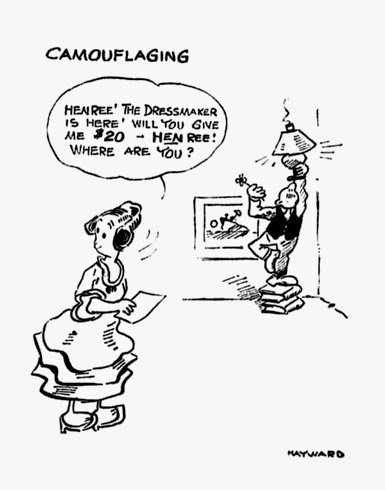
A.E. Hayward, September 27, 1917, p. 22
In an earlier post, we talked about American cartoonist  A.E. (Alfred Earl) Hayward (1884-1939), and reproduced one of his "camouflage cartoons" that appeared in 1917 in his daily series “The Padded Cell,” in the Philadelphia Public Ledger. Here (above and below) are more from that same series (restored and modified somewhat) from other issues of the same newspaper.

•••

Anon, BOOZE CAMOUFLAGED BY BREAD in The Brockport Republic (Brockport NY), February 21, 1918, p. 7—

The vigilance of a local post office clerk deprived a Camp Funston infantryman of two pints of whiskey and revealed a novel method transmitting through the mails. A compact package handled by a clerk, who noted it was damp. He opened the package and discovered two loaves of bread. A closer examination disclosed the inside of each loaf had been removed and a pint of whiskey inserted.

•••

Anon, The Plattsburgh Sentinel (Plattsburgh NY), Julu 1, 1921, p. 4—

Two loads of Canadian whiskey were captured in the vicinity of Malone during the past week. One car was cleverly camouflaged and booze skillfully hidden in the rear.

A.E. Hayward, October 5, 1917
Anon, INNOCENT LOOKING CADILLAC HAD 18 CASES OF WET GOODS in Essex County Republican (Keeseville NY), October 27, 1922, p. 1—

A neatly camouflaged booze car was captured [by police] near Keeseville. The troppers found that so far as appearances went there was nothing contraband in the car. An examination proved, however, that there were enough false compartments in the Cadillac 1922 touring car to conceal eighteen cases of Scotch and Canadian rye whiskey.


A.E. Hayward, September 18, 1917, p 18


A.E. Hayward, October 2, 1917, p 20
A.E. Hayward, October 3, 1917, p 22
A.E. Hayward, September 18, 1917
A.E. Hayward, September 28, 1917, p. 22

Monday, December 22, 2014

Trojan Horse Camouflage | Shakespeare Too

Sheboygan Press, January 1, 1918, artist unknown
Above A cartoon illustration on the historic antecedents of World War I camouflage as published in the Sheboygan Press (Sheboygan WI), January 7, 1918, p. 8. The artist's signature, at bottom right, is unreadable. Image restored and adjusted.

•••

Theodor Reik—

Where would a clever man hide a particular leaf? In the forest.

•••

Colin Watson—

A needle is much simpler to find in a haystack than in a bin of other needles.

Thursday, December 18, 2014

A.E Hayward's Camouflage Cartoons

Above Cartoon by A.E. (Alfred Earl) Hayward (1884-1939), from his daily series “The Padded Cell,” in the Philadelphia Public Ledger on October 4, 1917, p. 22. In addition to this series, Hayward also originated "Pinheads” and “Somebody’s Stenog," a strip about a stenographer named Cam O’Flage.

•••

Anon, CAMOUFLAGE BATHING SUIT CAUSES SENSATION, in Boston Sunday Globe, August 24, 1919, p. 47—

Old Orchard Beach, August 23—This week the town has been filled to its capacity. No such summer business was ever seen here before. There were more automobiles at Old Orchard Sunday afternoon than ever before in a single day, according to the traffic officers.

A camouflage bathing suit was seen here for the first time this week. It was worn by a tall, slim beauty, who attracted more attention than a flock of seaplanes. As she sauntered down the beach she resembled a crazy patchwork quilt. Beach loungers thought she was wrapped in a silk bed covering. She presented a wonderfully attractive picture, however, as she trotted down to the water and plunged into the surf.

Sunday, December 14, 2014

Camouflage: Making a Cannon Look Like a Cow

Above We recently found this delightful cartoon (which we've restored and reconstructed) in an old issue of the East Oregonian (Pendleton OR), Saturday, July 26, 1919. Unfortunately, the illustrator isn't credited nor is there any signature.

•••

Anon, TWELVE QUARTS PROVE TOO MUCH WHISKEY, in The Watchman and Southron (Sumter SC), March 23, 1921—

Officers Owen and Chandler yesterday afternoon came upon a hot trail which led to the arrest of a Florida man after twelve quarts of good whiskey had been found in his possession. The man was on the Northwestern train and was headed toward Camden with the whiskey at his side, the case containing the whiskey he had tried to camouflage by spreading on a layer of oranges over the top. When arrested he stated that he had purchased the whiskey in Savannah and was taking it to Asheville to sell at a profit. He said that his health had been bad lately and that he was in need of the money to go to a hospital on. The Florida citizen was kept in confinement at the police station last night and will probably remain put until some better arrangements can be made in his case.

Thursday, December 11, 2014

Eric Sloane | Camouflage and Comic Books

Eric Sloane (1942), Camouflage Simplified
We've talked about American artist Eric Sloane (1905-1985) in an earlier blog, specifically in reference to a 60-page Illustrated guidebook called Camouflage Simplified, published in 1942. It's easily our all-time favorite comic-style overview of the subject. It's a delight just to look at the drawings, such as the examples above and below. It turns out that, according to the Hathi Trust Digital Library, the book is now in public domain, and is available in full online. Take a look at it; it's a pleasurable way to spend some time.

Eric Sloane (1942), Camouflage Simplified