Showing posts with label films. Show all posts

Tuesday, September 2, 2025

Actor James Cagney trained as camoufleur in WWI

James Cagney (1932), film lobby card

Joann Rhetts, A LOOK AT A LEGEND, in The News and Courier (Charleston SC) April 5, 1986, p. 7—

The young James [Cagney, Hollywood film star] had a notion of becoming an artist, even entered Columbia University during World War I under an ROTC-type program as an artist assigned to a military camouflage unit.

RELATED LINKS 

Dazzle Camouflage: What is it and how did it work? /  Nature, Art, and Camouflage / Art, Women's Rights, and Camouflage /  Embedded Figures, Art, and Camouflage / Art, Gestalt, and Camouflage /  Optical science meets visual art /  Disruption versus dazzle / Chicanery and conspicuousness /  Under the big top at Sims' circus

Saturday, August 30, 2025

Glen Gano / US actor, cinematographer, camoufleur

Actor and Hollywood cameraman Glen Gano (1892-1973), born in Kokomo IN, was the cinematographer for four Three Stooges productions: Booby Dupes, Micro-Phonies, Idiots Dulux, and The Yoke’s on Me. But, prior to that, he was also a US Army camoufleur. On January 11, 1918, the Corvallis [OR] Gazette Times included an article titled CAMOUFLAGERS DUE FOR FRANCE VISIT HERE BEFORE DEPARTURE.

Gano, according to the article, “came here from Camp American University [Washington DC] with John F. Byrne… Both soldiers beong to a camouflage corps, Company F of the Twenty-fourth Engineers, who are about to go to France. Private Byrne is a former Carnegie Institute of Technology student and last night entertained [students from that school] at his home…

Showing that psychologists are at work in assigning young men to the positions they are best fitted, Private Byrne…being a [scene] decorator, was assigned to camouflage.

For a wholly different reason, Mr. Gano, who enlisted at Los Angeles, was detailed for camouflage because he was familiar with outdoor photograpy, and was competent to arrange scenes which might easily deceive the German and Austrian expert scouts in the air.

Mr. Gano, in speaking of the reasons impelling him to enlist, said that war could not be more hazardous than going over cliffs in automobiles, lassoing moving locomotives and the like [as he has done as an actor in Hollywood films]. “As a class we want to show the nation that screen actors have more enduring qualities than curly locks, and ‘looking pretty’ in close-ups,” Mr. Gano said. 

According to Wikipedia: “On December 6, 1915, during the filming of an episode of the serial The Hazards of Helen, Gano, reportedly acting as a stunt double for the film's star, suffered what, over the next few days, would be described variously as ‘a fatal fall,’ ‘tragic death,’ ‘injuries from which he will probably die,’ (aka ‘probably fatal injuries’), making an ill-fated leap from the 4th Street Bridge in Los Angeles. Thankfully, reports of his demise proved premature.”

RELATED LINKS

Dazzle Camouflage: What is it and how did it work? /  Nature, Art, and Camouflage / Art, Women's Rights, and Camouflage /  Embedded Figures, Art, and Camouflage / Art, Gestalt, and Camouflage /  Optical science meets visual art /  Disruption versus dazzle / Chicanery and conspicuousness /  Under the big top at Sims' circus


Wednesday, July 16, 2025

hollywood leg enhancer is biting the legs that feed him

Hazel Canning, EXPERTS ON FEMININE LEGS PUT CHARACTER ABOVE BEAUTY in Boston Sunday Post, April 29, 1945, p. 5—

Willy of Hollywood [dba Willy's of Hollywood] launched the topic of legs.

Willy is a stocking maker and leg camouflage expert in the movie city.

In fact, it is said that Willy can make stockings to give insoucient slenderness to the stumpy legs: a saucy challenge to the leg rather blocky and unshaped; whimsy, appeal and charm to the toughest, the stodgiest, the stiffest of feminine appurtenance which connects a shapely or otherwise ankle to the knee.

Recently Willy studied Miss Greer Garson as she was photographed in her kilt costume for the dance in Random Harvest.

These words he spoke more as a connoisseur than a critic, but nevertheless, the man whose speciality is reshaping feminine legs was not exactly pleased with Greer Garson’s. His comment sped across the ocean and into the London Mail. Garson read it, then she spoke.

“I,” said she, “have no need of a leg camouflager. My legs are my own; the ones with which I dance in Random Harvest. My paying customers have never complained about my legs. Now if this Willy is really a leg camouflager, I think he is rash. By advertising his trade, is he not, rather, biting the legs that feed him?”…

RELATED LINKS 

Dazzle Camouflage: What is it and how did it work? /  Nature, Art, and Camouflage / Art, Women's Rights, and Camouflage /  Embedded Figures, Art, and Camouflage / Art, Gestalt, and Camouflage /  Optical science meets visual art /  Disruption versus dazzle / Chicanery and conspicuousness /  Under the big top at Sims' circus

Sale-priced books on camouflage / free shipping

Monday, June 30, 2025

an expert at making black eyes disappear with paint

Movie poster (1937)
SIGN PAINTER AND CAMOUFLAGER OF BLACK EYES DIES in Graham Daily Reporter (Graham TX), January 24, 1936—

NEW HAVEN—Julius A. Rida, dean of New Haven sign painters and an expert at making “black eyes” disappear with deft touches of a paint brush, died last night.

Rida established a sign shop here when he was 19 years old. His place became a favorite with young bloods of bygone days with more spirit than pugilistic skill.

For $5 Rida would delicately color damaged eye areas and restore them to the natural appearance. The job took less than twenty minutes.

RELATED LINKS    

Dazzle Camouflage: What is it and how did it work? /  Nature, Art, and Camouflage / Art, Women's Rights, and Camouflage /  Embedded Figures, Art, and Camouflage / Art, Gestalt, and Camouflage /  Optical science meets visual art /  Disruption versus dazzle / Chicanery and conspicuousness /  Under the big top at Sims' circus

Sunday, April 20, 2025

architects / they have an eye for the looks of things

Above Photograph of Homer Saint-Gaudens, by De Witt Clinton Ward.

•••

HOLLYWOOD PROP MEN ABLE AT WAR CAMOUFLAGE in The Boston Globe, January 15, 1942, p. 12—

WASHINGTON January 15 (AP)—Hollywood “prop” men—the chaps who design the stage sets for the movie stars—make the best prospects for military camouflage work, an Army expert on strategic concealment asserted today.

Lieut. Col. Homer Saint-Gaudens, Harvard-educated head of the camouflage branch of the Office of the Chief of Engineers, said in an article in the Military Engineer:

"Our best men are moving picture property men. They not only have camouflage ideas, but they understand the application of those ideas. They are resourceful; they are disciplined; they have an eye for the looks of things: they can build you the answer."

The colonel, who was himself stage director for actress Maude Adams. and is director of fine arts, Carnegie Institute, says that when a would-be camouflage worker comes to his desk and declares he is a marvellous painter, he (Saint-Gaudens) makes this reply:

"That's okay. But let me have a look at your hands. How are your feet? Can you lug 60 pounds 20 miles and do it again the next day?

"Yes, I remember that set where Robert Taylor makes love to Hedy Lamarr. You say you designed it and helped build it, too? You are just the young man we are looking for."

Saint-Gaudens, who received numerous decorations for his camouflage work during the first World War, said the best camouflage officers, the ones who direct the workers, are young erst-while architects."

Such men, he declared, have "already learned to cope with the builders of new houses who insist on having the stairs and the clothes closet in the same place.”

•••

Below Page spread from an article by Edwin Schallert, Trick Photography in the Gold Rush, in Science and Invention (December 1925), pp. 714-715, showing various special effects and scenic props used in the filming of the Charlie Chaplin comedy The Gold Rush.

  RELATED LINKS    

Dazzle Camouflage: What is it and how did it work? /  Nature, Art, and Camouflage / Art, Women's Rights, and Camouflage /  Embedded Figures, Art, and Camouflage / Art, Gestalt, and Camouflage /  Optical science meets visual art /  Disruption versus dazzle / Chicanery and conspicuousness /  Under the big top at Sims' circus

Thursday, March 13, 2025

celebrated Hollywood art director was US camoufleur

To my surprise, I have known about Richard Day for years. I simply hadn’t realized that a camoufleur named Richard Day was the same person whom I was aware of for other reasons. As a graphic designer, I have long been interested in the book designs of Merle Armitage, and I knew that one of the books he designed was The Lithographs of Richard Day. Foreword by Carl Zigrosser. New York: E. Weyhe, 1932. While I have sometimes collected Armitage books, I’ve never owned this particular one (it’s not among his finest designs), and in truth I haven’t had much interest in Richard Day’s lithographs (or at least the ones in this volume).

But my interest has been reenlivened—for other reasons. This same Richard Day, as it turns out, was one of Hollywood’s most famous art directors. He was a Canadian whose full name was Richard Welsted Day (1896-1972). He didn’t settle in the US until c1918. Prior to that, he served in World War I as a captain in the Canadian Expeditionary Force, which may or may not have included experience with camouflage.

Following the war, having worked as a commercial artist in Victoria BC, he moved to Hollywood, in the hope that he might find work in the motion picture industry. By good fortune, he apprenticed with Eric von Stroheim, worked as a scene painter, and was soon appointed art director of the film Foolish Wives. As his career progressed, he moved on to other opportunites as a Supervising Art Director. In addition to von Stroheim, he also worked with Tod Browning, Samuel Goldwyn, and Elia Kazan.

Day’s work on hundreds of Hollywood films resulted in his nomination for forty Academy Awards, as well as earning Oscars for Dark Angel, How Green Was My Valley, This Above All, My Gal Sal, A Streetcar Named Desire, On the Waterfront, and Dodsworth. By the mid-1930s, as a motion picture art director, he was the highest-paid in Hollywood.

When the US joined the Allies in WWII, Day became an American citizen and joined the US Marine Corps, during which he specialized in “camouflage designs and relief mapping techniques.” His final film, produced in 1970, was Tora! Tora! Tora!, which included his reenactment of the attack on Pearl Harbor, which (according to the New York Times) cost the film’s producers “more money than the Japanese had [spent] on the original attack in 1941.”

RELATED LINKS    

Dazzle Camouflage: What is it and how did it work? /  Nature, Art, and Camouflage / Art, Women's Rights, and Camouflage /  Embedded Figures, Art, and Camouflage / Art, Gestalt, and Camouflage /  Optical science meets visual art /  Disruption versus dazzle / Chicanery and conspicuousness /  Under the big top at Sims' circus

Saturday, July 13, 2024

he painted camouflage on the sides of trucks & trains

Eisenstein and others in Japan
Above Such an astonishing photograph. Taken in the 1920s in Japan, this is a detail of a photograph of a larger group of those associated with Russian Constructivism. Here are writer Boris Pasternak, filmmaker Sergei Eisenstein, socialite Lilya Brik (wife of Osip Brik), and poet Vladimir Mayakovsky. Such intense personalities, at an especially mournful time in modern history.

•••

Marie Seton, Sergei M. Eisenstein: a biography. NY: Grove Press, 1960, p. 146—

One day he [Sergei Eisenstein] sat for many hours in the small unpretentious Lyons’ teashop next to the Holborn Underground [in Central London] with Paul Rotha. He drank several cups of coffee and “smoked like hell.” Normally he never smoked. But he had been with Rotha to the museum of the Royal College of Surgeons [aka Hunterian Museum]. He talked about the Russian Revolution and drew incessantly upon the marble table-top to illustrate the camouflage ideas used by the Red Army during the Civil War. [According to Seton, Eisenstein had “painted camouflage and propaganda on the sides of cattle-trucks and trains.”] From the museum of the Royal College of Surgeons to the Russian Civil War…There was a psychological thread linking the sights he has seen at the front and the sights in the museum. As he had once tried to conceal his innocence from his Red Army comrades by Rabelasian talk, so now Sergei Mikhailovich camouflaged his frustrations by speaking of psychoanalysis and smoking endless cigarettes.

Tuesday, October 3, 2023

contributions of Hollywood to WWI ground camouflage

Above Camouflage pattern (digitally-colorized, thus historically unreliable) on World War I huge long-range artillery, mounted for railway transport, c1918, unknown source.

•••

G.P. Harleman, News of Los Angeles and Vicinity in The Moving Picture World, December 1, 1917—

Lawson Organizes Camouflage Artists
Lee Lawson, [Hollywood] technical expert, has received from the Adjutant General authorization to form a company of two hundred and fifty men of the [motion picture] studio plants for the camouflage department to be incorporated in the Twenty-Fourth Engineers.

Lawson has been engaged at his trade locally for the past twelve years. He recently asked for authority to organize a company of camouflage artists. His appointment was made by Secretary of War [Newton] Baker.

All the ingenuity of “trick stuff” manifested in motion pictures will be transplanted to the camouflage activities in France. Scene painters, artists, sculptors, property men and numerous other classes of employees in studios will comprise the company.

Lawson already has sixty-four men enrolled. These will leave in a few days for American Lake [near Lakewood], Washington, where they will receive instruction in the most advanced methods of camouflage work.


•••

G.P. Harleman, News of Los Angeles and Vicinity in The Moving Picture World, December 15, 1917, page 1637—

Camouflage Artists Leave for Training
The greatest camouflage company in the world, according to Major George P. Robinson, United States Engineers Corps, left Los Angeles November 24, for an eastern training camp. There wre sixty-five men in the part, headed by Lee Lawson of the Universal. The personnel were recruited almost exclusively from the leading motion picture studios of Los Angeles.

“Nowhere else in the world could a company of men of similar qualifications have been recruited,” said Major Robinson. “The best scenic artists and men of kindred trades in the motion picture industry are here.”

Just before the train pulled out of the station Lee Lawson made a short speech to the crowd. “Friends, we’re going over there to fool the Kaiser, and if Yankee genius counts for anything we’ll be there with the goods,” he said.

The leave taking was different from any farewells given any party of soldiers leaving Los Angeles heretofore. Sixty-five young men, all of them known personally to the five hundred or more persons who bade them goodbye, caused everybody to cry goodbye to everybody else. It was a scene not easily forgotten.


•••

News of Cinema and Film Gossip in The New York Sun, February 2, 1919, p. 39—

Lieutenant Lee Lawson, former technical director, Sergeant Clarence DeWitt and Sergeant H. Divver, formerly of Universal City, for over nine months members of a camouflage regiment in France, has returned to the studio. When America entered the war Lieutenant Lee [sic] assembled scenic artists, sculptors, directors and property men in a camouflage platoon. He was wounded twice, Sergeant DeWitt gassed, and Sergeant Divver wounded twice.

RELATED LINKS    

Dazzle Camouflage: What is it and how did it work?

 Nature, Art, and Camouflage

 Art, Women's Rights, and Camouflage

 Embedded Figures, Art, and Camouflage

 Art, Gestalt, and Camouflage

 Optical science meets visual art

 Disruption versus dazzle

 Chicanery and conspicuousness

 Under the big top at Sims' circus

Tuesday, August 1, 2023

Perkins Harnly / artist and cross-dressing camoufleur

Poster, Index of American Design
Few people will have heard of Perkins Harnly (1901-1986), an obscure American artist who grew up in Nebraska, lived in New York for a number of years, and ended up in Hollywood. I first became aware of him while researching a Depression-era art program called the Index of American Design. In a book edited by Francis V. O’Connor, The New Deal Art Projects: An Anthology of Memoirs (Washington DC: Smithsonian Institution, 1972), there is an essay by Lincoln Rothschild in which it is mentioned that “a specially gifted artist” named Perkins Harnley [sic] had provided that agency with “amusing views of a Pullman diner and an ornate stable as well as more ordinary interiors” (p. 184).

If people know about the New Deal Art Projects, it is most likely because they’re familiar with the Works Progress Administration or WPA (see poster above), in which the US Government commissioned unemployed American artists to create public murals for permanent installation in post office lobbies throughout the country. A surprising number of these have survived, and some of them remain on view in local post offices throughout the country.

What is less well-known is the Index of American Design (1953-1942), in which other unemployed artists (not studio "fine artists" but men and women who had previously worked as designers and illustrators, commonly disparaged as “commercial artists”) were hired not to make “creative” murals but to document examples of vintage American crafts (including folk art), through precise, detailed renderings. Among the things included in the Index of American Design were historic children’s rocking horses, carved ship figureheads, folk pottery, handmade clothing and fabrics, cast iron toy banks, antique furniture, weather vanes and other architectural ornaments, and so on. 

These were all beautifully documented in watercolor renderings, in exacting detail and in color. Miraculously, 18,257 of these have been preserved, and are housed at the National Gallery of Art in Washington DC. These images are in public domain, and can be accessed online here. To commemorate that archive (as well as the graphic designers who made them), earlier this year, I designed and posted online a series of posters about  a few of the items it features. 

Among the artists commissioned to make Index of American Design renderings was Perkins Harnly. In addition, he also served briefly as a wartime camouflage instructor. While working for the Index of American Design, Harnly’s supervisor had been a Harvard-trained art museum administrator named Lloyd LaPage Rollins (1890-1970), who had also been director of the DeYoung Museum in San Francisco. According to Harnley, Rollins was gay and was an avid collector of outlandish Victorian-era artifacts, which today would be regarded as “camp.” His housemate and associate was, as Harnly described him, “an attractive pet Scotsman.”

Interestingly, as revealed by Harnly’s biographer Sarah Burns, Harnly himself was gay and would later become notorious for cross-dressing and related misbehavior. Rollins was (in Harnly’s words) “my WPA Projects boss.” It was apparently through Rollins that Harnly was commissioned to make illustrations for the Index of American Design, some of which were rather large, measuring twenty-two by thirty-one inches. Harnly greatly enjoyed this assignment, in which he apparently had few restrictions. In an interview many years later, the artist recalled the freedom he had in completing this project that continued for years:

On the WPA I had all the time in the world. Every plate took four weeks at fourteen hours a day seven days a week to paint…just one took four hundred hours to render so meticulously and none took less than two hundred hours.

These fact-based yet fanciful renderings of Victorian interiors were well-received by government administrators, and that success was underscored when they were later exhibited publicly (twice at the Metropolitan Museum of Art) and reproduced and written about in magazines. Two examples are posted here.

Perkins Harnly, Index of American Design

Perkins Harnly, Index of American Design


From the little that is known about Harnly’s involvement in camouflage, it appears to have been minor in comparison to the work he did for the Index of American Design. When America entered World War II, as Harnly later remembered in a Smithsonian interview, “we were put on defense projects…” He was assigned to camouflage as a civilian instructor, and sent to Fort Belvoir VA. There, he taught camouflage to officers, among them William Pahlmann, a well-known interior designer, and Gene Davis, the art director at Good Housekeeping magazine. The person in charge of camouflage at Fort Belvoir was Homer Saint-Gaudens, the son of Augustus Saint-Gaudens, the famous American sculptor. 

When that assignment ended, Harnly was sent back to California, where his supervisor was once again Lloyd Rollins, his former “WPA boss,” but this time he “taught a class on camouflage in the attic of a midtown fire station.” Soon however, that class abruptly crashed and burned when Harnly had a falling out with Rollins’ associate (his so-called “pet Scotsman”), who stormed out in the middle of a work session, whereupon the course was cancelled.

Harnly lived for 85 years. He was colorful, to say the least. Sarah Burns’ recent book about his life is titled The Emphatically Queer Career of Artist Perkins Harnly and His Bohemian Friends (Port Townsend WA: Process Media, 2021). Be prepared for some scandalous content. It is a highly detailed account of the life of a person who grew up in a setting of what he himself described as “trashy Tobacco Road types” in the dregs of rural Nebraska. When interviewed at age 80, he claimed that his birth was premature, by seven months, when he was born in a “pauper’s farmhouse.” With no access to medical care, much less an incubator, he was wrapped in cotton, placed in a shoe box, and kept warm inside an oven.

When he was four or five years old, the family moved to Lincoln NE, where they lived adjacent to the Lyric Theatre. Over the years, his proximity to that stage led to his fascination with linear perspective, painting, and set design. His interest in art had begun as a child, but he did not pursue it intently until he was hired by the WPA for their New Deal art program. It was that opportunity, Harnly recalled, that gave him “the reason, the encouragement, the research, the material, and I really went to town.” In the end, he completed a total of eighty-one renderings of Victorian interiors for the Index of American Design.

There is much more to this story of course, far too much to include in a blog post. But two other aspects of Harnly’s life are of particular interest. First, his paternal grandfather, a Nebraska farmer named Benjamin Harnly, enjoyed considerable success in building elaborate Queen Anne residences in Lincoln. He constructed at least sixteen, the most famous of which was the Bryan House, which he built for William Jennings Bryan. 

Second, Harnly worked temporarily for MGM in Hollywood. This resulted from a showing in New York of twenty-two of his Victorian interior renderings for the Index of American Design. In an exhibition titled “I Remember That,” they were displayed on the mezzanine at the Metropolitan Museum of Art from October 1942 to April 1943. Among the people who viewed them there was an MGM film director named Albert Lewin. He was just then preparing to produce a film version of Oscar Wilde’s novel, The Picture of Dorian Gray. In that story, circumstances are such that a painted portrait of its youthful, handsome protagonist, Dorian Gray, is reduced to putrefaction—as if by otherworldly means—as the physical man himself decays.

Based on his reaction to Harnly’s renderings of Victorian room interiors, Lewin persuaded him to relocate to Hollywood and to contribute to the film as a set design consultant. At the same time, Lewin also contracted two painters, who were brothers from Chicago, named Ivan Le Lorraine Albright, and his identical twin Malvin Marr Albright. They too were brought to Hollywood to work on site on the film. 

The original agreement was that Malvin would complete a portrait of Dorian Gray (looking both handsome and youthful), to be used at the film’s beginning, while Ivan would provide a comparable portrait of the same anti-hero, in a disturbing state of decay, at the end of the film. Ivan Albright’s (now-famous) painting (reproduced below) was used in the finished film, but the painting by his brother was eventually omitted, and replaced by an alternate portrait by a Portuguese artist, Henrique Medina. The paintings by the Albright twins upstaged Harnly’s achievements as a "sketch artist" and set designer. Ivan Albright’s painting was widely publicized, while Harnly is not even mentioned in the film credits.

RELATED LINKS    

Dazzle Camouflage: What is it and how did it work? /  Nature, Art, and Camouflage / Art, Women's Rights, and Camouflage /  Embedded Figures, Art, and Camouflage / Art, Gestalt, and Camouflage /  Optical science meets visual art /  Disruption versus dazzle / Chicanery and conspicuousness /  Under the big top at Sims' circus

Ivan Albright, The Picture of Dorian Gray (1943)


Wednesday, June 21, 2023

camouflage / everyone's doing it, including hollywood

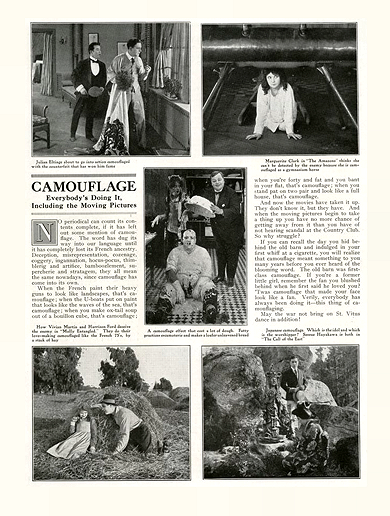
Above A page from Photo-Play Journal, December 1917, p. 25, featuring an article called CAMOUFLAGE: Everyone’s Doing It, Including the Moving Pictures. In an earlier blog post, we reproduced the article’s text, but not this image of the page.

SEE ALSO

Nature, Art, and Camouflage (35 min. video talk)

Art, Women’s Rights, and Camouflage (29 min. video talk)

Embedded Figures, Art, and Camouflage (26 min. video talk)

Art, Gestalt, and Camouflage (28 min. video talk)

Tuesday, November 1, 2022

disruptive geezer theatre doors / wartime propaganda

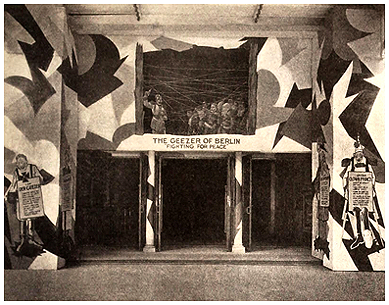
Above This photograph was published in an American theatre magazine during World War I. It shows the decorated entrance of a Broadway theatre in which disruptive abstract patterns (not unlike the confusing dazzle camouflage being applied at the time to merchant ships) have been used to contradict the building's physical form. 

It was common at the time for "scenic artists" (theatre and film set designers) to be assigned to wartime camouflage. 

The treatment of this entrance was a way of promoting the screening of a 1918 short propaganda film titled The Geezer of Berlin, which was of course in reference to the German Kaiser, aka the Beast of Berlin, and the Clown Prince (in reference to his son). Disruptive patterns such as these not only cause visual confusion; they can also disturb the emotions, and, to some extent, designs like this anticipate the use of skewed perspective and shape deformation in avant-garde "expressionist" films, such as The Cabinet of Dr. Caligari. In a recent video, titled Ames and Anamorphosis, I have talked about the use of distorted perspective in that and other early films.

Sunday, October 23, 2022

camouflage tricks behind the scenes in hollywood

Boston Globe, June 15, 1921
Anon, Movie Facts and Fancies, Boston Globe, October 1, 1921, p. 12—

The studio scenic artist of today…is an expert camouflage artist and a perfect copyist. The controlling principal in his work, however, is the photographic value of colors. Under the eye of the camera colors are often very deceptive, and often a color, which seems lighter to the eye than another color, might on the screen register a darker shade of gray than that color.

Often two colors which seem to form a most artistic and beautiful combination to the human eye, will, when photographed, present a most inharmonious, discordant color scheme, which is very ugly to look upon. Only by a careful study and a perfect knowledge of the photographic values of colors does the scenic artist avoid such color clashes.

The art of camouflage also is a very important phase of the studio scene painter’s art. He must make the imitation appear exactly like the real. Some of the commonest of such problems are included in the following examples: The camouflage of compo[sition] board squares and the proper laying of them so that when photographed they resemble a tile or stone floor; the painting of surfaces so that the result photographs like bronze, gold or other metals.

The artist can, with a well-placed strokes of his brush, dipped in the right kind of paint, make a new brick wall like the side of a dingy tenement house. He can give to a new redwood panelled wall the effect of an oak panel, hundreds of years old.

Thursday, February 3, 2022

New Film / Cook taught Gertrude Stein to drive / 2022

Duplicated from an identical posting on my alternative blog, CAMOUPEDIA , but important enough to deserve it—

I am pleased (albeit exhausted) to say that, as of yesterday, I completed what may be my most ambitious undertaking in recent years. It is a sixty-minute documentary voice-over film biography of the life of William Edwards Cook (1881-1959), an American expatriate artist, who grew up in Iowa, but spent his adult life in Europe, living in Paris, Rome, and Mallorca.

Titled COOK: The Man Who Taught Gertrude Stein to Drive, the film is freely available to everyone here online. More specifically, it is a detailed account of the life-long friendship of Cook with the American writer Gertrude Stein. It is based on her frequent adulation of him in her writings, as well as on the contents of 250 pages of their unpublished correspondence.

Cook was never a well-known artist, but he did acquire some renown for two other reasons: In 1907, he was the first American artist to be allowed to paint a portrait of Pope Pius X. Later, in 1926, he used his inheritance to commission the then-unknown Swiss-French architect Le Corbusier to design an early Modernist home (the "first true cubist house") in Boulogne-sur-Seine, which is still intact, and widely known as Maison Cook or Villa Cook.

The friendship of Gertrude Stein and William Edwards Cook (including the roles of their partners, Alice B. Toklas and Jeanne Moallic Cook) was first documented in (my earlier book)  COOK BOOK: Gertrude Stein, William Cook and Le Corbusier (Bobolink Books, 2005). This new documentary film corrects, updates, and adds to the information in that book.

This film project (as well as the earlier book) was made possible by the earlier work of such Stein scholars as Ulla Dydo, Bruce Kellner, and Rosalind Moad, as well as the Stein / Cook correspondence in the collection of the Beinecke Library at Yale University.

In 2005, when COOK BOOK was released, Ulla Dydo (the pre-eminent expert on Stein, and author of The Language that Rises) praised it in the following way: "This book jumps out at my eyes, my ears. It comes from everywhere, never drags those even blocks of print that dull the mind. Look at it, read it, let it tease you: It's researched with all the care that keeps its sense of humor and its visual and voice delights. Travel with it, leave home, go and explore the many ways for a book to be a house for living."

The distinguished critic Guy Davenport wrote: "This is as good as topnotch Behrens gets!"

This film is not without humor, and at times it shares surprises. It may prove of particular value to viewers (both scholars and the rest of us) who are particularly interested in American literature, Modernism, Gertrude Stein, art, architecture, horse racing, Harvard, William James, art collectors, expatriates, Paris, Mallorca, the American Midwest, Iowa, art history, the training of artists, Cézanne, Cubism, Picasso, Le Corbusier, LGBT, and gender identity issues. 


Saturday, December 19, 2020

1919 newsreel film on the design of ship camouflage

USS Sierra (1918)
Above US government photograph of the USS Sierra, 1918, port side, painted in dazzle camouflage plan Type N40 Design B. Digital coloring.

•••

The following is a paragraph from a film industry magazine, published near the end of World War I. It describes a "newsreel" segment that was filmed at a ship camouflage studio. We suspect that this film featured William Andrew Mackay, who oversaw the camouflage of merchant ships, and was probably filmed in his studio in New York. This seems probable in part because of the mention of the use of ship models made of plaster. Mackay is known to have used plaster models, while the US Navy Camouflage Design Subsection (which Everett Warner oversaw) seems to have used wooden models. It is unlikely that the film survived.

NEW SCREEN MAGAZINE FOR UNIVERSAL PROMISES MANY ATTRACTIVE FEATURES in Motion Picture Educator, February 22, 1919, p. 1—

[The first issue of New Screen Magazine, a non-print Hollywood periodical in the form of brief news stories on screen, includes] “How We Foiled the Huns” [which] gives an interesting illustration of how work was carried on at the Camouflage Department. It shows the making of plaster models of ships, the artists at work on these miniature pattern ships, and the inspection of the finished product through a periscope to test the quality of its deceptiveness. The exact theory on which the camouflaging of ships was carried out is fully explained.

•••

Note There are no full-color photographs of WWI ship camouflage. The original of the black and white image above (US government, public domain) has been digitally “colorized” using AI software. While its light / dark values are accurate, the choice and location of colors, even when plausible, may not be literally correct.

Thursday, June 11, 2020

hocus pocus, thimblerig, supercherie, and cozenage

Above Poster for Charlie Chaplin film, Shoulder Arms (1918), in which his character wanders behind enemy lines disguised as a tree trunk. Public Domain.

•••

CAMOUFLAGE: Everybody’s Doing It, Including the Moving Pictures, in Photo-Play Journal (December 1917), p. 25—

No periodical can count its contents complete if it has left out some mention of camouflage. The word has dug its way into our language until it has completely lost its French ancestry. Deception, misrepresentation, cozenage, coggery, ingannation, hocus pocus, thimblerig and artifice, bamboozlement, supercherie, and strategem, they all mean the same nowadays since camouflage has come into its own.

When the French paint their heavy guns to look like landscapes, that’s camouflage; when the U-boats put on paint that looks like the waves of the sea, that’s camouflage; when you make ox-tail soup out of a bouillon cube, that’s camouflage; when you’re forty and fat and you bant in your flat, that’s camouflage; when you stand pat on two pair and look like a full house, that’s camouflage.

And now the movies have taken it up. They don’t know it yet, but they have. And when the moving pictures begin to take a thing up you have no more chance of getting away from it than you have of not hearing scandal at the Country Club. So why struggle?

If you can recall the day you hid behind the old barn and indulged in your first whiff at a cigarette, you will realize that camouflage meant something to you many years before you ever heard of the blooming word. The old barn was first-class camouflage. If you’re a former little girl, remember the fan you blushed behind when he first said he loved you? ’Twas camouflage that made your face look like a fan. Verily, everybody has been doing it—this thing of camouflaging.…


•••

Boston Globe, March 31, 1918—

Cecil B. DeMille, of Paramount [Film Studios], will become a member of the United States Engineer Corps and will aid in recruiting technical experts and scenic artists for camouflage work in France.

According to a Wikipedia biography—

During World War I, the Famous Players-Lasky organized a military company underneath the National Guard called the Home Guard made up of film studio employees with DeMille as captain. Eventually, the Guard was promoted to a battalion and recruited soldiers from other film studios. They took time off weekly from film production to practice military drills. Additionally, during the war, DeMille volunteered for the Justice Department's Intelligence Office, investigating friends, neighbors, and others he came in contact with in connection with the Famous Players-Lasky. He volunteered for the Intelligence Office during World War II as well. Although DeMille considered enlisting in World War I, he stayed in the United States and made films.  


Cecil B. DeMille (1919). Public domain.

Sunday, March 15, 2020

Camoufleur and Hollywood star Wheeler Oakman

USS Major Wheeler
The SS Tuscania (launched in 1914) was a Cunard luxury liner until it was refitted in 1916 to serve as a wartime troopship. In late January 1918, it left New Jersey en route to Liverpool, with 2,013 US soldiers aboard. Although it had been painted in a dazzle camouflage scheme (not shown on this page), it was sunk by a German U-boat on February 5. More than 200 personnel perished. This was detailed in an earlier post.

On June 8, 1919, the Washington Post reported that the actor Wheeler Oakman, “considered one of the best looking and talented of [Hollywood’s] younger leading men” had returned from service in France, where he had been a camoufleur with San Francisco’s 144th artillery regiment. Earlier, despite the success of his acting career, the sinking of the Tuscania “fired his long-smoldering patriotism.” In response, he “appealed to Metro to release him from his contract and enlisted as a private” in the San Francisco regiment. Shipped to France, “he got as far forward as the second-line trench below Verdun on the Marne as one of the 24 members of his regiment’s camouflage corps.”

This Hollywood celebrity, the article notes, “is a fighter by heritage and actor by nature. In answering the call to arms the actor only heeded the fighting blood of his family.” His given name was Wheeler because his famous cousin was Joseph “Fighting Joe” Wheeler (1836-1906), a Confederate general in the Civil War, and a US Army general in the Spanish- and Philippine-American wars. Affiliated with Theodore Roosevelt’s Rough Riders, he fought at the Battle of San Juan Hill in 1898. During World War I, an American ship was named for him. It may have been the USS Major Wheeler, shown above in a dazzle camouflage scheme.

Joseph Wheeler (bearded), and Theodore Roosevelt (right)


Before and after the war, Wheeler Oakman was a star in countless Hollywood films, from 1913 to 1948. In his earlier acting days, he was usually a leading man, but those opportunities decreased with film's transition from silent to sound. In later years, he was usually cast as a villain.

Poster for one of Wheeler Oakman's films

Tom Mix stands tall | fearless, he is every inch a man

Cowboy film star Tom Mix \ he was every inch a man!
Surely, no one appreciates reader responses more than we do. But admittedly we were surprised by the number of followers who objected to our most recent post, in which we appeared to make light of the diminished stature of American artist Charles Lasar, who was fondly known as "Shorty Lasar."  To make amends, we are now posting a WWI-era Hollywood film advertisement for the famous cowboy actor Tom Mix (1880-1940). He stands heroically on his horse, keeping a look-out for outlaws. The caption reads:

Every Inch a Man! There is no camouflage about him!—no doubles to do his difficult stunts!—no actor on the face of the earth who can do what he does! TOM MIX: the man who never fakes…he is the reincarnation of fearlessness —a dare-devil who flirts with death.

In his personal life, he may have flirted otherwise too, since he was married five times. His thirst for adventure extended to cars. He died in 1940, at age sixty, when his speeding 1937 Cord 812 Phaeton swerved to avoid a highway flood detour and overturned in a desert wash near Florence AZ. The crash site is now known as the "Tom Mix Wash."

Reproduced below is another full-page ad with the same theme: Tom Mix Doesn't Camouflage, from the September-October 1918 issue of Motion Picture News.

Let it be known that we have equally high regard for Charles Lasar, however diminutive. In our opinion, he too was every inch a man.

Tom Mix doesn't camouflage

Saturday, January 12, 2019

WWI Camouflage, Motion Pictures and Surrealism

Charlie Chaplin disguised as tree trunk in Shoulder Arms (1918)
Above Screen grab from Charles Chaplin's famous film, Shoulder Arms (1918) about the surrealist dimension of being a doughboy during World War I , in the process of which he disguises himself as a tree trunk. In fact, it wasn't entirely absurd, since it was not unheard of to make use of steel-lined imitation tree trunks as elevated observation posts (see close-up below).

Phony tree trunk observation post (c1918)

Camouflage has everything to do with film-making, from costumes and make-up, to camera work and scenic design. Elsewhere we have talked about a few of the contributions made by Hollywood-based special effects designers, but there are many (many) more points of connection (in both World Wars), the majority of which are waiting to be documented.

Speaking of Surrealism (which I tend to think of as Dada + Freud, thanks to André Breton), the German-born American photographer and designer Erwin Blumenfeld (1897-1969) once made a Dada-inspired photo collage portrait of Chaplin (below), in which he appears to be wearing an image-adorned WWI trench helmet. The image on the helmet is from a well-known Dadaist poster from 1922.

Erwin Blumenfeld, collage portrait of Charlie Chaplin


•••

Melvin W. Riddle, CAMOUFLAGE! Concerning One of the Major Arts of Motion Pictures. The Atlanta Constitution. Sunday, October 24, 1920—

CAMOUFLAGE!
A new word—coined during the great war by the French, to denote an art which was highly developed during the war. A new word, but an age-old art—old as war itself, older than mankind, for even Nature made use of it as a means of protection for animals and plants. Truly, an age-old idea, but only in the last few years has it been developed by mankind to that state of perfection wherein it might be called an art.
    

Camouflage saved from distruction during the war innumerable lives and properties of inestimable value. Now that the war is over, one might think that the word and the art would temporarily become passé and useless until another war should come along to revive them. But such is not the case, for camouflage is an art without a knowledge of which, one of the greatest industries of today—the motion picture industry—could hardly exist.

Camouflage and the Movies
The art of camouflage is a vital factor—in fact, it might be said, almost a prime factor in the production of motion pictures, and it is with that phase of camouflage that this article is concerned.
    

It is the general impression, perhaps, that the war itself first developed the art of camouflage. This impression, however, is erroneous. For long before the war began, the art had been developed to a high degree by the industry of motion picture production, but as developed by this industry, it was an unidentified art because it was an art without a name. The truth of this assertion is proven by the fact that when America entered the war, men from the motion pictures studios, who had gained a knowledge of the art of scenic deception, formed an important part of the ranks of special camouflage corps which were sent over there. This was because these men had already a practical knowledge of this great study and had only to adapt this knowledge to the particular requirements of defense in war.
    

The one great difference between camouflage as practiced in motion pictures and as practiced in war is that war camouflage, although deceiving to the human optics, is readily detected by the camera, while in motion pictures the camouflage is especially arranged and prepared to deceive the eye of the camera, although it sometimes also deceives the human eye, unless a very close-up view is obtained. Primarily, it is the camera lens upon which the deception is practiced, however, for the eye of the camera is ultimately the eyes of the motion picture audience.

Vital Necessity
Motion pictures, before the beginning of the war, did more and are now doing more to develop the art of camouflage on a large scale than any other industry or even possibly could do. Camouflage is the very life of a motion picture—a vital necessity. Of course, the art has been employed from time immemorial in the theatrical profession—in the dressings of stage settings for legitimate productions, but camouflage, as used on a stage, is very limited in its scope, and is admittedly camouflage, for this reason loses its very effectiveness. It is when camouflage is mistaken for the genuine and the delusion is unquestioned, that it really serves the purpose for which it is intended.
    

Examples of some of the numerous instances where camouflage is employed in motion pictures might be of interst. At the Lasky studio, for instance, which is one of the largest of west coast film plants, one might see on every hand the evidences of this great art.
    

To begin with, the very make-up of the players is often the most perfect camouflage. The feeble-looking old man or the dissipated, rum-soaked hobo might be, in reality, one of the most gentle and best-appearing young men on the lot, hiding his real identity under a skillful application of camouflage.…
   

Even the most conscientious, exacting and painstaking producers, who fairly dote on realism in their productions and always secure it whenever possible, are never slow to admit the importance and the value of the art of camouflage, and the great frequency and regularity with which it is employed in the production of motion pictures.

Sunday, October 27, 2013

French Camouflage and Criminals

WWI French camoufleurs wearing hooded cagoule outfits
In an earlier post, we reproduced various images of French camoufleurs dressed in paint-streaked hooded outfits, the term for which was cagoule. These were adopted early in World War I by artists in the French infantry, to prevent themselves from being seen by aerial observers as they manned field artillery. Above is the cover of a French magazine (dated June 5, 1915) in which soldiers are wearing uniforms that look eerily like a mottled variation on the sinister ceremonial hoods of the American Ku Klux Klan. At the time, the French public was disturbed by this radical change of attire. This was described thirty years ago by art historian Elizabeth Louise Kahn in The Neglected Majority: "Les Camoufleurs," Art History, and World War I (University Press of America, 1984)—

Hidden beneath camouflaged cagoules…was a ghoulish image of the modern soldier, whose finely fitted and brilliant red and blue clothing was replaced by an amorphous costume of drab greens and browns that turned the individual into a frightening form.

Later on the same page, she mentions that one of the reasons for the initial disdain for camouflage was that "the very term camouflage held a devious and unseedy [sic] meaning for French readers of popular literature…" Prior to the founding of the first camouflage unit, it "was a word used to describe evil criminals who lurked about city streets and hid themselves from the police" (p. 148).

We were reminded of this when recently we ran across various images from French popular literature and film, before and during WWI, of a fictitious criminal named Fantomas. Created in 1911 by French writers Marcel Allain and Pierre Souvestre, the character was central to more than forty crime novels. The popularity of the books was amplified by various adaptations for film, television and comic books.


French crime character Fantomas
I mention this because in some of the images (such as those posted here), this crime character has an uncanny resemblance to a WWI hooded camoufleur. If Fantomas was on the minds of the French public at the outset of the war, no wonder they viewed with suspicion the cagoules (the "hoodies") of the camoufleurs.

books & historic prints and photographs