Showing posts with label William Andrew Mackay. Show all posts

Friday, April 18, 2025

camouflage applied to NYC police boats during WWI

Above An odd discovery. In an issue of the Spokesman Review (Spokane WA) on November 4, 1917, this photograph (poor quality vintage halftone) appeared with the caption CRAFT OF HARBOR GUARDS DISGUISED: Camouflaged Police Boat.

It shows an NYC municipal police boat that has presumably been camouflaged using a method first proposed by muralist and interior designer William Andrew Mackay. I’ve written about Mackay extensively in an online essay titled “Optical Science Meets Visual Art: The Camouflage Experiments of William Andrew Mackay.” This early method is also detailed in a patent application, submitted on September 4, 1917, as US Patent No. 1,305,296, “Process of Rendering Objects Less Visible Against Background.”

The text of the original news article reads as follows—

All New York City police boats are now being painted with a blue and green motif, which, when any distance away, causes the boats to appear to merge into the dark waters of the bay and river. It is said that at night is is almost impossible to distinguish the outline of the craft which guards the waters and keeps its eye on docks and shipping.

RELATED LINKS    

Dazzle Camouflage: What is it and how did it work? /  Nature, Art, and Camouflage / Art, Women's Rights, and Camouflage /  Embedded Figures, Art, and Camouflage / Art, Gestalt, and Camouflage /  Optical science meets visual art /  Disruption versus dazzle / Chicanery and conspicuousness /  Under the big top at Sims' circus

Saturday, February 8, 2025

John Downes Whiting / American ship camoufleur

For years I’ve been trying to find out about an American artist, author and book illustrator named John Downes Whiting (1884-1977). I’ve been looking for information about his activities as a ship camouflage designer during World War I. One complication is that he is often cited as John D. Whiting, so it’s easy to confuse him with another person named John David Whiting (1882-1951), who belonged to a religious sect in Jerusalem called The American Colony.

In contrast, John Downes Whiting (known as Jack Whiting) was, as he described himself, a “Connecticut Yankee” and a graduate of the Yale School of Fine Arts (BFA 1915). Born in Ridgefield CT, he was named after his uncle, John Ireland Howe Downes (1861-1933), who was also an artist, a Yale graduate, and the librarian for the art school there for 23 years.

As an artist, Jack Whiting’s own profession was that of a book and magazine illustrator, but he wrote books as well. In 1920, he published Practical Illustration: A Guide for Artists (see cover above), and in 1928, he wrote and illustrated a semi-fictionalized account of his experience during WWI, titled Convoy: A Story of the War at Sea.

On his draft registration form, dated September 5, 1918, he lists his occupation as a “camoufleur” with the US Shipping Board, at 345 East 33rd Street in New York. That is the street address of the studio of a prominent muralist and interior designer named William Andrew Mackay, whom I’ve been writing about for years. We have blogged about Mackay’s contribution to ship camouflage, and have also published an essay on Mackay, his ship camouflage proposals, and his school for camoufleurs, headquartered at his studio, which he called the Mackay School of Camouflage.

According to biographical entries, Whiting joined the Connecticut National Guard in 1917, where he served in Company F of the 2nd Regiment for one year. From June through December of 1918, he was affiliated with Mackay’s team of camouflage artists, who were assigned to develop so-called “dazzle camouflage” schemes for US merchant ships. They were not strictly a part of the US Navy, but were affiliated with the civilian Shipping Board, which was responsible for applying the schemes to merchant ships in the harbors.

As Mackay himself described it, it was at his Manhattan studio—

that the first work of camouflage was developed. In all, 749 vessels were camouflaged, and sixty men, artists, architects and designers, made this shop their headquarters, under direction of the United States Shipping Board, working over designs, testing colors, peering through the periscope at the wooden models, and then dashing off to try out some few effect on the vessels that, in a few days, would be depending upon our skill in the art of disguise to save them from the U-boats.


I have a list of the names of sixty-four (not sixty) of Mackay’s camouflage school affiliates. All this is more or less confirmed by a review of John Downes Whiting’s book on Practical Illustration that appeared in The Daily Northwestern (Evanston IL) on January 22, 1921, p. 7. The book’s author, the reviewer states—

…served in the camouflage department of the navy during the war. One of Mr. Whiting’s assignments was to find out just what lines and colors did in reducing the visibility of ships. The results of his experiments, conducted at sea and on the coast, formed the basis of many of the weird but efficacious desgns which camouflaged our transports. William Andrew Mackay, the mural painter, with whom Mr. Whiting worked for the navy, says that Whiting’s book is written in the same thorough manner in which the author tackled his war work.

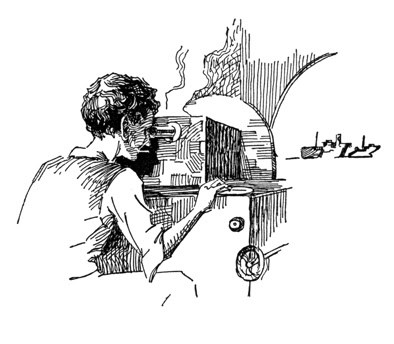
In 1928, when Whiting wrote a semi-fictionalized account of his wartime experience in Convoy: A Story of the War at Sea, it included an entire chapter about Mackay and his camouflage school. It also features a pen-and-ink drawing by Whiting (reproduced above) of a ship camoufleur looking at a camouflaged ship model in a testing theatre. In a different later source (from a 1932 issue of The Literary Digest), Whiting states that during the war he designed “camouflage for Army transports and supply ships.” In that case, it seems likely that he also worked with Frederick A. Pawla (1876-1964), who, as the head camouflage for the AEF Embarkation Service, oversaw the camouflage of “many of the army transports, particularly cargo carriers.” We have previously blogged about Pawla here and here.


On page 242 of Whiting’s book titled Convoy, there is an offhand reference to ship camouflage which may be relevant, or maybe not. The sentence reads: “The Monodoc, looking, in her camouflage, like an intoxicated snake, lay at anchor in the river.” The book’s text, as mentioned earlier is a book of fiction, based on fact. So perhaps we shouldn’t surprised that there doesn’t seem to have been a WWI American ship named Monodoc (altought there were ships named Monadnock). Maybe he simply invented the name.

In the same book, on page 80, Whiting provides some insight into an on-going conflict between Mackay’s camouflage team (affilidated with the US Shipping Board) and the US Navy’s own official Camouflage Section, which had been given the authority to originate all ship camouflage schemes, both Navy and civilian, which was greatly resented by those who were loyal to Mackay.

As Whiting alludes to in his book, Mackay’s camouflage school may not have been unauthorized by the Navy, and was thus conducted “quietly.” But, as he also implies, Mackay’s men also side-stepped strict compliance with the Navy’s regulations by claiming that the schemes that they were given required alteration to make them fit the vessels they were required to apply them to.


Here is the dialogue from Whiting’s book—

“I thought these [ship camouflage] designs were made in Washington, under the Navy Department.”

“Yep, that’s the theory. Those Johnnies think we only put their patterns on the steamers, but, b-bless you, the plans we get from there only fit half the shapes in this town. We have to camouflage every darned thing from a tanker to a barge.”

“And so your chief [William Andrew Mackay] is quietly evolving his own school for camoufleurs?”

“That’s it. The queerist lot of wights are working here, scraped up from the corners of Bohemia. But they work; Mackay is a hustler.”

“Drives you, does he?”

“No, he innoculates us; he has more ideas than all your admirals put together. And the boys are simply nuts about him.”


A small selection of other illustrations by Whiting, including book covers and an interior illustrations, are also featured in this post.

RELATED LINKS    

Dazzle Camouflage: What is it and how did it work? /  Nature, Art, and Camouflage / Art, Women's Rights, and Camouflage /  Embedded Figures, Art, and Camouflage / Art, Gestalt, and Camouflage /  Optical science meets visual art /  Disruption versus dazzle / Chicanery and conspicuousness /  Under the big top at Sims' circus

Friday, July 19, 2024

Thomas Casilear Cole / WWI ship camouflage artist

Thomas Casilear Cole
In the mid-19th century, there was a prominent trend in painting called the Hudson River School, which consisted of a cluster of landscape artists whose work was typically focused on the Hudson River Valley. The style’s founding artist was Thomas Cole (1801-1848), while another prominent member was John William Casilear (1811-1893).

Near the close of the century, when Thomas Casilear Cole (1888-1976) was born in Staatsburg-on-Hudson, he was named in honor of those two well-known painters. He initially studied at Harvard University, but eventually turned to art, in the course of which he studied at the School of the Museum of Fine Arts and Boston, where among his teachers were Edmund Tarbell, Frank Benson, and Philip Hale. In 1912, he studied with Jean Paul Laurens at the Académie Julian in Paris. Over the course of his life, he was primarily known for his portraits.

Of particular interest for the moment is that Cole was a designer of ship camouflage during World War I. An article in the Art Digest (January 15, 1931, p. 13) states that he “served two years in the navy during the World War, designing many of the camouflage patterns that protected American ships.” A biographical entry in Who’s Who in New York (1924 ed.) claims that he was among the “original, and one of the principal designers of naval camouflage in that service.” Elsewhere, he is cited as having been a student at William Andrew Mackay’s camouflage school that had been established in Manhattan during World War I.

In contrast to the prestige of the name(s) with which he was christened, his work has a lack of distinction. So it may not be surprising how little is said of him (two brief sentences) in the Benezit Dictionary of Artists, with no mention of camouflage.

Sunday, June 23, 2024

John W.K. Berrian / Tiffany designer and camoufleur

Berrian Draft Registration
There are ten stained glass windows, made by Tiffany and Company, at the Second Reformed Church in Hackensack NJ. According to the New York Times (May 4, 1979), these were among the “favorite windows” of Lewis Comfort Tiffany, who “frequently visited there with clients…”

The windows are well-known and admired. But what is all but unknown is that most of them were designed by long-term Tiffany designer John William Ketcham Berrian (1877-1953), who is also sometimes listed as John W.K. Berrian and John Ketcham Berrian. 

Born in New York, he designed and installed stained glass windows for Tiffany for thirty-five years. When Tiffany died in 1933, Berrian continued to work with the firm until the mid-1940s, at which time he “withdrew hs connections” and “went into business by himself.” Berrian died on February 25, 1953. In anticipation of that, he had arranged for his funeral to be held in the Second Reformed Church in Hackensack. The church’s tenth window, which he had designed, was installed a few weeks later.

Of additional interest is that Berrian also served as a ship camouflage designer for the US Shipping Board during World War I. We know this from three sources: In an obituary in the Bergen Evening Record, it was noted that he had served as a civilian wartime camoufleur, for which “he created designs and effects for the camouflage of warships and transports.”

That is also confirmed by his draft registration card, dated September 12, 1918, in which his occupation is listed as a camoufleur for the US Shipping Board. In that capacity, he worked for William Andrew Mackay, which is confirmed by the inclusion of his name on a list of Mackay’s associates at 345 East 33rd Street in Manhattan.

Sources
"John Berrian Rites Slated In Second Reformed Church: One Of Country’s Foremost Designers, Builders Of Stained Glass Windows, Dies In Hospital" in Bergen Evening Record (Hackensack NJ), February 26, 1953, p. 2.

"Tenth Window To Be Shown At Reformed Church Sunday: Berrian’s Best To Be Unveiled, Dedicated At Special Service; Blends With Other Nine" in Bergen Evening Record, May 13, 1953.

John Ketcham Berrian / Stained Glass Wndow (detail)


Saturday, April 27, 2024

John Wolcott Adams and World War I ship camouflage

Most likely, we have unearthed more information and have written more about the life of American artist William Andrew Mackay (1870-1939) than anyone else [in most online sources, his birth year is mistakenly cited as 1876] . It has been a long extended search, beginning in the 1970s—and it seems as if it never ends. Mackay was a muralist who, at least in that regard, is especially famous for his murals about the life of Theodore Roosevelt, installed beneath the rotunda in the Roosevelt Memorial Hall of the American Museum of Natural History in New York. But he also painted numerous other murals in prominent public buildings.

Our initial interest in him began with the contributions he made to the development of ship camouflage before and during World War I. We have talked about his efforts in various earlier blog posts, but we’ve also written a major, detailed essay about his discoveries (acessible free online), and have often featured his work in published books and articles.

Until recently, we were unaware of his connection to John Wolcott Adams (1874-1925), an American illustrator who was a descendant of the famous Adams family of New England, which had produced two US presidents. We learned recently, in an essay by Christine I. Oklander in an exhibition catalog titled John Wolcott Adams: American Life and History (Chadds Ford PA: Brandywine River Museum, 1998) that William Andrew Mackay was “one of [Adams’] closest friends” and that Adams had been “assigned to paint the American liner Philadelphia.” At least one photograph of that camouflaged ship has survived (reproduced above), taken on June 27, 1917.   

In Mackay’s approach to ship camouflage, the goal is low visibility, not confusion or surface disruption (as is the function of dazzle). As shown in the photograph of the ship, Mackay used an optical mixture of red, violet and green, applied in splotch-like patterns (not unlike Pointilism) on the surface of the ship.

Monday, December 12, 2022

Nichols brothers / NY ship camoufleurs during WWI

Hobart Nichols
Above We have met [Henry] Hobart Nichols Jr. (1869-1962) before, when in 2019 we mentioned him in a post in reference to his service as a civilian camouflage artist during World War I.

His brother (pictured below) was also an accomplished artist, Spencer Baird Nichols (1875-1950). Both resided in Lawrence Park, an artists’ colony near Bronxville NY. His brother was also a civilian ship camoufleur, both of them being affiliated with the Marine Camoufleurs of the US Shipping Board, Second District, a section that was headed by William Andrew MacKay.

•••

MR. HOBART NICHOLS TALKS TO NONDESCRIPT CLUB
Bronxville Review (Bronxville NY) April 11, 1919, p. 1—

Mr. Hobart Nichols [American illustrator and landscape painter] of this village talked most entertainingly to the ladies of the Nondescript Club, at the regular weekly meeting on Tuesday, on the subject of camouflage. Mr. Nichols was connected with the camouflage department of the United States Navy. He illustrated his remarks by drawings of his own, and by various miniature camouflaged ships. He made it quite clear how the effects produced render good aim at a camouflaged vessel most impossible. The remarkable showing of less than one per cent of ships sunk, demonstrated the value of the work.

Spencer Nichols


Friday, November 5, 2021

optical camouflage based on Maxwell's spinning disks

One of the earliest, most important contributors to World War I ship camouflage was an American muralist named William Andrew Mackay (1876-1939). He is best known for having created a series of murals about the achievements of Theodore Roosevelt, which are housed in the rotunda of the Roosevelt Memorial Hall of the American Museum of Natural History in New York. In advance of WWI, he began to experiment with optical color mixtures in the camouflage of submarines, which he demonstrated with spinning colored disks that had been developed earlier by James Clerk Maxwell. A detailed, richly illustrated account of Mackay's camouflage-related research is accessible online here, and is also downloadable online here.

• Nature, Art, and Camouflage (35 min. video talk) at <https://www.youtube.com/watch?v=ZLX5YQF-H3k> 

• Art, Women’s Rights, and Camouflage (29 min. video talk) <https://www.youtube.com/watch?v=hiSWNYCNRcM> 

• Embedded Figures, Art, and Camouflage (26 min. video talk) <https://www.youtube.com/watch?v=3asynn24nD4> 

• Art, Gestalt, and Camouflage (28 min. video talk) <https://www.youtube.com/watch?v=nS2ZwYyxy1Y>

Wednesday, January 20, 2021

Genevieve Cowles | Connecticut Woman Camoufleur

Genevieve Cowles, c1932
Above A news photograph of a Connecticut-based artist named Genevieve Alameda Cowles (1871-1950). We blogged about her several years ago in relation to her service during World War I as a camouflage designer for the US Shipping Board, which was a highly unusual role for a woman at the time. She was trained in camouflage design by William Andrew Mackay. An illustrator, stained glass window designer, and mural painter, she was unusual in other ways as well. She was the twin sister of Maude Alice Cowles (1871-1905), who had a parallel career, and with whom she worked collaboratively until the latter’s early death. Below is a photograph of them at age eighteen. 

Maude and (right) Genevieve Cowles

Shortly after her sister’s death, Genevieve proposed to paint a religious mural for the chapel at the State Prison at Wethersfield CT, using the prisoners as models. In the process, she took up the issue of prison reform, a cause she continued to advocate for the rest of her life. In 1932, she wrote a lengthy article (excerpts from which are reprinted below) in which she compared certain aspects of ship camouflage to prejudicial assumptions about the character of prisoners. She illustrated the article with two drawings of the same ship, the first one disruptively camouflaged, the other one not (see drawings reproduced below)—

Genevieve Cowles, CAMOUFLAGE AND CRIME: Local Artist Reveals Secrets of Black Magic That Protected Our Ships During World War and Draws Striking Analogy in Hartford Courant (Hartford CT), May 13, 1932—

During the Great War, when England was losing five vessels a day from submarine attacks, an artist named [Norman] Wilkinson invited a system of painted blots on ships called “dazzle camouflage” that actually worked like Black Magic. 

Through his periscope, the enemy U-Boat commander could survey his intended victim far more distinctly than with the naked eye. He had proved his ability by sinking many un-camouflaged ships. But when ships appeared painted with black blots it proved impossible for him to discover under those blots her real shape, and position, and the direction in which she was going.

Deprived of this hitherto available, most necessary information, the commander’s deadly torpedo was fired in vain, and often the submarine itself was sunk in consequence.

Not all the guns in creation could ward off the deadly torpedo when accurately fired at an unforeseen moment from an unseen quarter under the sea. This menacing problem, which no amount of force alone could successfully combat was solved by intelligence.

The artists, by using paint in scientific designs of optical illusions, saved the allied ships, without which our troops could never had reached France, or even engaged in winning the war.

Out of 12,000 ships camouflaged by Americans, we lost only nine. 

Only those who knew, or could guess, the laws of optical illusion used in these dazzle designs could see through them. It made not the slightest difference in facing these deceptions whether one were a villain or a saint, a patriot or a traitor, a friend or foe, one could surely be deluded if one did not know the laws of the deceptions.…

As an officially trained member of the Women’s Reserve Camouflage Corps during the Great War, I have received from the government permission to divulge the information that I possess. 

Mr George H. Rock, chief of the Navy Department Bureau of Construction and Repair, Washington DC, in a recent letter to me wrote: “While at that time (during the World War) the information was held as confidential, since the war it has not been so regarded, and there is no reason known to this bureau why you should not use such information as you may have as to camouflage practice during the war.” Also, Mr William Andrew Mackay, New York camoufleur of the marine service under which I was trained, has written to me saying: “You can rest assured that you will be given all assistance by this office.”

Let us begin by examining the accompanying drawing of a war camouflage ship seen approximately at the point of attack. In order to take affect, the torpedo should be fired at a two-point, or between a two-point and a three-point view. 


That is, one should fire when she was coming head on, showing the prow and a little of one side, or else retreating, showing the stern and part of one side.

The low visibility system of camouflage, so successful on land, and successful in a fog at sea, proved useless in bright daylight on a quiet sea, because the lights and shadows on the angles of the prow and stern, and especially on the deck houses, would betray the position of the ship and the direction in which she was going. If the U-boat commander could estimate correctly one single rectangle on the victim ship, he could sink her.

The camoufleur solved this problem first by painting sold black blots over these telltale angles. Later on he discovered that more or less dark bands or bars or spots would serve as well as solid blacks.…

The submarine commander was only allowed seven seconds for each observation by rolling waves that at such intervals obscured his vision through his periscope.…

Now compare this camouflaged ship drawing with an exact tracing of this identical ship in this identical position, also reproduced here, and you will see that she is not traveling in either direction that she seems to have when camouflaged, and the torpedo will not strike where intended.…

RELATED LINKS

Optical science meets visual art 

Disruption versus dazzle 

Chicanery and conspicuousness 

Under the big top at Sims' circus

Wednesday, January 6, 2021

WWI ship camouflage models in exhibition in Illinois


Above
and below are a few of the crisp new renderings of WWI dazzle camouflage patterns that are being recreated by Steve Morris, a designer based in Washington DC. We have blogged about his work before.

••• 

CAMOUFLAGE MODELS PUT ON EXHIBITION HERE TODAY in Daily Illini (Champaign-Urbana IL), April 18, 1918, p. 1—

Work of Famous Camoufleur Will Be Shown In University Hall 

William [Andrew] Mackay, camoufleur for the second district of the United States Shipping Board of New York, has sent a number of camouflage models for painting ships to Earl C . Bradbury of the department of art and design.

These models will be on exhibition in 401 University Hall today and tomorrow, from 9:00 to 12 o'clock and from 1:00 to 3:00 o'clock. 

“Camouflage is becoming more and more a factor in submarine warfare,” said Mr. Bradbury yesterday. “The ships which operate in the zone are being painted to reduce their visibility. We cannot hope to make them entirely invisible, but if their visibility can be reduced one-half an enormous saving in ships would result.”

“Marine camouflage was used in a small way in the Civil War when merchant ships were painted black like warships, with the representation of port holes in white. Today we have far outclassed that method.”

Parts of Ship Are Merged 

“The present basic theory in ship camouflagp is the merging of the hull and the upper works with the sea and sky. There are two methods of doing this, the low visibility and the dazzle system. A ship painted battleship gray is less visible than one painted black or white. However the breaking up of the object Into several smaller objects makes it less visible; just as a solid rank of men is more conspicuous than a rank scattered. So a chopny effect of painting the ship seems to suggest sky or sea between the several parts , and thus lowers the chances of the ship being seen.“

“As to the dazzle system which was originated by camoufleur Mackay,” continued Mr. Bradbury, “sunlight is composed of the rays of various colors as illustrated in the rainbow; an object painted in these pure colors would give a suggestion of the light of day which is shut out behind the object. Mr. Mackay found on applying this theory to ship painting that the pure colors blended into the ocean mists at several miles distance, and thus made [peri]scope focusing very difficult.”


RELATED LINKS

Optical science meets visual art 

Disruption versus dazzle 

Chicanery and conspicuousness 

Under the big top at Sims' circus

Saturday, December 19, 2020

1919 newsreel film on the design of ship camouflage

USS Sierra (1918)
Above US government photograph of the USS Sierra, 1918, port side, painted in dazzle camouflage plan Type N40 Design B. Digital coloring.

•••

The following is a paragraph from a film industry magazine, published near the end of World War I. It describes a "newsreel" segment that was filmed at a ship camouflage studio. We suspect that this film featured William Andrew Mackay, who oversaw the camouflage of merchant ships, and was probably filmed in his studio in New York. This seems probable in part because of the mention of the use of ship models made of plaster. Mackay is known to have used plaster models, while the US Navy Camouflage Design Subsection (which Everett Warner oversaw) seems to have used wooden models. It is unlikely that the film survived.

NEW SCREEN MAGAZINE FOR UNIVERSAL PROMISES MANY ATTRACTIVE FEATURES in Motion Picture Educator, February 22, 1919, p. 1—

[The first issue of New Screen Magazine, a non-print Hollywood periodical in the form of brief news stories on screen, includes] “How We Foiled the Huns” [which] gives an interesting illustration of how work was carried on at the Camouflage Department. It shows the making of plaster models of ships, the artists at work on these miniature pattern ships, and the inspection of the finished product through a periscope to test the quality of its deceptiveness. The exact theory on which the camouflaging of ships was carried out is fully explained.

•••

Note There are no full-color photographs of WWI ship camouflage. The original of the black and white image above (US government, public domain) has been digitally “colorized” using AI software. While its light / dark values are accurate, the choice and location of colors, even when plausible, may not be literally correct.

Thursday, December 10, 2020

William Andrew Mackay / Fighting U-Boats with Paint


One of the most clearly written and best illustrated articles on World War I Allied ship camouflage was authored by Waldemar Kaempffert, editor of Popular Science Monthly. Titled "Fighting the U-Boat with Paint," it was published in the April 1919 issue (Vol 94 No 4) of the same magazine.

It is now in public domain and can be accessed online. It consists of a three-page article, screen grabs of which are published above and below in this post.

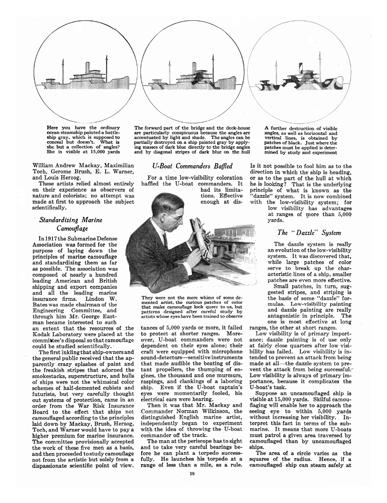
Among its interesting illustrations is (on the title page) a photograph of American muralist and camoufleur William Andrew Mackay studying a dazzle-painted ship model through a makeshift periscope-like devise. 

 On page 2, Mackay is shown painting a camouflage scheme onto a ship model, while at the top of the page are the first three drawings a series of simulated periscope views that purport to show the stages of applying a dazzle camouflage scheme. 

 On the third page, two final views from that series are shown, and, below that, an unidentified camoufleur is surveying Mackay's collection of camouflage-painted models.

Over the year, we've learned quite a lot about Mackay, and we've recently published a booklet (available online as a pdf) about his approach to ship camouflage, titled Optical Science Meets Visual Art.

Monday, August 10, 2020

Fighting the U-Boat with Pattern, Disruption and Paint

Waldemar Kampffert, Fighting the U-Boat with Paint: How American and English artists taught sailors to dazzle the U-boat in Popular Science Monthly. Vol 94 No 4 (April 1919), p. 17ff—


When the German U-boats began their depredations, it became desperately necessary to provide some protective coloration for transports, food ships, and the hundreds of vessels that were carrying munitions to Europe.

Battleship gray having proved utterly useless, naval officers turned instinctively to artists for advice and assistance. If an artist, with his trained eye, knows how to apply color, knows how to trace lines on canvas so that they become the counterfeit presentment of the thing he sees, couldn’t he reverse the process and devise some way of blotting out the thing to be looked at?

Above Camouflage pattern applied to USS Chibiabos (c1918), US Shipping Board.

It so happened that American artists interested themselves in devising schemes of protective coloration as soon as the U-boat began to sink on sight. The pioneers among them were William Andrew Mackay, Maximilian Toch, Gerome Brush, Everett L. Warner, and Lewis Herzog.

Above Dazzle camouflage applied to USS Beaumont (c1918), US Shipping Board.


Lindell T. Bates, MARINE CAMOUFLAGE BROUGHT TO PERFECTION IN AMERICA: First Authentic Account of the Development of Illusion in Foiling Hun Pirates Written by Leader in the Work Here—Scientific Explanation of Colors, Curves and Lines Used. The New York Sun. January 19, 1919, p. 11—

In the course of the war several American artists, noting the rapid development of land camouflage, became interested in its marine possibilities. William A. Mackay and Lewis Herzog, both of New York, appear to have been the pioneers of elaborate camouflage both of this country and abroad, although in 1917 attention was beginning to focus on this question simultaneously in many quarters. Gerome Brush, Maximilian Toch and Everett L. Warner soon entered the new field. Mr. Mackay even established a marine camouflage school in New York City, the first of its kind.

Above Dazzle camouflage applied to USS La Forge (c1918), US Shipping Board.

• Note Restored black and white US Government photographs have been colorized using AI digital coloring (not literally accurate).

Sunday, June 23, 2019

WWI Ship Camouflage Artist | Arthur Turnbull Hill

USS West Zula (1918)
In 1918, The East Hampton Star (East Hampton, Long Island NY) announced its plan to publish a list of residents who were serving in World War I. Among those who replied was an artist named Arthur Trumbull Hill (1868-1929), who had already been employed as a civilian “camofleur” [sic] for several months. He welcomed the opportunity, he said—

to give you some idea—no detailed description is allowable—of the unique and important work the Navy and Shipping Board have done in Marine Camouflage since the United States entered the war.

This was published as a Letter to the Editor on the front page on October 18, 1918. He went on to say—

Everyone, of course, has by this time, seen some of the camouflage ships, but few know that these remarkable, and frequently very handsome, cubistic looking productions in line and color, are the result of a carefully defined system adopted by our navy and only after the most exhaustive tests, and that the designs, far from being a hit or miss proposition, are most carefully worked out and elaborated [in] almost infinite variety under the immediate direction of artists employed solely for this purpose by the Federal Government. In fact, the personnel of the Navy and Marine Camouflage Departments include some of the most talented artists in America.

In signing his letter, Hill listed his affiliation as USSB, EFC—for US Shipping Board, Emergency Fleet Corporation. In other words, he was working for the civilian branch of wartime camouflage, which itself was overseen by the US Navy. In December 1918, four of his paintings were included in an exhibition in New York of war-related art, titled the Allied War Salon. His exhibited works were titled “Camouflage at Robins Dry Dock,” “Camouflaged Ships at Erie Basin,” “Camouflage on the Mystic River,” and “Leaving for Providence.”

These works and those of fourteen others were included in a section in which the artists were described as “Marine Camoufleurs of the US Shipping Board, Second District.” This is the same district (based in New York) for which William Andrew Mackay was the Chief Civilian Camoufleur. The other camoufleurs were Spencer B. Nichols, Hobart Nichols, Alonzo Kimball, Alfred Huty, George E. Harris, Hubert R. Chapin, Henry Davenport, Harry Farlow, Thomas D. Benrimo, Ralph T. Willis, Carol M. Sax, M. McGregor Jamieson, Alon Bement, and George Wright.

Arthur Trumbull Hill died in Brooklyn NY in 1929. Five years later, there was a memorial exhibition of his artwork at the South Gallery, Guild Hall in East Hampton. The majority of the exhibited works were from his wife’s collection. She also wrote the catalog introduction, which included the following statement—

In this collection, as a matter now of historical interest are several pictures of camouflaged ships which my husband painted when he served as a camoufleur in the marine camouflage in the World War.

USS Major Wheeler (1918)
USS Major Wheeler (1918) second view

•••

Sources

A.E. Gallatin, Allied War Salon. Exhibition catalog. New York: American Art Galleries, 1918.

Arthur Turnbull Hill, in National Cyclopedia of American Biography.

Hill, Arthur T. A.T. HILL, CAMOFLEUR. Letter to the Editor. The East Hampton Star (East Hampton NY). October 18, 1918, p. 1.

Local News: MEMORIAL SHOWING OF WORK OF A.T. HILL AT GUILD HALL. The East Hampton Star (East Hampton NY). July 19, 1934, p. 5.


Note The ship photographs on this post are intended merely as examples of WWI dazzle ship camouflage. They may not have any connection with Arthur T. Hill.

Monday, May 13, 2019

Camouflage Artist \ Theatre Designer Victor H. Martin

Above World War I US Army camoufleurs applying chalk lines to military equipment in advance of painting camouflage.

•••

So here’s another puzzling find. In its official activities report in 1920,  the Free Public Library of Elizabeth NJ included the following statement—

An interesting exhibition of Naval Camouflage work of the US Shipping Board was held in the library, October 5th to 8th [1920]. The models, perfect replicas of actual vessels, about twenty-five in number including a submarine, were prepared by Mr. Victor Martin of Elizabeth, who, with a large number of assistants during the War [WWI] was entrusted with the duty of camouflaging great numbers of mercantile vessels. Several of the models were examples of the Martin School of Camouflage marking, while others exhibited the French and English types. The periscope, theatre, and mechanism were made and set up by Captains Bickel and Grauss of our Elizabeth Fire Department and the entire exhibit was a very finished one.

Marking out color areas with chalk lines
Born in New York in 1877, Victor H. Martin appears to have worked as a scenic artist (theatre designer) in the years prior to WWI, with a studio at 145 East 56th Street in New York. During the war, he contributed to the camouflage of merchant ships, apparently as a civilian under William Andrew Mackay, head of the Second District of the US Shipping Board. His name appears on a 1918 listing of sixty-four camoufleurs who were associated with Mackay. After the war, he returned to theatrical design, for which he joined the Pauline MacLean Stock Company at Celeron Park in Jamestown NY for the summer of 1919. He taught commercial art (graphic design) at the Baron de Hirsch Trade School* in New York until his retirement in 1941. He died on June 23, 1944, in Elizabeth NJ.

Ship with incomplete camouflage, showing chalk lines


The library’s account of his wartime responsibilities is confusing. We have not found any other mention of a “Martin School of Camouflage,” but there are numerous claims about Mackay having founded a camouflage school. Equally bewildering is the use of the term “camouflage marking” instead of “camouflage painting.” It’s puzzling because it could refer to the use of chalk lines to “mark out” color zones on the surface of the ship in advance of the actual painting. Over the years, we have discovered text references to this method of “marking out” color boundaries as well as various photographs of chalk lines being applied to ships, tanks, and other vehicles. Some of these accounts have been posted on this blog.

USS Gretavale with chalk lines, in process of being painted


* The Baron de Hirsch Trade School (on East 64th Street in Manhattan) was set up in 1891 for the purpose providing free vocational training for Jewish men, especially to immigrants from Russia and Romania. It is of peripheral interest that this is the school attended by two of the Three Stooges, the brothers Shemp and Moe Howard. Shemp studied plumbing and Moe was an electrician, but they abandoned those ambitions to become vaudeville entertainers in 1922.

Saturday, March 9, 2019

American Camouflage Artist | William Andrew Mackay

Full text online essay on William Andrew Mackay

Note: The essay and web page to which this blogpost links have been substantially revised (enlarged and refined) since they were initially posted.—RB

Above Earlier this morning, we posted an online essay on the contributions to World War I ship camouflage of American muralist William Andrew Mackay. He was one of the most prominent and prolific of the artist-camoufleurs of that era, but his involvement has never been fully explained.

His camouflage experiments should be of particular interest to vision scientists, since his methods were partly derived from the color vision research of physicists James Clerk Maxwell and Ogden Rood. But art historians should also find it of relevance, since his research was related to the development of Neo-Impressionism. More>>>

•••

SEE ALSO

Nature, Art, and Camouflage (35 min. video talk)

Art, Women’s Rights, and Camouflage (29 min. video talk)

Embedded Figures, Art, and Camouflage (26 min. video talk)

Art, Gestalt, and Camouflage (28 min. video talk)

Tuesday, February 13, 2018

Camouflage Artist | I.B. Hazelton

Recruiting Poster (1914) by I.B. Hazelton
Isaac Brewster Hazelton (known professionally as I.B. Hazelton) was born in Boston, Massachusetts, on December 30, 1875. At age three, his family moved to Wellesley, where, in 1889, he graduated from Wellesley High School. That same year, he enrolled at the Massachusetts Institute of Technology, where he studied Engineering, Draftsmanship and Art. He graduated from MIT in 1894.

Hazelton’s father was a prominent physician named Isaac Hills Hazelton, who served during the Civil War as Assistant Surgeon in the U.S. Navy, and, subsequently, as a doctor at two asylums for the insane, in New Hampshire and Massachusetts. There were three daughters in the family, one of whom was Mary Brewster Hazelton, who became an accomplished portrait painter. The extensive family papers, known as the Hazelton Family Collection, are housed in the Wellesley Historical Society in Wellesley MA.

Throughout his life, I.B. Hazelton was a prolific illustrator, specializing in illustrations for advertisements, pulp magazines and books. After marrying in 1906, he and his wife moved to Providence, where he taught for several years at the Rhode Island School of Design.

In 1912, they settled in New York, where he worked for a publishing firm, while also concurrently working as a freelance illustrator. World War I began in Europe in 1914, and, although the US did not enter the war until 1917, Hazelton began to look for ways to contribute to the war effort.

According to David Saunders, in a biographical essay on the website for Field Guide to Wild American Pulp Artists, Hazelton designed a popular army recruiting poster (Men Wanted for the Army) in 1914, as is reproduced above. Saunders adds that later—

On September 12, 1918, he registered wth the draft board and was recorded to be of medium height, medium build, with gray eyes and brown hair. He was forty-four, married and the father of a child, so he was not selected for military service.

Denied the option of active service, Hazelton studied ship camouflage in 1918 with muralist and camouflage artist William Andrew Mackay (as proven by a letter signed by Hazelton and other associates of Mackay on September 25, 1918). For the remainder of the war, he worked in New York (as noted in a listing of the civilian wartime service of MIT graduates) as a

Marine Camoufleur, N.Y. District, U.S. Shipping Board, superintending painting of camouflage designs on ships, and research on the subject of camouflage.

Throughout the 1920s and 1930s, Hazelton pursued his work as an illustrator for newspapers, books and magazines. At age 73, while commuting to his Jersey City home from his Manhattan studio, he died of a heart attack on January 27, 1943.

•••

Note A slightly different version of this biographical entry has also been contributed to askART.com.

Sunday, February 4, 2018

Camouflage Artist | Charles R. Capon

Charles R. Capon Bookplate
Above The bookplate of designer, typographer and World War I ship camoufleur Charles R. Capon.

•••

Charles R. Capon (1884-1954) was born in Toronto, Canada, where he initially planned to become a lawyer. After only nine months in law school, he chose instead to study art, and enrolled at the Ontario Academy of Design in the same city. Subsequently, he worked for several years as a graphic artist for various printers and advertising firms.

By May 1914, he was sufficiently successful that his work was featured in The Graphic Arts magazine (Boston), in a selection described as “the work of designers and illustrators who are doing fine work in the graphic arts field” (see title page below). 


The Graphic Arts (May 1914)


In 1915, he studied at the Eric Pape School of Art in Boston. Two years later, he became the art director at the Amsden Studio in Cleveland.

In 1917-1918, he worked as a ship camouflage artist, probably as a civilian and most likely in connection with the Emergency Fleet Corporation. In 1918, he was a member of The American Society of Marine Camoufleurs, who were associated with muralist and camoufleur William Andrew Mackay.

Following the war, Capon established a studio in Boston. For many years, in addition to working for major advertising clients, he became well-known for his commissioned bookplate designs. In the Directory of Bookplate Artists (1921), he described his work as follows: “I work in pen and ink and wash. I specialize in decorative landscape and period decoration.…I have been making bookplates for 15 years.” In 1950, his bookplates were acquired by the Library of Congress.


Title panel for Map of Old Boston (1929)

Among his most striking artworks is a Map of Old Boston that he designed in 1929 for the Boston Five Cents Savings Bank; a thistle-themed cover for the 1938 Strathmore Handbook for the Strathmore Paper Company; and an illustration of a new building on campus for the cover of the 1950 Bowdoin College Bulletin.

Shortly before his death, Capon gave his entire collection of graphic arts books to the library at Colby College in Waterville ME. The year of his death is sometimes listed as 1955, but according to the New York Times, he died on November 2, 1954 in Hancock NH.

Strathmore Handbook Cover (1938)