Showing posts with label motion pictures. Show all posts

Saturday, December 20, 2025

khaki-colored dash down the boulevard in Hollywood

Hollywood actor Wallace Reid
Anon, in Picture Magazine (March-July 1918)—

[Hollywood film star] Wallace Reid is busily engaged in studying the art of camouflage so he can paint his new khaki-colored speed demon in such a manner that he can dash down the boulevard without being seen by the ever-watchful eye of the speed cop.

Sunday, December 14, 2025

turnip poses as onion / Buck Henry's mother's mimicry

film lobby poster (1928)
Motion Picture Magazine
, March-July 1918—

[As leading-lady in Jack Spurlock—Prodigal, Hollywood actress Ruth Taylor (1905-1984), star of the original version of Gentleman Prefer Blondes, and mother of comedian Buck Henry] had to eat an onion in one of the scenes, and she begged Director Carl Harbaugh to camouflage a turnip instead. But a "retake" was necessary, and as there had been only one turnip provided, she was obliged to eat an onion. She canceled a dinner engagement for the evening. Now they have a supply of camouflage onions at the Fox studio.

Saturday, July 12, 2025

I can transform anyone into whatever they want to be

Above Cartoon by W.K. Haselden in The Daily Mirror, January 14, 1918.

•••

EDITH HEAD (Hollywood costume designer), as interviewed in The Daily Mirror, November 2, 1970—

Well, I can go back to Mae West or right forward to Paul Newman. I was the first one to put clothes on Mae.

I remember she said to me: “Fit it tight, honey, I want them all to know I’m a girl from every angle.” But it didn’t work with Anita Eckberg.

There was so much of her that kept falling out.

I’m a camouflager. I can transform anyone into anything they want to be.…


•••

camouflage research site map

RELATED LINKS    

Dazzle Camouflage: What is it and how did it work? /  Nature, Art, and Camouflage / Art, Women's Rights, and Camouflage /  Embedded Figures, Art, and Camouflage / Art, Gestalt, and Camouflage /  Optical science meets visual art /  Disruption versus dazzle / Chicanery and conspicuousness /  Under the big top at Sims' circus

Thursday, November 7, 2024

a frieze of tiny men in uniform take pot shots at doves

Donald Friend. Anne Gray, Ed. The Diaries of Donald Friend. Vol 1. National Library of Australia (Canberra), 2001—

One day the editor of the Sydney Morning Herald came to Peter Bellew with a tin helmet: the editor was an Air Raid Warden, and he wanted his helmet “camouflaged.” Could Bellew get one of his artist friends to do the job? Peter gave it to me to do. Of course the camouflage idea for a warden was sheer frivolity. I suppose the editor thought it would look prettier that way—or fashionable, or useful or something. I was delighted to do the job. I took it home and painted on it numbers of fat, white, vapid peace doves, flying around with olive branches in their beaks, and on the lower part of it, a frieze of little men in uniform take pot shots at the birds with cannon and rifles.

Sunday, March 3, 2024

Wiard Boppo Ihnen / so why a duck why-ah no chicken

In 1933, the art director for the Marx Brothers film Duck Soup was a man named Wiard Boppo Ihnen (1897-1979). His German given name was pronounced as “weird,” and throughout his life he was usually known as William or Bill Ihnen.

He was born in Jersey City NJ, where his father was an architect and artist. He too practiced architecture, but he also studied painting at the Ecole des Beaux-Arts in Paris, as well as in Mexico City. On two occasions, he won an Academy Award for art direction, but he is also remembered for other well-known productions, including two of Mae West’s films (Go West, Young Man and Every Day’s a Holiday), and John Ford’s Stagecoach.

In 1940, he married Edith Head, the acclaimed costume designer (he was 5’6”, she was 4’11”). Years earlier, in October 1918 (at the close of World War I), he had enlisted in the US Army, for which he served in camouflage until his discharge in February 1919. According to an obituary in the Los Angeles Times (June 26, 1979, p. 30) he served “in the army” during both World Wars, “as a camouflage expert.”

Update According to an additional source (TILFORD ACTIVITIES ARE EXPANDING in Modern Studios and Laboratories, Vol 10 No 14 (September 3, 1921, p. 1)), Ihnen served not only in the US Army during WWI, but apparently also as a civilian ship camoufleur. The article states: "During the war he earned considerable commendation for himself for his camouflage work with the United States Shipping Board."


Tuesday, October 3, 2023

contributions of Hollywood to WWI ground camouflage

Above Camouflage pattern (digitally-colorized, thus historically unreliable) on World War I huge long-range artillery, mounted for railway transport, c1918, unknown source.

•••

G.P. Harleman, News of Los Angeles and Vicinity in The Moving Picture World, December 1, 1917—

Lawson Organizes Camouflage Artists
Lee Lawson, [Hollywood] technical expert, has received from the Adjutant General authorization to form a company of two hundred and fifty men of the [motion picture] studio plants for the camouflage department to be incorporated in the Twenty-Fourth Engineers.

Lawson has been engaged at his trade locally for the past twelve years. He recently asked for authority to organize a company of camouflage artists. His appointment was made by Secretary of War [Newton] Baker.

All the ingenuity of “trick stuff” manifested in motion pictures will be transplanted to the camouflage activities in France. Scene painters, artists, sculptors, property men and numerous other classes of employees in studios will comprise the company.

Lawson already has sixty-four men enrolled. These will leave in a few days for American Lake [near Lakewood], Washington, where they will receive instruction in the most advanced methods of camouflage work.


•••

G.P. Harleman, News of Los Angeles and Vicinity in The Moving Picture World, December 15, 1917, page 1637—

Camouflage Artists Leave for Training
The greatest camouflage company in the world, according to Major George P. Robinson, United States Engineers Corps, left Los Angeles November 24, for an eastern training camp. There wre sixty-five men in the part, headed by Lee Lawson of the Universal. The personnel were recruited almost exclusively from the leading motion picture studios of Los Angeles.

“Nowhere else in the world could a company of men of similar qualifications have been recruited,” said Major Robinson. “The best scenic artists and men of kindred trades in the motion picture industry are here.”

Just before the train pulled out of the station Lee Lawson made a short speech to the crowd. “Friends, we’re going over there to fool the Kaiser, and if Yankee genius counts for anything we’ll be there with the goods,” he said.

The leave taking was different from any farewells given any party of soldiers leaving Los Angeles heretofore. Sixty-five young men, all of them known personally to the five hundred or more persons who bade them goodbye, caused everybody to cry goodbye to everybody else. It was a scene not easily forgotten.


•••

News of Cinema and Film Gossip in The New York Sun, February 2, 1919, p. 39—

Lieutenant Lee Lawson, former technical director, Sergeant Clarence DeWitt and Sergeant H. Divver, formerly of Universal City, for over nine months members of a camouflage regiment in France, has returned to the studio. When America entered the war Lieutenant Lee [sic] assembled scenic artists, sculptors, directors and property men in a camouflage platoon. He was wounded twice, Sergeant DeWitt gassed, and Sergeant Divver wounded twice.

RELATED LINKS    

Dazzle Camouflage: What is it and how did it work?

 Nature, Art, and Camouflage

 Art, Women's Rights, and Camouflage

 Embedded Figures, Art, and Camouflage

 Art, Gestalt, and Camouflage

 Optical science meets visual art

 Disruption versus dazzle

 Chicanery and conspicuousness

 Under the big top at Sims' circus

Wednesday, June 21, 2023

camouflage / everyone's doing it, including hollywood

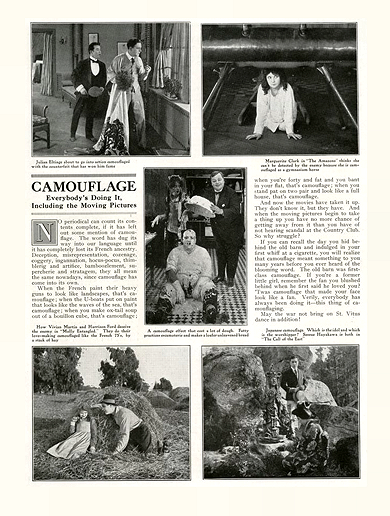
Above A page from Photo-Play Journal, December 1917, p. 25, featuring an article called CAMOUFLAGE: Everyone’s Doing It, Including the Moving Pictures. In an earlier blog post, we reproduced the article’s text, but not this image of the page.

SEE ALSO

Nature, Art, and Camouflage (35 min. video talk)

Art, Women’s Rights, and Camouflage (29 min. video talk)

Embedded Figures, Art, and Camouflage (26 min. video talk)

Art, Gestalt, and Camouflage (28 min. video talk)

Thursday, February 2, 2023

Art, Design and Gestalt Theory: The New Film Version

Recently completed: Our most popular video talk, titled Art, Design and Gestalt Theory: The Film Version (40 mins). It traces the emergence of Gestalt psychology (c1910), as well as its connections to holism, Taoism, yin and yang, displacements of attention, contrast illusions, color, camouflage, graphic design, and architecture. Ideal for classroom screenings, and library discussion events. Non-monetized, free full online access for anyone at YouTube.

Friday, February 18, 2022

WWI-era Scenic Film Camouflage at Lasky Studios

Above Photograph of Hollywood scenic designer Glen Dunaway (1895-1923), manager at the Lasky Studio in 1920, as published in THE SCENIC ART IN MOTION PICTURES: Glen Dunaway, Chief Scenic Artist, Explains Colorful Phase of Important Studio Work in Muncie Evening Press (Muncie IN). November 20, 1920. “Mr. Dunaway,” (not to be confused with Glenn Dunaway, a possible relative, who was a race car driver) the article states, “is a camouflage expert…” (not literally) in view of the highly deceptive effects that he creates for filmmaking purposes. Unfortunately, he died of carbon monoxide poisoning (adjudged accidental), as the result of a defective room heater, at the Lasky Studios on April 23, 1923.

Pictured in the same article is a scenic artist named Hans Ledeboer (1874-1962), described as “the most prominent” artist on Dunaway’s staff. He “was born in Holland of Dutch and French parentage and studied art and decoration in Rotterdam and The Hague. Twelve years ago [c1908] he came to America because of the wider opportunities offered by this country for his work… Since coming to America he had achieved considerable fame. In Chicago, he was commissioned to paint Holland scenes for the Onndaga Hotel in Syracuse NY, and later he also did the mural decorations for the San Francisco Exposition, and for that work [he] was awarded a gold medal. For the past three years he has decorated, each year, the great auto show room at the Pacific Auditorium in San Francisco, where the auto show is held annually.”

•••

Anon, MOVIE FACTS AND FANCIES in The Boston Globe. October 1, 1921, p. 12. Extended portions of this text were published (with attribution to Marvin M. Riddle) in The Photodramatist, with the title "From Pen to Silversheet." January (pp. 35-37) and February 1922—

The studio scenic artist of today is a high-class interior decorator.

In addltlon to this he is an expert camouflage artist and a perfect copyist. The controlling principal in his work, however, is the photographic value of colors. Under the eye of the camera colors are often very deceptive, and often a color which seems lighter to the eye than another color might on the screen register a darker shade of gray than that color.

Often two colors which seem to form a most artistic and beautiful combination to the human eye, will, when photographed, present a most inharmonious, discordant color scheme, which is very ugly to look upon. Only by a careful study and a perfect knowledge of the photographic values of color does the scenic artist avoid such color clashes.

The art of camouflage also is a very important phase of the studio scene painter’s art. He must make the imitation appear exactly like the real. Some of the commonest of such problems are included in the following examples: The camouflage of compo[sition] board square[s] and the proper laying of them so that when photographed they resemble a tile or stone floor; the painting of surfaces so that the photographic result[s] [are indistinguishable from] bronze, gold or other metals.

The artist can, with a few well-placed strokes of his brush, dipped in the right kind of paint, make a new brick wall like the side of a dingy tenement house. He can give to a new redwood panelled wall the effect of an oak panel, hundreds of years old.

Friday, December 25, 2020

the mouse-skeeters / a phenakistoscopic rodent race

Phenakistoscope motion picture toy (1833)

CAMOUFLAGE FOR MICE in Garnavillo Tribune (Garnavillo IA), November 21, 1929, p. 2—

Camouflage, which helped to win the World War, is being employed in Europe to catch mice. On the theory that rodents of today know their traps, inventors have produced, for use in office desks, a mouse catcher shaped like a harmless paper clip. Another, for general use, resembles an old tin can whose top closes suddenly. Still another resets iself automatically to catch mice all night and dump them into a vat of water.

RELATED LINK

How Form Functions

Monday, June 22, 2020

Earl B. Wooden | Hollywood designer and camoufleur

Earl B. Wooden (1893-1952) was a Kansas-born scenic film designer, who (as a "set decorator" and "set dresser") produced scenery for Hollywood films. One of those was Corpus Christi Bandits (1945), the poster for which is shown above. During World War I, he also served as a US Army camouflage artist, as described in the news article below.

•••

Stockton Review and Rooks County Record (Stockton KS), January 31, 1918—

Mr. and Mrs. E.B. Wooden received a letter this week from their son Earl, notifying them that he had arrived safely in France, where he went from California recently to work in the Camouflage Corps. His particular work will be the planning and architectural construction of camouflage for artillery and other things at the front that must be concealed from enemy airplanes. In this, he is an adept, as he has been engaged for the past four years in the creation of artificial scenery for a big film company at University City in Los Angeles. He says his work has hitherto ben to deceive the public at the movies; now it will be the pull the wool over the Bosche's eyes. His parents knew of his going and were surprised as well as pleased over getting word from him so promptly.

Thursday, June 11, 2020

hocus pocus, thimblerig, supercherie, and cozenage

Above Poster for Charlie Chaplin film, Shoulder Arms (1918), in which his character wanders behind enemy lines disguised as a tree trunk. Public Domain.

•••

CAMOUFLAGE: Everybody’s Doing It, Including the Moving Pictures, in Photo-Play Journal (December 1917), p. 25—

No periodical can count its contents complete if it has left out some mention of camouflage. The word has dug its way into our language until it has completely lost its French ancestry. Deception, misrepresentation, cozenage, coggery, ingannation, hocus pocus, thimblerig and artifice, bamboozlement, supercherie, and strategem, they all mean the same nowadays since camouflage has come into its own.

When the French paint their heavy guns to look like landscapes, that’s camouflage; when the U-boats put on paint that looks like the waves of the sea, that’s camouflage; when you make ox-tail soup out of a bouillon cube, that’s camouflage; when you’re forty and fat and you bant in your flat, that’s camouflage; when you stand pat on two pair and look like a full house, that’s camouflage.

And now the movies have taken it up. They don’t know it yet, but they have. And when the moving pictures begin to take a thing up you have no more chance of getting away from it than you have of not hearing scandal at the Country Club. So why struggle?

If you can recall the day you hid behind the old barn and indulged in your first whiff at a cigarette, you will realize that camouflage meant something to you many years before you ever heard of the blooming word. The old barn was first-class camouflage. If you’re a former little girl, remember the fan you blushed behind when he first said he loved you? ’Twas camouflage that made your face look like a fan. Verily, everybody has been doing it—this thing of camouflaging.…


•••

Boston Globe, March 31, 1918—

Cecil B. DeMille, of Paramount [Film Studios], will become a member of the United States Engineer Corps and will aid in recruiting technical experts and scenic artists for camouflage work in France.

According to a Wikipedia biography—

During World War I, the Famous Players-Lasky organized a military company underneath the National Guard called the Home Guard made up of film studio employees with DeMille as captain. Eventually, the Guard was promoted to a battalion and recruited soldiers from other film studios. They took time off weekly from film production to practice military drills. Additionally, during the war, DeMille volunteered for the Justice Department's Intelligence Office, investigating friends, neighbors, and others he came in contact with in connection with the Famous Players-Lasky. He volunteered for the Intelligence Office during World War II as well. Although DeMille considered enlisting in World War I, he stayed in the United States and made films.  


Cecil B. DeMille (1919). Public domain.

Monday, March 16, 2020

Camouflage used as film theatre entrance advertising

Theatre entrance for The Geezer of Berlin (1918), NYC
In a wartime issue of Motography (November 10, 1917, p. 975), a brief article appeared in which it was asserted by a Hollywood advertising executive that “There is absolutely no excuse…for making motion picture posters deceptive.” In the article, titled Camouflage Has No Place in Poster Making, the executive goes on to say that ”Camouflage has its uses but it does not lend itself to the theatre lobby.”

Almost a year later, this was contradicted by a full-page article in Motion Picture News (October 5, 1918, p. 2189) titled Lobby Display Gets Laughs and Pulls in Crowds to See “The Geezer of Berlin.” It describes a successful advertising ploy devised M. Kashin, theatre manager of The Broadway Theatre in New York.

In an effort to increase attendance at the showing of a propaganda film (the “geezer” in the title, of course, is Kaiser Wilhelm II), Kashin transformed the theatre entrance, as well as the inside lobby, by installing "dazzle camouflage" designs, cartoons, and humorous posters.

The “vivid colors” of the “real camouflage” on the facade, the article states, “are enough to stop anyone in their tracks,” and in turn to lead the audience to a cut-out of “Der Geezer,” as well as satirical posters about “The Clown Prince,” “Gott of Germany,” “Hindebug,” and “Turpentine.”

Reproduced above is a photograph of Kashin’s design for the entrance. In an article published elsewhere (titled Inexpensive Lobby Displays), Kashin discussed his methods for devising this and other advertising novelties. He wrote: “I have found that the lobby display, worked out to its finest detail, will bring more results than any other form of advertising…”

Sunday, March 15, 2020

Camoufleur and Hollywood star Wheeler Oakman

USS Major Wheeler
The SS Tuscania (launched in 1914) was a Cunard luxury liner until it was refitted in 1916 to serve as a wartime troopship. In late January 1918, it left New Jersey en route to Liverpool, with 2,013 US soldiers aboard. Although it had been painted in a dazzle camouflage scheme (not shown on this page), it was sunk by a German U-boat on February 5. More than 200 personnel perished. This was detailed in an earlier post.

On June 8, 1919, the Washington Post reported that the actor Wheeler Oakman, “considered one of the best looking and talented of [Hollywood’s] younger leading men” had returned from service in France, where he had been a camoufleur with San Francisco’s 144th artillery regiment. Earlier, despite the success of his acting career, the sinking of the Tuscania “fired his long-smoldering patriotism.” In response, he “appealed to Metro to release him from his contract and enlisted as a private” in the San Francisco regiment. Shipped to France, “he got as far forward as the second-line trench below Verdun on the Marne as one of the 24 members of his regiment’s camouflage corps.”

This Hollywood celebrity, the article notes, “is a fighter by heritage and actor by nature. In answering the call to arms the actor only heeded the fighting blood of his family.” His given name was Wheeler because his famous cousin was Joseph “Fighting Joe” Wheeler (1836-1906), a Confederate general in the Civil War, and a US Army general in the Spanish- and Philippine-American wars. Affiliated with Theodore Roosevelt’s Rough Riders, he fought at the Battle of San Juan Hill in 1898. During World War I, an American ship was named for him. It may have been the USS Major Wheeler, shown above in a dazzle camouflage scheme.

Joseph Wheeler (bearded), and Theodore Roosevelt (right)


Before and after the war, Wheeler Oakman was a star in countless Hollywood films, from 1913 to 1948. In his earlier acting days, he was usually a leading man, but those opportunities decreased with film's transition from silent to sound. In later years, he was usually cast as a villain.

Poster for one of Wheeler Oakman's films

Tom Mix stands tall | fearless, he is every inch a man

Cowboy film star Tom Mix \ he was every inch a man!
Surely, no one appreciates reader responses more than we do. But admittedly we were surprised by the number of followers who objected to our most recent post, in which we appeared to make light of the diminished stature of American artist Charles Lasar, who was fondly known as "Shorty Lasar."  To make amends, we are now posting a WWI-era Hollywood film advertisement for the famous cowboy actor Tom Mix (1880-1940). He stands heroically on his horse, keeping a look-out for outlaws. The caption reads:

Every Inch a Man! There is no camouflage about him!—no doubles to do his difficult stunts!—no actor on the face of the earth who can do what he does! TOM MIX: the man who never fakes…he is the reincarnation of fearlessness —a dare-devil who flirts with death.

In his personal life, he may have flirted otherwise too, since he was married five times. His thirst for adventure extended to cars. He died in 1940, at age sixty, when his speeding 1937 Cord 812 Phaeton swerved to avoid a highway flood detour and overturned in a desert wash near Florence AZ. The crash site is now known as the "Tom Mix Wash."

Reproduced below is another full-page ad with the same theme: Tom Mix Doesn't Camouflage, from the September-October 1918 issue of Motion Picture News.

Let it be known that we have equally high regard for Charles Lasar, however diminutive. In our opinion, he too was every inch a man.

Tom Mix doesn't camouflage

Saturday, February 29, 2020

Jasper | dappled dog with white chicken on backside

Above A vintage news photograph of a dog that appears to have the shape of a white chicken on its backside.

•••

A Conscientious Objector in The Ogden Standard (Ogden UT), September 7, 1918, p. 23—

The art of camouflage was resorted to in one instance in making a scene for [a motion picture titled] Young America… Jasper, the pet dog of the leading boy character, refuses to chase chickens. He was brought up among chickens and carefully trained from puppyhood not to molest them. When he was “ordered” to do this in the [filming], he positively refused.

It was necessary to get another dog [to use as a stand-in] for Jasper, and, while a canine was found of the same size and approximate type, it did not have the correct spotting. The double was turned over to the scenic artist.

Sunday, February 16, 2020

Hollywood camoufleur | Shotgun wedding in reverse

Poster for Tummell's award-winning film (1933)
William F. Tummell (1892-1977) was an award-winning Hollywood film director, who served as a camouflage artist during World War I.

Born in Kansas City MO, he grew up there, and in Muskogee OK. He attended Muskogee Central High School, where one of his classmates was Viola Kobler. Around 1913, they eloped and were married without her parents’ consent in Wagoner OK.

When they returned to Muskogee, they were confronted by the bride’s father, who “took the bride home with him and made her stay there and warned the youthful husband away with a shotgun.” Following unsuccessful “attempts at reconciliation,” the parents sent their daughter to Iowa.

In the fall of 1913, unable to locate the bride, Tummell filed a lawsuit in Superior Court for $20,000 in damages against her parents. When he learned her whereabouts, he “went after her and finally brought her home with him.” The following year, Tummell (apparently without his wife) moved to Los Angeles to work as a technical director for film companies. Whatever the circumstances, their marriage ended in divorce in 1917.

Earlier, while living in Missouri, Tummell had been a member of the Missouri National Guard. In 1917, he joined Company F of the 24th Engineers, an army camouflage unit. He passed through Kansas City on November 27, on his way to training at Camp American University in Washington DC. According to an article in the Muskogee Times-Democrat on the following day—

The company will be composed entirely of men recruited from the motion picture industry and its business will be to render [American] batteries, billets and other war instruments invisible to [enemy eyes]. After three months of intensive training in Washington [DC] the movie fighters will embark for the war zone.

Following the war, Tummell returned to his film career in Hollywood. Between 1925 and 1977, he contributed to 59 films. In 1933, he received an Academy Award as Best Assistant Director for his work on Cavalcade. He died in Los Angeles in 1977 at age 85.

While looking for information about William Tummell, we discovered that the US Army photograph that we used on the cover (below) of False Colors: Art, Design and Modern Camouflage (2002) is that of a camouflaged soldier from Tummell's unit, Company F of the 24th Engineers, taken at Camp American University in November 1917.


Friday, February 14, 2020

Set Design: Camouflage is as old as show business

Above Here are the sheep. But what has become of the shepherd? Can you find him?

•••

Daniel Dillon, STAGE SETTERS IN US FORCE in World War History (New York), August 11, 1917—

Indicative of the thoroughness and extent of preparation the American troops are now undergoing in occupying the trenches, is the fact that a large number of “stage setters” and “scenic painters,” architects, constructive engineers, etc., are now on the French and British fronts, learning the art of camouflage, that is, screening the artillery and concealing the observation points.…

•••

ART OF CAMOUFLAGE OLD AS SHOW BUSINESS in Cincinnati Commercial Tribune (Cincinnati OH), June 16, 1918, p. 17—

The art of camouflage, which has recently received widespread publicity because of its application to military operations in Europe, is really as old as show business, according to Blanche Evans, one of the pretty girls on the summer vaudeville bill at Keith’s [a major theatre at the current location of Fountain Square on Walnut Street] this week.

According to Miss Evans, theatre folks deserve full credit for developing and nursing this art of deceiving the eye through the ages, and of perfecting it to such a degree that it has become one of the important factors in modern warfare.

“Why, the very spirit of the stage is that of camouflage,” declared Miss Evans recently. “This stage makes believe, makes things appear what they are not, and that is camouflage in spirit and reality. Stage scenic artists are expert camoufleurs. They take a bit of canvas and with brush and paint transform it into a parlor, woods, or palace with ease. A series of costumes can change a single actor into a king, a beggar, a policeman, or a man of society. What is that but camouflage?…

The real relation between stage camouflage and military camouflage is perhaps best emphasized by the fact that hundreds of former theatre scenic artists are now engaged on the European battlefronts in creating illusions to deceive the observations of the enemy. American scenic artists are beginning to serve their country in the same way and before long we will have contributed hundreds to the same cause. Military camouflage is saving the lives of hundreds of soldiers every day and the theatre should be given full military credit for its patient and untiring development of the art.”


•••

Melvin M. Riddle, CAMOUFLAGE! Concerning one of the Major Arts of Motion Pictures. Atlanta Constitution (Atlanta GA), October 24, 1920—

…camouflage is an art without a knowledge of which, one of the greatest industries of today—the motion picture industry—could hardly exist.

The art of camouflage is a vital factor—in fact, it might be said, almost a prime factor in the production of motion pictures…

It is the general impression, perhaps, that the war first developed the art of camouflage. This impression, however, is erroneous. For long before the war began, the art had been developed to a high degree by the industry of motion picture production, but as developed by the industry, it was an unidentified art because it was an art without a name. The truth of this assertion is proven by the fact that when America entered the war, men from the motion picture studios, who had gained a knowledge of the art of scenic deception, formed an important part of the ranks of special camouflage corps which were sent over there. This was because these men had already a practical knowledge of this great study and had only to adapt this knowledge to the particular requirements of defense in war.

The one great difference between camouflage as practiced in motion pictures and as practiced in war is that war camouflage, although deceiving to the human optics, is readily detected by the camera, while in motion pictures the camouflage is especially arranged and prepared to deceive the eye of the camera, although it sometimes also deceives the human eye, unless a very close-up view is obtained. Primarily, it is the camera lens upon which the deception is practiced, however, for the eye of the camera is ultimately the eyes of the motion picture audience.

Motion pictures, before the beginning of the war, did more and are doing more to develop the art of camouflage on a large scale than any other industry or even possibly could do. Camouflage is the very life of a motion picture—a vital necessity. Of course, the art has been employed from time immemorial in the theatrical profession—in the dressing of stage settings for legitimate productions, but camouflage, as used on a stage, is very limited in its scope, and is admittedly camouflage, and for this reason loses its very effectiveness. It is when camouflage is mistaken for the genuine and the delusion is unquestioned, that it really serves the purpose for which it is intended.…


•••

See also theatre designer

Thursday, June 20, 2019

Camouflage Artist | Iowa Artist Halleck J. Finley

Halleck J. Finley (c1944)
Above A magazine photograph of American artist and photographer Halleck J. Finley in the 1940s, at which time he was an advertising artist, photographer and art director in New York. During World War I, he had served in France as a US Army camoufleur.

•••

Finley was born in 1895 in Knoxville IA. He was the son of a school administrator named S.J. Finley, who had moved from Quaker City OH to serve as the school superintendent in Knoxville and Oskaloosa IA. The family apparently also lived in Waterloo IA, as well as in Indianapolis IN, where Halleck graduated from high school. He studied at John Herron Art Institute of Art in Indianapolis for two years, until his family moved to Hollywood CA, where he continued to study art and design. His brother, Harold M. Finley, had joined the editorial staff of The Los Angeles Times in 1909. Around 1915, Halleck Finley began to work for the advertising section of the same newspaper, while still attending classes in the evenings.

In 1916, he was hired as a scenic artist to work on the production of Joan the Woman, an important early silent film, directed by Cecil B. DeMille and produced by Jesse Lasky, with Geraldine Farrar in the role of Joan of Arc. Soon after the US entered the war in 1917, DeMille was appointed to a government committee whose purpose was “to mobilize the theatrical profession for war work.” DeMille’s particular duties, the article continues, “will be to take charge of the recruiting for the camouflage companies.”
Halleck J. Finley in 1917


In 1917 (perhaps at DeMille's suggestion), Halleck Finley and another young artist, a scenic designer named David E. Taylor, volunteered to join the army as camouflage specialists. According to The LA Times, Finley “was the first man to be recruited to this branch of the service in Southern California.” The two men were trained at Camp American University in Washington DC, in preparation for serving in France.

Camp American University (Washington DC)


While in France, excerpts from wartime letters to his family were sometimes published in The LA Times. But they offer little insight into his involvement in camouflage. As an article in that paper surmised—

Whether the censor had deleted passages telling of the camouflage work of the corps at the front, or whether the actual work of making the Germans think a big gun is only a fallen tree has not yet begun, the letters tell of no particular doings yet of the camoufleurs.

•••

Harry A. Williams, MISSOULA MIKE A COLONEL: At Least that is What Every One Calls the Marine Philosopher, in Los Angeles Times, May 27, 1919—

[Williams describes a postwar conversation at the Times Building with a returned US Army veteran, known as Missoula Mike, who had served in France with Halleck Finley. Finley has returned from the war to work at the newspaper, and Mike recognizes him from across the room.] “See that guy with the pensive face humped over a drawin’ desk in Boss Dodge’s department. If that ain’t Halleck Finley who was over there with our camoufleurs, I’m a poor guesser.”

Mike crossed the editorial room for a closer look, and the mutual recognition was plain to the naked ear…

“Last time I saw Finley before this was up in the Argonne. The camouflage boys, at least some of ‘em, when not engaged camouflaging the trenches, roads, barracks an’ one thing an’ another was paintin’ pictures along the front. In other words, they was engaged in picklin’ a world war in oil. Crawlin’ out of the brush one day I comes on Finley all humped up in a shell hole drawing a life-like picture of a battle. About that time a small shell hits in a bucket of red paint an’ splatters it all over the canvas. That gave Finley an idea. Instead of notin’ what a close call he had, he simply remarks that the next time he wants to produce a likeness of a great battle he’s simply goin’ to drop a hand grenade in a bucket of red paint, an’ let the explosion do the rest.”


•••

After returning to Los Angeles c1919, Finley worked for a number of years as a free-lance designer and illustrator. During the mid-1920s, he worked in collaboration with his artist wife, Frances (Mudge) Finley, whom he married in November 1923. They had two children, a son (possibly Harold) and a daughter (Eliza Lee Petofi, born Finley), but the marriage appears to have ended. While working as an art director and illustrator, Halleck Finley “continued to do his own work and many leading advertising accounts boasted Finley color paintings in their ads.”

Halleck Finley magazine illustration

Over time, he became increasingly interested in the possibilities of creating illustrations, not by painting and drawing from photographic image sources, but by using photographs themselves as illustrations. Finley moved to New York, where he was hired by McCall’s magazine to use photographs to illustrate fiction.

In the June 1944 issue of Popular Photography, Finley published an article titled “What’s the Matter with Amateurs?”  in which he characterized amateur photographers as sloppy, undisciplined and preoccupied with gadgets (they were amateurs!). The article caused an uproar, which prompted the magazine to run a lengthy follow-up feature in the August issue, titled “What’s the Matter with Halleck Finley? The Amateurs Answer Back with Pro and Con Letters to the Editor.” In one of those letters, a reader asked (apparently aware of Finley’s Midwest origins) “Where did you see that sloppy print you write about? In Muddy Creek, Iowa?”

•••

In 1975, when Halleck Finley was 80 years old, he called the office of The LA Times, "asking for rights to reprint a piece he did in 1919, soon after he left the army camouflage forces at the end of World War I." Art Seidenbaum, the journalist who spoke with him, went on to talk to him at length about his feelings about growing old. The columnist continues—

We started to talk about old times—his—and how he'd lived in New York and Mexico and parts everywhere during the intervening years. "I never liked old people," he said, "until I woke up one day and found out I was one of them."

There is no mention of where Finley was living at the time of the phone conversation. But he continued on for twelve more years and died in Austin TX in 1987.

•••

SOURCES
 
ABANDONS NEWSPAPER WORK TO ENTER ARMY.  Los Angeles Times, September 30, 1917.


ANGELOS TO GO AS CAMOUFLEURS. Youths Leave for East to Aid in New Division, in Los Angeles Times, September 23, 1917.

CAMOUFLAGE FROM PICTURE STUDIOS. Los Angeles Times, September 22, 1917.

IOWAN WITH "CAMOUFLEURS": Halleck J. Finley, Now of Los Angeles, Accepted in Engineering Corps, in Marshalltown Evening Times Republican (Marshalltown IA), September 28, 1917.

Art Seidenbaum, OLD-TIME DERISION. Los Angeles Times, July 18, 1975.

WHAT'S THE MATTER WITH HALLECK FINLEY?: The Amateurs Answer Back with Pro and Con Letters to the Editor. Popular Photography, August 1944.

Saturday, January 12, 2019

WWI Camouflage, Motion Pictures and Surrealism

Charlie Chaplin disguised as tree trunk in Shoulder Arms (1918)
Above Screen grab from Charles Chaplin's famous film, Shoulder Arms (1918) about the surrealist dimension of being a doughboy during World War I , in the process of which he disguises himself as a tree trunk. In fact, it wasn't entirely absurd, since it was not unheard of to make use of steel-lined imitation tree trunks as elevated observation posts (see close-up below).

Phony tree trunk observation post (c1918)

Camouflage has everything to do with film-making, from costumes and make-up, to camera work and scenic design. Elsewhere we have talked about a few of the contributions made by Hollywood-based special effects designers, but there are many (many) more points of connection (in both World Wars), the majority of which are waiting to be documented.

Speaking of Surrealism (which I tend to think of as Dada + Freud, thanks to André Breton), the German-born American photographer and designer Erwin Blumenfeld (1897-1969) once made a Dada-inspired photo collage portrait of Chaplin (below), in which he appears to be wearing an image-adorned WWI trench helmet. The image on the helmet is from a well-known Dadaist poster from 1922.

Erwin Blumenfeld, collage portrait of Charlie Chaplin


•••

Melvin W. Riddle, CAMOUFLAGE! Concerning One of the Major Arts of Motion Pictures. The Atlanta Constitution. Sunday, October 24, 1920—

CAMOUFLAGE!
A new word—coined during the great war by the French, to denote an art which was highly developed during the war. A new word, but an age-old art—old as war itself, older than mankind, for even Nature made use of it as a means of protection for animals and plants. Truly, an age-old idea, but only in the last few years has it been developed by mankind to that state of perfection wherein it might be called an art.
    

Camouflage saved from distruction during the war innumerable lives and properties of inestimable value. Now that the war is over, one might think that the word and the art would temporarily become passé and useless until another war should come along to revive them. But such is not the case, for camouflage is an art without a knowledge of which, one of the greatest industries of today—the motion picture industry—could hardly exist.

Camouflage and the Movies
The art of camouflage is a vital factor—in fact, it might be said, almost a prime factor in the production of motion pictures, and it is with that phase of camouflage that this article is concerned.
    

It is the general impression, perhaps, that the war itself first developed the art of camouflage. This impression, however, is erroneous. For long before the war began, the art had been developed to a high degree by the industry of motion picture production, but as developed by this industry, it was an unidentified art because it was an art without a name. The truth of this assertion is proven by the fact that when America entered the war, men from the motion pictures studios, who had gained a knowledge of the art of scenic deception, formed an important part of the ranks of special camouflage corps which were sent over there. This was because these men had already a practical knowledge of this great study and had only to adapt this knowledge to the particular requirements of defense in war.
    

The one great difference between camouflage as practiced in motion pictures and as practiced in war is that war camouflage, although deceiving to the human optics, is readily detected by the camera, while in motion pictures the camouflage is especially arranged and prepared to deceive the eye of the camera, although it sometimes also deceives the human eye, unless a very close-up view is obtained. Primarily, it is the camera lens upon which the deception is practiced, however, for the eye of the camera is ultimately the eyes of the motion picture audience.

Vital Necessity
Motion pictures, before the beginning of the war, did more and are now doing more to develop the art of camouflage on a large scale than any other industry or even possibly could do. Camouflage is the very life of a motion picture—a vital necessity. Of course, the art has been employed from time immemorial in the theatrical profession—in the dressings of stage settings for legitimate productions, but camouflage, as used on a stage, is very limited in its scope, and is admittedly camouflage, for this reason loses its very effectiveness. It is when camouflage is mistaken for the genuine and the delusion is unquestioned, that it really serves the purpose for which it is intended.
    

Examples of some of the numerous instances where camouflage is employed in motion pictures might be of interst. At the Lasky studio, for instance, which is one of the largest of west coast film plants, one might see on every hand the evidences of this great art.
    

To begin with, the very make-up of the players is often the most perfect camouflage. The feeble-looking old man or the dissipated, rum-soaked hobo might be, in reality, one of the most gentle and best-appearing young men on the lot, hiding his real identity under a skillful application of camouflage.…
   

Even the most conscientious, exacting and painstaking producers, who fairly dote on realism in their productions and always secure it whenever possible, are never slow to admit the importance and the value of the art of camouflage, and the great frequency and regularity with which it is employed in the production of motion pictures.