Wednesday, August 26, 2026

camouflaged American soldier emerges from stump


World War I American soldier (digital animation)

Henry Berry (American artist / camoufleur), in Make the Kaiser Dance. New York: Doubleday, 1978, p. 207—

I picked Harry Hull [Howard Hull], the brother of Henry Hull, the actor, as my [US Army camouflage] partner, and we went to work. We decided to put together a fake stump, the kind that you move around and hide just about anything in…First we took some real bark off a tree and wired it to a cage we had. When we actually planted it in an area that had a lot of other stumps—really, you couldn't tell the damn thing from the others. We even had a little trap door on the bottom that you could crawl in or out of.

•••

FALSE COLORS: Art, Design and Modern Camouflage

CAMOUPEDIA: A Compendium of Research in Art, Architecture and Camouflage


SHIP SHAPE: A Dazzle Camouflage Sourcebook


Lowest price / three book bundle with free shipping 


Tuesday, August 25, 2026

aimed to distort the lines and to warp the perspective


Above WWII American ship camouflage (unidentified), 1944

•••

Matthew Luckiesh, Visual illusions, their causes, characteristics and applications. New York: Van Nostrand, 1922, pp. 225-227—

Many optical illusions have been devised and studied by scientists. In fact, some of these tricks are well known to the general reader. Straight lines may appear broken, convergent, or divergent by providing certain patterns or lines intermingled with them. [Beginning in World War I] Many of these were applied to models in laboratory experiments and it has been shown that confusion results as to the course of the vessel. The application of these on vessels has resulted in the grotesque patterns to be seen on ships during the latter stage of the war. It is well known that these illusions are most effective when the greatest contrasts are used, hence black and white patterns are common. Color has not been utilized as definitely as pattern in confusibility, although there is a secondary aim of obtaining low visibility at a great distance by properly balancing the black, white, and other colors so that a blue-gray results at distances too great for the individual patterns to be resolved by the eye. Color could be used for the purpose of increasing the conclusion by apparently altering the perspective. For example, blue and red patterns on the same surface do not usually appear at the same distance, the red appearing closer than the blue.

Such apparently grotesque patterns aimed to distort the lines of the ship and to warp the perspective by which the course is estimated. This was the final type of marine camouflage at the close of the war. Besides relying upon these illusions, ships zigzagged on being attacked and aimed in other ways to confuse the enemy. No general attempt was made to disguise the bow, because the bow-wave was generally visible. However, attempts have been made to increase it apparently and even to provide one at the stern. In fact, ingenuity was heavily drawn upon and many expedients were tried.

Monday, August 24, 2026

ship camouflage / as dazzling as Frisco pousse-café

Herman Whitaker
, SIMS'S CIRCUS, A Cruise with Our Destroyers Over There in The Independent Vol 94—

Barred, striped, blotched, smudged, ring streaked with vivid pinks, arsenic greens, blowsy reds, violent blues, they looked like—like nothing in the world unless it be that most poisonous of drinks, a Frisco pousse-café. All of the giraffes, zebras, leopards and tigers ever assembled in the "World Greatest Aggregation" exhibit conventional patterns in comparison with this destroyer camouflage.

Germans more adept at using WWI camouflage tricks

TRICKS IN ALL TRADES: The War Game Has Its Share of Them, as the Pictures on This Page Bear Witness—The Germans Have Been the More Adept at Their Use, Even to a Replica of the Trojan Horse
in The Constitution (Atlanta GA), June 13, 1915.

Sunday, August 23, 2026

WWI oil camouflage with views of ship in harbor

USS Lake Pleasant (1918)
Above
Two views of the starboard side of the same ship, the USS Lake Pleasant (1918), showing its dazzle camouflage scheme. Not directly pertinent to the news story posted below.

•••

OIL CAMOUFLAGE OF U-BOAT CAPTAINS IS EXPOSED BY ALLIES, Instead of Sailing on, Destroyers Drop Many Depth Charges Near Floating Oil in The Tulsa Weekly Democrat (Tulsa OK) July 25, 1918—

Tricky German U-boat commanders have concelved a new plan destined to deceive crews of the Allled submarine destroyers in the game of hide and seek in European waters. When a depth bomb is discharged and does not cripple or destroy the German under-sea boat, as sometimes happens, a quantity of oil is released by some device of the submersible and quickly rises to the water's surface.

The hope of the German U-boat captain is that the commander of the destroyer will see the oil, believe that the submarine has been wrecked and drop no more depth charges. Meanwhile, the German is endeavoring to escape.

Amerlcan and British commanders of destroyers and submarine chasers discovered the scheme some time ago and since then have been dropping depth bombs in greater number-than previously, using the oil as a guide to the general location of their target.

"Oil camouflage" the Amerlcans and British navymen call this Iatest German submarine trick.


Thursday, August 20, 2026

British Army Tank Camouflage / WWI Strategic Testing

Above
I recently ran across this book by Roger Pugh, titled THE MOST SECRET PLACE ON EARTH: The Story of the East Anglian Village of Elveden and the Birth of the World's First Tanks. Larks Press, 2014. It is an account of the village of Elveden during World War I, during which it secretly functioned as a development and testing site for the British Army's tanks.

I haven't yet seen the actual book, although copies are for sale online. I was initially pulled in by the image on the cover. In a further search, I found a website sponsored by St Edmundsbury, titled The Great War of 1914 to 1918 Picture Gallery of Bury St Edmunds and Surrounds. There is a caption on that site that provides more information about the image on the cover. It reads as follows:

The artist Solomon J Solomon was enlisted to design camouflage for the new weapons. He visited Elveden and also went to France to study the soil and vegetation there. In June 1916 Solomon began painting the first tanks in a mixture of pink, grey, green and brown blotches. This picture shows a modern attempt to reproduce this camouflage, which was soon replaced by a uniform khaki brown once in the field in France.

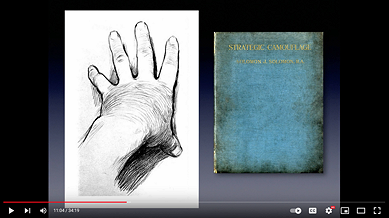
Those who follow this blog will most likely recognize the name of Solomon J. Solomon, who was the first commander of the British Army's camouflage section, and who wrote one of the earliest books (perhaps the first) on infantry camouflage, titled Strategic Camouflage. He is also featured in a free, online video talk I made several years ago (see link below).

Tuesday, August 11, 2026

that artists should be placed in charge of camouflage

False Colors: Art, Design and Modern Camouflage
Captain Aymar Embury II
, US Reserve, "Nature's Camouflage and Man's" in The New Country Life. Vol 34 No 2, June 1919, pp. 27-40—

It is fitting that military men should have turned to the artist-naturalists for information on camouflage, and should have placed artists in charge of military camouflage, not the United States alone, but in England and France as well, and I believe also in Germany. In this country the camouflage, both naval and land, is being done largely by artists with the assistance of men of kindred professions, such as the stage and architecture…

•••

FALSE COLORS: Art, Design and Modern Camouflage


CAMOUPEDIA: A Compendium of Research in Art, Architecture and Camouflage


SHIP SHAPE: A Dazzle Camouflage Sourcebook


Lowest price / three book bundle with free shipping 


•••


Below Drawing by Charles Livington Bull with the following caption: Perhaps the best known of all the camouflage tricks is the dead horse made of papier maché, or even of steel, so arranged that the sniper or lookout can hide in it and keep watch of the enemy.


Monday, August 3, 2026

the unknown role of Iowa artists in modern camouflage

Coming soon: At 2:00 pm on Sunday, August 9, I will be giving a one-hour illustrated talk on camouflage in connection with art, nature, and its military uses in World War I. The talk will take place at the German American Heritage Center & Museum at 712 West 2nd Street in Davenport, Iowa. Insights and surprises abound. Looking forward to it! For more information, see gahc.org.

Saturday, August 1, 2026

ship camoufleurs George Musaphia / B.R. Campbell

George Musaphia illustrations
I know almost nothing about an American illustrator named George Musaphia. The little that I do know I found in a brief news article in the Spokane Chronicle (October 7, 1918), which reads as follows—

RECORD CLAIMED BY CAMOFLEURS Two Seattle "camofleurs"—the men who paint the zig-zag stripes on ships returned recently from Portland OR, where they spent six days supervising the camouflaging of six vessels being built for the Emergency Fleet Corporation. The total of six ships in six days is believed a camouflaging record.

The two are George Misaphia [sic], formerly a New York portrait painter, and B.R. Campbell, who, in peace times, is a Boston theatrical scenery decorator.


That's it. I've searched for both artists, Musaphia (not Misaphia, unless I'm mistaken) and Campbell, the latter of whom is possibly a New England artist named Brooks R. Campbell (1898-1977), who worked as a sign painter in Manhattan. It seems likely that the other man was George (or Georges) Musaphia (1894-1979), but I could be wrong.

One thing about Musaphia that seems certain is that he was affiliated with the theatre, and that he worked in Boston (in advance of World War I) as an illustrator for theatre reviews. Maybe that's how he met Campbell, who is described as a "Boston theatrical scenery decorator."

The six Musaphia illustrations that I have found so far were all published in 1913. I've scanned and reproduced them here. They are stylistically consistent, but the attribution is also clear because he signed his name in an unusual way, part symbol and part letters. They were published in the Boston American on the following dates (from top to bottom) September 7, October 12 and 19, and November 2, 9 and 30. He probably was a portrait painter because his theatre illustrations are, without fail, essentially portraits of the actors as they appear in costume.