Showing posts with label sculptors. Show all posts

Thursday, August 14, 2025

camouflage artist's profile appears on Buffalo nickel

Buffalo Nickel

Ramon D. Forbes, NUMISMATIC NOTES in Philatelic West (Lincoln NE), Nebraska Philatelic Society, 1918—

I wonder how many of the readers of Philatelic West who carry Buffalo nickels in [their] pockets realize that they have the likeness of one of Uncle Sam's fighting men in their possession.

Corporal Robert G. Harper, who posed for the Indian head of the buffalo nickel, has arrived at Camp Sherman, and has been assigned to the 309th Engineers [as a camoufleur]. Harper, of French-Indian descent, was born in the Mohawk Valley in northern New York, answered the call of the West and spent many years on the Western plains. When James Earle Frazer of New York received the commission to execute the design for the new nickel, Harper was secured as a model.… 

•••

NICKEL "HEAD" QUITS POSING, Model for Coin Will Aid in Plastic Surgery, in Painesville Telegraph (Painesville OH) August 6, 1930, p. 3—

The "Buffalo Nickel Indian"—Robert G. Harper—has turned from a career of modeling for artists to helping plastic surgery within the reach of every man.

Harper, former local high school athlete and World War camouflage artist, has left Yale Art School, where he posed for sculpture classes, to become a "Plastic Surgeon's Plastic Expert" in the staff of the New York City Health Department, which hopes to bring such operations within the means of the average man.

Although not an Indian [sic], Harper's appearance fulfills the common impression of an American Indian. In addition to posing for the head of the Indian on the five-cent piece, Harper has posed for many noted statues. 

News photograph of Robert G. Harper
•••

'FORGOTTEN MAN' ON NICKEL PAYS VISIT TO BINGHAMTON, in Binghamton (NY) Press and Sun-Bulletin, September 12, 1938, p. 5—

The man who claims to be behind the face on the disappearing Buffalo nickel gave Binghamton a quick once-over Saturday afternoon.

He is Robert G. Harper, World War veteran, model and sculptor, who stopped off between trains at the Lackawanna station while en route to the veterans' hospital at Bath.

"It's a funny thing," he said, "here's the place I was born, and I haven't been here in years. My birthplace was an old Mohawk Indian reservation, near Union, a site which now is occupied by an Endicott Johnson factory."

His grandmother and mother, he said, were full-blooded Mohawk Indians.

"Not only were my features the most prominent on the nickel," Mr. Harper said, "but I also used for the statue of a running soldier right here in Binghamton at the end of Memorial Bridge [on a war memorial sculpture titled "The Skirmisher" by Robert Ingersoll Aiken]"…

Robert Ingersoll Aiken, The Skirmisher


NOTE: It is  sometimes claimed that the profile on the Buffalo nickel is not that of Robert G. Harper, but of another Native American, named Wolf Robe.

RELATED LINKS

Dazzle Camouflage: What is it and how did it work? /  Nature, Art, and Camouflage / Art, Women's Rights, and Camouflage /  Embedded Figures, Art, and Camouflage / Art, Gestalt, and Camouflage /  Optical science meets visual art /  Disruption versus dazzle / Chicanery and conspicuousness /  Under the big top at Sims' circus

Wednesday, April 9, 2025

Homer St. Gaudens as drawn by Gordon Stevenson

Above Cover of TIME magazine (May 12, 1924), featuring a portrait of Homer St. Gaudens (son of the celebrated sculptor Augustus St. Gaudens), who was in charge of US Army camouflage during both World Wars. It is of additional interest that this pencil-drawn portrait of St Gaudens was made by artist Gordon Stevenson, who served as a ship camoufleur with the US Navy during WWI.

•••

War diary of John Lee McElroy, 1st Lieut. 315th Field Artillery, 155th Brigade. Camden, N.J: Haddon Press, c1929, p. 8—

This afternoon I had fallen asleep while studying a map. My head had sunk down on my arms on the table, and I was aroused by someone shaking me by the shoulder. He was a very good looking Major, and said I evidently had not been to sleep for some time. I admitted it. Said he wanted to inspect my camouflage, as he was camouflage officer for the sector. His name is Homer St. Gaudens. 

RELATED LINKS    

Dazzle Camouflage: What is it and how did it work? /  Nature, Art, and Camouflage / Art, Women's Rights, and Camouflage /  Embedded Figures, Art, and Camouflage / Art, Gestalt, and Camouflage /  Optical science meets visual art /  Disruption versus dazzle / Chicanery and conspicuousness /  Under the big top at Sims' circus

Saturday, May 27, 2023

the tragic life of a taxidermist, camoufleur and convict

Above An assemblage by Romainian surrealist Viktor Brauner (1903-1966), titled Wolf Table (using taxidermy bits from a fox, not a wolf), 1939. Other than their shared interest in taxidermy, there is no explicit connection between Brauner and the story of Arthur J. Coleman below.

•••

In the 1921 Indianapolis city directory, Arthur J. Coleman is listed as a taxidermist (he was the curator at the Indiana Statehouse Museum) and a custodian, with the home address of 337 South State Avenue. James A. Coleman, his father, shared the same residence, as did Arthur’s mother, Nancy S. Coleman.

In connection with his museum position, Coleman was allowed to carry a gun, a revolver in a shoulder holster. In May 1920, he and three companions (including an eighteen-year-old woman named Floy Minck) were returning to Indianapolis at night, when Coleman, who was driving, noticed that an automobile tire was blocking the road. When he stopped to look more closely, he saw that a rope was attached to the tire, and that it was being pulled off from the side. He heard voices in the dark, and saw six men approaching the car. He drew his revolver and fired two rounds. The men fled and Coleman hurriedly drove off.

In September 1920, Floy Edna Minck (1902-1976) married an Indianapolis carpenter named Bernard B. Bartlett. Ten months later, Arthur J. Coleman married a young woman (the same age as Minck) named Elizabeth (Libby) Schmitter. In November of that same year, there was a jury trial in Indianapolis, in which Coleman was accused of threatening to kill Bartlett, because of a dispute about “a girl whom Bartlett later married” (presumably Floy Minck Bartlett). The jury could not agree on a verdict.

Coleman’s marriage to Libby Schwitter Coleman was an unfortunate pairing. It was troubled from the start, and they agreed to separate at the end of the first year. Coleman moved to New Harmony IN, on the Wabash River, while his wife lived twenty miles west in Crossville IL. They had lived apart for about a year, when, according to Coleman, he received a phone message and a letter from his wife, suggesting that they talk about living together again.

On April 26, 1923, Coleman (this is based on his account) drove to Crossville, to talk to his wife about reconciliation at a house where she was then staying (apparently owned by someone named Jeff Young). When he entered the front door, he was struck on the head from behind and fell to the floor unconscious. When he regained consciousness (he testified), he was lying in a room, with a revolver in his hand. His own revolver was still in his shoulder holster. Nearby was the body of his dead wife, who had died from three or four bullet wounds. In a 1923 news article, it was noted (without explanation) that the owner of the house, Jeff Young, is “an inmate of a hospital for the insane in Illinois.” It was also claimed that a man (unnamed) who was in the house at the time of the shooting had “left immediately and was away from [that area] for a year.”

Despite Coleman’s account of what happened, he was arrested at the site for his wife’s murder, and jailed in Carmi, the county seat. On the day after his arrest, his mother visited him at the jail. She later said: “When I pulled Arthur’s head down to kiss him, I felt a bump on his head and noticed blood on my hand as I left the jail.” But that injury was not mentioned in the documentation for his appeal.

Coleman said that, while he was in jail for three weeks, awaiting his court appearance, the sheriff brought a “professional hangman” to his cell, to describe the agony of dying that way. He was then taken to a window, and shown where the scaffolding would be built. He was told: “That’s where we will stretch your damned neck.” He was also warned about the horror of being lynched if an angry mob would storm the jail.

Coleman later described his condition, while awaiting his court date, as being “sick and nervous.” Inspite of having no memory of the shooting, he decided to plead guilty (to avoid the death penalty) when he appeared before a judge on May 19. He was then sentenced to life in prison for a term of ninety-nine years. He spent the next 21 years at the Illinois state prison at Joliet as well as on a prison farm.

[So what does any of this have to do with camouflage? Aha, I thought you’d never ask.]

It seems that during his confinement, Coleman continued his interest in taxidermy, including animal camouflage, sculpture, landscape design, and museum exhibitions. Various people, including other inmates, congressmen, and well-known citizens (soprano Mary Garden being one) spoke in favor of his work. He was permitted to open a shop inside the prison, and “because of his genius,” a campaign was started to allow him to be pardoned. It did not succeed.

When the US entered World War II, following the attack on Pearl Harbor, there was a further effort to secure Coleman's release in exchange for advising the army on wartime camouflage. An article described him as “one of the best camouflage artists in the United States.” According to another account, he was “a nationally-known taxidermist and artist” who has “taken up camouflaging” and whose “services were wanted to help camouflage coast artillery batteries.” But that appeal was also denied.

In the end, Arthur J. Coleman was not pardoned, but he was released on parole on July 27, 1944, having served 21 years of his life sentence. Thereafter, he earned his living as a professional taxidermist. As late as April 1960, he owned a taxidermy shop (specializing in “game fish and big game mounts”) in Boca Raton FL. 

Below is the most complete source of information about Coleman's life, consisting of two pages in the Indianapolis Times, September 12, 1932, pp. 1 and 3.


SEE ALSO

Nature, Art, and Camouflage (35 min. video talk)

Art, Women’s Rights, and Camouflage (29 min. video talk)

Embedded Figures, Art, and Camouflage (26 min. video talk)

Art, Gestalt, and Camouflage (28 min. video talk)

Saturday, May 13, 2023

snake-like sinuous piping / Mark Booth camouflage art

Tgrit © Mark Booth 2016
Recently I ran across the artwork of an Australian artist named Mark Booth. In 2021, he completed the research requirements for a Master of Fine Arts degree at The University of New South Wales. His thesis, titled Sculpture as Artifice: Mimetic Form in the Environment, can be found at his website along with detailed images of related projects.

Among the works you’ll find online is the one reproduced above, a sculpture titled Tigrit (2016). It was made from PVC pipe (commonly used for plumbing) which was covered with a camouflage-patterned vinyl wrap, then mounted on a wall, on a background that consists of a flat version of the same disruption scheme.

In his thesis, Booth refers to this and comparable works as “snake-like sinuous piping.” Many of us—presumably most—have a degree of aversion to snakes, and yet they are also astonishing, in part because their complicated patterns interfere effectively with the challenge of tracking their movements.

When I saw this initially, I thought of online images of a venomous gaboon viper reclining on a forest floor in sub-Saharan Africa. I wouldn’t like to step on that. Or, in the ranks of the nonvenomous, one cannot help but be impressed by the bewildering surface designs on ball pythons (called that because, when threatened, they coil up into a tight ball for protection).

But there are other things that also quickly spring to mind when confrontlng Mark Booth’s sculpture. After all, PVC is plumbing pipe, so it hardly surprising to think of the large intestines or the bowels. At that point scatology raises its head, and who knows where that path might lead.

This work also caught my eye because a few years ago, while making a series of digital montages, I inavertently ended up with Wind Instrument (reproduced below), that was probably inspired by the vagaries of bathroom jokes. Alimentary, my dear Watson.

For a closer look at Mark Booth’s work, visit his Instagram account. There is also online a selection of short, informative videos here.

In the meantime, given that this item originates from Australia, perhaps it would be fitting to mention Tasmania, the famed Australian island state. Here is an newspaper clipping, titled "Artists and Camouflage," as published in the Advocate (Burnie, Tasmania), on July 21, 1937—

“The problem of camouflage in war can only be solved with your help,” said Air Chief Marshall Sir Cyril Newall in addressing the painters at the Royal Academy banquet. “It is notable, however, that it is the academic and orthodox artist who is helping. At first glance we should have expected more help from the unorthodox—the surrealists, super-modernists, post-post-impressionists, post-mortem impressionists, or whatever you call them. These artists appear to me, as a layman, to misrepresent rather than represent the subjects they work upon.” 

Wind Instrument © Roy R. Behrens 2022


Friday, October 28, 2022

Gerome Brush and his memorial to Edward Thaw Jr.

Kasebier portrait of Evelyn Nesbit (1903)
Above Portrait of actress Evelyn Nesbit, made by Gertrude Kasebier (c1903), at about the time when she was allegedly seduced at Stanford White's New York architectural studio, an event that was later a factor in the shooting of White by Harry K. Thaw.

•••

Susan Wilson, Garden of Memories: A guide to historic Forest Hills. Boston: Forest Hills Educational Trust, 1998—

As you ascend [Milton Hill at Forest Hills Cemetery in Boston], you’ll see on the left one of the cemetery’s most unsual portrait sculptures. A winged, iron-clad archangel Michael stands by a beautiful young man, resting one hand on the youth’s shoulder, and another on a sword. The monument commemorates aviator Edward Thaw Jr (1908-1934) of Milton, who crashed in the mountains of New Mexico, while piloting a private plane from Quincy to San Diego.

Edward was the nephew of Harry K. Thaw, the millionaire who murdered handsome society architect Stanford White on the roof of Madison Square Garden in 1906. White’s crime was his tempestuous affair with showgirl Evelyn Nesbitt—his “Girl on the Red Velvet Swing”—prior to her marriage to Thaw. Thaw was aquitted on grounds of insanity.

Nephew Edward’s memorial at Forest Hills, commissioned by his mother, Jane Thaw, was sculpted by Gerome Brush. Son of well-known painter George DeForest Brush [and early aviator and airplane camoufleur Mittie Taylor Brush], Gerome studied art as a child in Europe [he was named in honor of French Academy painter, Jean-Leon Gerome, his father’s teacher], and was apprenticed to a Florentine marble carver. Upon returning to America, he worked on the World War I military [ship] camouflage program, and became a respected portraitist and painter, as well as an architectural and memorial sculptor.

•••

Below Roy R. Behrens, Death Announced, digital montage (2021), in which various vintage public domain graphic components have been altered and recombined. In the center background is a digitally-colored photograph of an enshrouded Evelyn Nesbit, being steadied by an assistant, as she appears in public for the first time after the death of Stanford White.

Digital montage © Roy R. Behrens 2021


Thursday, May 28, 2020

Paul Bartlett and the American Camouflage Division


Above Paul Wayland Bartlett in 1918 in Washington DC. Library of Congress Prints and Photographs. Digital coloring.

•••

In a blog post on Frank Overton Colbert in 2018, we mentioned his connection with a widely known Beaux-Arts American painter and sculptor named Paul Wayland Bartlett. In April 1917, Bartlett co-founded a group of Washington DC artists called the American Camouflage Division.

Bartlett was the group’s chairman, while among the other members were Felix Mahony, Michel Jacobs, Glen Brown, Richard Brooks, A.G. Smith, Alexis B. Many, and J. Crozier. When the US entered World War I, this group offered to contribute their expertise in the development of camouflage. At the same time, comparable groups had also been formed in New York City (called the New York Camouflage Society or American Camouflage) and San Francisco (American Camouflage Western Division).

In an issue of The Sunday Star (Washington DC) on April 29, 1917 (Section Four, page 1), a half-page article titled WASHINGTON ARTISTS ORGANIZE A CAMOUFLAGE DIVISION reported that Bartlett had recently—

made an address before an assemblage of fellow artists, architects, sculptors, and painters to explain the possibilities of camouflage. His explanations were inspiring; so much so, in fact, that the establishment of an American association of camouflage was begun then and there.

Paul Wayland Bartlett (1865-1925) had been born in New Haven CT. He began with the advantage of professional connections, because his father was a prominent sculptor, Truman H. Bartlett (1835-1922), who taught modeling for 22 years in the MIT architecture department. Both the father and the son were heavily influenced by Neo-classicism and the French Academy, and, as early as age 15, Paul Bartlett began to study sculpture in Paris.

Throughout the remainder of his life, he remained active in American art circles, but lived primarily in France. In 1914, artists serving in the French Army were the first to propose the establishment of a section de camouflage, so Bartlett’s endorsement of the "art of camouflage" was most likely encouraged in part by that.

Bartlett was known for his commissioned public sculptures, the most notable of which may be The Apothesis of Democracy, the House of Representatives pediment at the US Capitol building (as shown below). He died of blood poisoning in Paris in 1925.

Saturday, March 14, 2020

Two artists recall Paris and the origins of camouflage

American artist J. Alden Weir
The US entered World War I on April 6, 1917. About three weeks later, in an issue of American Art News (Vol 15 No 29), it was announced that an American Camouflage group had formed. Its membership consisted of thirteen artists whose purpose was “to put their art at the disposal of the government,” and “to use protective colors as a means of deceiving the enemy.”

Among the artists listed was Abbott H. Thayer (1849-1921), who would increasingly be known as “the father of camouflage,” largely because of a book co-authored with his son, titled Concealing Coloration in the Animal Kingdom, initially published in 1909. A dozen years in advance of the book, he was already known for his demonstrations of countershading, in which he made wooden ducks less visible (or, short of that, potatoes) by painting their undersides lighter. He said that this accounted for the survival value of “the white undersides of animals.”

Another artist on the list was J. Alden Weir (1852-1919), pictured above, a prominent American painter of the same generation as Thayer. Both had been students of Jean-Léon Gerome at the École des Beaux-Arts in Paris, and both were closely acquainted with John Singer Sargent. Weir was one of the founders of a group of American Impressionist painters known as The Ten, although he was the only one listed among the advocates of camouflage.

In the Norwich Bulletin (Norwich CT), dated July 30, 1917, a brief note was published that said: “Among famous American artists who have volunteered to teach soldiers abroad the new art of war disguise, camouflage, is J. Alden Weir, whose summer home is at Windham [CT].” He also had another home at Wilton CT, which has been preserved as the Weir Farm National Historic Site.

Another, longer news article that mentions Weir’s interest in camouflage was published a year later, on June 18, 1918, in the Press and Sun-Bulletin (Binghamton NY). The headline reads: Hold Camouflage Is Not Entirely Military Service. Visiting Artists Declare Painters’ Craft Is Equally Responsible for Changing Objects to Fool Enemy Successfully; Laud Weir as Pioneer.

The article describes a conversation between a local news reporter and two American artists, who, while passing through Binghamton, were staying at the Arlington Hotel. One of the artists was Alexis Jean Fournier (1865-1948), a painter, originally from St Cloud MN, who had earlier become known as the resident “court painter” at Elbert Hubbard’s Arts and Crafts artists community, called Roycroft, in East Aurora NY. As a twenty-year-old, he had been a student of Douglas Volk, who, in 1886, was among the founders of the Minneapolis College of Art and Design, and, when WWI began, an advocate of camouflage. It is of passing interest to note that Volk was named after his mother’s cousin, Stephen A. Douglas, the presidential campaign rival of Abraham Lincoln, and that, in 1860, the four-year-old Volk was present in the studio when his father, the sculptor Leonard Volk, made plaster casts of the face and hands of Lincoln as a congressman.

Cast of Lincoln's Hands by Leonard Volk (1860)


The second artist who took part in the newspaper conversation was an artist-photographer from Detroit named Frank Scott Clark (1865-1937). He was originally from Peru IN (as was songwriter Cole Porter)  on the Wabash River, which is also, as the article notes, “near the home of General Lew Wallace,” the Civil War Union general who wrote the novel Ben Hur.

The artists in the interview were only somewhat younger than J. Alden Weir, and, in their observations about camouflage, they seem determined to credit him with its adoption during the war. Mr. Fournier, according to the article, “stated that the idea of camouflage was first illustrated to military men in London by the painter J. Alden Weir, who used a potato to show the effect of painting out shadows and changing the appearance of an object.”

In truth, it was Abbott Thayer (not J. Alden Weir) who had been demonstrating countershading to American and European naturalists since the 1890s, as confirmed by publications then. And Thayer had traveled to Europe to share this and other techniques to British scientists and the military before the Americans entered the war. “The military experts laughed at Weir,” Fournier insists (when, in fact, they lampooned Thayer), “but the painter went to France where some of his ideas were successfully carried out, and when he returned to London they were put into use by the English army.”

Like Thayer and Weir, Fournier had studied in Paris, and at some point in the interview, the subject of how American artists survived in the Latin Quarter was brought up. Among the things that artists learned while living in Paris, it was noted, was “the art of going without meals.” The discussion turned to stories about a particular artist named Charles Augustus Lasar (1856-1936), a former blacksmith from Johnstown PA, better known as “Shorty” Lasar. This was not far off-topic, because Lasar’s survival tactics “revealed knowledge of camouflage of a lighter but no less interesting” kind. As proof, they provided these details—

When his [Shorty Lasar’s] shirt sleeves became ragged, he would cut off the edges…After so many cuttings that the sleeves reached the elbows only, Lasar, when it was necessary to make a respectable appearance, would punch a hole in his one pair of celluloid cuffs and attach them with strings to the edge of his shirt sleeves. When his necktie was worn threadbare, this unique artist painted a tie on his shirt front, and when his teeth had cavities he filled them with tinfoil…

Regarding Shorty Lasar, there is a note on The Athenaeum website, in which American artist Cecilia Beaux (who, incidentally, was a friend of Abbott Thayer) describes Lasar as "a funny little man with intensely bright eyes and dark hair, standing around—and his legs about two feet long."

RELATED LINKS 

Monday, June 5, 2017

Cornish Colony Camouflage | National Parks

Cornish Colony Camouflage
In an earlier blog post, we've talked at length about theatrical designer and arts administrator Homer Saint-Gaudens (1880-1958). The son of Augustus Saint-Gaudens (the most famous sculptor of his time) and a distant cousin of Winslow Homer, he was the officer in charge of US army camouflage during World War I. He grew up at his parents' home and studio near Cornish NH, sometimes called the Cornish Colony, which is now part of the National Park System.

As shown above, about two weeks ago, the website of the National Parks Conservation Association featured a blog post by Nicolas Brulliard on the connection to camouflage of the younger Saint-Gaudens, with reference to other Cornish Colony camoufleurs, among them the co-founders of the civilian American Camouflage Corps, sculptor Sherry Edmundson Fry, and muralist Barry Faulkner (who had been Homer Saint-Gaudens' roommate as a freshman at Harvard).

Below is a recent find from the Pictorial Section of the New York Times (Sunday, February 2, 1919). It's a photograph of Homer Saint-Gaudens at the time of his return to the US from Europe.


Homer Saint-Gaudens
For a related but different story about a link between camouflage and the US National Parks, go here for another earlier post.

Wednesday, January 25, 2017

Camouflage Artist | Anne Lemanski

Camoufleur © Anne Lemanski 2014
Above In recent days, we've been fortunate to run across the innovative sculpture of Anne Lemanski, an American artist whose representations of animals are in part derived from her knowledge of protective coloration in nature, aka animal camouflage.

Abbott Thayer would be delighted.

The piece shown here is Camoufleur (2014), and is made with vintage paper, epoxy, wood, etc. It measures 15.5 x 15 x 8.5 inches. There are many other works by her that are equally astonishing, as can be viewed on her website. See Ocelot (2016) and Tiger Target (2016) below.

All works copyright © Anne Lemanski. Reproduced with her permission.

Ocelot © Anne Lemanski 2026

Tiger Target © Anne Lemanski 2016

Friday, April 8, 2016

Making Faces | Masking Wartime Horrors

A delightful time was had yesterday while participating in an art and design conference at St Ambrose University in Davenport IA. Titled FAIR PLAY: Art and Social Justice, the two-day conference began Wednesday (April 6) and continued through the following day. Presenters came from various schools, among them Western Illinois University, St Ambrose, University of Iowa, Grinnell College, Augustana College, and the University of Northern Iowa. Above is the title slide from our own presentation titled MAKING FACES: Masking Wartime Horrors, about the work of Allied artists during World War I, in sculpting facial disfigurement masks for men whose identities had been ripped apart during trench warfare. Thumbnail views of other slides are shown below.

•••

US Major-General Smedley Butler (1881-1940) is a fabled hero, the most decorated US Marine in history. While courageous on the battlefield, he was wonderfully candid in public as well. As quoted by Studs Terkel in Touch and Go: A Memoir, this is how Butler summed up his military career in 1935, in an article in Common Sense magazine:

I spent 35 years and 4 months in active [duty] as a member of our country's most agile military force—the Marine Corps. I served in all commissioned ranks from a second lieutenant to major-general. And during that period, I spent most of my time being a high class muscle man for Big Business, for Wall Street and for the bankers. In short, I was a racketeer for capitalism…Thus I helped make Mexico and especially Tampico safe for American oil interests in 1914. I helped make Haiti and Cuba a decent place for the National City bank boys to collect revenues in. I helped in the raping of half a dozen Central American republics for the benefit of Wall Street…[and] I helped purify Nicaragua for the International Banking House of Brown Brothers in 1909-12.

In another context, Butler said—

War is a racket. It is the only one international in scope. It is the only one in which the profits are reckoned in dollars, and the losses in lives.

Weapons of Mass Destruction

Friday, November 20, 2015

Camouflage Artist | Charles Hafner

Charles Hafner, Peter Pan (1928)
Above Sculpture by Charles Hafner of literary character Peter Pan, originally made in 1928 for a fountain in the lobby of the Paramount Theatre in Times Square in New York. In 1975, it was given to the City of New York, and installed in an outdoor garden site in Carl Schurz Park. In 1999, it was vandalized and stolen, then soon after found to have been dumped into the East River. It was restored and reinstalled.

•••

The artist Charles Andrew Hafner was born in Omaha NE on October 28, 1888. He studied at the Boston Museum of Fine Arts, the Art Students League in NY, and the Beaux Arts Institute of Design in Paris. As a student he worked as an assistant to Daniel Chester French, and may also have been influenced by James Earle Fraser and Solon Borglum (whose brother Gutzon Borglum created the US presidents' busts at Mount Rushmore).

In 1918, Hafner served as a ship camouflage artist in the Third Naval District in New York, in the course of which he probably worked with muralist William Andrew Mackay. At the end of the war, the following social note appeared in Art News—

Charles Haffner, the sculptor who was working in the Camouflage Department for the Government, has returned to New York and has taken a studio in the Holbein [Studios at 154 West 55th Street in Manhattan] ] where he is modeling portraits and figure compositions.

According to Who Was Who in America, Hafner was a founding member of the American Veterans Society of Artists, a sculpture instructor, and was best-known for his portrait busts of Thomas Edison, Daniel Carter Beard, Maude Adams and Richard Strauss. He died In New York on July 29, 1960.

Sunday, December 14, 2014

David Bower | Camouflaged Room Interiors

All images © David Bower
We've known about and admired the three-dimensional "camouflaged rooms" of Chicago-area artist David Bower (1936-) for decades, as early as 1980 for sure. One of our favorites is pictured above.

Described by Bower as sculptural "shelf environments," this particular one, titled Sheep Have No Fear Because of Their Whiteness (1980), measures 33 in wide x 11 in high x 7 in deep, and was made with acrylic on wood. Other works of his from this series are shown below, courtesy the artist.

 David Bower, Camouflage Chicago (1977), 24 x 10 x 7, acrylic on wood.

David Bower, Room at Troggerstraus (1977), 24 x 10 x 7, acrylic on wood.

David Bower, Room for Sigmund (1977), 24 x 10 x 7, acrylic on wood.

David Bower, Like a Red Brick Room (1977), 24 x 10 x 7, acrylic on wood.

David Bower, Room for Rollo (1977), 24 x 10 x 7, acrylic on wood.

David Bower, Room at Bebelstrasse (1977), 24 x 10 x 7, acrylic on wood.

For more on American artist David Bower (Emeritus Professor of Art at Northern Illinois University) and his camouflaged room series, see Chapter Eight in False Colors: Art, Design and Modern Camouflage (2002).

Saturday, August 30, 2014

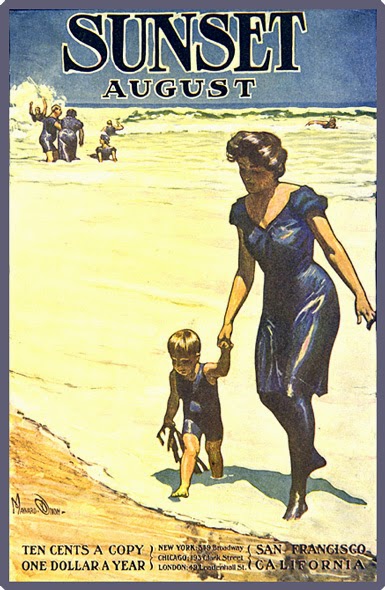
Maynard Dixon, Dorothea Lange & Camouflage

Maynard Dixon, Sunset magazine, cover illustration
Recently we were able to watch on Public Television a two-hour American Masters film about the life of American photographer Dorothea Lange (1895-1965). Like so many people, we are well-acquainted with Lange's documentary photographs, notably her Depression-era images for the Farm Security Administration (FSA). But somehow we hadn't remembered that her first husband (for fifteen years) was the Southwestern Modernist painter Maynard Dixon (1875-1946).

Born in Fresno CA, Dixon was descended from a prominent Confederate family from Virginia. He may have been related to the British surveyor Jeremiah Dixon, whose name is one half of the boundary that divides North from South, the so-called Mason-Dixon Line. It is also sometimes claimed that the nickname "Dixie" for the South was derived from the same family name. Whatever, Maynard Dixon is not typically linked with the South, but with the Southwest and West, especially New Mexico and California.

For the moment, we haven't found any evidence that Dixon was a camouflage artist. But we have found indications that some of his artist-friends were camoufleurs in San Francisco during World War I, and that in 1917 he was among the founding members of the American Camouflage Western Division in San Francisco. Although he apparently did not design camouflage, his awareness of the practice can be assumed by the fact that among his associates were Santa Fe-area artists William Penhallow Henderson (1877-1943) and (Swedish-born) Bror Jullius Olsson Nordfeldt (1878-1955), both of whom were ship camoufleurs in San Francisco. For more information on Maynard Dixon, see Donald J. Hagerty's The Life of Maynard Dixon (Smith Gibbs, 2010).

Cover of The Life of Maynard Dixon (2010)


The American Camouflage Western Division was a spin-off of the New York-based American Camouflage group (aka the New York Camouflage Corps), founded by Barry Faulkner and Sherry Fry. The purpose of the Western branch, whose designated founder was A. Sheldon Pennoyer, was the recruitment of "painters, sculptors, scene painters, house painters and all others interested in the application of protective coloration and devices for the deception of enemies and the rendering invisible of our own forces." That text excerpt appeared in the August 1917 issue of Western Architect and Engineer, in an article titled "San Francisco Architects and Artists as Camoufleurs" (p. 58), as did a roster of those who had by that time joined the Western camouflage unit, among them Maynard Dixon. Here's the list—

Chairman: Mr. Arthur Brown, architect. Assistant Chairman: Mr. Bruce Nelson, artist. Secretary: Mr. A. Sheldon Pennoyer, artist. Executive Members: Mr. John I. Walter, president, San Francisco Art Association; Mr. Edgar Walter, sculptor; Mr. E.S. Williams, scene painter Alcazar theatre; Mr. Ralph Nieblas, scene painter Columbia theatre; Mr. Warren C. Perry, instructor in architecture, University of California; Mr. Maynard Dixon, artist; Mr. Lee [Fritz] Randolph, director California School of Fine Arts.

In addition there is mention of experiments in ship camouflage, of which it is said "that the results obtained by the use of several colors in small squares, maplike patches, serpentine lines and similar methods have rendered our ships more invisible than those of any other navy treated in this manner."

In the January 18, 1919, issue of the El Palacio (Journal of the Museum of New Mexico), there is the following note about "Talk on Ship Camouflage"—

William Penhallow Henderson, the Santa Fe artist, who was a camoufleur on the Pacific Coast, one of the three in charge of the camouflage work in the western ship yards, gave an illustrated and instructive talk on Ship Camouflage on Museum Night, January 7. Besides blackboard drawings, a model of a camouflaged ship made by O.T. [sic] Nordfeldt, was used to illustrate the lecture.

Saturday, April 26, 2014

Camoufleurs Gerome Brush and Barry Faulkner

Gerome Brush (n.d.), Busts of Barry Faulkner
Above Two of three plaster busts (date unknown) of New Hampshire muralist (and co-founder of the New York Camouflage Corps) Barry Faulkner (1881-1966) by his friend the sculptor (and ship camouflage designer) Gerome Brush (1888-1954), the son of American painter George de Forest Brush. Recently, I was able to see the actual busts (which, as it turns out, are surprisingly large) when, on a visit to an Abbott H. Thayer and camouflage symposium, I had the fortune to spend some time with Allen Pierce, a descendant of the Brush family and the owner of these sculptures.

•••

Barry Faulkner (recalling his friendship with Gerome Brush) in his Sketches from an Artist's Life. Dublin NH: William Bauhan, 1973, p. 69—

Gerome was a Personality. His high spirits spread a feast for his friends, a feast of wit and good humor. His character had no ugly traits. He had no formal education, yet with wits as quick as those of a fox, from the talk of his father's distinguished friends he picked much information which he understood and remembered. His talents were versatile; he became a sculptor and painter, and in his last years he wrote several admirable essays on the lives of famous Italian women painters, expressed in an original and exciting form of poetic prose. Our friendship was easy and undemanding; after years of separation we were able to pick it up just where we had left off.

More about Brush and Faulkner

Friday, July 5, 2013

Camouflage Artist | Nishan G. Toor

Armenian-born American camoufleur Nishan G. Tooroonjian
In a recent post, we mentioned the return to San Francisco at the end of World War I of two dozen California artists who had served as US Army camoufleurs in France. Among those listed was an Armenian-born sculptor named Nishan G. Tooroonjian (1888-1966), who later changed his family name to Toor. 

Reproduced above is a photograph of him that appeared in a periodical called The New Armenia, Vol X No 3, March 1918 (at which time he was still in France). His drawing appears on the cover of that issue, and the photo caption reads: "N.G. Tooroonjian. Camoufleur, AEF in France. The cover design of The New Armenia was drawn by him." 

A substantial entry on his life was published in the 1942-43 edition of Who's Who in California, and there is a website that features about forty of his works, as well as some wonderful photos of him, self-described as a "disguised agitator."


additional sources

Wednesday, June 26, 2013

San Francisco Camouflage Artists

Chameleons, German book illustration (1897)
We've recently located a 1919 news article that describes the return to San Francisco from the war in France of twenty-five American camoufleurs, all but two of whom were from San Francisco. They arrived on the evening of February 12, and the news story (including three photographs) appeared on the front page of the San Francisco Chronicle the following day. The headline reads (in part): S.F. SOLDIER ARTISTS BACK FROM FRONT. Detachment of Camoufleurs From 20th Engineers Return to City. It mentions in particular Sergeant Frank W. Swain, who "was a well-known art student of San Francisco before he joined the camouflage section. He studied at the University of California School of Fine Arts, and later under [Frank] Duveneck, the great American artist of Cincinnati." Here is the article's list of the twenty-five men in the unit—

Lieutenants [Richard S.] Meryman and Jack [Gage] Stark [neither one from San Francisco]; Sergeant Nishan Tooroonjian, sculptor; Sergeant Jack L. Osthoff, artist; Sergeant Frank W. Swain, artist; Sergeant Louis De Wald, artist; Sergeant Marcus M. Meherin, Jr, artist; Sergeant Joseph Kopersky, designer; Sergeant Sam Macloud, painter; Stanley Long, painter; Sergeant Albert [Sheldon] Pennoyer, artist; Corporal Clifford Neil, artist; Sergeant William R. Moran, mechanic; Sergeant Frank Duncan, artist…

…All of the men wore on their left shoulder a yellow chameleon—nature's own camoufleur, and emblematic of the soldiers' work in colors to deceive and mislead.

Some of these names are familiar. The lieutenant in charge, Richard S[umner] Meryman, was a student of Abbott H. Thayer in Dublin NH, and had collaborated with Thayer and (his son) Gerald H. Thayer prior to 1909 in illustrating their influential book on Concealing Coloration in the Animal Kingdom (available online). 

In two earlier blog posts, we've also talked about A. Sheldon Pennoyer, who was one of the founders of the pre-war organization called the American Camouflage Western Division. There is mention of Pennoyer in an earlier column called "Artists and Their Work" by Anna Cora Winchell (San Francisco Chronicle, November 23, 1917), which reads as follows—

A greeting from artists and the camouflage corps comes from Camp Lewis, Washington, through A. Sheldon Pennoyer. It will be remembered that he was the dominating spirit, previous to being drafted, in organizing the camouflage in San Francisco.

••

 From R. Tripp Evans, Grant Wood: A Life. New York: Knopf, 2010—

During World War I, [Grant] Wood was stationed in Washington DC, where he worked for the American Expeditionary Force Camouflage Division…Given his penchant for self-effacement it is equally fitting, as [his sister] Nan records, that he kept a pet chameleon in his studio.

additional sources


Camouflage Artist | Edgar Walter

Edgar Walter, Beauty and the Beast (n.d.)
Above A sculpture titled Beauty and the Beast (n.d.) by San Francisco artist Edgar (Melville) Walter (1877-1938), who also played a prominent role in World War I ship camouflage, as noted in the brief news article below.

••

From "Sculptor Named Chief District Camoufleur" in San Francisco Chronicle, May 22, 1918, p. 6—

Edgar Walter, sculptor, has returned from a trip to New York, where he was called by the US Shipping Board. He has been appointed chief camoufleur for the Seventh District, which embraces California and a portion of Southern Oregon, and will direct the work of camouflage in the emergency fleet of the Shipping Board.

Monday, May 14, 2012

Camouflage Artist | Homer Saint-Gaudens


Above A portrait by Carlota Saint-Gaudens of her husband Lieutenant Homer Shiff Saint-Gaudens in his US Army uniform in 1917 when he was in charge of the camouflage corps. As published in International Studio (December 1919).

...

In the opening pages of Hannah Rose Shell's book about camouflage and surveillance, Hide and Seek: Camouflage, Photography, and the Media of Reconnaissance (Zone Books, 2012), she describes the resourcefulness of Homer Saint-Gaudens (1880-1958), who invented a way to make blanket-like camouflage coverings by shredding books and papers.

Recently I also found an online paper by Susan Platt, titled "Gambling, Fencing and Camouflage: Homer Saint-Gaudens and the Carnegie International 1922-1950." It was initially published in International Encounters (Carnegie Museum of Art) in 1996. Saint-Gaudens was the only child of Augustus Saint-Gaudens (the most famous sculptor of his time) and Augusta Homer Saint-Gaudens, also an artist, who was a distant cousin of Winslow Homer.

As Platt explains, the young Saint-Gaudens enjoyed gambling and fencing, and during World War I, he was the officer in charge of the American Camouflage Corps. Her thesis is not so much about Saint-Gaudens' camouflage service as about his presumed reliance on gambling, fencing and camouflaging skills in the decades while he was director of an annual competition called the Carnegie International Exhibition. In that capacity, she writes, he "would 'play the odds,' parry and thrust with the many different constituencies that he needed to satisfy, and disguise radical styles in the midst of bland examples in order to avoid attacks."

Homer Saint-Gaudens had earned his degree at Harvard, where his freshman roommate was future muralist Barry Faulkner (who soon dropped out to study art). Faulkner was a cousin of painter and naturalist Abbott H. Thayer, who was sometimes referred to in news articles as "the father of camouflage" because of his startling assertions about "concealing coloration" in animals. Faulkner had also studied with Saint-Gaudens' famous father, as had his friend, a sculptor named Sherry Edmundson Fry. Later, when Faulkner and Fry were living in New York, they formed a civilian camouflage group, called the New York Camouflage Society, for the purpose of preparing artists to serve as army camoufleurs. When the US actually entered the war, the two men were among the first to join a unit called the American Camouflage Corps. To their surprise, the person in charge of that unit was Homer Saint-Gaudens, who was fresh out of officer training.

It appears that other officers admired Saint-Gaudens, while the enlisted men despised him. According to Grenville Rickard, an architect and camoufleur who had graduated from Yale, and who served in France in WWI, "The 'Saint' [was] our generally accepted term for Lieutenant Saint-Gaudens…" but Faulkner (not an officer but an enlisted soldier in the same unit) recalls that Homer Saint-Gaudens was "intensely disliked by the men."

As Platt explains in detail, before and after WWI, Saint-Gaudens was employed in the theatre, as the stage manager for the widely-admired actress Maude Adams. In 1921, he was appointed Assistant Director of the Department of Fine arts at the Carnegie Institute in Pittsburgh, and then became the Director a year later.

It is of further interest that, in 1924, there was a new addition to the painting faculty at the Carnegie Institute. It was Everett Longley Warner, an artist who had been the head of a team of US Navy ship camoufleurs during WWI.

...

Below Roy R. Behrens, Angels Can Fly. Digital montage, print on paper (2011). Based partly on a photograph of a bronze sculpture by Augustus Saint-Gaudens (1891) for the Adams Memorial in Rock Creek Cemetery, Washington DC. The setting for the sculpture was designed by Stanford White. For detailed information, see Joyce K. Schiller, The Artistic Collaboration of Augustus Saint-Gaudens and Stanford White. PhD dissertation. (St Louis MO: Washington University, 1997).