Showing posts with label perspective. Show all posts

Wednesday, July 31, 2024

Edoardo Dotto / on camouflage & mimicry as duplicity

online link
Recently I became acquainted with the writings of a professor of architecture, named Edoardo Dotto, at the University of Catania in Italy. I am especially drawn to his articles because they are cross-disciplinary. While his essays may originate with architecture and drawing, he reaches out in deliberate ways to adjacent concerns, such as art and vision, pictorial representation, camouflage, humor, and so on. 

I am particularly interested in two of his conference papers, both of which can be accessed online in English. They are “Drawing Hands: The themes of representation in Steinberg and Escher’s Images” (2017); and “Lying to the eye: the mimicry between art and science” (2022), which pertains to art and camouflage

edoardo dotto 


Tuesday, November 1, 2022

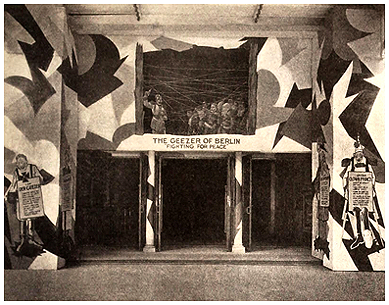
disruptive geezer theatre doors / wartime propaganda

Above This photograph was published in an American theatre magazine during World War I. It shows the decorated entrance of a Broadway theatre in which disruptive abstract patterns (not unlike the confusing dazzle camouflage being applied at the time to merchant ships) have been used to contradict the building's physical form. 

It was common at the time for "scenic artists" (theatre and film set designers) to be assigned to wartime camouflage. 

The treatment of this entrance was a way of promoting the screening of a 1918 short propaganda film titled The Geezer of Berlin, which was of course in reference to the German Kaiser, aka the Beast of Berlin, and the Clown Prince (in reference to his son). Disruptive patterns such as these not only cause visual confusion; they can also disturb the emotions, and, to some extent, designs like this anticipate the use of skewed perspective and shape deformation in avant-garde "expressionist" films, such as The Cabinet of Dr. Caligari. In a recent video, titled Ames and Anamorphosis, I have talked about the use of distorted perspective in that and other early films.

Sunday, October 16, 2022

Caligari, distorted film sets and WWI ship camouflage

Above
USS Nantahala
in dazzle camouflage scheme (1918).

•••

Herman George Scheffauer, “The Vivifying of Space” in The New Vision in German Arts. London: Ernest Benn, 1924—

[his description of The Cabinet of Dr. Caligari] Trees are resolved into conventionalized, constructed forms; foliage becomes a mass of light, dark and shaded crescents, rounds and silhouettes—brilliantly colored in the original scene. Floors and pavements are streaked, splashed and spotted, divided and decorated in bars, crosses, diagonals, serpentines and arrows. The walls become as banners or as transparencies, space fissued by age, or as slates upon which the lightning blazes strange hieroglyphs; or they become veils and vanish in a mosaic of scrambled forms and surfaces, like a liner in camouflage.

Gaunt chimneys rear and slant like masts in this city storm. Cunning lines of composition and the adroit use of diagonals drive the perspective into an invisible “vanishing point.”


For more on the Caligari film sets, forced perspective, and other early avant-garde cinema, see Part Three of my recently posted video trilogy on the Ames Demonstrations here.


Saturday, October 8, 2022

Part 03 has been posted / Ames and Anamorphosis

Unbelievable! At last I have completed it. Earlier this afternoon, I finished and posted on YouTube at <https://youtu.be/mxOEx2JLQBA> the third and final segment of a documentary trilogy on the life and work of Adelbert Ames II (known as Del Ames) (1880-1955), an American artist, lawyer, optical physiologist, and psychologist, best-known for having devised the Ames Demonstrations in Perception.

This part primarily focuses on Ames' influence on others, among them scientists, filmmakers, and artists, especially by his targeted use of anamorphosis (aka "forced perspective") in his well-known laboratory set-ups. It reveals the little-known links between Ames' experiments, Vorticism, and avant-garde filmmaking (Ballet Mécanique), as well as in popular culture, such as cinematic special effects and roadside tourist attractions.

In conclusion, it also provides a close-up look at the recent works of three contemporary visual artists, who, in one way or another, make astonishing use of perspective. They are Jan Beutener (Amsterdam), Richard Koenig (Kalamazoo MI), and Patrick Hughes (London).

All three parts of the trilogy (about 90 minutes in combined length) can be accessed online free at my YouTube channel at <https://www.youtube.com/channel/UCzYrUfsAvkZur5cBv6xlhSg>.  Of course, I am eager for others to see this. Do not hesitate to share it with anyone and everyone who might find it of value or interest.