Showing posts with label Rhode Island School of Design. Show all posts

Sunday, July 10, 2022

standing behind and above, painting faces on his head

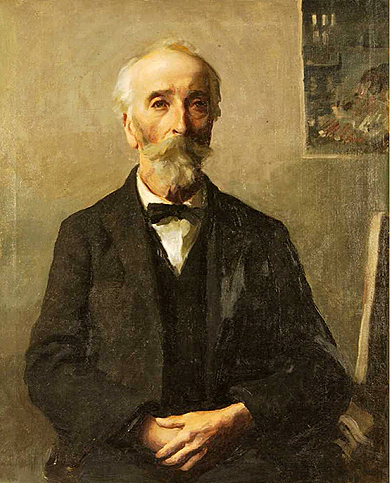
Painting by Frederick Rhodes Sisson (c1920-21)
There is a brief article in The Art Digest (February 15, 1943, p. 26) titled Sisson on Camouflage, which reads as follows—

Amherst College is to hear lectures on camouflage in the Plant Protection School. Frederick R. Sisson, instructor of drawing and painting at the Rhode Island School of Design, who has been conducting a course in camouflage there, to which students of Brown University are admitted, has been chosen for the task. Mr. Sisson acts also as critic of the Providence RI Journal.

We have mentioned Frederick Rhodes Sisson (1893-1962) in two earlier blog posts, here and here, in connection with his role as a studio assistant (one of three) to the well-known American painter Abbott Handerson Thayer. The other two assistants, in the last years of Thayer’s life, were Henry O’Connor, and David O. Reasoner, who would later become Thayer’s son in law, and who was a civilian ship camoufleur during WWI.

It is of particular interest to learn that Sisson lectured on camouflage at Amherst and RISD, since Thayer is regarded as a pioneering expert on protective coloration and natural camouflage, and is commonly referred to as the “father of camouflage.”

Sisson had two connections with RISD. Having grown up in Providence, he was a student at RISD prior to World War I, and then returned to teach there from 1924-1952. He was also an art critic for the Providence Journal from 1932-1950. When he retired in 1952, he moved to Falmouth MA, where he died ten years later.

RISD is at the center of this for another reason, as we have discussed in earlier posts. The Fleet Library at RISD is among the leading archival resources for the research of ship camouflage. One of the WWI American ship camoufleurs, who oversaw the painting of ships in the harbor, was an artist named Maurice L. Freedman. When the war ended in 1919, Freedman entered RISD as a student, and while there, he gave the art school his set of 450 color lithographic plans for American ship camouflage. It is a rare and remarkable resource. More information about it is here.

We also bring this up because, in recent years, there was an online notice about the sale of a painting attributed to Sisson (reproduced above), unsigned and undated, but stamped as part of his estate. It was labeled on the online post as a “3/4 portrait of Abbott Thayer in his later years.” I myself find it hard to believe that this is a portrait of Thayer. Sisson was presumably a capable painter. Indeed, among his responsibilities while working in Thayer’s studio was that of being able to make accurate copies of paintings that Thayer had started. This would then enable Thayer to complete his original painting, as well as apprentices’ copies, in differing ways, without spoiling the original effort.

Knowing that, one would expect a Sisson portrait of Thayer to be a convincing likeness of its aging sitter—which it is to a certain extent. What then is wrong with this picture? The most glaring problem is the hair. Thayer had begun to grow bald at a fairly early age. He had no hair on the top of his head, which prompted his children to refer to him as Shakespeare. Indeed, his bald pate was so hairless at top that his children amused themselves (and him) by standing behind and above him and painting faces on his head. So, one is led to wonder about the indentity of the sitter. The elderly man in the portrait has a receding hairline—that’s for certain—but he is far from bald on top and back.

Monday, July 13, 2020

Camoufleurs Maurice L. Freedman & Frank B. Masters

Launching of SS Everglades at Tampa FL, 1918 (AI digital color)
The United States entered World War I, on the side of the Allies, in 1917. The following year, American artist Maurice L. Freedman (1898-1983) served as a District Camoufleur for the United States Shipping Board, Emergency Fleet Corporation. He was assigned to Jacksonville FL, where it was his responsibility to oversee the application of camouflage to merchant ships. He was provided with colored lithographic plans of “dazzle camouflage” schemes that were designed by US Navy artists in Washington DC. When they did not exactly fit the ships, civilian artists at the docks (such as Freedman and his colleagues) made the required corrections.

Freedman was one of about two hundred civilian camouflage artists, who were assigned to seaside shipping ports on the east, south, and west coasts of the US. The extent of Freedman’s service was clarified about fifteen years ago, when Claudia Covert, a librarian and research scholar at Rhode Island School of Design (RISD), realized the significance of a collection of 450 colored lithographic plans of ship camouflage that had been in the school’s possession since 1919. As Covert researched this material, it soon became apparent that Freedman, at the end of the war, had enrolled as a student at RISD, where he studied drawing, painting, and design. While there, he donated his collection of the plans (only two other sets, complete or nearly so, are known to have survived, although scattered, stray components can be found in public and private collections), along with vintage photographs of the dazzled-painted ships.

To support her research, Covert was awarded a grant from RISD, which enabled her to visit the Imperial War Museum (IWM) in London, and the US National Archives and Records Administration (NARA) in Maryland, both of which have extensive holdings related to ship camouflage. As a result, she and others at RISD were able to embark on the arduous process of preserving the original lithographs, developing a lexicon of the different kinds of patterns, making archival digital scans, and arranging to share them publicly through publications, web-posting, exhibits, and symposia. As a way of supporting the project, some of the plans were reprinted at actual size, and sold online through RISD Works, the art school’s retail gift shop.

SS Everglades (1918), plan above, ship below


In 2008, Covert and librarian Ellen Petraits, working with other RISD staff and interns, documented their efforts in a presentation titled Dazzle Prints: Digitizing a Large Format Collection, which they then presented at a conference of The Art Libraries Association of North America (ARLIS/NA). Their report can be accessed online, as can other materials in the RISD Dazzle Print Collection.

Reproduced in that document are the plans for the camouflage pattern for an American merchant ship, named the SS Everglades, a 3,500-ton steel steamer. It had the distinction of being the first ship in which a camouflage pattern was applied while the ship was still being constructed, before the vessel had actually launched. As reported in several articles in the Tampa Tribune, the launching had originally been scheduled for July 4, 1918, but, because of complications, it was delayed until July 29. At 6:00 pm that day, it was officially launched at Oscar Daniels Shipyard in Tampa.

Maurice L. Freedman (who was headquartered in Jacksonville) may or may not have been present at the launching. His name does not appear in a lengthy news account as being among the attendees. But there is an explicit reference to the presence of one of his fellow artists, photographer and illustrator F(rank) B(ird) Masters, who is described in the article as having “completed his job Sunday.” The resulting “dazzle system” design, the article adds, is “one of the prettiest completed jobs imaginable.” It then speaks in some detail about the advantages of this approach to ship camouflage—

The “dazzle system” of camouflage, an adaptation from the latest English system, makes a much prettier looking boat. Instead of the hard straight lines with sharp angles that have characterized camouflage as used on vessels in the past, the new system comprises a series of graceful, curved lines and figures which deceive as to speed, size, and direction of progress, instead of attempting to hide the vessel. It Is said that as a cover or blending for the purpose of hiding the vessel, camouflage has been a failure but that it has proven its adaptability as a protective agency through deception. The new smooth and curving lines are said to be even more deceptive than the straight lines and hard angles. Certainly, on close-up observation the boat camouflaged under the new system is a much more pleasing sight to the eye, and as a success its value was apparent as one riding into town on Fifth Avenue looked down the estuary from near its head. Even at only this short distance away the vessel appeared considerably shorter as it was being towed to the river plant of the builders where a greater part of the machinery fitting and installation will be done.

Through the efforts of Covert at RISD, combined with other sources, there is additional information about Maurice L. Freedman. We know, for example, that, following his studies at RISD, he worked as an advertising artist in Providence RI, and, in the 1940s, designed Warfare: Naval Combat, an early iteration of a game since known as Battleship. In the 1950s, he was an assistant art director of Paramount Cards, the nation’s third-largest greeting card company, in Pawtucket RI. When he died at age 85, on December 4, 1983, he was living in Revere MA.

By comparison, there is considerably more information about Frank Bird Masters (1873-1955), who more often signed his work as F.B. Masters or Frank B. Masters. According to online postings, Masters was born in Watertown MA in 1873. He was initially drawn to science and engineering, with the result that he earned a BA degree from the Massachusetts Institute of Technology in 1895. He worked briefly for the B.F. Sturtevant Company (the country’s oldest fan manufacturer), and then taught high school industrial arts for several years in Boston.

Illustration by Frank B. Masters (1907)


Around the turn of the century, his interests appear to have shifted from science and technology to art. In 1900, he rejoined the Sturtevant Company, but this time as an advertising artist. He also worked as an illustrator for the Curtis Publishing Company in Philadelphia. After his work was represented in several art exhibitions, he subsequently studied art with the prominent illustrator Howard Pyle in Wilmington DE. At the same time, he experimented with photography (specifically cyanotypes), by which he made candid images of workers, backstreets, locomotives, and industrial sites. He made these not as “photographic art,” but as image references for his illustrations for books, magazines, and advertising. From 1905-1918, he maintained a studio in New York at 23 West 24th Street, near Madison Square Park (in the Flatiron District).

Illustration by Frank B. Masters (1907)


In 1918, Masters accepted employment as a civilian ship camoufleur in New York with the US Shipping Board. He subsequently worked on projects in Jacksonville FL, Tampa FL, Washington DC, Charleston SC, and Savannah GA. The war effectively ended with the Armistice on November 1, 1918, and soon after Masters returned to New York, where he resumed his profession as an advertising illustrator.

Advertising poster for Century Magazine by Frank B. Masters (1903)


•••

Above The two black-and-white illustrations by Frank B. Masters shown were originally published in the Washington Evening Star (Washington DC) on September 22, 1907.  

News articles about the launching of the SS Everglades were published in the Tampa Tribune on July 30, and August 4, 1918; and in the Tampa Bay Times on May 24, and August 1, 1918.

Thursday, May 2, 2019

Percyval Tudor-Hart | Canadian Camouflage Artist

Percyval Tudor-Hart (1934)
I first heard about the camouflage proposals of [Ernest] Percyval Tudor-Hart (1873-1954) years ago. Born and raised in Canada, he was a painter, teacher, and color theorist. Somewhat later, I saw photographs of a ship that he had camouflaged, a tank, and a pair of sniper’s gloves. In each, he had covered the surface with multi-colored, high-density zigzags. More recently, I saw the camouflaged gloves themselves in an exhibition sponsored by the Imperial War Museum (as shown below).

Tudor-Hart's camouflaged sniper's gloves

His proposal for WWI British ship camouflage (detail)
At one point, I ran across a reference to a Welsh medical doctor named Julian Tudor-Hart. The oddness of the family name prompted me to email him, asking if he were related to the Canadian camoufleur. As it turned out, it was his grandfather. I’ve since learned that Julian died only recently at age 91. I had intended to follow up with additional questions (he had offered to respond), but regrettably, I dropped the ball.

Cover of DVD package for Tracking Edith
Only a few weeks ago, I was fortunate to find a new documentary titled Tracking Edith. It is a film biography of Edith Tudor-Hart (1908-1973), an accomplished Modern-era photographer who studied at the Bauhaus in Dessau, worked as a Montessori kindergarten teacher, and recruited spies for the infamous Cambridge Marxist group that included Kim Philby, Anthony Blunt, and other intellectuals. Her story is at once fascinating and tragic, and the film is well worth watching (although I would not have included its unfortunate animations).

The father of medical doctor Julian Tudor-Hart was Alexander Tudor-Hart, who was the son of artist-camoufleur Percyval Tudor-Hart. Both of Julian’s parents were physicians, and after the couple’s marriage crashed, Julian’s father married Edith Tudor-Hart (née Suschitzky), who then became his stepmother. Julian, who seems to have been both kind and likable, is interviewed in the film.

I have since located what may be the only biography of Tudor-Hart the camoufleur. It’s a 250-page book by Alasdair Alpin MacGregor (who knew the artist), titled Percyval Tudor-Hart: Portrait of an Artist (London: MacMillan, 1961). Because I was searching primarily for information about his involvement in camouflage, the book was less than helpful. There is a short chapter on camouflage, describing the endless frustrations he faced when he submitted his proposals to the British government. “One department after another, having kept him on tenterhooks for varying periods, decided that his camouflage was impracticable and that further experiments were, therefore, inadvisable,” with the result, as MacGregory concludes, “one cannot but deplore that the time and energy he expended on all this had not gone into his painting.”

I think I first became aware of Tudor-Hart's connection with camouflage while reading Guy Hartcup's pivotal book, titled Camouflage: A History of Concealment and Deception in War  (New York: Charles Scribner's, 1980). Hartcup briefly mentions him in a section that reads in part as follows—

Another exponent of camouflage was P. Tudor-Hart, a painter who had made an intensive study of color values in Paris and had expounded his theories to a small coterie of artists in Hampstead before the war. Tudor-Hart was generally critical of current military camouflage and explained that when objects on land were concealed they tended to absorb rather than to reflect light. At sea, the opposite occurred. He proposed to paint a geometrical pattern of alternating stripes of warm and cold colors, graded according to the area they covered. At a distance these colors were supposed to mix optically, assuming a general gray tone. Tudor-Hart believed that because the colors were pure and arranged in a mathematical relationship they would "fluctuate with the increase or decrease in light."

Of related interest may be my recent essay on the camouflage proposals of American artist William Andrew Mackay, which also made use of the optical mixture of colors.

In the end, neither Tudor-Hart's paintings nor his camouflage proposals were likely his greatest achievements. He probably accomplished more as a mentor for younger artists (in Paris and London), a color theorist, and art restorer. His camouflage proposals came from his quasi-scientific view of color, and, more specifically, his beliefs about the ties between color and sound. In March 1918, at the apex of his interest in camouflage, some months before the war would end, he published a technical article in The Cambridge Magazine, titled “The Analogy of Sound and Color.” While obscure at the time (and even more so now) his theories influenced his students, one of whom, a decade earlier in Paris, was the American painter Stanton MacDonald-Wright. Together with Morgan Russell, MacDonald-Wright launched a style of painting based on color and abstraction called Synchromism.

Among Tudor-Hart’s other students were British artists Theodora Synge (cousin of Irish writer J.M. Synge), Donald Wood, W.T.H. Haughton, Margaret Beale, Richard and Sydney Carline, as well as their sister Hilda (who married Stanley Spencer). Among his American students were John Edward Thompson, George Carlock (Elbert Hubbard's nephew), and Richard H. Bassett. It was of particular interest to find that one of his favorite pupils was New Zealand-born painter Owen Merton, father of the admired American writer and Trappist monk, Thomas Merton.

Front right: Lieutenant Wilford S. Conrow, WWI camoufleur


As for camouflage, I was also pleased to find that another of his students was Wilford S. Conrow, an American portrait painter who served during WWI as a commissioned officer in the American army’s first camouflage corps, officially established on September 6, 1917, at Camp American University, near Washington DC. Lieutenant Conrow, according to a news article at the time, “helped to organize the company” and “is in charge of all the paints and materials used at the camp.”

According to MacGregor (who claims incorrectly that Conrow was “director of American Camouflage during the Second World War”), when Conrow was asked by a fellow student who to recommend as an expert on color, he replied, “What a stupid thing to ask!… Why not consult our own teacher—the Darwin of Color?”

As for biological roots, it seems that Tudor-Hart came from the intermingling of two families, the Tudors of Boston and the Harts of Montreal. The Tudors were the wealthy half, thanks largely to the fortune of Percyval Tudor-Hart’s grandfather, entrepreneur Frederic Tudor, more commonly known as the Ice King. He amassed that fortune by harvesting ice from New England (including Walden Pond), then shipping it to the American South and the tropics. A key enabler in this ambitious enterprise was Nathaniel Jarvis Wyeth, who harnessed horses to a plow-adapted blade to more efficiently cut the ice. It was interesting to learn that this Wyeth was an ancestor of the artist Andrew Wyeth.

The father of the Ice King was a wealthy Boston lawyer named William Tudor. During the American Revolution, he was the legal advisor for George Washington, and, in 1775, was appointed Judge Advocate for the Continental Army. His son the Ice King was his third son, but his first son, also named William Tudor, was equally interesting and certainly just as successful, but not in business nor in law. After graduating from Harvard, he became a leading Boston citizen and a prominent literary figure. He was a co-founder and the first editor of The North American Review.

One of the pleasures of research is to unearth unexpected links—so-called degrees of connection. In this case, it was fun to dig up two. First, for almost two decades, I was the art director for The North American Review, which had awakened from its dormancy in 1969, when it was revived at the University of Northern Iowa. Through the efforts of its editor then, Robley Wilson, it soon gained recognition as one of the top literary newsstand periodicals, and a persistent competitor with The New Yorker, Harper's, The Atlantic Monthly, and other famous, well-staffed and amply-funded magazines. By the time Wilson retired in 2000, it had won the National Magazine Award for Fiction twice and was a finalist for that award five times; placed stories in the annual O. Henry anthologies four times, in the Pushcart Prize annuals nine times, in Best American Short Stories eight times, in Best American Sports Writing and Best American Travel Writing.

The second connection is that, when I was in graduate school in the early 1970s at the Rhode Island School of Design, my finest teacher at the time was a literary scholar named C[harles] Fenno Hoffman. He didn’t use his given name, and I believe we called him Fenno. It was he who introduced us to Lytton Strachey's Eminent Victorians. He died in 1996, but over the years I concluded that he was descended from (and named after) a famous ancestor, Charles Fenno Hoffman, a prominent American writer. The link to Percyval Tudor-Hart is that the wife of the elder William Tudor (Washington’s legal advisor) was Euphemia Fenno, and together they started a line that branched out from the Fenno (Hoffman) bloodline.

•••

Postscript (added May 4, 2019): D. J. Enright, Interplay: A kind of Commonplace Book (Oxford University Press, 1995), p. 6—

One good thing about not going to a public school was that you didn't get recruited to spy for the Soviet Union. I was at Cambridge, but nobody approached me. Scholarship boys didn't have a guilty conscience (or not the right sort).

•••

New find: It would seem that we've located a photograph of Percyval Tudor-Hart (c1937) working in his studio. He is putting the finishing touches on a large-scale painted version of the Garden of Eden, with Adam and Eve. It was later translated into a magnificent tapestry. It includes a chimpanzee on the back of a zebra, a closer version of which is visible in the photograph of Tudor-Hart at the top of this blog post.


•••

Postscript (added May 6, 2019): This gets a tad confusing, but it may be worth the effort. Among Percyval Tudor-Hart's uncles was Frederic Tudor (1845-1902), who had an artist-daughter named Rosamond Tudor (1878-1949). She was the granddaughter of the Ice King.  In 1904, she married an aviation pioneer and naval architect named William Starling Burgess (1878-1947). He later worked with Buckminster Fuller on the Dymaxion Car. One of their children, née Starling Burgess, changed her name to Tasha Tudor and became well-known as a children's book author and illustrator. There is a brief item in the November 1918 issue of Flying (p. 908), which reads as follows—

Mrs. W. Starling Burgess, the wife of Lieutenant Commander Burgess, the noted aeronautic engineer, and naval constructor, has joined the Navy, having been given a civilian appointment to the Camouflage Section of the Navy—the first of its kind.

Mrs. Burgess is well known as "Rosamond Tudor." Her paintings have been exhibited under that name. She has just completed a portrait of Father Zahm, the famous explorer who was with Colonel Roosevelt in the latter's exploration trip in the interior of Brazil.

•••

RELATED LINKS    

Dazzle Camouflage: What is it and how did it work? /  Nature, Art, and Camouflage / Art, Women's Rights, and Camouflage /  Embedded Figures, Art, and Camouflage / Art, Gestalt, and Camouflage /  Optical science meets visual art /  Disruption versus dazzle / Chicanery and conspicuousness /  Under the big top at Sims' circus
Sunday, April 15, 2018

Ship Camouflage Website Revised and Updated

Introduction
We've embarked on a major revision, a complete overhaul, more or less, of our World War I ship camouflage research website. Above is a screen grab of a portion of the introduction or home page. At the top of that page is a black-and-white bar, each section of which links to one of five other pages: events (a timeline or chronology), the process of ship camouflage, the people or camoufleurs, ship camouflage plans, and a list of books, articles and media sources. Below are additional screen grabs of portions of those pages. In the coming days and weeks, more changes will be posted.

Chronology

Process

People

Plans

Sources


Monday, May 1, 2017

Dazzle Ships | Chris Barton and Victo Ngai 2017

Cover illustration | Victo Ngai 2017
Above The cover of a wonderful forthcoming book by award-winning children's book author Chris Barton, titled DAZZLE SHIPS: World War I and the Art of Confusion (Milbrook Press, 2017). The illustrator is Victo Ngai, about whom you can find out more at this Science Library Journal post.

The cover is phenomenal, as is the one full-color page spread I've seen (reproduced below). The illustrator is a graduate of the Rhode Island School of Design (my alma mater as well), where she studied illustration. As anyone knows who follows this blog, the RISD Fleet Library is also the location of a collection of the full-color lithographic dazzle ship camouflage plans from WWI (one of only three surviving sets).

Wish you had a copy now? That would be wonderful. Unfortunately, I'm jumping the gun because I couldn't wait to share the news. It won't actually be published until September, but you can pre-order it now.

Page spread from Chris Barton, DAZZLE SHIPS (2017)

Friday, May 6, 2016

Dazzle Camouflage Designs Applied Willy Nilly

John Goss book illustration (1919)
This is a full-page illustration from a rather curious book that came out the year that World War I ended. Written by Isabel Hornibrook and titled Camp Fire Girls in War and Peace (Lothrop, Lee and Shepard, 1919), it has an entire chapter about the efforts of a Camp Fire Girl named Sara, who (as shown here) decides to apply a dazzle design to a small boat. Throughout the chapter, there is some wonderful dialog on wartime camouflage and public attitudes toward it. The book's illustrator was John Goss (1887-1963), who headed the graphic arts department of the Rhode Island School of Design, and at one time shared a studio with typographer and book designer W.A. Dwiggins in Boston.

At about the same time, the application of dazzle-like camouflage patterns to rowboats was all but epidemic (see below), as were cartoon comparisons of dazzle with all sorts of commonplace phenomena.


Saturday, May 9, 2015

USS Sturgeon Bay in Camouflage at Green Bay WI

USS Sturgeon Bay in dazzle camouflage
What colors were used on World War I American camouflaged ships, and in what combination? It seems we can never be certain, since apparently no color photographs were made of them. Some hand-painted models exist. There are also several hundred color lithographic plans (including one full set at the Fleet Library at the Rhode Island School of Design), but they state that the colors shown on the plans are merely placeholders and may not be the actual colors applied. There are also dozens (probably more) of artists' on-site portrayals of dazzle-painted ships, c1918-1919.

Never before have we seen a hand-tinted photographic postcard of a dazzle-painted ship, of which there are two versions (above and below on this blogpost: NH 105922-A-KN and NH 105922-KN) on the website of the Naval History and Heritage Command. These are cropped and uncropped photographs of the USS Sturgeon Bay at Green Bay WI, two postcard versions of the same view, c. 1919 .

•••

Associated Press, SCHOOL FOR CAMOUFLAGE ARTISTS AT GREAT LAKES, Janesville Daily Gazette (Janesville WI), August 26, 1918, p. 1—

Great Lakes, Ill., Aug. 26—A school of camouflage artists is the newest feature of the art officer school of the Great Lakes naval training station. The instructor is Karl O. Amend,• formerly a theatrical scenic artist in New York. Courses in the school will take 12 weeks to complete and graduates are to be given opportunities for advance rating in the service.

USS Sturgeon Bay in dazzle camouflage


• From CAMOUPEDIA: A Compendium of Research on Art, Architecture and Camouflage (2009) and other sources: Karl (Otto) Amend (1885–January 2, 1944). Originally from Ohio, Amend was trained as a set designer. He designed stage sets for various Broadway plays, including Smile at Me, I Must Love Someone, and Vanities, and was founder and proprietor of Amend Scenic Studios. In 1982, an exhibition of his work, titled Behind the Scenes: The Theater Art of Karl Amend, was held at the New York Public Library.

more info

Thursday, October 24, 2013

Camouflage Sheet Music Covers

Sheet music illustration | Albert Barbelle (1919)
Thanks to camouflage scholar Claudia Covert at the Fleet Library at the Rhode Island School of Design, we are now aware of the work of an American illustrator named Albert (Wilfred) Barbelle (1887-1957). It was Claudia who alerted us to an illustration by Barbelle of a dazzle-painted World War I ship on the cover of the music for Down the Lane and Home Again (1919), reproduced above. In the 1930s, he drew the lead character for the first Walt Disney book about Mickey Mouse. Beyond that, we've since located a sheet music cover by Barbelle (for Baby's Prayer Will Soon Be Answered (c1919)) in which he again includes a dazzle-camouflaged ship (shown here).

Sheet music illustration | Albert Barbelle (1919)


Pertinent to ship camouflage (if not to Barbelle) we have also happened upon the sheet music for a Camouflage One Step (1917), for which the illustrator was Roger de Valerio (1886-1951), a prolific French designer who created more than 2,000 sheet music covers.

As you may recall, one of our earlier posts featured yet another example of camouflage-themed sheet music for Camouflage: A Soldier's Song (1918).

Sheet music illustration | Roger de Valerio (1917)

Thursday, October 11, 2012

Camouflage Poster | Megan Guldenpfennig


Above One of ninety posters designed by graphic design students at the University of Northern Iowa, to advertise an upcoming talk on WWI ship camouflage by RISD scholar Claudia Covert. This is one of three posters designed by Megan Guldenfennig. Copyright © 2012 by the designer. All rights reserved.

***

Anon, a poetic commentary on the reputed craziness of WWI dazzle ship camouflage, first published in The Independent. Vol 56 No 3645. October 12, 1918—

O blend of emerald wild and drunken amethyst,
O wild, hysteric nightmare of psychoanalyst,
O purple cow of Burgess, O blazing tiger of Blake,
O neo-impressionist lily, O super-Barnumcular fake,
What madman out of Potsdam, what loon from
    Blagovetschenskgeorgsrknlintvoff,
What Bolshevik or sideshow freak or Greenwich Village toff,
Told you that the way to hide was with vivid gobs of blue,
Cutting athwart green triangles and gray gridirons askew,
All done on a painted background of most unearthly hue,
Like a sunrise up at midnight dabbled with evening dew?