Showing posts with label Barry Faulkner. Show all posts

Monday, June 2, 2025

William Twigg Smith / New Zealand-born Camoufleur

In earlier blog posts we’ve talked about a New Zealand-born artist, named William Twigg-Smith (1882-1950) who was one of the first members of the American Camouflage Corps during World War I. Through online searches of vintage newspapers, it’s not difficult to find quite a few articles about him. Among the most thorough is a lengthy full page article by Mike Jay titled Twigg Smith Camoufleur: Camouflage Saved France from the Huns, which was published on page 1 of the Magazine Section of the Honolulu Star-Bulletin (July 12, 1919). An image of the article (not readable obviously) is reproduced above, and the article’s full text is as follows—

•••

Art for art's sake and camouflage for land's sake!

Camouflage saved the land of France, held the ground time and time again in the big German advances. Without it the gun positions would have been more readily detected by the enemy and progress of the Huns would have been more rapid and swift and perhaps might have fully succeeded. By the time the United States entered the war, France and the French troops knew full well the great life and land value of camouflage.

But to the American officers making their first appearance on the firing line "over there"—well!

"Suffering cats and blue blazes! We're here to fight, not hide! Whadda we want with that old stuff?"

That's the way they talked at the beginning. Then came the first mild shower of shells from an unknown and unseen source miles away and brought them around in double quick time with a request for all that "old stuff" such as wire, nets, burlap, screens, twigs and other material that goes to make up camouflage.

Later on, when these selfsame officers had endured it hot and heavy, their tendency was to swing too far into the other direction and to burrow into the ground for concealment of their guns with the camouflage section of the Fortieth Engineers, AEF.

Though born In Nelson, New Zealand, Smith was to all intents and purposes an American long before he secured his naturalization papers while in France on service for Uncle Sam. He was a student at art schools in San Francisco, Chicago and New York and had visited Honolulu eight or nine times before his start for France in 1917.

He landed on French soil on January 7, 1918, and was sent almost directly to the front. He remained at the front until within three days of the signing of the armistice, when he was ordered to an officers' training camp.

"Talk about trouble, I guess we had ours, all right," he remarks on the subject of camouflage for the American guns In France.

"After experimenting for many weary months with color schemes, different systems of coverings, various styles of screens and other stuff, the American camoufleurs finally decided upon a plan that worked to perfection. Not only could the gun position be hidden from ground observers but so well was the plan worked out that it was absolutely impossible to detect such a position even by photographs from the air.

"The French system of camouflage was on the burrow style with a little opening forward for the gun. The top was screened and carried twigs and other material to give it the appearance of the ground.

"That was fine so long as there was no aerial observation. But a photograph taken from an airplane immediately detected the shadows cast by the hump of the mound and the first thing that happened was a shell In the vicinity from a Hun gun."

After trying some 40 different styles, the American camouflage section decided upon a wire screening with strips of burlap hanging down. There were large open places in the top of this netting which made some of the officers think that it was not effective. But it certainly was. These strips cast a series of mottled shadows that photographed exactly like ground would under a tree and gave it such a natural appearance that it was impossible of detection. That was camouflage carried to the highest degree.

"The color scheme entered into this as well. The French had worked that out nicely. We practically used their systems of mottled colors for varied conditions. But the system of shadow casting was entirely our own.

"There was considerable difference in the systems of keeping up the camouflage work also. The English maintained 'dumps' all along their sectors and issued a catalogue of the various kinds of camouflage in store. When request for a certain kind was made a pamphlet of printed directions was sent up with the material of any point on the front. It was then up to the gunners themselves to put the camouflage in place.

"The French also maintained 'dumps' and their camouflage section would give word-of-mouth advice together with a lot of artistic terms as to the manner of placing it. They were strong on watching the color schemes. The artillerymen had to put up their own camouflage, however.

"The Americans on the other hand aimed to have men aways on the front. These men would issue from the 'dumps' and wherever possible herd a gang of trained workers with each division to attend to supervision of concealing a battery. Inspections were made daily to see that discipline was carried out. The camouflage section always had the last word In the matter. If it was negative to movements on dangerous grounds its word was followed. It it was agreeable then the rest of the authorities could thresh it out.

"The older officers, especially those who had served with the British and French troops before coming into the United States army, recognized the worth of camouflage without question and strictIy enforced the orders of the deception division. Just to give an idea, here's a case in point.

"In a position near Bois Chanot, in the vicinity of Beaumont, there was a light fall of snow one morning. The camouflage section immediately requested no movements in order to keep from making tracks to battery position. Orders were issued by the commanding officer of the battery to shoot anyone attempting to get off the paths wired out by the camouflage section.

"General Summeral of the 1st Division was a great crank on camouflage. He learned by bitter experience. He thought it 'all bunk' at first, but later issued orders that no camouflage be attempted without advice and direction of the camouflage section.

"One of the favorite tricks at the front was to use a position a great deal for a few nights and then move out, at the same time keeping up appearances of activity. A fire at times to make a lot of smoke. This would draw the fire and detract the enemy attention from a new position a few hundred yards to the right or left of the old.

"On the other hand some of the artillery officers seemed to think that anything sent out by the camouflage section was endowed with magic powers of concealment. Without any reference as to its fitness in the natural scheme they would drape the material over the ammunition guns in such a manner that if anything it made the position more conspicuous. And they would be well satisfied with the job until a camouflage section man came along to rave and tear his hair and straighten the thing out.

"The camouflage section was composed of artists, sculptors, house painters, marble workers, tile layers, bricklayers, builders, carpenters and if I remember right we even had a former parson one section. They were all trained at the school conducted back of the lines before, they went to the front to work. Some of them proved grand little camoufleurs, too.
"One stunt that was started by our section and taken up with avidity was that of laying temporary camouflage for guns on the march when making a short halt. The first thing gunners were ordered to do at a halt was to cut branches and arrange them over the field pieces. This saved many a gun from a sad fate. The gunners could always find room beneath the canopy of branches in times of stress."

Twigg Smith brought back with him from France a big collection of photographs of camouflage work, some of which are published today for the first time. These are unique pictures in that they show actual work done by the camoufleurs to protect guns, screen roads and conceal movement of either guns or troops.


•••

RELATED LINKS    

Dazzle Camouflage: What is it and how did it work? /  Nature, Art, and Camouflage / Art, Women's Rights, and Camouflage /  Embedded Figures, Art, and Camouflage / Art, Gestalt, and Camouflage /  Optical science meets visual art /  Disruption versus dazzle / Chicanery and conspicuousness /  Under the big top at Sims' circus

Tuesday, July 2, 2024

Herter's mural in Paris / American Camouflage Corps

Albert Herter mural at the Gare de Paris-Est
We’ve talked about the Herter family before. The family was descended from the well-known Herter Brothers (Gustave and Christian), who were leading designer-craftsmen in New York in the 19th century. The son of Christian Herter was Albert Herter (1871-1950), who was a prominent muralist. In turn, his sons were Everit Herter (1894-1918), a muralist who was among the first to join the American Camouflage Corps during World War I, and who died in action while serving in France. A second son was Christian Herter (1895-1966), who was a highly regarded US statesman and served as Secretary of State.

In an earlier post about the family, we only briefly focused on a huge mural (40 feet wide, 15 feet high) that Albert Herter painted after the war and gave to the French people. It was in part a tribute to the French soldiers (called poilus, French slang for soldiers) who had served in the war. Less obviously, it was as well a tribute to his son. Appropriately, the mural was initially hung in the departure hall of the historic Gare de Paris-Est in Paris, a major railway terminal, from which so many soldiers had departed for the battlefield.

Recently, I was pleased to find a lengthy paper about that famous mural. It was written by Mark Levitch, and is titled "En Souvenir: Albert Herter’s Le Depart des Poilus, Aout 1914 at Paris-Est." It was published in a volume of essays about WWI artworks, edited by Margaret Hutchison and Steven Trost, titled Portraits of Remembrance: Painting, Memory, and the First World War (University of Alabama Press, 2020).

Levitch’s paper is particularly informative because it is based on extensive research, far more complete and detailed than earlier accounts. For example, I had not known, or perhaps I had forgotten, that another American camoufleur, named John Dwight Bridge, had assisted Albert Herter in completing the mural. As we posted earlier, Bridge is himself of interest because both he and Everit Herter were associated with Barry Faulkner (a muralist and co-founder of the American Camouflage Corps), who was the cousin and student of Abbott H. Thayer, the so-called “father of camouflage.” In the years following the war, Bridge married the widow of Everit Herter, Caroline Keck Herter.

In the process of painting this huge railway terminal mural, Albert Herter chose to quietly include members of his own family in his depiction of various families bidding farewell to their soldier sons. To anyone who was unaware of Everit Herter’s wartime death, the mural might easily be interpeted as a generic portrayal (neither factual nor specific) of the sorrow of saying goodbye to one’s soldier son—whose departure may be final.

But things did not work out as smoothly as that. In the years after the war, there was some resentment among the French public about what they saw as the tendency of Americans to claim excessive credit for the war’s success. As a result, there were times when Herter’s mural was seen not primarily as an all-inclusive tribute to French infantry and others, but rather as a means by which the sacrifice of Everit Herter—and the Herter family’s efforts—could upstage the achievements of others.

This was especially reinforced by the mistaken but often repeated claim that an especially prominent soldier in the center of the painting represents Everit Herter. That figure can be clearly seen online, in a full view of the mural. He is elevated above the others, with arms outstretched, so it doesn’t take much to imagine him as an allusion to Christ on the cross. Hence, one can see how people might assume that this was a slightly veiled tribute to Everit Herter. In various essays over the years, other figures were also mistakingly said to be members of the Herter family.

There is no disagreement that Herter family members are included in the mural. But Levitch denies that the soldier with the outstretched arms is Everit Herter. Instead, the Herter family is quietly clustered on the right. In a detail of the mural (as shown below, along with a diagram of the same section), Albert Herter (the muralist and the father) is holding flowers and clutching his chest (1). His wife (2) stands behind him, and their martyred son, Everit Herter peers out quietly from inside the train (3). Their daughter-in-law (4), the widow of Everit Herter is facing Everit’s father, her hand to her face. And Everit’s fellow camouflage artist (who is soon to marry the widow), John Dwight Bridge (5), is bending down and comforting the sons of the father who had been killed in the war. I hope this is a reasonable explanation.

Levith’s essay is far more interesting, and more detailed, than the summary I have provided above. It makes for thoughtful reading.


Friday, May 19, 2023

Everett C. Hammond / WWI Boston-area camoufleur

Until a few days ago, I had never heard of a Boston-area artist named Everett C. Hammond, who served as a camoufleur during World War I. While described in newspapers at the time as a “portrait painter” and “well-known local artist,” his artistic expertise seems questionable if judged by the lackluster quality of the single drawing found so far. Reproduced above, it was made while he was serving as a US Army camoufleur in France, and was included as part of a letter to his sister in Boston (as described below in this post). At the time he made this drawing, he appears to have had little training in art—it is amateur at best.

•••

CORP HAMMOND TELLS OF CAMOUFLAGE WORK, in Boston Evening Globe, February 12, 1919, p. 9—

Corp. Everett C. Hammond, 1st Army Camouflage Service, a Cambridge man and well-known local artist, called at the local army headquarters today for final orders and to pay his respects to [Major] General [Clarence Ransom] Edwards [ranked last in his class at West Point in 1883].

Corp. Hammond went over seas with the 101st Engineers. He was a member of the old 1st Corps of Cadets when it changed to the engineer regiment. When he was overseas a short time, some one in authority learned that he was quite an artist, or rather “that he could paint” and he was shifted to the Camouflage School for further training in natural colors, etc. Then he was assigned to active duty on the fighting fronts, and went through every campaign. He, with others, would lay long stripes of burlap on the ground and paint them so that it would appear like grass or a natural science, when it was stretched over a battery of artillery that was hammering away at the enemy.

He was in every battle of the famed 26th Division [known as the Yankee Division, as commanded by General Edwards], although his official headquarters at all times was at Dijon. He declared that it quite an exploit, and certainly a dangerous and thrilling one, to first paint and then erect the disguises for the guns in the most active sectors.

He is the first of the camouflage men to report to the local offices, and his flaming yellow sleeve designation [a chameleon emblem], underneath a big blue A, excited curiosity.


•••

BOSTON ARTIST AS CAMOUFLEUR / E.C. Hammond Had Narrow Escape While Hiding Guns With Brush, in Boston Sunday Advertiser and American, March 1919, p. W-7—

More camouflage!

If the war has taught us anything, it has certainly acquainted us thoroughly with the art of camouflage. First it was used In concealing batteries, then to foil the U-boats, and finally came to peaceful pursuits, such as making certain things appear in a somewhat different light than might be otherwise construed—especially the truth.

Our story deals entirely with the first phase of the art—making raging, destructive batteries appear like harmless and aesthetic spots of nature. Something like the demon behind the man with the smiling face.

But now hear a real camouflage artist tell of bona fide camouflage. Listen to descriptions of this art in its original element, and incidentally a few other experiences of this expert camoufeur.

Boston Portrait Painter
By way of introduction, our artist is Corporal Everett C. Hammond. A Boston portrait painter. The war afforded him an opportunity to transfer his peaceful activity to a more fiery environment and he was quick to take advantage of it—enlisting two days after this country declared war. He has just returned to his home in Cambridge—with a thorough training in camouflage, but with an utter ignorance of "Camouflage."

His dally duties perfected him in the former art, but his schooling in the latter has been sadly neglected owing to the association with many clean, manly fellows, whose knowledge on that subject was meagre.

Hammond was among the first camoufleurs to be chosen by the government for this important work abroad. His highly developed training in done colors and natural features of landscapes qualified him for this branch of service with such men as [Homer] Saint-Gaudens, [F. Earl] Christy and [Barry] Faulkner, modern artists of wide popularity.

Was at Seicheprey
He was first with the 101st Engineers, with whom he served at the battle of Seicheprey [on April 20, 1918] and later with the 40th Engineers. Shortly before the battle of Seicheprey his company was engaged in constructing a camouflaged machine gun emplacement which they had half completed when the Boche shelling began. They were forced to abandon this work hurriedly, but not before two of their number had been killed and several wounded. After returning they found this position had been effectively shelled.

Hammond was later placed in charge of the camouflage work of the 130th Field Artillery, which used 75’s and 135mm guns. This unit was particularly active in the Toul sector between Gezencourt and Martincourt.

700 Women Helpers
About 700 French women were engaged during the war in making camouflage materials for the American government. This was done in Nancy and Dijon. Burlap was used principally and was prepared by a coloring process in which numerous natural colors were used. After being dried it was cut into uneven pieces and tied on chicken wire, having the appearance of the vibration and natural color of a grass field.

The colors were selected according to the particular environment, and when the structure was erected about a battery the blend served to conceal it from the enemy.

Each battery occupied an area about 100 feet long and 25 feet wide. This was entirely covered with camouflage raised to a height of twenty feet from the ground. It was done by means of posts surrounding the area at a distance of ten feet apart. These in turn were covered by the vast stretch of burlap colored according to the fields. At a distance this looked like a natural bank. The same was true from above and was indiscernible to the aviator's eye.

Camouflage While You Wait
The extensive operations were not carried on during a quick drive. In such case all guns carried forward their network consisting of burlap and fishnet. The latter was often covered with branches, leaves, etc. In quick drives a gun could be camouflaged in about thirty minutes. Along the established lines it required weeks and often months to construct the camouflage shelter.

The position of batteries were determined by the amount of natural protection, particularly near banks. They were often placed near brush, the effect of the shrubbery being carried out.

Hammond had several narrow escapes, among which was an incident when returning from the inspection of a camouflaged battery. Enemy guns wore searching out the territory, and as he crossed a barren field that section suddenly became the center of the foe's fire. He quickly sprang to a shell hole and was astonished when a dog, evidently a company mascot, came close to his heels. Both remained there until the guns ceased firing.

Another Narrow Escape
Later while he was discussing the camouflage of a certain battery with a comrade a large fragment of shell whizzed by his ear.


•••

SENDS PENCIL SKETCH OF CHAPLAIN EDWARDS, in Boston Post, April 21 1918, p. 12—

Miss Gladys E. Hammond of 241 Upham Road, Cambridge, received a letter yesterday from her brother, Everett C. Hammond of A Company, 101st Engineers, which contained a pencil sketch of Chaplain Edwards• addressing the men of the regiment before their departure for the front.

“My brother wrote,” said Miss Hammond, “that the engineers have been busy building miles of barbed wire entanglements, doing the work at night. He said that the work would keep the men busy for a long time. This letter was written March 12.”

The sketch shows Chaplain Edwards at the front of the colors, addressing the men. A line under the sketch, quoted as Chaplain Edwards’ words, reads: “I am going to commence the service this morning by reading a poem.”

•This appears to be an error, since I have yet to find any reference to a chaplain named Edwards in the Yankee Division, whereas the unit’s commander was Major General C.R. Edwards. Perhaps the two have been confused.

Friday, July 19, 2019

Camouflage Artist | John Dwight Bridge

Portrait of a Lady in a Red Dress by J. Dwight Bridge (n.d.)
J(ohn) Dwight Bridge was born on December 9, 1893, in St. Louis MO, where his family was socially prominent, wealthy and influential. His ancestors had been among the founders of Washington University. Having moved from Walpole MA to St. Louis, his family “made a fortune” from the railroad and the manufacture of cast-iron stoves.

Dwight attended a prestigious private school in Pawling NY. He then went on to study art at the Art Students League in New York, where he worked with painter, muralist and interior designer Albert Herter, whose father had co-founded the Herter Brothers interior design firm in New York, and whose son was Christian Herter, Secretary of State in the Eisenhower administration.

In 1917, having returned to St. Louis, Bridge announced his intention to “give up his career in art to enter the Episcopal ministry.” But when the US entered World War I, he decided instead to enlist as a camouflage artist. In September 1918, when the US Army formed its first camouflage unit, he was among the first to enlist, along with fellow artists Barry Faulkner (Abbott H. Thayer’s cousin), Sherry E. Fry, William Twigg-Smith from Hawaii, and Everit Herter (son of Albert Herter), who had only recently married.

Appointed Sergeant Major (and soon after First Lieutenant), Bridge was the highest-ranking non-commissioned officer of the group. He shared a tent with the unit’s leading commissioned officer, Lieutenant Homer Saint-Gaudens, the son of Augustus Saint-Gaudens, the celebrated American sculptor. After months of training at Camp American University in Washington DC, the camouflage unit (officially known as Company A of the 40th Engineers) departed for France at the end of December 1918. In the subsequent months at the front, two members of the unit died in action, including Everit Herter, who was killed at Chateau-Thierry. Following the war, Bridge lived in Paris, then resettled in New York.

In 1918, five weeks before her husband's death, Everit Herter's wife had given birth to a son named Everit Herter Jr., who never saw his father. Around 1920, Dwight Bridge relocated to Santa Barbara CA, where his former teacher Albert Herter had established a new permanent studio at his mother’s former estate, called El Mirasol. Bridge married Everit Herter’s widow, Caroline Keck Herter, and thus became the stepfather of Everit Herter Jr. In July 1919, the Herters’ second son, named Albert, died in Santa Barbara at the age of two years and ten months. In their early years of marriage, Dwight Bridge and Caroline Herter Bridge became parents of two of their own sons, Matthew and John Jr.


J. Dwight Bridge (c1933)

In the 1920s, Bridge’s marriage fell apart. After several years of estrangement, he and his wife obtained a divorce in 1933. At about the same time, Bridge’s father died in St Louis, and he was slated to receive an inheritance of about $100,000 (worth nearly two million dollars today). In newspaper interviews, he revealed that he would refuse to accept it, saying that “an inheritance is more of a hindrance than a help.” Instead, he gave the money to his former wife and their children, and announced that henceforth he would survive as what he called a “vagabond” or “hobo”  artist.

He decided to hitchhike somewhat aimlessly around the country (his travels would take him as far as Japan and China) all the time earning his living by painting portraits. Carrying few possessions and almost no money, he began his trek in Salina KS, “the geological center of the United States.” According to a 1933 newspaper story (of which there were many, since his story was rightly regarded as odd, even bizarre), having arrived at Salina at 9:30 in the evening, he “laid all his money—30 cents—and his half-filled package of cigarettes down on the station platform, buried his wedding ring and, although it was night, immediately began a search for employment. He was 40 years old.” He was allowed to sleep in jail that night, and, in the morning, began to hitchhike west, earning his meals and lodging by various means. He was, he explained to reporters, “a man from the East, without any funds, a painter who could whitewash fences and paint doors, portraits or murals.”

The news stories bore fruit. After trading pencil portraits of meals, he was soon receiving commissions for portrait painting. The first was for $200, but he gradually raised the price to $500. On his trip to Japan, where he had eight commissions, he stopped over in Hawaii to see his former fellow camoufleur, William Twigg-Smith, whose relatives owned the newspaper there. From Hawaii, he flew back to the US mainland, then resettled in New York, while also continuing to travel around, from city to city, painting portraits of the rich in Philadelphia, Pittsburgh, Dayton OH, San Francisco, Palm Beach, Colorado Springs, and elsewhere.

In a 1946 article in the Palm Beach Post, there is a pencil portrait of US Navy Captain Martin L. Marquette, who was then the commanding officer of the Naval Special Hospital (about to be closed) in Palm Beach. The drawing, the article explains, “is the work of J. Dwight Bridge, portrait artist and veteran of both World War I and II, to whom the closing of the hospital will signal a return to civilian life. During the past few months, while recuperating at the hospital, Mr. Bridge as part of his rehabilitation work has got his hand back in sketching by doing 90 portraits of the staff and patients at the hospital...During the war [WWII] he engaged in camouflage work in the AAF [Army Air Force] along similar lines he followed for the engineers in the previous war.”

Three years earlier, one of the Bridges’ sons, John Dwight Bridge Jr, (born 1920), had been killed in action while serving with the US Navy in the Mediterranean.

John Dwight Bridge Sr. died in Palm Beach FL on October 22, 1974.

•••

Sources

Evelyn Burke, “‘Hobo Artist’ Paints Society Folk But He Doesn’t Like Money” in Pittsburgh Press, May 2, 1935.

“Capt. M.L. Marquette” in Palm Beach Post (Palm Beach FL), February 3, 1946.

Helen Clanton, “Hitch-Hiking as a Form of Service” in St. Louis Globe Democrat, January 13, 1936.

“Noted Artist Says Fighting Elements Provides More Thrills Than Many Sports” in Dayton Daily News (Dayton OH), April 15, 1936.

“St. Louisan in Camouflage Unit of US Army Home” In St. Louis Post-Dispatch, February 15, 1919, p. 5.

“St. Louisan Who Paid Way Around World as Painter and Portrait He Made” in St. Louis Post-Dispatch, December 19, 1933.

•••

SEE ALSO

Nature, Art, and Camouflage (35 min. video talk)

Art, Women’s Rights, and Camouflage (29 min. video talk)

Embedded Figures, Art, and Camouflage (26 min. video talk)

Art, Gestalt, and Camouflage (28 min. video talk)

Wednesday, May 8, 2019

Frank Lloyd Wright Meets Camoufleur Barry Faulkner

Frank Lloyd Wright poster © Roy R. Behrens (2017)
Above Frank Lloyd Wright's City National Bank and Park Inn Hotel in Mason City Iowa. Poster by Roy R. Behrens (2017).

•••

In the Iowa City Press-Citizen (Iowa City IA), on April 21, 1932 (p. 8), there was an entry in Charles B. Driscoll's column "The World and All," in which he reported on a recent experience in New York with American architect Frank Lloyd Wright. Here's an excerpt—

Recently I attended a delightful party in honor of Frank Lloyd Wright at the studio of Barry Faulkner in East Seventy-Second Street. I found the guest of honor one of the most distinguished gentlemen I have met in moons.

Barry Faulkner's studio? Really. Those who know about the origins of the WWI American Army Camouflage will recognize that name. Faulkner, from New Hampshire, was Abbott H. Thayer's cousin. In collaboration with his friend, Iowa-born sculptor Sherry Edmundson Fry,  he co-founded the American Camouflage Corps, comprised of civilian artists and architects.

Driscoll continues—

To Mr. Wright, I ventured to put this question: "Why do your building designs so persistently emphasize the horizontal line?"

I had observed in pictures of the buildings designed by Wright the long roofline, the veranda or porch paralleling the roofline, and other efforts to squelch the vertical.

"Because," he replied, "the horizontal is the restful line, the line of repose and domesticity. It is what we need in this country."

"Then you must not think well of our New York architecture, with its emphasis on the vertical?" I asked.

"Is there architecture in New York?" replied the distinguished guest.

And I went hunting for another sandwich.

Friday, June 22, 2018

Teaching Camouflage | The Real Art of War 1917

Top photo shows painted mural concealing the road
In an earlier blog post, we shared drawings and photographs of the use of perspective Illusions as a means of concealing activity, such as the movement of troops and equipment. These were huge, painted canvas backdrops, probably inspired by the theatrical backdrops in stage settings. They are also not dissimilar from the enormous scenic murals that provided the outdoor backgrounds for Buffalo Bill's Wild West performances, including phony boulders made by simply draping canvas tarps. We've now run into yet another example of the use of forced perspective in World War I. The article, reproduced above, was an unsigned full-page article called TEACHING CAMOUFLAGE, THE REAL "ART" OF WAR, TO AMERICA'S SOLDIERS, published in the St Louis Dispatch (Sunday, July 22, 1917, pp. 9-10). The entire text of the article is reproduced below—

To the German observers this perspective looked just as it had the night before. In reality they were looking at a cleverly painted screen behind which heavy guns were being placed. Drawn from a photograph.

It is the painting cannon, depots, hangars, piles of ammunition, and other war materials to blend with the surrounding landscape and be invisible to aviators. Even a countryside has been transformed so that troops could move behind a screen unknown to the Germans. American painters already have formed an organization to volunteer for service.

CAMOUFLAGE—Humbugging disguise; its main principle is the destruction of outline by paint or other artifice. See Camoufle; Camoufleur.

Such is the made-to-order definition of one of the newest words in our language, put there by the necessities of war. It will not be found in any dictIonary as yet, but it will soon be there in its proper place, precise and up-to-date. The adaptive and imaginative Frenchman coined it; the Britishers were slow to take up this new art of concealing themselves and their equipment from the common enemy. In fact, so much so that their chief protagonist, H. G. Wells, goes after his compatriots in this fashion:

"The principle of breaking the outline does not seem to be fully grasped upon the British front. Much of the painting of guns and tents that one sees is a feeble and useless dabbing or strIping; some of the tents I saw were done in concentric bands of radiating stripes that would on the whole increase their visibility from above. In one place I saw a hangar painted a good gray-green, but surrounded and outlined by white tents. My impression—and it may be quite an unjust one—was that some of our British Colonels misunderstand and dislike camouflage.”

Be that as it may, America is for this now highly developed trick-of-war, brush, tube, palette and all. Two hundred of the foremost artists of New York and other cities have already responded to the call, and when our cannon roll out towards the front they will Iook like the grassy ground, from above; and our hangars and our camps and our depots for munitions and supplies will be peaceful bits of meadowland or forest, as viewed from the German aeros circling the blue; a tarpaulin covering a pile of big shells lyIng in a roadway will have the dust of the road and the green of its edges reproduced upon it—our army is for the camouflage, first, last and all the time!

Sherry E. Fry and Barry Faulkner, two New York artists who were the recipients of the American prize to Rome. were the prime movers in the American camouflage. They enlisted the aid of several others—Walter Hale, Edwin Blashfield, J. Alden Weir and men of similar distlnction and called a meeting. The American Academy of Design went in, and the Architectural League, followed by the Society of Illustrators and the Society of Scene Painters. Mr. Blashfield was made chairman and Mr. Fry secretary. Then Washington was notified, and an appreciative letter returned from the office of the Chief of Staff.

A battalion of four companies of the camouflage Is tentatively proposed for each field army of from four to six divisions. Each company will consist of a Captain of camouflage, with three or four Lieutenants, eight or 10 Sergeants, 15 to 20 Corporals and the remainder privates. Its members wlll be put on a strictly military basis as to pay and allowances. A committee of the War College Division is now studying camouflage with a view to making definite recommendations to the Secretary of War. In the meantime the New York volunteer artists have been asked to submit technical details as to material and functions.

Abbott Thayer of Dublin, N.H., was the fIrst person ever to take up the art of concealment when he began the study of the protective coloring of animals 25 years ago. He noted that such beasts as the zebra and okapi were parts of the landscape at a few yards distance and he evolved the prlnciple that the breaking or outline was the destruction of visibility.

Little was thought of camouflage at the onset of the present big conflict. There were white kid gloves—fatal targets for German snipers—and waving plumes; the burnished cuirass and the pennoned lance. Then the two contending lines dug themselves in and locked horns. Concealment became everything—concealment from the aero with the telescopic eye; from the artillery observation station, binocular-eyed; from the practiced glance of the sharpshooter and the keen vision of the patrols. French artists in the ranks busied themselves; a new branch of the art military was born—camouflage.

Today it is highly developed. There are two branches, invisibility and imitation. A supply train may look like a row of cottages; that is imitation. A screen tops a great gun so that the green of the screen blends with the grass of the meadow; that is invisibility. And there Is a third offshoot—the art of making compelling replicas of camps, guns, piles of supplies, trenches, ammunition depots and the like, which are not bonafide at all, but the aero man thinks they are and wastes his bombs and energy at attacking nothlng worthwhile.

Such is the great game of hocus-pocus. The French, grasping the idea of the zebra’s stripes and the leopard’s spots, paint their tents in map-like shapes of strong green and bright yellow. At short distances the objects so painter are completely swallowed up in the landscape. An airman will have to fly dangerously low to spy out the trick.

French women work zealously at camouflage—“a tip to American women now drilling in khaki, utterly useless,” says one officer of the American unit. They weave countless square yards of a special open green fabric out of rushes, which can be stretched between poles, or spread out on roofs of supply depots, or on sheds with extreme rapidity.

“We propose to makes ours,” says Mr. Fry, “of American chicken wire fencing or grillage. This will give us a substantial background in which to weave whatever green substance we need to blend with the particular landscape in hand.”

Some great feats of camouflage have been pulled off in the past few months by the clever French poilu-camoufleurs. It was necessary that a large force of troops be moved along a road swept by German artillery at the first sign of anything doing. In a snug place of concealment behind the lines the artists painted on a screen that entire stretch of exposed roadway, with its background, as if it were to be a scene on the stage. Then in the night it was mounted on piles on the side of the road towards the enemy, so that when day dawned the German saw nothing extraordinary—there was the familiar road, as of the day before, wholly barren of human movement. But behind the screen along that road thousands and thousands of French soldiers were quietly marching to take their new positions, a water cart rolling along every 100 yards between the companies to keep down the dust.

Another time the German positions commanded a railway track far into the distance behind the French lines. That whole track, signals, rails and ties, and the tress that fenced in the line and hills on the horizon, were all painted on a wide screen and set up in the night across a village street which was needed. The enemy never found out the trick.

It is no safe occupation, this camouflage. The camoufleur, to achieve the right perspective, must take flights over his objectives. He must set up his whimsies at the most exposed points. Aero and auto and motor cycle must be used by him to get about, nor can he carry weapons of offense while he works. With everyone else, he must take a sporting chance.

Already we see a little of the new art in New York. One army tug down the bay is painted a dull gray, with black horizontal wave lines all over it, hull, cabin, pilot house and all. Army motorcycles are painted olive drab, with maroon stripes. The official automobiles that whisk around the machine guns are similarly colored.


Monday, February 12, 2018

Camouflage Artist | Ivan Opffer

Homer St-Gaudens (c1918) by Ivan Opffer
Ivan Opffer was born in Nyborg, Denmark, on June 4, 1897, to a family of Danish scholars and journalists. His brother was Emil Opffer, a Danish merchant seaman and journalist who was known for his relationship with American writer Hart Crane.

Ivan was raised in Mexico City and New York, where his anarchist father was the editor of a radical Danish-language newspaper. His involvement in painting and drawing began at an early age. At a summer workshop, he met and studied drawing with Winslow Homer, then went on to study at the National Academy of Design and the Art Students League of New York.

When the US entered World War I, Opffer was one of the members of the American Army Camouflage Corps, headed by Homer Saint-Gaudens (whose mother was a relative of Winslow Homer), the son of Augustus Saint-Gaudens. As a camoufleur, Opffer served with other artists and architects, some of whom became well-known, including Barry Faulkner, Sherry Edmundson Fry, Kimon Nicolaides, Robert Lawson, Abraham Rattner, Kerr Eby and others. It was this same unit, while still in training in at Camp American University in Washington DC, that launched a camp newspaper called The Camoufleur. Only three issues were published before the unit’s deployment to France in late 1917. In the October 31 issue, a satirical portrait by Opffer of Homer Saint-Gaudens (titled “Our Boss”) was published on page 5 (as reproduced above).

After the war, Opffer returned to New York, where he became known for his caricatures of leading Modern writers, among them James Joyce, Edgar Lee Masters, Siegfried Sassoon, George Bernard Shaw, Carl Sandburg, G.K. Chesterton, and Thomas Mann.

In the years between the wars, Opffer married Betty à Beckett Chomley, and settled in Paris, where he was a student at the Academie Julian. He also lived in London and Copenhagen, where his drawings were frequently published in newspapers and magazines. With the outbreak of World War II, he and his family returned to New York and lived in Greenwich Village. Among his friends in that era were William Butler Yeats, F. Scott and Zelda Fitzgerald, Dylan Thomas and Ernest Hemingway. He and his wife Betty are said to be portrayed in Hemingway’s The Sun Also Rises.

When he retired in the 1960s, Opffer moved back to Copenhagen, where he died on March 3, 1980.

•••

This account is partly based on an online information page that was written by Ivan Opffer’s granddaughter, Yvonne Opffer Conybeare. Accessed on January 17, 2018 at <http://www.oocities.org/yconybeare/>.

A slightly different version of this biographical note has also been contributed to askART.com.

Sunday, February 11, 2018

Camouflage Artist | Frank H. Schwarz

Oregon Statehouse Rotunda (1938) Frank H. Schwarz
Frank Henry Schwarz was born in New York City on June 21, 1894, but his family moved to Chicago, where he eventually studied at the Chicago Art Institute. He survived by working as a bus boy in a restaurant, while his father returned to New York, where he worked as a waiter.

During World War I, Schwarz joined the American Army Camouflage Corps, where he served with other artists, among them Barry Faulkner, Sherry Edmundson Fry, and Robert Lawson. He remained with that unit in France, until, at the war’s end, he was stricken by pneumonia. While regaining his health, he settled in New York, where he set up a painting studio in Greenwich Village (as did several others from the same camouflage unit).

In the summer of 1921, Schwarz was featured in an article in The New York Times, titled PAINTER FACING EVICTION WHEN PAINTING WINS PRIX DE ROME. The article reported that, at age twenty-six and penniless, Schwarz had been only minutes away from being evicted from his NYC two-room studio when, to his surprise, a letter arrived telling him that he had won the Prix de Rome, among the most coveted prizes in art. In the weeks that followed, his success was featured nationwide in various newspapers. The painting for which he won the award was A Tribute to Heroism.

In 1926, he was awarded a Guggenheim Fellowship. Three years later, one of his works was acquired by the Brooklyn Museum.

Among his most enduring works are a number of murals, commissioned for architectural sites. He may have turned to murals as a result of his wartime connection to fellow camoufleur and muralist Barry Faulkner. In 1938, Schwarz and Faulkner were among the primary muralists for the Oregon State Capitol in Salem. It was Schwarz who painted two large murals for the building’s rotunda, the dome interior, and a mural in the Senate chamber. Later, Schwarz completed mural commissions for other buildings in the US and Canada.

He died on September 5, 1951, in Mount Vernon, New York.

•••

Faulkner, Barry, and Frank H. Schwarz. “Three Murals in the Capitol.” Oregon Historical Quarterly 41: 2 (June, 1940), 132-136.

Note  A slightly different version of this biographical note has also been contributed to askART.com.

Monday, June 5, 2017

Cornish Colony Camouflage | National Parks

Cornish Colony Camouflage
In an earlier blog post, we've talked at length about theatrical designer and arts administrator Homer Saint-Gaudens (1880-1958). The son of Augustus Saint-Gaudens (the most famous sculptor of his time) and a distant cousin of Winslow Homer, he was the officer in charge of US army camouflage during World War I. He grew up at his parents' home and studio near Cornish NH, sometimes called the Cornish Colony, which is now part of the National Park System.

As shown above, about two weeks ago, the website of the National Parks Conservation Association featured a blog post by Nicolas Brulliard on the connection to camouflage of the younger Saint-Gaudens, with reference to other Cornish Colony camoufleurs, among them the co-founders of the civilian American Camouflage Corps, sculptor Sherry Edmundson Fry, and muralist Barry Faulkner (who had been Homer Saint-Gaudens' roommate as a freshman at Harvard).

Below is a recent find from the Pictorial Section of the New York Times (Sunday, February 2, 1919). It's a photograph of Homer Saint-Gaudens at the time of his return to the US from Europe.


Homer Saint-Gaudens
For a related but different story about a link between camouflage and the US National Parks, go here for another earlier post.

Saturday, February 13, 2016

Camouflage Artist | Walter L. Tubesing

French camoufleurs armband insignia (not the US version)*
Walter L. Tubesing (1889-1949) was an American artist from St. Paul MN. He is of particular interest because he was among the artists who comprised the first American Army Camouflage Corps during World War I. He began his training (along with 250 others) at Camp American University (Washington DC) in September 1917. While in training there, he was listed as having contributed to issues of The Camoufleur, an illustrated camp newspaper that we've blogged about before.

Their training continued in the US for four months, and then the unit was reassigned to France (landing at Brest). Corporal Tubesing served as a camoufleur in France (Paris, Dijon, Nancy, Chateau Thierry and St. Michiel) for the rest of the war. At Dijon, he and other soldiers worked with French women in producing camouflage netting, and contributed to the camouflage of YMCA tents (see example below), where childcare was available for the French workers. He and his fellow camoufleurs even produced a circus-themed musical show for the French children.

Camouflaged YMCA tent in France, c1918. Public domain.


When his Tubesing’s unit returned to the US in February 1919, he was among those listed in an article in the society pages of the Washington Times (February 9, 1919, p11), which reported on the fundraising activities of the League of American Penwomen. Through the courtesy of the Fortieth Engineers, the article notes, members of “the Camouflage Section will make the posters and decorations” for the organization’s upcoming carnival ball. It also offers this aside—

Men of the camouflage corps are seen on the streets of Washington wearing funny looking yellow lizards on the left shoulder. The lizard is really a chameleon, a “critter” which changes color according to the background on which it is placed. The insignia therefore is significant of their work.

The following is a list of the camouflage artists who contributed to the carnival ball (including our many corrections): "Leslie Thrasher, H. K[err] Eby, A. Bloudheim, H[enry] R. Sutter, A. Rottnere [probably Abraham Rattner], G[eorge] B[radford] Ashworth, Fred[eric] S[eymour] [called Feg] Murray, Robert Laswent [maybe Robert Lawson], Joseph Cox, [Frederic] Earl Christie [Christy], Frank [Francis William] Swain, Don Methvin, Walter Tubesing, Howard [Ashman] Patterson and [William]Twigg Smith."

A month later, Tubesing’s work in camouflage was described at length in the Minneapolis Sunday Tribune (March 9, 1919), in an article titled CAMOUFLAGE IN WAR WORK; ARTISTS TOIL AS FOE SHELLS FLY. Corporal Walter Tubesing, Back From the Front; Shatters Several Illusions. Fish Net, Chicken Wire, Burlap and Canvas Important Tools of Workers. A photograph of the artist (not clear enough to publish here) appeared with the article.

The article states that “Mr. Tubesing lives at 714 Ashland Avenue, St. Paul, but is a member of the Attic Club in Minneapolis and has a studio here.” Through other sources, we learned that he was married to Lura Tubesing, and that, in 1940, they lived at 1854 Jefferson Avenue in St. Paul.

In the Brainerd Daily Dispatch (Brainerd MN), on April 4, 1949, page 4, there was news about his death. He died in St. Paul at age 60 on April 1, 1949, in the collision of a car driven by Alvin Hofstedt (age 35), a co-worker in St. Paul, and a Northwestern Railway passenger train, at a grade crossing near Tubesing’s home.

* Image is a detail from Hardy Blechman, DPM: Disruptive Pattern Material: An Encyclopedia of Camouflage (London: DPM, 2004), p. 274.

Saturday, November 21, 2015

Architects and Camouflage | Roy C. Jones

Architect and camoufleur Roy C. Jones
Above Portrait photograph of American architect Roy Childs Jones (1885-1963), who was for many years the head of the School of Architecture at the University of Minnesota. During World War I, he also served in the US Army's Camouflage Corps.

•••

In Aymar Embury II, "Architects and the Camouflage Service" in Architectural Forum 27 (November 1919), pp. 137-138, Jones is among those included in a list of architects who had served in the war as camouflage specialists. Embury, himself a prominent architect, was a captain in the Corps of Engineers, United States Reserves [in the list that follows, those in brackets were not per se on Embury's list]—

G.F. Axt, Charles F. Brunckhorst, Cromwell H. Case, Robert A. Clifford, Walter C. Clifford, David C. Comstock, G. Dexter, John H. Eastman, W[illiam] D. Foster, S.N. Hartell, Everit A. Herter, [Laurance Hitt], Burnham Hoyt, Clifford C. Jones, Roy C. Jones, Oliver Larson, Fred R. Lorenz, Alexander MacLean, [Wilmer] Bruce Rabenold, Thomas I. Raguere, Abraham Rattner, Greville Rickard, Reah de Bourg Robinson, [Louis C. Rosenberg], Prentice Sanger, Thomas E. Seyster, [J. André Smith], V.P. Spalding, [Evarts Tracy], Sheldon Viele, Louis F. Voorhees, Ralph T. Walker, Austin Whittlesey, James R. Wilson, and Van Horne D. Wolfe.

•••

According to other online sources, Roy C. Jones was born in Kendallville IN on June 22, 1885. He attended Purdue University, then earned a BS degree and a Masters in Architecture degree from the University of Pennsylvania. Prior to WWI, he worked at Holabird and Roche (Chicago) and McKim, Mead and White (New York). He also taught architecture at the University of Illinois and the University of Minnesota. It was during WWI that Jones served as an army camoufleur in France (not WWII, as was incorrectly claimed in a university senate obituary when he died).

After the war, Jones returned to the faculty of the University of Minnesota, where he was appointed head of the School of Architecture in 1937. He continued to practice architecture, and served as the university's advisor for building design from 1936 to 1950.

Friday, September 4, 2015

Camouflage Artist | Robert Lawson

Vintage pencil sharpener (c1938). P.D. Whitson Collection.
Above Vintage pencil sharpener by Walt Disney Enterprises, which produced an animated film of The Story of Ferdinand by Munro Leaf in 1938. Two years earlier, Robert Lawson had illustrated the original book version (New York: Viking 1936). P.D. Whitson Collection.

•••

The papers of American illustrator and US Army camouflage artist Robert Lawson (1892-1957) are in the University of Minnesota Children's Research Collections. Other materials (mostly illustrations, including Lawson's book mock-up for Ferdinand the Bull) are also housed in the Frederick R. Gardner Collection of Robert Lawson in the Rare Book Department of the Free Library of Philadelphia. Among the latter materials are a sketchbook and several letters that date from 1917 to 1918, at which time Lawson was stationed in France, as a US Army sergeant, assigned to camouflage.

For a detailed account of the service of Lawson and others in the American Camouflage Corps, see Barry Faulkner's Sketches from an Artist's Life (Dublin, New Hampshire: William Bauhan, 1973). While in France, the American camoufleurs produced amusing theatrical shows for the French children whose mothers were aiding the war effort by constructing camouflage nets. According to Faulkner, "It was his [Robbie Lawson's] sense of fantasy and humor which made our musical shows successful."

A news article about Lawson (with excerpts from an interview) was published in the Charleston Daily Mail (Charleston SC) on Sunday, November 30, 1930, on page 1 of the magazine section. Written by Rose Henderson and supplemented by Lawson's illustrations, the article was titled ROBERT LAWSON—MASTER OF FANTASY. The following are Lawson quotes, excerpted from the article—

In 1914 two great calamities occurred. The World War in Europe was one and my having to work and attempt to earn a living was the other. Europe's struggle is now more or less settled, but mine still continues.

From 1914 to 1917 I was a New Yorker and began to absorb things they hadn't taught in art school. My art activities were varied and pretty bad…

The French and English having by that time muddled the war all up, I joined the Camouflage Section of the Army which, as you are well aware, after a few years in France managed to get things straightened out. That being over, I really got to work, and have been doing illustrations and commercial drawings ever since, except for a period when my wife [née Marie Abrams] and I did nothing but Christmas cards.

Later in the article, the author (Rose Henderson) writes—

The Camouflage Section was composed of artists, architects, interior decorators, movie people, sailors, stage hands—loosely organized, quite comic and very efficient. He [Lawson] enjoyed long nights of talk with painters, sculptors, architects and musicians, in cafes, in dugouts, freight cars, tents or on the vine covered terraces of southern France. There were freedom and honesty in those conversations among artist soldiers far away from home and profession and conventional habits of thought and life.

Saturday, August 30, 2014

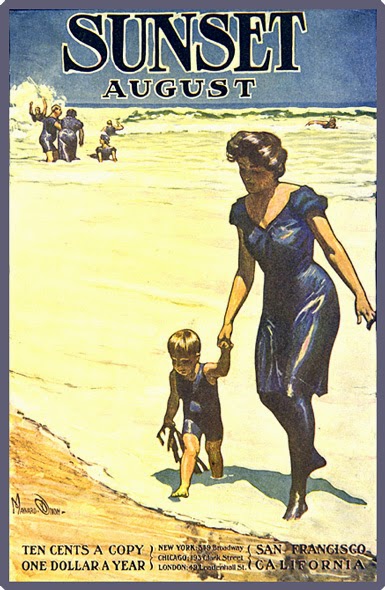
Maynard Dixon, Dorothea Lange & Camouflage

Maynard Dixon, Sunset magazine, cover illustration
Recently we were able to watch on Public Television a two-hour American Masters film about the life of American photographer Dorothea Lange (1895-1965). Like so many people, we are well-acquainted with Lange's documentary photographs, notably her Depression-era images for the Farm Security Administration (FSA). But somehow we hadn't remembered that her first husband (for fifteen years) was the Southwestern Modernist painter Maynard Dixon (1875-1946).

Born in Fresno CA, Dixon was descended from a prominent Confederate family from Virginia. He may have been related to the British surveyor Jeremiah Dixon, whose name is one half of the boundary that divides North from South, the so-called Mason-Dixon Line. It is also sometimes claimed that the nickname "Dixie" for the South was derived from the same family name. Whatever, Maynard Dixon is not typically linked with the South, but with the Southwest and West, especially New Mexico and California.

For the moment, we haven't found any evidence that Dixon was a camouflage artist. But we have found indications that some of his artist-friends were camoufleurs in San Francisco during World War I, and that in 1917 he was among the founding members of the American Camouflage Western Division in San Francisco. Although he apparently did not design camouflage, his awareness of the practice can be assumed by the fact that among his associates were Santa Fe-area artists William Penhallow Henderson (1877-1943) and (Swedish-born) Bror Jullius Olsson Nordfeldt (1878-1955), both of whom were ship camoufleurs in San Francisco. For more information on Maynard Dixon, see Donald J. Hagerty's The Life of Maynard Dixon (Smith Gibbs, 2010).

Cover of The Life of Maynard Dixon (2010)


The American Camouflage Western Division was a spin-off of the New York-based American Camouflage group (aka the New York Camouflage Corps), founded by Barry Faulkner and Sherry Fry. The purpose of the Western branch, whose designated founder was A. Sheldon Pennoyer, was the recruitment of "painters, sculptors, scene painters, house painters and all others interested in the application of protective coloration and devices for the deception of enemies and the rendering invisible of our own forces." That text excerpt appeared in the August 1917 issue of Western Architect and Engineer, in an article titled "San Francisco Architects and Artists as Camoufleurs" (p. 58), as did a roster of those who had by that time joined the Western camouflage unit, among them Maynard Dixon. Here's the list—

Chairman: Mr. Arthur Brown, architect. Assistant Chairman: Mr. Bruce Nelson, artist. Secretary: Mr. A. Sheldon Pennoyer, artist. Executive Members: Mr. John I. Walter, president, San Francisco Art Association; Mr. Edgar Walter, sculptor; Mr. E.S. Williams, scene painter Alcazar theatre; Mr. Ralph Nieblas, scene painter Columbia theatre; Mr. Warren C. Perry, instructor in architecture, University of California; Mr. Maynard Dixon, artist; Mr. Lee [Fritz] Randolph, director California School of Fine Arts.

In addition there is mention of experiments in ship camouflage, of which it is said "that the results obtained by the use of several colors in small squares, maplike patches, serpentine lines and similar methods have rendered our ships more invisible than those of any other navy treated in this manner."

In the January 18, 1919, issue of the El Palacio (Journal of the Museum of New Mexico), there is the following note about "Talk on Ship Camouflage"—

William Penhallow Henderson, the Santa Fe artist, who was a camoufleur on the Pacific Coast, one of the three in charge of the camouflage work in the western ship yards, gave an illustrated and instructive talk on Ship Camouflage on Museum Night, January 7. Besides blackboard drawings, a model of a camouflaged ship made by O.T. [sic] Nordfeldt, was used to illustrate the lecture.

Sunday, July 6, 2014

Countershading | Thayer's Disappearing Ducks

from MAS Context (Summer 2014)
We have featured earlier posts about American artist and naturalist Abbott H. Thayer’s use of wooden duck decoys to demonstrate countershading. Additional information continues to surface almost daily. Some of this is detailed in an essay in the Summer 2014 issue of a Chicago-based design and architecture magazine called MAS Context. Here’s the link to the free online version, with the title page above. Other discoveries are below.

•••

Barry Faulkner, Barry Faulkner: Sketches from an Artist’s Life. Dublin NH: William L. Bauhan, 1973, p. 18—

My first vivid memory of [his cousin] Abbott Thayer recalls him crouching in the dust of School Street, demonstrating to Mrs. Weeks, our teacher of drawing in the public schools, his newly evolved theory of Obliterative Gradation, or Protective Coloration—the foundations of his discovery of why birds and animals are difficult to see against their natural background.

The demonstration consisted of two small wooden ducks, mounted on wires, both painted the color of the dirt on which they stood, representing for the moment a natural background. One duck stood out solid and rotund, but the other Thayer had painted darker on its back and lighter on its belly until it had no more solidity than a cobweb. Suddenly a frightened cat bounded between Thayer’s legs, avoided the ungraded duck and dashed into and knocked over the duck it couldn’t see.  Cousin Abbott was as happy as a child at the cat’s vindication of his theory. Mrs. Weeks was entertained, if not enlightened.


•••


George Palmer Putnam, Wide Margins: A Publisher’s Autobiography. New York: Harcourt Brace and Company. 1942, p. 33—

We who were at Dublin [NH, where Abbott Thayer lived] were forever having first-hand lessons in protective coloring. Perhaps it would be dummies of birds set out in conspicuous places. Some were painted as in actual life, their upper parts dark, light below. Others had this reversed, with dark breasts and bottoms, and light backs. Those concocted in nature's way flattened amazingly against any routine background; the light below and the dark above, counteracting shadow and brilliance, made flat planes. These visual decoys we'd constantly trip over. But the others, where nature's process was reversed, stood out brutally in any environment.

•••


Mary Fuertes Boynton, ed., Louis Agassiz Fuertes: His Life Briiefly Told and His Correspondence. New York: Oxford University Press, 1956, p. 119—

[The Thayers’ book, Concealing Coloration in the Animal Kingdom] is weakened only by its tone…and by the ambiguity of some, and prominence of others, of the illustrations. For example, in the photographs of models used to display the effect of countershading, the shaded model disappears so completely that you cannot believe it was ever there in the first place; an altered or falsified picture would have been more persuasive.

•••


Fabian, “The Bushlover” in The Brisbane Courier (Queensland AU), October 9, 1926, p. 18—

An interesting experiment was made a short time ago at the British Museum of Natural History to demonstrate the great advantage of Nature’s commonest color arrangement among living creatures. Most of us have noticed that the great majority of animals are colored darker above and lighter below, and this is true, not only of nearly all our marsupials, but of most of the native birds as well. The rule holds good, too, in the case of fish, and, as more light comes from above than from below, the desired result is that the average fish in water becomes almost transparent and invisible. The British Museum experiment was carried out by Mr. [Abbott] Thayer, of America. He lined a large square box with gray flannel and placed in it two bird models, which were fastened to a rod running through the middle of the box. Both of these were covered with flannel, cut from the same material as that used to line the box, but one was painted dark above and white below, while the other was left in its plain gray. To the surprise of many observers the uncolored bird was decidedly the more conspicuous, and it was stated that at a few yards’ distance the painted bird, by counteracting the normal light and shade, was almost invisible. In Australia this color scheme for birds is a very common one. It is worth noting also that our really brilliant birds are almost always those of the dense shrubs, where protection is comparatively easy, while the birds of the plains and the open grassy spaces are far more protectively colored.

•••


Roger Pocock, “The Art of Concealment: Devices on Land and Sea” in The Mercury (Hobart, Tasmania) January 3, 1918, p. 6—

On the permanent staff of the Natural History Museum in London, there are two little wooden ducks…They are dressed in gray flannel, and each housed in a glass case with a gray flannel background. No. 1 duck is dressed in a plain gray flannel, and you can see her plainly at a hundred yards, because of the dark shadows cast by her neck and body, as well as by the brightness of her back. No. 2 duck is slightly whitened underneath to counteract the shadows, and slightly bronzed on top to counteract the light. Even at six feet the showcase appears to be empty. There is no sign of a duck. No hawk, no fox, no sportsman with a scatter gun and a small dog could possibly discover or kill the invisible duck unless she moved or made foolish quacks to guide her enemies. A great many years ago I wrote to Lords of the [British] Admiralty imploring them to go and see the invisible duck who could teach them priceless lessons in the art of concealing battleships and cruisers…

•••


James Devaney, “Nature Notes: An Experiment” in The Northern Miner (Charters Towers, Queensland AU), June 5, 1935, p. 4—

To illustrate just what it is which makes some birds hard to see, an interesting experiment was carried out by the American painter Abbott Thayer, who was also a keen Nature student. He wanted to prove how the darker back and lighter belly is a color scheme which tends to make birds less visible, so he made two wooden ducks as models. These he seated in a box on a perch, and both the interior of the box and the wooden ducks themselves were covered with brownish flannel. The ducks, exactly the same hue as their surroundings, were still plainly visible at a good distance. Then the experimenter [Abbott Thayer], who had an artist’s knowledge of color values, took his brushes and darkened the back of one and painted its under surface a whitish color. That particular duck then escaped notice at a little distance, and was absolutely invisible at about twelve feet, while the other one was very plain. Thayer carried out other experiments with imitation insects to show how Mother Nature gets her camouflage effects.