Showing posts sorted by relevance for query solomon j. solomon. Sort by date Show all posts

Monday, February 28, 2022

Solomon Solomon solemnized / two babies not one

Solomon J. Solomon, Self-Portrait
There were two British painters (unrelated) whose family name was Solomon. Both were well-known around the turn of the 19th century, but their reputations were distinct. Both were from Jewish families, and each faced challenges from the start.

The first, named Simeon Solomon (1840-1905) was associated with the Pre-Raphaelites. He was from a prominent family, and was an undoubtedly capable artist. But his life was ruined by a series of highly public scandals having to do with sexual licentiousness and alcoholism.

The second was Solomon J. Solomon (1860-1927), who was also an excellent painter, and one of the few Jewish artists to be elected to the Royal Academy. His personal reputation was beyond reproach, and indeed he became a hero of sorts during World War I when he was the first person to be placed in charge of British army camouflage. He was also the author of what may have been the first book on military camouflage, titled Strategic Camouflage.

Unfortunately, it was not uncommon for the public to confuse the two Solomons, so that “the good Solomon” was besmirched by being mistaken for “the bad Solomon.” There is a brief turnabout reference to this on page 103 of the autobiography of the Irish poet William Butler Yeats (The Autobiography of William Butler Yeats: Consisting of reveries over childhood and youth, the trembling of the veil, and dramatic personae. New York: Macmillan, 1953), in the following passage—

All [a certain group of artists] were pre-Raphaelite, and sometimes one might meet in the rooms of one or other a ragged figure, as of some fallen dynasty, Simeon Solomon the pre-Raphaelite painter, once the friend of [Dante Gabriel] Rossetti and of [Algernon Charles] Swinburne, but fresh now from some low public house. Condemned to a long term of imprisonment for a criminal offense, he had sunk into drunkenness and misery. Introduced one night, however, to some man who mistook him, in the dim candle light, for another Solomon, a successful academic painter and RA [Royal Academician], he started to his feet in a rage with, “Sir, do you dare to mistake me for that mountebank?”

Certain contributions made by Solomon J. Solomon in the development of military camouflage are explained in a new short video titled Nature, Art and Camouflage, free and accessible online here (see frame below).

Nature, Art and Camouflage (video)


Sunday, December 17, 2023

Diary of British camouflage artist Solomon J. Solomon

Solomon tank camouflage scheme
There is an article from the Boston Sunday Post, dated December 24, 1922 (p. B3), titled WAR ‘CAMOUFLAGE ARTIST’ COMPLETES PORTRAIT OF BRITISH ROYAL FAMILY. It tells the story of the delayed completion of a painting of  the Coronation Luncheon at Guildhall, an event that had taken place in 1911. Its culmination was put off by World War I. The artist assigned to complete it was Solomon J. Solomon, who is described in the article as “the most famous portrait painter in Europe today.”

When the war began, Solomon assumed that it would not greatly interfere with his artistic career, but it “interrupted him absolutely” because the government soon discovered [by way of his own prompting] that he was the one man in England familiar with the art of camouflage.” He was sent to France, to learn about that country’s section de camouflage, which was under the command of Lucien-Victor Guirand de Scevola. For a time, Solomon was the head of British Army camouflage, during which he oversaw the construction of imitation dead tree observation posts, advocated the use of overhead garnished nets (the shadows of which broke up the shapes of things below), aka "umbrella camouflage," and proposed designs for tank camouflage.

Solomon was the author of one of the first books on wartime deception, titled Strategic Camouflage (London: John Murray, 1920). Earlier, he had also published The Practice of Oil Painting and Drawing (London: Seeley, 1910).

Until recently, I had not realized that there is another book about him which contains extensive excerpts from his wartime diaries. That source is Olga Somech Phillips, Solomon J. Solomon: A Memoir of Peace and War (London: Herbert Joseph, 1933). Quoted below are a few passages (pertaining to camouflage mostly) from Solomon’s diary.

[p. 127] The French observation post trees were round; I made mine oval, so that that part of them facing the Germans should appear too small for a man to ascend; this was later adopted by the French.…

It was proposed in my report that I should need the assistance of three painters. I had made up my mind about these—two scene painters about whom I would consult Mr. Joseph Harker—and a theatrical property maker…

Harker had recommended to me Oliver Bernard—a small man, very deaf, who staged the operas at Covent Garden—a good organizer. He, on his return from New York, was on the Lusitania when she was torpedoed. He was rescued from the sea. He couldn’t swim a stroke and attributed his luck to a mascot he always wore, and which—in his opinion—would safeguard him throughout the war.

[p. 134] B—— spoke of his admiration for Giron[sic] de Scevola, the head of the French camouflage, who had, after much difficulty from the French Army people, to accept the idea of camouflage…

Scevola would only accept the rank of lieutenant, but stipulated that no one should be above him. He was—and is—a fashionable Parisian portrait painter, dressed very smartly, and invariably wore white kid gloves…

[p. 143] Who says the painter can’t organize? This seemed to be a military prejudice. When an artist is composing an imaginative picture his organizing faculties are at full stretch.

[p. 149] 11th March—…Major Alexander wanted some dummy heads—these dummies were made to attract fire, so that German snipers could be located—the line of fire would be indicated by putting a small stick through the back and front holes made by the sniper’s bullet.

Hitherto, adopting the French plan, we had mounted these heads on round sticks, and Major Alexander told me that often these would tend to turn in the hand, so that the exact direction was lost. In future I mounted the heads on square sticks fitted with a square sheath with cross feet; ths could be kept firmly in place. I had modeled several heads from our men who sat for them and I became quite a decent sculptor. The clay model was cast in plaster from which moulds were taken, and the pressing of successive sheets of paper saturated with flour paste into the moulds produced a sort of Guy Fawkes mask. We turned out quite large numbers of these papier mache “Tommies” which I colored from life.

…the Secretary of the French Camouflage Corps, asked me to model him, which I did, he wanted to send a paper mache reproduction of himself to his wife at Bordeaux. This added to our stock of types.


[p. 155] Wednesday, 22nd March—Giron[sic] de Scevola invited us all to dine with him at our little hotel at Wimereux, and an excellent meal it was for so small an inn. The Frenchmen sang and made witty speeches and kept it up till quite late. I was looking forward to returning the compliment when next de Scevola came our way, but that was not to be. We artists got on well with our French confreres.

Monday, June 4, 2012

Eric Kandel | Camouflage

The same engraving of a sphere (twice), but the right one is inverted.

As is increasingly being confirmed by current brain research, the Gestalt psychologists were right. They claimed that we as humans share certain perceptual inclinations that are hard-wired or innate—they "come in the box" with the rest of the brain. These are inborn universal traits, neither culture-laden nor unique.

Now that people think of "art" as all but exclusively having to do with individuality and self-expression, artists rarely talk about the traits that we inherently share, including these fundamental organizing tendencies. In contrast, graphic designers (whose temperament is in between artists and architects) use them constantly and, for the most part, are well aware of how they work. In fact, these same tendencies are the basis for all the age-old ploys in conjuring (sleight of hand and stage magic), pickpocketing—and, of course, in camouflage. Chief among them are similarity and proximity grouping, edge alignment, continuity, closure and so on.

Nobel Prize neuroscientist Eric Kandel talks about these tendencies (he calls them "bottom-up processing") in relation to current brain research in his amazingly wide-ranging book, The Age of Insight: The Quest to Understand the Unconscious in Art, Mind and Brain (NY: Random House, 2012). As he explains, when we look at objects or drawings of things, we come with the assumption that the source of light is overhead. As a result (as shown above), if two identical images of a shaded sphere are placed together, but one of them (the sphere on the right) has been vertically flipped, the other one (which is seemingly lit from above) looks spherical, expansive and solid. The one lit from the bottom looks deflated, less substantial and concave.

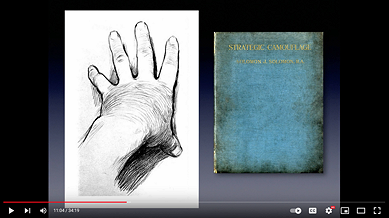
Solomon J. Solomon, Pencil drawing of a hand (c1910)


Artists and designers, even the earliest cave artists, seem always to have known this, the traditional technical name for which is shading. It is of great importance because it is such a reliable way to make flat drawings (which are merely marks on paper) appear to be three-dimensional shapes that bulge out in space toward the viewer. A particularly skillful example of this is a drawing of a hand (above) by British painter Solomon J. Solomon (1860-1927), from his book The Practice of Oil Painting and Drawing (London: Seeley, 1910).

Solomon was an uncle of the American playwright Moss Hart. Interestingly, he was also the person put in charge during World War I of the British Camouflage Section within the Royal Engineers (1916-18).

Solomon is often credited with the use of overhanging nets, garnished with burlap strips, so that anything beneath them will be visually broken up by irregular shadows—just as happens on the tennis court, when the shadows of the chain link fence disrupt the shape of the ball in the grass. It is also commonly said that he and his camouflage unit devised the first British steel-lined observation post, designed to look exactly like a dead tree on the battlefield.

Examples of countershading from Camoupedia (2009)

Years in advance of WWI, a prominent American artist, Abbott H. Thayer, revealed how inverted shading (commonly called countershading) contributes in a major way to  "protective coloration" (or animal camouflage). An avid naturalist as well as an artist, it was Thayer's belief that there is a functional reason why so many animals have "white undersides" (light-colored bellies, with darker coloring toward the top)—not unlike the coloring of the sphere on the right at the top of this page. As a result, countershaded animals look less dimensional, even flat. I have discussed this in detail, in print as well as online.

If an artist can apply shading to a shape on a flat surface, so that it looks three-dimensional, then the exact opposite can also be done:  Shading can be painted out and inverse shading painted in, so that a truly dimensional form looks flat and insubstantial. Here's how Thayer's son and collaborator, Gerald H. Thayer explained it:

If a rounded object, say a ball or cylinder…is to be made to disappear, it has, in the first place to be countershaded. That is, its shadowed parts must be lighter in color, must be painted lighter until the shadow no longer shows; and the portions facing toward the source of light must be just proportionately darkened. In this way, a rounded, solid form can be made to look perfectly flat.

The elder Thayer demonstrated this repeatedly. Sometimes he used artificial lighting and stuffed animals, such as the tiger he set up a Harvard University (as shown above, the third row down). Lighted from below (on the left), the animal is clearly visible, but it virtually disappears (on the right) when lighted from above. Thayer's more portable standard way of showing the effects of countershading was to "paint out" wooden duck decoys (or short of that, sweet potatoes). In the bottom photo, he claims that there are two decoys, but we only see one. The one on the left (clearly visible) is the color of the ground but has not been countershaded, while the one on the right (which I can't find) has been expertly countershaded.
...
• For more information, see this annotated bibliography on Art, Architecture and Modern Camouflage. See also public radio podcast on dazzle camouflage, and the trailer for an upcoming film on the same subject.

More info

Thursday, August 20, 2026

British Army Tank Camouflage / WWI Strategic Testing

Above
I recently ran across this book by Roger Pugh, titled THE MOST SECRET PLACE ON EARTH: The Story of the East Anglian Village of Elveden and the Birth of the World's First Tanks. Larks Press, 2014. It is an account of the village of Elveden during World War I, during which it secretly functioned as a development and testing site for the British Army's tanks.

I haven't yet seen the actual book, although copies are for sale online. I was initially pulled in by the image on the cover. In a further search, I found a website sponsored by St Edmundsbury, titled The Great War of 1914 to 1918 Picture Gallery of Bury St Edmunds and Surrounds. There is a caption on that site that provides more information about the image on the cover. It reads as follows:

The artist Solomon J Solomon was enlisted to design camouflage for the new weapons. He visited Elveden and also went to France to study the soil and vegetation there. In June 1916 Solomon began painting the first tanks in a mixture of pink, grey, green and brown blotches. This picture shows a modern attempt to reproduce this camouflage, which was soon replaced by a uniform khaki brown once in the field in France.

Those who follow this blog will most likely recognize the name of Solomon J. Solomon, who was the first commander of the British Army's camouflage section, and who wrote one of the earliest books (perhaps the first) on infantry camouflage, titled Strategic Camouflage. He is also featured in a free, online video talk I made several years ago (see link below).

Wednesday, February 18, 2026

so who invented camouflage / two more possibilities?

SS Lapland in camouflage 1918 (not related to text)
In an earlier post today, I made note of the credit that may be due to a British brewer, Joseph Williams Lovibond, for his early contributions to wartime camouflage. I had no sooner posted that when I ran across his name again, in a newspaper article (see text below) that dates from one year earlier and makes the same claim. However, it is even more interesting because it also claims that yet another man, a British bridge engineer named Reginald Arthur Ryves (1873-1949), made proposals for the camouflage of ships, guns and wagons as early as 1905.

•••

COLOR "COVER": Pioneers of Camouflage in The Telegraph. Brisbane, Queensland, Australia, on October 3, 1927—

Who Invented camouflage?

The recent death of Mr. Solomon J. Solomon, R.A., the famous artist, who was one of the pioneers of camouflage during the war, has made many people ask that question. For, though there was at first a tendency to describe him as the inventor of the art, It soon became obvious that there were other claimants to the honor.

As a matter of fact, It would seem that it was the Germans who first used this particular kind of deception during the war, although, thanks to the ingenuity of Mr. Solomon and his colleagues, we soon beat them at their own game.

It was, however, Britishers who first saw, before the outbreak of hostilities, that developments of this kind were necessary in modern war. As long ago as September 1905, a consulting engineer, Mr. Reginald Ryves, put forward an idea for the painting of ships to deceive an enemy, on practically the lines which were afterwards adopted. He added suggestions for the painting of guns and wagons.

Also some years before 1914 Mr. [Joseph Williams] Lovibond, a brewer, made experiments with painted screens for hiding gun positions. His system was demonstrated to the War Office, whose representative was much impressed by the success of the device. But nothing further was done, and it was only after the Germans had started it that we began to think seriously about the possibilities of camouflage.

It Is tragic when we think how many lives might have been saved had Mr. Lovibond's ideas—or Mr. Ryves's—been adopted earlier!

The real credit for the invention of camouflage must, however, be given to Nature. Look at the wonderful protective coloring of certain birds and insects—how they fit into the scenes which they commonly frequent. Or take the tiger. He looks conspicuous enough when we see him at the zoo, but in his native jungle he is practically invisible until the moment that it suits him to be otherwise.

But in one way at least we had begun to learn the lessons those animals had to teach even before we called upon Mr. Solomon to hide our guns from the enemy, or Mr. Norman Wilkinson to paint our ships so that no one could tell which way they were going. Our field service uniform of khaki was chosen because it blended naturally with the color of the surrounding country in many of the lands where our troops had had to operate.

Sunday, April 20, 2014

Camouflage Is Criminal

Laurel and Hardy in bungled prison escape
From Solomon J. Solomon, Strategic Camouflage. New York: E.P. Dutton, 1920—

When a man would commit a crime in a room overlooked from another the first thing he does is to pull down the blind; and, if he is using a light, he closes the shutters too.

War is a crime, and this war [WW1] was, and henceforth every other war will be overlooked, and the first the participants meed to do is to devise and prepare their blinds.

•••

From "Camouflage" in the Encyclopedia Britannica (1922), p. 543—

The processes of successful camouflage are closely analogous to those of successful crime—namely, preliminary reconnaissance, suppression of clues, provision of false clues, variety of method and concealment of the crime itself.

•••

From Anon, CONVICT PAINTS WAY INTO MILITARY SERVICE in The Brooklyn Daily Eagle (March 15, 1943), p. 9—

Richard R. Colyar, who knows how to make things invisible, painted himself out of San Quentin prison and into the army when army officers learned that the 52-year-old lifer had devised a new camouflage technique.

Colyar, a former commercial artist, was paroled to army authorities to explain and develop his process.

•••

From BOARD PAROLES SLAYER TO ARMY in The Modesto Bee and News-Herald (March 15, 1943), p. 3—

Richard R. Colyar, 52, former cartoonist and commercial artist, has been paroled to the army to explain and develop further a new camouflage technique, it was announced today.

Colyar, who was sentenced to life in prison in 1933 for killing his wife and sister-in-law in Los Angeles during a family quarrel, is the first California prisoner to be paroled directly to the army…

In prison Colyar continued painting. He did murals in the prison hospital and attracted wide attention. When the war started he developed a new type of military camouflage.

Army official learned of his work and investigated. His process had merit, the army said, and his parole was requested. Governor Earl Warren approved releasing Colyar to the army, and the board of pardons and paroles granted his release.

Colyar's whereabouts and details of his camouflage technique are secret.

More Info

Sunday, April 10, 2011

WWI Umbrella Camouflage

Disruptive shadows in a Spanish street festival (c1909)


For whatever reason, there was increased interest in the disruptive effects of shadows among photographers, painters and other artists near the close of the 19th century. This is especially evident in the paintings of certain European and American painters. See for example, John Singer Sargent's Breakfast on the Loggia or The Hermit. In some cases, no doubt it was inspired by patterns of disruption in the protective coloration of animals, as confirmed by demonstrations by Abbott H. Thayer and others. During World War I, comparable techniques were adopted for concealing from aerial observation personnel and equipment on the ground.

According to James E. Edmonds (in History of the Great War, Vol 1, London: Macmillan, 1932, pp. 83-84), “Concealment from the air was first attempted by the use of canvas sheets painted to represent the ground as seen from an airplane. Experience proved these to be heavy to erect and difficult to maintain in position. On the suggestion of Mr. [Solomon J.] Solomon, they were replaced by a lighter and more manageable article [called “umbrella camouflage” or "garnished nets"], in the form of old fish nets or wire netting, garnished with tufts of painted or dyed raffia (gardener’s bast). For the Somme thousands of rolls of wire netting were supplied to the divisional engineers who, when raffia was lacking, wove grass into it. In the course of time all batteries were equipped with these overhead covers. As the demand increased and the supply of raffia became inadequate, canvas strips were substituted for it, and were found to be less flammable.”

But apparently long before the war, there was a civilian tradition of doing more or less the same, as shown here by this photograph from a 1909 issue of The Strand Magazine (p. 719) of a Spanish street festival. Submitted by Edmund Pöhler of Barcelona, the article states: "This strange effect, produced by sunshine and shade, is a common scene in Spanish towns, where, once every year, about eight days are set apart as the Fiesta Major (Grand Holidays). During this period each district vies with its neighbor in adorning the streets. Dancing at night to the music of hired musicians, under the fantastic canopy overhead, illuminated by the many lights of every open window and door, invites one and all to participate in the gaiety and animation of the scene."

Tuesday, July 5, 2016

More Horse Carcasses & Phony Observation Trees

Steel-Lined Dead Tree Observation Post
Above During the trench warfare of World War I, both sides of the conflict "test drove" the idea of clandestinely replacing familiar large dead tree trunks with steel-lined replicas of the same trees. Equipped inside with a ladder and a telephone, these were used as observation posts. Given the skill and effort required to construct one of these, not to mention the challenge of putting it in place (at night, in total darkness), there can only have been a few of these.

As noted in an earlier post, British painter Solomon J. Solomon (initially in charge of the Camouflage Section of the Royal Engineers) is thought to have been responsible for erecting the first British observation tree in March 1916, a task that he later depicted in a well-known painting.

In this wartime photograph, we see a British soldier apparently inspecting a faux tree made by German camoufleurs. There are a few eyewitness accounts of how these were constructed, and at least one British observation tree has survived and is in the collection of the Imperial War Museum in London.

•••

E. Alexander Powell, Italy at War and the Allies in the West. [The War on All Fronts series. Vol IV] New York: Charles Scribner’s Sons, 1919.

At a certain very important point on the French front there long stood, in an exposed and commanding position, a large and solitary tree, or rather the trunk of a tree, for it had been shorn of its branches by shell fire. A landmark in that flat and devastated region, every detail of this gaunt sentinel had long since become familiar to the keen eyed observers in the German trenches, a few hundred yards away. Were a man to climb to its top—and live—he would be able to command a comprehensive view of the surrounding terrain. The German sharpshooters saw to it, however, that no one climbed it. But one day the resourceful French took the measurements of that tree and photographed it. These measurements and photographs were sent to Paris. A few weeks later there arrived at the French front by railway an imitation tree, made of steel, which was an exact duplicate in every respect, even to the splintered branches and the bark, of the original. Under cover of darkness the real tree was cut down and the fake tree erected in its place, so that, when daylight came, there was no change in the landscape to arouse the Germans' suspicions. The lone tree-trunk to which they had grown so accustomed still reared itself skyward. But the "tree" at which the Germans were now looking was of hollow steel, and concealed in its interior in a sort of conning tower, forty feet above the ground, a French observing officer, field glasses at his eyes and a telephone at his lips, was peering through a cleverly concealed peep-hole, spotting the bursts of the French shells and regulating the fire of the French batteries.

•••

Of course there were other kinds of battlefield observation posts as well, such as the supposed use of imitation horse carcasses as hiding places, as was featured earlier. My own suspicion is that few of these colorful camouflage ploys were actually used on the battlefield. But they proved immensely valuable as amusing illustrations for exaggerated news reports, which boosted recruiting and Liberty Loans. Below for example are photographs of the two sides of a roughed-out dead horse carcass trick, mocked-up in clay by camoufleurs at Camp Taylor KY (c1918).

Phony Horse Carcass Used as Observation Post

Thursday, September 15, 2016

Camouflage Through Purposeful Shadow Disruption

Paul Strand, Porch Shadows (1916)
Above Photograph by Paul Strand, titled Porch Shadows (1916)•. Courtesy Library of Congress. Public domain.

Strand was one of a number of photographers before and after World War I who relied on a well-known shadow effect that resembles the patterns of venetian blinds. Other examples are easily found, notably in the photographs of Max Dupain••, Harold Cazneaux, Alexander Rodchenko, and Laszlo Moholy Nagy.

As mentioned in an earlier post, disruptive shadow effects are also frequently found in paintings in the latter part of the 19th century, especially Impressionist. Among the most compelling is John Singer Sargent's masterful Breakfast in the Loggia (1910), which is reproduced below.

John Singer Sargent, Breakfast in the Loggia (1910)


In the early years of World War I, military camoufleurs began to apply disruptive patterns to vehicles and other equipment, to purposely break up their shapes. Soon after (probably as a consequence of a proposal by British painter and camouflage officer Solomon J. Solomon), it became evident that disruptive patterns can also result from the shadow effects of the overhead sun. Nets suspended overhead, garnished with scraps of fabric, could break up any components below, without applying any paint. We've talked about this earlier as umbrella camouflage.

Of course, this was nothing new. Today the same effect is seen on a tennis court, when the shadows of the chain link fence break up the shape of a lost ball in the grass. In an issue of the Illustrated London News (August 31, 1918, p. 233), this disruptive shadow effect was demonstrated in a photograph (shown below) of a group of soldiers inspecting a supply of ammunition, stored beneath a garnished net.


At the end of the war, non-military examples of shadow disruption were published in an issue of The Sketch (May 22, 1919, p. 209), with the headline: SUN PICTURES! LIGHT EFFECTS IN A FEZ BAZAAR: A Picturesque Network Effect of Light and Shade: Interesting French Photographs of a Covered Market at Fez. One example is shown below.


Finally, it is only fitting to conclude with one of the best-known photographs of shadow distruption (below) by the Russian Constructivist Alexander Rodchenko, titled Girl with a Leica (c1933).

• There is some disagreement about the proper orientation of Paul Strand's photograph. Should it be in vertical format, as shown here, or should it be horizontal instead, with the circular table in the upper right corner? It is most commonly reproduced as a vertical.
•• Australian art historian Ann Elias has written extensively on Max Dupain and the purposeful use of shadows in photography and camouflage.