Showing posts sorted by relevance for query puzzle picture. Sort by date Show all posts

Wednesday, November 23, 2022

vintage picture puzzle / harmless sleeping puppy dog

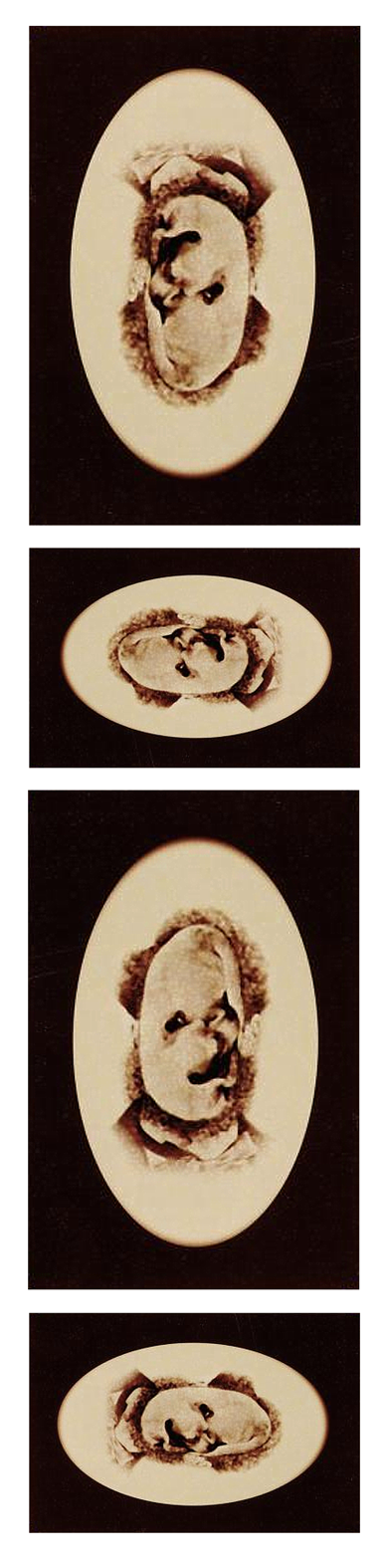
Reproduced above (the same image four times, but repositioned and resized) is a Victorian-era “puzzle picture” that was printed on an advertising card in Liverpool UK in the 1870s. The caption read “What is it?” 

Beginning at the top, the first two images are somewhat suggestive (not unlike an inkblot) but require some work to interpret. The third one is more likely to be seen as a human face, albeit greatly distorted. 

But the puzzle is solved at the bottom, when a closer look reveals that all four have resulted from a single photograph of a harmless sleeping puppy dog. For more on embedded figures and picture puzzles, see this brief video, articles on Clemens Gretter, Gobolinks, and camouflage.

Wednesday, November 24, 2010

Puzzle Picture

Above An embedded figure drawing or puzzle picture from a turn-of-the-century issue of The Strand Magazine (c1907). Finding the footman is a matter of shifting attention or emphasis, at which point his figure emerges from what had formerly been the (back)ground.

Monday, September 8, 2025

WWI anti-German propaganda cartoon puzzle pig

Above As in all wars, there was no limit to propaganda during World War I. Allies referred to Germans as Huns, Boche—and portrayed them as non-human savages. 

This is one example of an anti-German cartoon, a folding paper puzzle.  The top image shows the flat unfolded puzzle picture of what appears to be four pigs. Where is the fifth pig? it asks in French. And when the paper is folded, as shown in the lower half, the pigs have magically become a German officer and his helmet.

Saturday, January 17, 2026

who has been stealing my cigars—it surely is a puzzle

ARNOT ART GALLERY
, Star-Gazette (Elmira, New York), 17 Dec 1918, p. 4—

The Arnot Art Gallery will be open this evening from 7 to 9 o'clock and every afternoon during the remainder of this week from 2 to 5 o'clock. Two hundred and sixty-six visitors called at the gallery Sunday to see the color concealment or camouflage pictures. They are very interesting and some of them will puzzle you a little to find the hidden bird. The principles of camouflage are embodied in these pictures.…

Can you find the cigar thief in the Victorian-era puzzle picture above?

Saturday, June 5, 2010

Annie Dillard and Dali


Above An embedded figure drawing from a 1907 issue of The Strand Magazine. Compare that with this observation by Gestalt psychologist Wolfgang Köhler, from his Gestalt Psychology (NY: Liveright, 1947), pp. 92-93—

…sometimes we see from a distance a strange object which later, when we approach it, splits into a well-known thing and parts of other objects… The puzzle-pictures which years ago amused the readers of magazines were examples of this kind of thing. In modern wars it has become a real art to make objects such as guns, cars, boats, etc., disappear by painting upon these things irregular designs, the parts of which are likely to form units with parts of their environment.

Or this from Annie Dillard, Pilgrim at Tinker Creek (NY: Bantam 1975), p. 18—

Nature is like one of those line drawings of a tree that are puzzles for children. Can you find hidden in the leaves a duck, a house, a boy, a bucket, a zebra, and a boot?

This drawing shown here is reminiscent of a double-image painting by Salvador Dali (two nuns who suggest the shape of Robert Houdin's bust of Voltaire), who remembered his interest in puzzles in his article titled "Total Camouflage for Total War" in Esquire Vol 18 No 2 (August 1942), pp. 64-66, 129-130—

Every Saturday [as a child] I received a juvenile publication to which my father had subscribed for me. Its final page was always devoted to a puzzle picture. This would present, for instance, a forest and a hunter. In the tangled underbrush of the forest the artist had cleverly concealed a rabbit; the problem was to find it. Or, again, a doll must be discovered, lost by a child in an apparently empty room. My father would bring me the puzzle, and what was his astonishment to see me find, not one but two, three or four rabbits, not a single doll but several—and never the one which the artist had meant to conceal.

Wednesday, November 22, 2017

Concealing Coloration Through Figure Disruption

from Concealing Coloration in the Animal Kingdom (1909)
Above In a recent find of a brief newspaper article by Francis Rolt-Wheeler on natural camouflage (quoted below), we were reminded of a demonstration of background matching versus figure disruption in butterflies, using cut-out paper shapes, by Abbott H. Thayer and (his son) Gerald H. Thayer, from their early book about Concealing Coloration in the Animal Kingdom (1909). 

•••


Francis Rolt-Wheeler, CAMOUFLAGE IN THE WOODS in The Richmond Palladium (May 29, 1920), p. 14—

Of course you’ve read [Rudyard] Kipling’s Just So Stories. If you haven’t, get busy! And if you have, you’ll have read “How the Leopard Got His Spots.”

The point is that there’s a lot of good woodcraft in that story. All the woods folk fit into their backgrounds. Watch, and you’ll see!

Khaki has been found to be the color least visible at a distance, and how many of the woods folks are brown? If you don’t really look hard, of course, you won’t see. Why? Simply because though the creatures are there, you don’t see them. They’re camouflaged.

Good observers have said that it you go silently into any place in the deep woods, and keep perfectly still, by and by you’ll see one creature, and then another, until maybe half a dozen are right near you. You didn’t see them at all, at first, they seem to grow out of the woods like a puzzle picture. Sometimes even the most striking colors are the hardest to see.

Try it. Take a piece of gray-green paper and pin it on a butterfly cut out of paper, solid color. You see that butterfly a block away. Now take that same paper butterfly, scallop his wings, and give him big white spots and shades of blue. Near at hand he looks twice as conspicuous. Pin him on the paper. Twenty yards away you can’t see him at all.

Now try the trick yourself. A girl who wants to see the wild folk should put on a light green frock, a little hat with flowers and stay quite still in shrubbery that is not too dense. Don’t hide. If you fit into the background, you’ll be really concealed. And you might see a fawn stroll by, prettiest of all spring creatures in the woods.


•••

Tim Caro, Sami Merilaita and Martin Stevens, “The Colors of Animals: From Wallace to the Present Day. I. Cryptic Coloration” in Charles Hyde Smith and George Beccaloni, eds., Natural Selection and Beyond: The Intellectual Legacy of Alfred Russel Wallace. UK: Oxord University Press, 2010—

[The Thayers were among] the first to argue that camouflage consisted both of blending (background matching), and disruption (G. Thayer called it “ruptive”)—the latter being where the animal’s appearance is broken up by strongly contrasting patterns that mask the outline of the body. Similarly, disruptive patterns may disguise otherwise conspicuous or vulnerable parts such as the legs or eyes. In addition to disruptive coloration, [the] Thayer[s] also pioneered the related idea of “dazzle markings” (the term “dazzle” stemming from the American term “razzle dazzle,” to confuse).

•••

Francis Rolt-Wheeler, THE WONDER OF WAR AT SEA. Lothrop, Lee and Shepard, 1919, pp. 346-347—

“Do you suppose, Chief," asked the lad, as they were standing on deck, rejoicing in the capture of the submarine and looking at her checkerboard colored conning tower, "that this marine camouflage is really useful? Some of it looks so absurd?"…

[The Chief replies] "The ‘dazzle’ system o’ camouflage, which is British, is designed to puzzle the eye. At a mile and a half or two miles, ye can’t tell whether a ‘dazzled’ ship is comin’ or goin’. Ye can’t tell if she’s high out o’ the water, or low. Ye can’t tell, sometimes, if she has one, two, or three funnels. For a soobmarine, with a periscope maybe four to six feet out o’ the water, a ‘dazzled’ ship is like shootin’ at a ‘now ye see it an’ now ye don’t’ target. Soobmarines have been known to fire torpedoes as much as eight degrees out o’ line, when thinkin’ they were firin’ straight at a dazzled ship, even at close range. The human eye, after all, is no’ a pairfect mechanism.”


Exhibition at Dubuque Museum of Art

Friday, September 9, 2022

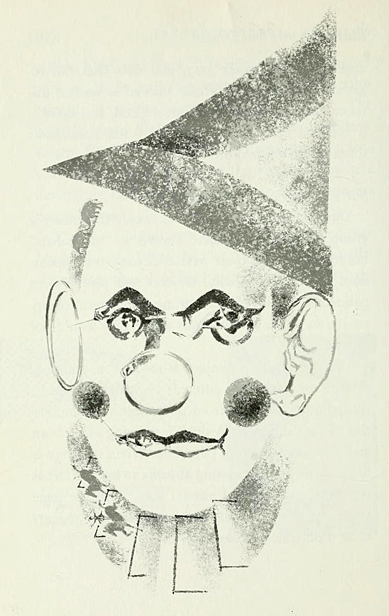
an upright clown but a circus when turned clockwise

Above Viewed upright, it is a portrait of a clown. Rotate one turn clockwise, and it becomes a circus scene. Ambiguity. Double image. Puzzle picture. Hidden figure. For more on embedded figures and camouflage, go here. Artist unknown, from Larry Kettelkamp, Tricks of Eye and Mind: The Story of Optical Illusions, 1974.

Sunday, May 5, 2019

Cave Canem | How To Camouflage Your Dog

How to camouflage your dog
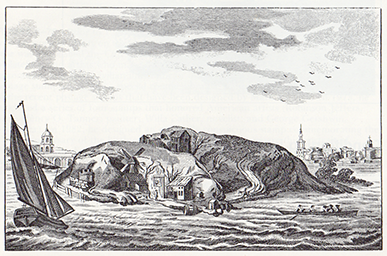
Artist unknown. Catchpenny print, 18th century "puzzle picture" titled The Isle of Dogs.

•••

Anon, THE MAGIC OF CAMOUFLAGE in Edmonton Journal (Edmonton, Alberta, Canada), September 19, 1918, p. 6—

An American artist has discovered a new use of camouflage. He has a favorite dog which his neighbors have been kicking out of their way whenever the animal chanced to stray there.

He had been admiring the great camouflaged battleships on the Hudson River and reading of eminent members of the British Royal Academy, garbed as colonels, directing painters on the Western Front how to camouflage a gun emplacement into a village school or a poultry run.

A happy idea struck him: he would camouflage his dog—all but the tip of his tail. So he has, with the result that the dog now looks like something else, and enjoys complete immunity from the attentions of his neighbors, for he moves about as a beautiful cloud effect.

Monday, December 29, 2025

can you find a camouflaged cat / an embedded figure

Above Can you find the camouflaged cat? A Victorian-era puzzle picture from The Strand Magazine.

•••

Roland Pertwee, "Camouflage" in The Strand Magazine, May 1917, p. 502—

For the benefit of those who may not be acquainted with what camouflage means, it might be truthfully described as a thin veil drawn over great events.

There are endless varieties of camouflage and endless uses to which it may be put. A great white road is concealed from the enemy lines by a hedge of thinly-plaited twigs—camouflage, An observation point hidden in the heart of a haystack—camouflage. A mighty gun masked by an awning of fishermen’s nets sprinkled with dead leaves—camouflage. A corpse brought in from No Man’s Land and replaced by a live man, who watches what is toward in the Hun trenches—again camouflage. But perhaps the subtlest variety of all is the kind that men and women devise to screen their real emotions from each other and the world.

Thursday, July 3, 2025

have lent a beauty and color to ocean-going vessels

John Everett
In years past, we have posted images of and articles about the World War I-era paintings of dazzle-camouflaged ships by British artist (Herbert Barnard) John Everett. Those earlier blog posts can be accessed online here. A number of his artworks were exhibited in New York in 1918, as is described in a lengthy article and interview in the Atlanta Constitution, the full text of which is quoted below. It was apparently written by Anne Morton Lane (London correspondent for the New York Mail and Express) and appeared in other newspapers as well. The paintings by Everett in this post are in the collection of the Royal Museums in Greenwich UK, and are not the same as those reproduced in earlier posts.

•••

"DAZZLE ARTIST" TO EXHIBIT HERE Outcome of Naval Camouflage, Work of English Painter, Is Unique in Its Interest and Beauty, in Atlanta Constitution (Atlanta GA), December 22, 1918—

London, December 9—Toward the middle of December there will be an exhibition in New York of pictures which have received the sanction of the British government to be shown outside Great Britain. They are the work of John Everett, a highly interesting and distinguished English artist, who has made a specialty of seascapes, and pictures of ships on the high seas, and at rest in docks.

Early in the war when the use of camouflage as applied to shipping became a special and practical portion of defense at sea, as the camouflage of guns, airplanes, munition sheds and other machinery of battles became a component part of war on land, Mr. Everett saw the wonderful possibilities that might accrue from a record of the commerce afloat as a pictorial history in color. As we all know, now that hostilities have ceased, the mystery that surrounded all ports and shipping in the allied countries was as necessary as it was dense. Therefore it was only after many weary months that Mr. Everett through personal persuasion, practical influence and genuine hard work was accorded the privilege by his majesty's government of visiting the great docks of London and Liverpool in order that he might make pictures of the amazing transformations wrought by paint and scientific knowledge upon the units of the fleet.


John Everett


John Everett

Submarines at Rest
And now that the U-boats have ceased from troubling and the submarines are at rest within British waters. by permission of his majesty's government Mr. Everett will shortly be able to display the fruit of his two or three years' work in dockyards, at exhibitions to be held in London and New York.

I went to see Mr. Everett the other day in his interesting and remarkable studio, which is situated off the beaten track of general traffic in a sort of side-tracked field in St. John's Wood—a well-known artists' quarter of suburban London. This studio of Mr. Everett's is a converted barn of great size and with unusual lighting qualifications. Its walls are lined, and a large portion of its floor space filled with pictures of ships. All these ships display camouflage designs, and they represent many vessels that have plied their way between England and America in war-time, and survived the lurking dangers of enemy attacks. Others have succumbed to the perils of U-boats. These pictures form a remarkable record that must be of extreme interest not only to those people who have crossed the Atlantic in war-time, but also to many thousands who have heard of the strange masquerading of ships on the high seas.

In England the painting and designing of sea-going vessels has been carried on under the direction of a department known colloquially as the "dazzle office," and Mr. Everett was appointed as its illustrator.

Curtain Is Lifted
Now that the curtain is being lifted from some of the amazing secrets of the admiralty and war office. Mr. Everett has many interesting things to relate concerning the art of "dazzle-painting" at sea, and the possibility of its continuation after the war.

"Although the word camouflage is an excellent one that has been adopted by the Anglo-Saxon tongue since its uses in war-time have been discovered," said Mr. Everett, "I think that the descriptive 'dazzle-ships' is a more descriptive title when applied to the use of this art at sea. And after all, it is not a very new idea, because we are told that the ancient Greeks painted their ships with big eyes and cheeks upon their bows to give them a terrifying expression of wisdom that might serve to confound their enemies. But we moderns did better than this in war-time; we had our ships painted in ways such that their strange colorings and curious stripings and curves would puzzle the enemy and serve to give rise to uncertainty by dazzling the eyes of the watchful foe. In fact, as I very early discovered in my work as official artist to the dazzle department, the object of ship painting in war-time has really very little to do with the real meaning of the French word camouflage, which means the dissimulation of natural objects with the landscape by protective coloring. Dazzle-painting was invented by the well-known sea painter, Lieutenant Commander Norman WIlkinson, RNVR, and it is the only system which has practically solved the problem of the variation of light, and which attains its object not by eluding the submarine by invisibility, but by confusing its observers.

Limitations of Paint
By recognizing the limitations of paint, the art of dazzle as applied to ocean-going ships pushes these limitations as far as possible, and makes the object of its being not invisibility, but distortion; it makes the problem of calculating the course of vessel extremely difficult.

"Each design, as you will notice in the many pictures I have painted of ships, is entirely different from the other entirely different from the other. No two dazzle-ships are alike in detail, either in color or design; the success of Commander Wilkinson's inventions were so marked during all the weary war-time months that they were adopted by every entente nation with a marine service. I think that this is one of the reasons why my pictures when they are seen in New York will be of extreme interest Americans. They will then be able to see exactly the source from which came all those wonder ships that braved the perils of the sea during the past four years. I have shown my portraits of these masquerading voyagers in English waters, and British docks—settings that perhaps will be better appreciated nowadays in the new world, because it is so closely linked in these days with the old."

Among the pictures which will be seen in New York next month by permission of the British government are "HMS Victorian Bringing a Convoy of American Troops Into London." Mr. Everett told me that this ship was afterwards torpedoed. She was hit amidships, but by some miracle she was brought into port and no lives were lost. Another picture is of the steamship Shuma discharging timber.

Dazzled Flour Ship
"This," explained Mr. Everett, "in a ship with an interesting dazzle showing a great deal of light sky blue picked out with black and white." Another picture shows a dazzled flour ship, and another the conversion of the Cunard steamship Nanerig into an armored cruiser. These and many other pictures of a like kind display with extraordinary clearness something of the practical side of what those who have "gone down to the sea in ships" have had to do in order to confound the enemy.

There is something very dramatic about these pictures of Mr. Everett's. They give the story of the life of the sea, and the traffic across that great grim stretch of water between England and America with wonderful vividness. The artist confesses that these pictures, painted under circumstances both difficult and dangerous, are the most fascinating work he has ever undertaken.

"The painting of these pictures, which I regard as a sort of diary of the merchant service at sea during war-time," he said, "has given me an immense belief in and admiration for this dazzle theory; the whole point of it has been the deception of the submarine as to the course of a ship, thus causing miscalculation of her distance. You ask me if the dazzled-ships will die with war-time; I suppose for practical purposes they will do so. But it seems to me a pity, for undoubtedly they have lent a beauty and color to ocean-going vessels and have transformed dirty old tramp steamers into objects of remarkable harmony of shape and hue."

Certainly amongst the strange records which the war leaves behind it these paintings of "dazzle-ships" by John Everett will not be among the least curious. It has been suggested that the dazzled colors might still be used in peace time, not to distort, but to emphasize shipping. As Mr. Everett himself suggests, it certainly might be diverted from its past uses to the purpose of making a ship's course more clear and thus bringing about an avoidance of collisions.

John Everett


RELATED LINKS 

Dazzle Camouflage: What is it and how did it work? /  Nature, Art, and Camouflage / Art, Women's Rights, and Camouflage /  Embedded Figures, Art, and Camouflage / Art, Gestalt, and Camouflage /  Optical science meets visual art /  Disruption versus dazzle / Chicanery and conspicuousness / 

Monday, June 25, 2018

Herbert Barnard John Everett | An Interview in 1919

William Orpen, Portrait of John Everett (c1900)
In earlier posts, we've praised the wartime paintings of dazzle-painted ships by British artist [Herbert Barnard] John Everett (1876-1949). Many of his paintings are in the collection of the National Maritime Museum in Greenwich UK. The painting reproduced above is not a painting by Everett, but a portrait of him by William Orpen (c1900). Shown below is one of Everett's paintings of camouflaged ships, titled Convoy (1918). Both works by Orpen and Everett are in the collection of the National Maritime Museum, and are listed by Wikipedia as public domain.

According to art historian Gwen Yarker

In the spring of 1918 he [Everett] was commissioned by the Ministry of Information to complete some drawings and paintings of wartime London docks and the Thames which were subsequently exhibited in America.

In connection with that American exhibition and a subsequent one in London, Anne Morton Lane (London correspondent for the New York Mail and Express) interviewed Everett and prepared a substantial news article. Published in the Richmond Times-Dispatch (Richmond VA) on Monday, January 13, 1919, p. 7, the article was accompanied by a portrait photograph of Everett (not shown here).

Reprinted below is the entire article—

“DAZZLE SHIPS” HELPED TO CONQUER HUN MENACE
Interesting Story Is Told in Pictures, the Work of Artist John Everett
FORM A REMARKABLE RECORD
Ship Painting in War Time Proves One of Many Methods Used by Entente Seamen to Puzzle German U-Boat Commanders


LONDON, January 12—Recently there was begun an exhibition in New York of pictures which have received the sanction of the British government to be shown outside Great Britain.

They are the work of John Everett, a highly interesting and distinguished English artist, who has made a specialty of seascapes and pictures of ships on the high seas and at rest in docks.

Early in the war, when the use of camouflage as applied to shipping became a special and practical portion of defense at sea, as the camouflage of guns, airplanes, munition sheds and other machinery of battles became a component part of war on land, Mr. Everett saw the wonderful possibilities that might accrue from a record of the commerce afloat as a pictorial history in color.

As we all know, now that hostilities have ceased, the mystery that, surrounded all ports and shipping in the allied countries was a necessary as it was dense. Therefore, it was only after many weary months that Mr. Everett, through personal persuasion, practical influence and genuine hard work, was accorded the privilege of His Majesty’s government of visiting the great docks of London and Liverpool, in order that he might make pictures of the amazing transformation, wrought by paint and scientific knowledge upon the units of the fleet.

ALL MAY SOON SEE HOW CAMOUFLAGE WORK WAS DONE

And now that the U-boats have ceased from troubling and the submarines are at rest within British waters, by permission of the government, Mr. Everett is now able to display the fruit of his two or three years work in dockyards, at exhibitions in London and New York.

I went to see Mr. Everett the other day in his interesting and remarkable studio, which is situated off the beaten track of general traffic in a sort of side-tracked field in St John’s Wood, a well-known artists’ quarter of suburban London.

This studio of Mr. Everett’s is a converted barn of great size and with unusual lighting qualifications. Its walls are lined and a large portion of the floor space filled with pictures of ships.

All these ships display camouflage designs, and they represent many vessels that have plied their way between England and America in wartime, but also to many thousands, who have heard of the strange masquerading of ships on the high seas.

In England the painting and designing of sea-going vessels has been carried on under the direction of a department known colloquially as the “dazzle office,” and Mr. Everett was appointed as it illustrator.

Now that the curtain is being lifted from some of the amazing secrets of the admiralty and War Office, Mr. Everett has many interesting things to relate concerning the art of “dazzle-painting” as used, and the possibility of its continuation after the war.

“DAZZLE SHIPS” IS GOOD DESCRIPTIVE TERM

“Although the word camouflage is an excellent one that has been adopted by the Anglo-Saxon tongue since its uses in war time have been discovered,” said Mr. Everett. “I think that the descriptive title of “dazzle ship” is much more illustrative when applied to the use of this art at sea.

And, after all, it is not a very new ideas, because we are told that the Ancient Greeks painted their ships with big eyes and cheeks upon their bows to give them a terrifying expression of wisdom that might serve to confound their enemies.

But we moderns did better than this in war time: we had out ships painted in such a way that their strange colorings, and curious stripings and curves would puzzle the enemy and serve to give rise to uncertainty by dazzling the eyes of the watchful foe.

In fact, as I very early discovered in my work as official artist to the dazzle department, the object of ship painting in war time has really very little to do with the real meaning of the French word camouflage, which means the dissimulation of natural objects with the landscape by protective coloring.

Dazzle-painting was invented by the well-known sea painter, Lieutenant-Commander Norman Wilkinson, RNVR, and it is the only system which has practically solved the problem of the variation of light, and which attains its object not only eluding the submarine by invisibility, but by confusing its observers.

MAKES IT DIFFICULT TO CALCULATE SHIP’S COURSE


“By recognizing the limitations of paint, the art of dazzle as applied to ocean-going ships, pushes back these limitations as far as possible and makes the object of its being not invisibility but distortion: It makes the problem of calculating the course of a vessel extremely difficult.

Each design, as you will notice in the many pictures I have painted of ships, is entirely different from the other. No two dazzle-ships are alike in detail, either in color design, and the success of Commander Wilkinson’s inventions were so marked during all the weary war time months, that they were adopted by every entente nation with a marine service.

I think that this is one of the reasons why my pictures when they are seen in New York will be of extreme interest to Americans. They will then be able to see exactly the source from which came all those wonder ships that braved the perils of the sea during the past four years.

I have shown my portraits of these masquerading voyagers in English waters and British docks—settings that perhaps will be better appreciated nowadays in the New World, because it is so closely linked in these days with the old.”

BRITISH WARSHIP HIT AMIDSHIP, NO LIVES LOST

Among the pictures which will be seen by permission of the British government are HMS Victorian Bringing a Convoy of American Troops into London. Mr. Everett told me that this ship was afterwards torpedoed. She was hit amidships, but by some miracle she was brought into port and no lives were lost. Another picture is of the steamship Shuma discarding timber.

“This,” explained Mr. Everett. “is a ship with an interesting dazzle, showing a great deal of light sky-blue picked out with black and white.” Another ship shows a dazzled flour ship, and another the conversion of the Cunard steamship Nanerig into an armored cruiser.

Those and many other pictures of a like kind display with extraordinary clearness something of the practical side of what those who have “gone down to the sea in ships” have had to do in order to confound the enemy.


John Everett, Convoy (1918)
TELL VIVID STORY OF WAR TRAFFIC BY SEA

There is something very dramatic about these pictures of Mr. Everett’s. They give the story of the life of the sea, and the traffic across that great grim stretch of water between England and America with wonderful vividness. The artist confesses that these pictures, painted under circumstances both difficult and dangerous, are the most fascinating work he has ever undertaken.

“The painting of these pictures, which I regard as a sort of diary of the merchant service at sea during war time,” he said, “has given me an immense belief in, and admiration for, this dazzle theory; the whole point of it has been the deception of the submarine as to the course of the ship, thus causing a miscalculation of her distance. You ask me if the dazzle ships will die with war-time; I suppose for practical purposes they will do so.

But it seems to me a pity, for undoubtedly they have lent a beauty and color of ocean-going vessels and have transformed dirty old tramp steamers into objects of remarkable harmony of shape and hue.”

Certainly amongst the strange records which the war leaves behind it, these paintings of “dazzle ships” by John Everett will not be among the least curious. It has been suggested that the dazzled colors might still be used in peace time, not to distort, but to emphasize shipping. As Mr. Everett himself suggests, it certainly might be diverted from its past uses to the purpose of making a ship’s course more clear and thus bringing about an avoidance of collisions.


•••

Note Art historian Gwen Yarker (cited above) is one of seven speakers at a day-long "dazzle study day" that will take place from 9:30 am to 4:45 pm on Saturday, June 30 at the University of South Hampton, UK.  She will be speaking about John Everett's paintings of camouflaged ships.
Friday, April 3, 2026

a cubist romance / 'mong the cubes i'd love to ramble

Above
 Cubism predated WWI French Army camouflage, more or less. This still image is from Rigadin painter cubist [Rigadin the Cubist Painter] a film by Georges Monca (1912), Pathé. See online detail

•••

All Aboard, a musical comedy that opened June 5, 1913 at Lew Fields' 44th Street Roof Garden in New York, as reviewed in The Sun, July 27, 1913, p. 12—

It is Ralph Riggs and his wife Katherine Witchie, who do the Cubist dance. The scene is in a studio of a Cubist and a Futurist painter and the lyrics of the song are as follows:

Said the Futurist boy to the Cubist girl

As they met on a poster blue:

"I don't know who the dickens I am—

and who in the deuce are you?"

Said the Cubist girl to the Futurist boy:

"We both were born, I think,

On a dark and dismal night last week

When the cat tipped over the ink."

Said the girl, "You must agree

We're awful sights to see."

Said the boy, "You seem to be

The girl that's made for me."

CHORUS

Oh, you Cubist girl, in cubes that curl

You little, wiggy-waggy, riggy-raggy,

ziggy-zaggy maid—

Picture puzzle queen,

From what I've seen

I think my style will suit you.

In the future when I'm painted

in every shade, like a crazy quilt,

although you're built,

to find you in the scramble

'Mong the cubes I'd love to ramble

A while some future day you'll be

My jumble ju-ju bee

My riggy-raggy,

Ziggy-zaggy,

Cubist girl.

Wednesday, November 23, 2022

hidden horse / caw said crows are calling his name

We have all heard of a cowbird, and a horsefly. But might this image qualify as a froghorse, because a closer look reveals that there is indeed a hidden horse in this vintage picture puzzle. Can you find it?

Sunday, June 18, 2017

Devising Dazzle Camouflage by Isolating Details 3

Hypothetical dazzle schemes
Above Hypothetical dazzle ship camouflage schemes (2017) devised by Roy R. Behrens by isolating details from four areas of a single painting by a famous artist from the past. Can you name the artist?

•••

Northrup Fry, Fearful Symmetry: A Study of William Blake. University of Toronto Press, 2004—

[In addition to camouflage] Another form of puzzle is provided by the painter who uses darkness as a positive basis and light as a sporadic scattering of it. The Dutch pictures with a candle in the center and the rest of the picture shading off to blackness at the edges are typical of this, and even Rembrandt and Vermeer do the same thing in subtler ways.

Thursday, September 30, 2021

Poet William Carlos Williams meets Gerald H. Thayer

Above Gerald H. Thayer, Male ruffed grouse in the forest (1907-08). Watercolor on paper. 19.75 inches high x 20 inches wide. First published as an illustration in his book, Concealing coloration in the animal kingdom, New York: Macmillan, 1909. Plate II, 38 (public domain). The original painting is in the Metropolitan Museum of Art.

Roy R. Behrens, “Khaki to khaki (dust to dust): the ubiquity of camouflage in human experience” in Ann Elias, Ross Hartley and Nicholas Tsoutas, eds., Camouflage Cultures: Beyond the art of disappearance. AU: Sydney University Press, 2015—

The grouse [in Thayer’s painting] is completely motionless (a common means of defence among animals) for the same reason that the Ames distorted room [one of the Ames Demonstrations in psychology] works best from a rigid, “frozen” one-eyed view. Motion is a great spoiler of camouflage, and if the grouse moves even a muscle, it will be quickly given away.…

•••

Halter Peter, The revolution in the visual arts and the poetry of William Carlos Williams. Cambridge University Press, 1994, pp. 125-126—

[From an analysis of a William Carlos Williams poem]…the last lines [of the poem]—“a / partridge / from dry leaves”—contain a reference to the painting Male Ruffed Grouse in the Forest by Gerald H. Thayer…Thayer’s watercolor of a partridge merging with dry leaves and winter trees behind it is related to the Audubon tradition of accurate and loving observation of the American fauna which Wlliams so highly valued…

Moreover, Thayer’s painting is a kind of picture puzzle: Based on the systematic exploration of mimicry in animals, it depicts a partridge that is indeed difficult tell “from dry leaves.’…Williams may well have singled out Thayer’s painting as a work of art that, not unlike his own poem, explores ambiguty and foregrounds the problem of figure and ground. Both painting and poem are about what has to be “figured out”; both contain, in other words, the hide-and-seek dimension that asks for the viewer’s or reader’s active participation.

VIDEO LINKS

Nature, Art, and Camouflage  

Art, Women's Rights, and Camouflage

 Embedded Figures, Art, and Camouflage

 Art, Gestalt, and Camouflage

Sunday, December 8, 2013

FDR In Camouflage | Cecil Calvert Beall

Portrait of FDR by Cecil Calvert Beall (c1933)
The American artist who produced this portrait of US President Franklin D. Roosevelt did not (to our knowledge) serve as a camouflage artist, but it certainly looks like he could have. It is a clever composite (chockful of delightful puns) devised c1933 (some say 1936) by magazine illustrator Cecil Calvert Beall (1892-1967). This is a black and white version of course, but the initial painting (as shown below) was in full-color. It was met with such widespread approval that the National Democratic Party used it in its next presidential campaign, assigning it the title of Find What Roosevelt Means to the US in This Picture.

Full-color versions of the same composite portrait

Then or sometime later, it was apparently revised for promotional use in connection with FDR's residence at Warm Springs GA, describing it as "The Little White House," and introducing images of Eleanor Roosevelt and the United Nations.

Beall was a native of Montana who had studied at the Art Students League in New York with George Bridgman. It doesn't seem that "visual puns" were his usual way of working (look up Arcimboldo for historical precedents), but we do know that he used the same technique in at least one other painting. As shown below, it appeared in a wartime poster for the US Army Recruiting Service (presumably for World War I, if the soldier's helmet is correct).


In psychology, composite puzzle pictures such as these are typically referred to as "embedded figures." For a discussion of how these have been used in art, architecture and design (as well as, literally, in camouflage), here is an online essay.

additional sources


Wednesday, July 10, 2019

Despoiled ship shape: only a seagull fouls a deck

Above World War I-era photograph of dock workers loading an unidentified dazzle-painted ship, c1918.

•••

CAMOUFLAGE in the Sydney Morning Herald (AU), Tuesday, August 19, 1941, p. 6ff.—

…There is a story of one naval officer who, when the painting of the decks of his ship was proposed, turned indignantly on the camoufleur, saying: "What, foul the teak of my decks! Only a seagull has the right to that, sir." 

•••

GLOOM DISPELLERS: Camouflage in Rockland County Times (Rockland County NY), April 6, 1918—

Officer Ford found a man clothed in pajamas promenading on Sharp Street at two o'clock the other morning.

On being accosted the man was startled, and then explained that he was a somnambulist.

"I don't care a #%## what your religion is," said the Chief, "you can't go around wearing them kind o' duds."

•••

STORIES OF INTEREST: A Cubist Puzzle in the Los Angeles Herald. November 12, 1917—

The wife of a well known cubist artist was returning from Spain to France. The customs officer opened her baggage and discovered a remarkable canvas. The picture appeared to represent a collection of old iron, which had been strongly colored. The officer gazed with astonishment, mingled with suspicion, at the work of art. "That's my portrait," said the lady coldly. "Never!" returned her examiner. "That must be the plan of a submarine or airplane." An engineer as expert was called. He looked at the masterpiece for a long time and turned it round and round. Finally, he said, "It is possibly a machine, but it will not explode." On this the lady was allowed to depart.