Tuesday, February 18, 2025

we paint fake cows and nail them on wooden frames

Above The founder of Futurism, Italian poet and editor Filippo Tommaso Emilio Marinetti (1876-1944), a fascist if ever there was one. As in: “We will glorify war—the world's only hygiene—militarism, patriotism, the destructive gesture of freedom-bringers, beautiful ideas worth dying for, and scorn for woman.” Below that is a notebook sketch he made of a dazzle-camouflaged ship.

•••

Margaret E. Sangster, “Camouflage” in Christian Herald, 1918—

“I’m in the Camouflage Division,” the rather new soldier told me proudly.

“Camouflage?” I repeated it after him in a questioning way. “Camouflage?” (That, of course, was before the word became nationally-known and popular.)

“Yes, camouflage,” the rather new soldier told me. “Most of the fellows in it are artists, and we have an awfully interesting time.”

“What.” I asked,"do you do?”

“Why,” the rather new soldier told me, “we disguise things to—to fool the enemy. For instance, we paint canvas cows and nail them on wood frames, and when they are placed in the field in front of a trench, anybody looking across the field would think that it was nothing but a peaceful bit of pasture. We paint the sides of ships. too, with long, quivering lines so that they will look like waves, and sometimes with great spots of vivid color so that, at a distance, they will be too indefinite for a submarine to shoot at. That’s camouflage!”

“Then,” I said, “it isn't a new idea, is it? How about the siege of Troy when they brought spies into a city concealed in a wooden horse? That was camouflage! How about the time, in Macbeth, when an army of men marched on a castle holding boughs before them so that they looked like a moving grove of trees? That was camouflage, too.”  

"Of course it was,” agreed the rather new soldier, “you're right—camouflage isn’t a new idea. It’s only the old idea of deception made into a fine art!”

• Okay, I admit to being puzzled at first. American writer Margaret Elizabeth Sangster (1938-1912) died in 1912. Camouflage was not formally introduced (by that name) until 1914, and this news article is dated 1918. What's wrong with this picture? Nothing, as it turns out. There was another Margaret E. Sangster, who was also a writer and the granddaughter of the earlier person—it was the granddaughter who wrote this article.

RELATED LINKS    

Dazzle Camouflage: What is it and how did it work?Nature, Art, and Camouflage / Art, Women's Rights, and CamouflageEmbedded Figures, Art, and Camouflage / Art, Gestalt, and Camouflage /  Optical science meets visual artDisruption versus dazzle / Chicanery and conspicuousness /  Under the big top at Sims' circus

Monday, February 17, 2025

H. Ledyard Towle / artist, camouflage instructor / hero

The Army officer encircled in yellow above is Captain H. Ledyard Towle. He is conducting an outdoor instructional session during World War I, for the purpose of teaching camouflage to members of the American Womens Reserve Camouflage Corps. In earlier postings, we may have blogged about Towle more often than nearly anyone else. 

Not only did he work with this unusual women’s organization, he also became prominent as a “color engineer” in the years following the war. 


He had a significant influence on the postwar popularity of brightly colored automobiles, the colors used in American homes (inside and out), and the choice of colors used (for increased worker safety) in factory interiors. We’ve talked about his activities not only in various blogposts but also in an online video called Art, Women’s Rights, and Camouflage.


•••

Here now are two more recent finds about Towle’s doubly “colorful life”:

GLEANINGS FROM THE WORLD’S PRESS. What Colors Can Do. Queenslander (Brisbane, Queensland). August 8, 1929, p. 63—

“Who did this?” roared the president of a New York bank when he discovered an impish cartoon of himself on the back of an envelope. The guilty 13-year-old mail clerk jumped guiltily, but stood his ground, “I did, sir.” He held out shaking fingers, for he needed his three dollars a week. “I’ll rub it off for you, sir.”

“You will not!” snapped the president. He put the cartoon in his pocket, and his eyes twinkled at the young culprit. “If you can draw as well as that you’d better study art. Go to school nights if you have to, but leave my stationery alone, young man!”

In this unconventional way began the artistic career of Capt. H. Ledyard Towle, chief color expert for the General Motors Corporation and a pioneer in the modern movement to put beauty and color into the American home. If you have a lavender ice box, or a “sunlit” alarm clock, or a flame-colored sports car, the chances are he is responsible (writes Grace M. Fletcher, in “The World’s Work”).


•••

Carnegie Hero Fund Commission (online post). Harold Ledyard Towle, Merry Point VA. Act Details: July 5, 1951. Type of Act: Drowning—

Harold Ledyard Towle saved SheIva Jean Lankford from drowning, Merry Point, Virginia, July 5, 1951. While riding on an inflated tire-tube in the Carrotoman River, Shelve, 9, who could not swim, was swept into deep water by a strong wind and drifted 300 feet from the bank. Although warned by a physician to avoid exertion, Towle, 51, color engineer, ran 250 feet to the bank and entered the water. He waded 50 feet and with great effort swam 325 feet through waves two feet high to overtake Shelva. In a badly winded and weakened condition he took hold of Shelva and supported her. A man rowed a boat to them, and he and Towle aided Shelva from the water. Towle lacked strength to climb into the boat and grasped the gunwale. The man rowed towing Towle to wadable water, and all reached the bank. Shelva was extremely nervous, and she and Towle sustained numerous welts from stinging nettles. Both recovered.

RELATED LINKS    

Dazzle Camouflage: What is it and how did it work?Nature, Art, and Camouflage / Art, Women's Rights, and CamouflageEmbedded Figures, Art, and Camouflage / Art, Gestalt, and Camouflage /  Optical science meets visual artDisruption versus dazzle / Chicanery and conspicuousness /  Under the big top at Sims' circus

Saturday, February 15, 2025

women's contributions to wartime camouflage / WWI

It is difficult to know to what extent American women contributed directly to the design of wartime camouflage. A case in point is the artist Constance Cochrane (1888-1952), whose father and grandfather were career military officers. As a painter, she had a lifelong interest in seascapes and coastal views. In one source it is said that “she joined the navy during both the first and second World Wars to design camouflage for ships.” Another claims that “during World War I she, like Frederick Waugh [a prominent seascape artist], designed camouflage for navy battleships.” A graduate of the Philadelphia School of Design for Women (Moore College of Art), she was associated with an alliance of women artists known as The Ten or The Philadelphia Ten. During WWI, she was a member of the Women’s Reserve Camouflage Corps, whose activities we’ve discussed at length in earlier posts and in an online video talk.

RELATED LINKS    

Dazzle Camouflage: What is it and how did it work?Nature, Art, and Camouflage / Art, Women's Rights, and CamouflageEmbedded Figures, Art, and Camouflage / Art, Gestalt, and Camouflage /  Optical science meets visual artDisruption versus dazzle / Chicanery and conspicuousness /  Under the big top at Sims' circus

Saturday, February 8, 2025

John Downes Whiting / American ship camoufleur

For years I’ve been trying to find out about an American artist, author and book illustrator named John Downes Whiting (1884-1977). I’ve been looking for information about his activities as a ship camouflage designer during World War I. One complication is that he is often cited as John D. Whiting, so it’s easy to confuse him with another person named John David Whiting (1882-1951), who belonged to a religious sect in Jerusalem called The American Colony.

In contrast, John Downes Whiting (known as Jack Whiting) was, as he described himself, a “Connecticut Yankee” and a graduate of the Yale School of Fine Arts (BFA 1915). Born in Ridgefield CT, he was named after his uncle, John Ireland Howe Downes (1861-1933), who was also an artist, a Yale graduate, and the librarian for the art school there for 23 years.

As an artist, Jack Whiting’s own profession was that of a book and magazine illustrator, but he wrote books as well. In 1920, he published Practical Illustration: A Guide for Artists (see cover above), and in 1928, he wrote and illustrated a semi-fictionalized account of his experience during WWI, titled Convoy: A Story of the War at Sea.

On his draft registration form, dated September 5, 1918, he lists his occupation as a “camoufleur” with the US Shipping Board, at 345 East 33rd Street in New York. That is the street address of the studio of a prominent muralist and interior designer named William Andrew Mackay, whom I’ve been writing about for years. We have blogged about Mackay’s contribution to ship camouflage, and have also published an essay on Mackay, his ship camouflage proposals, and his school for camoufleurs, headquartered at his studio, which he called the Mackay School of Camouflage.

According to biographical entries, Whiting joined the Connecticut National Guard in 1917, where he served in Company F of the 2nd Regiment for one year. From June through December of 1918, he was affiliated with Mackay’s team of camouflage artists, who were assigned to develop so-called “dazzle camouflage” schemes for US merchant ships. They were not strictly a part of the US Navy, but were affiliated with the civilian Shipping Board, which was responsible for applying the schemes to merchant ships in the harbors.

As Mackay himself described it, it was at his Manhattan studio—

that the first work of camouflage was developed. In all, 749 vessels were camouflaged, and sixty men, artists, architects and designers, made this shop their headquarters, under direction of the United States Shipping Board, working over designs, testing colors, peering through the periscope at the wooden models, and then dashing off to try out some few effect on the vessels that, in a few days, would be depending upon our skill in the art of disguise to save them from the U-boats.


I have a list of the names of sixty-four (not sixty) of Mackay’s camouflage school affiliates. All this is more or less confirmed by a review of John Downes Whiting’s book on Practical Illustration that appeared in The Daily Northwestern (Evanston IL) on January 22, 1921, p. 7. The book’s author, the reviewer states—

…served in the camouflage department of the navy during the war. One of Mr. Whiting’s assignments was to find out just what lines and colors did in reducing the visibility of ships. The results of his experiments, conducted at sea and on the coast, formed the basis of many of the weird but efficacious desgns which camouflaged our transports. William Andrew Mackay, the mural painter, with whom Mr. Whiting worked for the navy, says that Whiting’s book is written in the same thorough manner in which the author tackled his war work.

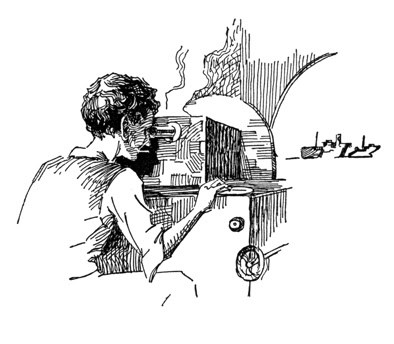
In 1928, when Whiting wrote a semi-fictionalized account of his wartime experience in Convoy: A Story of the War at Sea, it included an entire chapter about Mackay and his camouflage school. It also features a pen-and-ink drawing by Whiting (reproduced above) of a ship camoufleur looking at a camouflaged ship model in a testing theatre. In a different later source (from a 1932 issue of The Literary Digest), Whiting states that during the war he designed “camouflage for Army transports and supply ships.” In that case, it seems likely that he also worked with Frederick A. Pawla (1876-1964), who, as the head camouflage for the AEF Embarkation Service, oversaw the camouflage of “many of the army transports, particularly cargo carriers.” We have previously blogged about Pawla here and here.


On page 242 of Whiting’s book titled Convoy, there is an offhand reference to ship camouflage which may be relevant, or maybe not. The sentence reads: “The Monodoc, looking, in her camouflage, like an intoxicated snake, lay at anchor in the river.” The book’s text, as mentioned earlier is a book of fiction, based on fact. So perhaps we shouldn’t surprised that there doesn’t seem to have been a WWI American ship named Monodoc (altought there were ships named Monadnock). Maybe he simply invented the name.

In the same book, on page 80, Whiting provides some insight into an on-going conflict between Mackay’s camouflage team (affilidated with the US Shipping Board) and the US Navy’s own official Camouflage Section, which had been given the authority to originate all ship camouflage schemes, both Navy and civilian, which was greatly resented by those who were loyal to Mackay.

As Whiting alludes to in his book, Mackay’s camouflage school may not have been unauthorized by the Navy, and was thus conducted “quietly.” But, as he also implies, Mackay’s men also side-stepped strict compliance with the Navy’s regulations by claiming that the schemes that they were given required alteration to make them fit the vessels they were required to apply them to.


Here is the dialogue from Whiting’s book—

“I thought these [ship camouflage] designs were made in Washington, under the Navy Department.”

“Yep, that’s the theory. Those Johnnies think we only put their patterns on the steamers, but, b-bless you, the plans we get from there only fit half the shapes in this town. We have to camouflage every darned thing from a tanker to a barge.”

“And so your chief [William Andrew Mackay] is quietly evolving his own school for camoufleurs?”

“That’s it. The queerist lot of wights are working here, scraped up from the corners of Bohemia. But they work; Mackay is a hustler.”

“Drives you, does he?”

“No, he innoculates us; he has more ideas than all your admirals put together. And the boys are simply nuts about him.”


A small selection of other illustrations by Whiting, including book covers and an interior illustrations, are also featured in this post.

RELATED LINKS    

Dazzle Camouflage: What is it and how did it work?Nature, Art, and Camouflage / Art, Women's Rights, and CamouflageEmbedded Figures, Art, and Camouflage / Art, Gestalt, and Camouflage /  Optical science meets visual artDisruption versus dazzle / Chicanery and conspicuousness /  Under the big top at Sims' circus

Sunday, December 29, 2024

who cut off your tie at the Art Academy of Cincinnati?

Batchelor and Behrens / Art Academy of Cincinnati
In the late 1980s, I was living in Cincinnati OH, where I was head of the graphic design program at the Art Academy of Cincinnati. It was an interesting place at the time, the school as well as the city, and I have enduring memories of wonderful students and colleagues. After more than thirty years, I am still in contact with some of them.

Among my favorite colleagues from those days was a British-born printmaker named Anthony (Tony) Batchelor, who died a few months ago. The two of us, given the right circumstances, were prone to bursting out with Pythonesque sillyness. I still have a photograph (shown here) of Tony and myself at one of those spontaneous moments.

In 1981, I had published a book called Art and Camouflage: Concealment and Deception in Nature, Art and War. It did not sell particularly well, but it received sufficient attention (as from the Whole Earth Catalog, for example) that it acheived some small notoreity as one of the early books about the role that artists played in the study of camouflage, both in nature and in war. 

Various things happened as a result: In 1988, soon after I joined the faculty at AAC, the school succeeded in obtaining a grant from the National Endowment for the Arts to host a community-wide series of activities (talks, exhibits, and other events) on the theme of art and camouflage

That same year I was contacted by British documentary filmmakers who were in process of making a film on the same subject, to air on television in both the US and the UK. The UK version was titled The Art of Deception, and appeared as a segment of Equinox on BBC televison (the name Cincinnati was misspelled). The American version, titled Disguises of War, was broadcast as part of NOVA on American Public Television, by way of WGBH Boston. That version can still be viewed online

Roy Behrens as interviewed on NOVA (1990)


A still frame from that program is reproduced here. It was filmed on an exceedingly hot afternoon on the grounds of the Wright-Patterson Air Force Base in Dayton OH. It was nearly impossible to complete the filming because (being an air force base) airplanes were constantly taking off. I was wearing a purple shirt and an especially appropriate necktie, the top half of which was a contrasting color, while the bottom half was the very same color as the shirt. 

When it aired nationally, I recall that my mother comically asked, “Who cut off your tie?” Another funny consequence is that the next day after its national broadcast, I received phone calls at the AAC, from former students in Wisconsin and Iowa, saying that they had watched the program, not knowing that I was included. One person told me that, “as the program started, I said to myself, ‘This is something that Roy Behrens would really enjoy”—and then, suddenly, I appeared on screen. Believe me, I no longer look like this.

PRINT magazine article on camouflage


Around the same time I received a call from the managing editor at PRINT in New York, the leading graphic design newstand magazine in the US. Would I be willing to prepare a major article on camouflage in relation to art and design? The resulting article was called Blend and Dazzle: The Art of Camouflage (January / February 1991). In no time, that then led to being appointed a Contributing Editor at PRINT, which I enjoyed tremendously for at least a dozen years or more.

RELATED LINKS    

Dazzle Camouflage: What is it and how did it work?Nature, Art, and Camouflage / Art, Women's Rights, and CamouflageEmbedded Figures, Art, and Camouflage / Art, Gestalt, and Camouflage /  Optical science meets visual artDisruption versus dazzle / Chicanery and conspicuousness /  Under the big top at Sims' circus

Saturday, December 28, 2024

from art to camouflage to the demolition of his home

Walter K. Pleuthner at age 82
Walter Pleuthner's WWI ship camouflage scheme

When Walter Karl Pleuthner registered for the draft in White Plains NY on September 12, 1918, he was officially listed—and signed the verification—as Walter Charles Pleuthner. That’s odd. Elsewhere, I’ve seen him listed as Walter Carl Pleuthner. There is no reason to assume that these were different people, because his birthdate is cited correctly as January 24, 1885. He was 33 years old at the time of his draft registration, and was self-employed as an artist and architect, living on Scarsdale Avenue, in Scarsdale NY.

Pleuthner was born in Buffalo NY. When as young as five years old, he began to take art lessons at what is now the Buffalo AKG Art Museum. His watercolors were first exhibited in New York City in 1903. Three years later he moved to New York, where he worked in his uncle’s law firm, while taking art courses at the Art Students League and the Academy of Design. Among the instructors he studied with were Frank DuMond and F. Luis Mora. When the Armory Show (the infamous International Exhibition of Modern Art) took place in New York in 1913, he was the youngest artist to have his work included.

Later, as an architect, he was primarily known for designing homes for wealthy clients. In 1909, he married Clara Riopel Von Bott, a concert singer, and designed a spacious stately Tudor home for them in Scarsdale. It was of sufficient distinction that his full color painting of the property’s entrance gate, with a view of the home in the background, was featured on the cover of a 1909 issue of American Homes and Gardens magazine. In the magazine’s interior pages was a full page feature on the home, with exterior photographs, floor plans, and marginal notes.

Magazine Cover / Walter Pleuther / 1909
Magazine interior featuring Pleuthner home / 1909


Pleuthner is listed as having been a member of the Society of Independent Artists, as well as of a New York group called American Camouflage, organized by Barry Faulkner and Sherry Edmundson Fry (for the purpose of becoming proficient at army camouflage) in anticipation of the US declaration of war in 1917.

At some point, as a civilian, he also became involved in ship camouflage. We know this because there is a photograph of a painted wooden ship silhouette, credited to him, that was published in March 1918 (in black and white only) as part of a lengthy research report by the Submarine Defense Association. After his scheme was tested by camouflage researchers at Eastman Kodak Laboratories in Rochester NY, his camouflage proposal was not selected for actual use.

Pleuthner’s wife died from a heart ailment in 1957. He lived for thirteen additional years. His newspaper obituary reads: “His techniques ranged from American impressionism to the unusual use of found objects. He wrote humorous anecdotes and philosophical essays. An architect by profession, he created many of the Gothic and Tudor style homes in Scarsdale and neighboring towns.” He died on December 2, 1970.

The Pleuthners had no children. After his wife’s death, he continued to live alone in their large residence in Scarsdale (although it isn’t entirely clear if this was the original house from 1909, or perhaps a later equivalent from 1920). What is certain is that he had difficulty in maintaining the house. In 1963, it caught on fire, but was not structurally damaged. Soon after, it caught on fire on two other occasions, followed by vandalism and thefts. Concerns were increasingly voiced by area residents, fire safety officials and the village board. Some people urged that the house be condemned and dismantled “as a danger.” This debate provoked a longtime Pleuthner friend and former neighbor to publish an objection in the Scarsdale Inquirer on November 22, 1967.

“We all know Walter’s eccentricities,” the letter to the editor said, “and it is easy to criticize them. With less formal education than some, Walter, through his own efforts, became an excellent architect. He built expensive and admirable houses as far away as Pennsylvania and several in Westchester County…”

The request to raze the Pluethner’s home should be denied, the writer urged. “Walter has suffered several serious misfortunes and since Mrs. Pleuthner’s death, he has mostly lived alone with his paintings and sculpture. His house has suffered damage from fires but appears structurally sound. He is now an old man.”

One cannot help but wonder why Pleuthner was regarded as “eccentric,” even among his defenders and friends. One early indication may be a 1941 news article titled “Tipsy House” in the American Builder magazine. 

Tipsy House: No hurricane; just a bad spill


Pleuthner ran into unforessen difficulties, the article reported, “with a model house he bought, cut into two sections and tried to move to another site. After a lot of figuring, he started out at dawn one morning with the first section on a big trailer. Things went all right until they rounded a sharp curve on a hill. At that point the house got tipsy, rolled off the trailer and landed on its side. The house wasn’t damaged, but it got Architect Pleuthner into all sorts of trouble with various people, including the Traffic Department, who objected to having a main highway blocked. Thousands of people who had inspected the house [earlier] when it was known as the ‘Home for Better Living,’ sponsored by Westchester Lighting Company, were intrigued by the sight ot the house, complete with shutters, slate roof and equipment, laying on its side by the road, where it stayed for several days.”

But the straw that eventually broke the authorities’ back was the increasingly disheveled state of his large self-built Tudor home. At the time he built the house, we are told in an article in Progressive Architecture magazine, it “was no more pixyish than many another in the high Eclectic period, and was distinguished only by having true half-timber construction, a massive braced frame with brick nogging. Loving handmade things and solid workmanship, he had the house put together by craftsmen who used a minimal amount of millwork and ready-sawn lumber. One of the timbers in the living room is a heavy stick from the privateer Hornet of War of 1812 fame. Originally, the house reflected in a conventional way Pleuthner’s triple artistic role as architect, painter…and sculptor, as fragments of old ironwork and woodwork and paintings accumulated on the walls. The great living room was the rehearsal room of the Wayside Players, an amateur group that included Robert Benchley, Dorothy Parker, and the cartoonist Rollin Kirby. At some point, the cultured clutter to be expected in an artist’s house passed over into whimsy, and Pleuthner decided to work on the walls, ceilings, floors, and furnishings of the various interiors. The kitchen at one period was transformed into an Italian garden. Floorboards were painted to imitate polychromed tiles. Other floors were carved out and inlaid with mosaic. A bathroom scale had the outlines of two feet painted on the platform, while the dial became a screaming baby face. Unpleasant book bindings were painted white, with code words daubed on the spines in red. An automobile hood became a canopy over the entrance to a summer house. And more and more odds and ends were added inside and out. In 1963, the house caught fire, but its substantial construction saved it. …the house is now in sad shape. The authorities claim that it is unsafe, and want to tear it down, but Pleuthner is confident that he can restore it. This winter, the house was leaky, drafty, and uninhabitable, but Pleuthner is already experimenting with the textural effects created on the floor by the latest fire.”

Pleuthner home interior in 1968


When that article appeared in 1968, Walter Pleuthner was 82 years old. His home was condemned and soon after demolished near the end of that year. When he died two years later, he was listed as residing at a nursing home in White Plains.

SOURCES

• Cover and “A Handmade House, Walter Pleuthner, Architect,” in American Homes and Gardens. Vol IV No 6, June 1909, p. 78.
• “Tipsy House” in American Builder 1941-09: Vol 63 Issue 9, p. 87.
• Letters to the Editor, Harold A. Herriet, “Defends Walter Pleuthner” in Scarsdale Inquirer, Vol XLIV No 47, November 22, 1967.
• “Dwellings: The Rationales in their Design” in Progressive Architecture, May 1968.
• “Walter K. Pleuthner” [obituary], in Scarsdale Inquirer. Vol 52 No 49, December 10, 1970.

Monday, December 23, 2024

Lewis W. Rubenstein / WWII US Navy ship camoufleur

Everett L. Warner (front center), with WWII ship camoufleurs
In 1993, Stephen Polcari, Director of the Archives of American Art, conducted a tape-recorded interview with American artists Lewis W. Rubenstein and Erica Beckh Rubenstein, in which Lewis Rubenstein spoke about various aspects of his artistic life, including his camouflage service during World War II.

Among the things that Rubenstein recalled were his associations with scientist Edwin Land, inventor of the Polaroid camera, with whom he had been college friends at Harvard, and a government official named Richard C. Morrison, who had also been at Harvard and was in charge of a camouflage research project in Boston, which involved the development of a camouflage paint (invented by Samuel Cabot) called “haze paint.” He also worked with Land on research that pertained to underwater vision in relation to submarines.

Rubenstein was originally from Buffalo NY. After graduating fom Harvard in 1930, he received a fellowship to study in Europe. When he returned, he taught the Boston Museum School and the University of Buffalo, then joined the faculty at Vassar College. A newsletter from that school announced in early 1942 that Rubenstein had taken leave from teaching “for the duration of the war,” in order to contribute to US Navy camouflage.

In his interview for the Archives of American Art, he shared specific information about his wartime service, albeit the interview transcript is replete with phonetic name spelling mistakes. “…I went into the navy in ship camouflage…” he states, “…[where] I worked with Charles Benninger [sic, Charles Bittinger]…”

He continues: “[Dazzle] was one kind of [ship camouflage], and the other kind was just low visibility, and I did both. I was in that camouflage unit during the war. There were a number of artists in that too. [Bittinger]  was an artist and his half-brother was a member of the National Academy—his half-brother was John Maron [sic, John Marin]. He once invited me to lunch with [Marin]. And Edward Warner [sic, Everett Longley Warner], who was a painter, was the other half of that. Eliot O’Hara was in the group, [as was] Bennett Buck, [and] a number of artists.”

The remaining mention of camouflage in the interview is filled with mistakes, and more confusing than informative. But, just for the record, it goes like this:

Polcari: Yeah, I remember—Ellsworth Kelly was in the camouflage unit.

Lewis Rubenstein: He wasn’t in that one.

Polcari: No, he wasn’t in that one.

Erica Rubenstein: Maybe he was in army camouflage.

Polcari: Yeah, army camouflage, that’s right. Rourkie [sic, Arshile Gorky] taught camouflage—[Gorky] taught camouflage in New York City.

Rubenstein: (Laughs.) He made the best use of it, I think.

Polcari: Yes, he did. Well, that’s true, that he used it in his style. He used it in his style.


Reproduced above is a photograph that was given to me by one of the ship camoufleurs who served in the same unit as Rubenstein. It was given to me by Robert R. Hays, who is on the far right in the photograph. He was one of those who served under Everett L. Warner, who is shown holding the ship model at the front center. I’ve identified the other four members of Warner’s team who are standing around him. They are (from left to right) H. Bennett Buck, Sheffield Kagy, William Walters, and Arthur Conrad (father of artists Daniel Conrad and Tony Conrad). The only person whom I haven’t identified is the man in the very back at the extreme left. I now wonder if that might be Lewis Rubenstein, but I can’t confirm it. As shown by a later photograph of Rubenstein (at the bottom of this post) it might well be him.

Lewis W. Rubenstein / ship camoufleur
ONLINE VIDEO TALKS

Dazzle Camouflage: What is it and how did it work?

Nature, Art, and Camouflage 

Art, Women's Rights, and Camouflage

Embedded Figures, Art, and Camouflage

Art, Gestalt, and Camouflage

Sunday, December 22, 2024

WWI camouflage artist / taxidermist Louis Paul Jonas

Taxidermy Hall of Fame
It certainly comes as no surprise that a person who practices taxidermy would also be interested in the appearance of animals, in protective coloration, mimicry, and camouflage. Over the years, I’ve run across any number of naturalists, museum exhibit designers, ornithologists, and wildlife artists, who, at one time or another, have contributed to the study of camouflage in nature. Some have even served during wartime as camouflage consultants.

Shown above is a photograph of the well-known museum display of a group of African elephants in the Akeley Hall of the American Museum of Natural History. It was completed by a famous naturalist, taxidermist and sculptor named Carl Akeley, who collaborated on it with one of his prominent students, the sculptor and museum exhibit designer Louis Paul Jonas (1894-1971). Born in Budapest, Hungary, Jonas initially worked with his two older brothers, who owned a taxidermy studio in Denver (eventually there were five brothers in the firm). After moving to New York, he established his own studio, and created admired exhibits in more than 50 museums throughout the world.

I want to focus on Louis Paul Jonas because I hadn’t realized that, during World War I, he served in the US Army’s Camouflage Corps. I learned this only recently from a news article titled MONSTER MAKER, so-titled because he had been commissioned by the Sinclair Oil Company to build full-size fiberglas models of dinosaurs for the New York World’s Fair.

In that article (published in the Barrytown Explorer, Barrytown NY, on October 1, 1963, p. 4), it states that Jonas bought a 120-acre farm near Churchtown NY “and gradually made over the barns and stables into studios, and built up a staff from among his Columbia County neighbors. Now he has a staff of 16 experts, all trained by himself. One he found in a Hudson shirt factory, a young Italian who had been a mold maker in a ceramics works back home; several were members of an Adult Education class in sculpture conducted by Jonas in connection with the Hudson school system—bricklayers, housewives, and factory workers among them; three came to him via the GI Training Program, and the rest are members of his own family, including his ‘key man,’ Louis Paul Jonas Jr.” An extraordinary person obviously.

Saturday, December 21, 2024

disrupting Picasso and Man Ray on the French Riviera

Speaking of shadow disruption (an addendum to the previous post), I must also recommend a fascinating documentary video that is available to watch free on the Tubi streaming video site. 

Above is a still frame from the video in which Picasso, Man Ray and their friends are shown seated beneath a tree, the shadows of which are disrupting their figures. 

The 54-minute film is called On the French Riviera with Man Ray and Picasso, and the online link is here.

chain link fence shadows as disruptive camouflage

I am tempted to call it “chain link fence camouflage” since it occurs so frequently on the tennis court on a sunny day. 

A ball is hit over the chain link fence, and in searching for it in the grass (a green ball especially) it may be difficult to see because its shape is broken up by the shadow of the fence.

It has had other names as well: “umbrella camouflage,” “garnished fish net camouflage,” “shadow disruption” and so on.

It is nothing new, and can easily be found in art history, especially in photography and in impressionist painting. But it seems that it wasn’t officially and commonly practiced until World War I. It’s use of course is now widepread.

Shown above is the cover of a special issue of Art News magazine (November 1-14, 1942), which included several articles on wartime uses of camouflage. The photograph on the cover is an optimal example of shadow disruption.

We’ve blogged about in the past, as in this post from 2016. And there is an interesting account of its use by Ellsworth Kelly (who was a wartime camoufleur) in E.C. Goossen’s book about his life and work.

Friday, December 20, 2024

Edward Wadsworth / camouflage UK postage stamp

Until recently I hadn’t realized that the UK had at one time (not sure when) issued a postage stamp that featured a famous woodcut of a WWI dazzle-camouflaged ship by British Vorticist artist Edward Wadsworth (1889-1949).

During the war, Wadsworth actually served as a dock supervisor, meaning that he directed teams of workers who painted enormous ship camouflage schemes onto the full-sized ships in the harbors.

He was a fascinating person in many regards, not just for his involvement in camouflage. He created a number of woodcuts that demonstrate the visual effect of high contrast disruptive patterns, as well as a famous large format painting on the same subject. We’ve focused on various aspects of his life and artistic achievements in earlier postings on this blog.

Portrait photograph of Edward Wadsworth
ONLINE VIDEO TALKS

Dazzle Camouflage: What is it and how did it work?

Nature, Art, and Camouflage 

Art, Women's Rights, and Camouflage

Embedded Figures, Art, and Camouflage

Art, Gestalt, and Camouflage

Monday, December 16, 2024

engaged by the government to design ship camouflage

Hobart (left) and Spencer Nichols
We have known about an American artist named Spencer Baird Nichols (1875-1950) for some time, and we earlier blogged about the fact that he and his older brother, named Henry Hobart Nichols Jr. (usually known as Hobart Nichols) (1869-1962), also an artist, both served during World War I as civilian ship camouflage artists. We know this because they are listed as being among the artists who were affiliated with the Marine Camoufleurs of the US Shipping Board, Second District, a section that was headed by William Andrew MacKay. It is also mentioned in various news articles from that time period. Unfortunately, there is little if any mention of their camouflage contributions in other online articles, including Wikipedia.

When we blogged about them earlier, we published a newspaper item from 1919, which reported that Hobart Nichols had given a talk about wartime ship camouflage at the Nondescript Club in Bronxville NY.

Since then, two additional factors have come to light: 

One is an article in the Evening Star (Washington DC) from July 23, 1898, which reveals that Spencer Nichols had left Washington for St Louis, “to join the United States engineer corps in camp there.” He has done this, as the article states, “in the capacity of an artist, and his regular work will be of a kind that is not uncongenial to him, and it will afford him at the same time an excellent chance to gather material that may prove of the greatest value to him later on.” It is not clear from the article if his service was connected to the Spanish-American war, which had broken out in April of the same year.

The other item is a more detailed article in the Bronxville Review on March 4, 1933, p. 19, for which the headline reads: SPENCER NICHOLS, NOW TEACHING HERE, WAS GOVERNMENT ARTIST DURING WAR. The article goes on to say—

A native of Washington DC, where he studied with Howard Helmick at the Art Students League, Mr. Nichols first came to New York as the associate of the late Louis Tifanny. For fifteen years, he executed Commissions for stained glass windows in important churches and other publc buildings and designed decorations for homes and institutions. During the war Mr. Nichols was engaged by the government to design camouflage for transports: his technical knowledge of color and design was applied to giving a ship the appearance of being out of alignment with its true course—a responsible and difficult task for the wartime artist.

Saturday, December 14, 2024

like a wartime camouflaged ship with cartoons added

WOMAN PLANS UGLIEST HOME in Journal News, July 10, 1933, p. 2—

[A woman from Glen Ridge NJ] who set out a year ago to make her house the ugliest in the world announced today she was far from satisfied and appealed to the Famous Artists of America to advise her on a color scheme that will make the motley structure shriek.

The present color scheme—pink, blue, green and purple in the manner of camouflage on a wartime ship, interspersed with huge cartoons—is bad enough, according to some residents. But [the woman] is determined to make the $30,000 residence such an eyesore to the community that the Bourough Council will implore her to lease it for a business development.

The strange feud started when the Council decided the house was in a residental zone. [The woman] thought she should be permitted to sell it for a business site. From the impasse the house sprouted red flannel underwear from the windows and all the colors of the rainbow oddly mingled on its sides. A clothesline appeared across the front yard and on it waved the underwear of the 1890’s.

In addition, [the woman] has placed signs about the front yard, expressing her opinion regarding the borough council and on one side of the house is a row of four hogs heads. It happens that the borough council has four members.

Charles Le Brun, Resemblances


Monday, November 18, 2024

scout's oath / true boys do not chew gum in classroom

CAMOUFLAGE in The Clinton County Times (Lockhaven PA), December 6, 1918—

Long before the word was used there were boys who practiced camouflage. When a boy in school gets a book up before his face apparently to study, but in reality to chew gum, he is guilty of camouflage. Camouflage is used when a boy who has not looked at his lesson attempts to make an impressive recitation, or when he looks straight at the teacher while his mind is traveling off to the baseball ground. In war, camouflage has its place, but it has no place in the life of a true boy.

british dazzle plane is mostly black and jazzy yellow

DAZZLE PLANE IS ENGLAND’S LATEST in Times Daily, March 3, 1925—

LONDON, England (UP)—Airplanes “like flying zebras” have joined the British air navy.


Officially, they are known as “dazzle planes.” They [are] splashed with color in an extension of camouflage so that even a short distance away, while in flight, it is impossible to tell what kind of machine it is.


Tests with several of these airplanes were made at one of the Royal Air Force stations.


Witnesses said that the “dazzle planes” seemed “all out of proportion,” with the fuselage in some places apparently badly bent. It looked, said one, as if the wings were about to fall off.


The colors chosen were mostly black and also jazzy yellow.


•••


Image credit: Animated version of print from David Versluis and Roy R. Behrens, Iowa Insect Series (2012)

Sunday, November 17, 2024

dazzle / pied pigment is a nuisance in a crowded port

USS West Galoc / 22 August 1918
RAZZLE, DAZZLE, NEW CAMOUFLAGE EFFECT in Pittsburg Press, February 24, 1918—

NEW YORK, Feb 23—Camouflage is all right on the high seas but it is a nuisance in port. So say skippers on the harbor ferries here.

A great liner with razzle, dazzle decorations almost cut a Lackawanna ferry in two when the steamship emerged from her self established concealment the other day.

With the port full of pied pigment, commuters are wearing goggles to avoid paint shock. Whereas the early idea of camouflage was to make the ship blend into the sea and air, the latest wrinkle is to so dazzle enemy gunners with startling designs that they are unable to properly adjust their range finders.

The steamer that almost sank the ferryboat was a work of art. Light blue covered her bow for twenty feet than appeared three green and white semi-circles while a great black band ran from the poop deck at the sheer strake to a point on the waterline abaft the foremast. It was thirty feet broad. This black streak sprang from an arrangement of black and white concentric circles.

Thursday, November 7, 2024

a frieze of tiny men in uniform take pot shots at doves

Donald Friend. Anne Gray, Ed. The Diaries of Donald Friend. Vol 1. National Library of Australia (Canberra), 2001—

One day the editor of the Sydney Morning Herald came to Peter Bellew with a tin helmet: the editor was an Air Raid Warden, and he wanted his helmet “camouflaged.” Could Bellew get one of his artist friends to do the job? Peter gave it to me to do. Of course the camouflage idea for a warden was sheer frivolity. I suppose the editor thought it would look prettier that way—or fashionable, or useful or something. I was delighted to do the job. I took it home and painted on it numbers of fat, white, vapid peace doves, flying around with olive branches in their beaks, and on the lower part of it, a frieze of little men in uniform take pot shots at the birds with cannon and rifles.

Wednesday, November 6, 2024

French Infantry helmet broken up by painted lines

POILUS CAMOUFLAGE EVEN HELMETS NOW in Bridgeport Telegram (Bridgeport CT), September 13, 1918—

The French poilus [slang term for WWI French soldiers] have startled the Hun [German forces] repeatedly with their cunning in fighting materials. The latest bit of strategy pulled by the French fighters is the camouflage helmet. The poilu found that the ordinary steel helmet was visible for some distance against the mottled background of brush and barbed wire. So the army artists were called upon to help. Now the helmets are marked with a series of white lines which makes them blend with the background and helps make the wearer part of the landscape.

Veil on Helmet intended to Deflect Flying Fragments

Above WWI infantry helmet (1918) with a suspended veil of chain, which was supposed to lessen the damage caused by flying schrapnel fragments. Public domain NARA photograph 533656.

•••

CAMOUFLAGED NOISE LATEST FROM FRONT: Burlap Coverings Prevent Tin Derbies from Playing Tunes on Wire, in Stars and Stripes (France), April 5, 1918—

The camouflaged tin hat is the latest in spring styles in the Army. It appeared first among a number of men a few weeks ago, and is now becoming a real sensation.

The camouflage hat is a homemade affair, in so far as the camouflage goes. You take a piece of burlap, fit it neatly to the helmet, and then bind it in place on the inside rim with threaded cord. The main idea of the camouflage is to keep your hat from being noisy in the trenches. Wire and strips of camouflage are stretched across the trenches at intervals, and you have to duck under them. If you raise up too soon and your helmet scratches against the wire, it fairly rings. Hence the burlap-noise-camouflage idea.

Every day that goes by brings more affection for the tin hat from the American fighting man. There are few who have been in the trenches, or about artillery emplacements who have not had shell pieces pounced off their helmets. Without the tin hat these shell pieces would have meant death or at least a serious wound.…