|
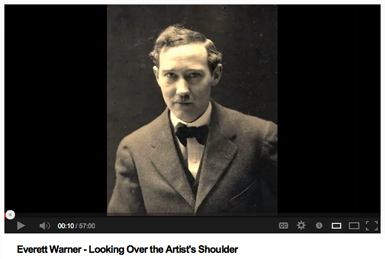
Everett L. Warner (front center), with WWII ship camoufleurs
|
In 1993,
Stephen Polcari, Director of the
Archives of American Art, conducted a
tape-recorded interview with American artists
Lewis W. Rubenstein and
Erica Beckh Rubenstein, in which Lewis Rubenstein spoke about various aspects of his artistic life, including his
camouflage service during World War II.
Among the things that Rubenstein recalled were his associations with scientist
Edwin Land, inventor of the Polaroid camera, with whom he had been college friends at Harvard, and a government official named
Richard C. Morrison, who had also been at Harvard and was in charge of a camouflage research project in Boston, which involved the development of a camouflage paint (invented by Samuel Cabot) called “
haze paint.” He also worked with Land on research that pertained to underwater vision in relation to submarines.
Rubenstein was originally from Buffalo NY. After graduating fom Harvard in 1930, he received a fellowship to study in Europe. When he returned, he taught the Boston Museum School and the University of Buffalo, then joined the faculty at Vassar College. A newsletter from that school announced in early 1942 that Rubenstein had taken leave from teaching “for the duration of the war,” in order to contribute to US Navy camouflage.
In
his interview for the Archives of American Art, he shared specific information about his wartime service, albeit the interview transcript is replete with phonetic name spelling mistakes. “…I went into the navy in ship camouflage…” he states, “…[where] I worked with Charles Benninger [sic,
Charles Bittinger]…”
He continues: “[Dazzle] was one kind of [ship camouflage], and the other kind was just low visibility, and I did both. I was in that camouflage unit during the war. There were a number of artists in that too. [Bittinger] was an artist and his half-brother was a member of the National Academy—his half-brother was John Maron [sic,
John Marin]. He once invited me to lunch with [Marin]. And Edward Warner [sic,
Everett Longley Warner], who was a painter, was the other half of that.
Eliot O’Hara was in the group, [as was]
Bennett Buck, [and] a number of artists.”
The remaining mention of camouflage in the interview is filled with mistakes, and more confusing than informative. But, just for the record, it goes like this:
Polcari: Yeah, I remember—Ellsworth Kelly was in the camouflage unit.
Lewis Rubenstein: He wasn’t in that one.
Polcari: No, he wasn’t in that one.
Erica Rubenstein: Maybe he was in army camouflage.
Polcari: Yeah, army camouflage, that’s right. Rourkie [sic, Arshile Gorky] taught camouflage—[Gorky] taught camouflage in New York City.
Rubenstein: (Laughs.) He made the best use of it, I think.
Polcari: Yes, he did. Well, that’s true, that he used it in his style. He used it in his style.Reproduced above is a photograph that was given to me by one of the ship camoufleurs who served in the same unit as Rubenstein. It was given to me by
Robert R. Hays, who is on the far right in the photograph. He was one of those who served under Everett L. Warner, who is shown holding the ship model at the front center. I’ve identified the other four members of Warner’s team who are standing around him. They are (from left to right) H. Bennett Buck,
Sheffield Kagy, William Walters, and
Arthur Conrad (father of artists
Daniel Conrad and
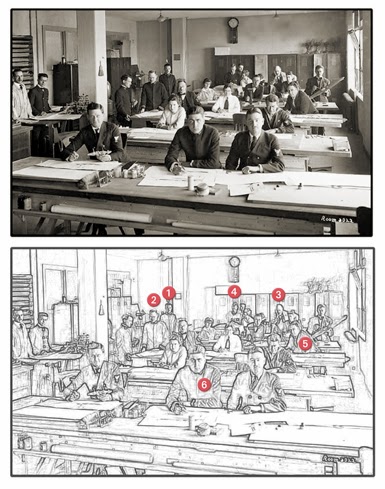
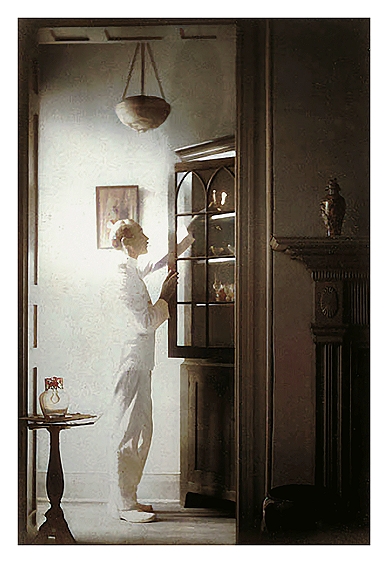
Tony Conrad). The only person whom I haven’t identified is the man in the very back at the extreme left. I now wonder if that might be Lewis Rubenstein, but I can’t confirm it. As shown by a later photograph of Rubenstein (at the bottom of this post) it might well be him.
 |
Lewis W. Rubenstein / ship camoufleur
|
ONLINE VIDEO TALKSDazzle Camouflage: What is it and how did it work?
Nature, Art, and Camouflage
Art, Women's Rights, and Camouflage
Embedded Figures, Art, and Camouflage
Art, Gestalt, and Camouflage