Until a few days ago, we had never heard of an Italian-born American cartoonist named Maurice Ketten (1875-?), née Prosper Fiorini, and at this point we still know very little. Apparently he studied art in Paris at the École des Beaux Arts, then emigrated to the US around 1906. He became a well-known cartoonist for the New York World (1907-1930s), for which he produced a daily cartoon. Shown here are two cartoons he made about camouflage that were featured in the Washington Post in 1917.
••
Dialog for Office Camouflage (above)—
—Mr. John, hereafter I want to see you at your desk more. You spend too much time out of the office. Tell Mr. Bill this applies to him too.
—Yes , Boss.
—He! He!
.
—Yes, Boss, they are at their desks.
—Good!
.
—Did it work?
—Yes, the boss thinks he saw you at your desk, Mr. John.
••
Dialog for Home Camouflage (below)—
—Go to our room and go to bed! You can't go out tonight.
—O, very well.
.
—The inventor of the fire escape must have been a married man.
.
—Something queer! He is not snoring.
.
—Well! What a clever home camouflage!
.
—Won't she get onto it?
—Never! If she goes to my room she'll think I'm asleep. I did a nice little bit of camouflage.
.
—The idiot! He doesn't know yet after forty years that he never sleeps without snoring.
Wednesday, July 17, 2013
Monday, July 15, 2013
New Uses of Dazzle | Stephanie Syjuco
![]() |
| Dazzle-painted Fallingwater (2013) © Stephanie Syjuco |
![]() |
| Camouflaged Google bus (2013) © Stepanie Syjuco |
![]() |
| Dazzle-patterned IKEA furniture (2013) © Stephanie Syjuco |
![]() |
| Camouflaged jeepney (2013) © Stephanie Syjuco |
Monday, July 8, 2013
Ship Camouflage Poster | L.A. Shafer
![]() |
| buy online |
••
From "WILL EXHIBIT 'CAMOUFLAGE'" in the Washington Post, December 30, 1917, p. 14—
"Camouflage" will play an interesting part in the fourteenth national motorboat show at Grand Central Palace, New York. There will be at least one exhibit illustrating in models how "camouflage" is applied to ships in the form of war paint. "Camouflage" as painted these days has all the evidence of an escaped lunatic having enjoyed an orgy with paint pots.
Friday, July 5, 2013
Camouflage Artist | Nishan G. Toor
![]() |
| Armenian-born American camoufleur Nishan G. Tooroonjian |
Reproduced above is a photograph of him that appeared in a periodical called The New Armenia, Vol X No 3, March 1918 (at which time he was still in France). His drawing appears on the cover of that issue, and the photo caption reads: "N.G. Tooroonjian. Camoufleur, AEF in France. The cover design of The New Armenia was drawn by him."
A substantial entry on his life was published in the 1942-43 edition of Who's Who in California, and there is a website that features about forty of his works, as well as some wonderful photos of him, self-described as a "disguised agitator."
![]() |
| additional sources |
Thursday, July 4, 2013
Dazzle Camouflage Skirts and Swimsuits
••
From the "It's Town Talk" column in Free Lance (New Zealand), Issue 972, March 6, 1919, p. 22—
That the new "dazzle camouflage" design on summer skirts may be all right for the ethereal nymph-like form, but for over umpteen stone specimens the least said the better.
••
From "Camouflage Finds Use in Fashions" in The Coshocton Tribune (Coshocton OH), April 15, 1920, p. 8—
LONDON—The artists who decorated our recently almost invisible ships and who hid the armies of the western front behind and under painted canvas and "ersatz" villages are out of a job.
Hence the spring millinery styles.
The dazzle hat has arrived, and with it a game.
Says one fashion writer:
"If you see coming toward you a woman who in some unaccountable way seems to melt into a sort of rainbow mass above the shoulders, don't be alarmed; try to find her hat."
To the uninitiated the new spring designs seem to be meaningless collections of colored stripes and zigzags. Some are even more like forked lightning.
![]() |
| additional sources |
Wednesday, June 26, 2013
San Francisco Camouflage Artists
![]() |
| Chameleons, German book illustration (1897) |
Lieutenants [Richard S.] Meryman and Jack [Gage] Stark [neither one from San Francisco]; Sergeant Nishan Tooroonjian, sculptor; Sergeant Jack L. Osthoff, artist; Sergeant Frank W. Swain, artist; Sergeant Louis De Wald, artist; Sergeant Marcus M. Meherin, Jr, artist; Sergeant Joseph Kopersky, designer; Sergeant Sam Macloud, painter; Stanley Long, painter; Sergeant Albert [Sheldon] Pennoyer, artist; Corporal Clifford Neil, artist; Sergeant William R. Moran, mechanic; Sergeant Frank Duncan, artist…
…All of the men wore on their left shoulder a yellow chameleon—nature's own camoufleur, and emblematic of the soldiers' work in colors to deceive and mislead.
Some of these names are familiar. The lieutenant in charge, Richard S[umner] Meryman, was a student of Abbott H. Thayer in Dublin NH, and had collaborated with Thayer and (his son) Gerald H. Thayer prior to 1909 in illustrating their influential book on Concealing Coloration in the Animal Kingdom (available online).
In two earlier blog posts, we've also talked about A. Sheldon Pennoyer, who was one of the founders of the pre-war organization called the American Camouflage Western Division. There is mention of Pennoyer in an earlier column called "Artists and Their Work" by Anna Cora Winchell (San Francisco Chronicle, November 23, 1917), which reads as follows—
A greeting from artists and the camouflage corps comes from Camp Lewis, Washington, through A. Sheldon Pennoyer. It will be remembered that he was the dominating spirit, previous to being drafted, in organizing the camouflage in San Francisco.
••
From R. Tripp Evans, Grant Wood: A Life. New York: Knopf, 2010—
During World War I, [Grant] Wood was stationed in Washington DC, where he worked for the American Expeditionary Force Camouflage Division…Given his penchant for self-effacement it is equally fitting, as [his sister] Nan records, that he kept a pet chameleon in his studio.
![]() |
| additional sources |
Camouflage Artist | Edgar Walter
![]() |
| Edgar Walter, Beauty and the Beast (n.d.) |
••
From "Sculptor Named Chief District Camoufleur" in San Francisco Chronicle, May 22, 1918, p. 6—
Edgar Walter, sculptor, has returned from a trip to New York, where he was called by the US Shipping Board. He has been appointed chief camoufleur for the Seventh District, which embraces California and a portion of Southern Oregon, and will direct the work of camouflage in the emergency fleet of the Shipping Board.
Camouflage Music | Dinner Disappears
Above The cover of the sheet music for a song called Camouflage: A Soldier's Song, with words by F.P. Drowne and music by Harry C. Zerfing (1918).
••
From "Camoufleurs Makes Seven Course Dinner Disappear" in the Chicago Daily Tribune, March 17. 1918, p. 8—
The camoufleurs of Camp Grant, Chicago artists and cartoonists, who are proficient in the art of making things disappear, caused a seven course dinner to vanish last night in the club rooms of the Advertising Association. Numerous camouflage stunts added "pep" to the function.
••
From "Camoufleurs Makes Seven Course Dinner Disappear" in the Chicago Daily Tribune, March 17. 1918, p. 8—
The camoufleurs of Camp Grant, Chicago artists and cartoonists, who are proficient in the art of making things disappear, caused a seven course dinner to vanish last night in the club rooms of the Advertising Association. Numerous camouflage stunts added "pep" to the function.
Monday, June 24, 2013
Camouflage Around the House
• Our thanks to Richard Hawkins for providing additional info.
•••
From "Dazzle Dinners" in the Aukland Star, Saturday, May 13, 1922, p. 19—
Nothing is stranger in appearance, more barbaric than the latest style in the French dinner table.
Wine glasses are of the weirdest forms, without stems, and each guest has a different colored glass before him.
Plates are any shape except circular. Some are square, some irregular, and some simply no shape at all. They are not plain white, or colored, or even decorated with floral designs, but in their coloring resemble the 'dazzle paint camouflage' of war memory.
Knives and forks retain their usual shape, as nothing better has yet been invented for cutting up food and conveying it to the mouth, but their handles are of queer, tortured forms, and made of green glass or composition of many hues. Table cloths have, of course, gone long ago, and red lights in alteration, by means of clockwork devices, and so the whole atmosphere is one of uncanny strangeness.
••
From "Pumpkin Pie, Without, A Camouflage Trick" in the Boston Daily Globe, November 19, 1917, p. 3—
Washington, Nov 18—The art of camouflage has now reached the good old pumpkin pie. Mrs. G.M. King of East Orange NJ today sent to the National Emergency Food Garden Commission a recipe for making pumpkin pie without the pumpkin. Here it is:
Scald one quart of milk, add scant cup of indian meal, little salt. When cold, add two eggs. Cinnamon and ginger to taste. Sweeten with brown sugar. Put little cream or milk on top and bake.
![]() |
| additional sources |
Sunday, June 23, 2013
Camouflage Artist | Grant Wood
![]() |
| Dust Jacket with Grant Wood painting (detail) |
•••
It's nothing new to mention that Iowa artist Grant Wood (1891-1942) enlisted in the US Army near the end of World War I, and that he served briefly as a camouflage artist. Nearly every account of his life makes note of that in passing, and states that he was responsible for the camouflage of artillery. Here, for example, is one account, from R. Tripp Evans' recent biography (cited above)—
[After his enlistment in the Army Corps of Engineers in 1917] Wood was stationed outside Des Moines at Fort Dodge, where he passed his free time sketching portraits of his fellow soldiers. After an appendicitis attack landed him in an army hospital, Wood was transferred to Washington DC, where he joined the American Expeditionary Force Camouflage Division. Charged with camouflaging heavy artillery and creating convincing cannon "dummies" [sometimes known as "Quaker guns"], Wood found that his background in theater design served him surprisingly well.
Meanwhile, we recently ran across a news clipping in scrapbooks put together by Wood's sister, Nan (available online here), in which Wood talks briefly about his wartime camouflage service. The article (the source isn't noted, but it's most likely from the Des Moines Register and Tribune, accompanied by the penciled note "Nov 1933?") is titled "3 Will Show Oil Paintings. Iowan's in Exhibit Here Next Week." It goes on to announce an upcoming joint exhibition (at Younkers in Des Moines) by three artists "who served in the same camouflage squad during the world war." Grant Wood is the Iowan, and the remaining two artists are John Kilgore from Chicago and Orrin White from Pasadena. "Stationed at Washington DC," the text continues, "the three young men were trained to camouflage cannons." And there is this paragraph in which Wood remembers their camouflage work—
"It was a difficult job," Mr. Wood recalls. "They took airplane photographs before and after our work was finished. Grass photographs like velvet, every footstep leaves its mark. We had to dig the hole for the cannon and fix it so that not a mark showed."
I have since been able to locate one of the artists who worked on camouflage with Wood. He was Orrin A[ugustine] White (1883-1969). Born in Hanover IL on December 5, 1883, he studied at Notre Dame and the Philadelphia School of Applied Arts. His parents owned a woolen mill in his hometown, and he was initially interested in textile design and the chemistry of dyes. He even taught chemistry briefly at Portland University, but eventually turned instead to interior design and landscape painting. Several online sources confirm that he was a second lieutenant in the 40th Engineers Camouflage Section.
As for John Kilgore, his case is slightly more challenging. The Iowa news article lists him as John Kilgore, as does Nan Wood's scrapbook note. But I can't find an artist-camoufleur named John Kilgore, although I've easily located one named Charles P. Killgore (or Kilgore) (1889-1979). Other than the apparent name error, everything else fits perfectly. Born in Huntington WV, he attended Marshall College and the Art Institute of Chicago. His professional life was centered in Chicago, where he worked for forty-three years as a color consultant for the Chicago Tribune. He too is said to have served as a WWI camoufleur, and to have been a good friend of Orrin White.
Mystery solved—sort of.
![]() |
| Additional sources |
Dazzle Camouflage in Obsolete! Magazine
![]() |
| Cover of Obsolete! Magazine Number 8 (2013) |
Friday, June 21, 2013
Dazzle-Camouflaged Coffee Cups
![]() |
| Dazzle-painted coffee cups © Roy R. Behrens (2013) |
Instead of being some dark color as one would imagine, they [WWI dazzle-painted ships] are painted in the most fantastic designs, and a crazy quilt is a model of accuracy compared to the streaks and stripes on a camouflaged ship. They start at the prow with a black streak, perhaps, that may resemble the figure 7 or something else as grotesque and follow this all the way back with alternate streaks and stripes of white, yellow, pale blue and other colors.
The complicated whole very much resembles a futurist or cubist painting and a close view reminds you of looking at a zebra after a session of several hours with a few quarts of champagne, if you can imagine how a zebra would look under such circumstances.
![]() |
| additional information |
Thursday, June 20, 2013
Douglas Garofalo's Camouflage House
![]() |
| David Garofalo (model), Camouflage House (1991) |
Wednesday, June 19, 2013
John Dewey | Camouflaging One's Self
Above World War I photograph of a British soldier, dressed in bark mimic sniper's outfit, posed beside a bark-covered observation post, disguised as a dead tree. From Ferdinand Foch, et al., The People's War Book. Cleveland OH: R.C. Barnum, 1920. Public domain.
•••
From Randolph S. Bourne, in J.W. Cunliffe and G.R. Lomer, eds., Writing of Today. New York: Century Company, 1919, p. 175—
In all his [John Dewey's] philosophy there is no place for the psychology of prestige. His democracy seems almost to take that extreme form of refusing to bring ones self or ones ideas to the attention of others. On the college campus or in the lecture room he seems positively to efface himself. The uncertainty of his silver-gray hair and drooping moustache, of his voice, of his clothes, suggests that he has almost studied the technique of protective coloration.
•••
From Randolph S. Bourne, in J.W. Cunliffe and G.R. Lomer, eds., Writing of Today. New York: Century Company, 1919, p. 175—
In all his [John Dewey's] philosophy there is no place for the psychology of prestige. His democracy seems almost to take that extreme form of refusing to bring ones self or ones ideas to the attention of others. On the college campus or in the lecture room he seems positively to efface himself. The uncertainty of his silver-gray hair and drooping moustache, of his voice, of his clothes, suggests that he has almost studied the technique of protective coloration.
Friday, June 14, 2013
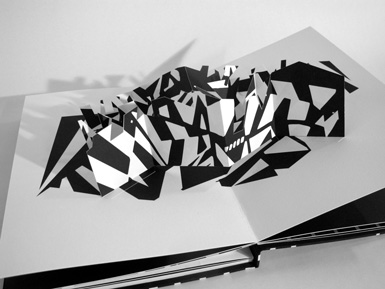
Stephen Hobbs | Camouflage Pop-Up Book
![]() |
| Pop-up book (2013) © Stephen Hobbs |
In the meantime, he's been branching out, turning most recently to innovative uses of woodblock and linocut methods (some of which also use dazzle-related surfaces), the assemblage of parts of printed proofs into three-dimensional forms, including (see sample page spreads below) the construction of a limited edition pop-up book.
![]() |
| ©Stephen Hobbs (2013) |
![]() |
| ©Stephen Hobbs (2013) |
![]() |
| Stephen Hobbs, surface design for the Craftsman's Ship (2013) |
In a related but separate commission, Hobbs is also working with Propertuity, Developers of the Maboneng Precinct, on the application of dazzle-painting to an actual urban building site. This ambitious in-process project is for a building to be known as the Craftsman's Ship, located at the corner of Main and Kruger Streets, City and Suburban, Johannesburg.
•••
![]() |
| additional sources |
Wednesday, June 12, 2013
Dazzle Camouflage Bathing Suits
Just when we thought we'd exhausted World War I photos and articles on dazzle-camouflage bathing suits, here are more. Above is a newspaper photo that appeared in the Free Lance (Wellington, New Zealand) Vol 19 No 996, on August 6, 1919, p. 18. The headline reads: DAZZLE BATHING SUITS THE LATEST VOGUE.
And then there's this from the front page of the Washington Herald, on Monday, June 2, 1919 (with no photo)—
HER BATHING SUIT IS GOOD, BUT NOT MUCH
Young Woman in Camouflage Outfit at Coney Island, Reverses Art as Practiced in War and Reveals—Oh, Boy!
New York, June 1—Camouflage, according to the general understanding, is intended to conceal; but the young lady who sprung a "camouflage" bathing suit at Coney Island this afternoon—providing that was her intention—failed to accomplish any such purpose.
It is doubtful if anything about the suit, or the young lady, escaped the attention of the several thousand persons on the beach. No two could be found who agreed on the details of the costume, but they all agreed beautifully regarding the details of the young lady. A woman's description of the effect would be highly technical, so here's one by a man:
Head—Bare.
Face—Slightly tinted.
Neck—Bare.
Arms—Bare.
Legs—Bare.
The rest—bathing suit:
The costume was made of something or other, and its principle colors were violet, indigo, blue, green, yellow, orange and red, with intermediate shades. It was a perfect fit.
And then there's this from the front page of the Washington Herald, on Monday, June 2, 1919 (with no photo)—
HER BATHING SUIT IS GOOD, BUT NOT MUCH
Young Woman in Camouflage Outfit at Coney Island, Reverses Art as Practiced in War and Reveals—Oh, Boy!
New York, June 1—Camouflage, according to the general understanding, is intended to conceal; but the young lady who sprung a "camouflage" bathing suit at Coney Island this afternoon—providing that was her intention—failed to accomplish any such purpose.
It is doubtful if anything about the suit, or the young lady, escaped the attention of the several thousand persons on the beach. No two could be found who agreed on the details of the costume, but they all agreed beautifully regarding the details of the young lady. A woman's description of the effect would be highly technical, so here's one by a man:
Head—Bare.
Face—Slightly tinted.
Neck—Bare.
Arms—Bare.
Legs—Bare.
The rest—bathing suit:
The costume was made of something or other, and its principle colors were violet, indigo, blue, green, yellow, orange and red, with intermediate shades. It was a perfect fit.
Sunday, June 9, 2013
A Vivid Account of Dazzle Camouflage
![]() |
| Muirhead Bone, from Merchantmen-at-Arms (1919) |
THIS IS a large post, but deservedly so. It is a lengthy portion of a book (available in full online) by David W. Bone, titled Merchantmen-at-Arms: The British Merchants' Service in the War (London: Chatto & Windus, 1919). The author was one of three brothers from an extraordinary family of Scottish writers and artists. David William Bone was born in 1873. His father was a prominent Glasgow journalist, as was his older brother, James Bone, who was the London editor of the Manchester Guardian for more than thirty years. A younger brother (oddly, also named David) was Sir (David) Muirhead Bone, who, during World War I, was the country's first official war artist, a position he returned to during World War II. David W. Bone, who wrote the astonishing passages here, commanded British merchant ships. His brother Muirhead provided the illustrations for the book, three of which are published here. The excerpted text below is from an especially wonderful chapter called "On Camouflage—And Ships' Names" (the concluding paragraphs on naming ships, omitted here, are especially hilarious). It provides an engaging narrative of the development of WWI British naval camouflage, one that differs considerably from the standard widely-touted views. Undoubtedly it has to be one of the most vivid descriptions of dazzle camouflage by someone who actually witnessed its use. Here it is—
[Partly in response to the sinking of the British ocean liner the RMS Lusitania by a German U-boat in May 1915, British merchant ship commanders] set about to make
our vessels less conspicuous. Gray! We painted our hulls and funnels gray. In
many colors of gray. The nuances of our coatings were accidental. Poor quality
paint and variable untimely mixings contributed, but it was mainly by crew
troubles (deficiency and incapacity) that we came by our first camouflage. As
needs must, we painted sections at a time—a patch here, a plate or two
there—laid on in the way that real sailors would call "inside-out"! We sported
suits of many colors, an infinite variety of shades. Quite suddenly we realized
that gray, in such an ample range—red-grays, blue-grays, brown-grays,
green-grays—intermixed on our hulls, gave an excellent low-visibility color
that blended into the misty northern landscape.
Bolshevik now in our
methods, we worked on other schemes to trick the murderer's eye. Convention
again beset our path. The great god Symmetry—whom we had worshipped to our
undoing—was torn from his high place. The glamour of Balances, that we had thought so fine and ship shape, fell
from our eyes, and we saw treachery in every regular disposition. Pairs—in masts,
ventilators, rails and stanchions, boat-groupings, samson posts, even in the
shrouds and rigging—were spies to the enemy, and we rearranged and screened and
altered as best we could, in every way that would serve to give a false
indication of our course and speed.
Freighters and colliers (that we had scorned because of ugly forward rake of
mast and funnel) became the leaders of our fashion. We wedged our masts forward
(where we could) and slung a gaff on the fore side of the foremast; we planked
the funnel to look more or less upright; we painted a curling bow wash over the
propeller and a black elaborate stern on the bows. We trimmed our ships by the
head, and flattered ourselves that, Janus-like, we were heading all ways!
![]() |
| Muirhead Bone, from Merchantmen-at-Arms (1919) |
Few, including the
enemy, were greatly deceived. At that point where alterations of apparent course were important—to
put the putting Fritz off his stroke—the deck-houses and erections with their
beam-wise fronts or ends would be plainly noted, and a true line of course be
readily deduced. With all our new zeal, we stopped short of altering standing
structures, but we could paint, and we made efforts to shield our weakness by
varied applications. Our device was old enough, a return to the checker of
ancient sea-forts and the line of painted gun-ports with which we used to decorate
our clipper sailing ships. (That also was a
camouflage of its day—an effort to overawe Chinese and Malay pirates by
the painted resemblance to the gun-deck
of a frigate.) We saw the eye-disturbing value of a bold crisscross, and those
of us who had paint to spare made a "Hobson-jobson" of awning spars and
transverse bulkheads.
These were our
sea-efforts—rude trials effected with great difficulty in the stress of the new sea-warfare. We could only
see ourselves from a surface point of view, and, in our empirics, we had no
official assistance. During our brief stay in port it was impossible to procure
day-laboring gangs—even the "gulls" of the dockside were busy at sea. On a
voyage, gun crews and extra look-outs left few hands of the watch available for
experiments; in any case, our rationed paint covered little more than would
keep the rust in check. We were relieved when new stars of marine coloration
arose, competent shore concerns that, on Government instruction, arrayed us in
a novel war paint. Our rough and amateurish tricks gave way to the ordered
schemes of the dockyard; our ships were
armed for us in a protective coat of many colors.
Upon us like an
avalanche came this real camouflage. Somewhere behind it all a genius of
pantomimic transformation blazed his rainbow wand and fixed us. As we came in
from sea, dazzle-painters swarmed on us, bespattered creatures with no bowels
of compassion, who painted over our cherished glass and teak-wood and brass
port-rims—the last lingering evidences of our gentility. Hourly we watched our
trim ships take on the hues of a swingman's roundabouts. We learned of fancy colors
known only in high art—alizarin and gray-pink, purple-lake and Hooker's green.
The designs of our mantling held us in a maze of expectation. Bends and
ecarteles, indents and rayons, gyrony and counter Flory, appeared on our
topsides; curves and arrowheads were figured on boats and davits and deck fittings;
apparently senseless dabs and patches were measured and imprinted on funnel
curve and rounding of the ventilators; inboard and outboard we were streaked
and crossed and curved.
With our arming of guns
there was need for instruction in their service and maintenance; artificial
smoke-screens required that we should be efficient in their use; our Otters
called for some measure of seamanship in adjustment and control. So far all
governmental appliances for our defense relied on our understanding and
operation, but this new protective coloration, held aloof from our confidence,
it was quite self-contained, there was no rule to be learnt; we were to be
shipmates with a new contrivance, to the operation of which we had no control.
For want of point in discussion, we criticized freely. We surpassed ourselves in adjectival review; we
stared in horror and amazement as each
newly bedizened vessel passed down the river. In comparison and simile we racked memory for text to the gaudy
creations. "Water running under a bridge."…”Forced draught on a
woolly sheep's back."…”Mural decoration in a busy butcher's shop."…”Strike
me a rosy bloody pink!" said one
of the hands, "if this 'ere don't remind me o' jaundice an' malaria an' a
touch o' th' sun, an' me in a perishin' dago 'orspittel!"
While naming the new
riot of color grotesque—a monstrosity, an outrage, myopic madness—we were ready
enough to grasp at anything that might help us in the fight at sea. We scanned
our ships from all points and angles to unveil the hidden imposition. Fervently
we hoped that there would be more in it than met our eye—that our preposterous
livery was not only an effort to make Gargantuan faces at the Boche! Only the
most splendid results could justify our bewilderment.
Out on the sea we came
to a better estimate of the value of our novel war-paint. In certain lights and
positions we seemed to be steering odd courses—it was very difficult to tell
accurately the line of a vessel's progress. The low visibility that we seamen
had sought was sacrificed to enhance a bold disruption of perspective. While
our efforts at deception, based more or less on a one-color scheme of greys,
may have rendered our ships less visible against certain favoring backgrounds
of sea and sky, there were other weather conditions in which we would stand out
sharply revealed. Abandoning the effort to cloak a stealthy sea passage, our
newly constituted Department of Marine Camouflage decked us out in a bold pattern, skillfully
arranged to disrupt our perspective, and give a false impression of our line of
course. With a torpedo traveling to the limit of its run striking anything
that may lie in its course, range is of little account. Deflection, on the
other hand, is everything in the torpedo-man's problem—the correct estimation
of a point of contact of two rapidly moving bodies. He relies for a solution on
an accurate judgment of his target's course; it became the business of the
dazzle-painters to complicate his working by a feint in color and design. The
new camouflage has so distorted our sheer and disrupted the color in the mass
as to make our vessels less easy to hit. If not invisible against average
backgrounds, the dazzlers have done their work so well that we are at least
partially lost in every elongation.
![]() |
| Muirhead Bone, from Merchantmen-at-Arms (1919) |
The mystery withheld
from us—the system of our decoration—has done much to ease the rigors of our war-time sea-life.
In argument and discussion on its origin and purpose we have found a topic,
almost as unfailing in its interest as the record day's run of the old sailing
ships. We are agreed that it is a brave martial coat we wear, but are divided
in our theories of production. How is it done? By what shrewd system are we
controlled that no two ships are quite alike in their splendor? We know that
instructions come from a department of the Admiralty to the dockyard painters,
in many cases by telegraph. Is there a system of abbreviations, a colorist’s
shorthand, or are there maritime Heralds in Whitehall who blazon our arms for
the guidance of the rude dockside painters? It can be worked out in fine and
sonorous proportions:
For SS CORNCRIX
Party per pale, a pale; first, gules, a fesse dancette, sable; second,
vert, bendy, lozengy, purpure cottised with nodules of the first; third, sable,
three billets bendwise in fesse, or: sur tout de tout, a barber's pole
cockbilled on a sinking gasometer, all proper. For motto: "Doing them in the eye."
One wonders if our old
conservatism, our clinging to the past, shall persist long after the time of
strife has gone; if, in the years when war is a memory and the time comes to
deck our ships in pre-war symmetry and grace of black hulls and white-painted
deck-work and red funnels and all the gallant show of it, some old masters
among us may object to the change.
“Well, have it as you
like," they may say. "I was brought up in the good old-fashioned
cubist system o' ship painting—fine patterns o' reds an' greens an' Ricketts' blue, an' brandy-ball stripes
an' that! None o' your damned new-fangled ideas of one-color sections for me!…Huh!…And black hulls, too!…Black! A
funeral outfit!…No, sir! I may be wrong, but anyway, I'm too old now to chop
and change about!"
Saturday, June 8, 2013
Camouflage Artist | Norman Wilkinson
![]() |
| Norman Wilkinson (1919) |
••
Anon, in The Evening Post (Wellington, New Zealand), Saturday, May 31, 1919, p. 16—
People who cannot imagine what practical advantage could be derived from camouflaging ships should read Sir Henry Newbolt's description, in Submarine and Anti-Submarine, of the extraordinarily confusing effect it has when seen through the periscope of a submerged submarine. "You look long and hard at this dazzle-ship. She doesn't give you any sensation of being dazzled; but she is, in some queer way, all wrong—her proportions are wrong, she is somehow not herself, not what she ought to be. If you fix your attention on one end of her, she seems to point one way—if you look way at her other end, she is doing something different. You can't see the height of her funnels clearly, or their relative positions. But, with care, you decide she is coming about southeast, and will therefore be your bird in two minutes' time…The bird ends up getting away to the northeast. Your error covered just ninety degrees, and the camouflage had beaten you completely…But this ship is nothing of a dazzle, the commander tells you—he can show you one whose cut-water seems always to be moving at a right angle to her stern!"
![]() |
| additional sources |
Friday, June 7, 2013
Abbott Thayer's Bald Head
Above Recently we ran across this photograph from a 19th-century stereograph of an artist in his studio, entertaining his children (more likely, he has fallen asleep at the easel). The little boy is painting a face on his father's bald head. It may have been a common amusement, because it also occurs in the story below.
••
Nelson C. White, Abbott H. Thayer: Painter and Naturalist. Hartford CT: Connecticut Printers, 1951, p. 99—
Although Thayer's prevailing mood was intensely serious when absorbed with his painting, he liked to relax and share their amusements with his children. Indeed he sometimes excelled them in the invention of fanciful nonsense, as when his daughter Gladys painted the face of an Irishman on the back of Thayer's bald head, the scant dark fringe of his remaining hair serving for the beard. When he entered the room walking backwards and giving life to this grotesque apparition by flexing the muscles of his scalp it was startlingly effective. He also made small sculpted animals out of bread at the table by way of showing the cook good-naturedly that her bread was doughy. With [his student] Louis Fuertes and [Thayer's son] Gerald, he drew composite portraits of imaginary birds and animals by combining the assorted heads and tails of pelicans, alligators, and other unrelated species at random and giving them pseudo-scientific names.
••
Nelson C. White, Abbott H. Thayer: Painter and Naturalist. Hartford CT: Connecticut Printers, 1951, p. 99—
Although Thayer's prevailing mood was intensely serious when absorbed with his painting, he liked to relax and share their amusements with his children. Indeed he sometimes excelled them in the invention of fanciful nonsense, as when his daughter Gladys painted the face of an Irishman on the back of Thayer's bald head, the scant dark fringe of his remaining hair serving for the beard. When he entered the room walking backwards and giving life to this grotesque apparition by flexing the muscles of his scalp it was startlingly effective. He also made small sculpted animals out of bread at the table by way of showing the cook good-naturedly that her bread was doughy. With [his student] Louis Fuertes and [Thayer's son] Gerald, he drew composite portraits of imaginary birds and animals by combining the assorted heads and tails of pelicans, alligators, and other unrelated species at random and giving them pseudo-scientific names.
Tuesday, June 4, 2013
Dazzle Camouflage as Delirium Tremens
Above In an earlier post, we featured a World War I-era paragraph from the Washington Times, in which dazzle ship camouflage was compared to what the writer called "marine delirium tremens." Reproduced here is a similar sentiment, in cartoon form, that was published in the Observer (Auckland, New Zealand). Vol 38, No 20, on 19 January 1918.
•••
•••
![]() |
| additional sources |
Art and Camouflage | John Everett
Above Watercolor painting by UK artist John Everett of the SS Sardinian (Allan Line) in 1918. The original is in the Beaverbrook Collection of War Art, Canadian War Museum (CWM 19710261-0141).
••
From the Daily Kennebuc Journal (Augusta ME), 10 July 1918, p. 8—
A.H. Webber, a sign writer, who for the past two and a half years has made his home in this city, enlisted Tuesday at the local naval recruiting station in the aviation section of the US Naval Reserves as a camoufleur, and will take his final examination today at Portland. If he is successful in the examination he will leave soon for Mineola, Long Island, for a two-months course of training. Mr. Webber is the first young man from this section if not from the entire state to enroll in the naval reserves as a camouflage artist.
••
From the Daily Kennebuc Journal (Augusta ME), 10 July 1918, p. 8—
A.H. Webber, a sign writer, who for the past two and a half years has made his home in this city, enlisted Tuesday at the local naval recruiting station in the aviation section of the US Naval Reserves as a camoufleur, and will take his final examination today at Portland. If he is successful in the examination he will leave soon for Mineola, Long Island, for a two-months course of training. Mr. Webber is the first young man from this section if not from the entire state to enroll in the naval reserves as a camouflage artist.
Friday, May 31, 2013
Ghost Army Camouflage DVD
Good news! Rick Beyer's excellent documentary on the Ghost Army, the World War II deception unit, which premiered only last week, is already available for online purchase for only $19.95 at the PBS website here.
Wednesday, May 29, 2013
Jonnie Morris Film on Dazzle Camouflage
![]() |
| Jonnie Morris | Dazzle Camouflage Documentary |
Above I've known about this documentary film project since the fall of 2011, when I was interviewed for it. But until today I hadn't realized that this "trailer" is available online at Vimeo. I'm not sure when the film is coming out, but it promises to be one of the richest, most comprehensive documentaries on the subject, and especially on high difference disruption, sometimes known as dazzle camouflage or (more fashionably now) razzle dazzle. As nearly everyone knows by now, it came into widespread use during World War I, initially as a means of throwing off the calculations of German U-boat torpedo gunners.
Spurious claims on websites state that it didn't actually work, but scientific testing at MIT (c1919) confirmed that it did (more about that in a forthcoming post). It is also commonly said that, with the introduction of radar, the practice died out during World War II. But that doesn't seem to be the case, and indeed, on the basis of contemporaneous photographs, some of the most puzzling dazzle designs were produced during WWII, by both sides of the conflict.
This photograph (from WWI) was first published in a magazine article by American artist (and a prominent US Navy camoufleur during both wars) Everett L. Warner. It shows the dazzle-painted SS Congaree (the photo is dated December 9, 1918), looking like a conglomerate of pyramids. This, like many of the best dazzle plans from that time period, was devised by marine artist (and camoufleur) Frederick Judd Waugh. If this photograph looks retouched, it's because it is. It was scanned from a black-and-white lantern slide in Warner's collection (following WWII, he gave slide talks on the subject), on which he had attempted to add translucent color tinting (not very successfully). It has always reminded me of the stage sets from the German silent horror film, The Cabinet of Dr. Caligari (1920), which it predates by a couple of years.
Filmmaker Jonnie Morris will be among the speakers (along with Ann Elias, myself and others) at the Sydney College of the Arts (August 8 through August 11, 2013) at an international conference called Camouflage Cultures: Surveillance, Communities, Aesthetics, Animals.
Subscribe to:
Posts (Atom)