Thursday, August 3, 2017

Camouflage Artist | Carol Sax from Ottumwa IA


Above The top image is a colored lithographic print of a World War I dazzle camouflaged merchant ship. These plans were printed in multiples and distributed to various harbors around the country, They were used, as described below, as on-site reference diagrams as the ships were being painted. This particular copy (in the collection of the Cooper-Hewitt Museum) is oddly signed by Baltimore artist Griffith Bailey Coale, suggesting that he designed it. He may or may not have, probably not. As a camouflage artist, he was not attached to the US Navy's Camouflage Design Subsection in Washington DC, where the plans were originated. Instead, he and Carol Sax were part of the Emergency Fleet Corporation, whose artists were responsible for applying designs that had been developed by the artists at the subsection. Several incomplete sets have survived, most notably at the Fleet Library at the Rhode Island School of Design. In each complete set, there are more than 450 dfferent designs.

Below that is a wooden model of the same ship, covered with more or less the same design. These ship models (about one foot in length) were prepared first, then tested for effectiveness in a special periscope-equipped viewing theatre. Based on those test results, the scheme was either abandoned, or modified and then passed on to the drafting room, where the colored diagram was prepared.

***

Carol Mayer Sax (1885-1961) was an American artist, theatrical designer and teacher who served as a ship camouflage designer during World War I. Born and raised in Ottumwa IA, he spent much of his professional life as a teacher and theatre designer in Baltimore MD, Lexington KY, and New York. His father, Jacob B. Sax (1853-1922) had immigrated to the US from Germany, where he became the proprietor of a major clothing store in Iowa, the J.B. Sax Company in Ottumwa. 

Sax's mother Estella (or Stella) Mayer Sax (1864-1928) (born Rosenfield) grew up in Rock Island IL. Described in retrospect as a “wealthy socialite,” she was a prominent member of the Ottumwa Women’s Club, and in 1903 was the city's delegate to a meeting of the Iowa Federation of Women’s Clubs in Des Moines. She “was involved in other civic and charitable activities and was known for her collection of art, and [her] love of travel.” In a article in the Ottumwa Courier (December 15, 1945, p. 11), it was announced that the family mansion had been given to the Trinity Episcopal Church, which is in the same Fifth Street Bluff Historic District. Following the death of the parents, the huge home was maintained for several years by Carol Sax and his sister “as a virtual museum and memorial to their parents who had filled the home with art treasures, collections of antiques and rare furnishings. The garden, too, had been maintained as one of the city’s showplaces."

After completing high school, Carol Sax studied art at the School of the Art Institute of Chicago, the Art Students League in New York, the National Academy of Design, and Columbia University. In the fall of 1912, he returned to Iowa to deliver a talk at the Southern Iowa Normal School (a school for teacher training in nearby Bloomfield) on the value of drawing, and to urge that subject to be taught in public schools “more fully or dropped entirely.” The text of his talk was reprinted in the Ottumwa Courier (August 27, 1912, p. 4).

Denis Broughton (1900) Photograph of Ruth St. Denis


In 1916, while working independently as a designer in Baltimore, Sax was one of three founders of the Vagabond Players, one of the country’s oldest, continuous acting arenas, associated with the Little Theatre Movement. It was Sax who designed the Vagabond Theatre interior, on West Center Street near Monument Square in Baltimore. Meanwhile, while working professionally, he was praised for the sets and costumes he designed for Ruth St. Denis, an early proponent of Modern Dance, co-founder of the American Denishawn School of Dance, and a teacher of Martha Graham.

In the fall of 1915, while still living in Baltimore, Sax started an informal workshop in applied (or commercial) art, in which his students (functioning as informal interns) designed and constructed theatre components for actual stage productions. The success of that workshop apparently led to an offer to teach at the Maryland Institute of Art. In the words of a Baltimore news article (quoted in an issue of the Ottumwa Daily Review, April 10, 1916, p. 3)—

There was a feeling among the pupils [in Baltimore] that in graduating they suffered a disadvantage in trying to take commercial positions without having any distinctly commercial training. Understanding this difficulty on the part of the pupils and feeling that there existed a [rationale] for it, Mr. Sax started his commercial art class, at first quite separate from the Maryland Institute. A studio was rented [in] November a year ago [1915] and Mr. Sax, to give the class a start, turned over to it his personal commissions, which, he declared, was no sacrifice, as he didn’t have time to do them himself anyway.

From November to April of the first season the pupils handled commissions amounting in all to $2,000, a pretty good starter.

This year [1916] the class, having got a start, [was taken over by] the Maryland Institute. The former studio was [abandoned and the class is now taught] in a big room on the first floor of the Institute Building.

***

Later that year, the Ottumwa Courier noted (September 12, 1916, p. 7) that "The Maryland Institute is the largest art school in the country, having an enrollment of 1,400 pupils, and Mr. Sax has 300 in his classes.”

••• 

Baltimore’s Vagabond Theatre opened in November 1916 with an inaugural program that included three one-act plays, one of which (an esoteric experiment called The Artist) was written by celebrated Baltimore journalist H.L. Mencken. In the months before the opening, as Carol Sax was painting the interior of the Vagabond Theatre, a local artist who worked with him was a muralist named Griffith Bailey Coale (1890-1950), who had studied at the Maryland Institute of Art, and at European museums and art schools. Coale’s participation is curious because (like Sax) he too would later work as a camouflage artist in the closing years of WWI. Both men were contracted by the Emergency Fleet Corporation, which oversaw the application of dazzle camouflage schemes to American merchant ships. Among other camouflage artists who worked as camoufleurs in the Baltimore shipyards were James H. Daugherty, W.S. Gephart, Ralph Boyer, Henry G. Pierce and Jesse Mason. 

Another of the founders of the Vagabond Players was Constance d’Arcy Mackay (1887-1966), whose family was from St Paul MN, and who popularized the Little Theatre Movement by her influential book in 1917. It is entirely speculation that she may have been related to a prominent New York interior designer named William Andrew Mackay (1876-1939), who had created murals in 1904 for the Minnesota House of Representatives Statehouse in St Paul. Later, during WWI, Mackay established a camouflage school in his New York studio, and was hired by the Emergency Fleet Corporation to oversee merchant ship camouflage at the New York-area shipyard. A substantial number of the artists who contributed to WWI ship camouflage (including Coale and some of those listed above) were apparently trained by Mackay, of whom Sax was probably one. As for another possible link between theatre innovator Constance d’Arcy Mackay and camoufleur William Andrew Mackay, it may be significant that the latter’s father, Frank Findley Mackay (1832-1923), was a well-known stage actor, acting teacher, theatre enthusiast, and owner of the Chestnut Street Theatre in Philadelphia. Another possible link may be through Charles Donald Mackay (1867-1935), brother of William Andrew Mackay, who was a stage and silent film actor. 

While not directly relevant to camouflage, it is fascinating nevertheless that, as Carol Sax was preparing the Vagabond Theatre for its opening, another person who worked with him was a physics professor named Robert Williams Wood (1868-1955). Wood was an accomplished American physicist, and a pioneering contributor to the study of ultra-violet light and infra-red, He was living in Baltimore because he had been teaching at Johns Hopkins University since 1903. Wood served in the US Army during WWI, and even if not directly involved in camouflage, he was greatly interested in theatrical lighting, stage magic, and the widest range of illusions. In addition, Wood was notoriously inclined toward practical jokes (not always harmless) and amusing but simple humorous rhymes. Among non-scientists today, he is most often remembered as the author and illustrator of a children’s book about spurious resemblances, titled How To Tell the Birds from the Flowers and Other Wood-Cuts: A Manual of Flornithology for Beginners, in which he used mock-mimicry (in drawings and verse) to confuse a Pansy with a Chimpansy, an Antelope with a Cantaloupe, and a Parrot with a Carrot.


When WWI ended in November 1918, Carol Sax had been working as a camouflage artist for only a few months. Soon after, when he returned to Iowa to visit, an article was published in the Des Moines Register about his experience as a camoufleur. The following is the complete text from that

IOWAN AIDED US AS CAMOUFLEUR in Des Moines Register. February 2, 1919, p. 30—

OTTUMWA, IA, Feb. 1—C.M. Sax, an Ottumwa boy who was one of the 246 artists of the country salaried by the Emergency Fleet Corporation as an official camoufleur has laid down his brush for a time with the coming of peace and has been visiting at his home here. Mr. Sax is art instructor in the Maryland Institute at Baltimore and chair of the art division, Baltimore Admen’s Club.

His particular duty was camouflaging Uncle Sam’s transports and cargo carriers so that these ocean liners could evade the German sub. Recent figures given out show that camouflage of ships played one of the biggest parts in the defeat of submarines. So effective was the “dazzle” system of camouflage used by the Americans that of the 1,240 ships painted in this manner only nine were sunk by subs. The percentage of sinkings among uncamouflaged vessels is said to have been nearly four times as great.

“At the outset,” says Mr. Sax, “painters were secured and foremen employed to mark off lines from the designs furnished in a purely mechanical way. This was effective only when the designs had been drawn to the scale of a given ship. However, when designs had to be adapted to other ships of differing types and sizes, as was invariably the case, it was necessary to have the supervision of a camoufleur throughly conversant with the principles of camouflage. 

"In some instances the vessels were not camouflaged, but merely repainted in weird color schemes. Without the scientifically artistic eye, the very angle that should have been covered might have been left undone, and shadow effects placed where there should have been light.

"It was found that no design could be used without some adaptation on two different types of ships, even though they be of about the same size. Hence it was necessary to have camoufleurs on the job at all times to determine these adaptations. Sailors often would assist the artists with a zeal not displayed by less interested employees.

"Camoufleurs also had their troubles, especially when the work was first taken up. When the scheme finally was accepted, however, orders came in rushes. Consequently it was up to the camoufleurs to get them out in a hurry. Often times a ship would come into port, and while it was being loaded or unloaded as the case might be, artists had to veil it with a coat of disguising designs. Ordinarily it took from one to six days to ‘do’ a ship.

"In the beginning camoufleurs experienced some difficulty in convincing proud ship captains that at times neatly kept brass fittings must be marred by great streaks of paint. To leave any parts undone meant the annulling of the whole camouflage scheme. It was the purpose to break up straight lines or any distinguishing angles about the ship’s structure so that from the periscope it would be unable to determine the course of the ship. Many of the designs caused the ship to have two bows or sterns.

"When naval officers were skeptical about the effect of camouflage they would be taken to the camouflage theater [in William Andrew Mackay’s studio] in New York City, where from improvised periscopes they would attempt to observe the course of models which had been camouflaged. Their inability to determine the course quickly convinced them.”

***

At the end of WWI, Carol Sax returned to his position at the Maryland Institute of Art. A few years later he moved to the University of Kentucky at Lexington, where he served as the Head of the Art Department from 1921 to 1929. Around 1924, he once again founded a “little theatre,” called the Romany Theatre (the name alludes to vagabonds and gypsies) in Lexington. This became possible when an African-American Baptist church relocated, and its small ramshackle building (on the edge of the university campus) became vacant. The purpose of the Romany Theatre was “the presentation of plays on the basis of art with the element of commercial profit left out, and its players are both local and imported” (as reported in The Key, Vol XLII No 1, February 1925, pp. 25-26). In 1928, a new director was appointed, and it was renamed the Guignol Theatre.

Initially, the outside of the newly founded Romany Theatre was “a dreary sight…sickly, greenish gray in hue, a drab, ugly shack.” As a promotional gimmick, Sax and his students came up with a plan of “inviting the student body and townspeople to a painting party, the purpose of which was to be the brightening of the Romany’s exterior.” Earlier, in WWI news reports, dazzle-camouflaged ships (such as those that Sax and Coale had worked on) had been lampooned as cubist nightmares, sea-going easter eggs, a Russian toyshop gone made—and even the delirium tremens. At the end of the Romany Theatre’s painting party, the building’s exterior was “adorned wth gaily colored splotches of paint, campus caricatures, and football scores…” It reminded some people of a dazzle-camouflaged ship, and indeed it was described in a magazine as “a nightmare, a riot of color, resembling nothing so much as the palette of an artist with delirium tremens."

In contrast to the outside, the building’s interior (of which a photograph survives) was anything but chaotic. Presumably designed by Sax, it was “a soothing symphony of exquisite blended color harmonies. The wall of the toy foyer are decorated with beautifully patterned Russian designs, and the entire interior carries out the gypsy motif in tambourine lights, mural decorations and curtains." 

Romany Theatre painting party

Romany Theatre interior and stage


In 1922, while Carol Sax was still at the University of Kentucky, his father died. His father Jacob B. Sax, a wealthy Ottumwa clothing store merchant, was praised in the press at the time of his death as a “bank trustee and official, promoter of civic enterprises and one of the leaders in charitable and philanthropic efforts…[a person who] was active in every form of civic interest.”  Six years later, when Carol Sax’s mother died, she too was remembered as having been remarkably generous in her contributions to the community. It was recalled that she was active in the group that organized the public library, years in advance of the opening of the city’s Carnegie Library in 1902. The civic activities of Carol Sax’s parents appear to have encouraged his own. Throughout his professional life, he was frequently featured in Ottumwa newspaper articles, describing the occasional visits he made, during which he encouraged local artists, sponsored art exhibitions, and gave talks on the virtues of studying art. 

One of his last visits took place in 1941, when he was slated to discuss “Art and the Theatre” to a public audience at the city’s community art center. As reported in an article in the Ottumwa Courier (October 16, 1941, p. 7), the walls of the gallery in which Sax’s talk was held were lined with works of abstract art. Sax began by talking about his career in the theatre, but at some point an audience member asked, “What is that conglomeration behind you?” His talk then became a discussion of how to understand abstract art, portions of which were reprinted in the news story: “Abstract art has value,” said Sax, “if it contributes something in the way of aesthetic appreciation. Too many people look at abstract art and try to find representation there. It isn’t present. It isn’t supposed to be. Abstract art is a treatment of form, color, line, space."

***

In 1929, Sax left the University of Kentucky, and relocated to New York. He then joined another experimental theatre, in this case an American stock company, located in Paris on the Champs Élysées. But the governmental red tape was frustrating and the productions were not of sufficient appeal to French audiences, in part because they only used American actors, performing in mostly American plays. He remained for only a season, then returned to New York, where he once again worked as a theatre designer. 
Another opportunity to live outside of the US came in the fall of 1934, when he was named the managing producer of the Manchester Repertory Theatre in Manchester, England. But that too was short-lived, and he soon returned to New York, where he resumed his professional work in theatre design and production.

Carol Sax died in New York on September 28, 1961, at age 76.

***
I am grateful to the staff at the Ottumwa Public Library, where I was able to find information about Carol M. Sax in their genealogy research files.—RB

Monday, July 24, 2017

Scandalous Camouflage Bathing Attire 1919

You may recall earlier posts that included photographs and news reports on scandalous dazzle-camouflaged bathing suits (see below) that began in the UK at the close of World War I, then spread to the US and elsewhere. We've now located an American newspaper cartoon on the same subject (reproduced above). Created by Walter R. Allman as part of his series called DOINGS OF THE DUFFS, it appeared on page 4 of The Palm Beach Post on August 20, 1919. It shows a woman dressed in the same kind of striped bathing suit that had been sighted on the beach.
 
•••
 
William Edward Ross, “America’s Pledge to Humanity’s Cause” in The National Magazine. Vol XLVII No 7 (June 1918), p. 326—

The sudden importance of everything attached to ships has resulted in many new devices for their protection, and perhaps no word coined during the present war has sprung into such instant popularity as the term “camouflage.” Born of necessity, its particular appeal to the need of the hour has rendered it extremely expressive. The general definition of “camouflage” is to deceive the enemy through some subterfuge which leads him to believe that what he sees is not what it is. It has proven one of the most valuable adjuncts to present war tactics, as applied to naval and merchant marine disguise. 

The artists assigned to the camouflage work have a well-appointed studio and theatre [which simulate] conditions that the ships will experience on the ocean as portrayed. It is their duty to devise ways and means, as well as do the actual work, to disguise these vessels in such a way that they will be almost indistinguishable.

Records received from the British Government indicate that camouflage is working even more successfully than was believed possible. A recent test was made when a camouflaged British ship was fired at with blank torpedoes, and the submarine captain insisted that he had made the best shots he had ever made, but the men on the camouflaged vessel hardly knew they were being fired at, the shots went so wide of the mark. On another instance, two vessels were passing each other, one camouflaged, the other au natural. One captain figured that their courses were going to meet. He blew his whistle to signal change of course. The first vessel paid no attention to his signals, and he began to notice that the thing was sliding sideways. They passed about a quarter of a mile apart, although the captain would have sworn the camouflaged ship was coming directly toward him. The entire system is simply a matter of physics and optical illusion. It is what the British call the “dazzle system,” and, when several duly camouflaged ships are passing by in Hampton Roads, it resembles nothing so much as a futurist painting—a conglomerate mass of phantom shapes. The use of camouflage and its value as a protective force furnishes an apt paraphrase on a prominent quotation, namely, “The hand which wields the paint brush saves the ship.”
 

Tuesday, July 11, 2017

Pull Together | Maritime Maine Exhibition

Burnell Poole (1918)
Above A new exhibition will open October 7, 2017, at the Maine Maritime Museum in Bath ME. On the exhibition web page is a detail of a painting by Burnell Poole (1918) of two dazzle-painted ships, in which the USS Leviathan (in the background) is being escorted by the USS Allen, a destroyer. The exhibit will continue through June 10, 2018.

Sunday, July 2, 2017

Camouflage | Organic Inevitability of Abstraction

Hypothetical dazzle camouflage / Part One and Part Two
Above Hypothetical dazzle ship camouflage schemes (2017) devised by Roy R. Behrens by isolating a single detail from each of various paintings, made by artists from the past (only one artist appears twice).

•••

Margaret Vandenburg, An American in Paris: A Novel. San Francisco CA: Cleis Press, 2001, an excerpt from a fictional conversation between Pablo Picasso and Ernest Hemingway——

"My ambition is to render reality, which is itself a form of autobiography, with unwavering precision," said Picasso.

"How can you say that when your work is often so abstract?" Hemingway asked.

Picasso immediately took offense, "Abstract? Never!"

"But what about your theory about camouflage?" Hemingway insisted. "How the camouflage of each country is different, and how the subtle differences are the signatures of each nationality? And that camouflage itself proves the organic inevitability of modern abstraction?…"

•••

Woody Allen, from his stand-up comedy act—

…I was in Europe many years ago with Ernest Hemingway. Hemingway had just written his first novel, and Gertrude Stein and I read it, and we said that is was a good novel, but not a great one, and that it needed some work, but it could be a fine book. And we laughed over it. Hemingway punched me in the mouth. 

That winter Picasso lived on the Rue d'Barque, and he had just painted a picture of a naked dental hygienist in the middle of the Gobi Desert. Gertrude Stein said it was a good picture, but not a great one, and I said it could be a fine picture. We laughed over it and Hemingway punched me in the mouth. 

Francis Scott and Zelda Fitzgerald came home from their wild new years eve party. It was April. Scott had just written Great Expectations, and Gertrude Stein and I read it, and we said it was a good book, but there was no need to have written it, 'cause Charles Dickens had already written it. We laughed over it, and Hemingway punched me in the mouth. 

That winter we went to Spain to see Manolete fight, and he was... looked to be eighteen, and Gertrude Stein said no, he was nineteen, but that he only looked eighteen, and I said sometimes a boy of eighteen will look nineteen, whereas other times a nineteen year old can easily look eighteen. That's the way it is with a true Spaniard. We laughed over that and Gertrude Stein punched me in the mouth. 

For more on Gertrude Stein, go here>>>

Devising Dazzle Camouflage by Isolating Details 6

Hypothetical dazzle camouflage
Above Hypothetical dazzle ship camouflage schemes (2017) devised by Roy R. Behrens by isolating details from four areas of a single painting by a famous artist from the past. Can you name the artist?

•••

Steen Eiler Rasmussen, Experiencing Architecture. Cambridge: MIT Press, 1964, p. 94—

But the houses he [Le Corbusier] designed [during the late 1920s] were quite different—an attempt to create a Cubist framework for everyday life. They were color compositions without weight, just as intangible as the camouflage ships [in WWI].

Friday, June 30, 2017

Devising Dazzle Camouflage by Isolating Details 5

Hypothetical dazzle schemes
Above Hypothetical dazzle ship camouflage schemes (2017) devised by Roy R. Behrens by isolating details from four areas of a single painting by a famous artist from the past. Can you name the artist?

•••

Willa Cather, One of Ours. New York: Knopf, 1922, p. 272—

Over in the Cunard and French docks they saw the first examples of the "camouflage" they had heard so much about; big vessels daubed over in crazy patterns that made the eyes ache, some in black and white, some in soft rainbow colors.

Thursday, June 22, 2017

Devising Dazzle Camouflage by Isolating Details 4

Hypothetical dazzle schemes
Above Hypothetical dazzle ship camouflage schemes (2017) devised by Roy R. Behrens by isolating details from four areas of a single painting by a famous artist from the past. Can you name the artist?

•••

Alfred E. Corebise, Art from the Trenches: America's Uniformed Artists in World War I. College Station: Texas A&M University, 1991, p. 26—

To [American artist and illustrator Ernest] Peixotto's artist eye, the [dazzle-painted] ships that he observed, "brilliantly camouflaged like wasps, queerly striped with black and white, with spots between of yellow, gray-blue, and water-green," or painted with low-visibility colors and "toned like Monet's pictures with spots of pink and green" never failed to fascinate.

Sunday, June 18, 2017

Devising Dazzle Camouflage by Isolating Details 3

Hypothetical dazzle schemes
Above Hypothetical dazzle ship camouflage schemes (2017) devised by Roy R. Behrens by isolating details from four areas of a single painting by a famous artist from the past. Can you name the artist?

•••

Northrup Fry, Fearful Symmetry: A Study of William Blake. University of Toronto Press, 2004—

[In addition to camouflage] Another form of puzzle is provided by the painter who uses darkness as a positive basis and light as a sporadic scattering of it. The Dutch pictures with a candle in the center and the rest of the picture shading off to blackness at the edges are typical of this, and even Rembrandt and Vermeer do the same thing in subtler ways.

Saturday, June 17, 2017

Devising Dazzle Camouflage by Isolating Details 2

Hypothetical dazzle schemes
Above Hypothetical dazzle ship camouflage schemes (2017) devised by Roy R. Behrens by isolating details from four areas of a single painting by a famous artist from the past. Can you name the artist?

•••

A. Newnham, as quoted in H.B. Cott, Adaptive Coloration in Animals. London, Methuen, 1940, p. 330—

I was stretching across to collect a beetle and in withdrawing my hand touched what I took to be the disgusting excrement of a crow. Then to my astonishment I saw it was [not excrement but] a caterpillar half-hanging, half-lying limply down a leaf…[What] struck me was the skill with which the coloring rendered the varying surfaces, the dried section at the top, then the main portion, moist, viscid, soft, and the glistening globule at the end. A skilled artist, working with all the materials at his command, could not have done it better.

Thursday, June 15, 2017

Devising Dazzle Camouflage by Isolating Details

Hypothetical dazzle schemes
Above Hypothetical dazzle ship camouflage schemes (2017) devised by Roy R. Behrens by isolating details from four areas of a single painting by a famous artist from the past. Can you name the artist?

•••

Anon, "Cubism in War" in the New York Tribune, Sunday, September 15, 1918, p. 6—

Baffle painting is the latest development of marine camouflage, the idea being not to make the ship invisible, but to break up all accepted forms of a ship by masses of strong contrasting colors, distorting her appearance so as to destroy her general symmetry and bulk, the result being to keep the U-boats guessing as to whether she is "going or coming." A practical use has been found for cubism, after all.

Monday, June 5, 2017

Cornish Colony Camouflage | National Parks

Cornish Colony Camouflage
In an earlier blog post, we've talked at length about theatrical designer and arts administrator Homer Saint-Gaudens (1880-1958). The son of Augustus Saint-Gaudens (the most famous sculptor of his time) and a distant cousin of Winslow Homer, he was the officer in charge of US army camouflage during World War I. He grew up at his parents' home and studio near Cornish NH, sometimes called the Cornish Colony, which is now part of the National Park System.

As shown above, about two weeks ago, the website of the National Parks Conservation Association featured a blog post by Nicolas Brulliard on the connection to camouflage of the younger Saint-Gaudens, with reference to other Cornish Colony camoufleurs, among them the co-founders of the civilian American Camouflage Corps, sculptor Sherry Edmundson Fry, and muralist Barry Faulkner (who had been Homer Saint-Gaudens' roommate as a freshman at Harvard).

Below is a recent find from the Pictorial Section of the New York Times (Sunday, February 2, 1919). It's a photograph of Homer Saint-Gaudens at the time of his return to the US from Europe.


Homer Saint-Gaudens
For a related but different story about a link between camouflage and the US National Parks, go here for another earlier post.

Saturday, May 20, 2017

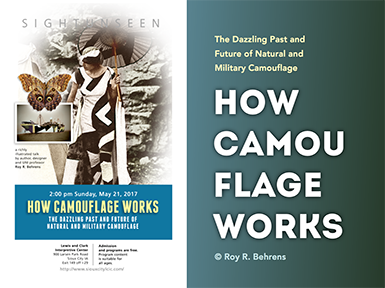
Camouflage in Sioux City Iowa Tomorrow

Above Don't miss the upcoming public program on HOW CAMOUFLAGE WORKS: The Dazzling Past and Future of Natural and Military Camouflage.

Free and open to the public, it starts at 2:00 pm tomorrow afternoon, Sunday, May 21, 2017, at the Sioux City Lewis and Clark Interpretive Center / Betty Strong Encounter Center. It's an excellent educational facility at 900 Larsen Park Road in Sioux City (Exit 149 off I-29).

Roy R. Behrens, Professor of Art and Distinguished Scholar, teaches graphic design and design history at the University of Northern Iowa. He is internationally-known for his publications about art, design and the history of camouflage. The author of eight books and hundreds of published articles, he has appeared in films and interviews on NOVA, National Public Radio, 99% Invisible, Australian Public Television, BBC and IPTV. His most recent book is Frank Lloyd Wright and Mason City: Architectural Heart of the Prairie (2016).


•••

Stuart Guthrie, Faces in the Clouds. New York: Oxford University Press, 1993, p. 49—

…natural selection has produced highly camouflaged and practically invisible animals in every environment. A tawny, countershaded (darker above, lighter below) coyote walking on a tawny Colorado slope, for example, recently disappeared before my eyes merely by pausing and then reappeared simply by walking again.

Sunday, May 14, 2017

Fourth of July Camouflage Parade 1918

Dazzle Ship float in NYC parade 1918
Among the vehicles in the 1918 Fourth of July parade down Fifth Avenue in New York City was a truck carrying a large-scale model ship. Adorned in a dazzle camouflage scheme (probably mostly black and white) in a nest of stars and stripes below, it was labeled with a sign that read “Built by Finnish shipbuilders, launched by Foundation Co., Kearny, New Jersey.” (Actually, the spelling is more eccentric than that: "Build by Finnish Ship Builders Launchd by Foundation Co., Kearny NJ.")

We’ve found four photographs of what may be the same parade float. Three of these are moving to the left, and appear to have been taken by the same photographer just moments apart. But the fourth (see colorized version above) is moving toward the right, so it may have been the work of a second photographer, on the opposite side of the street.

Sounds like a reasonable theory, but there are some inconsistencies: In the group of three photographs, the men walking along with the float are wearing fedora hats, but in the single photograph the men are dressed not in fedoras but in straw boater hats. Hmm. Were there two or more ship building floats that day, perhaps in recognition of the different nationalities of the shipbuilders? Or, was there an exchange of hats or escorts? On closer inspection, our best guess is that there were (at least) two different floats that day, largely because two different styles of dazzle designs seem to have been used on the two model ships—although, granted, we can see only the starboard side on one, the port side on the other.

Our versions of these photographs (reproduced below) have been digitally enhanced (dust and scratch removal, contrast adjustments, cropping) from the originals which are available online at the Library of Congress Prints and Photographs website at the link below each image.

Source

Source

Source


The fourth photograph (sepia-toned below) is listed as being the same event, on the same day. The source of its original is the National Archive and Records Administration (NARA) website as linked below the image.

Source

Saturday, May 13, 2017

Cat's Pajamas Camouflage | Fontana Park in Iowa

Animal Camouflage talk (2017)
Above Opening slides for a talk we gave recently on animal camouflage, titled The Cat's Pajamas, at Fontana Park, a Buchanan County park near Hazelton IA.

We had a delightful time talking about the exotic coloration of pets and wildlife, to the widest age group possible, from preschool to retirement age. It's a beautiful park, with camping, fishing, hiking, picnicking, and an impressive Interpretive Nature Center. During our visit, we watched a thriving family of bison, including one just recently born.

Cat's Pajamas sheet music (c1920s)

Wednesday, May 3, 2017

Model of USS Agwidale in Dazzle Camouflage

Above Model of the USS Agwidale, US cargo ship, showing dazzle camouflage scheme (1918). The model is on exhibit at the Mariners' Museum, Newport News VA. Photographed by Mr.TinDoc (2012) and posted online at flickr with some rights reserved.

•••

Anon, from the Bradford Era (Bradford PA) on April 5, 1918—

The staunchest upholders of the academic in art can scarcely carry their opposition to cubism into its new field as a basis for camouflage. It has been evident, for some time, to people living near Atlantic ports, that cubism has been pitched open as the most valuable system of reducing the visibility of ocean liners. The seemingly systemless way in which greens, blues, grays, and pinks are panted on in bands and blocks of color has quite puzzled persons who have gained close views of these ships; but at a distance of a mile, another story is told, for the various masses of color set up a curious and disconcerting dazzling effect. Painting with gray has been largely superseded by the new method, which escapes the silhouette effect that too often betrayed the gray ships.

Monday, May 1, 2017

Dazzle Ships | Chris Barton and Victo Ngai 2017

Cover illustration | Victo Ngai 2017
Above The cover of a wonderful forthcoming book by award-winning children's book author Chris Barton, titled DAZZLE SHIPS: World War I and the Art of Confusion (Milbrook Press, 2017). The illustrator is Victo Ngai, about whom you can find out more at this Science Library Journal post.

The cover is phenomenal, as is the one full-color page spread I've seen (reproduced below). The illustrator is a graduate of the Rhode Island School of Design (my alma mater as well), where she studied illustration. As anyone knows who follows this blog, the RISD Fleet Library is also the location of a collection of the full-color lithographic dazzle ship camouflage plans from WWI (one of only three surviving sets).

Wish you had a copy now? That would be wonderful. Unfortunately, I'm jumping the gun because I couldn't wait to share the news. It won't actually be published until September, but you can pre-order it now.

Page spread from Chris Barton, DAZZLE SHIPS (2017)

Sunday, April 30, 2017

Ciara Phillips | Exquisite Dazzle-Camouflaged Ship

Dazzle-camouflaged ship |  Ciara Phillips
This is the centenary span of years that marks the occurrence of World War I, from 1914 to 1919. As early as 2014, various agencies began to provide opportunities for artists and arts organizations (especially in the UK) to revisit the process of applying dazzle camouflage schemes to currently existing ships. We’ve featured quite a few of those on earlier blog posts, including those in London, Liverpool, the Island of Jersey and (in Australia) on Lake Burley Griffin in Canberra. There were others as well.

There is one we haven’t yet mentioned, oddly enough, because it’s easily one of our favorites. It differs from the others, because some of those, although their designs are disruptive, do not have a lot to do with the dazzle camouflage schemes that were used in WWI. Sometimes this may have occurred because the artists commissioned were too intent on being uniquely “creative,” on arriving at something appropriate for our own time period, or on using the opportunity to endorse a pressing social concern.

Actually, there’s no reason why all three of those intentions can’t have been emphasized—and, at the same time, have given priority to a design that was in keeping with the intentions of the WWI camouflage artists. The designs that they produced were not arbitrary confusions, not radical juxtapositions of bits. They were certainly accused of that, but as was explained at the time by American ship camoufleur Everett Longley Warner

…it was precisely when our work was most firmly grounded on the book of Euclid that the uninitiated were the most positive that the ships were being painted haphazard by a group of crazy cubists.

Of the recent centenary ships, the most successful one (I think) was designed by Ciara Phillips, titled Every Woman Dazzle Ship, for the Edinburgh Art Festival (EAF) and 14-18 NOW. There’s an online time lapse video of the painting process, and a brief but informative interview with the artist. By the way, it was of particular interest to learn that one of Phillips’ primary influences was the work of American printmaker and social activist Corita Kent, a favorite artist of ours as well.

Wednesday, April 26, 2017

Mirrored Camouflage Listening Posts in WWI

An apparent problem during World War I was that of trying to conceal an eavesdropper within listening distance of the enemy's position. As we've shown in earlier posts, this was sometimes accomplished by constructing (probably using papier mâché) the convincing likeness of a rotting horse carcass. Hollowed out and equipped with peepholes, it was of sufficient size that a soldier could secretly listen during the day, then return to his unit in darkness.

It is impossible to know how often (if at all) "ye olde dead horse deception" was actually used on the battlefield. The only photographs we've seen were made as demonstrations at camouflage training camps, and distributed to various American news services, for amusing wartime anecdotes. If the method were actually used on the battlefield, it would not be wise to reveal it to the public.

Other devices were also employed, or at least they were tested at camouflage training camps. Reproduced above, for example, is a US Army photograph of three soldiers who were testing a curious listening device that consists of a mirrored sheet mounted on a wooden frame (tilted forward slightly). The irregularly-shaped leafy edge is an attempt to make it fit in better within a natural setting. Because the panel front is mirrored, a distant observer would see a reflected image of the terrain, but not the soldier behind it. It may seem like a brilliant idea, but it can't have been very effective. In this photograph, the three soldiers are positioned so closely together that their own bodies would be partly visible in the mirror of the person behind them.

The National Archives and Records Administration online documentation of this (NARA 55162019 and 55162023) includes an additional photograph (as in before-and-after views). In that image (shown below), we see the enemy's point of view (more or less) and—voila!—there is not a trace of the hidden listeners (well, almost).


This idea was not unprecedented at the time of WWI, and it has since resurfaced frequently, probably independently of its older wartime function. As one of many examples, reproduced below is a patent drawing for a "Reflective Hunting Blind," invented c2008 by Kevin Pottmeyer and Chester Burdette and registered as US Patent 8579007 B2. It is currently available as the GhostBlind Waterfowl Blind.


It consists of four hinged panels, irregularly shaped along the top edge, with peepholes through which a hunter can look. The inner surface is covered with a disruptive camouflage pattern, while the side that faces out (as shown here) is a reflective mirror surface (tilted forward slightly). As a result, the inventors explain—

A game animal looking into the front of the blind from a distance therefore sees only a reflection of the terrain surrounding the blind, thereby making the blind substantially indiscernible from the surrounding terrain and effectively obscuring a hunter…

Tuesday, April 18, 2017

WWI Camouflaged Observation Car

Above Camouflaged World War I US Army staff observation car (c1918). Based on an Ordnance Department photograph now in the collection of the National Archives and Records Administration (NARA). 165-WW-296A-019. Extracted from original black and white photograph and digitally colorized.

•••

Anon, ‘Soul Study’ Photos for Ugly Folk: Camera Decreases Years and Removes Double Chins for Patrons (reprinted from the New York Sun) in Abel’s Photographic Weekly. Vol 30 No 774, October 21, 1922, pp. 460-462.

I’m satisfied with photography that shows people as they are. I think that’s what it’s for. I never could see that it was any compliment to a photograph to say that it looked like an oil painting.

It isn’t a photograph’s business to be like an oil painting, and a thing that imitates something else is just a joke, with no sincerity or usefulness in it. All that foggy, smokey, posey camouflage that they’ve dragged into photography to make it look like art doesn’t make any impression on me at all. I want a picture of myself as I am or none at all, but if you want one that makes you look like a dying duck in a thunderstorm you’d better go and get it without consulting me. 

Tuesday, April 4, 2017

Dazzle-Camouflaged Beverage Can

Above Des Moines-based graphic designer Kenny Miesner (former student of whom we have warm memories) shared with us this image and link to Focus Lab studio's concept (not actually used by the client) of a dazzle-camouflaged beer can. It reminded us of a reviewer's comment when the Chelsea Arts Club Dazzle Ball was held in London in 1919. The writer cautioned that the dazzle-patterned costumes might cause the dancers to collide. No doubt a couple of beers would help.