Tuesday, January 28, 2014

WW1 Commonwealth Ship Camouflage

buy online
Above Dazzle-camouflaged British Commonwealth transport ship SS Australford as photographed by Allan C. Green (c1918). Digitally adjusted. Original in collection of Victoria State Library AU.

•••

American artist Thomas Hart Benton, quoted in Richard Cork, A Bitter Truth: Avant-Garde and the Great War. New Haven CT: Yale University Press, 1994, p. 193—

[Working as a camoufleur during WW1] was the most important thing that, so far, I had ever done for myself as an artist. The mechanical contrivances of buildings, the new airplanes, the blimps, the dredges, the ships of the base, because they were so interesting in themselves, tore me away from all my grooved habits, from my play with colored cubes and classic attenuations, from my aesthetic drivelings and morbid self-concerns.

detail

Monday, January 27, 2014

Camouflage Paintings | Pia Dehne

© Pia Dehne 2011
In the late 1960s, when we first began to write about art and camouflage, there wasn't much interest. But in recent years, the subject's popularity has grown phenomenally, and now it seems a commonplace for artists or academic scholars to be engaged, in one way or another, in camouflage-related research. Some of the results are fascinating, while, not surprisingly, a lot of what is being done is neither interesting nor innovative.

Among those whose art pertains to camouflage, I find of particular interest a series of paintings (oil on canvas) by German-born American artist Pia Dehne. One of those works (titled Red Leaf Hunter, 2011) is above, with a second below (F-16 Jet, 2011). She has an artist's website that includes a subsection on Camo Vision, which houses the series of paintings that I find of particular value. Her gallery representation is with Salomon Contemporary in NYC and with AJLART in Berlin.

© Pia Dehn 2011
books on art and camouflage

WW1 Norwegian Ship Camouflage

buy online
Above Dazzle-camouflaged Norwegian tanker SS Ranella as photographed by Allan C. Green (c1918). Digitally adjusted. Original in collection of Victoria State Library AU.

•••

J.M. Daiger, CAMOUFLAGE MAKES WARSHIP INTO "TUB;" ENEMY IS DECEIVED: Painters So Disguise Craft That Brand New Torpedo Boat Looks Like Old Tub or Leaves Landscape Vacant; OLDER NAVAL OFFICERS LIKE NAVY GRAY THE BEST in Ludington Daily News (Ludington MI), December 17, 1917—

NORFOLK, Va., Dec 17—…naval camouflage—the painting of ships to look at a short distance like what they are not and at a long distance like nothing at all.

Impossible as it might seem to make super dreadnoughts appear anything but the monsters they are, there are nevertheless processes of camouflage for them. It is obvious that details as to what designs are being used on various types of ships are not for publication, especially in view of the fact that experimental schemes for having ships sail in false colors—not under them—are constantly being tried out.

detail

I saw one of the largest of the naval colliers, which has several times crossed the Atlantic since America's entry into the war, that had a very simple scheme of camouflage in which only grays were used. Simple in conception and execution apparently, but it had an amazing effect on the appearance of the ship a short distance at sea, and from what happened at that short distance I have no doubt the collier was lost to the eye when it got much farther away.

The older naval officers incline to the opinion that the regulation navy gray by itself is better than any camouflage that the artists have invented, and they are frankly skeptical about these riots of color and freak designs that the scientific application of one of the fine arts is smearing over their ships.

The camouflage used by a great many merchantmen is familiar to every one who has observed the shipping in the harbors along the Atlantic coast. These vessels close by look like scrambled rainbows or like the palette of an artist in his cups. The weather has much to do with the power of these gay colors to create optical illusions.

Saturday, January 25, 2014

Dazzle Camouflage House Paint

WW1 ship camouflage motifs (1919)
Above Ship camouflage patterns from Robert G. Skerrett, "How We Put It Over on the Periscope" in The Rudder, Vol 35 Nos 3 and 4 (March and April 1919), pp. 97-102, as reprinted in SHIP SHAPE: A Dazzle Camouflage Sourcebook (2011). When initially published, it included the following caption:  

Patterns designed to produce interrupted margins and to blur outlines so that the periscopic observer would find it difficult if not impossible to keep his cross hairs upon any feature of the ship long enough to obtain an accurate measurement for the determination of the target craft's speed or range.

•••

Anon, ZIG-ZAG PAINTING MAY BE ANSWER in the Spokane Daily Chronicle (Washington), June 20, 1949—

NEW YORK, June 20 (AP)—Herman Rodenberger, 75, thinks maybe this paint job will last.

Many times Rodenberger has tried to paint his home in Brooklyn. Each time he's failed. His house is a favorite for ball-bouncing games played by kids in the neighborhood.

Each time Rodenberger slapped on a new coat of paint—wham! The boys gathered round and bounced balls off the walls, ruining the paint job.

But this time it's different. Rodenberger had a painter do a "dazzle job" on the house—"just like camouflage" with all sorts of irregular black designs on white paint. Now the kids can't see the ball coming back at them.

"Look," one of them told a reporter. "It drives me crazy. Bounce a ball there, and it'll be back in your puss before you know it."

Zébrage | Striped Camouflage

Above WW1 New Zealand passenger cargo ship, SS Tofua, docked at Nelson (c1919) in striped disruptive camouflage, known in French as zébrage.*

•••

Norman Wilkinson in "Dazzle Painting of Ships" in The Nautical Gazette (September 13, 1919), p. 177—

Sometime before the end of the war we had arrived at the striped type of design which was the most successful type. These striped designs were commented on by a great number of seamen as being by far the best for upsetting the calculation of a ship's course.

* Image Source Digital restoration of photograph by F.N. Jones of the SS Tofua at Nelson NZ (c1919). Original in collection of State Library of Victoria AU.

more info

Tuesday, January 21, 2014

Abbott Thayer's Spartan Funeral

William Adair © 2013
Above In September 2013, William Adair (of Gold Leaf Studios in Washington DC) visited the environs of American painter (and "father of camouflage") Abbott Handerson Thayer in Dublin NH, in the shadow of Mount Monadnock. This is an on-site watercolor he made during that sojourn (and mountain climb), showing Dublin Pond, with Thayer's beloved mountain beyond.

•••

From Alice Frost Lord, SUNLIT TRAIL WITH MAINE FOLKS in the Lewiston Evening Journal (Lewiston ME), September 14, 1928—

Now Maine lovers of the beautiful in nature are being appealed to in behalf of another New Hampshire mountain, promoters of the Old Man of the Mountains' campaign having been encouraged by their success to undertake this new venture. The sum of $20,000 is the goal of today.

It is proposed to buy 1300 acres in two mountain townships which include Monadnock—a height famous in prose and poetry of New England, Emerson, Edna Dean Proctor, William Ellery Channing, Whittier, Thomas Wentworth Higginson, John White Chadwick, Richard Burton, Edwin Arlington Robinson, Rudyard Kipling and Lord Dunsany have lauded its beauty in immortal lines.

Abbott Thayer, the artist loved this mountain and spent many hours exploring its heights. His masterpiece of the eminence hangs in the Metropolitan Art Museum in New York today. So did he love the mountain that in acccordance with his wish his body was cremated after this death in 1921 and he was given a "clean Spartan funeral."

In the afternoon of a perfect June day, his son [Gerald Handerson Thayer], barefoot and alone, carried his ashes up the long climb of the great ridge of Monadnock to the open heights. Hermit thrushes, warblers, wrens, all the pensive choir of sundown, sang from the green spruce coverts below. The sun shone full upon the western slope of the mountain; and, overflowing, mantled the summits of the distant Peterborough hills. The gleaming lakes that gem the landscape caught and sent back the deepening colors of the sunset sky. A cool breeze was blowing from the northwest; and up there under the open sky, in the waiting majesty, royal fellowship, and perfect peace of Nature, the ashes of artist and friend were given to the wind and the mountain he loved. Something of his free spirit lingers there, and Monadnock will be forever a prouder and greater mountain because he lavished so richly upon it his genius and affection.

Postcard of Dublin NH in 1906

Camouflage Artist | Raymond J. Richardson

US Navy camoufleurs (1918)
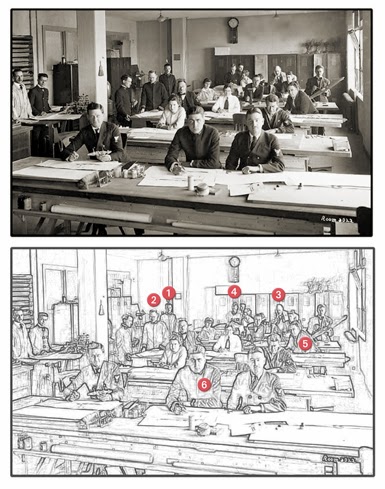
Above This is a rare World War 1-era photograph (c1918) of the drafting room at the Design Subsection of the US Navy's Camouflage Section. This art-centered subsection (under the direction of artist Everett L. Warner) was located in Washington DC, while a second science-centered Research Subsection (under the direction of optical physiologist Loyd A. Jones) was at the Eastman Kodak research facility in Rochester NY. The executive officer in charge of the combined subsections (the Camouflage Section per se) was architect (and Olympic fencing champion) Harold Van Buskirk. Through extensive searches (in part thanks to notes received from the descendants of the camoufleurs), we've been able to identify more of these individuals and to learn about their lives. In this photograph, as indicated by numbers, we have identified Harold Van Buskirk (1), Everett Warner (2), painter Frederick J. Waugh (3) (seated to the right of him is sculptor John Gregory), painter Gordon Stevenson (4), painter Manley K. Nash (5) (standing behind and right of him, holding a large ship model, is Kenneth Stevens MacIntire), and architect Raymond J. Richardson (6), who was in charge of the drafting room. It is not surprising that two of the supervisory personnel (Van Buskirk and Richardson) were architects, because it was often claimed that the best camouflage officers were not artists but architects, because of their experience in working collaboratively. Note also the inclusion of women (an innovation at the time), four or five of whom are in this group.

Richardson (left) and Van Buskirk, looking at model and ship plans

Richardson (?) and Van Buskirk in model storage room

Below is more information about Raymond J. Richardson, with details regarding this unit. It is of additional interest that in 1922 Richardson was appointed Assistant Professor in the Department of Architecture at Carnegie Institute of Technology in Pittsburgh. The head of that school's Department of Art was Homer Saint-Gaudens, who had commanded the US Army's Camouflage Corps during WW1, and in 1924, Everett Warner also joined the faculty there.

•••

Anon, from SERVED IN CAMOUFLAGE SECTION OF U.S. NAVY. READING MAN UNDER WATER, ON LAND AND IN THE AIR in the Reading Eagle (Reading PA), April 11, 1919—

Ensign Raymond J. Richardson, of Reading, who, as a member of the US naval reserve forces, had been serving in the camouflage section of the navy, has been placed on inactive list and has returned to this home town to again take up architecture, the profession which he had been following when he left civilian life to answer the call to the colors. Ensign Richardson enlisted on July 10, 1917, at Newport RI, and was sent from that station to New York City, where he trained under William A. Mackay, considered the dean of naval camouflage in America. Mr. Mackay was at that time engaged in working out camouflage designs for the shipping board.

Later Ensign Richardson was transferred to the League Island Navy Yard, Philadelphia, and had charge of the camouflage work there. On February 25, 1918, he was sent to Washington, where he helped to organize the camouflage section of the navy. At first the designing department consisted of only three men [Van Buskirk, Warner and Richardson, presumably]. This finally grew until there were between 50 and 60 men.

Lieutenant Harold Van Buskirk, a well-known architect, was the executive head of the department, and Lieutenant Everett L. Warner, one of America's best landscape painters, was the head designer. Ensign Richardson served as assistant to these two men and had charge of the drafting room.

The work of this department was to design the type of camouflage which was to be used on the various vessels, both of the transport and combatant type. Models of the vessels were made in wood and these models were studied at various angles and ranges through periscopes and in this way the most effective type of camouflage was determined. Plans and blueprints were then prepared and these were used by the men in applying the camouflage.*

During the time that he was in the service, Ensign Richardson had occasion to make short cruises in submarines and also to make flights in airplanes in order to determine the effectiveness of the work of the camoufleurs. So he served under water, on land and in the air.

Among the men attached to Ensign Richardson's department at Washington was Earl Bankes* * , a brother of C.W. Bankes, of this city. Bankes was a warrant officer.

Ensign Richardson is a graduate of Reading High School, class of 1910, and of the University of Pennsylvania, class of 1913. He took a post graduate course at the latter institution and was awarded the degree of master of science in architecture in 1915.

After graduation Ensign Richardson worked in the offices of some of America's most prominent architects, principally in and about New York City. At present he is with E.Z. Scholl, a Reading architect.

Ensign Richardson is a son of Mr. and Mrs. Fred H. Richardson, 1324 Pricetown Road. His father is a member of the firm of Richardson and Early, wholesale confectioners.

* There were about 450 of these ship painting plans (reproduced in multiples as color lithographs), but apparently only two sets of the plans have survived. The most complete set is in the collection of Fleet Library at the Rhode Island School of Design (RISD), while a second set is housed at the National Archives and Record Administration (NARA).

** Through various online newspaper archives, we've located a number of articles on an Earl Bankes from Reading PA who had resettled in Miami FL, where his paintings were included in various art exhibitions.

Sunday, January 19, 2014

Camouflaged Artillery

Above A US government-issued photograph of a camouflaged heavy artillery mortar, mounted on a railway in France. These were large moveable cannon that could be in place and ready to fire within fifteen minutes, and could strike at fortifications as far as ten miles away. As is evident here, some styles of disruptive camouflage (as distinct from background matching) outlined the contours of the shapes, producing a jigsaw puzzle effect.

•••

Anon, a US Army officer in World War I, having learned of the formation of an American Camouflage Corps

Oh God, as if we didn't have enough trouble! They send us artists!

more info

Friday, January 17, 2014

Camouflage Artist | John Everett

buy online
British painter John Everett (1876-1949) was born in Dorset, England, with the full name of Herbert Barnard John Everett. He studied at the Slade School of Art, and the Academie Julian in Paris. Although he was a close friend of marine painter Julius Olsson (who served as a WW1 ship camoufleur), Everett himself appears not to have designed camouflage—but he did make paintings of camouflaged ships.

Here's part of a note we found about him in an online article (which may no longer be online) by art historian Gwen Yarker at the Maritime Art Greenwich website —

In the spring of 1918 he [Everett] was commissioned by the Ministry of Information to complete some drawings and paintings of wartime London docks and the Thames which were subsequently exhibited in America…In his paintings Everett also explored the visual effects of dazzle painting. This was a form of camouflage put on ships during the war. He experimented with the formal possibilities these designs offered…

There's another online article by the same author on the relationship between Everett's family and the novelist Thomas Hardy, who was also a native of Dorset. Reproduced above is a reconstructed facsimile (reasonably accurate) of a poster from 1918, announcing an exhibition of Everett's paintings of camouflaged ships.

more info

Thursday, January 16, 2014

Camouflaged Cars

We've posted on camouflaged cars before, notably on the Kissel Kar and an ambulance that was camouflaged by the US Women's Camouflage Corps. But we still keep finding more and more. A recent discovery is the British dental car above. But we also found a newspaper article with the headline CHANDLER 'CAMOUFLAGE CAR' IN DISAPPEARING ACT in the New York Sun, on September 23, 1917, p. 6. There is a photo of the car, but it's of such poor quality that it's not worth reproducing here. Nevertheless, here's what the unsigned article says—

Motorcycle policemen, magistrates and justices of the peace are to be eliminated as sources of trouble.

How are they going to "get" you if they can't see you? They can't, that's all. They are through, down and out, and will have to go to work.

It's all very easy. It's "camouflage."

If your car is painted in the magic colors that the French at the front have found melt into the landscape and make the whole outfit invisible at certain distances, what chance will the motorcycle policeman have either to time you or to catch you? Even if your "camouflaged" cap and mask should come off and he should see your face sailing through space on invisible wings, how could he convict you of speeding? One cannot do much with a face of this kind if it is not connected up with something.

The crowds in front of the show window of the Brady-Murray Motor Corporation on Broadway and Sixty-Second Street , where an "invisible Chandler car" is on exhibition, speculate on the kind of service the strangely mottled creation has been giving at the battle front. It is a mysterious car that is worth a lot of study. An army officer is responsible for the strange curves and waves and splotches of color that have made the car scientifically and artistically invisible.

Assurances are generally given at Brady-Murray headquarters that there is a real car under the strange disguise.

"Of course it's real," said a salesman to a skeptic yesterday. "Let somebody offer to buy it and then you'll see how real it is. It will come out of the camouflage with a jump."

The car will be on exhibition for several days.

more information


Wednesday, January 8, 2014

WW1 US Ship Camouflage Schemes

buy online
Above As explained in an earlier post, during World War 1 the US government approved the use on merchant ships of five ship camouflage schemes. These illustrations of them (along with several others), were published in full color in Lindell T. Bates, The Science of Low Visibility and Deception as an Aid to the Defense of Vessels Against Attack by Submarines (Submarine Defense Association, 1918).

Since there are no color photographs of WW1-era ship camouflage, these contemporaneous illustrations may offer some insight into what paint colors were used. More detailed reproductions of these and more are available here.

Camouflage pattern being applied to unidentified US ship (c1917)


From CAMOUFLAGE RECORD in the Weekly Commercial News. Vol 57 No 17, p. 8—

Ten painters in a Jacksonville (Fla.) yard recently put the coat of a camouflage on a vessel for the emergency fleet in two days and six hours. "The Hun Hammer" believes this is a speed record for painting. The ship was 285 feet long. "The Hun Hammer" invites reports from any crew in the country that can beat the Jacksonville record. It recalls that recently on the Pacific Coast a painting record was established, but remarks that nearly four days were required to complete the job.

Saturday, January 4, 2014

WWI Camouflage in Des Moines

WWI truck camouflage
Above World War I camouflaged truck in France (c1918).

•••

From an unsigned news article titled CAMOUFLAGE ARTIST SUGGESTS HOW TO HELP AUTOISTS GET AROUND COP'S FEET in the Des Moines News, Des Moines IA (1917)—

Pierre Defregger, artist, issued from his East-side attic last week for the first time in nigh onto 20 years.

For years Pierre has been so busy in his attic painting pictures of cast iron oak trees growing beside wooden rivers that run uphill, that the census man has never discovered him.

But Pierre should worry.

When he came out of his attic, he brought with him a regular twentieth century idea, hatched by him in solitude, which he says will save the city of Des Moines thousands of dollars in the long run, and prove a pleasure and convenience to local taxpayers.

All Pierre asks in return is that he be put on the city's payroll at a fair salary, with the title of Professional Camouflage Artist.

Here are some of the time-saving, money-saving innovations that Pierre Defregger thinks that a first-class camouflage artist could accomplish for Des Moines:

1. Camouflage the feet of all traffic officers to look like the pavement, so that motorists can drive right over them and not have to go way around. "This would take considerable paint," Defregger points out, "but the cost is inconsiderable when compared with the saving of time to motorists."

2. Camouflage the legs of all women who wear unreasonably short skirts this winter. This might be done in a number of ways. Either camouflage them the color of the atmosphere so that they are invisible, thus saving the boys great eye strain, or camouflage them to represent hitching posts. "When it is taken into consideration," says Pierre at this point, "that most women wait from an hour to two hours for a car, it readily may be seen that a number of teamsters could tie their horses to the camouflaged posts during that period."

3. Camouflage the soft coal smoke issuing from Des Moines' winter chimneys, to represent sunset cloud effects. This could be accomplished by painting the soot particles by means of a squirt gun filled with paint of the desired shade. Says Pierre: "Fly specks on restaurant ceilings could be camouflaged into picturesque effects at small cost, obviating the necessity of redecorating each spring."

4. Camouflage a river to stick under the $400,000 worth of new bridges being built by the city.

5. Show Emil Schmidt* how to camouflage stoves in his street cars this winter.

6. Show Ralph Bolton** how to camouflage heat and light for the Coliseum.

Pierre Defregger, artist that he is, says if the city hires him, he will not guarantee successfully to camouflage food, brains nor clothing. The first two are honestly impossible, says Pierre, and camouflaged clothes always would meet opposition, he thinks, from the prudes.

When asked what he considered the best example of camouflage, Pierre replied: "Bread pudding."

...

* President of the Des Moines City Railway Company.
** Secretary of the Greater Des Moines Committee

Thursday, December 26, 2013

War Log of the Camouflaged Mauretania

Herbert Paus, Collier's magazine cover (1918)
The World War I dazzle camouflage of the RMS Mauretania (designed by British camoufleurs) was a sight to behold. Equally interesting is a 1919 painting of that ship (below) by American artist Burnell Poole (1884-1933), a US government artist and a wartime correspondent for Everybody's Magazine. To the right of it, at a distance, can be seen a second dazzle-painted ship.

Burnell Poole, painting of the RMS Mauretania (1919)


That same year, another rendition of the Mauretania was reproduced (below) in the June 1919 issue of a magazine called Printing Art. It was lauded by editors as an effective use of a dazzle motif—

The war has brought out a great many wonderful effects in decoration, illustration, etc., and among these the various uses of the camouflage must be placed early in any list. Naturally this camouflaging of ships has lent itself better to pictorial illustration than to decoration, but in the insert [in this issue, facing page 304] will be seen a decoration adapted from camouflage designs for the cover of a booklet for the Cunard Steam Ship Company, Limited. This booklet, "The War Log of the Mauretania," while small in size, carries on the cover such an appropriate handling of this peculiar design that we are very glad to be able to show it as this time. The production is the work of Gaines Thurman, Inc., of New York City (p. 312).

Cunard Booklet Cover (c1919)


At the time, the Mauretania was transporting Canadian and American soldiers to and back from Europe. Its astonishing complex design was well-known and widely admired. A year before Cunard came out with its war log, a detail of the ship appeared on the cover of Collier's: The National Weekly (June 15, 1918), in a painting by American illustrator Herbert Paus (1880-1946), as shown at the top of this blog post.

Saturday, December 21, 2013

Horses Camouflaged with Paint

We've talked about this before, but here's more information on an apparently once-common practice of actually painting horses, for purposes of camouflage, during World War I. In an earlier post, we wondered what if any harm this would do to the horse. It appears that the "paint" that was typically used was potassium permanganate (aka permanganate of potash or Condy's crystals). Among US soldiers during WWI, it was used twice daily as an irrigation in treating gonorrhea. Today, it is used in connection with eczema, blisters and athlete's foot—and in rocket propellent. Hmmm.

But first, a parenthetical note for those who are acquainted with Jerzy Kosinski's novel called The Painted Bird. Here's an excerpt that's oddly related to that from the Field Artillery Journal (November-December 1935, p. 537)—

[While awaiting orders to go into Mexico in 1915, the US 6th Field Artillery] had been instructed to leave behind any conspicuously marked animal. The favorite horse of Battery A was a big gray. The men were so anxious to take him along that they dyed him with potassium permanganate. The result was a dirty brown. It might have served, but when the dyed horse returned to his coral, his herd failed to recognize him and attacked him as a rookie. The gray won the fight that followed, but he lost most of his war paint.

Now back to the spurious zebras: As confirmed by a news photograph (above), early in WWI in East Africa, a band of British scouts under the leadership of Berkeley Cole (as described in Valerie Pakenham, Out in the Noonday Sun: Edwardians in the Tropics, p. 213)—

painted their ponies zebra-fashion with iodine to blend into the landscape, and spent five months leading a glorious cowboy existence, riding across a vast game reserve full of herds of almost tame game, before being brought sharply back to reality by a vicious fight with the Germans as Mbuyuni. Cranworth's zebra-striped mule, to his horror, bolted headlong through the German lines, and he then had to charge them in reverse.

Another confirmation of this (see photo below) was published in various US newspapers, such as in a story titled TRICKS IN ALL TRADES, in the Atlanta Constitution, on Sunday, June 13, 1915, with a caption that reads: English Troops in Egypt Paint Their Horses to Resemble Zebras, Which Are Almost Invisible Against a Tropical Background. In a concurrent but different clipping (with the same photograph), the caption reads: A British officer's pony dyed with permanganate of potash in order to make it less noticeable when fighting against the Germans on the East African border.


That said, consider three additional bits: According to Wikipedia, there is a tradition in northern Mexico of painting white donkeys to look like zebras, commonly referred to as Tijuana Zebras. In 2012, new research was published in the Journal of Experimental Biology claiming that a zebra's stripes make it less attractive to horseflies—with the result that some horse owners have since been painting black stripes on their horses.

More recent (if not all that surprising) is apparent confirmation in the journal Zoology that zebras' stripes may be confusing as they move.

Additional Sources

Sunday, December 15, 2013

Aerial Views, Camouflage & Crazy Quilts

Prior to World War I, in part in response to the Armory Show (1913), there was a flood of comparisons (in cartoons in particular) of cubism and futurism with less exalted forms of "art," such as the "crazy quilts" (made of leftover quilting fragments) created unassumingly by America's grandmothers. Above is an especially funny cartoon of grandma and her cubist quilt. Drawn by Clare Briggs and titled THE ORIGINAL CUBIST, it was published in the New York Evening Sun, on Tuesday, April 1, 1913.

After World War I began, camouflage was widely adopted, and inevitably there were comparisons of camouflage and cubism, and, in turn, of camouflage and crazy quilts. More serious, and far more interesting as well, were the various many comparisons of cubism, camouflage, crazy quilts and views of the earth from an airplane (a novelty then). Here's what Ernest Hemingway said in "A Paris-to-Strasbourg Flight" in the Toronto Daily Star on September 9, 1922—

The plane began to move along the ground, bumping like a motorcycle, and then slowly rose into the air. We headed almost straight east of Paris, rising in the air as through we were sitting inside a boat that was being lifted by some giant, and the ground to flatten out beneath us. It looked cut into brown squares, yellow squares, green squares and big flat blotches of green where there was a forest. I began to understand Cubist painting.

Of course Hemingway wasn't the only one to make such comparisons. Journalists and the general public saw it too. Below are two aerial photographs of the French landscape from the same time period. The second view, which appeared initially in Collier's Weekly in 1918, was captioned with a text that read—

NO WONDER CUBISM STARTED IN FRANCE! No one need wonder any longer where the cubists got their inspiration. They must have gone up in an airplane and had a good look at France! This airplane view of an observation balloon floating over a French village is as good a bit of cubist art as anything that Marcel Duchamp ever turned out.

Sunday, December 8, 2013

FDR In Camouflage | Cecil Calvert Beall

Portrait of FDR by Cecil Calvert Beall (c1933)
The American artist who produced this portrait of US President Franklin D. Roosevelt did not (to our knowledge) serve as a camouflage artist, but it certainly looks like he could have. It is a clever composite (chockful of delightful puns) devised c1933 (some say 1936) by magazine illustrator Cecil Calvert Beall (1892-1967). This is a black and white version of course, but the initial painting (as shown below) was in full-color. It was met with such widespread approval that the National Democratic Party used it in its next presidential campaign, assigning it the title of Find What Roosevelt Means to the US in This Picture.

Full-color versions of the same composite portrait

Then or sometime later, it was apparently revised for promotional use in connection with FDR's residence at Warm Springs GA, describing it as "The Little White House," and introducing images of Eleanor Roosevelt and the United Nations.

Beall was a native of Montana who had studied at the Art Students League in New York with George Bridgman. It doesn't seem that "visual puns" were his usual way of working (look up Arcimboldo for historical precedents), but we do know that he used the same technique in at least one other painting. As shown below, it appeared in a wartime poster for the US Army Recruiting Service (presumably for World War I, if the soldier's helmet is correct).


In psychology, composite puzzle pictures such as these are typically referred to as "embedded figures." For a discussion of how these have been used in art, architecture and design (as well as, literally, in camouflage), here is an online essay.

additional sources


Saturday, December 7, 2013

Camouflage Artist | Everit Herter

Herter Brothers cabinet (c1875)
Above An astonishing decorative cabinet, made of ebonized cherry and mixed wood marquetry, circa 1875. It is now in the High Museum of Art in Atlanta. Its creators were the German-born designers Gustave (1830-1898) and Christian Herter (1845-1883), whose design firm in New York was called Herter Brothers.

During the Eisenhower administration, while growing up in the Midwest, we were well aware of the name Herter, because another Christian Herter (1895-1966), a respected American statesmen, was Secretary of State from 1959-1961. That person was the son of an American artist and muralist, named Albert Herter (1871-1950), whose own father had been the earlier Christian Herter, the designer-craftsman.

Although we didn't know it then, the artist Albert Herter had a second older son, a young artist named Everit Albert Herter (1894-1918), who died tragically at the front at Chateau-Thierry in France in World War I. The young Herter was a Harvard graduate, among whose college friends had been the muralist Barry Faulkner (cousin of Abbott H. Thayer) and theatrical designer Homer St. Gaudens (son of Augustus Saint-Gaudens, the most famous sculptor of his time).

Portrait (perhaps a self-portrait) of Everit Herter (n.d.)


When the US Army officially started its Camouflage Corps in 1917, Herter was one of the first to enlist, along with Faulkner, Iowa sculptor Sherry Fry (an Augustus Saint Gaudens protegé), and others whose names I have listed in earlier posts, among them William Twigg-Smith, Valentin di Colonna and Cobb X. Shinn. Saint Gaudens was the officer in charge of the unit, the same unit that published a camp newspaper called The Camoufleur. They trained for several months on the grounds of the American University in Washington DC, then sailed for France in the last few days of December 1917 or the first week of January 1918 (there are conflicting accounts of the departure date).

Until recently we hadn't realized Herter's capabilities as an artist, and still know very little. While it's unfair to assess his potential on the basis of a single painting, we cannot help but be impressed by a work of his in the collection of the Fogg Museum at Harvard. Reproduced below, its title is Portrait of a Young Man in a Brown Shirt (c1913). There is writing on the side that reads: "Study by Everit Herter Harvard Class of 1914 Sergeant Camouflage Corps: [not readable] died in France June 1918." Obviously, the inscription was not added by Herter, but perhaps it was placed there by his teacher, Harvard professor and art theorist Denman W. Ross (1853-1935), whose family gave it to Harvard in 1936.

Everit Herter (1913), Fogg Museum, Harvard

Nor had we realized until recently that Everit Herter had kept a diary during the war, and that a good portion of it can now be accessed online, in M.A. DeWolfe Howe, Memoirs of the Harvard Dead in the War Against Germany. Vol 3. (Cambridge MA: Harvard University Press, 1922), pp. 229-247. He was the first of two American camoufleurs to be killed in action at the front (the other being Faulkner's friend Harry Dickinson Thrasher).

There are numerous accounts of Herter's death, given his friends and family ties. A brief report that first appeared in the Harvard Graduates' Magazine. Vol 27 (1918) reads as follows—

Everit Albert Herter, sergeant, 40th Engineers, died of wounds, June 13, 1918. A small body of men had volunteered to camouflage a gun in a position in advance of the front line. Sergeant Herter was the first to go out, and after reaching the appointed place, waited for the rest of the party. The other members were either delayed or were unable to come, and while waiting, Herter was severely wounded by a bursting shell. He tried to make his way back to the lines, but lost consciousness. Finally he was rescued and carried to a hospital, but he never regained consciousness, and died within a few hours.

His family was of course devastated, made more poignant by the fact that Everit and his wife were the parents of two infant sons. In Everit's memory, his painter father gave to the French people a huge, magnificent mural that was installed in the lobby of the Gare de Paris-Est (East railway terminal). It can be accessed on Wikipedia here. In addition, there are other photographs of it and an insightful account of its meaning on a blog called Invisible Paris.

additional sources

Tuesday, December 3, 2013

Camouflage Artists | Davenport & Benrimo


buy online

Three views of dazzle-painted USS Mount Vernon (1918)
The following is a newspaper article (JAMAICA WOMEN'S CLUB) that appeared in The Daily Long Island Farmer (Jamaica NY), January 9, 1919, p. 1—

The program for the January meeting of the Jamaica Woman's Club yesterday was in charge of the Arts and Crafts Department of which Mrs. J.T. Cooley is chairman. Mrs. Cooley had succeeded in procuring as speakers, Messrs. Henry Davenport, a portrait painter of Boston, and Thomas B.[sic] Benrimo, a magazine illustrator. These artists responded to their country's first call for camoufleurs, and as such have been working on boats in New York Harbor for many months. The father of naval camouflage is Wm. A. Mackey [should read William Andrew Mackay], lately returned from France. The French has used land camouflage for some time. Naval camouflage has been a great success, as out of 150[sic] boats* so treated by the United States, none have been sunk and only two or three hit. The object at first was to render boats invisible, but owing to changing clouds, light and shade, this became impossible and the best plan was found to deceive the eye of the enemy as to the direction in which the boat was proceeding. This was accomplished by means of disappearing and converging lines, black, white and gray being the colors most effective.

It has been a tedious and most difficult job for these artists, for besides a long day at work, 7 days in the week, the boats themselves were not easy to decorate, as on one side they were unloaded of their cargoes and on the other, perhaps loaded. All the work had to be done while ships were in port and besides the loading and unloading there were the usual number of mechanics on board, clearing, painting and repairing. The original plans of working were made at Washington [DC, at the Design Subsection of the Navy's camouflage unit] and might or might not fit the boat they were designed for. Much of the actual work or painting—the large masses—was done by Swedes with huge brushes, but the marking out and finishing was done by these patriotic artists who were accustomed to much finer and more congenial work.

Mr. Benrimo said that the English had adopted our idea of camouflage and had made it much finer, and been wonderfully successful in work turned out.

The object of all the different methods was to apparently turn the course of the boat so that submarine commanders would make wrong sights. Mr. Benrimo in conjunction with this spoke of the importance of painting out prominent parts of a boat using massed color, and bringing different surfaces all on one plane.

Mr. Davenport spoke of the difficulties of actually applying the designs and paint. His talk was very humorous and both he and Mr. Benrimo made one realize how portrait painters can pitch into work wholly foreign to them and accomplish something really big, while the public regards it as picturesque and amusing.


* This may be a printing error since, according to Harold Van Buskirk (the executive officer in charge of the Navy's two-pronged Camouflage Section), more than 1250 US ships were dazzle-painted prior to 1919.
___

There is more to know about Messrs. Davenport and Benrimo. American painter Henry Davenport (1881-1965) was born in Brookline MA. A Harvard graduate, he went to Paris to study architecture but turned instead to painting. Returning in 1914, he studied at Provincetown MA under Charles Hawthorne and George Elmer Browne, then founded his own school in Paris in 1916. Later, he taught studio art and art history at Yale University. In Richard H. Love's fascinating book on Carl W. Peters: American Scene Painter (NY: University of Rochester Press, 1999), there is a suspect statement that claims that "In the New York area, the artist in charge of camouflaging ships in military service during World War I was Henry Davenport, an accomplished painter who had worked in Europe." On the contrary, William Andrew Mackay was in charge of the New York civilian camoufleurs.

As for Thomas D[uncan] Benrimo (1887-1958), he is fairly well-known as a magazine illustrator and early Modernist painter. He also worked successfully as a theatrical designer. His wartime service (during which he is said to have worked with Mackay) is described as follows in David L. Witt, Modernists in Taos (Santa Fe NM: Red Crane Books, 2002):

Benrimo became a lecturer in camouflage methods, training others in this art while at the same time gaining experience valuable to his later teaching career. Using tape measures, chalk lines, and rules, the camoufleur marked out the design on the ship and supervised quality control in the actual paint application…[he] apparently thought this design experience important because he kept his lecture notes and drawings (pp. 72-73).

It is of curious interest that Benrimo, while on the faculty at Pratt Institute (1935-39), was an influential teacher for graphic designer Gene Federico, who himself served as a camoufleur during World War II.

Saturday, November 30, 2013

Camouflage Artist | Douglas D. Ellington

US Navy camoufleurs in model-making room (1918)
In 2011, in Ship Shape: A Dazzle Camouflage Sourcebook, we published a 1918 US government photograph of World War I ship camouflage artists working in the Design Subsection of the American Navy's marine camouflage unit.

In that photograph (reproduced above), five men are shown constructing wooden ship models, on which would be painted experimental "dazzle camouflage" designs, which in turn would then be tested in an observation theatre. Through notations in the papers of Everett L. Warner, we were able to identify the camoufleurs (from left to right) as Douglas D. Ellington, Kenneth MacIntire, Frederick C. Clayter, Richards, and D. Frank (Sully) Sullivan. We have since learned more about Ellington, MacIntire, Sullivan and Clayter, but Richards remains to identified.

Douglas D. Ellington (1886-1960) was an architect who would later become known for his innovative Art Deco public buildings. Indeed, among the historic attractions of Asheville NC (which we inevitably think of as the location of Black Mountain College) are four buildings he designed: First Baptist Church, Asheville City Hall, S&W Cafeteria, and Asheville High School. There is an extensive online biography of Ellington, posted as an article on North Carolina Architects and Builders: A Biographical Dictionary.

•••

[Added 18Jun2014] RELEASED FROM NAVAL SERVICE, Wilmington Morning Star (Wilmington NC), December 23, 1918—

Washington DC, December 22—Douglas Ellington, of Johnston County, has been released from service in the camouflage department of the navy and has returned to Pittsburgh. He is a professor in the Brezel School of Architecture. Mr. Ellington is the only living American credited with having won the Paris prize in architecture.

Additional Sources

Friday, November 29, 2013

Camouflage Artist | Manley Kercheval Nash

We've been trying to find information about an American artist named Manley Kercheval Nash, pictured above c1918, when he was working for the US Navy in Washington DC as one of its camouflage artists. This portrait is a detail from a larger government photograph (reproduced below) of the ship model-painting room of the design subsection of the Navy's Camouflage Section.


Nash, who is seated in the right foreground, is applying a dazzle camouflage scheme to a wooden ship model, which will then be tested for its effectiveness in a specially-designed observation theatre.

Given the historical prominence of all three of Nash's names, perhaps he was descended from venerable families in the South. One source states that Nash was born in Fleming County KY in 1882. There was a lawyer named Samuel Kercheval (1767-1845), who wrote an early well-known history of the Shenandoah Valley (A History of the Valley of Virginia). And Nashville TN was named for the Revolutionary War hero, Francis Nash (1742-1777), who also grew up in Virginia. Manley may also be a family name, and a quick look on the internet finds people who have name combinations like Kercheval Nash, Manley Nash, and so on.

So Manley K. Nash (1882-1947) remains a mystery more or less. One source (Edan Hughes, Artists in California 1786-1940) claims he studied art in Paris in 1905 (as did everyone at the time). When he returned to the US, he apparently lived briefly in (possibly) Harris TX, then moved to St Louis MO, where he painted scenery for the stage, and where other relatives may have settled. After World War I, he moved to southern California, and then, prior to 1930, to Oklahoma City OK. While on the West Coast, he must have made connections with Hollywood movie studios because he continued to paint stage sets for films and in 1938 (according to Hughes) "painted the burning of Atlanta for Gone With the Wind." Moving back to St. Louis, he may have taught at the School of Fine Arts at Washington University, where he himself had studied art as an undergraduate.

Not much to go on really. But we did find one other curious bit. It seems that in 1940, with Hollywood listed as his residence, Nash and another person named Arthur J. Thomas were granted a patent for a toothbrush (US Patent No 2246867) that features a "polishing and massaging element" that "combines with the bristles in cleaning and polishing the teeth [while] also imparting gentle massaging action to [the gums]." Their patent drawing is below.