Sunday, January 6, 2013

Still More on H. Ledyard Towle | A Hue Guru


Women's Reserve Camouflage Corps (1918
H(arold) Ledyard Towle was an American artist and industrial colorist, who was born in Brooklyn, New York, in 1890. After studying art at Pratt Institute, and at the Art Students League (under Frank Vincent DuMond and William Merritt Chase), he embarked on what he thought would be a career as a painter of portraits and landscapes. However, as he later admitted, his experiences as a camouflage artist during World War I changed many of his attitudes, including how he looked at art.

During WWI, Towle was a camouflage instructor in the 71st Infantry Regiment of the New York State National Guard. In that capacity, he provided camouflage training for troops who were preparing to fight on the battlefields in Europe. He also taught a course about camouflage at the Columbia University Teachers College. Before the war ended, he himself shipped off to France as a machine-gunner and camoufleur at the Front.

While still in New York, he also took on an unusual task, which led to a flood of news articles. In early 1918, approval was made to establish a Women’s Reserve Camouflage Corps, and Towle was designated as the instructor for a unit of about thirty-five to fifty civilian women volunteers. The training was largely conducted out of doors in New York, on the grounds of the Billings Estate, which is now the museum The Cloisters.

Full-page article on Towle's women camoufleurs (July 1918)

Towle’s course for women was not only about camouflage, since it also offered training in military drill, boxing, and pistol and rifle marksmanship. Because (or so it was commonly said at the time) women were naturally inclined toward sewing, one of their primary challenges was to make hooded camouflaged “observation suits,” with which they could blend in with natural settings. There was no shortage of news stories about the unit’s activities (enlivened by photographs, along with appropriate quotes from Lieutenant Towle). In July 1918, there were widely published stories about these women camoufleurs (jokingly referred to then as “camoufleuses”) because they had applied a camouflage scheme to a scaled-down wooden battleship (called the USS Recruit) in the middle of New York City in Union Square. In fact, it was not a genuine ship, but a landlocked replica built in 1917 for use as a novelty recruiting station. It was someone’s suggestion that it would be even more novel, generate more publicity, and encourage more recruits to join if its surface was totally covered in brightly-colored, abstract shapes (in “dazzle camouflage”). The women camoufleurs in Towle’s course were chosen to accomplish this. They did the whole thing overnight—and it was the talk of the town the next morning.

When Captain Towle returned from the war, surely he was discouraged to find (like others of his generation) that American Impressionism was no longer in vogue, having been swept aside by Modernism that had begun with the Armory Show in 1913. Beginning in 1919, he worked for the US Treasury Department in Washington DC, in connection with the Victory Liberty Loan Committee, then moved on to positions at several advertising agencies, including one at which he was in charge of the DuPont Company account.

A breakthrough in his career took place in 1925, when he was hired by DuPont (working in cooperation with General Motors in Detroit) to establish a Duco Color Advisory Service in New York. As documented in a book by Regina Lee Blaszczyk on the history of color use in industrial production (The Color Revolution), this enterprising artist-turned-camoufleur became phenomenally influential at DuPont, General Motors (where he worked with other former camoufleurs, and with Harvey J. Earl), and Pittsburgh Plate Glass Company, as industry’s first and foremost “color engineer.”

Towle moved from New York to Detroit in July of 1928, when General Motors launched an “art and color section” and appointed Towle its “chief color expert.” He talked about his career transition in news articles at the time. “I went into the war,” he explained, “thinking art belonged to the chosen few. I came out knowing that it belonged to every urchin in the street. Working on wartime camouflage problems taught one how to use color with a purpose. I saw the futility of painting portraits to collect dust in museums, and turned to camouflaging industry and its products of everyday life.” His disdain for the art world is evident in his statement that “The automobile manufacturers and plumbing magnates are rivaling the Medici of old as patrons of art, and the resources of modern corporations are unlimited.”

In Blaszczyk’s book, she concludes that Towle was “America’s top automotive and paint colorist.” In the 1928 news article (cited earlier), he is described as "a pioneer in the movement which has brought lavender tea boxes, turquoise alarm clocks and a host of vivid motor cars…," a hue guru who “is now studying the 'color consciousness' of each section of the country, hoping to perfect hues which will satisfy the particular desires of each district."

In December 1934, Towle joined the Pittsburgh Plate Glass Company as director of its Division of Creative Design and Color. In 1941, he was interviewed in a news article about his proposal to set up a Pittsburgh civilian camouflage committee, for the purpose of determining which facilities in that city were most vulnerable to attacks by enemy aircraft, and “to design methods either to hide these places by breaking up their shadows or by making them harder to hit.”

From 1945 through 1950, Towle was a lecturer in Business Administration at the College of William and Mary. He died on November 8, 1973. His papers are housed in the Manuscript and Archives Department at the Haley Museum and Library in Wilmington DE.

...

Sources
Roy R. Behrens, False Colors: Art, Design and Modern Camouflage. Dysart, Iowa: Bobolink Books, 2002.
_________, Camoupedia: A Compendium of Research on Art, Architecture and Camouflage. Dysart, Iowa: Bobolink Books, 2009.
_________ ed., Ship Shape: A Dazzle Camouflage Sourcebook. Dysart, Iowa: Bobolink Books, 2012.
Regina Lee Blaszczyk, The Color Revolution. Cambridge, Massachusetts: MIT Press, 2012.
“Color Engineer Sees New Epoch of Vivid Utility” in Waterloo (Iowa) Courier, April 10, 1929, p. 14.
“Raid Defense Gets Impetus in Pittsburgh” in Sandusky (Ohio) Register and News. September 16, 1941.
H. Ledyard Towle, “What the American ‘Camouflage’ Signifies” in New York Times. June 3, 1917, p. 14.
_________, “Projecting the Automobile into the Future” in Society for Automotive Engineering Journal, July 29, 1931.
_________, “Here It Comes” in American Magazine, September 1932.
“Ledyard Towle” (obituary), in New York Times, November 11, 1973, p. 73.

Friday, January 4, 2013

Camouflage Artist | Valentin di Colonna

Cover of John Clayton's book about novelist Caroline Lockhart

Valentin di Colonna (who sometimes used the Anglicized name W.H. “Bill” Miller) was born in Rome, Italy, on September 25, 1879. According to a newspaper clipping (no date, no attribution), he was descended from Italian nobility, reputedly the same Colonna family who were Princes Assistant to the Pontifical Throne.

Apparently (again based on a news report), his father was a diplomatic envoy for Italy to the US, and was involved, in that capacity, with the Chicago World’s Fair in 1893. It is not clear when the younger di Colonna moved to the US, but at some point he enrolled at the University of Notre Dame in Indiana, then subsequently studied art at the School of the Art Institute of Chicago.

At an unknown date, for reasons that remain unclear, he settled in Cody, Wyoming, the town named for Buffalo Bill (William F. Cody), who was one of the people who founded it in 1896, and the location of Cody’s Irma Hotel. It isn’t clear how Colonna supported himself while living in Wyoming. If he was a practicing artist, most likely he was a designer, and, in the diary of a friend and possible love interest, there is mention of his having designed posters on display in town.

His training and interest in art would explain why he was chosen to serve during World War I in the US Army’s first camouflage unit. In a 1917 issue of an area newspaper, the Pinedale Roundup, there is the following news feature:

Wyoming is one of the first states in the union to be represented in the new Camouflage Unit now being organized for service abroad. Valentine[sic] Colonna of Cody, more familiarly known as W.H. Miller in Buffalo Bill’s town, has the distinction of being the first Wyoming man, and one of the first from anywhere, to enroll in this highly specialized force which is expected to render great service in Uncle Sam’s war with Germany (p. 2).

Di Colonna’s service is further confirmed by two brief items that appeared in the camouflage unit’s camp newspaper (of which there were only three issues) called The Camoufleur. (It was written, illustrated and produced by members of the Camouflage Corps, who were in training on the grounds of the American University in Washington DC.) The first mention of him appears in the following paragraph from the October 31, 1917 issue:

Corporal Di Colonna, Buffalo Bill’s right hand man, makes ‘em hustle to keep him supplied with food when he gets a meal downtown [in Washington DC]. He says if a waiter in the Plains Hotel, in Cody, tried to get away with what passes for service here, he’d be shot five times before he hit the ground. Cody isn’t the only place either (p. 6).

A few weeks later, he is mentioned again, in an issue of the same publication dated November 17, this time in a story about a camp visit by President Woodrow Wilson and other civilian and military officials for a demonstration of camouflage, ending with a dinner and a stage performance by the troops. The last paragraph reads as follows:

Artistic balance was achieved by the statuesque figure of Sergeant-at-Arms Di Colonna, who towering above our honored guests, with that practiced eye trained in the hills of Wyoming, watched over their welfare (p. 5).

In December, di Colonna and his fellow camoufleurs departed for France, where they would apply their skills on the battlefield. Presumably after the unit arrived, Colonna asked to be transferred from the camouflage unit to a combat outfit because “to get into the big fight was more to the liking of the Cody man.” As a result, he fought in significant battles, was wounded three times, was terribly burned in a poison gas attack, and suffered a back injury when a tree fell on him. He was twice cited for bravery and received the Croix de Guerre, but for the rest of is life, he lived with the after effects of his wounds.

Before going off to war, it seems likely that Colonna had been romantically linked with another Cody resident, a female Western novelist named Caroline Lockhart (1871-1962). Lockhart was acquainted with Buffalo Bill, but it isn’t certain what connection, if any, there was between Colonna and Cody (so it remains a puzzle why Colonna was called “Buffalo Bill’s right hand man.”)

In a recent book on Lockhart’s life by John Clayton (2007), di Colonna is described as “an Italian nobleman” who in 1918 was “a soldier now off fighting in the war in Europe.” She had received from him a “rather incoherent letter, sending a kiss” (p. 123). When Lockhart’s genteel sister saw one of di Colonna’s letters, she became upset by his use of such words as “bitch” and “pimp”—“A gentleman,” she insisted, “would not write such a letter to a lady.” But Caroline defended him: “Though the son of a bona fide Italian count,” she said, “di Colonna lived a rugged outdorsy life in Cody. Such earthy language was part of his appeal” (p. 123).

As the war persisted, Colonna (a “handsome younger nobleman” who was both “manly and chivalrous”) continued to send her affectionate notes. Lockhart was enroute from Oklahoma on the evening in 1919 when Colonna returned from the war. According to a newspaper account, he was surprised to be met at the station at Cody by a hundred cheering friends “who had been ‘tipped off’” and were waiting to meet the train. That evening, he was the guest at a huge banquet. His friend the novelist couldn’t be there, “but two days later he had a more intimate welcome: dinner and drinks at the home of Caroline Lockhart. He asked if he could kiss her, and though she coquettishly refused, she was quite smitten” (p. 138).

What happened to di Colonna in the remaining years of his life? In 1930, he may still have been in Wyoming, because he is referred to in a news article as the “former State Adjutant of the American Legion, Department of Wyoming.” Beyond that, virtually nothing is known.

That same news clipping (mentioned earlier), with the headline HEART ATTACK CLAIMS BILL MILLER, FAMOUS OLDTIMER AND VETERAN, claims that he never recovered from his wartime injuries, and had been advised for health reasons to move to a lower altitude. When he died somewhere in Maryland on September 7, 1938, he was buried in Arlington National Cemetery, where his gravestone mistakenly carries the name Valentin D. Colonna.

***

Sources
“Cody Man Enters Camouflage Unit” in Pinedale Roundup (October 4, 1917) p. 2.
“William Miller Lies Wounded in Hospital” in Northern Wyoming Herald No 44 (September 25, 1918) p. 1.
“Bill Miller Is Home” in Northern Wyoming Herald No 28 (June 11, 1919) pp. 1 & 4.
John Clayton, The Cowboy Girl: The Life of Caroline Lockhart. Lincoln: University of Nebraska Press, 2007.
Necah Stewart Furman, “Western Author Caroline Lockhart and Her Perspectives on Wyoming, in Montana: The Magazine of Western History Vol 36 No 1 (Winter 1986), pp. 50-59.

Thanks especially to John Clayton who kindly provided invaluable leads, as well as his notes on that unidentified news clipping from Caroline Lockhart’s scrapbook.

Thursday, January 3, 2013

Book Review | The British Phantom Army

Rick Stround, The Phantom Army of Alamein (2012)

The Phantom Army of Alamein: 
How the Camouflage Unit and
Operation Bertram 
Hoodwinked Rommel
by Rick Stroud
Bloomsbury Publishing, London, 2012
288 pp., illus. b&w. Trade, $25.95
ISBN: 978-1-4088-2910-3.


Some time in 2013, a new documentary film titled The Ghost Army will premiere on American public television. It will spell out the little-known story of a World War II U.S. Army unit that operated secretly in Europe from 1944 until the war’s end. That unit was made up of more than a thousand soldiers who in civilian life were so-called “creative types,” among them such now prominent names as the painter Ellsworth Kelly, fashion designer Bill Blass, wildlife artist Arthur Singer, and photographer Art Kane. Working as a team, they impersonated other army units and created persuasive illusions (both physical and auditory) of misleading, unreal battle events.

This book is not about that American unit, as tempting as it is to think that “ghost army” is synonymous with “phantom army.” Rather, this book tells the story of a comparable but earlier British outfit—consisting largely of artists as well—that was formed in 1942 for the massive, focused task of fooling German forces (headed by General Erwin Rommel, aka the “Desert Fox”) in the sands of North Africa in the Second Battle of El Alamein. The resulting Allied victory was in part attributed to (by none other than Winston Churchill) the ingenious clandestine trickery of the British Middle East Command Camouflage Directorate in a famous large-scale project called “Operation Bertram.”

Unlike the American Ghost Army (kept secret until 1996), details of this British ruse have been known since at least 1949, when one of its self-touting members, British stage magician Jasper Maskelyne, wrote what is widely considered to be an embellished and largely self-serving account, titled Magic—Top Secret. Three years later, the film director who headed the unit, Major Geoffrey Barkas, published his own eyewitness report of the operation, titled The Camouflage Story (from Aintree to Alamein). Over the years, those two books have been supplemented by ten or more others about the unit’s achievements. According to its publisher, this one, which has just come out, “tells for the first time the full story.”

So what did these soldier-artist-camoufleurs do? How did they hoodwink the Desert Fox? The answer(s) to that constitutes the best moments in the book. In general, I think it would be fair to say that they used two approaches: First, they made key weaponry disappear—not by vanishing, but by disguising it as something else, as a less threatening, innocuous thing. Tanks were made to look like trucks. Field artillery was concealed in other phony forms. And food, fuel and other supplies were covered up and stacked to look like harmless transport vehicles. Second, at other times, for other purposes, they did the opposite—making clever use of the simplest materials, they constructed trompe l’oeil dummies (tanks, artillery, support vehicles) to create an illusory build-up, to “reveal” things that were never there. As a result, they made the enemy think that Allied forces were being amassed at times and places that differed critically from the real situation. This Second Battle of El Alamein, in which these methods were employed, was the war’s first victory for the Allies.

If illusions, unfounded resemblance and various other visual subterfuges are bewildering to experience, they are at least equally hard to describe. One thing that sets this book apart is the richness of… more>>>

Wednesday, January 2, 2013

Film Review | Rockwell Kent

Dust jacket for Moby Dick with Melville's name omitted

Rockwell Kent
by Frederick Lewis, Director
Dundee Road Productions, Athens, GA, 2005
DVD. 170 mins. Sales $39.95
Distributor’s website: http://www.amazon.com.


In 1902, as a 20-year-old art student at the New York School of Art, Rockwell Kent (1882-1971) studied with the painter Robert Henri. He was one of the top three students in the class, the others being George Bellows and Edward Hopper. Given their talents, at the time all three looked forward to promising futures.

Among Kent’s relatives was a wealthy aunt with an interest in art who had briefly been a student of the painter and naturalist Abbott Handerson Thayer (the "father of camouflage"). By her suggestion, her nephew became Thayer’s apprentice in the summer of 1903, at the artist’s home and studio in Dublin, New Hampshire. Kent fit in remarkably well in the Thayer household, a blissfully fanciful setting which some (uncritical) visitors called “Thayeryland.” In subsequent years, he was a close friend of Thayer’s son Gerald while “Uncle Abbott,” to some extent, was a belated surrogate for his own father, who had died when Kent was an infant. In other than the summer months, Kent also learned architectural drafting in New York, which later, whenever needed, provided a reliable way to survive financially.

Kent's self-portrait photomontage of himself surrounded by Thayers*
A decade later, Kent was dismayed when his work was ignored for the 1913 International Exhibition of Modern Art—now famously known as the Armory Show—while among the featured works was a controversial painting by the French artist Marcel Duchamp, titled Nude Descending a Staircase. Four years later, when Duchamp submitted an entry to an exhibition by the Society of Independent Artists in New York, for which Kent was a board member, that organization rejected Duchamp’s strange submission because (conveniently) the entry form was not properly filled out. The “artwork” that Duchamp submitted was—of course—his first, most famous “readymade,” an unaltered porcelain urinal called Fountain, signed “R. Mutt 1917.”

It was around that time that Kent grew disillusioned with the New York “art world.” He turned essentially to design, even when he was “designing” with paint on canvas. Not surprisingly, today he is especially remembered as an extraordinary book illustrator (for me, his greatest achievement may be the Random House edition of Moby Dick, which, amazingly, was published initially with his name on the front cover, while omitting the name of the author, Herman Melville); an insatiable adventurer, having lived (and lusted, both within and outside of his marriage(s)) on Monhegan Island in Maine, and in Newfoundland, Alaska, Tierra del Fuego, Ireland and Greenland; a phenomenally fluent writer; and a person who bravely protested when he was publicly targeted by Senator Joseph McCarthy in the latter’s fabled manhunt for Communist sympathisers. Kent was openly supportive (too uncritically, in retrospect) of the Soviet Union during the Stalinist era, but he was never a member of the American Communist Party. more>>>

* Kent is the large illuminated figure in the background. The five Thayers seated in front of him are (l to r) Abbott (Papa) H. Thayer, his second wife Emma (Addie) Beach Thayer, Gladys (Galla), Mary (Je-Je, Mandarin Chinese for "big sister"), and Gerald (Gra). Kent has given himself a halo, while Abbott and Gerald have elf ears. In subsequent years, Kent and Gerald Thayer were frequent friends, but he fell out of favor with Abbott because of his unfaithfulness to his first wife, Kathleen Whiting Kent, who was Abbott Thayer's niece. For more on this and other images and information, see the Rockwell Kent Collection at Plattsburgh State University. 

Tuesday, January 1, 2013

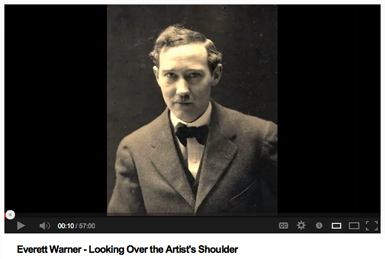
Camoufleur Everett Warner on YouTube

An autobiographical talk by Everett Warner on YouTube
Everett Longley Warner (1877-1963) was an American Impressionist whose artistic career (like that of most promising artists in the early decades of the last century) was destroyed by Modernism. As he himself admitted, he had no taste for abstraction, and yet, ironically, he is largely remembered today as one of the key contributors to the development of dazzle ship camouflage during World War I—the examples of which would be hard to surpass in geometric abstract painting.

In the past decade, there has been a resurgence of interest in Warner, coincident with the popularity of Modern-era ship camouflage. There is an article about him on Wikipedia, an online chronology of his life, and four of his published essays about the theory and practice of camouflage were republished this year in SHIP SHAPE. In addition, a one-hour lecture with an audio track in which Warner himself talks about his art and life (more…) is available on YouTube. In addition, here are links to earlier posts in which he is pictured or mentioned.

•••

Since this was originally posted, I have run across an online interview of American artist Everett Raymond Kinstler, titled "On the Shoulders of Giants," conducted in 2009 by Ira Goldberg. It is online here at LINEA: The Artist's Voice.  On page 9, Kinstler states:

[When he was nominated for membership to the National Academy of Art,] The academy turned me down…I got a letter from Everett Warner, who was a member of the academy and a good landscape painter. "Dear Mr. Kinstler," he wrote, "I was very disappointed to see that you were turned down at the Academy. You're a young artist of great potential and talent." He continued, "Don't be discouraged. The Academy needs people like you." It has always made me sensitive about writing to people.

Tuesday, December 11, 2012

Rockwell Kent and Camouflage

Photograph of Rockwell Kent (c1920) at Wikipedia Commons
On the cover of the December 1918 issue of Everybody’s Magazine is a full-color painting by American artist Rockwell Kent (1882-1971) of a dazzle-camouflaged ship. Online you can see it here.

In 1903, Kent spent the summer as an apprentice to Abbott H. Thayer, while living at the Thayers’ home in Dublin NH. At the time, Thayer and his son Gerald were preparing a large pioneering book on animal camouflage, titled Concealing Coloration in the Animal Kingdom (1909, reprinted 1918). Kent contributed to the book by working with Gerald and his stepmother Emma on a painting of a copperhead snake in a woodland setting.

Later, in 1909, Kent married Thayer’s niece, Kathleen Whiting, but that unfortunate partnership crashed in 1926, largely because of Kent’s repeated infidelities.

Below is an Associated Press news article that appeared in The Lowell Sun (Lowell MA), on February 7, 1941, p. 1—

ROCKWELL KENT HITS US POLICY. Says Camouflage Artists Should Be Paid Higher Wages.

Boston, Feb 7 (AP)—Artist Rockwell Kent, describing the art of camouflage as one of the essential phases of military defense, said today the government was making a serious mistake by paying what he said were “charity labor” wages for camouflage artists.

WPA artists, he asserted in an interview, were being paid only $22.50 a week on projects to make factories, ships and other military objects “look like what they’re not” in case of war. He questioned whether this was wise.

“Most of the rest of our defense is being produced under the best labor conditions—why skimp here?” he asked.

Known chiefly for his woodcut drawings and as an author, Kent said he spoke as head of the United American Artists branch of the Office and Professional Workers Union (CIO).

“Because of the effect of color and pattern on vision,” he said, “camouflage is an essential part of the survival of the fittest.”

“The late Abbott Thayer, who originated the idea of painting wild stripes on ocean vessels to deceive submarines, laid down the principle that if you can’t make objects invisible, make them look like what they’re not.

Naturally, it requires a specialist’s training and years of learning for artists. I was discovered by artists and can be understood only by artists. Yet the government is paying charity labor wages for work on this phase of our defense, instead of paying adequate scales and thus granting recognition of those artists whose work has become essential.”

Kent said his union would work to alter the situation.

“We will soon offer a plan which we hope will result in artists receiving the recognition they achieved in the first World War. There was no relief then, yet men of high standing were employed to design camouflage.”

Saturday, December 8, 2012

Dazzle Ship Camouflage Cartoon

H.A. MacGill (1918), newspaper cartoon


A few days ago, we ran across a newspaper cartoon (above) from the Bridgeport Telegram, Monday, August 26, 1918, p. 12. The artist was H.A. MacGill and the title of the comic strip was Percy and Ferdie—Another Gas Balloon Punctured. When it first appeared in print, there were three additional panels, but they've been omitted here (because they weren't very funny, and had little or nothing to do with camouflage). This remaining panel offers some sense of the American public's response to World War I dazzle-painted ships when they saw them in the harbor.

Wednesday, November 21, 2012

William Twigg-Smith | Camouflage Artist

William Twigg-Smith, Hilo Sampans (1917), oil on canvas

On Wikipedia, there is a brief biography (which admittedly I contributed to) of a New Zealand-born American artist named William Twigg-Smith (1883-1950), a painter, illustrator and musician (primarily a flutist), who lived most of his adult life in Hawaii. During World War I, in 1917 he paid his own expenses to travel from Honolulu to Washington DC to join the American Camouflage Corps on the grounds of Camp American University. According to a news article (Riley H. Allen, "Camoufleur Twigg Smith Is Wearing Corporal's Stripes" in Honolulu Star-Bulletin, October 20, 1917, p. 8), he "was about the first man on the ground, and he carries No. 1 card showing him to be the first member of Company F, 25th United States Engineers, Camouflage, the official name of the unit." Soon after, he was joined in that unit by Iowa sculptor Sherry Edmundson Fry, Everit Herter (brother of statesman Christian Herter), and New Hampshire muralist Barry Faulkner (cousin of Abbott H. Thayer, frequently referred to as the "father of camouflage"). In Faulkner's autobiography (Sketches From an Artist's Life), he recalls that when he, along with Fry and Herter, first arrived at their tent, "we found a minstrel [Twigg-Smith] easing his solitude by playing Hawaiian airs on a ukelele. He came from the islands and was pleasant and companionable."

I recently found a photograph of Twigg-Smith (reproduced below) that appeared initially in the Honolulu Star-Bulletin (Saturday, February 17, 1917) in connection with his collaboration with two other artists on three Pan-Pacific Carnival dioramas that year. Five months later, he would leave to join the army. To enable Twigg-Smith to travel to Washington DC, a large exhibit of his work was mounted in the Pan-Pacific building, with proceeds from the sales to go to covering his enlistment costs.

left to right: Joseph Whittle, Lionel Walden, D. Howard Hitchcock, and William Twigg-Smith


Twigg-Smith was born in Nelson, New Zealand. At age 16, he moved to the US, living first in San Francisco, where he studied painting with Evelyn Almond Withrow, and then in Chicago, where he worked with Harry M. Walcott at the Art Institute. A naturalized US citizen, in 1916 he settled in Hawaii, where he was a flutist for the Honolulu Symphony, and where, by his marriage to Margaret Carter Thurston, he became related to the American entrepreneurs (descended from the original missionaries) who had engineered the overthrow of the Hawaiian royalty. He was the father of Thurston Twigg-Smith.

Prior to his camouflage service, Twigg-Smith was known for on-site paintings of active Hawaiian volcanoes. In a news article (Honolulu Star-Bulletin, December 9, 1916, p. 8), he is said to have exhibited "a sequence of volcano paintings—an attempt to catch Madame Pele in a systematic series of her changeful moods." A later article (December 26, p. 4) reports that the "crater Mauna Loa is smoking…[and Twigg-] Smith is anxious to get to the Big Island and paint the crater in action."

In February 1919, having returned from France but still in Washington, Twigg-Smith was among a dozen artists who were listed as having contributed "posters and decorations" for a philanthropic fundraising event. In a news account of that (Washington Times, February 9, 1919, p. 11) it was stated that "Men of the camouflage corps are seen on the streets of Washington wearing funny looking yellow lizards on the left shoulder. The lizard is really a chameleon, a 'critter' which changes color according to the background on which it is placed. The insignia therefore is significant of their work." Below is a photograph of Twigg-Smith's fellow camoufleur, Barry Faulkner, in a uniform bearing his yellow camoufleur's shoulder patch.

American muralist Barry Faulkner (c1918), wearing camoufleur's patch


In that same article, the names of those in the Camouflage Corps (no doubt some of them misspelled) are listed as follows: "Leslie Thrasher, H. K[err] Eby, A. Bloudheim, H[enry] R. Sutter, A. Rottnere [probably Abraham Rattner], G[eorge] B[radford] Ashworth, Fred[eric] S[eymour] [called Feg] Murray, Robert Laswent, Joseph Cox, [Frederic] Earl Christie [Christy], Frank [Francis William] Swain, Don Methvin, Walter Tubesing, Howard [Ashman] Patterson and [William]Twigg Smith."

Friday, November 9, 2012

Camouflaged Nebraska | Wolfgang Kring

USS Nebraska in Watson-Norfolk camouflage (1918)
Above World War I photograph of the USS Nebraska (1918), painted in an experimental camouflage scheme proposed by an American poster artist named F.M. Watson, who was the chief ship painter at the Norfolk Navy Yard in Norfolk VA.• In government documents, this system was referred to as the Watson-Norfolk plan. Photo Naval History and Heritage Command (NH 101208).

In recent years, as shown in the photos below, a German ship modeler named Wolfgang Kring has produced an amazing replica of the same strangely-painted ship.


Model of camouflaged USS Nebraska © Wolfgang Kring


• Several WWI posters by Watson are listed and described on the website for the Finding Aid of the WWI Poster Collection in the State Archives of North Carolina. Each time, he is cited as "F.M. Watson, Navy Yard Norfolk."

.....

Heber Blankenhorn, Adventures in Propaganda: Letters from an Intelligence Officer in France. Boston: Houghton Mifflin, 1919, p. 3—

It's odd how childish and unbelievable camouflage makes the war seem. It makes it all look like the insane jest of the feeble-minded or a kid's toy. Man's war playthings—childish, ridiculous!

Finally, the convoying destroyers have come, tearing up out of a foggy, rainy, menacing deep—with terrific speed and bringing great comfort, but still looking like jokes—painted, restless insects.

Sunday, November 4, 2012

Camouflaged Mauretania | Jim Baumann

RMS Mauretania (December 1918)


Above I haven't seen this particular photo before (although I've seen plenty of others, almost identical). I found it in an issue of the American Review of Reviews. Vol 59 No 1 (January 1919), p. 19. The caption reads—

THE GREAT TRANSATLANTIC LINER MAURETANIA ARRIVING AT NEW YORK ON DECEMBER 1 [1918] WITH THE FIRST AMERICAN TROOPS RETURNING FROM EUROPE. For more than a year, and particularly since the German offensive of last spring, British as well as American transports had been making eastward voyages crowed with human freight in khaki, through a submarine-infested ocean. Now their peculiar war, to deceive German submarine commanders, is unnecessary. When the Leviathan arrived, two weeks later than the Mauretania, the war paint had been removed. While war was on it was not considered advisable to print picture showing these so-called "camouflaged" vessels.

For more about the RMS Mauretania, I recommend a website called Atlantic Greyhound RMS Mauretania (1907-1935). It offers an extensive history of the ship, but even more fascinating are its dozens of photographs (scroll down the page to see them) of an exquisitely detailed model (numerous in-process views as well as the finished work, two of which are shown below) built by ship modeler Jim Baumann. What an amazing accomplishment.

RMS Mauretania (model by Jim Baumann ©)


RMS Mauretania (model by Jim Baumann ©)

Saturday, November 3, 2012

Philadelphia Ship Camouflage Artists

Philadelphia ship camoufleurs (c1918)
Above This photograph was published in an essay by William Bell Clark, titled "Camouflage Painting on the Delaware."• It is an artfully posed group portrait of some of the Delaware River-area artists who contributed to ship camouflage during World War I. The people are positioned to look as if they are studying the colored lithographic camouflage plans (sent out by the US Navy from Washington DC), while others are applying dazzle camouflage schemes to wooden ship models, or discussing the appearance of already painted models. I am not familiar with many of the Philadelphia artists from that era, but I have identified two of them: Arthur B. Carles ( the father-in-law of graphic designer Herbert Matter) is standing on the right, with black hair and beard, smoking a cigarette, while, directly below him, seated in the front, smoking a pipe, is Frank Vining Smith. Someone else who is well-acquainted with that era and region of the country might be able to name the rest.

In the same article, there is a list of some of the artists who camouflaged merchant ships for the Navy and the US Shipping Board. It may be that someone will be able to match the names with the men who are shown in the photo. Here are the names (in no particular order): Paul [Bernard] King, Harold E. Austin, Frank V[ining] Smith, George W[arren] Lawlor, Albert Rosenthal, Oscar de Clerk, Earl Selfridge, George McLaughlin, Harry W. Moore, Fred J. Thompson, Wilson V. Chambers, Ralph P[allen] Coleman, Franklin C. Watkins, Leo Kernan, Hamilton D. Ware, Worden [G.] Wood, Robert D[avid] Gauley, Mitchel R. Buck, and Arthur B[eecher] Carles [Jr.]. Henry C. Grover (whom we talked about in the previous post) is also mentioned as Manager of the Camouflage Department. Twenty names are listed in the article, while there are thirteen people in the photograph. (Other possibilities are Adolphe Borie, Jean Knox, Waldo Peirce and Carroll Tyson.) Does anyone recognize them?

• Clark's essay was first published in Philadelphia in the World War 1914-1919. NY: Philadelphia War History Committee, 1922, pp. 318-322. It has since been reprinted in SHIP SHAPE: A Dazzle Camouflage Sourcebook (2012).

Camouflage Artist | Henry C. Grover

We wish we knew more about Henry C. Grover (above). Described as being from Boston, during World War I he was—

in direct charge of camouflage painting of all vessels—those of the United States Shipping Board and the United States Navy, the work for the Navy being done in coordination with the proper official in each naval district corresponding to each of the districts of the Shipping Board. The camouflage painting of all vessels by the baffle system [an alternative name for dazzle camouflage] is necessary and obligatory. It supersedes all other methods.•

We recently found an essay by him, titled "Developing Methods of Ship Protection"•• in which he writes that—

Camouflage painting was considered so important [during WWI] that it became a part of the construction division of the [Emergency Fleet] corporation. A nationwide organization was built up, there being district camoufleurs in 11 different districts of the country, distributed according to the requirements of the work. The organization was started at the home office in Washington under the management of Henry C. Grover, and within a short time about 150 men were actively at work and graded as district camoufleurs, camoufleurs and assistant camoufleurs. There were also subdistricts in charge of resident camoufleurs who were stationed at Portland OR, Los Angeles, Norfolk VA, Providence RI, and Montreal, Canada.

Early in 1918 a training school for camouflage painters was started [by William Andrew Mackay] in New York. From this school graduate camoufleurs were detailed to other districts when they were competent to apply designs to ships and had a thorough understanding of the dazzle theory.

Reproduced below are four photographs of dazzle-camouflaged ships that were published with Grover's essay. From top to bottom, they include (1) the USS Isanti camouflaged, (2) a dazzle camouflage pattern on the starboard side of the SS Crawl Keys, (3) and (4) camouflage patterns on two other US ships (not identified).


• Edwin D. Twombley, "How the Paint Box Baffles the Submarine," New York Tribune (August 25, 1918), p. 6, reprinted in SHIP SHAPE: A Dazzle Camouflage Sourcebook.
•• William Courtney Mattox, ed., Building the Emergency Fleet. Cleveland OH: Penton Publishing, 1920, pp. 89-97. 

Thursday, November 1, 2012

The Color Revolution and Camouflage

Ad in Ladies Home Journal, October 1929


The Color Revolution
by Regina Lee Blaszczyk
The MIT Press, Cambridge, MA, 2012
368 pp., illus. 121 col. Trade: $34.95
ISBN: 9780262017770.

Reviewed by Roy R. Behrens

THE PHRASE in this book’s title initially appeared in print in a 1929 issue of Fortune magazine, a few months after the huge financial crash that launched the Great Depression. It announced that there was an ongoing “color revolution,” a widespread adoption of color in industrial products, resulting in “apricot autos, blue beds, and mauve mops.”

Ironically, this book also documents that, in another sense, this was not so much a “revolution” as an “evolution,” the stirrings of which can be traced to the early nineteenth century. It was massively encouraged by the Industrial Revolution, in the interior uses of color at the Crystal Palace Exhibition (the first World’s Fair in 1851), the invention of synthetic dyes, and chromolithographic prints and packaging.

It was also about “evolution” because in part it was empowered by the theories of Charles Darwin, whose much-debated writings about natural selection prompted an increase of interest in the survival function of colors and patterns in natural forms. Was conspicuous coloration a means by which to find a mate? At the same time, did subdued coloration contribute to concealment? One consequence of this exchange was the rise of modern theories about ”protective coloration” in nature, which in World War I acquired the name of “camouflage.” In turn, this led to chatter about “warning coloration,” such as zoologist Hugh B. Cott’s remark that the traffic commission “has adopted a system of coloration whose copyright belongs by priority to wasps and salamanders.”

A recurring theme throughout this book—which the author plays up from beginning to end—is that modern applications of color have developed hand in hand with advances in camouflage. Indeed, it is even contended that, at the end of WWI, it was former camouflage experts (both army and navy) who “applied their knowledge of visual deception to product design and created a new profession: the corporate colorist.” If a person has the wherewithal to conceal an object, he or she can also make that same object conspicuous, through reverse engineering. As this book points out repeatedly, the uses of color in product design were based on the inversion of camouflage techniques—in the words of American artist (and WWI camoufleur) H. Ledyard Towle, it was “reverse camouflage.” More>>>

Wednesday, October 31, 2012

Poop Mimic Camouflage


Above Photographs of swallowtail butterfly larvae in our backyard in Iowa, affectionately referred to as "poop mimics." Photo by Mary Snyder Behrens. The "poetry mimic" below is another stinker.

Gene Fowler, "Camouflage" in Our Paper. November 10, 1917, p. 533 (originally published in the Denver Labor Bulletin)—

The shades of night were falling fast
As through a busy street there passed
A dame dressed up like seventeen,
But fifty years, at least, she'd seen—
     Camouflage!

An old sport, with a foxy vest,
Wears one huge diamond on his chest.
His friends admire him for his taste.
They do not know it is of paste—
     Camouflage

The actress with the Titian hair
Makes hearts beat hard and fond eyes stare.
Ah! Those rare tints of auburn locks
Rise deftly from some drugstore box:
     Camouflage!

The bunk man seeketh him a hick
And slippeth him a neat gold brick.
The sucker thinks he's bought in snug.
Ho, Warden, ho! another bug—
     Camouflage

The girl you woo is small and sweet
You lay your love there at her feet
A year you're married. Ring, bells, ring.
Ah! tell me. Death, where is thy sting?
     Camouflage!

And so, in every vale of life.
(Look out, you're eating with your knife),
You find the things that are, just ain't!
(Get out another coat of paint)—
     Camouflage

Sunday, October 28, 2012

More on Camoufleur H. Ledyard Towle


In earlier writings, we've documented the contributions of American women to camouflage, in connection with their service in the Women's Reserve Camouflage Corps during World War I. In the photo above, published in the Evening Public Ledger Philadelphia (May 13, 1918), four women camoufleurs are demonstrating their camouflaged "observer's suits." These had been constructed as part of a camouflage course, taught by a New York portrait painter, named H. Ledyard Towle, whom we wrote about recently with regard to his prominent later career as an industrial color consultant for DuPont, General Motors and Pittsburgh Plate Glass. Below is most likely a news publicity photograph of Towle at the time he was teaching this camouflage course.

More recently, we ran across an Associated Press news article in the Waterloo Courier (IA) (Wednesday, April 10, 1929, p. 14), which reproduces a photo of Towle, and describes him as a "chief color expert for the General Motors corporation" and "a pioneer in the movement which has brought lavender tea boxes, turquoise alarm clocks and a host of vivid motor cars."

Towle is briefly quoted about his experiences as an army camoufleur and camouflage instructor. "I went into the war thinking that art belonged to the chosen few," he recalls, but "I came out knowing that beauty belonged to every urchin in the street. Working on war-time camouflage problems taught me how to use color with a purpose. I saw the futility of painting portraits to collect dust in museums, and turned to camouflaging industry and its products of everyday life."

In June 1928, according to this news account, General Motors established an "art and color section," and Towle was appointed its "chief color expert." The article concludes: "He is now studying the 'color consciousness' of each section of the country, hoping to perfect hues which will satisfy the particular desires of each district." As we observed in an earlier post, the story of Towle's contributions (and other camoufleurs as well) to the uses of color in commerce has recently been published in Regina Lee Blaszczyk's The Color Revolution (2012).

Camouflage Artist | Frederick J. Hoertz


Above These news photographs of unidentified American dazzle-camouflaged ships were published in The Morse Drydock Dial (April 1919), p. 4. They accompanied an article by C. Stewart Wark titled "Why Camouflage?" Here are a couple of excerpts—

We all remember the first camouflaged ship that came into the dry dock. How grotesque it looked and what a strange sight it was to our eyes. Then the number of them began to increase with such amazing rapidity that the sight no longer had any charms, and we began to regard the zigzag and whatnot painting designs without any particular regard.

Later in the article, Wark talks about having seen the camouflage of an American troopship the USS Von Steuben, which bore a dazzle camouflage scheme on its starboard side, while on its port side was painted a ship silhouette, making it seem escorted by a destroyer. It is highly probable, the article continues—

that this idea originated with Mr. [Frederick J.] Hoertz [1889-1978], the artist who drew the cover for this issue of The Dial. Mr. Hoertz submitted designs to the government which were exactly duplicated on the Von Steuben. His idea also called for smoke pots just over the dummy funnels to make the painted destroyer seem more realistic.

This idea of deception in regard to the character of the craft was used more extensively and to better effect by the Italians than by the naval authorities of our country, where that system could not be said to have gotten above the experimental stage.

A favorite effect employed by the Italian navy was to camouflage a ship so that from a distance it looked like two or three vessels, all heading in different directions. The Italian battleships at our docks some time ago showed that method of camouflaging.

Saturday, October 27, 2012

Camouflage Poster | Daniel O'Shea


Above One of ninety posters designed by graphic design students at the University of Northern Iowa, to advertise an upcoming talk on WWI ship camouflage by RISD scholar Claudia Covert. This is one of three posters designed by Daniel O'Shea. Copyright © 2012 by the designer. All rights reserved.

***

Wallace Stevens—

From time immemorial, the philosophers and other scene painters have daubed the sky with dazzle paint.

Camouflage Poster | Cassie Onnen


Above One of ninety posters designed by graphic design students at the University of Northern Iowa, to advertise an upcoming talk on WWI ship camouflage by RISD scholar Claudia Covert. This is one of three posters designed by Cassie Onnen. Copyright © 2012 by the designer. All rights reserved.

***

E.S., “Impressions of the Fifth Year” in The Atlantic Monthly. December 1918, p. 808— 

[WWI ship camouflage] is so incredible to rational thinking that even its remoter manifestations seem grotesque. One thinks of it as of a prodigious joke, in which the world conspires to conduct the neophyte through some solemn farce of preposterous initiation. To the summer tourist, what could be more unreal than the ostentatious secrecy of sailing, the ships painted in whorls or cubes or checkers, as a child would paint his Noah’s Ark or a vorticist his exhibition canvas; the cruisers, destroyers, balloons, and hydroplanes enveloping the convoy; the passengers, with life-preservers on their shoulders, looking for all the world like stage figures in some masque of Pilgrim’s Progress; and at night the blackened ports and the secret flashings from bridge to bridge, as if the ships were winking at each other in enjoyment of some monumental humbug? Gradually the sense of illusion weakens. The decks, crowded with khaki, moving bands of gray-green topping the camouflage of the ship’s side, grow very real.

Camouflage Poster | Randy Timm Jr.


Above One of ninety posters designed by graphic design students at the University of Northern Iowa, to advertise an upcoming talk on WWI ship camouflage by RISD scholar Claudia Covert. This is one of three posters designed by Randy Timm Jr. Copyright © 2012 by the designer. All rights reserved.

***

C.M. Holland, “Brief Review of Experiences with the AEF…” in Northwestern Dental Journal. Vol 13 Nos 2-3. June-October 1919, pp. 52-53—

Each ship was well camouflaged by various, freakish designs in gaudy colors which to our critical eyes seemed less beautiful and logical than the old reliable battleship gray. Until the principle of marine camouflage had been explained it was difficult to conceive how such bold grotesque designs could render any degree of protection from submarines, but we learned that it required science, research, consultation and good judgment, to arrive at conclusions for effective camouflaging, and our eyes were soon dimmed to the beauty of the battleship gray for it had been shown that within the effective range of the submarine no ingenuity could render its gray invisible so that idea had given way to the idea of confusing the enemy.