Showing posts sorted by relevance for query kenneth MacIntire. Sort by date Show all posts

Saturday, November 30, 2013

Camouflage Artist | Douglas D. Ellington

US Navy camoufleurs in model-making room (1918)
In 2011, in Ship Shape: A Dazzle Camouflage Sourcebook, we published a 1918 US government photograph of World War I ship camouflage artists working in the Design Subsection of the American Navy's marine camouflage unit.

In that photograph (reproduced above), five men are shown constructing wooden ship models, on which would be painted experimental "dazzle camouflage" designs, which in turn would then be tested in an observation theatre. Through notations in the papers of Everett L. Warner, we were able to identify the camoufleurs (from left to right) as Douglas D. Ellington, Kenneth MacIntire, Frederick C. Clayter, Richards, and D. Frank (Sully) Sullivan. We have since learned more about Ellington, MacIntire, Sullivan and Clayter, but Richards remains to identified.

Douglas D. Ellington (1886-1960) was an architect who would later become known for his innovative Art Deco public buildings. Indeed, among the historic attractions of Asheville NC (which we inevitably think of as the location of Black Mountain College) are four buildings he designed: First Baptist Church, Asheville City Hall, S&W Cafeteria, and Asheville High School. There is an extensive online biography of Ellington, posted as an article on North Carolina Architects and Builders: A Biographical Dictionary.

•••

[Added 18Jun2014] RELEASED FROM NAVAL SERVICE, Wilmington Morning Star (Wilmington NC), December 23, 1918—

Washington DC, December 22—Douglas Ellington, of Johnston County, has been released from service in the camouflage department of the navy and has returned to Pittsburgh. He is a professor in the Brezel School of Architecture. Mr. Ellington is the only living American credited with having won the Paris prize in architecture.

Additional Sources

Monday, March 1, 2021

diagram of a ship camouflage viewing theatre in 1918

Recently, we devised a diagram of the type of observation theatre (equipped with an upsidedown periscope) that was first used by the British and then the Americans (and most likely other Allies too) for testing dazzle ship camouflage schemes during World War I. 

Reproduced above is the left half of the diagram, showing two camouflage artists. Included in the diagram are American Navy camoufleurs Kenneth MacIntire (taking notes), and Harold Van Buskirk, who is looking through the periscope, trying to determine the angle at which a camouflage-painted ship model is headed.

As shown below in the right half of the diagram, the ship model was placed on an adjustable turntable, on the other side of a barrier wall. Behind that turntable was a painted canvas background that could be changed to simulate various visibility factors, such as weather or surrounding. Illumination could also be changed. The turntable (or perhaps the surface on which it was mounted) was marked with degree increments. When the periscopic observer had rotated the ship model to an angle that appeared correct, the person on the other side of the wall could easily tell the exact degree to which the observer’s adjustment was mistaken. The greater the error, the more effective the scheme would likely be in deceiving the periscope calculations of a U-boat gunner.

An especially clear, succinct account of the entire process (albeit, not every detail is fully correct) was published in the New Zealand Tablet, on January 29, 1920, including the following excerpt—

…a small wooden model of each ship was made to scale, on which was painted a dazzle design. This was carefully studied in a prepared theatre through a submarine periscope, and when the design had been so altered and arranged that it gave the maximum distortion, the model was handed over to a trained plan-maker, who fitted that design to scale for the particular ship it was intended. The plan was then dispatched to the port at which the particular ship was lying, and transferred to the vessel. Thus a model and plan were made for every ship. For each type a number of designs were made, so that on arrival at port any ship requiring a dazzle plan could be immediately camouflaged. Sometimes as many as 100 vessels were being painted at the same time in one port.

Not all WWI ship camouflage testing theatres were constructed just like this. Some were less elaborate, even makeshift, while others differed in other regards, but the overall principle was the same. 

SEE ALSO

Nature, Art, and Camouflage (35 min. video talk)

Art, Women’s Rights, and Camouflage (29 min. video talk)

Embedded Figures, Art, and Camouflage (26 min. video talk)

Art, Gestalt, and Camouflage (28 min. video talk)

Thursday, January 12, 2017

US Camouflage Artists Preparing Ships for Testing

US Ship Camouflage Artists (1918) [colorized]
Above Our unfinished colorization of a World War I US Navy photograph, an original of which is in the collection of the National Archives and Record Service (No 165-WW-70C-001). It is described as having been received from the Navy Department, Bureau of Construction and Repair, on July 12, 1918, but there is no indication of when it was actually taken.

In this photograph, four ship camouflage artists are applying dazzle camouflage schemes to various sizes and types of wooden ship models. When completed, the models were stored on the shelves on the back wall. We now know the identities of these four artists, all of whom had been career artists in civilian life. They are (left to right) John Gregory, Gordon Stevenson, Frederick Judd Waugh, and Manley Kercheval Nash.

•••

Haldane Macfall [reviewing a London exhibition of paintings by John Everett of WWI camouflaged ships], "The Dazzle-Painter" in Land and Water (February 6, 1919), p. 31—

Now, whilst the guns, for instance, on land were best fogged from observation by camouflage, this problem was not quite so easy for the sea-folk. The sea-gong camouflage artist had to wash out all land laws and discover the whole business anew. First of all, the main object of true camouflage, invisibility, had to go by the board. The light made invisibility pretty questionable: a light sky behind any ship converts it into a solid silhouette. The painter soon found this out; but his endeavor discovered to him a fact almost as important, and on that fact the camouflaging of ships was largely developed. Nothing could reveal this to the landsman better than the art of John Everett in these paintings, in which he has displayed the beauty that camouflage wrought upon modern shipping in an age that we are wont to look upon as lacking in color and romance. The fact may perhaps be most simply stated somewhat thus: The painting of a ship upon the sea in stripes, or violently contrasted masses employed by skill, curiously enough makes it prodigiously difficult to make out her movement and intention of movement, to make out exactly how she is steering. As Lieutenant [Jan] Gordon neatly puts it, "Dazzle-painting attains its object, not by eluding the submarine by invisibility, but by confusing his judgment." It perplexes the submarine as to the ship's course, its range, and its size. Everett has deliberately treated these dazzle-painted ships with realism and set down his impressions without qualification; and the result is a convincingness that is untainted by any suggestion of trickery or special pleading.

•••

Below Following completion of the dazzle painted ship models, each was carefully tested in an observation theatre, which simulated its appearance through a periscope at sea against different backgrounds, varied lighting , and in various weather conditions). Shown here are two camouflage artists from the same Navy unit, in the process of testing the models. The person at the periscope is architect Harold Van Buskirk, executive officer in charge of the two camouflage subsections (the one shown here was in Washington DC; the other at Eastman Laboratories in Rochester NY). Standing beside him is Kenneth MacIntire, an artist who headed the workshop in which the wooden models were made.

Ship Model Testing Theatre (1918) [colorized]
For more information on American and British WWI ship camouflage (both detailed text and images), see James Taylor's recent book on DAZZLE: Disguise and Disruption in War and Art (2016).

Saturday, September 14, 2024

World War I marine camouflage exhibited in Brooklyn

Above An official US Navy photograph (digital coloring) of Lieutenant Harold Van Buskirk, who was head of the Camouflage Section (comprised of two sub-sections) in the Navy's Bureau of Construction and Repair during World War I. He is applying the finishing touches on the "dazzle" camouflage pattern on a scale model of an American ship. Notice the completed models on the background storage shelf.

Once the model was completed, it was taken to a testing theatre, equipped with a periscopic viewing device and changeable seascape backgrounds. The viewer was challenged to estimate the angle of the model as it was positioned on an adjustable platform (as shown in a photograph of Navy camoufleurs Van Buskirk and Kenneth MacIntire ).

•••

Exhibit of Marine Camouflage in Science, Vol 50 No 1287, c1919, p. 205—

The Brooklyn Museum Quarterly describes a special exhibit held at the museum of models, design. and other objects illustrating the practice and some of the principles of marine camouflage. The exhibition was arranged by the curator of the department of natural science, and was made possible through the interest and cooperation of Mr. William A. Mackay, of the United States Shipping Board, camoufleur of the Second Naval District, and Lieutenants Harold Van Buskirk and Everett L. Warner, of the Camouflage Section, Bureau of Construction and Repair, United States Navy. Numerous other naval officers, members of the American Society of Marine Camoufleurs, and others, also contributed to the success of the exhibit by lending illustrative material.

A aeries of photographs made in the naval laboratories at Washington DC, and Rochester NY, showed successive stages of the experimental work by means of which the colors and patterns employed in the camouflage designs had been arrived at. These illustrations included views of the elaborate periscopic theater at Rochester, in which painted models of ships were tested under conditions which simulated, in all essential respects, the open ocean. The history of marine camouflage was briefly traced by means of labels and colored models, while approved as well as experimental designs of the "low-visibility" type, the British and American "dazzles," and the French system, were shown by means of models, photographs and colored lithographs issued by the Navy Department.

A case in the center of the exhibition room contained a miniature convoy of transports in charge of a cruiser and a flotilla of destroyers, each camouflaged model an exact replica of its namesake, or, rather, the original working model from which the transport or war vessel had been camouflaged. A simple, illuminated theater, equipped with a periscope, enabled visitors to observe a model as if from a submarine point of view, and moreover, demonstrated surprisingly well the distortion and other types of illusion produced by the camoufleur's design. 

Thursday, July 4, 2024

Clayter, Sullivan & other Pittsburgh Navy camoufleurs

Frederic C. Clayter / 1918
Above Many years ago, when we first wrote about the team of camouflage artists who designed US Navy ship camouflage with Everett Longley Warner during World War I, among those we cited was someone named Frederic Charles Clayter (1890-1978).

Earlier, we had unearthed a wartime government photograph of Clayter and others in the camouflage “model-making shop” In Washington DC, but we must not have known much more than that. In CAMOUPEDIA: a compendium of research on art, architecture and camouflage (2009), there is no biographical entry for him, although his name is listed in the caption for that photograph.

Clayter, working as a camoufleur in Washington DC


The above portrait photograph of him appeared in The Gazette Times (Pittsburgh, December 22, 1918, p. 1). The headline reads: CAMOUFLEUR IN US NAVY RETURNS TO INDUSTRIAL ART DEPARTMENT AT PITT. Professor Clayter, the article states, is—

head of industrial art education in the University of Pittsburgh, [and] has returned to the School of Education after having served in the camouflage section of the United States Navy. He enlisted in the navy last spring and received a leave of absence from the university…While in the navy he was associated with several well-known artists who were engaged in the same work.

Clayter was originally from Muskegon MI. In a newspaper obituary, he is described as a “master craftsman and jewelry maker,” who had studied at the Philadelphia Museum School of Art, and had been awarded a fellowship at the L.C. Tiffany Foundation in New York. He also studied goldsmithing in England. As a professor, he had taught at the University of Pittsburgh from 1916 to 1921, and at the Carnegie Mellon University from 1921 to 1956. In 1953, he was designated Pittsburgh Artist of the Year.

•••

In the photograph below (the same photograph as before, but cropped differently) four camoufleurs are pictured. They are (left to right) Kenneth MacIntire, Frederic C. Clayter, someone named Richards, and an artist named D. Frank (Sully) Sullivan (1892-1967). The only one yet to be identified is Richards.

Clayter (rear center) in model-making studio


According to an article in the Pittsburgh Daily Post (August 11, 1919, p 16)—

Sullivan had charge of public school industrial arts in Boston before the war and has just been discharged from the service where he was employed as a camouflage artist in Washington DC.

A few weeks in advance of that article, another notice (which includes a photograph of Sullivan, as shown below) had appeared in the Gazette Times (Pittsburgh, July 6, 1919), with the headline BOSTON MAN APPOINTED EXTENSION WORK CHIEF IN PITTSBURGH ACADEMY. It reads—

The appointment of [D. Frank] Sullivan of Boston as director of extension work for the Pittsburgh Academy has been announced by Director Herbert G. Lytle of the local school. Mr. Sullivan was recently relased from the Navy, where he was assigned to the headquarters of the naval camouflage department. He is a native of Massachusetts, and a graduate of the Massachusetts Normal Art School. He has been a member of the faculty of this school and of the Parlin School of Everett MA. Just before entering the service he was head of the department of mechanical drawing and drafting in the Pittsburgh Academy.

D. Frank Sullivan / 1919


In later years, Sullivan appears to have taught commercial art at Connelley Vocational School in Pittsburgh. In an article in the Pittsburgh Post Gazette (March 30, 1951) titled RESCUE OF SUSANNA, it is reported that Sullivan was the owner of a painting by Allesandro Pomi (1890-1976) titled Susanna. A month ago, the article states—

fire swept Mr. Sullivan’s studio in the Whitfield Building, East End, and destroyed practically everything. But Susanna was saved. He carried her out himself…
Alessandro Pomi, Susanna (193

Tuesday, January 21, 2014

Camouflage Artist | Raymond J. Richardson

US Navy camoufleurs (1918)
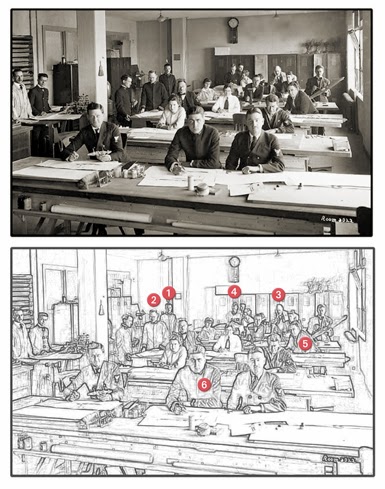
Above This is a rare World War 1-era photograph (c1918) of the drafting room at the Design Subsection of the US Navy's Camouflage Section. This art-centered subsection (under the direction of artist Everett L. Warner) was located in Washington DC, while a second science-centered Research Subsection (under the direction of optical physiologist Loyd A. Jones) was at the Eastman Kodak research facility in Rochester NY. The executive officer in charge of the combined subsections (the Camouflage Section per se) was architect (and Olympic fencing champion) Harold Van Buskirk. Through extensive searches (in part thanks to notes received from the descendants of the camoufleurs), we've been able to identify more of these individuals and to learn about their lives. In this photograph, as indicated by numbers, we have identified Harold Van Buskirk (1), Everett Warner (2), painter Frederick J. Waugh (3) (seated to the right of him is sculptor John Gregory), painter Gordon Stevenson (4), painter Manley K. Nash (5) (standing behind and right of him, holding a large ship model, is Kenneth Stevens MacIntire), and architect Raymond J. Richardson (6), who was in charge of the drafting room. It is not surprising that two of the supervisory personnel (Van Buskirk and Richardson) were architects, because it was often claimed that the best camouflage officers were not artists but architects, because of their experience in working collaboratively. Note also the inclusion of women (an innovation at the time), four or five of whom are in this group.

Richardson (left) and Van Buskirk, looking at model and ship plans

Richardson (?) and Van Buskirk in model storage room

Below is more information about Raymond J. Richardson, with details regarding this unit. It is of additional interest that in 1922 Richardson was appointed Assistant Professor in the Department of Architecture at Carnegie Institute of Technology in Pittsburgh. The head of that school's Department of Art was Homer Saint-Gaudens, who had commanded the US Army's Camouflage Corps during WW1, and in 1924, Everett Warner also joined the faculty there.

•••

Anon, from SERVED IN CAMOUFLAGE SECTION OF U.S. NAVY. READING MAN UNDER WATER, ON LAND AND IN THE AIR in the Reading Eagle (Reading PA), April 11, 1919—

Ensign Raymond J. Richardson, of Reading, who, as a member of the US naval reserve forces, had been serving in the camouflage section of the navy, has been placed on inactive list and has returned to this home town to again take up architecture, the profession which he had been following when he left civilian life to answer the call to the colors. Ensign Richardson enlisted on July 10, 1917, at Newport RI, and was sent from that station to New York City, where he trained under William A. Mackay, considered the dean of naval camouflage in America. Mr. Mackay was at that time engaged in working out camouflage designs for the shipping board.

Later Ensign Richardson was transferred to the League Island Navy Yard, Philadelphia, and had charge of the camouflage work there. On February 25, 1918, he was sent to Washington, where he helped to organize the camouflage section of the navy. At first the designing department consisted of only three men [Van Buskirk, Warner and Richardson, presumably]. This finally grew until there were between 50 and 60 men.

Lieutenant Harold Van Buskirk, a well-known architect, was the executive head of the department, and Lieutenant Everett L. Warner, one of America's best landscape painters, was the head designer. Ensign Richardson served as assistant to these two men and had charge of the drafting room.

The work of this department was to design the type of camouflage which was to be used on the various vessels, both of the transport and combatant type. Models of the vessels were made in wood and these models were studied at various angles and ranges through periscopes and in this way the most effective type of camouflage was determined. Plans and blueprints were then prepared and these were used by the men in applying the camouflage.*

During the time that he was in the service, Ensign Richardson had occasion to make short cruises in submarines and also to make flights in airplanes in order to determine the effectiveness of the work of the camoufleurs. So he served under water, on land and in the air.

Among the men attached to Ensign Richardson's department at Washington was Earl Bankes* * , a brother of C.W. Bankes, of this city. Bankes was a warrant officer.

Ensign Richardson is a graduate of Reading High School, class of 1910, and of the University of Pennsylvania, class of 1913. He took a post graduate course at the latter institution and was awarded the degree of master of science in architecture in 1915.

After graduation Ensign Richardson worked in the offices of some of America's most prominent architects, principally in and about New York City. At present he is with E.Z. Scholl, a Reading architect.

Ensign Richardson is a son of Mr. and Mrs. Fred H. Richardson, 1324 Pricetown Road. His father is a member of the firm of Richardson and Early, wholesale confectioners.

* There were about 450 of these ship painting plans (reproduced in multiples as color lithographs), but apparently only two sets of the plans have survived. The most complete set is in the collection of Fleet Library at the Rhode Island School of Design (RISD), while a second set is housed at the National Archives and Record Administration (NARA).

** Through various online newspaper archives, we've located a number of articles on an Earl Bankes from Reading PA who had resettled in Miami FL, where his paintings were included in various art exhibitions.