Showing posts sorted by relevance for query everett warner. Sort by date Show all posts

Tuesday, January 1, 2013

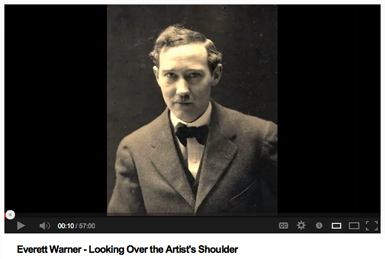
Camoufleur Everett Warner on YouTube

An autobiographical talk by Everett Warner on YouTube
Everett Longley Warner (1877-1963) was an American Impressionist whose artistic career (like that of most promising artists in the early decades of the last century) was destroyed by Modernism. As he himself admitted, he had no taste for abstraction, and yet, ironically, he is largely remembered today as one of the key contributors to the development of dazzle ship camouflage during World War I—the examples of which would be hard to surpass in geometric abstract painting.

In the past decade, there has been a resurgence of interest in Warner, coincident with the popularity of Modern-era ship camouflage. There is an article about him on Wikipedia, an online chronology of his life, and four of his published essays about the theory and practice of camouflage were republished this year in SHIP SHAPE. In addition, a one-hour lecture with an audio track in which Warner himself talks about his art and life (more…) is available on YouTube. In addition, here are links to earlier posts in which he is pictured or mentioned.

•••

Since this was originally posted, I have run across an online interview of American artist Everett Raymond Kinstler, titled "On the Shoulders of Giants," conducted in 2009 by Ira Goldberg. It is online here at LINEA: The Artist's Voice.  On page 9, Kinstler states:

[When he was nominated for membership to the National Academy of Art,] The academy turned me down…I got a letter from Everett Warner, who was a member of the academy and a good landscape painter. "Dear Mr. Kinstler," he wrote, "I was very disappointed to see that you were turned down at the Academy. You're a young artist of great potential and talent." He continued, "Don't be discouraged. The Academy needs people like you." It has always made me sensitive about writing to people.

Sunday, February 2, 2014

Everett L. Warner Aerial View of NYC

Everett L. Warner, New York From a Sea Plane (c1919)
Above Everett Longley Warner, New York From a Sea Plane (c1919). Pastel on paper, 14 x 11 inches. As of this posting, this artwork is available for purchase at MME Fine Art in New York.

•••

About the Warner pastel sketch above, we were surprised and delighted to find it online. We'd seen it reproduced before, but had never seen it framed. When I showed the frame to William Adair at Gold Leaf Studios in Washington DC, he replied that it is typical of a Boston-area "Murphy-style frame," so-named because of the work of American artist and frame designer Hermann Dudley Murphy (1867-1945). As a painter, Murphy was primarily known for his portraits and landscapes, but he also did some wonderful floral still lifes. His papers are in the Archives of American Art.

When I saw Murphy's name, I realized I had heard it before, and that he was somehow connected to wartime camouflage. Indeed, that seems to be the case. In an online biographical note at the National Academy Museum website, it states that "during World War I he worked as inspector of camouflage for the US Shipping Board." During the war, ships in the Boston Navy Yard were being painted with various camouflage schemes by artists and others. Artist Philip Little from Salem MA (whom we've posted on before) was prominent in that group and was surely well-acquainted with Murphy. Little (and probably Murphy as well) was in direct contact with Everett Longley Warner, who was serving in Washington DC at time, as head of the US Navy's team of artists who designed the camouflage patterns required of all merchant ships, as regulated by the US Shipping Board.

Now back to the wonderful Warner pastel on this blog page. Here's what Helen K. Fusscas wrote in an exhibition catalog titled A World Observed: The Art of Everett Longley Warner 1877-1963. Old Lyme CT: Florence Griswold Museum, 1992—

In June 1919, although the war was over and his skills in camouflage were no longer needed, Warner had still not been discharged. He conceived a scheme whereby his last few weeks in the service would be helpful to him as an artist…As a result Warner spent three or four weeks being flown daily in US Navy seaplanes over New York City and the Eastern seaboard painting small sketches in oils from the air to be enlarged later in his studio…He completed several dozen fairly complete sketches, perhaps the first paintings ever done during actual flight.

Warner was soon discharged from the service. His first thought as a civilian was to enlarge enough pictures of flight to make an exhibition.…In a burst of enthusiasm he quickly completed three large paintings from the sketches…New York From a Sea Plane [is] the only one of this series known to have survived even as a sketch…

Warner exhibited his aerial paintings frequently, but the excitement that he had hoped to stir up never materialized. He discovered that few people new or cared what the land looked like from the air. Totally discouraged by the indifference with which his excursions into this new field were received, Warner gave up the idea of painting aerial views…[He] finally painted two out and burned the other.

Tuesday, January 21, 2014

Camouflage Artist | Raymond J. Richardson

US Navy camoufleurs (1918)
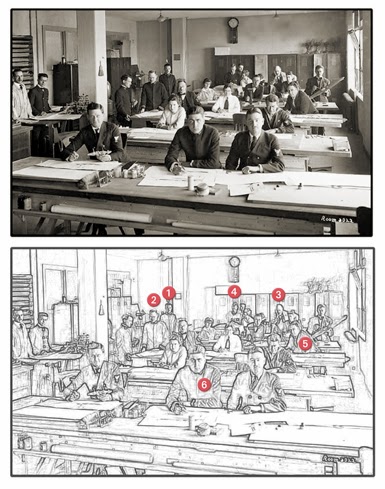
Above This is a rare World War 1-era photograph (c1918) of the drafting room at the Design Subsection of the US Navy's Camouflage Section. This art-centered subsection (under the direction of artist Everett L. Warner) was located in Washington DC, while a second science-centered Research Subsection (under the direction of optical physiologist Loyd A. Jones) was at the Eastman Kodak research facility in Rochester NY. The executive officer in charge of the combined subsections (the Camouflage Section per se) was architect (and Olympic fencing champion) Harold Van Buskirk. Through extensive searches (in part thanks to notes received from the descendants of the camoufleurs), we've been able to identify more of these individuals and to learn about their lives. In this photograph, as indicated by numbers, we have identified Harold Van Buskirk (1), Everett Warner (2), painter Frederick J. Waugh (3) (seated to the right of him is sculptor John Gregory), painter Gordon Stevenson (4), painter Manley K. Nash (5) (standing behind and right of him, holding a large ship model, is Kenneth Stevens MacIntire), and architect Raymond J. Richardson (6), who was in charge of the drafting room. It is not surprising that two of the supervisory personnel (Van Buskirk and Richardson) were architects, because it was often claimed that the best camouflage officers were not artists but architects, because of their experience in working collaboratively. Note also the inclusion of women (an innovation at the time), four or five of whom are in this group.

Richardson (left) and Van Buskirk, looking at model and ship plans

Richardson (?) and Van Buskirk in model storage room

Below is more information about Raymond J. Richardson, with details regarding this unit. It is of additional interest that in 1922 Richardson was appointed Assistant Professor in the Department of Architecture at Carnegie Institute of Technology in Pittsburgh. The head of that school's Department of Art was Homer Saint-Gaudens, who had commanded the US Army's Camouflage Corps during WW1, and in 1924, Everett Warner also joined the faculty there.

•••

Anon, from SERVED IN CAMOUFLAGE SECTION OF U.S. NAVY. READING MAN UNDER WATER, ON LAND AND IN THE AIR in the Reading Eagle (Reading PA), April 11, 1919—

Ensign Raymond J. Richardson, of Reading, who, as a member of the US naval reserve forces, had been serving in the camouflage section of the navy, has been placed on inactive list and has returned to this home town to again take up architecture, the profession which he had been following when he left civilian life to answer the call to the colors. Ensign Richardson enlisted on July 10, 1917, at Newport RI, and was sent from that station to New York City, where he trained under William A. Mackay, considered the dean of naval camouflage in America. Mr. Mackay was at that time engaged in working out camouflage designs for the shipping board.

Later Ensign Richardson was transferred to the League Island Navy Yard, Philadelphia, and had charge of the camouflage work there. On February 25, 1918, he was sent to Washington, where he helped to organize the camouflage section of the navy. At first the designing department consisted of only three men [Van Buskirk, Warner and Richardson, presumably]. This finally grew until there were between 50 and 60 men.

Lieutenant Harold Van Buskirk, a well-known architect, was the executive head of the department, and Lieutenant Everett L. Warner, one of America's best landscape painters, was the head designer. Ensign Richardson served as assistant to these two men and had charge of the drafting room.

The work of this department was to design the type of camouflage which was to be used on the various vessels, both of the transport and combatant type. Models of the vessels were made in wood and these models were studied at various angles and ranges through periscopes and in this way the most effective type of camouflage was determined. Plans and blueprints were then prepared and these were used by the men in applying the camouflage.*

During the time that he was in the service, Ensign Richardson had occasion to make short cruises in submarines and also to make flights in airplanes in order to determine the effectiveness of the work of the camoufleurs. So he served under water, on land and in the air.

Among the men attached to Ensign Richardson's department at Washington was Earl Bankes* * , a brother of C.W. Bankes, of this city. Bankes was a warrant officer.

Ensign Richardson is a graduate of Reading High School, class of 1910, and of the University of Pennsylvania, class of 1913. He took a post graduate course at the latter institution and was awarded the degree of master of science in architecture in 1915.

After graduation Ensign Richardson worked in the offices of some of America's most prominent architects, principally in and about New York City. At present he is with E.Z. Scholl, a Reading architect.

Ensign Richardson is a son of Mr. and Mrs. Fred H. Richardson, 1324 Pricetown Road. His father is a member of the firm of Richardson and Early, wholesale confectioners.

* There were about 450 of these ship painting plans (reproduced in multiples as color lithographs), but apparently only two sets of the plans have survived. The most complete set is in the collection of Fleet Library at the Rhode Island School of Design (RISD), while a second set is housed at the National Archives and Record Administration (NARA).

** Through various online newspaper archives, we've located a number of articles on an Earl Bankes from Reading PA who had resettled in Miami FL, where his paintings were included in various art exhibitions.

Thursday, March 10, 2011

Camouflage and Everett Warner's Cousin

I recently found an old memoir by an American clergyman named John B. Ferguson, a graduate of Miami University of Ohio (1903), who was pastor for fourteen years at two Presbyterian churches in Indiana, in the towns of Howe and Hopewell, then later at the American Union Church in Manila in the Philippines. During World War I, he also served in France with the YMCA, an experience that he later described in Through the War with a Y Man (1919). It turns out that Ferguson was a relative of Everett Longley Warner, an American Impressionist painter who played an especially pivotal role in the development of US Navy ship camouflage during that war. In the book, Ferguson writes this about the day of his departure from New York Harbor for Europe on the SS Chicago (pp. 46-47)—

As was the case with most boats we did not sail immediately. It was exceedingly interesting to see all the camouflaged ships in the harbor. My artist cousin, Everett Warner, very graciously came to see me off. When I saw him come on deck, my first question was, "How did you get on this boat without a passport." He showed a little silver badge which meant the naval board, and I saw that ranks and badges were very important things in the army. From him I took my first lesson in the interesting art of camouflaging. A big freighter near us was all in gray and black. He told me how important it was to have the funnels properly done. There were many theories about it, and I suppose the cubists had their ideal opportunity, for the color scheme on some of the boats seemed to the layman's eye about the most conspicuous mark on any except a painted ocean.

Wednesday, May 14, 2014

Camouflage Artist | Frederick J. Waugh

Camouflage of USS Proteus by Frederick J. Waugh (c1918)
In earlier posts, we've talked about American painter Frederick Judd Waugh (1861-1940), a World War 1 ship camoufleur who worked with Everett L. Warner. As Warner describes in the notes he used for a postwar slide talk on ship camouflage, the 57-year-old marine artist Waugh was the team's most resourceful designer. As evidence, Warner in his notes describes Waugh's solution for "dazzle-painting" the collier USS Proteus, a cargo ship for carrying coal. Above (top) is a photograph of the starboard side of the painted wooden model of the plan proposed by Waugh, while below that is a 1918 photograph of the actual painted ship, as seen from the bow and the port side. Here is what Warner recalled in his notes about the process of designing it—

The eye is so accustomed to the normal operation of the laws of perspective that if you were to see a group of telegraph poles, and they had been so graded in height that the nearest one was much the shortest, you would be likely to think that the tall one in the distance was the nearest. I remember this design well because it cost me a box of cigars. When the model came in (a collier looks like an unfinished skyscraper afloat) it looked like such a difficult problem that I offered a box of cigars if any one of the designers could fool me with a design. Mr. [Frederick] Waugh won the box of cigars, but the joke was on him as he does not smoke. [It was] An effective design, but one belonging to [the] early period before we had entered the realm of solid geometry.

•••

Cecelia Van Auken, COLLECTOR'S LONG-TIME LOVE AFFAIR WITH PAINTINGS OF FREDERICK WAUGH. Bridgeport Sunday Post (Bridgeport CT), July 19, 1970 , pp. 3 and 12—

The Waughs' idyllic life in Kent [CT] was interrupted in 1918, where they had moved four years previously, when Waugh, because of his extraordinary knowledge of the sea, was asked [by Everett Warner] to take part in the important work of marine camouflage being carried on by the Navy department. He went to Washington [DC] for the duration.

•••

Anon, HAD TO FALL BACK ON LUNCH: Seemed the Only Thing Left to Which Host Could Invite His Artistic Friends. Dakota County Herald (Dakota City NE), January 19, 1922, p.2—

Mr. Heming tells an amusing little incident to disprove the general belief that artists are temperamental, dissipated creatures who thrive on the white lights. In the ancient days before prohibition Mr. Heming was in New York to invite American artists to exhibit in the Canadian national exhibit in Toronto. Gardner Symons, the well-known American artist, invited Heming and Frederick Waugh, another leading artist, to dinner at the National Arts club. "Let's go down and have a cocktail before lunch," said Symons. "I never take anything," said Heming. "Neither do I," said Waugh. Symons laughed. "That's funny," he said. "Neither do I, but anyway we'll have some cigars." "I don't smoke," said Waugh. "And I don't smoke," said Heming. "Well, this is a great joke," said Symons. "I don't smoke either, but I thought you fellows would at least take a cigar. Say, you eat, don't you?—because I've ordered lunch."

•••

Anon, VISUAL THERAPY in Morning Herald (Hagerstown MD), March 10, 1953, p. 8—

Fine paintings on a hospital wall constitute a "visual therapy" and are helpful to the sick, New York hospital workers say…We think this very probable and are sure the routine paintings and prints on such walls up to now retard recovery…(A still-life showing a faded apple, a couple of green pears and a slice of melon once kept us laid up at least a week longer than was necessary.)…We remain a little skeptical about the masters…We want no doctor to prescribe a Picasso when we can get a good Frederick Waugh or Winslow Homer…A lot of widely heralded moderns make us sick…

•••

Anon, MAKES UNIQUE PICTURES FROM BITS OF DRIFTWOOD: Many-Sided Waugh, Known to Milwaukee Through Marine Paintings, Expresses Inspiration in Diverse Forms, in the Milwaukee Sentinel, January 15, 1922 [announcing an exhibition of Waugh's driftwood artwork at the Milwaukee Art Institute]—

…When the Boer War was on and [Frederick] Waugh was painting in London  he even temporarily gave up the game of chance as to an artist's livelihood to rehandle sketches sent back to the London Graphic by officers and artists at the front. When no sketches came in, telegraphic description was all the data he needed for his series of spirited battle pictures.

His knowledge of sea-craft and ready enthusiasm made him a most valuable assistant in the bureau of camouflage during the late war.

…From his home in Mount Clair NJ, Waugh often went down to wander along the beach of his always bel0ved sea. The usual driftwood, remnants of ruined craft, bits of tree roots and gnarled branches from only the waves know where, have always fascinated him. He often gathered them up. Their curious shapes kindled his imagination. His creative desire wound itself around their blanched, smooth surfaces and he set about to make them beautiful, to incorporate them into art.

With knives and paints, brush and ingenious vision he worked these bits of driftwood into designs, pictures if you will, charming things, delicately colored.…

Twenty-eight drawings by Waugh, derived in part from gnarled wood shapes, were used as illustrations for a children's book titled The Clan of Munes (New York: Charles Scribner's Sons, 1916). The original book illustrations were recently exhibited at the Ulrich Museum of Art at Wichita State University (Wichita KS) from January 25 through April 13, 2014. The same museum owns a large collection of more than 300 artworks by Waugh, donated in 1974 by Edwin A. Ulrich.

•••

See also an earlier mention of Waugh in Vladimir Nabokov's scandalous novel, Lolita (New York: Knopf, 1992). Below A portrait of Waugh (1929) in Peter A. Juley and Son Collection, Smithsonian American Art Museum.

Peter A. Juley & Son, Portrait of Frederick Judd Waugh (1929)

Monday, September 28, 2020

Everett Warner and WWII Disruptive Ship Camouflage

Reproduced below is an extremely rare photograph of a small team of US Navy ship camouflage artists during World War II. In the center foreground, holding a ship model, is Everett Longley Warner, who was the Chief Civilian Aid in charge of ship camouflage. Warner had served in a similar capacity during World War I. The person in the top left background is unidentified, but the remaining five staff members are (l to r) Bennet Buck, Sheffield Kagy, William Walters, Arthur Conrad, and Robert R. Hays. It was Hays who provided a scan of this photograph when we corresponded with him in the 1990s.


In researching naval camouflage, I have typically emphasized WWI, largely because, as an artist and designer, it is far more intriguing to me than WWII, and, more generally, because I am less interested in military technology than in parallel form developments in camouflage (natural and military) and Modern-era art and design.

Related to that, it has always puzzled me to find that, when I speak to audiences about WWI dazzle ship camouflage, a common response is for people to say that such “high difference” confusion patterns must only have been used in WWI, because (or so they assume) non-visual means of detection (such as radar) were predominant during WWII.

Yet, if I look through my archive of ship camouflage photographs (see examples of WWII below, c1944-45), I easily have as many or more examples of “disruptively patterned” ships from WWII as I have from WWI. An additional consideration is that the same person (Everett L. Warner, as noted above) was responsible for ship camouflage in both World Wars.

USS Passig
USS Lenoir
USS Breckenridge


This is not to say that pattern disruption in WWI and WWII were the same. They were not. As I tried to explain in an earlier published essay, titled Disruption versus Dazzle: Prevalent Misunderstandings about World War I Ship Camouflage (2018), disruptive patterns were still widely used in WWII, but with an important distinction. 

WWII ship camouflage was no longer addressed solely or primarily to the viewpoint of a U-boat periscope, but to multiple observation points, such as the view from the deck of a ship, or from an airplane’s overhead view. As a result, as shown by WWII ship camouflage plans, it became essential to apply disruptive patterns to the horizontal surfaces of a ship, surfaces that would not have been visible during WWI from the viewpoint of a German submarine.

Unless I’m mistaken, this issue has largely been ignored by others who research the subject. But there is at least one exception. It is discussed in an online paper titled Naval Camouflage and its Application on HMC Ships REGINA and MONCTON: A Brief History, published in March 2020. Its author, Timothy Choi, is a doctoral candidate at the University of Calgary’s Centre for Military, Security and Strategic Studies.

RELATED LINKS

Ship Shape: A Dazzle Camouflage Sourcebook

Khaki to Khaki (dust to dust): The ubiquity of camouflage in human experience

Chicanery and Conspicuousness: Social Repercussions of World War I Ship Camouflage 

Sunday, November 29, 2020

irrefutable confirmation that the artist can be practical

Lieutenant Warner at his residence


Washington Evening Star
(Washington DC), March 17, 1918, p. 28—

Everett L. Warner of this city and New York has lately received a commission as a first lieutenant, senior grade, in the Navy, on account and for the continuation of his work in what is known as “marine camouflage.”

The particular branch of work that Lieutenant Warner has been conducting is, in point of fact, not camouflage along the lines understood by this term at present, but is, rather, what is known under the general name of “dazzle system.” Upon careful observation it has been found that there is no such thing as camouflage for ships, there being no single color which will make them invisible under all circumstances. The “dazzle system,” which distorts a boat’s shape and prevents accurate marksmanship on the part of the enemy, has, however, proved not only helpful, but a real protection. And it is this that is being followed out scientifically under the charge of Lieutenant Warner and other artists with the co-operation and approval of the United States Shipping Board and the Navy Department.

The theory was developed primarily and largely in England, and three-fourths of the mail streamers between the United States and England now make use of it.

This is an interesting use to make of art and one which has proved its value. It goes to show, moreover, that the artist can be practical as well as artistic and has his place in warfare as well as in days of peace.

•••

Postscript A day or two after we posted this, we happened to run across an online newspaper article about Everett Warner and camouflage, published in the Pittsburgh Post-Gazette on December 25, 2019. 

Tuesday, December 5, 2017

Camoufleur Everett Warner at Griswold Museum


We are indebted to Jim Dodge for alerting us to a current exhibition called World War I and the Lyme Art Colony at the Florence Griswold Museum in Old Lyme CT. The small exhibition, which includes a selection of artworks by historic Lyme Colony artists who contributed to the war, will continue through January 28, 2018. 

Of particular interest to us are war-related artifacts that pertain to US ship camoufleur Everett Longley Warner, including three aerial cityscape views. A two-page article [above] about the exhibition appears in the December issue of the New England Antiques Journal, which can be viewed in full online at <http://tinyurl.com/ybt3mlop>.

US ship camoufleur Everett Longley Warner (c1918)

Monday, December 23, 2024

Lewis W. Rubenstein / WWII US Navy ship camoufleur

Everett L. Warner (front center), with WWII ship camoufleurs
In 1993, Stephen Polcari, Director of the Archives of American Art, conducted a tape-recorded interview with American artists Lewis W. Rubenstein and Erica Beckh Rubenstein, in which Lewis Rubenstein spoke about various aspects of his artistic life, including his camouflage service during World War II.

Among the things that Rubenstein recalled were his associations with scientist Edwin Land, inventor of the Polaroid camera, with whom he had been college friends at Harvard, and a government official named Richard C. Morrison, who had also been at Harvard and was in charge of a camouflage research project in Boston, which involved the development of a camouflage paint (invented by Samuel Cabot) called “haze paint.” He also worked with Land on research that pertained to underwater vision in relation to submarines.

Rubenstein was originally from Buffalo NY. After graduating fom Harvard in 1930, he received a fellowship to study in Europe. When he returned, he taught the Boston Museum School and the University of Buffalo, then joined the faculty at Vassar College. A newsletter from that school announced in early 1942 that Rubenstein had taken leave from teaching “for the duration of the war,” in order to contribute to US Navy camouflage.

In his interview for the Archives of American Art, he shared specific information about his wartime service, albeit the interview transcript is replete with phonetic name spelling mistakes. “…I went into the navy in ship camouflage…” he states, “…[where] I worked with Charles Benninger [sic, Charles Bittinger]…”

He continues: “[Dazzle] was one kind of [ship camouflage], and the other kind was just low visibility, and I did both. I was in that camouflage unit during the war. There were a number of artists in that too. [Bittinger]  was an artist and his half-brother was a member of the National Academy—his half-brother was John Maron [sic, John Marin]. He once invited me to lunch with [Marin]. And Edward Warner [sic, Everett Longley Warner], who was a painter, was the other half of that. Eliot O’Hara was in the group, [as was] Bennett Buck, [and] a number of artists.”

The remaining mention of camouflage in the interview is filled with mistakes, and more confusing than informative. But, just for the record, it goes like this:

Polcari: Yeah, I remember—Ellsworth Kelly was in the camouflage unit.

Lewis Rubenstein: He wasn’t in that one.

Polcari: No, he wasn’t in that one.

Erica Rubenstein: Maybe he was in army camouflage.

Polcari: Yeah, army camouflage, that’s right. Rourkie [sic, Arshile Gorky] taught camouflage—[Gorky] taught camouflage in New York City.

Rubenstein: (Laughs.) He made the best use of it, I think.

Polcari: Yes, he did. Well, that’s true, that he used it in his style. He used it in his style.


Reproduced above is a photograph that was given to me by one of the ship camoufleurs who served in the same unit as Rubenstein. It was given to me by Robert R. Hays, who is on the far right in the photograph. He was one of those who served under Everett L. Warner, who is shown holding the ship model at the front center. I’ve identified the other four members of Warner’s team who are standing around him. They are (from left to right) H. Bennett Buck, Sheffield Kagy, William Walters, and Arthur Conrad (father of artists Daniel Conrad and Tony Conrad). The only person whom I haven’t identified is the man in the very back at the extreme left. I now wonder if that might be Lewis Rubenstein, but I can’t confirm it. As shown by a later photograph of Rubenstein (at the bottom of this post) it might well be him.

Lewis W. Rubenstein / ship camoufleur
ONLINE VIDEO TALKS

Dazzle Camouflage: What is it and how did it work?

Nature, Art, and Camouflage 

Art, Women's Rights, and Camouflage

Embedded Figures, Art, and Camouflage

Art, Gestalt, and Camouflage
Friday, July 17, 2015

Edison Shmedicine | Ship Camouflage Wizardry

Thomas A. Edison's camouflage for the SS Ockenfels
Above Two views (before and after) of an American merchant ship, the SS Ockenfels (later called the USS Pequot), a ship assigned to Thomas A. Edison for testing experimental camouflage (it is apparently not the SS Valeria, described below). He was also loaned the services of Naval Reserve Officer Everett L. Warner, who later made the comment below about Edison's fiasco.• more>>>

Everett L. Warner in a letter (no date) quoted in Nelson C. White, Abbott H. Thayer: Painter and Naturalist. Hartford CT: Connecticut Printers, 1951, p. 138—

[A ship camouflage proposal by Thayer] was no more visionary than Thomas Edison's scheme involving a big spread of canvas. But Edison was an inventor, so they let him try out his idea, and a very wild idea it turned out to be. I know because I had the job of doing the painting work on the vessel (SS Ockenfels). Part of the added camouflage structural work was so unseaworthy that it got carried away before the vessel got out of New York harbor.

•••

EDISON'S SHIP CAMOUFLAGE (reprinted from The Outlook) in Arizona Republican (Phoenix AZ), March 15, 1918, p. 4—

A scheme of camouflage for ships, attributed to Mr. [Thomas A.] Edison is described as consisting in cutting down the masts and funnels and covering the ship fore and aft with canvas strips painted in various colors. Lofty masts, it may be remarked, are a survival of the days of sails, and might be dispensed with altogether, as in the "monitor" type of vessels.

•••

CAMOUFLAGE in Examiner (Launceston, Tasmania) May 6, 1919, p. 4—

How Edison, the famous American, invented one of the earliest and most successful systems of "camouflaging" merchant vessels has just been revealed by one who assisted in the experiments. In those days, before the convoy system had been so largely developed, and when merchant ships had to rely so much for safety upon their own unaided efforts, scientists of all countries were devoting much time to the question of the reduction of visibility at sea. Amongst them was Thomas Alva Edison, the American inventor. To aid him in his work the Cunard Company placed at his disposal for experimental purposes the Valeria, a 10,000-ton freight carrying steamer. Edison got quickly to work, and, before long, the result was seen in the Mersey, where an incoming vessel—squat, dumpy, barge-like—excited general wonder. It was the "camouflaged" Valeria. Her funnels had almost disappeared and her masts were cut right down; portions of her super-structure had been removed or concealed; and finally immense painted screens of canvas were hanged along the ship and "wrapped" around her top side like nothing else on earth—or at sea. She was almost invisible at a short distance and quite unrecognizable. It was the crew of the Valeria that had the thrill of feeling a shock in the vessel's bottom, and the subsequent pleasure of seeing a German submarine emerge with a broken periscope. The distance separating the two vessels was so small that the Valeria's guns had to be depressed to the fullest extent in order to fire on the intruder.

•••

Benedict Crowell, "Marine Camouflage" in The Giant Hand: Our Mobilization and Control of Industry and Natural Resources, 1917-1918. Part 2. New Haven CT: Yale University Press, p. 502—

The cloth screen for breaking up the outline of a ship was popular with the inventors. No less a savant than Mr. [Thomas] Edison was intrigued by this notion. The Cunarder Valeria was turned over to Mr. Edison for experiment. Among other things that he did to the ship, he screen her upper work in canvas. The screen was blown off shortly after the ship left New York. The inventors, who were usually landsmen, appreciated neither the force of the Atlantic winds nor the psychology of the sailors, who scoffed at the screen contrivances and would not rig them up again if they below down.

•••

Lindell T. Bates, The Science of Low Visibility and Deception as an Aid to the Defense of Vessels Against Attacks by Submarines. Submarine Defense Association, 1918, p. 31—

The new ships for the Emergency Fleet Corporation have been designed with low superstructure. A notable example of a vessel with superstructure reduced is the SS Valeria. The vessel was a Cunarder supplied to Mr. Thomas A. Edison by the Submarine Defense Association for this experimental purpose. The funnels and mast were cut short and the superstructure concealed by canvas screens. These measure appear to have rendered her less visible, but she has lately been torpedoed and sunk [while traveling in a convoy for the first time].

•  All this is somewhat confusing because on pages 498-499 of Crowell's The Giant Hand, the US Navy's official account credits Everett L. Warner with the camouflage of the SS Ockenfels (which is true in the sense that he carried it out), without any mention of Edison being the source of the camouflage plan. It reads as follows —

The dazzle system that was at length universally adopted originated in England. Yet we possessed in America an artist  who had not only advised distortion painting from the outset,  but had also applied his theory to several American vessels, which were therefore the first to carry dazzle designs to sea. This artist was Mr. Everett L. Warner of New York. On September 29, 1917, he brought to the Navy certain painted models which showed how he would break up a vessel's silhouette in order to make it hard for the enemy to get her range. This he did by using angular patches of whites and other colors in successive rows that overlapped each other and ran upwards from the water line at an angle of sixty degrees, covering hull,  structure, funnels, and masts, and bending around transverse surfaces, such as the ends of deck houses. The Navy adopted  the system and ordered Mr. Warner to paint the ex-German ship Ockenfels as an experiment. The pattern which he applied made the ship's water line elusive. He cut down the funnels and masts and stretched a screen of canvas from bow to stern,  the upper edge of the screen being on a level with the tops of  the truncated masts. He also affixed to the stern of the vessel a boom with trailing cordage, to equalize the two ends in appearance.


Tuesday, November 9, 2021

Margaret Fitzhugh Browne on WWI ship camouflage

Margaret Fitzhugh Browne, Self-Portrait
Above Self Portrait by Margaret Fitzhugh Browne (1884-1972). Browne was a Massachusetts portrait painter, and this is one of her finest works. She was also the art editor for the Boston Evening Transcript at the end of World War I. Presumably while serving in that capacity, she attended a public talk by American Impressionist Everett Longley Warner. Wartime censorship having been lifted, Warner spoke in great detail about his involvement in American ship camouflage, including so-called “dazzle painting.” Browne published a lengthy and especially vivid account of Warner’s lecture. Her complete text is published below. It may be one of the finest accounts of the process. For my overview of the same subject, see Disruption versus Dazzle: Prevalent Misunderstandings about World War I Ship Camouflage, as well as the four short videos listed at the end of this blog post.

•••

Margaret Fitzhugh Browne, TAKING DAZZLE OUT OF DAZZLE PAINTING: Lieutenant Everett L. Warner, an Artist in Charge of the Navy’s Camouflage Designs During the War, Explains Secrets of the Optical Illusions Created, in the Boston Evening Transcript. August 11, 1920, Part 2, Page 5—

Perhaps none of the devices and inventions of science used in the late war has had such a general and pictureque appeal as the subject of camouflage. Certainly the principles of none have been so apparently easy for the public to grasp, as the general acceptance of the term and its useful and established place in the language bear witness. But in spite of this wide understanding of the broad aims of camouflage—namely, to produce an optical illusion—there has been an almost universal misapprehension of its methods and principles. This has been especially the case in marine camouflage and was due to the fact that the many attempts to explain it were made by writers who, because of the close navy censorship, which was maintained even long after the armistice, had access to no reliable information. The result was that an emormous amount of false or misleading material was published even in periodicals of a semi-scientific character.

A most interesting and valuable opportunity to understand the true aims and principles of naval camouflage was afforded in a talk on the subject in Duxbury MA, under the auspices of the Duxbury Art Association, by Lieut. Everett L. Warner, who was in charge of the Section of Design of naval camouflage in Washington during the war.

Lieutenant Warner is an artist of high standing, a member of the artists’ colony at Lyme CT, with a studio in New York in the winter, and was one of the many artists who turned to account their imagination, ingenuity and years of training in the study of things as they appear in this branch of war service. His talk at the Duxbury Yacht Club was delightfully informal, full of interesting anecdotes and illustrated by lantern slides from photographs of ships or models made to demonstrate the camouflage designs.

Land and Marine Camouflage
Lieutenant Warner first emphasized the essential difference between land and marine camouflage, saying that the two had almost nothing in common, either in their methods or their aims. Land camouflage was more obviously a deception of the eye, as it attempted to make things invisible or make them look like something else. Whereas in the navy, though it was desirable to conceal the character or identity of a ship when possible, that was far from being the chief end of camouflage. The early experiments tried for “low visibility,” as it was called, almost exclusively, but it was soon found that the movement of the ship and the constantly changing and infinite variety of light upon her made such deception very uncertain.

Many suggestions along these lines, however, were submitted to the Navy Department throughout the war. One man had an elaborate scheme for painting the ship to look like an island with trees and houses and even a lighthouse on it—a suggestion which would have been only more complete by having the steamer’s smoke issue from the chimney of the lighthouse keeper’s house. Of course an obvious drawback to this plan was that as the ship was not stationary the camouflage would hardly be very convincing.

Another idea was that the ships be covered with mirrors, which it was supposed would reflect the surrounding sky and sea and so make the ship invisible. The originator of the plan, however, while he had realized one of the necessities of “low visibility” camouflage, namely, that it would have to change with every condition of sea and sky to be effective, still was far from a solution, as he did not recognize the fact that the mirrors would only reflect the sky and water behind the submarine, and not behind the ship to which they were applied, and that furthermore, with every roll of the ship, they would flash alternatively light and dark, greatly increasing her visibility; a condition which the Navy had realized and tried to eliminate by giving up entirely the use of any glossy paint or bright surfaces on the ships. Other imaginative minds suggested such things as enveloping the ship in a net to make her look like a cloud on the horizon, or painting a destroyer on her sides so that she would appear to be closely convoyed—a scheme which would, of course, have its only chance of deception when she was exactly broadside on to the submarine.

Low Visibility Abandoned
Doubtless the people who submitted these kindred ideas for “low visibility,” and, in fact, the public at large, have wondered how the crazy zig-zag patterns with which the ships were painted could possibly achieve this result, and it certainly did seem as if the vessels were made more noticeable by them. The truth of the matter was that the designers and experimenters with marine camouflage did not make ships invisible simply because they couldn’t, and the patterns on the ships were not designed with that in view. It was soon discovered that a method of painting which could make a ship less visible on one kind of day made her more visible on another, and that a paint which would look dark on sunny days would appear most white on cloudy days, in contrast with gray skies and seas. Then, too, the microphone, a listening device by which a submerged submarine could hear the engines of a moving vessel at a distance of as much as twelve miles, and could often hear and roughly determine the position of a steamer long before it could be seen, rendered the reduced visibility of ships of doubtful value.

As an illustration of the extreme delicacy of this instrument, Lieutenant Warner told of an experience of the British Q-boat Barranca, while hunting submarines. A German U-boat was located by microphone on the bottom of the sea, where, as it was before the days of depth bombs, she was safe from attack, though the listener at the instrument on the Barranca could plainly hear a phonograph playing German songs on the U-boat below.

The development of this marvelous instrument forced the scientists to come to the conclusion that there was nothing to be done but to evolve a color of the lowest visibility and paint the ships with that without any further attempts at camouflage. But the imagination of the artists had been aroused and they would not give up. The idea of “dazzle painting,” as it was ultimately known, was finally conceived by a British artist, Norman Wilkinson. In the spring of 1917 he presented to the British Admiralty his plan. This was the use of strongly contrasted designs which so distorted the appearance of the ship that it was difficult to determine her course. He argued that though it had not proved possible to paint a vessel so that she was hard to see, it was still possible to paint her so that she would be hard to hit, and that as she could be both seen and heard anyway, a method of painting which rendered her more invisible would lessen her danger from torpedo attack if it distorted her course.

Spoiling the Torpedoes’ Aim
From then on the basic idea of marine camouflage was, not to make a ship difficult to see or to change her character, but to make it difficult for a submarine to determine the course which she was traveling. The submarine, after locating her prey, tries to reach a good position for firing by keeping submerged and thrusting up her periscope at as long intervals and for as short periods as possible. A ship whose course was puzzling would force the submarine to keep her periscope up longer, and the chances were that she would be seen and her quarry make its escape before she put up her periscope to locate it again. Furthermore, as the ships cannot be fired at point blank, owing to the slow rate of speed at which a torpedo travels, the range must be determined with the greatest accuracy, and the torpedo aimed so as to meet the ship at a given point on her course. The slightest mistake in the estimation of her course would send the torpedo harmlessly ahead or astern of her, and “dazzle painting,” by distorting the course, frequently caused the U-boats to take up the wrong position, and spoiled the accuracy of their long shots.

That the Germans fully realized the importance of determing the true course of a ship is shown by a quotation which Lieutenant Warner gave from the confidential manual issued for the instruction of German submarine officers at Kiel. A copy of this was secured by the British Secret Service and passed on to us through the office of Naval Intelligence. In this manual it was stated that “the determination of the track angle of the enemy’s course is the foundation of the whole art of firing submerged.”

Now that the importance and value of course distortion was generally accepted, the next step was the principles of design and pattern which would produce this result. At first the work was carried on by means of countless experiments with one pattern after another, and the English evolved some very successful designs in this way. Lieutenant Commander Wilkinson, the originator of the idea, came to this country for a month and gave our navy the benefit of the British experience in ship camouflage. Lieutenant Warner worked with him and many of the devices and patterns which the English had found resulted in “course distortion” were adopted by our Navy, but it was not until some time afterwards that the principles underlying these results were understood and the general law governing the effect produced was discovered.

Working with Models
As everyone knows, teaching a subject involves reducing it to its basic principles and putting the principles in a clear and easily understood form, and it was largely through explaining the “dazzle painting” to the camoufleurs of the Shipping Board, whose duty it was to apply the navy designs to the ships, that the subject was put upon a practical basis of procedure, having a logical certainty of result. To secure more complete cooperation and that they might better understand the principles underlying the designs, three of the camoufleurs came to Washington each week for an intensive course given by the camouflage designers.There, in the Navy Department’s camouflage theatre, they were shown the little models of the different types of ships, carefully made to scale, with which the camouflage designers made their experiments. The ships were painted with different dazzle designs, placed upon the turntable and viewed through a periscope to determine whether the camouflage gave the necessary course distortion before the designs were approved and issued for use.

In order that the camoufleurs might be more familiar with the basic construction of the patterns, Lieutenant Warner had made a number of wooden blocks of different geometric shapes, which could be arranged in imitation of the patterns applied to the ships, and it was gradually discovered that every successful pattern, whether based on geometric or any other form, was capable of explanation along the same lines, and was governed by the laws of perspective.

One of the most successful methods of producng course distortion was that of projecting upon the ship’s sides a pattern consisting of a series of forms which apparently turned towards or away from the observer, according to the way in which they were drawn, with the result that the ship appeared to be steering in the direction indicated by the pattern.

Illusion of this sort is familiar to everyone in scene painting, or, in fact, any pictorial representation, and Lieutenant Warner gave an illustration which should make the principle clear, even to those not accustomed, like the painter, architect or sculptor, to realize the changes in the appearance of objects seen at different angles, and of course explainable by the laws of perspective. For instance, a row of bathhouses along a curving beach painted upon the backdrop of a stage would look equally convincing if that backdrop were erected upon an actual beach. The beach and houses would appear to be curving away, though in reality painted upon a flat surface. The same principles of perspective applied to a pattern made up of geometric forms painted upon a ship’s sides would make her appear to be turning away from the observer when she was actually broadside on.

Other methods of producing an optical illusion were also used such as parallel, vertical bands to make a ship look taller and to conceal smokestacks or confuse her construction, and so make it difficult to fix upon a point in calculating the range. Broad bands were sometimes painted upon her sides at such angles as to create the illusion of a bow in advance of her real bow, and the lights and darks cause by her actual construction were confused by the application of fictitious structural shadows painted upon her.

The matter of color was not of importance in “dazzle painting,” dealing as it did with the distortion of form, and though many experiments with color were tried especially in the earlier attempts for “low visibility,” it was finally demonstrated that values or degrees of light and dark were of more importance, and some of the best results were obtained with only blacks and grays, though blue was frequently used, in the hope that it might on certain days blend with the sea or sky and so add to the distortion of the form of the ship and obscure the direction of the course upon which she was traveling.

The success of camouflage cannot, of course, be definitely demonstrated, owing to all the other factors which enter into the matter of a ship’s safety, but the navy statistics in comparing the losses among the camouflage and un-camouflaged ships are so greatly in favor of the former as practically to prove its success. Its future is, of course, problematical. In the event of another war it would, without doubt, be carried even further and its field widened. There may be a future for it in peace, however, for if ships can be painted so as to distort their course they could be made to show more clearly the direction in which they are traveling and so lessen the chances of collision and miscalculation.


•••

See also 

<https://en.wikipedia.org/wiki/Margaret_Fitzhugh_Browne>

Nature, Art, and Camouflage (35 min. video talk)

Art, Women’s Rights, and Camouflage (29 min. video talk)

Embedded Figures, Art, and Camouflage (26 min. video talk)

Art, Gestalt, and Camouflage (28 min. video talk)

Sunday, November 6, 2016

Warner, Waugh and Camouflaged Ship Model

Everett L. Warner with ship model (c1918). Courtesy NARA.
More than two years ago, in a blog post about World War I American artist Frederick Judd Waugh (1861-1940), we reported on his camouflage plan for the USS Proteus, a cargo ship for carrying coal. We included two photographs at the time, one showing the painted wooden ship model (reproduced below), as prepared by Waugh, the other a view of the actual ship after the scheme had been applied.

More recently, we have located another photograph of Waugh's model (above). It shows Everett Longley Warner (Waugh's immediate supervisor) standing beside an observation theatre, used for testing ship camouflage plans. The ship model has been placed on a circular turntable that can be angled at any degree. Also evident is a painted backdrop on a roll of canvas, which allows the background to be changed, to simulate various weather effects.

Close-up view of same ship model

Saturday, April 9, 2011

WWI Ship Camouflage Teams

 
Location of WWI Ship Camouflage Teams © Roy R. Behrens
When the US entered World War I, the design of all ship camouflage, including that of civilian commercial (merchant) vessels was taken over by the US Navy. The Navy's camouflage section, consisting of two subsections, was administrated by architect Harold Van Buskirk. Physicist Loyd A. Jones was put in charge of a science-based Research Subsection at Eastman Laboratories in Rochester NY, while artist Everett Longley Warner was in charge of a team of artists at a Design Subsection in Washington DC. In addition, ten groups of civilian camoufleurs were set up at various US ports, as shown by this map. Using lithographic painting plans that were prepared by Warner's team, it was the responsibility of these civilian artists to apply dazzle camouflage schemes to the actual ships. There is a post-war description of this in Everett L. Warner, "Fooling the Iron Fish" in Everybody's Magazine. Vol 41. November 1919, pp. 102-109—
 
[Early in the war] An arrangement was reached with the United States Shipping Board whereby all existing types of camouflage were to be discontinued. The Navy undertook to supply dazzle designs for all American vessels and the Shipping Board agreed to organize and maintain at the ports a force of camoufleurs whose duty it should be to supervise the application of these designs to the vessels.

The Navy worked so quietly and under such close censorship that few people were aware of the leading part that it was playing in the work. There exists even today a very widespread impression that the designs which the Shipping Board camoufleurs applied to the ships originated with them. This belief is entirely without foundation. All designs were supplied by the Navy, and while it is true that at several of the ports the camoufleurs built small testing theatres copied after ours and did a certain amount of experimental model painting, this was wholly for their own education or relaxation, and none of the dazzle designs so made was ever authorized for application to any ship.

Thursday, September 2, 2021

speeding up the daily production of ship camouflage

During World War I, did any of the ship camouflage artists come up with clever procedures by which they could speed up the daily production of dazzle designs?

The answer is affirmative, although we do not know to what extent these were actually put into practice. Among the most ingenious was a method that originated with an American Navy camoufleur named Everett L. Warner. It was he who oversaw the ship camoufleurs in Washington DC at the Design Subsection of the US Navy’s Camouflage Section. Not only did he originate this method, he also documented it with photographs and described it in an article that was later published.

Here is what we know about his innovative method of producing new schemes for the sides of ships: At some point, he discovered that the painters at the harbors, who were applying the schemes to the actual ships, did not fully understand how various distortions worked. As a result, he initiated the practice of requiring small groups of those painters to attend training sessions at the Design Subsection. The distortion effects were a challenge to explain, and Warner soon found it was helpful to have on hand a number of cut-up, variously-colored wooden scraps to use in demonstrations.

One day, while preparing these demonstrations, Warner inadvertently arranged a number of these scraps of wood on the surface of a table. With no particular purpose, a wooden model of a ship, painted in monochrome gray, had been placed on the same surface, so that it served as a contrasting background. At that point, Warner realized that he could easily rearrange the scraps, in all but an infinite number of ways, and then use that arrangement as a flat, confusing pattern on the surface of the ship. If the scraps were aligned at an oblique angle, the plain gray ship behind them would appear to be positioned at the same angle. more>>>