Friday, January 29, 2021

our chef is no dub, and is good at camouflaging grub

Patent Drawings
Above Application drawings for US Patent No US2005/0081272 for a “camouflage hood assembly,” for use in game hunting, invented by Richard Dean Shaklee (2005). The hunter’s face is concealed by a suspended hood, covered with webbing, which the user can see through.

•••

Camouflage in WAR-TIME JINGLES by Men in Service, in The Blue Island Sun (Blue Island IL), damaged page, no readable date (c1918)—

At camouflage our chef’s no dub,
And every day at mess
He practices on all our grub,
With great effectiveness.

He serves a cereal, of course,
For breakfast every day,
The same would even fool a horse,
It tastes so much like hay.

The tea and coffee that is placed
Before us in that hall,
Are camouflaged so they don’t taste
Like anything at all.

And he can camouflage the stew
That’s given us to eat,
So we can’t find a gol darn clew
Of any kind of meat.

On his efficiency I would bank;
Today I tried to take
A bite of solid hickory plank,
Disguised as sirloin steak.

While camouflage may be an art,
We possibly may need,
I’m asking you, please have a heart,
Why camouflage our feed?

measles, camouflage and asymmetrical shoes in 1918

SHOES DIFFER IN COLOR in the Davenport Democrat and Leader (Davenport IA), March 1, 1925, p. 3—

Futurism, cubism or some other art complex has descended upon French custom bootmakers, who insist that they set the styles in women’s shoes for the world. These bootmakers all are of one mind in turning out symmetrical footwear. The first models of this year styles were shown a few weeks ago. They seemed freakish, but the bootmakers have carried their original ideas further until now one side of a shoe is quite different, not only in design, but in color, from the other side. Humorists are speculating whether the makers will not soon decree that right and left shoes be entirely dissimilar.

Wednesday, January 20, 2021

Genevieve Cowles | Connecticut Woman Camoufleur

Genevieve Cowles, c1932
Above A news photograph of a Connecticut-based artist named Genevieve Alameda Cowles (1871-1950). We blogged about her several years ago in relation to her service during World War I as a camouflage designer for the US Shipping Board, which was a highly unusual role for a woman at the time. She was trained in camouflage design by William Andrew Mackay. An illustrator, stained glass window designer, and mural painter, she was unusual in other ways as well. She was the twin sister of Maude Alice Cowles (1871-1905), who had a parallel career, and with whom she worked collaboratively until the latter’s early death. Below is a photograph of them at age eighteen. 

Maude and (right) Genevieve Cowles

Shortly after her sister’s death, Genevieve proposed to paint a religious mural for the chapel at the State Prison at Wethersfield CT, using the prisoners as models. In the process, she took up the issue of prison reform, a cause she continued to advocate for the rest of her life. In 1932, she wrote a lengthy article (excerpts from which are reprinted below) in which she compared certain aspects of ship camouflage to prejudicial assumptions about the character of prisoners. She illustrated the article with two drawings of the same ship, the first one disruptively camouflaged, the other one not (see drawings reproduced below)—

Genevieve Cowles, CAMOUFLAGE AND CRIME: Local Artist Reveals Secrets of Black Magic That Protected Our Ships During World War and Draws Striking Analogy in Hartford Courant (Hartford CT), May 13, 1932—

During the Great War, when England was losing five vessels a day from submarine attacks, an artist named [Norman] Wilkinson invited a system of painted blots on ships called “dazzle camouflage” that actually worked like Black Magic. 

Through his periscope, the enemy U-Boat commander could survey his intended victim far more distinctly than with the naked eye. He had proved his ability by sinking many un-camouflaged ships. But when ships appeared painted with black blots it proved impossible for him to discover under those blots her real shape, and position, and the direction in which she was going.

Deprived of this hitherto available, most necessary information, the commander’s deadly torpedo was fired in vain, and often the submarine itself was sunk in consequence.

Not all the guns in creation could ward off the deadly torpedo when accurately fired at an unforeseen moment from an unseen quarter under the sea. This menacing problem, which no amount of force alone could successfully combat was solved by intelligence.

The artists, by using paint in scientific designs of optical illusions, saved the allied ships, without which our troops could never had reached France, or even engaged in winning the war.

Out of 12,000 ships camouflaged by Americans, we lost only nine. 

Only those who knew, or could guess, the laws of optical illusion used in these dazzle designs could see through them. It made not the slightest difference in facing these deceptions whether one were a villain or a saint, a patriot or a traitor, a friend or foe, one could surely be deluded if one did not know the laws of the deceptions.…

As an officially trained member of the Women’s Reserve Camouflage Corps during the Great War, I have received from the government permission to divulge the information that I possess. 

Mr George H. Rock, chief of the Navy Department Bureau of Construction and Repair, Washington DC, in a recent letter to me wrote: “While at that time (during the World War) the information was held as confidential, since the war it has not been so regarded, and there is no reason known to this bureau why you should not use such information as you may have as to camouflage practice during the war.” Also, Mr William Andrew Mackay, New York camoufleur of the marine service under which I was trained, has written to me saying: “You can rest assured that you will be given all assistance by this office.”

Let us begin by examining the accompanying drawing of a war camouflage ship seen approximately at the point of attack. In order to take affect, the torpedo should be fired at a two-point, or between a two-point and a three-point view. 


That is, one should fire when she was coming head on, showing the prow and a little of one side, or else retreating, showing the stern and part of one side.

The low visibility system of camouflage, so successful on land, and successful in a fog at sea, proved useless in bright daylight on a quiet sea, because the lights and shadows on the angles of the prow and stern, and especially on the deck houses, would betray the position of the ship and the direction in which she was going. If the U-boat commander could estimate correctly one single rectangle on the victim ship, he could sink her.

The camoufleur solved this problem first by painting sold black blots over these telltale angles. Later on he discovered that more or less dark bands or bars or spots would serve as well as solid blacks.…

The submarine commander was only allowed seven seconds for each observation by rolling waves that at such intervals obscured his vision through his periscope.…

Now compare this camouflaged ship drawing with an exact tracing of this identical ship in this identical position, also reproduced here, and you will see that she is not traveling in either direction that she seems to have when camouflaged, and the torpedo will not strike where intended.…

RELATED LINKS

Optical science meets visual art 

Disruption versus dazzle 

Chicanery and conspicuousness 

Under the big top at Sims' circus

Wednesday, January 13, 2021

when father mangles celery with unctuous enthusiasm

Above A vintage photograph (source unknown) of a highly unusual example of ship camouflage during World War I in which the shape of the vessel has been made confusing by applying warped perspective shapes to the bow, while also attaching triangular forms to the masts, smoke stack, and upper deck surfaces, as a means of distorting the ship’s silhouette.

Note Since this was initially posted, we have been told by Aryeh Wetherhorn that this is a photograph of a Russian patrol boat, the Kondor, in the Baltic Sea.

•••

Everett L Warner, in Summary of Points to be Made in First Part of General Lecture on Marine Camouflage, unpublished typescript (n.d.)—

[The] British called [the] ultimate type [of WWI ship camouflage] “dazzle painting,” and this name, which we also used, was in itself a source of misunderstanding. [There was an] effort in [the US] Navy Department to find [a] more descriptive name, and to differentiate [the] American system from its British prototype. Suggestions [were] invited. Three days leave [was] offered [as a reward, but] no one secured it. One man suggested “jazz painting,” [and] I have always thought that this name summed up accurately the popular idea.

•••

FLORIBEL’S FLAPPERGRAMS in The Lafayette Journal and Courier (Lafayette IN), May 17, 1923— 

Floribel says: That jazz record on the fireside phonograph is mighty fittin’ at times. Put it on, say, when father mangles celery with unctuous enthusiasm or when he swiffles soup or swings a wicked saucer. A full-tone needle and enough jazz may help distract the awe-stricken dinner guests in the celery crisis. That same jazz may drown out the midnight racket of those dropped shoes in the parental bedroom upstairs. Any girl will tell you that when the “date” is a likely one, and a bit skittish, ‘most any household camouflage is justified, even jazz. At that, the average jazz record is no worse than the Teething-Baby Blues.

Note There are no full-color photographs of WWI ship camouflage. The original of the black and white image above has been digitally “colorized” using AI software. While its light / dark values are accurate, the choice and location of colors, even when plausible, may not be literally correct.

RELATED LINKS

Optical science meets visual art 

Disruption versus dazzle 

Chicanery and conspicuousness 

Under the big top at Sims' circus

Wednesday, January 6, 2021

WWI ship camouflage models in exhibition in Illinois


Above
and below are a few of the crisp new renderings of WWI dazzle camouflage patterns that are being recreated by Steve Morris, a designer based in Washington DC. We have blogged about his work before.

••• 

CAMOUFLAGE MODELS PUT ON EXHIBITION HERE TODAY in Daily Illini (Champaign-Urbana IL), April 18, 1918, p. 1—

Work of Famous Camoufleur Will Be Shown In University Hall 

William [Andrew] Mackay, camoufleur for the second district of the United States Shipping Board of New York, has sent a number of camouflage models for painting ships to Earl C . Bradbury of the department of art and design.

These models will be on exhibition in 401 University Hall today and tomorrow, from 9:00 to 12 o'clock and from 1:00 to 3:00 o'clock. 

“Camouflage is becoming more and more a factor in submarine warfare,” said Mr. Bradbury yesterday. “The ships which operate in the zone are being painted to reduce their visibility. We cannot hope to make them entirely invisible, but if their visibility can be reduced one-half an enormous saving in ships would result.”

“Marine camouflage was used in a small way in the Civil War when merchant ships were painted black like warships, with the representation of port holes in white. Today we have far outclassed that method.”

Parts of Ship Are Merged 

“The present basic theory in ship camouflagp is the merging of the hull and the upper works with the sea and sky. There are two methods of doing this, the low visibility and the dazzle system. A ship painted battleship gray is less visible than one painted black or white. However the breaking up of the object Into several smaller objects makes it less visible; just as a solid rank of men is more conspicuous than a rank scattered. So a chopny effect of painting the ship seems to suggest sky or sea between the several parts , and thus lowers the chances of the ship being seen.“

“As to the dazzle system which was originated by camoufleur Mackay,” continued Mr. Bradbury, “sunlight is composed of the rays of various colors as illustrated in the rainbow; an object painted in these pure colors would give a suggestion of the light of day which is shut out behind the object. Mr. Mackay found on applying this theory to ship painting that the pure colors blended into the ocean mists at several miles distance, and thus made [peri]scope focusing very difficult.”


RELATED LINKS

Optical science meets visual art 

Disruption versus dazzle 

Chicanery and conspicuousness 

Under the big top at Sims' circus

Sunday, January 3, 2021

Alice in Wonderland meets the Wizard of Oz in 1918

WWI US government photograph (AI colorized)
Edwin Carty Ranck, SERVICE OF SUPPLY IN FRANCE AND WHAT IT MEANS TO SAMMY WHO IS BATTLING “OVER THERE” in The Brooklyn Daily Eagle (New York), June 30, 1918, p. 2—

At the camouflage camp, which is, by the way, one of the most interesting spots in France, I was shown around by one of the youngest majors in the American Army… One could easily spend a week there, so fascinating is this work.…

I saw many camouflage mounds and hills that would deceive the naked eye at a distance of even twenty-five feet. And there was a weirdly camouflaged automobile that excited the laughter of the men who had camouflaged it, because it was so outrageously absurd. They were trying it as an experiment to see if it wouldn’t be a good vehicle for use at the front.

“Doesn’t it look like it might serve as a crazy wagon for Fred Stone to ride during a performance of The Wizard of Oz or some other fantastic show?” asked my guide.

“Yes, it makes me think of Alice in Wonderland,” I replied. And everything around me made me think of Alice in Wonderland. It was a bizarre, artificial world that lay around me…

Illustration that accompanied article (1918)


Saturday, December 26, 2020

hollywood trompe l'oeil / catastrophic film tomfoolery

MOVIE CAMOUFLAGE DRIVES CAT CRAZY in Pittsburgh Post Gazette (Pittsburgh PA), February 24, 1944—

Camouflage experts of the cinema industry had an alley cat going crazy recently.

They had constructed a backing for a set being used in Paramount’s Ministry of Fear… The garden depicted a garden scene with a wall painted at one end.

Into the scene strayed one of the cats which has made Paramount its home. Frightened by the sudden booming voice of C[ecil] B. DeMille over a public address systems, the cat took off, intending to clear the wall in a mighty jump. Instead, he banged into the painted background above the wall. Unhurt, he scrambled to his feet, gave one belligerent “meow,” and took off in another direction.

Friday, December 25, 2020

the mouse-skeeters / a phenakistoscopic rodent race

Phenakistoscope motion picture toy (1833)

CAMOUFLAGE FOR MICE in Garnavillo Tribune (Garnavillo IA), November 21, 1929, p. 2—

Camouflage, which helped to win the World War, is being employed in Europe to catch mice. On the theory that rodents of today know their traps, inventors have produced, for use in office desks, a mouse catcher shaped like a harmless paper clip. Another, for general use, resembles an old tin can whose top closes suddenly. Still another resets iself automatically to catch mice all night and dump them into a vat of water.

RELATED LINK

How Form Functions

Wednesday, December 23, 2020

Designer John Vassos / WWII Camouflage Consultant

John Vassos, c1932

Above
Art Deco-era turnstyle, designed by John Vassos, c1932. We blogged about Greek-American designer John Vassos a few years go in reference to his service as a camouflage consultant during World War II.

•••

CUBISM DOMINATES NEW PARIS SALON ARTISTS, in Bluefield Daily Telegraph (Bluefield WV), September 19, 1926, Section 2, Page 4—

Paris, Sept 18—Cubism completely dominates the new Paris Salon of decorative artists. The curve must only be used in case of grave necessity. Straight lines, angles and zigzags dominate tables, chairs, lighting, jewelry, clocks, and, above all, architecture. Even carpets and curtains have to fit octogonal rooms, and are cut up themselves into tee-squares and triangles.

Chairs look as though they were cut out of solid cubes of wood and then camouflaged with a medley of colors. Curtains are often painted by hand in vivid thunder and lightning effects. The edges are made of strips of different color, each of which is a littler shorter than the last, like the ABC of a diary. Clocks are made entirely of glass, but have square faces, and are supported by glass stands cut like a Chinese puzzle. Heading lamps are equally geometrical problems. Colors are almost as angular, consisting of vivid greens, purples, magnates, raw siennas, sometimes all mixed together. The new Decorative Salon is nothing if it is not revolutionary.

Tuesday, December 22, 2020

in Oswego / a tonsorial camoufleur of the first water

USS Wilbert Edwards (1917) in camouflage
Oswego Independent (Oswego KS), November 21, 1919, p. 2—

The question of whether a barber is a camouflage artist or whether he makes you look just like you is, was the subject of an animated discussion in an Oswego tonsorial parlor one day this week. When you see him slick some other uncouth up until he looks like he had just jumped out of a band box, you are persuaded that he is a human camoufleur of the first water, and then when you look in the glass when he has dolled you up some, you are equally sure that he has only exposed to better scrutiny the fine points of facial appearance that you possess and instead of being camouflaged, you have only been unmasked.

Note There are no full-color photographs of WWI ship camouflage. The original of the black and white image above (US government, public domain) has been digitally “colorized” using AI software. While its light / dark values are accurate, the choice and location of colors, even when plausible, may not be literally correct.

Saturday, December 19, 2020

1919 newsreel film on the design of ship camouflage

USS Sierra (1918)
Above US government photograph of the USS Sierra, 1918, port side, painted in dazzle camouflage plan Type N40 Design B. Digital coloring.

•••

The following is a paragraph from a film industry magazine, published near the end of World War I. It describes a "newsreel" segment that was filmed at a ship camouflage studio. We suspect that this film featured William Andrew Mackay, who oversaw the camouflage of merchant ships, and was probably filmed in his studio in New York. This seems probable in part because of the mention of the use of ship models made of plaster. Mackay is known to have used plaster models, while the US Navy Camouflage Design Subsection (which Everett Warner oversaw) seems to have used wooden models. It is unlikely that the film survived.

NEW SCREEN MAGAZINE FOR UNIVERSAL PROMISES MANY ATTRACTIVE FEATURES in Motion Picture Educator, February 22, 1919, p. 1—

[The first issue of New Screen Magazine, a non-print Hollywood periodical in the form of brief news stories on screen, includes] “How We Foiled the Huns” [which] gives an interesting illustration of how work was carried on at the Camouflage Department. It shows the making of plaster models of ships, the artists at work on these miniature pattern ships, and the inspection of the finished product through a periscope to test the quality of its deceptiveness. The exact theory on which the camouflaging of ships was carried out is fully explained.

•••

Note There are no full-color photographs of WWI ship camouflage. The original of the black and white image above (US government, public domain) has been digitally “colorized” using AI software. While its light / dark values are accurate, the choice and location of colors, even when plausible, may not be literally correct.

Friday, December 18, 2020

commuters now wear goggles to counter dazzle paint

Above US government photograph of a dazzle-camouflaged British tank steamer, the Cadillac (c1918). AI colorized black and white photograph.

•••

RAZZLE DAZZLE THE LATEST CAMOUFLAGE in the Dayton Daily News (Dayton OH), February 24, 1918—

NEW YORK, Feb 23—Camouflage is all right on the high seas but its a nuisance in port.

So say skippers on the harbor ferries here.

A great liner with razzle, dazzle decorations almost cut a Lackawanna ferry in two when the steamship emerged from her self-established concealment the other day.

With the port full of pied pigment, commuters are wearing goggles to avoid paint shock. Whereas the early idea of camouflage was to make the ship blend into the sea and air, the latest wrinkle is to so dazzle enemy gunners that they are unable to properly adjust their range finders.

The steamer that almost sank the ferry boat was a work of art. Light blue covered her bow for 20 feet then appeared three green and white semi-circles while a great black band ran across the poop deck at the sheer strake to a point on the waterline abaft the foremast. It was thirty feet broad. This black streak sprang from an arrangement of black and white concentric circles.

Wednesday, December 16, 2020

guyed, razooed and hifalutin / as full as a boiled owl

WWI "dazzle-painted" ship (unidentified)
Since posting our previous entry—on the use of the term razzle dazzle in reference to dazzle camouflage—we have found that inventor Thomas Edison made a motion picture of the amusement park ride we documented called "Razzle-Dazzle." It was filmed by cameraman A.C. Abadie at Wilmington Springs DE on June 30, 1903 (FLA3490), and is described as follows—

 The entire film was photographed from a position that permitted the camera to encompass a peculiar amusement concession named "Razzle Dazzle." It consists of a large circle suspended from cables, giving it the effect of a maypole. Children sit on it and the circle is revolved and undulated in the air.

•••

From this and other turn-of-the-century sources, it is evident that the term razzle dazzle was commonly-used English slang far in advance of World War I, when dazzle schemes were first employed for ship camouflage. For example, the following is a lengthy article (sorry, but it does have its moments) titled RAZZLE-DAZZLE: A Reporters’ Still Hunt After the Mysterious Phrase; Popular Ideas As to Its Full Scope and Meaning; Shall the Phrase Enrich the Columns of the Unabridged? from The Evening World (New York), March 1, 1889, p. 1—

The razzle-dazzle.

You hear of it everywhere. 

It is indoors and out of doors.

It is a persistent mystery and follows us with a mysterious persistency.

Evening World reporters, fired by a zeal worthy of the cause, set out on its track, determined to chase it out of its word-shadow form and, if it has a common meaning and an inclination to stay in the language, to hunt it into its proper place in the vocabulary.

These were the questions with which the city philologists were confronted wherever they were met this morning—

What, in your best judgment, is the meaning of the phrase “Razzle-Dazzle”?

Do you favor its permanent incorporation into the United States language?


There seemed to be a preponderance of affirmative opinion in answer to the second question.

Here are some of the replies, showing great diversity as to the interpretation of this new-born phrase:

Major Grant—I really do not know. It is a weird combination. It razzle-dazzles me to give an interpretation.

Judge Martine—If a person does not know what he is about he is razzle-dazzled. Lawyers frequently razzle-dazzle witnesses.

County Clerk Reilly—As there is no razzle-dazzling done in this office we don’t recognize such a phrase here. However, it is an expressive combination. If a man gets so tangled up that he does not know what he is doing he is razzle-dazzled.

Alderman Divver—I suppose it’s when a man has been on a tear. I saw a picture in The World of a dilapidated chap being taken to the station house between two policemen. The tired-looking party had the razzle-dazzle. 

George Slosson, the wizard of the cue—If I could only get at Jake Schaefer in a match game of billiards I could give him the razzle-dazzle in the most approved fashion.

Broker Ed Murphy—Razzle-dazzle is a nineteenth-century slang expression that in the eighteenth used to mean full as a boiled owl. But the 400 don’t use it. They say “somewhat screwed,” which is English, you know.

Broker William F. Howe—When a fellow has got bottled lightning in his brain and can’t get it out I guess he is razzle-dazzled.

Alderman Barry—I see people are using the term instead of “boycott.” But I don’t think it means just that. 

Assistant District Attorney Lindsay—Razzle-dazzle means a good old-fashioned drunk.

Lawyer John Graham—I never heard the expression before, but suppose it means something like hocus pocus. I mean to look it up.

Clerk Sparks, of the Criminal Courts—I suppose when a man is on a lark he is razzle-dazzled.

Actor Murphy, who created the razzle-dazzle song—One night after the theatre, after I had sung my razzle-dazzle song, I imbibed a little too much razzle-dazzle juice, and went along Broadway singing the song. I was run in and fined $10. I was razzle-dazzled.

Lawyer Fred Swain—When a man is somewhat under the influence, he usually feels razzled. If he escapes being dazzled as well he is lucky.

Probate Clerk Tinney—It’s when forty men come in here and ask forty questions apiece when I am busy. Then I get razzle-dazzled, and refer them to the Surrogate, who razzle-dazzles them in turn in short order.

Administration Clerk O’Brien—When a man is made to believe something that is not so he is razzle-dazzled.

Assistant Administration Clerk Scannell—When a man gets doubled he is razzle-dazzled.

Counsellor Joe Steiner—When you are introduced to a man and he steals your watch he razzle-dazzles you. 

Deputy Coroner Conway—When I was a young man I knew what razzle-dazzle meant, but for the last few years I have been out of practice. Possibly, however, during convention time I might still experience the razzle-dazzles.

Clerk Edward Reynolds—When a man has been having too good a time he is often razzle-dazzled.

Secretary Burns, of the Park Department—I have often heard the term, but really am at a loss to give you a definition. When a person does not know what he is about, I presume it may be claimed he is razzle-dazzled.

C.H. Smith, of the Park Department—It is like a razoo. People get the razoo or razzle-dazzle when they have been having too good a time.

J.J. Odell, of the Park Department—I am a Quaker, and not a New Yorker; so of course I have never experienced a razzle-dazzle. You had better ask some of the natives.

Deputy Mortgage Clerk Loper—When a man is too full for utterance, he is razzle-dazzled. 

Delivery Clerk Pyne—Wine looked on when it is red is apt to produce the razzle-dazzles.

Grantee Clerk Lynch—When a man is drunk as a lord he has no regard for anything and will do all sorts of razzle-dazzle things.

Broker P.G Weaver—When one has been out all night, painting the town red, so to speak, he is apt to feel “rocky” when he gets home—in other words he is razzle-dazzled.

Broker S.O. Caldwell—The conditions of the stock market in Wall Street is a razzle-dazzle.

Broker Louis Marks—When a man gets mixed he may be said to be razzle-dazzled.

Broker Walter Smith—Ask [US President] Cleveland what a razzle-dazzle is. He knows. He got one last fall [in losing his bid for re-election].

J.D and Mr. D., Wall Street brokers, said to razzle-dazzle a person was to entangle him.

Mr. E., also a Wall Street man, who said he had lived at the Windsor Hotel ten years and wanted this fact duly chronicled, claimed that razzle-dazzle meant hifalutin.

Broker M. said it meant hither and thither.

Broker H. defined it as follows: “When a gentleman does not know whether he wants a pancake or a gin cocktail he is razzle-dazzled.”

Broker C. Spencer Boyd—Under the surroundings and impressions of a lurid evening, and when the luridness is continued till the sun rises, a man is likely to feel razzled. When he cools off after a good sleep he is more likely to feel dazzled to think what a fool he made of himself.

Broker Robert Van Hueson—What do you ask me for? The didoes cut out by Ed Murphy after 12 o’clock at night are razzle-dazzlers.

Broker John Helyer—When a man gets off his base he is razzled and dazzled, too.

Broker Wood Gibson—When a man can’t tell the difference between a billiard ball and a [high]ball taken over the bar he is decidely razzle-dazzled.

Up to this point there had been the voice of one person to adopt the phrase into the language. Webster’s great work was declared to be seriously abridged while lacking this expressive form.

Billy Edwards, ex-champion lightweight pugilists—If I plank a man between the eyes or on the jaw I rather think he would be razzle-dazzled for a time, or if a man drinks too much of the sparkling water he is very liable to become slightly under the influence of the razzle-dazzle.

W.E. Harding, of the Police Gazette—We gave the detectives in Toronto the grand razzle-dazzle when we made the match for Jake Kilrain to fight John L. Sullivan right under their noses.

Arthur T. Lumley of the Illustrated News—I’d just like to razzle-dazzle John L. Sullivan for writing such an infernally long letter this week. Here are four columns which have got to be chopped down to less than two.

Frank Stevenson, the sporting man at 157 Bleeker Street—Do I know what razzle-dazzle means? Well, now, if I don't you can have my hat.

Billy Ottman, of the St. James Hotel—It’s to be skinned. I can’t think of anymore expressive explanation.

Clerk Simpson, of the St. James—Were you ever guyed? Well, then, you have been razzle-dazzled.

W.H. Robertson, of 296 Broadway—If you should go to a ball and have your overcoat and hat stolen and your pockets picked, I should say you have been razzle-dazzled in great shape.

“Yes,” chimed in L. Lavein, the well-known athelete, “and how about the umbrella? You are beaten out of anything nowadays, and you have to console yourself by the charming thought that you are razzle-dazzled.”

Harry Chapman, the veteran theatrical manager, who is on the other side of sixty—I first heard “razzle-dazzle” about thirty years ago as a gag by Billy O’Neill, an Irish comedian, who was then performing at the old Bowery Theatre. It was used in a farce where O’Neill played the lover and fooled “the ould man,” whom he said he had “razzle-dazzled.” If my memory serves me rightly, I also heard Tom Riggs, another Irish comedian, use the same term. It wouldn’t do to incorporate it in the language. Like every other slang word, it will die out in a little while.

Mike Kelly, the $10,000 prize beauty and pet of the baseball community—I first heard “razzle-dazzle” from George Floyd, Nat Goodwin’s manager, in Boston, last August or September. The song was originated in California by a social club, who gave it to Charlie Hoyt. Noah Webster’s spirit would rebel if we should put it in his dictionary.

Miss Ella Rodriguez, soprano singer on the vaudeville stage—I heard it as a gag before the song appeared, but never used it myself. I know the song well and have often sung it. I don’t think it sounds good enough for the dictionary.

Will Collins, comedian—I never heard it used on the stage in traveling companies I have appeared with, and it was not until the song came out that the word became commonly used. Being slang, we should not incorporate in our dictionaries.

Gus Heckler, presiding genius at the Bohemia—I first discovered it at the last election, when I ran for Alderman in the Eleventh Assembly District and got gloriously defeated. Lexicographers will scarely adopt the term.

Eugene Wellington, business manager of “The Dark Side of a Great City”—I first heard it seven or eight years ago in the Buckingham, at Louisville, where J.J. Quinlan, of the “Horseshow Four,” used it as a gag. I also heard him use it in this city. It will hardly do for Webster’s dictionary.

Harry Cottrell, comedian and singer—Jim Quinlan, of the “Horseshoe Four,” used “razzle-dazzle” in a variety performance in this city several years ago, giving it as a gag. There are good enough English words without giving the dictionary the “razzle-dazzle.”

Monday, December 14, 2020

seasickness / a merry-go-round with the jim-jams

American ship camoufleurs, c1918 (AI colorized)
Camouflage was originally a French slang term and did not migrate into English until 1915, as a result of the establishment of the first section de camouflage in military history. To large extent, that seems the case. 

But the OED (Oxford English Dictionary) points out that as early as 1885, in a French to English translation of Fortuné Du Boisgobey’s Old Age of Lecoq (in his Sensational Novels), the following line appears: “He was also master of the art of camoufflage or disguise, his face being without age and readily changed to any style of physiognomy.” Note two f’s in camoufflage. Aha!

No less puzzling is the origin of razzle-dazzle, which today is used willy-nilly as a more engaging name for disruptively-patterned World War I camouflage. We know that the term dazzle was adopted by the British Admiralty in 1917, when they approved a proposal by the artist Norman Wilkinson. But the word was dazzle, not razzle-dazzle. Yet, these days, the latter is almost inevitably used. There are books, films, and exhibitions about ship camouflage that are (for marketing purposes) called “razzle dazzle” (even, regrettably, some of my own).

It turns out that razzle-dazzle was in common use as English slang far in advance of WWI, and that, initially, it had nothing to do with ship camouflage. In general it referred to confusion and bewilderment (as from drunkenness or deceit). Here is how it was used by Juvenal, the author of An Englishman in New York (London: Stephen Swift, 1917, p. 7), “…if the man in the moon were to take it into his head to visit mother earth in search of what Americans used to call ‘razzle-dazzle,’ he would turn his airplane towards the lights of Broadway sometime after midnight.”

Razzle-Dazzle at Coney Island


As early as 1890, it was the name for a popular ride at amusement parks. In the following news article, which describes it in some detail, it is said to be equivalent to a “merry-go-round with the jim-jams,” one consequence of which may be seasickness on dry land.

UP, DOWN AND ALL AROUND, Have You Tried the Merry-Go-Round with the Jim-Jams? in The Scranton Republican (Scranton PA), December 18, 1890, p. 7—

“Whoopee!"

“Yah!”

“Let me off!”

"Wow!”

That's the way it goes every time, and the men at the ropes keep on jerking them and pulling away with unabated energy as it swings around and bobs up and down and makes eccentric circles.

What does?

Why, the “razzle dazzle," to be sure.

Don’t know what a razzle dazzle is, eh?

A razzle-dazzle is a—well, one man describes it as a merry-go-round with the jim-jams. That’s it, precisely, but as perhaps every one does not know how a merry-go-round acts when it has an an attack of mania-a-potu, here is a description of the razzle dazzle.

To begin with there is a heavy upright center pole about 25 feet high, set firmly in the ground and strongly braced. At the top of this pole is a spindle, and attached to the spindle are a number of wire ropes. The lower ends of these are fastened to a strong circular seat, which is suspended about five feet from the ground.

To better understand the arrangement, take a pencil and stand it upright on a table. Lay a bracelet or a napkin ring on the table so that it will encircle the pencil. Now, imagine a number of threads attached to the top of the pencil and tied to the napkin ring so that the ring is suspended from them. See?

That would be a miniature razzle-dazzle, except that instead of a napkin ring the circle should be made of thick boards so as to make a comfortable seat. Now are you beginning to catch the idea? If that is so, perhaps you would like to know how it works.

In the first place you pay five cents to the man who runs the thing. That is absolutely necessary. Then you walk up a stepladder and sit down on the razzle-dazzle circular seat. If there is no one else on it, your weight will bring it down close to the ground on your side, while the opposite side will naturally be high in the air.

The man who assisted you to your seat now turns the circle around and another victim gets on. In this way, if business is good, perhaps thirty or forty persons will be seated. When all are seated the stepladder is taken away out of danger.

Thus far you have only seen the razzle. Now comes the dazzle.

Two or three men grab hold of stout ropes which hang from the circular seat. They begin to walk around in a circle, like the ringmaster at the circus, and they pull the ropes with them. This sets the passengers swinging around and around.

After sufficient momentum has been attained a new motion is introduced. One side of the circular seat is yanked down to the round and the other side flies up in the air. This is continued until the delightful sensations of the whirlgig and the flying trapeze are experienced.

A trip on the cowcatcher of a locomotive in convulsions wouldn’t be a marker to the razzle-dazzle in full swing.

A combination of the motion of a ship in a cyclone and a wounded whale in a whirlpool comes a little nearer to it.

This keeps up for five minutes. At the end of that time you have had enough for your money. Maybe you’ve had more than enough. You either get off or fall off.

Then you go off to one side and experience what may be termed a paradoxical disease. You suffer from mal de mer [sea-sickness] on dry land. Try it.

Razzle-Dazzle at Steeplechase, Coney Island


Thirty-five years later, “razzle-dazzle” was apparently still a popular ride at amusement parks, as reported in an article titled RAZZLE-DAZZLE: Collapses at Glebe: Twelve People Injured in the Sydney Morning Herald (Sydney AU), February 28, 1925—

Twelve persons were injured when a razzle-dazzle collapsed in Derby Place, Glebe, shortly after 10 o’clock last night.

All those injured, with some others, were riding on the razzle-dazzle, when the part on which they were seated suddenly broke away from its pole. Many were thrown heavily to the ground, and some received severe injuries…

The police were informed that whilst the razzle-dazzle was in motion a number of youths, who were riding on it, jumped off. This affected the balance of the razzle-dazzle, which tilted, and, the cup on which it swung, becoming dislodged from its pivot, crashed with its passengers heavily to the earth.

Sunday, December 13, 2020

Robert G. Skerrett on WWI ship camouflage at its best

Robert G. Skerrett, HIDING SHIPS WITH PAINT: How protective coloring causes Fritz [the German Navy] much waste of torpedoes. It is camouflage at its best in Popular Science Monthly (1918) Vol 92, pp. 514-516—

The first illustration [in the panel above] shows how closely related the problems of a submarine commander are to those of a duck hunter. He must estimate the speed and course of his target and shoot enough ahead to allow for them. The center picture shows the appearance of a ship at 2,000 yards, seen through the periscope of a submarine under ideal conditions. The range is determined by the height of the smokestacks above the waterline. The two side illustrations are examples of the way the camoufleur changes the light and shade on the hulls, funnels, etc., of vessels, thereby confusing an observer both as to the length of the ship and the angle of her approach or departure. The ordinarily high lights are toned down. and the naturally dull portions  are thrown up by painting them in bright colors. At the bottom is seen a complete camouflaged boat, and one that was painted by a master-hand. The whole idea is to give the impression of a sinking ship, and to merge the ship proper into the background. It will be noticed that the dark shaded patches on the hull would convey, at a distance, the impression of a funnel and waterlogged hull, while the sham “sea” merges into the real sea and makes it appear that the alleged steamer is in a sinking condition. A more common one is to paint the hull of a smaller vessel of radically different dimensions on the hull of the boat, or to “paint off” the stern and raise up the apparent waterline.

USS Huntington in harbor 1918 (AI digital coloring)


Saturday, December 12, 2020

mechanic and dairyman listed as camouflage artist

RECRUIT OF DRAFT AGE HAS EIGHTY SIX YEARS EXPERIENCE: Personnel Section of Mustering Office Finds a Man Who’s Done Many Things: Dairyman Finally Listed as Camouflage Artist, in Washington Standard (Olympia WA), August 2, 1918, p. 5—

Embedded Cow
Men in the personnel section of the mustering office have rare opportunities for the study of human nature. They interview all styles and conditions of men in filling out the personnel question cards. Many of the replies to their questions are numerous, while the stories that some of the new recruits tell them would find a place among the best of Ananias’ tales.

When the card of one dairyman was filled out it was found that although he was 28 years of age, he had already had 86 years of experience in various lines of work. Besides being a mechanical engineer, he had been a mechanic in several lines, was a poet and artist. The interviewer listed him as a camouflage artist.…

RELATED POSTS

Embedded Figures 

Hypothetical Camouflage

Thursday, December 10, 2020

William Andrew Mackay / Fighting U-Boats with Paint


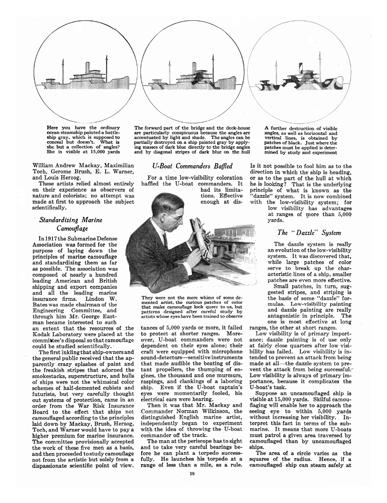
One of the most clearly written and best illustrated articles on World War I Allied ship camouflage was authored by Waldemar Kaempffert, editor of Popular Science Monthly. Titled "Fighting the U-Boat with Paint," it was published in the April 1919 issue (Vol 94 No 4) of the same magazine.

It is now in public domain and can be accessed online. It consists of a three-page article, screen grabs of which are published above and below in this post.

Among its interesting illustrations is (on the title page) a photograph of American muralist and camoufleur William Andrew Mackay studying a dazzle-painted ship model through a makeshift periscope-like devise. 

 On page 2, Mackay is shown painting a camouflage scheme onto a ship model, while at the top of the page are the first three drawings a series of simulated periscope views that purport to show the stages of applying a dazzle camouflage scheme. 

 On the third page, two final views from that series are shown, and, below that, an unidentified camoufleur is surveying Mackay's collection of camouflage-painted models.

Over the year, we've learned quite a lot about Mackay, and we've recently published a booklet (available online as a pdf) about his approach to ship camouflage, titled Optical Science Meets Visual Art.

Sunday, November 29, 2020

using a periscope to view camouflage-painted models

The US Secretary of the Navy during World War I was Josephus Daniels (1862-1948), a prominent North Carolina newspaper editor. He was appointed by President Woodrow Wilson, while Franklin D. Roosevelt served as Assistant Secretary of the Navy.

There are various photographs of Daniels in connection with his wartime duties, both army and navy. In the government photo above, for example, he is shown while on a visit to the US Navy’s Camouflage Section in Washington DC. He is peering through a submarine periscope (positioned upsidedown) to view dazzle-painted wooden ship models (like those on shelves behind him) that had been set up for testing in an adjoining room. 

In a second (poor quality) news photograph (above), he is in the same facility, probably on the same day, where (according to the caption) he is examining the model for the USS George Washington (as published in UNCLE SAM HAS CAMOUFLAGE FOR SHIPS IN PEACE in The Brooklyn Daily Eagle (New York), on April 27, 1919, p. 9). According to Everett Warner (who oversaw the artists who designed ship camouflage) this was one of the largest ship models, measuring twenty-two and a half inches in length.

There is a surviving photograph of the camouflaged model for the same ship (below), but it shows only the opposite side (the port side), while the starboard side is visible in the photograph of Secretary Daniels.

It is of additional interest to note that this camouflage scheme was apparently never applied to the USS George Washington. According to an article by Robert Skerret (1919), at the close of the war, when that same vessel was selected to transport President Wilson to Europe, the ship and its fleet of escorts were not dazzle-painted, but instead were covered in “Omega Gray,” a monotone developed not by US Navy camoufleurs but by the Submarine Defense Association. 

[OOPS I seem to have made a mistake. I forgot that in an earlier post, I published photographs of the USS George Washington painted in this same dazzle camouflage scheme, and quoted from texts that described it. It appears to have been repainted at a later date in monotone gray.]

In a third photograph (below), Daniels is shown out of doors, presumably in an army training field, talking to an infantryman who is camouflaged to blend in with the surrounding foliage.


Daniels is commonly credited with being a supporter of women’s suffrage. And, while serving as Secretary of the Navy, it was he who first enabled women to be employed by and serve in the US Navy.

There is more information about his support of women's service in a news article in the Poughkeepsie Eagle News (LIFE HAD ITS PROBLEMS FOR SAILOR GIRLS OF 1917), on September 29, 1942—

"Is there any law that says a yeoman must be a man?" Secretary Daniels asked his legal advisors. The answer was no but only men had been enlisted up to then. The law did not say "male."

"Then enroll women in the Naval Reserve as Yeomen," Secretary Daniels said, "and we will have the best clerical assistance the country can provide."

The Navy got a total of 11,000 yeomen (F) by calling women to the Naval Reserve, mostly to take care of clerical work at the Navy Department in Washington. Some Yeomen (F) were translators, some were draughtsmen, fingerprinters, camouflage designers [assigned to the Camouflage Section], recruiting agents, or workers in the Bureau of Medicine and Surgery or in Naval Intelligence."

According to Aryeh Wetherhorn in The Easter Egg Fleet (2020), among the American women who held camouflage-related positions in the Office of Naval Intelligence (ONI) were Sara Elizabeth Carles [sister of artist Arthur Beecher Carles, who also worked as a ship camoufleur], Ruth Prentice Thompson, Lilian A. Jones, Jean Knox, Sara Scott, and Florence Dorothea Fischer.

•••

That given, there are deeply troubling aspects of Daniels’ actions and beliefs. He has been described as a “vehement white supremicist and segregationist,” and a supporter of the Ku Klux Klan. It is especially disturbing to read about his connection with the Wilmington Massacre of 1898, in Wilmington NC.

a ruler proves / are you bow-legged or knock-kneed?

Anon, DO YOU BELIEVE ALL YOU SEE? Source unknown—

Which one of these figures has bowlegs and which knock-knees? Easy to see that the knees of the one on the right incline toward each other, while the other gentleman carries his legs on a gentle outward curve?

Easy, is it?

Well, it so happens that neither of them is knock-kneed or bow-legged. In fact the legs of both of them are perfectly straight. Take a ruler and prove it. It's just simply a case of the eyes being deceived. An optical illusion and a very common one.

There are a lot of things like that. No two persons see the same thing alike and when a thing is made with intent to deceive, as this was, it would take an expert to discover the deception.

Actors take advantage of this fact in their make-up on the stage, and dressmakers are known to use it. For instance, a short, stout woman wearing a dress with horizontal stripes will look still shorter and fatter with horizontal stripes will look still shorter and fatter and a tall, thin woman wearing a dress with perpendicular stripes will look taller and thinner.

irrefutable confirmation that the artist can be practical

Lieutenant Warner at his residence


Washington Evening Star
(Washington DC), March 17, 1918, p. 28—

Everett L. Warner of this city and New York has lately received a commission as a first lieutenant, senior grade, in the Navy, on account and for the continuation of his work in what is known as “marine camouflage.”

The particular branch of work that Lieutenant Warner has been conducting is, in point of fact, not camouflage along the lines understood by this term at present, but is, rather, what is known under the general name of “dazzle system.” Upon careful observation it has been found that there is no such thing as camouflage for ships, there being no single color which will make them invisible under all circumstances. The “dazzle system,” which distorts a boat’s shape and prevents accurate marksmanship on the part of the enemy, has, however, proved not only helpful, but a real protection. And it is this that is being followed out scientifically under the charge of Lieutenant Warner and other artists with the co-operation and approval of the United States Shipping Board and the Navy Department.

The theory was developed primarily and largely in England, and three-fourths of the mail streamers between the United States and England now make use of it.

This is an interesting use to make of art and one which has proved its value. It goes to show, moreover, that the artist can be practical as well as artistic and has his place in warfare as well as in days of peace.

•••

Postscript A day or two after we posted this, we happened to run across an online newspaper article about Everett Warner and camouflage, published in the Pittsburgh Post-Gazette on December 25, 2019. 

Thursday, November 26, 2020

camouflage and the ames demonstrations in vision

Above Photograph of the author and a colleague in an Ames Distorted Room, a demonstration in perceptual psychology in which people seem to shrink and grow. It was first constructed in the 1930s by American artist, psychologist and optical physiologist Adelbert Ames Jr, at Dartmouth College. It has been replicated innumerable times, for a variety of purposes. This particular model was built in 1975, as one component in a participatory children's exhibit, co-designed by Roy R. Behrens (wearing dark jacket in photos above) and John Volker (not shown), and installed at the Waterloo Center for the Arts in Waterloo IA.

•••

To Make a Room Look Larger, in Ladies’ Mirror. Vol 5 No 4, October 1, 1926—

It is something of an art into which camouflage may be said to enter, that of creating the sense of space in a small room. 

RELATED LINKS

Ames, Heider and the Chair Demonstration

Wikipedia biography / Adelbert Ames Jr

Eyed Awry: The Ingenuity of Del Ames

The Artistic and Scientific Collaboration of  Blanche Ames Ames and Adelbert Ames II

concealed as snow, as a tree stump or a bale of hay

WWI US soldier positioned on tree stump (c1918)

Oliver Herford, quoted by Constance Murray Greene in HUSH, BLUSH AND PLUSH IN NEW BOOKS OF POEMS, The New York Sun, 19 January 1919, p. 11—

If you can stand upon one spot
And look like something you are not
And wouldn’t if you could be—say
A bean bag or a bale of hay—
You’ll find it quite a useful stunt
To practice on the Western Front:
This picture shows how Private Dunne,
Disguised as snow, deceived the Hun.
Who could not possibly see through
The camouflage; no more can you!”

Oliver Herford, An Alphabet of Celebrities


Monday, November 23, 2020

Paris is dazzle-mad, seemingly part of a futurist dream

USS Aniwa (c1918), Type 9 Design D

Other People’s Troubles: A Paris Letter in The Sketch (London), October 13, 1920, p. 412—

Paris is dazzle-mad. I think every woman who has the courage to wear these dazzle furs that I see deserves the Legion of Honor. They are striped with great slashing streaks of white on black. Hats are dazzle hats. Dresses are dazzle dresses. Pajamas are dazzle pajamas. Everywhere are to be seen these angular lightning effects. The decorations most in favor in the very private and particular room are dazzle decorations. I seem to be existing in a weird Futurist dream.

Note There are no full-color photographs of WWI ship camouflage. The original of the black and white image above (US government, public domain) has been digitally “colorized” using AI software. While its light / dark values are accurate, the choice and location of colors, even when plausible, may not be literally correct.

RELATED LINKS