Showing posts with label wildlife. Show all posts

Sunday, October 30, 2022

Abbott Thayer and Concealing Coloration / Dublin NH

Above Abbott Handerson Thayer, Charcoal drawing for ship camouflage experiment, c1915. From Abbott Handerson Thayer Family Collection

•••

Excerpted from L.W. Leonard and J.L. Seward, The History of Dublin NH. Published by the Town of Dublin, 1920, pp. 684-686—

Throughout the world the word “camouflage” has become familiar during the war. Although this word is of French origin, the thing itself is primarily an American creation, the work neither of warriors nor army experts, but of a distinguished artist, a well-known Dublin resident, Abbott H. Thayer, who has permanently lived here for more than twenty-five years.

In 1896, an essay by Mr. Thayer on “The Law Which Underlies Protective Coloration,” was published in The Auk, and shortly afterwards reprinted in the Year Book of the  Smithsonian Institution. In 1909, the Macmillans published Concealing-coloration in the Animal Kingdom, written by Abbott H. Thayer’s son, Gerald H. Thayer, and illustrated by father and son.

Protective coloration, as set forth in this book, was one of the main starting points of camouflage, and to a considerable extent has guided its development. Assurance of these facts were given Mr. Thayer in England and Scotland in the winter of 1915-16, when he went abroad to tender the Allies’ more direct help in this matter.

Professor [Sir William Abbott] Herdman of the University of Liverpool, suggested that the naturalists of Great Britain ought to sign a joint statement to the effect that they believed Mr. Thayer’s unique knowledge of protective coloration could be made of the greatest use to the War Department. It proved, however, that, owing to the efforts of several other British scientists, notably Professor J. Graham Kerr of Cambridge and the University of Glasgow, who had even urged that the government create a special bureau for the adoption of Thayer’s discoveries, “concealing coloration” was already doing war service of various kinds, both on land and sea.
 
Camouflage has carried the principles of visual deception to hitherto undreamed-of lengths of application, and to manifold and divergent new developments.

But the latest military camouflage was mainly a matter of masking batteries and guns for airplane detection. Standardized materials, wire netting, colored shreds of burlap, etc., manufactured in vast quantities behind the lines were the main dependence for this roofing-over and screening of guns. The latest marine camouflage, again, sought not concealment of ships, but effects of distortion of outline and perspective which would puzzle the U-boat observers looking through the periscope, as to the vessel’s speed, distance, exact form, and especially her course, or direction of movement.
 
Professor E. B. Poulton, F. R. S., etc., President of the Linnean Society of London, the distinguished English evolutionist, writes as follows:

“During the sixty years which have elapsed since the historic day [of the reading before the Linnean Society of Darwin’s and Wallace’s joint essay on Natural Selection], English-speaking workers—among the foremost the American artist-naturalist, Abbott H. Thayer, and his son Gerald H. Thayer—have studied this principle [protective coloration], continually extending it by the discovery of fresh applications, and analysing it into a whole group of cooperating principles; but inspite of all these naturalists have done, it required the Great War and a misused French word in order to arrest the attention of their fellow-countrymen…

We may, however, forgive the inccurate use of a new word which the war has bought into our language because of the attention which has now been focused upon a most interesting subject—attention which rightly demands a new and widely accessible edition of this work [Thayers’ Concealing Coloration]. Here are clearly explained and illustrated the principles underlying the art of camouflage, practiced by nature from time immemorial but in some of its main lines only made known to man by the discoveries of Abbott H. Thayer.”

Saturday, October 29, 2022

Thayer's camouflage of William James' Norfolk jacket

Above A comparison of two photographs, the one on the far left identified as Abbott H. Thayer, attired in a Norfolk hunting jacket that had previously been owned by philosopher William James. When James, a friend of Thayer, died, the jacket was given to Thayer by James' two sons, Aleck and Billy, both of whom were artists and had studied with Thayer. 

Later, early in World War I, Thayer used that same jacket as a way to demonstrate how fabric scraps (rags) and his wife's discarded stockings might be attached to its surface, to break the continuity of the figure. By superimposing the one photograph on top of the other, I am trying to "prove" that the person in the photograph in the center and on the right (unidentified when published) is in fact Abbott Thayer himself, with a painted face, wearing that Norfolk jacket.

•••

Be warned that the story below is full of inaccuracies. Thayer submitted a ship camouflage proposal (based on countershading) to the US Government during the Spanish-American War (not WWI), but asked for too much money. I have never seen any indication that he was asked, during WWI, “to guide a Navy program.” He did attempt (ineptly) to persuade the British to adopt disruptively patterned infantry uniforms—but his prototype was literally made (as shown above) partly of rags and worn-out womens' hose.

•••

Ernest Henderson, The World of “Mr. Sheraton.” New York: Popular Library, 1962, p. 83—

When World War I was raging, deceptive markings to disguise merchant ships falling prey to German torpedoes became a matter of national necessity. To meet this grave emergency, Dublin’s [NH] great naturalist [artist Abbott H. Thayer] was offered an impressive financial inducement to guide a Navy program for confusing the enemy with camouflage. Despite a threatening spector of poverty, Thayer flatly declined. It would mean a military role, and this his conscience would not then permit.

Subsequently, as the fever of war increased, realizing that human lives were involved, Thayer offered the British a new type of uniform designed to render soldiers partially invisible. This the British promptly rejected, concluding, no doubt, that fitting their men with unbecoming rags could injure national morale even more than could a mere reduction in the deadliness of approaching German bullets.

Abbott Handerson Thayer / the master at his very best

Abbott H. Thayer (c1915)
Above Abbott Handerson Thayer, Study of Alma Wollerman, oil on canvas, c1915. From Abbott Handerson Thayer Family Collection. Thayer made a number of paintings of Alma Wollerman Thayer (his daughter-in-law as of 1911, wife of Gerald H. Thayer), but surely this must be the finest. This is the elder Thayer at his best.

•••

Ernest Henderson, The World of “Mr. Sheraton.” New York: Popular Library, 1962, pp. 82-83—

Another Dublin [NH] resident was the artist and naturalist Abbott H. Thayer, considered by many the discoverer of protective coloration. While still in my teens, I saw a demonstration of his skill. He had produced a piece of stone carved to resemble a duck. Painted to match the roadway, the object had a dark brown back, with much lighter colors on its belly.

In broad daylight Thayer placed the duck, supported by a stiff wire, in the roadway and led me twenty paces away. Turning, I was sure the object had vanished; nothing was visible at all. A few paces nearer, and the wire could be seen—absolutely nothing else. Another few paces, and the duck began to take form. Yes, Abbott Thayer had indeed mastered nature’s private secret for deceiving the human eye.

Saturday, May 30, 2020

As human folly brings about yet another catastrophe

Above Cover of Ballast Quarterly Review. Vol 8 No 1 (Autumn 1992), featuring a wood engraving by British printmaker Robert Gibbings, titled Fowey Habor (c1919).  All issues of Ballast (a periodical commonplace book that ran for twenty-one years) are now available online as pdf downloads.

•••

Robert Gibbings, Sweet Thames Run Softly. NYC: E.P. Dutton, 1945—

The war [WWII] broke out, but I was overage. Besides, I had met a bullet in the last war. I tried for camouflage. I offered to make drawings from submarines, having already worked underwater in a diving helmet…if it was human folly which had brought about the catastrophe, it was, for the most part, only human beings who were paying the price. The world of nature was unaffected; flowers still bloomed, birds still sang, even butterflies continued their migrations, and rivers flowed towards the sea.

Tuesday, April 14, 2020

Harrison S. Morris | His memories of Abbott H. Thayer

Harrison S. Morris
Above Photograph of Harrison S. Morris (1856-1948), a writer, editor, and arts administrator. From 1893-1905, he was the managing director of the Philadelphia Academy of the Fine Arts, the nation’s oldest art school. In 1896, he married Anna Wharton, whose father was Joseph Wharton, a prominent industrialist who co-founded Bethlehem Steel, as well as Swarthmore College. Morris was the editor of Lippincott’s Magazine, and the art editor of the Ladies Home Journal. A prolific writer, he was the author of poetry, fiction, and essays. He was in frequent contact with artistic and literary figures of his time, including (as described below) Abbott Handerson Thayer and George de Forest Brush.

•••

Harrison S. Morris, Confessions in Art. New York: Sears Publishing, 1930, pp. 142-144—

It was he [Abbott H. Thayer] and George de Forest Brush who, I believe, first thought of camouflage for ships at sea. They had pondered much and experimented much over the scientific problems of light and color, even outside the uses of pigment. They were among those to whom art brings ripened intellect, like Morse and Fulton, inventors who revolutionized the world's methods of contact.

So when we were in the war with Spain, Brush and Thayer disinterestedly went to Washington and offered their services and discoveries to the Secretary of the Navy. Of course, he was skeptical, as official life always is of change. He wanted to know, you know, and all that sort of thing. But while he was deliberating, and telling perhaps why the scheme was no good, one of the painters stuck in the ground a slender stick which he held in his hand, painted after their theory of protective coloration. Then Brush alluded and pointed in the course of conversation to the stick before them. To the Secretary of the Navy, there was no stick in sight. He went on speaking his conventional thought. But quietly and as if accidentally one of the painters turned the slender stick around in its place, so that the sun touched it another way, and, would you believe it, there was the stick which the Secretary could not see.

I rather think nothing came of the offer in the day of the Spanish War. But we know vividly enough what came of it later, and what ships and lives were saved by the wisdom of the two incomparable artists who thus could coordinate their art to the uses of life.


Thayer holding one of his duck decoys upsidedown

And another time, so Brush tells me, Thayer was invited to lecture on his theories of color before a Royal Institution of Science in London. He had before him on the platform a table on which was visible a decoy duck of wood such as sportsmen use in gunning. In his address, he alluded much to these ducks before him, and as well before the audience. At last, the patience of one of the English pundits could stand this no longer. He got up in some irritation at the offense to his intellect of speaking of ducks when there was only one duck in view. Would the learned gentleman be pleased to explain why he referred to ducks, thus plural, when there was only one duck in sight? He sat down well satisfied with exposing an American impostor who didn't know how to use the English language.


Thayer then gave a quick twist to a wooden duck, made invisible by his coloring, and the second bird was exposed in all its solidity. So was the English skeptic.

Wednesday, February 12, 2020

bark- and leaf-like camouflage suit on tree stump

Above World War I photograph of an American soldier, dressed in a bark- and leaf-like camouflage suit, positioned on a tree stump (c1918). Public domain. Digital coloring.

Friday, September 27, 2019

Rockwell Kent | ship camouflage cover reconstructed

Rockwell Kent (1918), magazine cover (restored)
In 2011, Joyce Shiller, who was then the Curator at the Norman Rockwell Museum in Stockbridge MA, posted a brief online article about historic illustrations that portray “dazzle camouflaged” ships from World War I. She included reproductions of two magazine covers (Popular Science and Everybody’s Magazine, both 1918) and a Victory Liberty Loan poster (1919).

I had seen all three before, but the one of particular interest to me was the cover of the December 1918 issue of Everybody’s Magazine. Near the lower-right corner is the artist’s printed signature “Kent.” The cover artist was Rockwell Kent (1882-1971), the well-known American artist, illustrator, and author (see his edition of Melville’s Moby Dick, and his illustrated autobiography, It’s Me, O Lord). 


I first saw his camouflage-themed magazine cover (as I recall) in the late 1990s, when an art historian named Jake Wien (who has written about Kent and others) shared a small-size, low-resolution photograph of a copy he had found. It appeared to be in poor shape, with major surface damage and tattered edges. I later found that its color was substantially different from the one that Schiller reproduced. The color cast of Wien’s copy (as shown below, on left) is emphatically green, while the one in Schiller’s post (below, right) was blue. The other colors are consistent, which may suggest that the printing ink used for the background was fugitive and that one of the copies had been altered by years of exposure to light. If so, the question remains: Was the original background blue or green? Given the well-worn condition of the one that Jake Wien shared, I would guess the original color was blue.

Rockwell Kent magazine cover (two copies, same issue)


Whatever it must be a very rare item. It is possible that no other copies have survived. Over the years, I’ve looked for the issue repeatedly on online vintage magazine sites, in searchable archives, and in library holdings. Probably one of the reasons for its scarcity is that university libraries (maybe most of them) tended to discard the covers of magazine issues before they were bound as a volume. So, in the library that I mostly use, the inside pages of Everybody’s Magazine are intact, but the covers of all of the issues are gone. Fortunately, I recently found a black-and-white scan of the cover and was able to use that as a point of departure in an attempt to digitally reconstruct the full-color cover (as shown above). I chose to use blue as the background. Note that the title in the masthead is restored from the original, but the issue date and price (and Kent's signature) have been replaced with a new, if appropriate, typeface.

That Rockwell Kent would have created an illustration of ship camouflage is of particular interest because (as I’ve discussed in earlier posts), he had been a student of Abbott Handerson Thayer, and a close friend of Thayer’s son, artist and naturalist Gerald Handerson Thayer, both of whom are credited with important early findings about protective coloration in nature. In 1909, the Thayers co-produced (with Gerald as the author of record) a major book on the subject, titled Concealing Coloration in the Animal Kingdom. It had an abundance of illustrations, including collaborative paintings by a handful of Thayers’ family members, students, and friends, one of whom was Rockwell Kent.

Friday, February 8, 2019

Ship Camouflage and Nature Talk / Hartman Reserve

Above Title slide for a richly illustrated talk that will take place this weekend at the Hartman Reserve Nature Center in Cedar Falls IA. The 50-minute talk begins at 2:00 pm, Sunday, February 10, 2019* and is free and open to the public at the center's Interpretive Building. It focuses on the connection between turn-of-the-century studies of animal camouflage (called protective coloration then) and the development of military camouflage by artists during World War I.

*PLEASE NOTE This event has been postponed because of winter weather. It has been rescheduled for 2:00 pm, Sunday, April 14, 2019. Perfect timing in view of its Easter-themed title.

•••

NEWS OF THE SCHOOLS: Navy Camoufleur at Manual. Brooklyn Daily Eagle. May 6, 1919, p. 14—

Alon Bement, a camoufleur, first class, of the United States Shipping Board, and formerly a teacher at the Teachers’ College, Columbia University, was the speaker at the Senior Assembly of the Manual Training High School yesterday. At the beginning of the war Mr. Bement, who had considerable reputation as an artist, was called to act as a naval camoufleur. He was sent to Washington where he worked out designs for camouflaging ships, using small models for the purpose. If the designers were found to be feasible, they were reproduced on a linen sheet, taken to a shipyard and painted on a ship.

Mr. Bement went into detail to show how portions of the ship were marked out for certain colors by means of a hand mirror when the sun was shining. The camoufleur would stand on the edge of the drydock and reflect the light along the lines which were intended to mark the borders of the various colors. In this way the apportioning off of the ship was readily accomplished.


Mr. Bement told of other schemes which were attempted to combat the submarine menace such as the construction of an outer hull to prematurely explode the torpedo. This means was hastily abandoned because such a hull would slow down the ship to such an extent that it would fall an easy prey to the U-boats.

He also explained why only the transports, freighters and destroyers wore camouflage and not battleships. The big fighters were not daily subject to submarine attack so that it was unnecessary to give them their “make-up” and since it costs $3,000 to paint a battleship, attention was confined to the first mentioned ships.

Mr. Bement told of how in a captured German U-boat, the British found fifty-eight pages of a leaflet in the commander’s cabin, telling what methods the Prussians were taking to combat the camouflage of Allied ships. With this find, the Allied camoufleurs were able to take new steps to offset the year’s calculations of the Germans.

Friday, December 14, 2018

Anne Lemanski Animal Posters Now Available Online

Online Selection of Posters
In recent weeks, we've been posting on this blog a selection of posters designed this semester by graphic design students at the University of Northern Iowa. This is the last post in that series. Instead, we've now designed a website (see screen grab above) which showcases about forty of the final posters, amounting to about a half of all the posters the students designed. Twenty-five of the actual printed posters will continue to be on exhibit through December 31, 2018, at the interpretive building at the Hartman Reserve Nature Center in Cedar Falls IA. Coincident with my retirement after 46 years of university teaching, it was a pleasurable way to go out. More>>>

Sunday, November 25, 2018

Hartman Poster Exhibit about Anne Lemanski's Art

Poster by Sabrina Wiebold (2018)

Here are a few more examples of various posters that were made by graphic design students at the University of Northern Iowa. They celebrate the animal-themed artwork of Anne Lemanski, an artist from North Carolina.
Poster by Amelia Duax (2018)


Twenty-five of the posters are currently on exhibit at the interpretive center at the Hartman Reserve Nature Center in Cedar Falls IA, where they'll remain up until the end of December.
Poster by Aimee Luksan (2018)
Poster by Hayden Klemme (2018)

Saturday, November 17, 2018

Hartman Poster Exhibit about Anne Lemanski's Art

Animal Poster Exhibit (2018)
Very soon I will retire from university teaching. My final semester is nearly over, about four more weeks to go. It's been a pleasurable opportunity for me, as well as for my students, to design a series of posters having to do with the animal sculptures of a North Carolina-based artist named Anne Lemanski. We've blogged about her once before. At her website, you can see lots of examples of her current work. She also makes wonderfully colorful collages based on natural images.

Animal Poster Exhibit (2018)

The students designed about 90 posters. There isn't space to exhibit them all. At the moment, 25 are on display at the interpretive center at the Hartman Reserve Nature Center in Cedar Falls IA, where they'll remain up until the end of December.

On this blogpost are several installation views, showing some (not all) of the posters. Another fifteen are also on exhibit on the second floor of the north wing of the Kamerick Art Building on the campus of the University of Northern Iowa. I'm hoping to post those and others on this blog in the coming weeks.

Animal Poster Exhibit (2018)

Poster by Wren Kress (2018)
Poster by Emily Schroeder (2018)

Saturday, November 3, 2018

Lemanski Animal Posters | Julia Sippola 2018

Poster by Julia Sippola 2018
The animal sculptures featured in these three posters are the work of a North Carolina-based artist named Anne Lemanski. We've blogged about her once before. At her website, you can see lots of examples of her current work. She also makes wonderfully colorful collages based on natural images.

Poster by Julia Sippola 2018


The three posters were designed by Julia Sippola, a graphic design student at the University of Northern Iowa (she is actually from Finland and is studying at our school as a visitor). She designed these in response to a problem in which 30 students (this was their first course in graphic design) designed a series of three posters about Lemanski's animals. Of the resulting 90 posters, 25 of them (including all three of Julia's) are being exhibited at the interpretive building of the Hartman Reserve Nature Center in Cedar Falls IA. The exhibit (curated by Roy Behrens) begins officially on Monday, November 5 and continues through December 31, 2018. It is free and open to the public. We will be sharing more of these on this blog in the days and weeks ahead.

Poster by Julia Sippola 2018


By fortunate coincidence, this poster exhibition will open in the same week (November 7-9) as the annual gathering of the Iowa Association of Naturalists, which means that these works will be viewed by a substantial number of wildlife and conservation advocates. The schedule of events and registration materials are available online.

Artworks shown are copyright © the artist, and the posters are copyright © by their designer. Our thanks to Katie Shelton and Anne Lemanski for enabling this project to happen. It has been entirely enjoyable.

RELATED LINKS    

Dazzle Camouflage: What is it and how did it work?Nature, Art, and Camouflage / Art, Women's Rights, and CamouflageEmbedded Figures, Art, and Camouflage / Art, Gestalt, and Camouflage /  Optical science meets visual artDisruption versus dazzle / Chicanery and conspicuousness /  Under the big top at Sims' circus

Lemanski Animal Posters | Hartman Nature Center

Poster by Erica Scherer (2018)
The delightful bird sculpture in this poster is the work of a North Carolina-based artist named Anne Lemanski. We've blogged about her once before. At her website, you can see lots of examples of her current work. She also makes wonderfully colorful collages based on natural images.

The poster itself was designed by Erica Scherer, a graphic design student at the University of Northern Iowa. She designed it as part of a problem in which each of 30 students (this was their first course in graphic design) designed three different posters about Lemanski's animals. Of the resulting 90 posters, 25 of them are being exhibited at the interpretive building of the Hartman Reserve Nature Center in Cedar Falls IA. The exhibit (curated by Roy Behrens) begins officially on Monday, November 5 and continues through December 31, 2018. It is free and open to the public.

Below is a second poster, designed by Kailie Hesner, that resulted from the same class project. We will be sharing more of these in the days and weeks ahead.

Poster by Kailie Hesner (2018)


By fortunate coincidence, the exhibition will open in the same week (November 7-9) as the annual gathering of the Iowa Association of Naturalists, which means that these works will be viewed by a substantial number of wildlife and conservation advocates. The schedule of events and registration materials are available online.

Artworks shown are copyright © the artist, and the posters are copyright © by their designers. Our thanks to Katie Shelton and Anne Lemanski for enabling this project to happen. It has been enjoyable.

Tuesday, July 3, 2018

Gerald Thayer Talks on Camouflage at Ithaca 1919

G.H. Thayer, Cottontail Rabbit (1909). Public domain.
Above Gerald H. Thayer, painting of a cottontail rabbit, first published as an illustration in his Concealing Coloration in the Animal Kingdom (NY: Macmillan, 1909). There are 16 full-color illustrations in the book, nearly all of which were collaborative paintings. In this example, Gerald painted the rabbit figure, while the background (as credited) was completed by Abbott H. Thayer and Emma B. Thayer.

•••

CAMOUFLAGE ONLY NATURE IMITATION: Is Shown By Gerald Thayer in Lecture at Reorganization Meeting of Cayuga Bird Club in Ithaca Journal (Ithaca NY), Tuesday, March 18, 1919—

An unusual and enlightening lecture was given last night in Roberts Hall when Gerald H. Thayer, son of the famous artist, Abbott H. Thayer, spoke on “Camouflage in War and in Nature,” illustrating the talk with lantern slides showing birds and animals in their natural surroundings, in some cases so perfectly concealed that they could not be seen until pointed out, and concluding with illustrations of the use of camouflage in war. Not only did Mr. Thayer show what looked like trees, bushes and grasses and then prove that they were birds and animals, but he reversed the process, showing what looked like birds and animals, and proved to be only sections of trees, bushes, etc.

Mr. Thayer’s lecture was the first to be given this year under the auspices of the Cayuga Bird Club, and in introducing him, Louis A. Fuertes spoke of the success of the club in past years, of the wonderful opportunities for the study of birds offered in Ithaca and of the bird sanctuary with its recorded list of more than 200 different species of birds-and a wealth of flowers in the spring. He explained that the club is now entering upon a period of reorganization after the war, and asked all who were interested to renew their memberships.

“Abbott Thayer and his son GeraId have worked together on the wonderful problems of protective coloration,” said Mr. Fuertes “and the resuIt is the art of camouflage, which did not prove successful when presented to the military authorities of this country and of England, but which was eagerly taken up by the French and developed by them, stolen by the Germans, and given to their allies.”

“There are three principal kinds of camouflage in nature and in war,” said Mr. Thayer. “The first consists of hiding things, making them more or less disappear, and plays an important part in nature. The second type is [the] making of fake things, things which are made to look like something else.”

In ilIustration of this second type in war he spoke of the use of supposed stumps of trees, made out of iron and covered with bark, in which telephones and observers could be concealed, and which looked so exactly like the real thing that they were seldom noticed by the enemy. Another instance which he told as a true story of the war was that of the aviator who came back to headquarters and urged the captain in charge to train some guns on a cemetery just back of the enemy lines. When the captain objected to firing on a cemetery, he explained that when he flew over early that morning the “cemetery” was on the opposite side of certain field.

As a good iIlustration of this type of camouflage in nature he spoke of the walking stick, measuring worms and caterpillars which are made to look exactly like a twig.

“The third kind of camouflage can best be used with things that move around,” said Mr. Thayer “and has been developed during the past year, particularly on ships at sea, painting them in striking contrasts, making them harder to hit and sometimes making them look as if they were going in a different direction, an iIlusion which proved particularly deceptive when seen through the periscope of a submarine. He explained that the object in painting these vessels in stripes and blotches was not to conceal them, as so many supposed, but to make them look strange, so that they were hard to locate. In the early years of the war, he added, they did try to make vessels resemble clouds, sea horizon, etc., but were unsuccessful for nothing but the whitest white will disappear against the sky.

He spoke of the sinking of the Titanic when she struck an iceberg on a clear, starry night, and explained the catastrophe by the fact that the white iceberg must have been practicalIy invisible against the sky.

Saturday, March 17, 2018

Sims' Circus | Checkerboards Meet Harlequins

Cover illustration by Gayle Porter Hoskins (1919)
Above Cover, The Ladies Home Journal (March 1919), with a stunning illustration by American artist Gayle Porter Hoskins (1887-1962). It depicts the dazzle-painted RMS Mauretania arriving in New York with the first returning American troops on December 1, 1918. It is evident why this checkerboard style of camouflage (mostly employed by the British) was compared to a harlequin's outfit. Public domain image.

•••

Herman Whitaker, SIMS' CIRCUS: A Cruise with Our Destroyers Over There in The Independent (June 1, 1918), pp. 358-359—

From the train window approaching the base I obtained my first view of "Sims' circus" [in reference to its commander, US Admiral William Sims], as the flotilla had been named by the irreverent ensign…

…A convoy was ready to sail, a dozen or so of our destroyers were to be seen nestling like speckled chickens under the wings of the mother repair ships.

I said "speckled." It is, however, too weak a term for the "dazzle" paint with which they were bedaubed. No wonder the irreverent ensign dubbed them "brick-yards."

Barred, striped, blotched, smudged, ring straked with vivid pinks, arsenic greens, blowsy reds, violent blues, they looked like—like nothing in the world unless it be that most poisonous of drinks, a 'Frisco pousse cafe. All of the giraffes, zebras, leopards and tigers ever assembled in the "World's Greatest Aggregation" exhibit conventional patterns in comparison with this destroyer camouflage. The exception to this blazing color scheme, a recent arrival from home, looked in her dull lead paint like a Puritan maiden that had fallen by accident into a blowsy company of painted Jezebels.

The object of this wanton display is, of course, to fool Fritz of the submarines. That is might do so by hurting his eyes or the shock of his artistic sensibilities none would deny; but I found it hard to believe that these rainbow colors make a difference in visibility. Yet they do. Whereas, at sea the following day, the "Puritan maiden" showed a clear black outline at four miles with every spar clearly defined, the "Jezebels" presented at the same distance a blurred, wavering mass of color. It was difficult to tell bow from stern or judge their direction. They presented about as fair a target as a darting hummingbird.

Hypothetical dazzle schemes © Roy R. Behrens 2018

Thursday, November 30, 2017

Native Americans | War Paint as Camouflage

Edward Curtis, Photograph of Medicine Crow
Above Edward Curtis, Portrait photograph of Medicine Crow (c1905). Public domain. Library of Congress Prints and Photographs.

•••

J. Keeley, WAR PAINT AT THE FRONT. How Many Lives and Much Material Are Saved. Snipers Like Indians of Old. The Dominion Post (Wellington, New Zealand). July 28,1917 p. 7 (reprinted from The San Francisco Chronicle)—

…France owes its indebtedness in this protective color science [called camouflage] to the American Indian, who painted his face and nude body to blend with nature so that in his ambuscades he might creep upon his enemy unseen. It is customary to think of the painted Indian as he was when going on his raids, decorated wildly with bright colors which added to the fierceness of his facial expression and which struck terror into the hearts of those who opposed him for the first time. Picturesque as was this phase of the Indian coloring, it was not infrequently nearly as considerable as his more artful concealment by tricks of colors. He could with plant and earth dyes make himself become to all intents and purposes part of the ground to which he hugged or part of the tree trunk to which he clung.

He, in his turn, owed his indebtedness to the birds and beasts of the forest. The quail in the weeds is as brown as the herbage about it; its back and breast are flecked with white in such a manner that it must move before it is detected. The squirrel on the bough is of the same brown hue as the bark; the rabbit crouching in the stubble blends perfectly with the plant life. The polar bear is white because of the advantage it gives him in stealing upon seals across the snow. The bears of more southern districts are brown and black to harmonize with the forests and weather-beaten rocks in which they live. Tropical animals are in the main spotted or mottled, because the sun of the equator is mainly unobscured, shining brightly down upon matted jungles and thus making spotted and flecked shade. Tigers, snakes, leopards, gazelles, giraffe all are marked so. The lion is of a duller dun hue, but one which is beautifully adapted to the rocks and veldts where he stalks.

That man should have in the heyday of his civilization, when the painted Indian had been relegated almost to mythland, had recourse to these savage methods of protection is marvelous and yet it is too common for remark in the ranks of the European soldiers.

Saturday, May 20, 2017

Camouflage in Sioux City Iowa Tomorrow

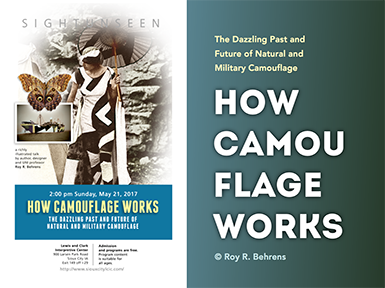
Above Don't miss the upcoming public program on HOW CAMOUFLAGE WORKS: The Dazzling Past and Future of Natural and Military Camouflage.

Free and open to the public, it starts at 2:00 pm tomorrow afternoon, Sunday, May 21, 2017, at the Sioux City Lewis and Clark Interpretive Center / Betty Strong Encounter Center. It's an excellent educational facility at 900 Larsen Park Road in Sioux City (Exit 149 off I-29).

Roy R. Behrens, Professor of Art and Distinguished Scholar, teaches graphic design and design history at the University of Northern Iowa. He is internationally-known for his publications about art, design and the history of camouflage. The author of eight books and hundreds of published articles, he has appeared in films and interviews on NOVA, National Public Radio, 99% Invisible, Australian Public Television, BBC and IPTV. His most recent book is Frank Lloyd Wright and Mason City: Architectural Heart of the Prairie (2016).


•••

Stuart Guthrie, Faces in the Clouds. New York: Oxford University Press, 1993, p. 49—

…natural selection has produced highly camouflaged and practically invisible animals in every environment. A tawny, countershaded (darker above, lighter below) coyote walking on a tawny Colorado slope, for example, recently disappeared before my eyes merely by pausing and then reappeared simply by walking again.

Sunday, March 20, 2016

Abbott H. Thayer's Camouflage at Williams College

Thayer Exhibition as viewed through duck silhouette
Several years ago, as we repeatedly blogged about then, it became known that a substantial number of artifacts (drawings, paintings, demonstrations, photographs, letters and so on) had been located that pertain directly to the early camouflage research by American artist Abbott H. Thayer (1849-1921). The source for some of these artifacts was the Thayer Family Estate (who had given about a hundred items to the Smithsonian Institution in 1949), while a second substantial cache was in the possession of Richard Meryman, a prominent writer and editor (author of Andrew Wyeth: A Secret Life) whose father (artist Richard Sumner Meryman) had been Thayer’s student and a US Army camoufleur during World War I.

Under the sponsorship of Gold Leaf Studios (Washington DC), on behalf of the family estate, some of these artifacts were first shown publicly in the spring of 2013 in an exhibition at the National Sporting Museum and Library in Middleburg VA. The following spring, a second exhibition (featuring much of the same material) was held at the Army and Navy Club in DC, supported in part by the Smithsonian Institution’s Freer Gallery of Art. In both cases, the exhibits were accompanied by a full-color exhibition catalog, titled Abbott Handerson Thayer: A Beautiful Law of Nature, edited by Ari Post. The opening for the second exhibition included presentations by a panel of five Thayer and camouflage scholars, among them Richard Meryman.

Now (again beginning in the spring), a third installation of camouflage-related materials from this large Thayer archive has opened only days ago at the Williams College Museum of Art (Meryman’s alma mater). Curated by Kevin M. Murphy and titled Not Theories but Revelations: The Art and Science of Abbott Handerson Thayer, the exhibition opened on March 11 and continues through August 21, 2016. In time, the exhibit will be supplemented by a 136-page catalog, with the same title, prepared by the curator, with a foreword by museum director Tina Olsen. While we haven’t yet seen the exhibition (nor the catalog, which won’t actually come out until June), we have seen some of its components, as is apparent from online photographs.

From those exhibition photographs, it appears that a virtue of this event is the unorthodox manner in which the items are installed. For example, instead of a neutral background, the walls on which the items are hung are covered with an elegant camouflage-patterned wallpaper. The effect is both appropriate and wonderful. Another conspicuous innovation is the use of a cut-out silhouette of a duck, through which one is able to view the exhibition as a disruptive inversion of figure and ground. As we have earlier blogged about, Thayer made frequent use of cut-out silhouettes of animals, soldiers, indigenous warriors and so on. One of the most famous examples of this is a painting of a copperhead snake (with a cut-out silhouette overlay) by his student Rockwell Kent, as was published in the famous book that he produced with his naturalist son (author of record), Gerald Handerson Thayer, titled Concealing Coloration in the Animal Kingdom (1909/1918).

Thayer—the artist, the naturalist, and the person himself—is a topic of limitless interest, as confirmed by the ever-mounting surge of books, films, dissertations, magazine articles, and exhibitions about the so-called “father of camouflage” and his two-pronged impassioned commitment to the science and art of concealment that have come out in just the past thirty years. The subject has gone viral, and there are still others now “in press,” including an important documentary film.

By the way (not pertaining to camouflage), one great highlight of the Williams College exhibition is the first public showing (unless I’m mistaken) of one of Thayer’s portraits of his enigmatic model Alma Wollerman, who later became his daughter-in-law. As he often did, he produced differing “end results” (at least three or four, I think) of this one astonishing painting.

Abbott H. Thayer silhouette camouflage demonstration

Saturday, February 20, 2016

Robert Williams Wood | Carrot in Camouflage

Robert W. Wood, How to Tell the Birds From the Flowers
Above One of the comparative illustrations in How To Tell the Birds from the Flowers: A Revised Manual of Flornithology for Beginners, with verses and illustrations by Robert Williams Wood (New York: Dodd, Mead, 1917). A later edition was published by Dover Publications in 1959. Wood (1868-1955) was a prominent American scientist. In his children's book, each comparative image is accompanied by a nonsense verse. This one reads as follows—

The Parrot and the Carrot one may easily confound,
They're very much alike in looks and similar in sound,
We recognize the Parrot by his clear articulation,
For carrots are unable to engage in conversation.

•••

Anon, The Versatile Carrot in the Urbana Daily Courier (Urbana IL), May 28, 1919—

There is nothing like a war to change the status of things. Look, for example, at the humble carrot. Before the war it was one of the lowliest of all the vegetables, seldom used except for stews or New England boiled dinners, but it certainly has been doing its bit in the culinary line recently. It has become a past master in the art of camouflage. Grated raw, it is said to be a very good substitute for eggs in certain things. Little slices dried become raisins and currants, and other bits, treated a little differently, masquerade as candied orange and lemon peel. Orange marmalade and certain kinds of jam are made of them, and large chances of them boiled and sugared make wonderful candied fruits of very kind—pineapples, pears, apricots, cherries—and are used by many caterers to give their war cakes and puddings a prosperous and festive look.

Thursday, February 4, 2016

Martin Stevens on Cheats and Deceits in Nature

Book jacket for Cheats and Deceits (2016)
A wonderful new book by zoologist Martin Stevens is out today in the UK, with US release to follow. Titled Cheats and Deceits: How Animals and Plants Exploit and Mislead (great title!), it is a timely follow-up to his other two recent volumes: Animal Camouflage: Mechanism and Function (2011) and Sensory Ecology, Behavior and Evolution (2013), all from Oxford University Press. Here is the jacket description from the latest, followed by an author’s bio from Amazon.com—

In nature, trickery and deception are widespread. Animals and plants mimic other objects or species in the environment for protection, trick other species into rearing their young, lure prey to their death, and deceive potential mates for reproduction. Cuckoos lay eggs carefully matched to their host's own clutch. Harmless butterflies mimic the wing patterning of a poisonous butterfly to avoid being eaten. The deep-sea angler fish hangs a glowing, fleshy lure in front of its mouth to draw the attention of potential prey, while some male fish alter their appearance to look like females in order to sneak past rivals in mating. Some orchids develop the smell of female insects in order to attract pollinators, while carnivorous plants lure insects to their death with colorful displays.

In Cheats and Deceits, Martin Stevens describes the remarkable range of such adaptations in nature, and considers how they have evolved and increasingly been perfected as part of an arms race between predator and prey or host and parasite. He explores both classic and recent research of naturalists and biologists, showing how scientists find ways of testing the impact of particular behaviors and colorings on the animals it is meant to fool. Drawing on a wide range of examples, Stevens considers what deception tells us about the process of evolution and adaptation.


•••

Martin Stevens is Associate Professor of Sensory and Evolutionary Ecology in the Centre for Ecology and Conservation at the University of Exeter, UK. His research work and teaching focuses on animal behavior and their sensory systems and ecology. Most of his work aims to understand the evolution and function of animal coloration, including camouflage, mimicry, and warning signals, from the perspective of animal vision. His work has included studies on a wide range of animals, including fish, reptiles, birds, insects, crabs, and primates. Martin's work has frequently covered topics related to deception, including mimicry by brood parasites ("cuckoos") and anti-predator coloration, including camouflage, eyespots, and mimicry. He has published over 80 scientific manuscripts, two textbooks, and a general audience book on deception in nature. Martin's research is frequently covered in the international media and he has taken part in a wide range of TV, radio, and magazine productions and given public lectures around the world.