Valentin di Colonna (who sometimes used the Anglicized name W.H. “Bill” Miller) was born in Rome, Italy, on September 25, 1879. According to a newspaper clipping (no date, no attribution), he was descended from Italian nobility, reputedly the same Colonna family who were Princes Assistant to the Pontifical Throne.
Apparently (again based on a news report), his father was a diplomatic envoy for Italy to the US, and was involved, in that capacity, with the Chicago World’s Fair in 1893. It is not clear when the younger di Colonna moved to the US, but at some point he enrolled at the University of Notre Dame in Indiana, then subsequently studied art at the School of the Art Institute of Chicago.
At an unknown date, for reasons that remain unclear, he settled in Cody, Wyoming, the town named for Buffalo Bill (William F. Cody), who was one of the people who founded it in 1896, and the location of Cody’s Irma Hotel. It isn’t clear how Colonna supported himself while living in Wyoming. If he was a practicing artist, most likely he was a designer, and, in the diary of a friend and possible love interest, there is mention of his having designed posters on display in town.
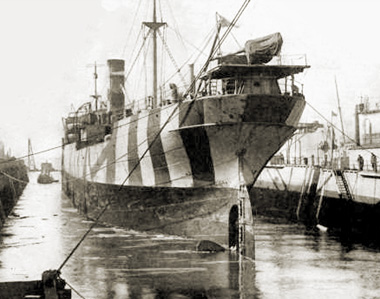
His training and interest in art would explain why he was chosen to serve during World War I in the US Army’s first camouflage unit. In a 1917 issue of an area newspaper, the Pinedale Roundup, there is the following news feature:
Wyoming is one of the first states in the union to be represented in the new Camouflage Unit now being organized for service abroad. Valentine[sic] Colonna of Cody, more familiarly known as W.H. Miller in Buffalo Bill’s town, has the distinction of being the first Wyoming man, and one of the first from anywhere, to enroll in this highly specialized force which is expected to render great service in Uncle Sam’s war with Germany (p. 2).
Di Colonna’s service is further confirmed by two brief items that appeared in the camouflage unit’s camp newspaper (of which there were only three issues) called The Camoufleur. (It was written, illustrated and produced by members of the Camouflage Corps, who were in training on the grounds of the American University in Washington DC.) The first mention of him appears in the following paragraph from the October 31, 1917 issue:
Corporal Di Colonna, Buffalo Bill’s right hand man, makes ‘em hustle to keep him supplied with food when he gets a meal downtown [in Washington DC]. He says if a waiter in the Plains Hotel, in Cody, tried to get away with what passes for service here, he’d be shot five times before he hit the ground. Cody isn’t the only place either (p. 6).
A few weeks later, he is mentioned again, in an issue of the same publication dated November 17, this time in a story about a camp visit by President Woodrow Wilson and other civilian and military officials for a demonstration of camouflage, ending with a dinner and a stage performance by the troops. The last paragraph reads as follows:
Artistic balance was achieved by the statuesque figure of Sergeant-at-Arms Di Colonna, who towering above our honored guests, with that practiced eye trained in the hills of Wyoming, watched over their welfare (p. 5).
In December, di Colonna and his fellow camoufleurs departed for France, where they would apply their skills on the battlefield. Presumably after the unit arrived, Colonna asked to be transferred from the camouflage unit to a combat outfit because “to get into the big fight was more to the liking of the Cody man.” As a result, he fought in significant battles, was wounded three times, was terribly burned in a poison gas attack, and suffered a back injury when a tree fell on him. He was twice cited for bravery and received the Croix de Guerre, but for the rest of is life, he lived with the after effects of his wounds.
Before going off to war, it seems likely that Colonna had been romantically linked with another Cody resident, a female Western novelist named Caroline Lockhart (1871-1962). Lockhart was acquainted with Buffalo Bill, but it isn’t certain what connection, if any, there was between Colonna and Cody (so it remains a puzzle why Colonna was called “Buffalo Bill’s right hand man.”)
In a recent book on Lockhart’s life by John Clayton (2007), di Colonna is described as “an Italian nobleman” who in 1918 was “a soldier now off fighting in the war in Europe.” She had received from him a “rather incoherent letter, sending a kiss” (p. 123). When Lockhart’s genteel sister saw one of di Colonna’s letters, she became upset by his use of such words as “bitch” and “pimp”—“A gentleman,” she insisted, “would not write such a letter to a lady.” But Caroline defended him: “Though the son of a bona fide Italian count,” she said, “di Colonna lived a rugged outdorsy life in Cody. Such earthy language was part of his appeal” (p. 123).
As the war persisted, Colonna (a “handsome younger nobleman” who was both “manly and chivalrous”) continued to send her affectionate notes. Lockhart was enroute from Oklahoma on the evening in 1919 when Colonna returned from the war. According to a newspaper account, he was surprised to be met at the station at Cody by a hundred cheering friends “who had been ‘tipped off’” and were waiting to meet the train. That evening, he was the guest at a huge banquet. His friend the novelist couldn’t be there, “but two days later he had a more intimate welcome: dinner and drinks at the home of Caroline Lockhart. He asked if he could kiss her, and though she coquettishly refused, she was quite smitten” (p. 138).
What happened to di Colonna in the remaining years of his life? In 1930, he may still have been in Wyoming, because he is referred to in a news article as the “former State Adjutant of the American Legion, Department of Wyoming.” Beyond that, virtually nothing is known.
That same news clipping (mentioned earlier), with the headline HEART ATTACK CLAIMS BILL MILLER, FAMOUS OLDTIMER AND VETERAN, claims that he never recovered from his wartime injuries, and had been advised for health reasons to move to a lower altitude. When he died somewhere in Maryland on September 7, 1938, he was buried in Arlington National Cemetery, where his gravestone mistakenly carries the name Valentin D. Colonna.
***
Sources
“Cody Man Enters Camouflage Unit” in Pinedale Roundup (October 4, 1917) p. 2.
“William Miller Lies Wounded in Hospital” in Northern Wyoming Herald No 44 (September 25, 1918) p. 1.
“Bill Miller Is Home” in Northern Wyoming Herald No 28 (June 11, 1919) pp. 1 & 4.
John Clayton, The Cowboy Girl: The Life of Caroline Lockhart. Lincoln: University of Nebraska Press, 2007.
Necah Stewart Furman, “Western Author Caroline Lockhart and Her Perspectives on Wyoming, in Montana: The Magazine of Western History Vol 36 No 1 (Winter 1986), pp. 50-59.
Thanks especially to John Clayton who kindly provided invaluable leads, as well as his notes on that unidentified news clipping from Caroline Lockhart’s scrapbook.