Showing posts with label WPA. Show all posts

Thursday, April 24, 2025

WPA artists / engineers also worked on camouflage

Recently, while preparing a talk about the Depression-era WPA (Works Progress Administration), I was surprised to find how many American camouflage artists were also involved in various WPA public art projects. Below is one example of that—

WPA SEEKING OKAY ON ROAD CAMOUFLAGE in Greensburg Daily Tribune (Greensburg PA), October 18, 1940—

Traverse City MI—WPA engineers at a conference here disclosed plans are under consideration for a camouflage project to conceal highways and gun emplacements.

The project, discussed at a conference of national, regional and state WPA engineers, would be undertaken by Michigan artists. Huge camouflage nets would be spread over strategic defense spaces and military objectives, it was disclosed.

Approval of the project was awaited from Washington.

RELATED LINKS    

Dazzle Camouflage: What is it and how did it work? /  Nature, Art, and Camouflage / Art, Women's Rights, and Camouflage /  Embedded Figures, Art, and Camouflage / Art, Gestalt, and Camouflage /  Optical science meets visual art /  Disruption versus dazzle / Chicanery and conspicuousness /  Under the big top at Sims' circus

Thursday, July 11, 2024

American ship camoufleur / Henry Wadsworth Moore

Henry Wadsworth Moore
Recently I’ve run across multiple references to a World War I American ship camoufleur named Henry Wadsworth Moore (1879-1968). He was an artist, as noted in a news article (The Boston Herald, September 8, 1918), who was also “a marine camoufleur with the Emergency Fleet Corporation of the US Shipping Board.” In view of his name, he must have been an aristocrat from New England, and indeed that seems to have been the case. He was the great-grandson of Commodore Alexander Scammell Wadsworth of the frigate US Constitution; and the great-grand nephew of Lieutenant Henry Wadsworth, who served on the US Decatur during its action in Tripoli, and who was the uncle of Henry Wadsworth Longfellow. “Other ancestors of note,” the article continues, “are General Peleg Wadsworth of Portland ME, and Colonel George Baylor of Virginia, both of whom were on General George Washington’s staff.”

I’ve also found online his WWI draft registration card, dated 1918, when he was age 39. He was living in Brookline MA, and was associated with the US Shipping Board at 45 Bromfield Street in Boston. He can only have served very briefly, because the war soon ended. It is doubtful that he served “abroad during the war,” as claimed in a subsequent article below. Later, in the 1930s, he was associated with the Works Progress Adminstration (WPA), at which time he was commissioned to paint a portrait of Frederick Douglass. Let’s hope it was a finer work than his magazine cover illustration for The Modern Priscilla (1913), as reproduced below.

•••

BOSTON SALON IS EXHIBITING MOORE’S WORKS in Salt Lake Herald-Republican (Salt Lake City UT), January 31, 1920, p. 2—

Attracting the attention of art connoisseurs from all parts of the east, an exhibition of the latest paintings of Henry Wadsworth Moore is currently being staged at Boston, according to word received in Salt Lake yesterday by the artist’s father-in-law.

Mr. Moore recently married Rosamond Ritchie, daughter of Judge M.L. Ritchie [of Salt Lake City]…

Mrs. Moore is at present with her husband at Boston. The artist passed several months in the service of the naval camouflage service abroad during the war. 


Tuesday, August 1, 2023

Perkins Harnly / artist and cross-dressing camoufleur

Poster, Index of American Design
Few people will have heard of Perkins Harnly (1901-1986), an obscure American artist who grew up in Nebraska, lived in New York for a number of years, and ended up in Hollywood. I first became aware of him while researching a Depression-era art program called the Index of American Design. In a book edited by Francis V. O’Connor, The New Deal Art Projects: An Anthology of Memoirs (Washington DC: Smithsonian Institution, 1972), there is an essay by Lincoln Rothschild in which it is mentioned that “a specially gifted artist” named Perkins Harnley [sic] had provided that agency with “amusing views of a Pullman diner and an ornate stable as well as more ordinary interiors” (p. 184).

If people know about the New Deal Art Projects, it is most likely because they’re familiar with the Works Progress Administration or WPA (see poster above), in which the US Government commissioned unemployed American artists to create public murals for permanent installation in post office lobbies throughout the country. A surprising number of these have survived, and some of them remain on view in local post offices throughout the country.

What is less well-known is the Index of American Design (1953-1942), in which other unemployed artists (not studio "fine artists" but men and women who had previously worked as designers and illustrators, commonly disparaged as “commercial artists”) were hired not to make “creative” murals but to document examples of vintage American crafts (including folk art), through precise, detailed renderings. Among the things included in the Index of American Design were historic children’s rocking horses, carved ship figureheads, folk pottery, handmade clothing and fabrics, cast iron toy banks, antique furniture, weather vanes and other architectural ornaments, and so on. 

These were all beautifully documented in watercolor renderings, in exacting detail and in color. Miraculously, 18,257 of these have been preserved, and are housed at the National Gallery of Art in Washington DC. These images are in public domain, and can be accessed online here. To commemorate that archive (as well as the graphic designers who made them), earlier this year, I designed and posted online a series of posters about  a few of the items it features. 

Among the artists commissioned to make Index of American Design renderings was Perkins Harnly. In addition, he also served briefly as a wartime camouflage instructor. While working for the Index of American Design, Harnly’s supervisor had been a Harvard-trained art museum administrator named Lloyd LaPage Rollins (1890-1970), who had also been director of the DeYoung Museum in San Francisco. According to Harnley, Rollins was gay and was an avid collector of outlandish Victorian-era artifacts, which today would be regarded as “camp.” His housemate and associate was, as Harnly described him, “an attractive pet Scotsman.”

Interestingly, as revealed by Harnly’s biographer Sarah Burns, Harnly himself was gay and would later become notorious for cross-dressing and related misbehavior. Rollins was (in Harnly’s words) “my WPA Projects boss.” It was apparently through Rollins that Harnly was commissioned to make illustrations for the Index of American Design, some of which were rather large, measuring twenty-two by thirty-one inches. Harnly greatly enjoyed this assignment, in which he apparently had few restrictions. In an interview many years later, the artist recalled the freedom he had in completing this project that continued for years:

On the WPA I had all the time in the world. Every plate took four weeks at fourteen hours a day seven days a week to paint…just one took four hundred hours to render so meticulously and none took less than two hundred hours.

These fact-based yet fanciful renderings of Victorian interiors were well-received by government administrators, and that success was underscored when they were later exhibited publicly (twice at the Metropolitan Museum of Art) and reproduced and written about in magazines. Two examples are posted here.

Perkins Harnly, Index of American Design

Perkins Harnly, Index of American Design


From the little that is known about Harnly’s involvement in camouflage, it appears to have been minor in comparison to the work he did for the Index of American Design. When America entered World War II, as Harnly later remembered in a Smithsonian interview, “we were put on defense projects…” He was assigned to camouflage as a civilian instructor, and sent to Fort Belvoir VA. There, he taught camouflage to officers, among them William Pahlmann, a well-known interior designer, and Gene Davis, the art director at Good Housekeeping magazine. The person in charge of camouflage at Fort Belvoir was Homer Saint-Gaudens, the son of Augustus Saint-Gaudens, the famous American sculptor. 

When that assignment ended, Harnly was sent back to California, where his supervisor was once again Lloyd Rollins, his former “WPA boss,” but this time he “taught a class on camouflage in the attic of a midtown fire station.” Soon however, that class abruptly crashed and burned when Harnly had a falling out with Rollins’ associate (his so-called “pet Scotsman”), who stormed out in the middle of a work session, whereupon the course was cancelled.

Harnly lived for 85 years. He was colorful, to say the least. Sarah Burns’ recent book about his life is titled The Emphatically Queer Career of Artist Perkins Harnly and His Bohemian Friends (Port Townsend WA: Process Media, 2021). Be prepared for some scandalous content. It is a highly detailed account of the life of a person who grew up in a setting of what he himself described as “trashy Tobacco Road types” in the dregs of rural Nebraska. When interviewed at age 80, he claimed that his birth was premature, by seven months, when he was born in a “pauper’s farmhouse.” With no access to medical care, much less an incubator, he was wrapped in cotton, placed in a shoe box, and kept warm inside an oven.

When he was four or five years old, the family moved to Lincoln NE, where they lived adjacent to the Lyric Theatre. Over the years, his proximity to that stage led to his fascination with linear perspective, painting, and set design. His interest in art had begun as a child, but he did not pursue it intently until he was hired by the WPA for their New Deal art program. It was that opportunity, Harnly recalled, that gave him “the reason, the encouragement, the research, the material, and I really went to town.” In the end, he completed a total of eighty-one renderings of Victorian interiors for the Index of American Design.

There is much more to this story of course, far too much to include in a blog post. But two other aspects of Harnly’s life are of particular interest. First, his paternal grandfather, a Nebraska farmer named Benjamin Harnly, enjoyed considerable success in building elaborate Queen Anne residences in Lincoln. He constructed at least sixteen, the most famous of which was the Bryan House, which he built for William Jennings Bryan. 

Second, Harnly worked temporarily for MGM in Hollywood. This resulted from a showing in New York of twenty-two of his Victorian interior renderings for the Index of American Design. In an exhibition titled “I Remember That,” they were displayed on the mezzanine at the Metropolitan Museum of Art from October 1942 to April 1943. Among the people who viewed them there was an MGM film director named Albert Lewin. He was just then preparing to produce a film version of Oscar Wilde’s novel, The Picture of Dorian Gray. In that story, circumstances are such that a painted portrait of its youthful, handsome protagonist, Dorian Gray, is reduced to putrefaction—as if by otherworldly means—as the physical man himself decays.

Based on his reaction to Harnly’s renderings of Victorian room interiors, Lewin persuaded him to relocate to Hollywood and to contribute to the film as a set design consultant. At the same time, Lewin also contracted two painters, who were brothers from Chicago, named Ivan Le Lorraine Albright, and his identical twin Malvin Marr Albright. They too were brought to Hollywood to work on site on the film. 

The original agreement was that Malvin would complete a portrait of Dorian Gray (looking both handsome and youthful), to be used at the film’s beginning, while Ivan would provide a comparable portrait of the same anti-hero, in a disturbing state of decay, at the end of the film. Ivan Albright’s (now-famous) painting (reproduced below) was used in the finished film, but the painting by his brother was eventually omitted, and replaced by an alternate portrait by a Portuguese artist, Henrique Medina. The paintings by the Albright twins upstaged Harnly’s achievements as a "sketch artist" and set designer. Ivan Albright’s painting was widely publicized, while Harnly is not even mentioned in the film credits.

RELATED LINKS    

Dazzle Camouflage: What is it and how did it work? /  Nature, Art, and Camouflage / Art, Women's Rights, and Camouflage /  Embedded Figures, Art, and Camouflage / Art, Gestalt, and Camouflage /  Optical science meets visual art /  Disruption versus dazzle / Chicanery and conspicuousness /  Under the big top at Sims' circus

Ivan Albright, The Picture of Dorian Gray (1943)


Monday, August 1, 2022

Reginald Marsh / South Pacific WWII ship camouflage

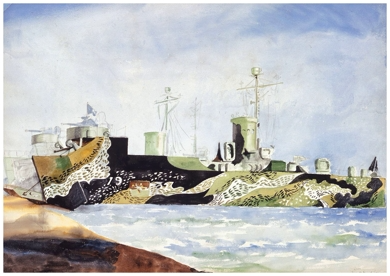
Reginald Marsh, painting of camouflaged ship
Of American artist Reginald Marsh, I know very little. For example, it isn’t clear if he served in the military. Apparently not, and yet on the website of the Naval History and Heritage Command, there are at least thirteen paintings by him that feature US Navy themes.  

One of them, titled The Navy’s Happy Medium, shown above, is a watercolor painting of an LSM (Landing Ship, Medium) ship. It is dated 1944, and is described as having been painted in “South Pacific jungle camouflage.” But did he observe it while on duty in the South Pacific? Perhaps not, since elsewhere he is said to have been an artist-correspondent for Life magazine during World War II, in the course of which he traveled to Brazil to paint scenes of American troops. 

Below (from the Archives of American Art) is a photograph of Marsh, with artists Louis Bouché (center), and William Zorach, most likely prior to WWII, holding what appears to be a WPA-era poster. It is related (if faintly) because Bouché actually was affiliated with wartime camouflage during WWI. Working for the US Navy, he had the same assignment as Thomas Hart Benton—that of making on-site colored paintings of the camouflage on any ships that entered the harbor, whether domestic or foreign.

Reginald Marsh, Louis Bouché and William Zorach


Wednesday, June 25, 2014

Edward Morton | More Milwaukee Camouflage

Restoration of WPA mural by Edward Morton (1938)
Above A Depression-era Works Progress Administration (WPA) mural (titled Winter Sports) by Wisconsin artist Edward Morton, commissioned in 1938 by the US Government for permanent installation in the post office at Oconomowoc WI. In the 1970s, the mural was taken down and thereafter kept in the basement. Fortunately, it was restored in 2003, and is once again on public display in the post office.

•••

Many years ago, we taught for more than a decade at the University of Wisconsin-Milwaukee. So did an aging artist named Edward Morton, who was then an adjunct instructor of drawing. I had just published a book on art and camouflage. If I had known better, I would have talked to him at length, in part because one day he said that he had served as an army camoufleur during World War II. I didn't follow up on it. He has long since died—and now I have plenty of questions to ask.

A few weeks ago, I ran across an article from the Milwaukee Sentinel (December 11, 1944), which includes a photograph of the young Ed Morton, home on leave from the army, painting a portrait of his wife. Here's what the article says, followed by the news photo—

On leave from camp at Maldon MO, Sergeant Edward L. Morton turned from painting things that do not exist to painting things that are real. In the army, Sgt. Morton is a camoufleur, but in civilian life he was an instructor at [Milwaukee's Layton School of Art] and won prizes for his own work at State Fair art shows. Here he is completing a portrait of his wife Dorothy, at the home of her parents…

Edward L. Morton, US Army camoufleur (1944)


Friday, April 6, 2012

Camouflage Artist | Maurice (Jake) Day

Frank S. Nicholson, National Park Service Poster (c1938)
Above Frank S. Nicholson, wildlife poster for the National Park Service (c1918). Courtesy of the Library of Congress.

It turns out that the artist in the Disney Studios who determined what Bambi would look like was also a World War I ship camoufleur. His name was Maurice (Jake) Day (1892-1983).

There is an online biography of Day, written by Andrew Vietze, titled "The Mainer Who Found Bambi" (DownEast.com, December 2009).

Here's an excerpt that pertains to his service as a camoufleur—

Born in Damariscotta [ME] in 1892, Jake Day attended high school at Lincoln Academy, where he did his first serious painting of a local church. From there he moved on to the Massachusetts Normal School, studying for a year before transferring to the School of the Museum of Fine Arts, Boston. Upon graduation he found the world embroiled in a war and enlisted in the Naval Camouflage Department of the Emergency Fleet Corps in New Orleans.

As a ship camoufleur in New Orleans, Jake Day presumably worked with Paul F. Brown, whom we featured in a recent earlier post.

The Vietze article provides a substantial account of Day's experiences as an animator in California, where he moved in 1935. One of the firms he worked for was the Walt Disney Studio, which had just purchased the rights to an Austrian children's book about a fawn named Bambi. Disney planned to make an animated film, basing the look of the young deer on a California mule deer. Day convinced Disney to used a white-tailed deer instead—and the rest is history.

Saturday, March 24, 2012

Camouflage Artist | Ezra Jack Keats

Ezra Jack Keats (from Keat's Neighborhood)

Like Robert Lawson (who illustrated The Story of Ferdinand in 1936), his acclaimed predecessor in writing and illustrating children's books, award-winning artist and author Ezra Jack Keats (1916-1983) was also a camouflage artist. Lawson had served in France in the US Army's American Camouflage Corps in World War I, while the younger Keats (known then by his birth name, Jacob Ezra Katz) designed camouflage patterns during World War II in Tallahassee FL for the US Army Air Corps. Before the war, he had worked as a mural painter for the Works Progress Administration (WPA), and as a background artist for the Captain Marvel comic strip. At war's end, searching for employment after receiving an honorable discharge, he was so dismayed by the prevalence of anti-Semitism that he changed his legal name to Ezra Jack Keats. He began illustrating children's books in 1954. According to his obituary in the New York Times, in the last three decades of his life, he illustrated 33 books, 22 of which he also wrote.

Saturday, November 20, 2010

Camouflage Artist | Perkins Harnly

The following is an excerpt from an Oral History Interview of American artist Perkins Harnly (1901-1986), who served as a Depression-era Works Progress Administration muralist and, during World War II, as a camouflage instructor. The interview, which took place on October 15, 1981, was conducted for the Archives of American Art by Estil Pennington and Lynda Hartigan. The entire interview can be accessed online here—

Mr. Harnly: …when the WPA broke up—when the war was declared, you see—we were put on defense projects. I was put in aluminum.
Ms. Hartigan: And you taught camouflage design?
Mr. Harnly: Yes. I was an…instructor of officers. Yes, I certainly was. One of my officers in camouflage was William Pahlmann, who was the famous interior decorator. Gene Davis, who was the art [director] of [Good] Housekeeping Magazine. I had big shots.
Mr. Pennington: Leslie Cheek, did you work with him?
Mr. Harnly: I know the name, I know the name. I know the—I can't place him at the moment. But they gave me the project of the people who had much experience, much background, and all that. And we went to Fort Belvoir, Virginia, the place where Homer Saint-Gaudens was, a relative, son of the great sculptor, I think.
Mr. Pennington: Yes.
Mr. Harnly: Well, anyhow, he was the head of this thing, of camouflage, until the air bombing of Cologne. It took 22,000 planes to mow the city down. All but the cathedral, they left the cathedral. And after that, camouflage, as we knew it, was not of any use. They used tactical camouflage after that.