Showing posts with label trick photography. Show all posts

Tuesday, October 3, 2023

contributions of Hollywood to WWI ground camouflage

Above Camouflage pattern (digitally-colorized, thus historically unreliable) on World War I huge long-range artillery, mounted for railway transport, c1918, unknown source.

•••

G.P. Harleman, News of Los Angeles and Vicinity in The Moving Picture World, December 1, 1917—

Lawson Organizes Camouflage Artists
Lee Lawson, [Hollywood] technical expert, has received from the Adjutant General authorization to form a company of two hundred and fifty men of the [motion picture] studio plants for the camouflage department to be incorporated in the Twenty-Fourth Engineers.

Lawson has been engaged at his trade locally for the past twelve years. He recently asked for authority to organize a company of camouflage artists. His appointment was made by Secretary of War [Newton] Baker.

All the ingenuity of “trick stuff” manifested in motion pictures will be transplanted to the camouflage activities in France. Scene painters, artists, sculptors, property men and numerous other classes of employees in studios will comprise the company.

Lawson already has sixty-four men enrolled. These will leave in a few days for American Lake [near Lakewood], Washington, where they will receive instruction in the most advanced methods of camouflage work.


•••

G.P. Harleman, News of Los Angeles and Vicinity in The Moving Picture World, December 15, 1917, page 1637—

Camouflage Artists Leave for Training
The greatest camouflage company in the world, according to Major George P. Robinson, United States Engineers Corps, left Los Angeles November 24, for an eastern training camp. There wre sixty-five men in the part, headed by Lee Lawson of the Universal. The personnel were recruited almost exclusively from the leading motion picture studios of Los Angeles.

“Nowhere else in the world could a company of men of similar qualifications have been recruited,” said Major Robinson. “The best scenic artists and men of kindred trades in the motion picture industry are here.”

Just before the train pulled out of the station Lee Lawson made a short speech to the crowd. “Friends, we’re going over there to fool the Kaiser, and if Yankee genius counts for anything we’ll be there with the goods,” he said.

The leave taking was different from any farewells given any party of soldiers leaving Los Angeles heretofore. Sixty-five young men, all of them known personally to the five hundred or more persons who bade them goodbye, caused everybody to cry goodbye to everybody else. It was a scene not easily forgotten.


•••

News of Cinema and Film Gossip in The New York Sun, February 2, 1919, p. 39—

Lieutenant Lee Lawson, former technical director, Sergeant Clarence DeWitt and Sergeant H. Divver, formerly of Universal City, for over nine months members of a camouflage regiment in France, has returned to the studio. When America entered the war Lieutenant Lee [sic] assembled scenic artists, sculptors, directors and property men in a camouflage platoon. He was wounded twice, Sergeant DeWitt gassed, and Sergeant Divver wounded twice.

RELATED LINKS    

Dazzle Camouflage: What is it and how did it work?

 Nature, Art, and Camouflage

 Art, Women's Rights, and Camouflage

 Embedded Figures, Art, and Camouflage

 Art, Gestalt, and Camouflage

 Optical science meets visual art

 Disruption versus dazzle

 Chicanery and conspicuousness

 Under the big top at Sims' circus

Wednesday, June 28, 2023

iowa trickster makes photographic camouflage / 1919

Antonius J. Viken, Waterloo IA / 1919
Above These three photographs were a reader’s contribution to Popular Mechanics, where they were published in Vol 31 Issue 2 (1919) of that magazine. The photographs were taken by A.J. Viken of Waterloo, Iowa, as examples of makeshift camouflage. Here is the text he submitted—

Practical examples of “camouflage” are shown in these three photographs. In the upper left-hand corner the man has adopted an effective, if somewhat strenuous means of making his appearance blend with his surroundings [by standing on his head, his belt line coincides with the horizon]. To the right, the small rider on the horse’s back is almost indistinguishable against the background of sky and trees, while the lower picture shows how difficult it may be to distinguish such a striking object as a goat.

A.J. Viken (Antonius Johnson Viken) [Skinderviken] was a Norwegian-American photographer. Born in Norway on October 4, 1885, he came to the US in April 1911, and became a naturalized citizen (in Chicago) in 1924. He registered for the draft on September 12, 1918, at Waterloo, where he and his wife Johanna (nee Hansen) Viken lived at 1123 Mulberry Street. As a photographer, he was employed by Louis A. Wangler at 227 East 4th Street in that city. In 1919, when his humorous camouflage photographs were published, his residence was listed as Waterloo, but in later years he also lived in Sioux City IA, Chicago, Jackson Heights NY, and on Long Island, New York. He died in Nassau NY on September 26, 1959.

Among Viken’s associates was photographer and inventor Donald Cameron Biedler (1885-1943). In 1924, both men listed their residence as 864 Buckingham Place, Chicago, in the vicinity of Wrigley Field. 

Beidler was a well-known photographer of wealthy, socially prominent clients (and their children) in Chicago, and later in Manhasset, Long Island NY. Originally from Mt. Pulaski IL, Beidler was a grandson of Jabez Capps, the town's founder. In collaboration with A.J. Viken, he was also invented a special motor-driven children's portrait twin camera, called the Beidler-Viken camera (see below), which they patented in 1925. Although it consisted of two cameras, side-by-side, it was not designed to make stereoscopic images. Instead, it was operated by two photographers, one of whom maintained exact focus on the (squirming) child being photographed, while the other tripped the shutter at the opportune moment. Beidler's Chicago studio was in the Lyon and Healy Building at 64 East Jackson Boulevard, circa 1920. In 1929, he and Viken established the  Beidler-Viken Studios in Manhasset on Long Island. Fourteen years later, Beidler died of a sudden heart attack, while Viken lived until 1959. In Biedler’s obituary, his partner Viken was described as “a man highly skilled in the mechanical end of photography.”

Between the years 1925 through 1936, Antonius J. Viken and Donald C. Beider worked together on a number of technical devices related to photography, including various camera stands (1925, 1930), a camera tiltback adjustment (1931), and their Beidler-Viken camera (1931). But Viken obtained patents independently for other inventions, such as a film hanger (1926), a hood for camera finders (1929), a tripod head (1931), and a film holder and hanger (1936). In 1931, Viken also worked with a bacteriologist, acetone expert, and Chicago physician named Dr. Nathaniel Frutkow (described in a research document as “a somewhat quackish physician specializing in pneumonia”) in patenting a diagnostic table and therapeutic lamp. 


The following is a list, arranged by date, of some (probably not all) of the patented inventions that are attributed to Viken, Beider and Viken, or Viken and Frutkow. Full pdf patent documents can be found online by searching Google Patents.

Stand for camera and the like, 25Aug1925, w/Donald C. Beidler. Film hanger, 4May1926, 1,583,708. Hood for camera finders and the like, 26Nov1929, 1,737,038. Camera and camera stand, 14Jan1930, w/Donald C. Beidler, 1.743,184. Tripod, 10Mar1931, 1,795,747. Tiltback for cameras and the like, 17Mar1931, w/Donald C. Beidler, 1,796,315. Tripod head for portrait camera, 30Jun1931, 1,812,614. Diagnostic table, 15Sep1931, w/Nathaniel Frutkow, 1,823,534. Therapeutic Lamp, 15Sep1931, w/Nathaniel Frutkow, 1,823,535. Camera and the like, 24Nov1931, w/Donald C. Beidler, 1,833,668. Film holder and hanger, 21Jan1936, 2,028,262.

Wednesday, June 21, 2023

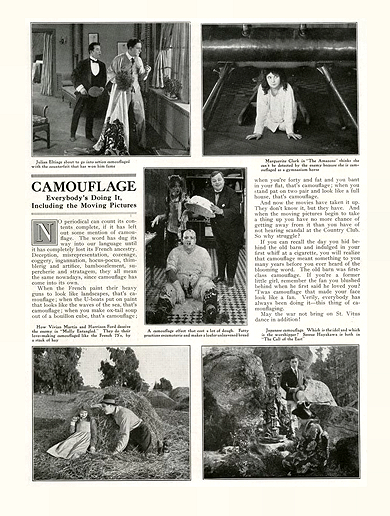
camouflage / everyone's doing it, including hollywood

Above A page from Photo-Play Journal, December 1917, p. 25, featuring an article called CAMOUFLAGE: Everyone’s Doing It, Including the Moving Pictures. In an earlier blog post, we reproduced the article’s text, but not this image of the page.

SEE ALSO

Nature, Art, and Camouflage (35 min. video talk)

Art, Women’s Rights, and Camouflage (29 min. video talk)

Embedded Figures, Art, and Camouflage (26 min. video talk)

Art, Gestalt, and Camouflage (28 min. video talk)