Showing posts with label theatre designers. Show all posts

Wednesday, August 20, 2025

camoufleur Bérard made Chantecler farm yard scene

costume from Chantecler
Back in 2014, we blogged about the French stage designer Louis Bérard, perhaps best known as "le decorateur de Chantecler," a wonderfully zany satirical play by Edmund Rostand, in which all the actors were dressed in animal costumes (as shown above). But he was also a camoufleur for the French during World War I. More recently, we've found a different news article on his life and work, reprinted below.

•••

SCENERY FOR WAR: M. [Louis] Bérard of "Chantecler" Fame a Camouflage Artist in The Spokesman-Review (Spokane WA) May 28, 1918—

Camouflage is an art which attracts the best artists who have been engaged for some time in painting scenery for war.

In Paris there are many studios, employing thousands of men and women. In Montmartre there is a studio where young American artists of the Latin Quarter are busy camouflaging for the American front. Not only guns, but motor trucks, buildings—whole villages even—have to be made to appear what they are not, which, indeed, is the essence of camouflage.

A French scene painter, M. [Louis] Bérard, was one of the inventors of war camouflage. For the last 35 years he has been the leading French scene painter, to whose genius was due the scenic triumphs of the Sardou and Rostand plays. It was he who created the marvelous farm yard scene in Chantecler, and it was the trees which he built for this play which gave him the idea for the observation posts which look like trees.

When war broke out M. Bérard had turned 60 years of age, but he at once offered his services to the French government, and asked to be allowed to go to the front to develop his ideas of camouflage.

With the assistance of his expert pupils he created "lakes" where there was no water, "forests" where no trees grow, and thousands of guns, huts and artillery emplacements changed their hue as the seasons advanced. When M. Bérard put the finishing touches to a particular important piece of work he would go up in an airplane to obtain the same view as that afforded to the Boche.


•••

Note In Cécile Coutin's Tromper l'ennemi (2012) Louis Bérard (1865-1920) is described as an accessoiriste de théatre (property man) who served in the Section de Camouflage (1914-15) as a camouflage instructor at the studio at Amiens. She includes a three-page section on "Louis Bérard and His Contribution to the Invention of Camouflage" (pp. 48-51). It will require translation, since the text is in French.

RELATED LINKS

Dazzle Camouflage: What is it and how did it work?Nature, Art, and Camouflage / Art, Women's Rights, and CamouflageEmbedded Figures, Art, and Camouflage / Art, Gestalt, and Camouflage /  Optical science meets visual artDisruption versus dazzle / Chicanery and conspicuousness /  Under the big top at Sims' circus

Sale-priced books on camouflage / free shipping

Friday, July 18, 2025

more on camoufleur Carol M. Sax from Ottumwa Iowa

Carol M. Sax / passport photograph (AI colorized)
In earlier blog posts, we've shared quite a lot about Iowa-born theatrical designer and ship camoufleur Carol M. Sax, originally from Ottumwa. Below is a full article about him from 1917, with additional mention of Boston-area artist Clara Lathrop Strong. An essay on Sax's life and his involvement in camouflage is included in the book, DREAMS OF FIELDS: Memory Traces of Iowa's Past (August 2025).

•••

Katherine McKinsey, MARYLAND INSTITUTE CAMOUFLEURS: They Are Working With Carol M. Sax In The Hope Of Becoming An Integral Part Of The Nation's Military Establishment And Already Have Been Recognized By The Government, in Baltimore Sun, December 16, 1917—

Camouflage? What is this camouflage, anyway? You may have noticed the word—nay, you must have noticed it! It pops out at you as regularly and much more often than the brute who endeavors monthly to collect a large rent for your very small apartment. There is no escaping it. It is as popular as hot fudge sundaes!

Unless you have introduced it into your vocabulary and can work it as easily as any other good American word like "ain't" and "Ish'dworry" you are, so far as the chatter of the day is concerned, practically speechless. It appears in newspaper print quite as frequently as "over there," which is saying much.

An expert who comes into closeup contact with all terms, decadent and otherwise, flung about by fertile fancied writers, says the public is fairly "wised up" on the word camouflage. It is his candid opinion that you can run up to Elkton, drop into the corner grocery store and get from the grocer's clerk's youthful assistant a fairly intelligent definition of the word.

Camouflage? Why, Sure
A New Yorker who dropped into the Army Information Bureau in his city didn't find anyone there in doubt as to its meaning. The moment it was mentioned a dozen khaki clad figures stopped whatever they were doing and stood ready to volunteer for the duty of explaining. Camouflage is just as plain to them as the noses on their comrades' faces.

Jane Dixon in the New York Sun reports the great experience of the adventurous New Yorker as follows:

"'See that water cooler there?' indicated the Sammie who reached the front trench of information a trifle in advance of the others.

"The water cooler was conceded.

"'Well, if I took that water cooler and painted it gray to match the wall so the slackers who come in here just to hang around and get an earful wouldn't see it and drink up all our ice- water, that would be camouflage.'"

So you see: Camouflage is rigging up things to fool persons—particularly and especially enemy persons in war time. The word began in French music-hall slang before there was a war or any thought of war and it meant "faking"—which it still means, but with more serious import now.

The curious New Yorker's pursuit of knowledge on the subject of camouflage led him to the British recruiting offices where he was received by Sergeant Major MacKenzie. To quote again from Jane Dixon's report of the pursuit:

"'Camouflage?' he smiled from high altitude (he measures something over six feet four unshod). Indeed, yes. It is most important. We have been employing it regularly and with great success.

"'For instance,' prompting.

"The last time I remember seeing a flagrant example of the worth of camouflage was in the battle of the Somme. The artillery fire was terrific. We kept pumping in the shells and as we pumped we advanced.

"'We were in what is called the chalk country. There is a thin layer of topsoil and under it a chalk formation. The recoil of the big guns stripped the topsoil off, leaving the chalk exposed. The chalk, of course, is white. To prevent the enemy from sighting the guns against this white background daubed them white. It was difficult for airplanes to detect them and give the range.'

"'Sounds reasonable,' this by way of encouragement.

How It Works
"This daubing of guns, trucks, ambulances, supply trains, tanks and the like is general along the front. A variety of colors are used to give the bulk a conglomerate appearance and defy detection.

"'Gun positions are concealed by boughs stripped from trees and made to look like a clump of underbrush. A hedgerow, common in that country, will often be a mushroom growth built up to last a few hours and conceal an advanced trench.'

"What is the most effective bit of camouflage you have ever seen?' was asked.

"'A difficult question, I should say. You see in our ranks each man works his own camouflage. The ingenuity of individuals, companies and whole regiments in inventing ways and means to deceive the enemy is a marvel of human wit.

"'Probably the best example of it I have seen was a little cottage nestled down among fruit trees somewhere in France. It was a peaceful cot, with chickens and a pigsty and a cow and a dog lying on the stoop in the sụn.

"The enemy advanced within range. Suddenly one end of the peaceful little cottage opened up and a very unromantic nine-two poked its nose out. My word, how she did bite!'

"'The identity of the nine-two is not entirely clear, but from the tone used in referring to her she is adjudged a highly explosive shell shooting machine with steel jaws and a sweet tooth for Huns."

So this is camouflage! Since it has a French name no doubt the French were first to employ it. Then the British took it up and we Americans are to apply to the uses of camouflage our thought and skill and make it a thing of more value than has as yet been dreamed of.

The United States Army now numbers among its many branches one Camouflage Company which is in training at camp at the American University, near Washington. Its personnel includes artists, sculptors, architects, engineers, chemists. stage directors, theatre and circus mechanics, photographers, moving-picture scene makers, metal workers, etc. They are all enlisted or commissioned members of the army.

Maryland Institute Has Class
But not only in the properly enlisted and commissioned ranks of the Camouflage Corps is there training in the use of disguises and protective coloring. In Baltimore, at the Maryland Institute, there is a hard-working class of camouflage students preparing for a time when their services may be needed.

One of the plaster casting rooms in the basement is being used as a studio by the class and if you visit this studio it is best to enter warily since it is not pleasant to bump one's nose upon a camouflaged hunk of clay.

The work here is necessarily of a very limited nature since camouflage involves engineering, mechanics, construction (which includes building with wood and masonry, and the finer points of trench digging and the making of wire entanglements); and, in addition to the purely artistic branches of the work, the members of the Camouflage Corps are trained in all military branches in order that they may be self-protecting and thus a help rather than a burden to the army corps with which they are detailed.

But that such a class as that being conducted at the Maryland Institute may be of recognized value is indicated by a letter from Major General W. M. Black, Chief of Engineers, United States Army, under whose command is the Corps of Engineers known as the Camouflage Corps, which is commanded by Captain Aymar Embury, USR. The letter is addressed to Mr. Carol M. Sax, instructor of the School of Design of the Maryland Institute and instigator and volunteer instructor of the camouflage class. It reads as follows:

Letter To Mr. Sax
"In reply to your inquiries as to the probable utility of experimental work in camouflage conducted independently by the Maryland Institute of Fine Arts, I beg to inform you as follows: We believe that an organization trained as you have suggested will be extremely useful. First, because of the probability that new ideas might be developed by such an organization; second, because a continuous organization of this kind will be of value to the Department in insuring the preservation of all schemes which have been tried and thought out; third, because there may very likely be a call for civilians to prepare articles to be shipped abroad so that they may be concealed as readily as possible.

"As to the co-operation of this department with you—your organization will have to be entirely voluntary as we have no authority to assist such an organization financially. A competent officer or non-commissioned officer could be detailed to criticize and instruct or advise your classes, should its size and interest warrant this course. It will be advisable to have this course conducted near the American University Camp, Washington, DC, where camouflage experiments under the Regular Army are being made, if possible. If not they may be forwarded to some convenient spot near Baltimore.

"Mrs. S. L. Strong, of Marshfield Hills, MA, is desirous of forming such a class and writes that she has a very considerable number of persons who are ineligible for military service and who desire to attend such a class. I would suggest that you take the matter up with her and see if the two classes cannot be combined. Our experience is that interchange of ideas between groups of persons results in more fertility of invention than when it is confined to a few people."

A later letter from Major General Black stated that a scarcity of "competent officers or non-commissioned officers" which had become evident precluded the possibility of sending such an officer to the Maryland Institute class. The promise of the service of such an officer, however, is not the most significant note in the quoted letter of the department's recognition of the value of a class such as that suggested by Mr. Sax.

This letter says "second, because a continuous organization of this kind will be of value to the department in insuring the preservation of all schemes which have been tried and thought out." The significance of this clause appears when it is explained that the Camouflage Corps now in training is destined for work at the war fronts in Europe. When its course of training is completed it will be sent "over there," and unless its personnel is divided and some of its members are kept in this country to train future corps the results of its experiments and thought will be carried with it and a new corps will of necessity be compelled to start its experimental work where the first corps started instead of where the first corps finished.

Here, then, is the value of a definite and permanent camouflage organization composed of persons not eligible for military service, but eminently eligible for camouflage work. That the department would keep such an organization in touch with the work done by the Camouflage Corps can be the only inference placed upon the clause quoted above, for an organization cannot preserve "all schemes which have been tried and thought out" unless it is officially informed of those schemes.

Women Camoufleurs
Mrs. Strong, in a letter to Mr. Sax, told of her plans for a woman's camouflage training course for which she expected at least 1,100 members from all over the country. She had been offered land at Edgemoor, near Washington, for a camp and proposed a course of training to extend over a month or six weeks. This, of course, would be insufficient time to become proficient in all camouflage includes and the difficulty now, when Washington is overwhelmed by transient and new population, of housing and boarding a large body of women would be great. This class was not intended to be a permanent organization.

In a later letter Mrs. Strong expressed a strong desire to merge her plans with those of Mr. Sax if it should become possible to have a military instructor from the Camouflage Corps. In the event of such co-operation about 50 women would come to Baltimore to join the class. Home accommodations can be secured for them by the Young Women's Christian Association. Mr. Sax has been assured by that organization. But the difficulty in carrying such a plan into operation lies in the fact that there is not to be a military instructor. So it is probable that the Maryland Institute class will continue as it is now—an independent and voluntary organization working under the tutelage of Mr. Sax and with the sanction and approval of the War Department as given through Major General Black.

Therefore any day that you may feel so inclined you may step into the camouflage studio at the Maryland Institute and watch a clay cube be made to become invisible by the clever application of paint. So far only the problems of protective coloring as are to be overcome in a fixed light coming from a single angle have been studied. Shortly the class will hold its meetings outdoors so as to become familiar with the difficulties to be overcome in the changing light of the open air. There are at present eighteen members and they meet every day.

Sax Enthusiastic
In speaking of his work Mr. Sax becomes enthusiastic. "I have always been: very much interested in the protective coloring of animals as an outgrowth of my routine art work and I studied quit a good deal in the American Museum of Natural History in New York and in the Field-Columbian Museum in Chicago, where the animals are mounted in their natural surroundings so as to show the value of their colorings as a protection from detection.

"When the subject of camouflage in war first became known I was interested in it for the same reason that the camouflage of the wild animals appealed to me. I read whatever I could secure on the subject and heard several excellent and interesting lectures. There is, however, so little written or generally known of methods already used or still waiting the discovery of the experimenters that the ideas of the veriest amateurs have every possibility of being quite as valuable as those of the experienced 'camoufleur.'


There are two systems of camouflage in use. One makes battleships invisible at a distance of three miles. I could see them fairly distinctly at distance of one mile, but I could see the battleships painted the customary plain gray even more distinctly at a greater distance.

"The colors are put on in alternate stiples of glazed and dull paint. The blotches are by no means applied at haphazard as a close view of the result might lead one to suppose, but a small, flat model of the ship's side is made and painted during a series of experiments in which it is frequently placed upon a wheel and revolved at a definite speed, whereupon the colors blend into the color of sky and sea or not, just as the colors are correctly placed or not.

"This is, of course, only one phase of camouflage, but it involves more than any other the problems of protective coloring. There is here no framework covered with boughs to hide a gun—which is merely the hiding of a gun. A gun painted in such a fashion that it merges at a certain distance with the colors of the earth upon which it rests will have been treated to a coat of protective coloring.

Disguising Wire Entanglements
"The McKay system is much used in the camouflaging of wire entanglements. A black wire stretched upon ground of light color, or a bright wire stretched over a dark surface is easily discernable, but a wire painted in alternate stripes of black and white becomes at a comparatively small distance invisible to the observer.

"And now that we are really getting to know something of the methods of protective coloring it is necessary for us to seek ways of detecting the result such methods when used by our enemies. It has been learned that a cleverly camouflaged fence may be detected by the shadow which it casts and though such a shadow may not be readily discerned by the eyes it is infallibly revealed by the camera.

"The photographic plate also frequently reveals artificial coloring. It has even been said that the camera can detect the use of artificial foliage or grass, because it photographs in a different tone from that which real foliage or grass photographs, but no successful demonstration of this fact (if it is a fact) has as yet been made.

"The possibilities for new discoveries of value in protective coloring or in the detection of protective coloring are tremendous and it is our hope that some of the discoveries of greatest value may be made through experiments made in Baltimore at our own art school." 

RELATED LINKS

Dazzle Camouflage: What is it and how did it work?Nature, Art, and Camouflage / Art, Women's Rights, and CamouflageEmbedded Figures, Art, and Camouflage / Art, Gestalt, and Camouflage /  Optical science meets visual artDisruption versus dazzle / Chicanery and conspicuousness /  Under the big top at Sims' circus

Sunday, April 20, 2025

architects / they have an eye for the looks of things

Above Photograph of Homer Saint-Gaudens, by De Witt Clinton Ward.

•••

HOLLYWOOD PROP MEN ABLE AT WAR CAMOUFLAGE in The Boston Globe, January 15, 1942, p. 12—

WASHINGTON January 15 (AP)—Hollywood “prop” men—the chaps who design the stage sets for the movie stars—make the best prospects for military camouflage work, an Army expert on strategic concealment asserted today.

Lieut. Col. Homer Saint-Gaudens, Harvard-educated head of the camouflage branch of the Office of the Chief of Engineers, said in an article in the Military Engineer:

"Our best men are moving picture property men. They not only have camouflage ideas, but they understand the application of those ideas. They are resourceful; they are disciplined; they have an eye for the looks of things: they can build you the answer."

The colonel, who was himself stage director for actress Maude Adams. and is director of fine arts, Carnegie Institute, says that when a would-be camouflage worker comes to his desk and declares he is a marvellous painter, he (Saint-Gaudens) makes this reply:

"That's okay. But let me have a look at your hands. How are your feet? Can you lug 60 pounds 20 miles and do it again the next day?

"Yes, I remember that set where Robert Taylor makes love to Hedy Lamarr. You say you designed it and helped build it, too? You are just the young man we are looking for."

Saint-Gaudens, who received numerous decorations for his camouflage work during the first World War, said the best camouflage officers, the ones who direct the workers, are young erst-while architects."

Such men, he declared, have "already learned to cope with the builders of new houses who insist on having the stairs and the clothes closet in the same place.”

•••

Below Page spread from an article by Edwin Schallert, Trick Photography in the Gold Rush, in Science and Invention (December 1925), pp. 714-715, showing various special effects and scenic props used in the filming of the Charlie Chaplin comedy The Gold Rush.

  RELATED LINKS    

Dazzle Camouflage: What is it and how did it work?Nature, Art, and Camouflage / Art, Women's Rights, and CamouflageEmbedded Figures, Art, and Camouflage / Art, Gestalt, and Camouflage /  Optical science meets visual artDisruption versus dazzle / Chicanery and conspicuousness /  Under the big top at Sims' circus

Wednesday, April 9, 2025

Homer St. Gaudens as drawn by Gordon Stevenson

Above Cover of TIME magazine (May 12, 1924), featuring a portrait of Homer St. Gaudens (son of the celebrated sculptor Augustus St. Gaudens), who was in charge of US Army camouflage during both World Wars. It is of additional interest that this pencil-drawn portrait of St Gaudens was made by artist Gordon Stevenson, who served as a ship camoufleur with the US Navy during WWI.

•••

War diary of John Lee McElroy, 1st Lieut. 315th Field Artillery, 155th Brigade. Camden, N.J: Haddon Press, c1929, p. 8—

This afternoon I had fallen asleep while studying a map. My head had sunk down on my arms on the table, and I was aroused by someone shaking me by the shoulder. He was a very good looking Major, and said I evidently had not been to sleep for some time. I admitted it. Said he wanted to inspect my camouflage, as he was camouflage officer for the sector. His name is Homer St. Gaudens

RELATED LINKS    

Dazzle Camouflage: What is it and how did it work?Nature, Art, and Camouflage / Art, Women's Rights, and CamouflageEmbedded Figures, Art, and Camouflage / Art, Gestalt, and Camouflage /  Optical science meets visual artDisruption versus dazzle / Chicanery and conspicuousness /  Under the big top at Sims' circus

Tuesday, November 1, 2022

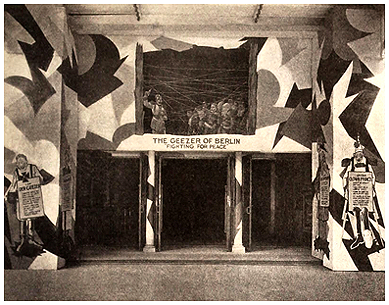
disruptive geezer theatre doors / wartime propaganda

Above This photograph was published in an American theatre magazine during World War I. It shows the decorated entrance of a Broadway theatre in which disruptive abstract patterns (not unlike the confusing dazzle camouflage being applied at the time to merchant ships) have been used to contradict the building's physical form. 

It was common at the time for "scenic artists" (theatre and film set designers) to be assigned to wartime camouflage. 

The treatment of this entrance was a way of promoting the screening of a 1918 short propaganda film titled The Geezer of Berlin, which was of course in reference to the German Kaiser, aka the Beast of Berlin, and the Clown Prince (in reference to his son). Disruptive patterns such as these not only cause visual confusion; they can also disturb the emotions, and, to some extent, designs like this anticipate the use of skewed perspective and shape deformation in avant-garde "expressionist" films, such as The Cabinet of Dr. Caligari. In a recent video, titled Ames and Anamorphosis, I have talked about the use of distorted perspective in that and other early films.

Sunday, October 23, 2022

camouflage tricks behind the scenes in hollywood

Boston Globe, June 15, 1921
Anon, Movie Facts and Fancies, Boston Globe, October 1, 1921, p. 12—

The studio scenic artist of today…is an expert camouflage artist and a perfect copyist. The controlling principal in his work, however, is the photographic value of colors. Under the eye of the camera colors are often very deceptive, and often a color, which seems lighter to the eye than another color, might on the screen register a darker shade of gray than that color.

Often two colors which seem to form a most artistic and beautiful combination to the human eye, will, when photographed, present a most inharmonious, discordant color scheme, which is very ugly to look upon. Only by a careful study and a perfect knowledge of the photographic values of colors does the scenic artist avoid such color clashes.

The art of camouflage also is a very important phase of the studio scene painter’s art. He must make the imitation appear exactly like the real. Some of the commonest of such problems are included in the following examples: The camouflage of compo[sition] board squares and the proper laying of them so that when photographed they resemble a tile or stone floor; the painting of surfaces so that the result photographs like bronze, gold or other metals.

The artist can, with a well-placed strokes of his brush, dipped in the right kind of paint, make a new brick wall like the side of a dingy tenement house. He can give to a new redwood panelled wall the effect of an oak panel, hundreds of years old.

Thursday, February 4, 2021

Sunday, April 5, 2020

Theatrical special effects | Thayer's disappearing man

Abbott H. Thayer holding one of his duck decoys (upsidedown)
Until recently, I had not heard of Percy MacKaye (1875-1956), an American poet and playwright. That should come as no surprise, since (according to Michael J Mendelsohn in his essay by on “Percy Mackaye’s Dramatic Theories”), he “is rarely mentioned today.” But in “the pre-Freudian, pre-O’Neill days of American drama, he was a major figure.”

A Harvard graduate, MacKaye traveled and lived in Europe from 1897 to 1900, then returned to the US to teach at a private school in New York. In 1904, he moved to Cornish NH (ten miles from Plainfield), where he was allied with the Cornish Art Colony, which included such prominent artists as Augustus Saint-Gaudens, Maxfield Parrish, Daniel Chester French, Paul Manship, George de Forest Brush, and Barry Faulkner.

Sixty-five miles southeast of Cornish is Dublin NH, at the foot of Mount Monadnock. At the time, there was considerable contact between the artists in Cornish and Dublin, in part because the latter was the location of the disheveled home and studio of artist-naturalist Abbott Handerson Thayer (the so-called “father of camouflage”). Faulkner was Thayer’s cousin,  Brush was his closest friend, and some of the artists mentioned above were his long-time associates.

Only lately have I learned that Thayer and Percy MacKaye were also acquainted, possibly well-acquainted, and, in 1906, they made an attempt to collaborate on the “special effects” for the staging of Edward H. Sothern and Julia Marlowe’s 1907 production of MacKaye’s play about Joan of Arc, titled Jeanne d’Arc. The playscript was dedicated to Augustus Saint-Gaudens.

In the script, Jeanne d’Arc reveals that she has been visited by St Michael the Archangel. In a couple of scenes, “the glorified form of St Michael” appears as an apparition, then disappears. At a certain point, the ghostly form of Charles the Great (aka Charlemagne) appears within a stained glass surface, then speaks with the voice of St Michael. Obviously, anyone producing the play would need to decide how to handle these ethereal appearances (and vanishing acts) of Jeanne's visions of St Michael.

As early as the mid-1890s, Abbott Thayer had been researching, writing about, and devising demonstrations of a natural form of camouflage called countershading (essentially inverse shading). He claimed that it accounted for the prevalence of “white undersides” in the coloration of animals.

Thayer's disappearing duck (as recreated by Fuertes)


Using wooden duck decoys, as seen in the photographs above (or even raw sweet potatoes), he could make solid forms all but vanish in a natural ground surrounding. (In these two photographs, made by Thayer's student, Louis Agassiz Fuertes, a white sheet of paper has been placed behind the duck decoys to make the counter-shaded one visible, on the right.) Scientific audiences were astonished by his outdoor demonstrations of this. He published articles about countershading in scientific journals, and it led to his being invited to European universities to demonstrate and to install exhibitions of the same phenomenon.

Thayer was inept at managing money. But when his discovery of countershading (sometimes known as Thayer’s law) was received so laudably, he began to imagine practical ways by which he and his family could profit. One of his options had to do with theatrical stage effects. Instead of vanishing duck decoys, could countershading be applied to an actor’s skin-toned leotards, and then, by a simple switch of the lights, might the actor disappear?

We know that Thayer actually carried this out because two photographs of the effect have survived (as reproduced below). They are before-and-after photographs of a male artist’s model (a Boston man named Dutton) wearing counter-shaded tights, in the setting of a lighted box. In one, the light is coming from the bottom (contrary to natural lighting), in which case the figure is easily seen. In the other photograph, the light is coming from the top, and the model all but disappears.

Thayer's vanishing actor in counter-shaded leotards


In 1906, as Percy MacKaye was preparing for the premiere of Jeanne d’Arc, he may have reached out to Thayer—more likely Thayer appealed to him—about the possibility of using on-stage countershading as a way to bring about the appearance and disappearance of St Michael. We know this in part because MacKaye described it in Percy MacKaye: A Sketch of His Life with Bibliography of His Works (Cambridge MA: Harvard University, 1922). Here is the passage—

Midwinter, in the little town hall of Dublin NH: a man-model against a dusky curtain: Abbott Thayer, the artist-inventor, intent, excited, testing (in 1906!) his new “camouflage” principles to create a stained-glass vision of Charlemagne for the Sothern-Marlowe production of my play Jeanne d’Arc.

But did their collaborative efforts succeed? The answer is no: In the end, their project came to naught. There are letters from Thayer to MacKaye in the Archives of American Art that record his frantic if genuine efforts to locate appropriate lanterns and to photograph the model in tights. On March 26, 1906, he sent photographs to MacKaye (perhaps the same two reproduced here), saying: “When Dutton got his suit on again, and took his place, the effect was almost as perfect as ever, quite enough without a single retouch (but the lantern’s the thing!)” A full month later, on April 26, he assured MacKaye that he has made “progress, but only that,” and is awaiting a shipment of new and better lanterns, which, he hopefully asserts, “will make a true total invisibility.”

There is apparently more to the story, but the details remain rather murky. In the files of the Archives of American Art, there is another letter to MacKaye (dated May 25), written by Emma Thayer, on behalf of Abbott, her husband. She reveals that Thayer is overwhelmed, and instead—

he has got that gifted young man [his student] Rockwell Kent (whom Abbott wanted before and could not) to do the thing. Abbott has had him up here, and Abbott says he will do it superbly. But to make sure Abbott is having him do the only complicated thing, the St Michael, first and if he has any difficulty he is to telegraph Abbott, and Abbott will go down.

Rockwell Kent is swiftness itself—and having more endurance can do the thing quicker than Abbott, and is masterly and precise in the way he does everything.


Despite such good intentions, Thayer and Kent were not able to provide a final prototype for the Sothern and Marlowe production. “Unable to get [it] together in time,” according to Thayer’s biographer, Nelson C. White, the collaborative experiment concluded “in complete failure.”

Soon after, Thayer came to realize the futility of making a fortune by inventing practical things. As he wrote to his patron, Charles L. Freer (as quoted by White)—

My failure to make my cursed invention suit itself to Sothern’s immediate needs was the eye-opener I need. I had gone on thinking the Thayer family must have the thousands I was to scoop so easily so as to set me free to work. My eyes opened for good and all and although the thing got into such perfected shape that it seems both to me and my patent lawyer destined for success, nothing will divert another thought from my own work [as an artist], which envelops me like the arms of a beloved again…

…P.P.S. The theatre invention is all ready for someone to take up, patent applied for and covered already in four foreign lands. If the right man looms up within a year or two he shall have it. Otherwise, it can go to hell. I am safe cured! 

•••

Updates
The above was posted only three days ago, but I've just found two updates, including one that's especially surprising: (1) From a news article about a talk that Gerald H. Thayer gave in 1921 in Lowell MA (Lowell Sun, January 20) it appears that he showed the lantern slides of the model who vanished in his leotards. In the article, the space in which the man is posed is described as a "piano box" (a box for shipping pianos), set up in the Dublin NH town hall. (2) Today, I found out that the autobiography of psychologist Michael Wertheimer, the son of Gestalt psychologist Max Wertheimer, has been published in Europe. I couldn't resist buying a digital copy, as expensive as it was. When I paged through it, I was completely aghast to discover that Michael's first wife's grandfather (her mother's father) was—you guessed it—Percy MacKaye. See photo below—I do love these hidden links.

Percy MacKaye

RELATED LINKS    

Dazzle Camouflage: What is it and how did it work?Nature, Art, and Camouflage / Art, Women's Rights, and CamouflageEmbedded Figures, Art, and Camouflage / Art, Gestalt, and Camouflage /  Optical science meets visual artDisruption versus dazzle / Chicanery and conspicuousness /  Under the big top at Sims' circus

SALE book bundle / free shipping


Monday, March 30, 2020

Freighters as unrecognizable as a portrait by Picasso

Hypothetical dazzle schemes © Roy R. Behrens
Lee Simonson, THE WAR AS ART CRITIC in Minor Prophecies. New York: Harcourt Brace, 1927, pp. 87-88—

Among the startling ironies of this war [World War I] is the role it has assigned to the artist. He had remained an image-maker, primarily interested in recording fields in sunlight, women disrobing, bowls of fruit, and sprays of flowers. To his amazement, he found himself necessary to assure the efficience of a fifty-millimeter gun, the safety of a cargo of herring, or the sale of a million bonds. 

Hypothetical dazzle schemes © Roy R. Behrens
The technique of his purely pictorial experiments, impressionism which had bewildered the juries of fifty years ago, became part of the technique of war. For camouflage began with the discovery by the manager of the largest emporium at Lyons that if a sentry’s cape were dabbed with color in much the same manner as Monet had painted a haystack, the sentry became a less obvious target. The development of camouflage has paralleled in its logic the development of modern art. 

Hypothetical dazzle schemes © Roy R. Behrens
As one passes the camouflaged steamers in our harbors it is apparent that the particular system of color planes which disguise them would never have been so readily devised if the clue to it had not already existed in cubist and futurist canvases. The atmospheric unity binding figure and landscape in a picture has been transferred to the soldier in the field, and the identity of a freighter becomes as unrecognizable as the features of Mr. X in a portrait by Picasso. We have found that naked weapons are ineffective, and called on the artist to decorate them.

RELATED LINKS

Monday, March 23, 2020

Paint manufacturers, scenographers, and camoufleurs

Harrison Marine Paints Advertisement (1918)
Above There are apparently no full-color photographs of WWI-era camouflaged ships, since color photography (as we know it) had not yet been perfected. But there are thousands of black-and-white photographs, hand-painted ship models (used for testing), and artists' full-color drawings and paintings of ships, including colored diagrams that were used as reference plans as the ships were being painted. There is also this rather extraordinary magazine advertisement that appeared on the back cover of DuPont Magazine: A Review of American Industrial Progress (Wilmington DE) Vol IX No 1, July 1918. Unfortunately, the artist is not credited.

•••

Paint manufacturers of the United States, Paint and Varnish in the Great War. Washington DC: Institute for Industrial Research, 1919, p. 8—

Ships of war are ships of steel…[and are] serviceable only as long as [they are] protected from corrosion. Paint protection is therefore a necessity to the successful operation of a battle fleet. To the uninitiated, it might seem rather surprising to learn that the coating of one large ship may require over 100 tons of paint and that the painting is renewed practically every six months in order to maintain permanent protection and appearance.

•••

SHIPYARD NEWS: CAMOUFLEURS HERE THROW OUT CHESTS: Pennsylvania Shipyard Force Claims Record for Disguising War Emergency Vessels in Evening Public Ledger (Philadelphia PA), December 3, 1918, p. 6—

The Pennsylvania shipyard camoufleurs are getting increased chest measurements.

They boast of the honor of having camouflaged the first and last ship built on the Delaware River for war emergency purposes.

The first ship on which the paint shop artists spilled their gaudy colors was the [USS] John M. Connelly, a 7,000-ton tanker which was launched November 10, 1917.

USS John M. Connelly in dazzle camouflage


The last vessel so decorated to deceive the eye, before the armistice was signed, was the [USS} Indianapolis, a 12,800-ton cargo carrier launched July 4 of this year.

According to the paint shop workers of the Pennsylvania yard at Gloucester, the finishing touches were put on the Indianapolis on November 11, the big day when the glorious news arrived.

USS Indianapolis in dazzle camouflage


The paint shop in the Gloucester yard is in the charge of Harry Epting, foreman.

Virtually all the deceptive lining placed on the ships was done by G.V. Ancker and the fields between colored by the brush wielders of the paint shop.

But the general supervision of the camouflage work fell on the shoulders of Paul [Bernard] King, of the camouflage department of the United States Shipping Board.

We’ve recently learned that G.V. Anker (who drew the outlines of the camouflage schemes on the ships, while less skillful painters filled them in) worked for the Nixon-Nirdlinger Theatrical Company and other major theatres in Philadelphia. In the early 1920s, he relocated to Camden NJ, and established his own firm, in which he designed and painted a wide range of components (including elaborate parade floats), as described in his advertisement below. Of particular distinction was his interior design for the New Lyric Theatre in Camden.

RELATED LINKS    

Dazzle Camouflage: What is it and how did it work?Nature, Art, and Camouflage / Art, Women's Rights, and CamouflageEmbedded Figures, Art, and Camouflage / Art, Gestalt, and Camouflage /  Optical science meets visual artDisruption versus dazzle / Chicanery and conspicuousness /  Under the big top at Sims' circus

G.V. Anker Company Advertisement (1924)

Thursday, March 19, 2020

Oliver Percy Bernard | Camoufleur and Scenographer

Oliver Percy Bernard (c1915)
The RMS Lusitania was torpedoed by a German U-boat on May 7, 1915. It sank in 18 minutes, eleven miles off the southern coast of Ireland. Among the fatalities were 1,198 passengers and crew, including 128 American citizens. Among the survivors was a British architect and stage designer named Oliver Percy Bernard, who gained importance later as an Art Deco interior designer. But he also played a significant role in World War I British army camouflage. When the Lusitania sank, Bernard was moving back to London from Boston.

On May 8, there was an article in the Boston Post, with the headline ARTIST AMONG PASSENGERS: Oliver Bernard in Boston All Winter. It included a photograph of Bernard (above), accompanied by the following text—

Oliver Bernard, one of the passengers on the Lusitania, lived with Dr, and Mrs. Arial W. George of 38 Winchester Street, Brookline, from last October until he sailed for England.

Mr. Bernard was the director and resident artist of the Royal Opera House, London. He was also the business manager of the English Players, who were in Boston some weeks ago.


•••

About twenty years later, Bernard (known to friends as “Bunny”) published an autobiography, titled Cock Sparrow: A True Chronicle [WorldCat lists it as fiction] (London: Jonathan Cape, 1936). Bernard was small and terribly hard of hearing, and the title refers to the slanderous name that he had been given by bullies. We have searched for a copy of his autobiography for years, either to buy or to borrow. Interlibrary loan requests have not been successful. When it first came out, there was the following brief review in the Sydney Morning Herald (July 25, 1936), p. 12—

Mr. Oliver Bernard is now a successful interior decorator in London, but his training for that position is by no means like most others of his colleagues. For that reason, his autobiography makes fascinating reading. We see the successful decorator as a small and unhappy boy, as an assistant in a scenery painting studio, as a deck-hand on a Norwegian windjammer, as an American stage designer, and, finally, as a camouflage expert during the war. In the interval of following these various activities, Mr. Bernard also went down with the Lusitania, about which experience he writes illuminatingly, and formulated his own design for living. In revealing the stages of this mental growth he is not so successful as when chronicling the highlights of his adventures. It is, perhaps, those very adventures and their variety which have left him a little muddled, and, consequently, his literary method tends toward diffuseness. But as a camouflage expert reconciling the arts of war and the arts of painting, he has such an unusual and interesting topic that the book becomes really worthwhile. Indeed, he feels so himself, for he devotes most of his chapters to the war years, and leaves the chronicle of his life at that point.

•••

To date, the best, most detailed discussion of Bernard’s contributions as a British camoufleur (short of someday obtaining his memoir) is in Nicholas Rankin’s excellent book, A Genius for Deception: How Cunning Helped the British Win Two World Wars (UK: Oxford University Press, 2009).  See also War and Theatrical Innovation (2017).

To avoid confusion, it helps to know that Oliver Percy Bernard had a son who is also cited as Oliver Bernard, known for his translations of Arthur Rimbaud.

RELATED LINKS

Monday, March 16, 2020

Camouflage used as film theatre entrance advertising

Theatre entrance for The Geezer of Berlin (1918), NYC
In a wartime issue of Motography (November 10, 1917, p. 975), a brief article appeared in which it was asserted by a Hollywood advertising executive that “There is absolutely no excuse…for making motion picture posters deceptive.” In the article, titled Camouflage Has No Place in Poster Making, the executive goes on to say that ”Camouflage has its uses but it does not lend itself to the theatre lobby.”

Almost a year later, this was contradicted by a full-page article in Motion Picture News (October 5, 1918, p. 2189) titled Lobby Display Gets Laughs and Pulls in Crowds to See “The Geezer of Berlin.” It describes a successful advertising ploy devised M. Kashin, theatre manager of The Broadway Theatre in New York.

In an effort to increase attendance at the showing of a propaganda film (the “geezer” in the title, of course, is Kaiser Wilhelm II), Kashin transformed the theatre entrance, as well as the inside lobby, by installing "dazzle camouflage" designs, cartoons, and humorous posters.

The “vivid colors” of the “real camouflage” on the facade, the article states, “are enough to stop anyone in their tracks,” and in turn to lead the audience to a cut-out of “Der Geezer,” as well as satirical posters about “The Clown Prince,” “Gott of Germany,” “Hindebug,” and “Turpentine.”

Reproduced above is a photograph of Kashin’s design for the entrance. In an article published elsewhere (titled Inexpensive Lobby Displays), Kashin discussed his methods for devising this and other advertising novelties. He wrote: “I have found that the lobby display, worked out to its finest detail, will bring more results than any other form of advertising…”

Saturday, February 29, 2020

Jasper | dappled dog with white chicken on backside

Above A vintage news photograph of a dog that appears to have the shape of a white chicken on its backside.

•••

A Conscientious Objector in The Ogden Standard (Ogden UT), September 7, 1918, p. 23—

The art of camouflage was resorted to in one instance in making a scene for [a motion picture titled] Young America… Jasper, the pet dog of the leading boy character, refuses to chase chickens. He was brought up among chickens and carefully trained from puppyhood not to molest them. When he was “ordered” to do this in the [filming], he positively refused.

It was necessary to get another dog [to use as a stand-in] for Jasper, and, while a canine was found of the same size and approximate type, it did not have the correct spotting. The double was turned over to the scenic artist.

Friday, February 14, 2020

Set Design: Camouflage is as old as show business

Above Here are the sheep. But what has become of the shepherd? Can you find him?

•••

Daniel Dillon, STAGE SETTERS IN US FORCE in World War History (New York), August 11, 1917—

Indicative of the thoroughness and extent of preparation the American troops are now undergoing in occupying the trenches, is the fact that a large number of “stage setters” and “scenic painters,” architects, constructive engineers, etc., are now on the French and British fronts, learning the art of camouflage, that is, screening the artillery and concealing the observation points.…

•••

ART OF CAMOUFLAGE OLD AS SHOW BUSINESS in Cincinnati Commercial Tribune (Cincinnati OH), June 16, 1918, p. 17—

The art of camouflage, which has recently received widespread publicity because of its application to military operations in Europe, is really as old as show business, according to Blanche Evans, one of the pretty girls on the summer vaudeville bill at Keith’s [a major theatre at the current location of Fountain Square on Walnut Street] this week.

According to Miss Evans, theatre folks deserve full credit for developing and nursing this art of deceiving the eye through the ages, and of perfecting it to such a degree that it has become one of the important factors in modern warfare.

“Why, the very spirit of the stage is that of camouflage,” declared Miss Evans recently. “This stage makes believe, makes things appear what they are not, and that is camouflage in spirit and reality. Stage scenic artists are expert camoufleurs. They take a bit of canvas and with brush and paint transform it into a parlor, woods, or palace with ease. A series of costumes can change a single actor into a king, a beggar, a policeman, or a man of society. What is that but camouflage?…

The real relation between stage camouflage and military camouflage is perhaps best emphasized by the fact that hundreds of former theatre scenic artists are now engaged on the European battlefronts in creating illusions to deceive the observations of the enemy. American scenic artists are beginning to serve their country in the same way and before long we will have contributed hundreds to the same cause. Military camouflage is saving the lives of hundreds of soldiers every day and the theatre should be given full military credit for its patient and untiring development of the art.”


•••

Melvin M. Riddle, CAMOUFLAGE! Concerning one of the Major Arts of Motion Pictures. Atlanta Constitution (Atlanta GA), October 24, 1920—

…camouflage is an art without a knowledge of which, one of the greatest industries of today—the motion picture industry—could hardly exist.

The art of camouflage is a vital factor—in fact, it might be said, almost a prime factor in the production of motion pictures…

It is the general impression, perhaps, that the war first developed the art of camouflage. This impression, however, is erroneous. For long before the war began, the art had been developed to a high degree by the industry of motion picture production, but as developed by the industry, it was an unidentified art because it was an art without a name. The truth of this assertion is proven by the fact that when America entered the war, men from the motion picture studios, who had gained a knowledge of the art of scenic deception, formed an important part of the ranks of special camouflage corps which were sent over there. This was because these men had already a practical knowledge of this great study and had only to adapt this knowledge to the particular requirements of defense in war.

The one great difference between camouflage as practiced in motion pictures and as practiced in war is that war camouflage, although deceiving to the human optics, is readily detected by the camera, while in motion pictures the camouflage is especially arranged and prepared to deceive the eye of the camera, although it sometimes also deceives the human eye, unless a very close-up view is obtained. Primarily, it is the camera lens upon which the deception is practiced, however, for the eye of the camera is ultimately the eyes of the motion picture audience.

Motion pictures, before the beginning of the war, did more and are doing more to develop the art of camouflage on a large scale than any other industry or even possibly could do. Camouflage is the very life of a motion picture—a vital necessity. Of course, the art has been employed from time immemorial in the theatrical profession—in the dressing of stage settings for legitimate productions, but camouflage, as used on a stage, is very limited in its scope, and is admittedly camouflage, and for this reason loses its very effectiveness. It is when camouflage is mistaken for the genuine and the delusion is unquestioned, that it really serves the purpose for which it is intended.…


•••

See also theatre designer

Monday, May 13, 2019

Camouflage Artist \ Theatre Designer Victor H. Martin

Above World War I US Army camoufleurs applying chalk lines to military equipment in advance of painting camouflage.

•••

So here’s another puzzling find. In its official activities report in 1920,  the Free Public Library of Elizabeth NJ included the following statement—

An interesting exhibition of Naval Camouflage work of the US Shipping Board was held in the library, October 5th to 8th [1920]. The models, perfect replicas of actual vessels, about twenty-five in number including a submarine, were prepared by Mr. Victor Martin of Elizabeth, who, with a large number of assistants during the War [WWI] was entrusted with the duty of camouflaging great numbers of mercantile vessels. Several of the models were examples of the Martin School of Camouflage marking, while others exhibited the French and English types. The periscope, theatre, and mechanism were made and set up by Captains Bickel and Grauss of our Elizabeth Fire Department and the entire exhibit was a very finished one.

Marking out color areas with chalk lines
Born in New York in 1877, Victor H. Martin appears to have worked as a scenic artist (theatre designer) in the years prior to WWI, with a studio at 145 East 56th Street in New York. During the war, he contributed to the camouflage of merchant ships, apparently as a civilian under William Andrew Mackay, head of the Second District of the US Shipping Board. His name appears on a 1918 listing of sixty-four camoufleurs who were associated with Mackay. After the war, he returned to theatrical design, for which he joined the Pauline MacLean Stock Company at Celeron Park in Jamestown NY for the summer of 1919. He taught commercial art (graphic design) at the Baron de Hirsch Trade School* in New York until his retirement in 1941. He died on June 23, 1944, in Elizabeth NJ.

Ship with incomplete camouflage, showing chalk lines


The library’s account of his wartime responsibilities is confusing. We have not found any other mention of a “Martin School of Camouflage,” but there are numerous claims about Mackay having founded a camouflage school. Equally bewildering is the use of the term “camouflage marking” instead of “camouflage painting.” It’s puzzling because it could refer to the use of chalk lines to “mark out” color zones on the surface of the ship in advance of the actual painting. Over the years, we have discovered text references to this method of “marking out” color boundaries as well as various photographs of chalk lines being applied to ships, tanks, and other vehicles. Some of these accounts have been posted on this blog.

USS Gretavale with chalk lines, in process of being painted


* The Baron de Hirsch Trade School (on East 64th Street in Manhattan) was set up in 1891 for the purpose providing free vocational training for Jewish men, especially to immigrants from Russia and Romania. It is of peripheral interest that this is the school attended by two of the Three Stooges, the brothers Shemp and Moe Howard. Shemp studied plumbing and Moe was an electrician, but they abandoned those ambitions to become vaudeville entertainers in 1922.

Friday, June 22, 2018

Teaching Camouflage | The Real Art of War 1917

Top photo shows painted mural concealing the road
In an earlier blog post, we shared drawings and photographs of the use of perspective Illusions as a means of concealing activity, such as the movement of troops and equipment. These were huge, painted canvas backdrops, probably inspired by the theatrical backdrops in stage settings. They are also not dissimilar from the enormous scenic murals that provided the outdoor backgrounds for Buffalo Bill's Wild West performances, including phony boulders made by simply draping canvas tarps. We've now run into yet another example of the use of forced perspective in World War I. The article, reproduced above, was an unsigned full-page article called TEACHING CAMOUFLAGE, THE REAL "ART" OF WAR, TO AMERICA'S SOLDIERS, published in the St Louis Dispatch (Sunday, July 22, 1917, pp. 9-10). The entire text of the article is reproduced below—

To the German observers this perspective looked just as it had the night before. In reality they were looking at a cleverly painted screen behind which heavy guns were being placed. Drawn from a photograph.

It is the painting cannon, depots, hangars, piles of ammunition, and other war materials to blend with the surrounding landscape and be invisible to aviators. Even a countryside has been transformed so that troops could move behind a screen unknown to the Germans. American painters already have formed an organization to volunteer for service.

CAMOUFLAGE—Humbugging disguise; its main principle is the destruction of outline by paint or other artifice. See Camoufle; Camoufleur.

Such is the made-to-order definition of one of the newest words in our language, put there by the necessities of war. It will not be found in any dictIonary as yet, but it will soon be there in its proper place, precise and up-to-date. The adaptive and imaginative Frenchman coined it; the Britishers were slow to take up this new art of concealing themselves and their equipment from the common enemy. In fact, so much so that their chief protagonist, H. G. Wells, goes after his compatriots in this fashion:

"The principle of breaking the outline does not seem to be fully grasped upon the British front. Much of the painting of guns and tents that one sees is a feeble and useless dabbing or strIping; some of the tents I saw were done in concentric bands of radiating stripes that would on the whole increase their visibility from above. In one place I saw a hangar painted a good gray-green, but surrounded and outlined by white tents. My impression—and it may be quite an unjust one—was that some of our British Colonels misunderstand and dislike camouflage.”

Be that as it may, America is for this now highly developed trick-of-war, brush, tube, palette and all. Two hundred of the foremost artists of New York and other cities have already responded to the call, and when our cannon roll out towards the front they will Iook like the grassy ground, from above; and our hangars and our camps and our depots for munitions and supplies will be peaceful bits of meadowland or forest, as viewed from the German aeros circling the blue; a tarpaulin covering a pile of big shells lyIng in a roadway will have the dust of the road and the green of its edges reproduced upon it—our army is for the camouflage, first, last and all the time!

Sherry E. Fry and Barry Faulkner, two New York artists who were the recipients of the American prize to Rome. were the prime movers in the American camouflage. They enlisted the aid of several others—Walter Hale, Edwin Blashfield, J. Alden Weir and men of similar distlnction and called a meeting. The American Academy of Design went in, and the Architectural League, followed by the Society of Illustrators and the Society of Scene Painters. Mr. Blashfield was made chairman and Mr. Fry secretary. Then Washington was notified, and an appreciative letter returned from the office of the Chief of Staff.

A battalion of four companies of the camouflage Is tentatively proposed for each field army of from four to six divisions. Each company will consist of a Captain of camouflage, with three or four Lieutenants, eight or 10 Sergeants, 15 to 20 Corporals and the remainder privates. Its members wlll be put on a strictly military basis as to pay and allowances. A committee of the War College Division is now studying camouflage with a view to making definite recommendations to the Secretary of War. In the meantime the New York volunteer artists have been asked to submit technical details as to material and functions.

Abbott Thayer of Dublin, N.H., was the fIrst person ever to take up the art of concealment when he began the study of the protective coloring of animals 25 years ago. He noted that such beasts as the zebra and okapi were parts of the landscape at a few yards distance and he evolved the prlnciple that the breaking or outline was the destruction of visibility.

Little was thought of camouflage at the onset of the present big conflict. There were white kid gloves—fatal targets for German snipers—and waving plumes; the burnished cuirass and the pennoned lance. Then the two contending lines dug themselves in and locked horns. Concealment became everything—concealment from the aero with the telescopic eye; from the artillery observation station, binocular-eyed; from the practiced glance of the sharpshooter and the keen vision of the patrols. French artists in the ranks busied themselves; a new branch of the art military was born—camouflage.

Today it is highly developed. There are two branches, invisibility and imitation. A supply train may look like a row of cottages; that is imitation. A screen tops a great gun so that the green of the screen blends with the grass of the meadow; that is invisibility. And there Is a third offshoot—the art of making compelling replicas of camps, guns, piles of supplies, trenches, ammunition depots and the like, which are not bonafide at all, but the aero man thinks they are and wastes his bombs and energy at attacking nothlng worthwhile.

Such is the great game of hocus-pocus. The French, grasping the idea of the zebra’s stripes and the leopard’s spots, paint their tents in map-like shapes of strong green and bright yellow. At short distances the objects so painter are completely swallowed up in the landscape. An airman will have to fly dangerously low to spy out the trick.

French women work zealously at camouflage—“a tip to American women now drilling in khaki, utterly useless,” says one officer of the American unit. They weave countless square yards of a special open green fabric out of rushes, which can be stretched between poles, or spread out on roofs of supply depots, or on sheds with extreme rapidity.

“We propose to makes ours,” says Mr. Fry, “of American chicken wire fencing or grillage. This will give us a substantial background in which to weave whatever green substance we need to blend with the particular landscape in hand.”

Some great feats of camouflage have been pulled off in the past few months by the clever French poilu-camoufleurs. It was necessary that a large force of troops be moved along a road swept by German artillery at the first sign of anything doing. In a snug place of concealment behind the lines the artists painted on a screen that entire stretch of exposed roadway, with its background, as if it were to be a scene on the stage. Then in the night it was mounted on piles on the side of the road towards the enemy, so that when day dawned the German saw nothing extraordinary—there was the familiar road, as of the day before, wholly barren of human movement. But behind the screen along that road thousands and thousands of French soldiers were quietly marching to take their new positions, a water cart rolling along every 100 yards between the companies to keep down the dust.

Another time the German positions commanded a railway track far into the distance behind the French lines. That whole track, signals, rails and ties, and the tress that fenced in the line and hills on the horizon, were all painted on a wide screen and set up in the night across a village street which was needed. The enemy never found out the trick.

It is no safe occupation, this camouflage. The camoufleur, to achieve the right perspective, must take flights over his objectives. He must set up his whimsies at the most exposed points. Aero and auto and motor cycle must be used by him to get about, nor can he carry weapons of offense while he works. With everyone else, he must take a sporting chance.

Already we see a little of the new art in New York. One army tug down the bay is painted a dull gray, with black horizontal wave lines all over it, hull, cabin, pilot house and all. Army motorcycles are painted olive drab, with maroon stripes. The official automobiles that whisk around the machine guns are similarly colored.