Showing posts with label artist. Show all posts

Thursday, February 19, 2026

Troccoli's involvement in artillery camouflage in WWI

Giovanni Battista Troccoli (1882-1940) was an Italian-American painter who came to the US at age 11 in 1893. He began his career in Boston, where he worked as a wood carver at age 14, and soon after as a modeler for a well-known Boston sculptor, Hugh Cairns.

WWI artillery camouflage (Watertown Arsenal) AI Colorized

He turned from sculpture to painting, and in the process studied with Denman Ross (author of A Theory of Pure Design: Harmony, Balance, Rhythm), and with artist and frame designer Hermann Dudley Murphy, both of whom were associated with Harvard University. The latter, as explained in earlier posts, supervised the application of ship camouflage during World War I.

Troccoli also studied painting in Paris, Amsterdam and Spain, and seems to have been primarily known as a portrait painter. Of greater interest at the moment is his little-known involvement in wartime camouflage. During WWI, perhaps as a civilian, he was involved in developing camouflage patterns for American field artillery at the Watertown Arsenal, in Watertown MA. It is unconfirmed but he may have contributed to the camouflage of the field guns that are shown above and below in this post, all of which were apparently processed at Watertown.

Tuesday, April 8, 2025

sculptor Frederick Triebel denied role as camoufleur

American artist Frederick E. Triebel (1865-1944) was not a camouflage artist. He was certainly qualified, and he offered to enlist as that during World War I. But to no avail, with his age as a possible factor.

He was born in Peoria IL, and his parents were from Germany, where his father had been a sculptor, a stone carver and monument craftsman. Frederick followed his father’s profession. He apprenticed to a Chicago stone carver, and subsequently studied art in New York, Boston, and in Florence, Italy. When he returned to the US in 1899, he was the first artist to locate his studio in MacDougal Alley in Greenwich Village. His studio was at No. 6.

When the US entered WWI in 1917, Triebel applied unsuccessfully to be a US army camoufleur. He also asked to be assigned to the American Intelligence Service as an interpreter. But that too was denied, so he then applied to work for the YMCA in France, in connection with their duty huts.

As reported in an article titled SCULPTOR A SHIP WORKER: F.E. Triebell Applied in Overalls for a job at Hog Island (China Press, December 15, 1918)—

 “Finally, he attired himself in a laborer’s clothes, journeyed to Hog Island [a major shipyard] and applied for a position.”

In applying, he said “'1 am a stone cutter and have worked at the trade nearly all my life.’

The interviewer did not reply immediately. He was looking at the hand which rested on his desk. It was long, slim, and with tapering fingers, the nails neatly manicured and in appearance as soft as a woman's.

‘I am sorry, but we have no positions open for stone cutters at this time,’ the interviewer said.

‘Then you can use a tracer?’ the applicant persisted. ‘I really have few superiors in that line.’

Tracers were badly needed, an affirmative reply was given, the applicant was accepted and put to work.” 

RELATED LINKS    

Dazzle Camouflage: What is it and how did it work?Nature, Art, and Camouflage / Art, Women's Rights, and CamouflageEmbedded Figures, Art, and Camouflage / Art, Gestalt, and Camouflage /  Optical science meets visual artDisruption versus dazzle / Chicanery and conspicuousness /  Under the big top at Sims' circus

Wednesday, February 19, 2025

John M. Goodwin / WWI railway artillery camoufleur

Here’s a puzzle: I haven’t been able to ascertain if the John Goodwin who authored a book in 2016 on Railway Guns (see cover above) is the same World War I American artist who developed railway artillery during that war. Of course, it can't be (unless that book was a reprint), but they may be related. The full name of the earlier person was John M. Goodwin. But I know almost nothing beyond that. What I do know comes from searching archival newspapers. Below are two items I’ve recently found— 

ANON, The Washington Times (Washington DC), April 25, 1919, p. 9—

John M. Goodwin, of the artillery division, Ordinance Department, and in charge of the camouflage of railway artillery, will give an illustrated talk on “Camouflage” at the United Service Club of America, Dupont Circle, tonight at 8:15.

•••

J.M. GOODWIN TO LECTURE. Will Give Course in Art at Research University, in The Washington Post, February 5, 1921, p. 7—

John M. Goodwin, Civil Engineer, has been named professor of art at Research University. The appintment was announced yesterday by President L.W. Rapeer, of the university.

Mr, Goodwin developed the dual complementary system for concealing big railway mounts during the World War, making his studies amid observations from airplanes. He later delivered lectures for the government on “Scientific Color Camouflage.” His studies have been pursued in the United States, Italy and France…

RELATED LINKS    

Dazzle Camouflage: What is it and how did it work?Nature, Art, and Camouflage / Art, Women's Rights, and CamouflageEmbedded Figures, Art, and Camouflage / Art, Gestalt, and Camouflage /  Optical science meets visual artDisruption versus dazzle / Chicanery and conspicuousness /  Under the big top at Sims' circus

Saturday, February 8, 2025

John Downes Whiting / American ship camoufleur

For years I’ve been trying to find out about an American artist, author and book illustrator named John Downes Whiting (1884-1977). I’ve been looking for information about his activities as a ship camouflage designer during World War I. One complication is that he is often cited as John D. Whiting, so it’s easy to confuse him with another person named John David Whiting (1882-1951), who belonged to a religious sect in Jerusalem called The American Colony.

In contrast, John Downes Whiting (known as Jack Whiting) was, as he described himself, a “Connecticut Yankee” and a graduate of the Yale School of Fine Arts (BFA 1915). Born in Ridgefield CT, he was named after his uncle, John Ireland Howe Downes (1861-1933), who was also an artist, a Yale graduate, and the librarian for the art school there for 23 years.

As an artist, Jack Whiting’s own profession was that of a book and magazine illustrator, but he wrote books as well. In 1920, he published Practical Illustration: A Guide for Artists (see cover above), and in 1928, he wrote and illustrated a semi-fictionalized account of his experience during WWI, titled Convoy: A Story of the War at Sea.

On his draft registration form, dated September 5, 1918, he lists his occupation as a “camoufleur” with the US Shipping Board, at 345 East 33rd Street in New York. That is the street address of the studio of a prominent muralist and interior designer named William Andrew Mackay, whom I’ve been writing about for years. We have blogged about Mackay’s contribution to ship camouflage, and have also published an essay on Mackay, his ship camouflage proposals, and his school for camoufleurs, headquartered at his studio, which he called the Mackay School of Camouflage.

According to biographical entries, Whiting joined the Connecticut National Guard in 1917, where he served in Company F of the 2nd Regiment for one year. From June through December of 1918, he was affiliated with Mackay’s team of camouflage artists, who were assigned to develop so-called “dazzle camouflage” schemes for US merchant ships. They were not strictly a part of the US Navy, but were affiliated with the civilian Shipping Board, which was responsible for applying the schemes to merchant ships in the harbors.

As Mackay himself described it, it was at his Manhattan studio—

that the first work of camouflage was developed. In all, 749 vessels were camouflaged, and sixty men, artists, architects and designers, made this shop their headquarters, under direction of the United States Shipping Board, working over designs, testing colors, peering through the periscope at the wooden models, and then dashing off to try out some few effect on the vessels that, in a few days, would be depending upon our skill in the art of disguise to save them from the U-boats.


I have a list of the names of sixty-four (not sixty) of Mackay’s camouflage school affiliates. All this is more or less confirmed by a review of John Downes Whiting’s book on Practical Illustration that appeared in The Daily Northwestern (Evanston IL) on January 22, 1921, p. 7. The book’s author, the reviewer states—

…served in the camouflage department of the navy during the war. One of Mr. Whiting’s assignments was to find out just what lines and colors did in reducing the visibility of ships. The results of his experiments, conducted at sea and on the coast, formed the basis of many of the weird but efficacious desgns which camouflaged our transports. William Andrew Mackay, the mural painter, with whom Mr. Whiting worked for the navy, says that Whiting’s book is written in the same thorough manner in which the author tackled his war work.

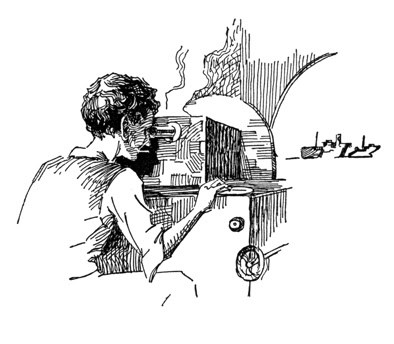
In 1928, when Whiting wrote a semi-fictionalized account of his wartime experience in Convoy: A Story of the War at Sea, it included an entire chapter about Mackay and his camouflage school. It also features a pen-and-ink drawing by Whiting (reproduced above) of a ship camoufleur looking at a camouflaged ship model in a testing theatre. In a different later source (from a 1932 issue of The Literary Digest), Whiting states that during the war he designed “camouflage for Army transports and supply ships.” In that case, it seems likely that he also worked with Frederick A. Pawla (1876-1964), who, as the head camouflage for the AEF Embarkation Service, oversaw the camouflage of “many of the army transports, particularly cargo carriers.” We have previously blogged about Pawla here and here.


On page 242 of Whiting’s book titled Convoy, there is an offhand reference to ship camouflage which may be relevant, or maybe not. The sentence reads: “The Monodoc, looking, in her camouflage, like an intoxicated snake, lay at anchor in the river.” The book’s text, as mentioned earlier is a book of fiction, based on fact. So perhaps we shouldn’t surprised that there doesn’t seem to have been a WWI American ship named Monodoc (altought there were ships named Monadnock). Maybe he simply invented the name.

In the same book, on page 80, Whiting provides some insight into an on-going conflict between Mackay’s camouflage team (affilidated with the US Shipping Board) and the US Navy’s own official Camouflage Section, which had been given the authority to originate all ship camouflage schemes, both Navy and civilian, which was greatly resented by those who were loyal to Mackay.

As Whiting alludes to in his book, Mackay’s camouflage school may not have been unauthorized by the Navy, and was thus conducted “quietly.” But, as he also implies, Mackay’s men also side-stepped strict compliance with the Navy’s regulations by claiming that the schemes that they were given required alteration to make them fit the vessels they were required to apply them to.


Here is the dialogue from Whiting’s book—

“I thought these [ship camouflage] designs were made in Washington, under the Navy Department.”

“Yep, that’s the theory. Those Johnnies think we only put their patterns on the steamers, but, b-bless you, the plans we get from there only fit half the shapes in this town. We have to camouflage every darned thing from a tanker to a barge.”

“And so your chief [William Andrew Mackay] is quietly evolving his own school for camoufleurs?”

“That’s it. The queerist lot of wights are working here, scraped up from the corners of Bohemia. But they work; Mackay is a hustler.”

“Drives you, does he?”

“No, he innoculates us; he has more ideas than all your admirals put together. And the boys are simply nuts about him.”


A small selection of other illustrations by Whiting, including book covers and an interior illustrations, are also featured in this post.

RELATED LINKS    

Dazzle Camouflage: What is it and how did it work?Nature, Art, and Camouflage / Art, Women's Rights, and CamouflageEmbedded Figures, Art, and Camouflage / Art, Gestalt, and Camouflage /  Optical science meets visual artDisruption versus dazzle / Chicanery and conspicuousness /  Under the big top at Sims' circus

Wednesday, July 17, 2024

not a camoufleur / Maine artist Willard W. Cummings

Willard W. Cummings
So, who actually served as a wartime camoufleur? It’s not always easy to answer. For example, I recently ran across published references to an American artist named Willard W. Cummings (1915-1975). He was a portrait painter, whose prominence is mostly due to having co-founded the Skowhegan School of Painting and Sculpture in Maine. The school was launched in 1946, after World War II had ended, on property his family owned.

Cummings had studied art at the Académie Julian in Paris, the Art Students League in New York, and at Yale University. He served in the US Army during WWII.  

When he died in 1975, an obituary in the New York Times (July 25) reported that “When he joined the Army in 1941 he was put to work painting camouflage.” But that is not entirely true. According to an interview with him, which took place in 1973 and which can now be found online at the Archives of American Art, his role as a camoufleur never panned out. He was sent to Fort Belvoir, where camouflage training was taking place, but instead of actually practicing that, “A colonel asked him to do a portrait, and this led to his being named an official army artist.” The same thing had happened to Norman Rockwell during World War I, when he was reassigned from camouflage to the task of making portraits of the top brass.

In Cummings’ case, it led to postwar commissions in which he painted the portraits of civilian celebrities, among them Bette Davis, Pablo Casals, Margaret Chase Smith (the senator from Maine), and Adali Stevenson. But he was never really a camouflage artist.

Friday, March 29, 2024

unheralded accomplishments of Walter Tandy Murch

Monograph on Walter Tandy Murch (2021)
Recently I became aware of the paintings of an extraordinary Canadian-born artist named Walter Tandy Murch (1907-1967). I am amazed to think that I had never heard of him before. I am drawn to his work in part because it has so much to do with styles and “ways of seeing” that I myself feel compatible with.

His work has the seemingly effortless charm of collages and assemblages, in which familiar components are recognizable—up to a point—yet disarmingly strange and beclouded. His paintings are not collages of course. They are unforced yet purposeful patterns of paint. The mystery that they induce comes partly from the struggle between the clarity of the thing portrayed—a bowler hat, gears and scientific tools, the backside of a manikin—and a half-rhyming, impending surrounding that threatens to merge. But it doesn’t.

Murch’s very finest works traverse a tight rope on the cusp of genuinely excellent gallery art (not easily found at the moment) and the best magazine illustration. Somehow he excelled at both, and we should not be surprised to find that his work remains formidable whether mounted on a gallery wall, or printed in full color on a magazine cover. Among his most powerful paintings are works that were commissioned as illustrations for the covers of Fortune Magazine and Scientific American.

Walter Tandy Murch / Cover Illustration
In researching Murch’s origins, I was more than pleased to find that he was student of Arthur Lismer (of the Canadian Group of Seven), one of my favorite painters, and one whose well-known works include a masterful depiction of the RMS Olympic, dressed in dazzle camouflage. As in Murch’s own paintings, Lismer is good at inviting us to participate in hide-and-seek. Murch moved from Canada in 1927 to New York, where he later studied with Arshile Gorky, another favorite artist of mine, who taught civilian camouflage during World War II. He was also greatly interested in the dream-like box collages of Joseph Cornell, of whom he painted a portrait in 1941.

While he was always prolific, Murch was never widely known, perhaps in part because he dared to be a “fine artist” when exhibiting at the Betty Parsons Gallery, and yet to apply the very same skills in illustration, advertising, graphic design, restaurant murals, the design of department store windows, and teaching. He lived for only sixty years. In the year before he died, his work was exhibited in a major retrospective at the Rhode Island School of Design. In 2021, Rizzoli USA published a full-color book about his life and work, titled Walter Tandy Murch: Paintings and Drawings, 1925-1967. At the top of this post is the cover.

Walter Tandy Murch / painting
Those who are immersed in vision and art—whether fine art or design—are nearly always prone to be devotees of cinema. I certainly fall within that group. Among the films that I admire are The Conversation, The English Patient, Julia, The Godfather series, and many more. That said, as I was basking in the pleasure of having found the artist Walter Tandy Murch, imagine my further exhuberance when I also learned that Murch’s son is the celebrated filmmaker and sound designer Walter Scott Murch. Among his many remarkable films are the few that I have listed above, but there are many more of equal or greater distinction.

RELATED LINKS    

Dazzle Camouflage: What is it and how did it work?

 Nature, Art, and Camouflage

 Art, Women's Rights, and Camouflage

 Embedded Figures, Art, and Camouflage

 Art, Gestalt, and Camouflage

 Optical science meets visual art

 Disruption versus dazzle

 Chicanery and conspicuousness

 Under the big top at Sims' circus

Tuesday, July 4, 2023

artist Alan Collier / whose training was on civvy street

Above Alan Caswell Collier (1911-1990), All Is Green and Gold, 1974, oil on canvas. Collier was a Canadian landscape artist. Born in Toronto, he studied at the Ontario College of Art and the Art Students League, New York. During the final years of World War II, he served in the Canadian Army. The statement below is from an interview of Collier by Paul Bennett, conducted in an exhibition catalog, Retrospective. Oshawa, Ontario CA: Robert McLaughlin Gallery, 1971, pp. 14-15—

When I was drafted into the army they asked me, when they saw my background if I wanted to go into camouflage. I decided that if I wasn't going to be a war artist, with a commission and so on, to hell with it; my training was on Civvy Street and I wasn't going to go in and be a private in the army and do art work as a private. I felt that I wanted something better than that, so I just said no, I did not want to go in the camouflage; I don't regret that I went into artillery survey. 

Thursday, June 8, 2023

officer's headquarters disguised as refreshment stand

Above Photograph of a post-World War I British mobile refreshment stand to which a dazzle camouflage pattern has been applied. Unemployed navy veterans were recruited as cafe staff.

•••

CAMOUFLAGE ARTIST CONVERT LEAR’S POST INTO ROAD STAND in Reading Eagle (Reading PA) September 12, 1941—

Somewhere in Louisiana with the Second Army (AP)—People just walk up and demand service—the place looks exactly like a refreshment stand. But the structure, on closer inspection, turns out to be Lieutenant General Benjamin Lear’s headquarters, artfully camouflaged in cloth.

It solves the problem of placing the directive headquarters of the Second Army in a spot close to telephonic communications without being too conspicuous.

The make-believe soft drink stand can be moved quickly and the general with it. So it violates no secret to reveal this fact as the enemy would have to inspect every refreshment stand in Louisiana to find it.

The job brought to light the work of the heretofore highly specialized group of soliders—the 8th Engineers Battalion, the first camouflage engineer unit ever formed in the army. It is quartered regularly at Fort Belvoir VA and commmanded by Major Ralph Lincoln.

Half-Skilled Workers
Now, the goal of virtually every artist and sculptor taken into the army, the battalion already has 50 per cent of its personnel professionally skilled workers. Each of the nation’s four armies will have similar units within the next few months.

The prize project in camouflage now underway is one by Private First Class Joseph Arasimowicz [1917-], of Pittsburgh, which he calls “new fall colors for snipers’ suits.” This consists of baggy, pajama-like uniforms dyed various shades of reds, browns and green to match the seasonal foliage the sniper picks to hide in. Arasimowicz claims a man in one of these suits is almost invisible at 30 yards.

To reduce worry for soldiers sleeping in the field, Corporal Constantine Dallas [b.1915], of Pittsburgh, who exhibited paintings throughout the East, is trying to figure out how to camouflage a pup tent so airmen overhead can’t spot it.

To cover up an entire sawmill, Corporal F[orest] C. Bess [1912-1977], former Bay City TX landscape gardener, has a crew busy stretching wires from tree to tree, from which bushes are suspended to look like the top of a forest.

The camouflage troops look on these jobs as those of “life savers,” for the reason the less the enemy can see the soldiers the less their chance of killing them.


Friday, December 23, 2022

deceptive non-service in the WWII camouflage corps

G. Burr Inwood, cartoon from Life, 1917.

•••

Lee Hall, Wallace Herndon Smith: paintings. University of Washington Press, 1987, pp. 60 and 64—

On Sunday, December 7, 1941, the Smiths were entertaining friends at lunch in their comfortable home in the country. A neighbor who had not been included in the party rushed in shouting, “Turn on the radio, turn on the radio.” Conversation stopped and while the guests tried to make sense of the neighbor’s urgent cries, he added, “They’re bombing us.” The Smiths and their guests, knowing the interloper’s proclivities for alcohol, assumed that he was well under the influence. When the message bearer dived under the piano, still wailing, they were prepared to dismiss his cries as an inept joke among joking neighbors. Soon, however, they were persuaded to tune in the radio and, with millions of other Americans, they learned of Pearl Harbor.

Talk of war—of Hitler and Europe, of England and of the United States’ loyalties—hummed in Connecticut as elsewhere. But even so, the news of the Japanese attack staggered the revellers. The next morning Wally telephoned a friend from Princeton who lived in Washington and who, to Wally's vague recollection, worked for the government. Through this friend, Wally managed to make an appointment with yet another friend who, he believed, "was handing out commissions." He flew to Washington and returned to Connecticut as a captain in the Camouflage Corps. “I was given a costume [a uniform],” he said, “but I never wore it.”…

The Camouflage Corps, to which Wally had been assigned as a commissioned officer, was by this time stationed in Missouri. Captain Smith was not called up to serve, but he chose nonetheless to mingle from time to time with his fellow officers. “The Camouflage Corps,” according to Kelse [Smith, his wife], “was a joke. They fought the war in the bars of the Chase and Park Plaza hotels.” 

restaurant robbery and a camouflaged futurist coffin

Above Anon, cartoon from The Sketch (London), 1919.

•••

REDSKINS GET $1,000 LOOT. Brooklyn Gunmen Paint Faces Then Stage Holdup. East Liverpool Review. East Liverpool OH, July 16, 1928, p. 8—

NEW YORK, July I6—Chicago gun­men may claim the distinction of hav­ing first introduced the submachine gun into the hold-up “racket,” but to Brooklyn goes credit for the first use of camouflage by stick up men. Three bandits today entered a State Street restaurant with their faces dis­guised with paint used in a manner like that employed formerly only by Indians on the warpath. The paint was streaked over their faces in [a] weird pattern. The leader wore a heavy black hue under one eye, while the rest of his face was streaked a brilliant red. The proprietor and his staff were so astonished that the bandits es­caped with $1,000 in cash and jewelry before an alarm was raised. 

RELATED LINKS    

Dazzle Camouflage: What is it and how did it work?Nature, Art, and Camouflage / Art, Women's Rights, and CamouflageEmbedded Figures, Art, and Camouflage / Art, Gestalt, and Camouflage /  Optical science meets visual artDisruption versus dazzle / Chicanery and conspicuousness /  Under the big top at Sims' circus


Thursday, November 10, 2022

she was not only good in math, science & philosophy

Frida Kahlo
Barbara Mujica, Frida: A Novel. Woodstock: Overlook Press, 2001, pp. 102-103—

“Everyone said I had an eye for color,” she told me, very impressed with herself. “Only that stupid Lorenzo, you know what he said? He said I should become a dress designer!” Obviously, she thought dress designing was beneath her, although as an adult she actually wore a lot of her own creations. I can understand how someone might have thought that Frida would become a dress designer. She was so particular about her clothes—the jewelry, the colors, the ribbons in her hair. Everything had to match. Clever Frida. I have to admit it; she was good not only in math and science and philosophy, but she knew how to doll herself up in order to camouflage her defects. I mean, Frida wasn’t really pretty—I told you that before—but she was very particular about her appearance. She took hours to get dressed and do her hair. It was important to her to divert people’s eyes from that ugly, deformed leg. More>>>