Showing posts with label illustrator. Show all posts

Saturday, August 1, 2026

ship camoufleurs George Musaphia / B.R. Campbell

George Musaphia illustrations
I know almost nothing about an American illustrator named George Musaphia. The little that I do know I found in a brief news article in the Spokane Chronicle (October 7, 1918), which reads as follows—

RECORD CLAIMED BY CAMOFLEURS Two Seattle "camofleurs"—the men who paint the zig-zag stripes on ships returned recently from Portland OR, where they spent six days supervising the camouflaging of six vessels being built for the Emergency Fleet Corporation. The total of six ships in six days is believed a camouflaging record.

The two are George Misaphia [sic], formerly a New York portrait painter, and B.R. Campbell, who, in peace times, is a Boston theatrical scenery decorator.


That's it. I've searched for both artists, Musaphia (not Misaphia, unless I'm mistaken) and Campbell, the latter of whom is possibly a New England artist named Brooks R. Campbell (1898-1977), who worked as a sign painter in Manhattan. It seems likely that the other man was George (or Georges) Musaphia (1894-1979), but I could be wrong.

One thing about Musaphia that seems certain is that he was affiliated with the theatre, and that he worked in Boston (in advance of World War I) as an illustrator for theatre reviews. Maybe that's how he met Campbell, who is described as a "Boston theatrical scenery decorator."

The six Musaphia illustrations that I have found so far were all published in 1913. I've scanned and reproduced them here. They are stylistically consistent, but the attribution is also clear because he signed his name in an unusual way, part symbol and part letters. They were published in the Boston American on the following dates (from top to bottom) September 7, October 12 and 19, and November 2, 9 and 30. He probably was a portrait painter because his theatre illustrations are, without fail, essentially portraits of the actors as they appear in costume.

Tuesday, April 21, 2026

like a circus / weird triangles and lines over the hulls

Above
Cover illustration by C. McKnight Smith for Scientific American, October 26, 1918.

•••

Robert H. Ferrell, Woodrow Wilson and World War I, 1917-1921. New York: Harper and Row, 1985, p. 35—

Having [to] resort to lookouts only when searching for victims, the U-boats [German submarines] enjoyed the advantage of a thin silhouette. Moreover, the U-boat lookout could see the masts of a steamer as far as fifteen miles whereas the steamer’s lookout could discern the sub only at four. The Allies camouflaged their ships by painting weird triangles and lines over the hulls, lending a circus aspect to every harbor.

Monday, April 21, 2025

stained glass artist / WWI camoufleur / bird enthusiast

Len R. Howard, Grace Church window
Surely, there can’t be many people—outside of those who specialize in stained glass window design— who have ever heard of a British-born American artist named Len R. Howard. Born Leonard Richard Howard in London on August 2, 1891, he became a youthful apprentice at a large British stained glass company, James Powell and Sons. He had also attended school at St. Martins and the Camberwell Art School in London.

Howard moved to the US in 1913, where he studied in New York at the Art Students League, and Pratt Institute. He was living in Boston in June 1917, when he registered for the draft. He had moved to the US from England in 1913. Two years later, he married an American woman named Madeleine Copping, and began to apply for citizenship. Soon after, they settled in New England, and Howard continued his studies at the Copley Society in Boston.

World War I began in Europe in 1914, but the US did not enter the war until 1917. In that year, Howard joined the army, and was assigned to the Camouflage Corps of the AEF, during which he served in France.

Len R. Howard

When the war ended, he returned to the US, where he worked for the Gorham Company in New York. In 1922, he and his wife settled in Kent CT, where he established his own commercial studio, where he designed stained glass windows. According to an article in the Scarsdale Inquirer (March 2, 1951), “His windows are in business buildings, churches and schools all over the country.”

During the Depression, Howard was commissioned by the WPA Federal Arts Project to complete a stained glass window, titled American Literature, for the high school in New Milford CT. Years later (c1963), he also designed a major window for Grace Church in Milbrook NY. That window, known as "the Lincoln window" (shown at the top of this blog post) was initially controversial because it portrays Abraham Lincoln as a “savior,” and because its imagery includes a reference to a slave auction. 

Whatever the circumstances, Howard was also interested in birds. He was the author of two unusual books on the subject (both illustrated with photographs and drawings), titled Birds as Individuals, and Living with Birds. There is online access to both at Internet Archive. He continued to work into his eighties. He died in 1987 in Arkansas.

RELATED LINKS    

Dazzle Camouflage: What is it and how did it work? /  Nature, Art, and Camouflage / Art, Women's Rights, and Camouflage /  Embedded Figures, Art, and Camouflage / Art, Gestalt, and Camouflage /  Optical science meets visual art /  Disruption versus dazzle / Chicanery and conspicuousness /  Under the big top at Sims' circus

Saturday, February 8, 2025

John Downes Whiting / American ship camoufleur

For years I’ve been trying to find out about an American artist, author and book illustrator named John Downes Whiting (1884-1977). I’ve been looking for information about his activities as a ship camouflage designer during World War I. One complication is that he is often cited as John D. Whiting, so it’s easy to confuse him with another person named John David Whiting (1882-1951), who belonged to a religious sect in Jerusalem called The American Colony.

In contrast, John Downes Whiting (known as Jack Whiting) was, as he described himself, a “Connecticut Yankee” and a graduate of the Yale School of Fine Arts (BFA 1915). Born in Ridgefield CT, he was named after his uncle, John Ireland Howe Downes (1861-1933), who was also an artist, a Yale graduate, and the librarian for the art school there for 23 years.

As an artist, Jack Whiting’s own profession was that of a book and magazine illustrator, but he wrote books as well. In 1920, he published Practical Illustration: A Guide for Artists (see cover above), and in 1928, he wrote and illustrated a semi-fictionalized account of his experience during WWI, titled Convoy: A Story of the War at Sea.

On his draft registration form, dated September 5, 1918, he lists his occupation as a “camoufleur” with the US Shipping Board, at 345 East 33rd Street in New York. That is the street address of the studio of a prominent muralist and interior designer named William Andrew Mackay, whom I’ve been writing about for years. We have blogged about Mackay’s contribution to ship camouflage, and have also published an essay on Mackay, his ship camouflage proposals, and his school for camoufleurs, headquartered at his studio, which he called the Mackay School of Camouflage.

According to biographical entries, Whiting joined the Connecticut National Guard in 1917, where he served in Company F of the 2nd Regiment for one year. From June through December of 1918, he was affiliated with Mackay’s team of camouflage artists, who were assigned to develop so-called “dazzle camouflage” schemes for US merchant ships. They were not strictly a part of the US Navy, but were affiliated with the civilian Shipping Board, which was responsible for applying the schemes to merchant ships in the harbors.

As Mackay himself described it, it was at his Manhattan studio—

that the first work of camouflage was developed. In all, 749 vessels were camouflaged, and sixty men, artists, architects and designers, made this shop their headquarters, under direction of the United States Shipping Board, working over designs, testing colors, peering through the periscope at the wooden models, and then dashing off to try out some few effect on the vessels that, in a few days, would be depending upon our skill in the art of disguise to save them from the U-boats.


I have a list of the names of sixty-four (not sixty) of Mackay’s camouflage school affiliates. All this is more or less confirmed by a review of John Downes Whiting’s book on Practical Illustration that appeared in The Daily Northwestern (Evanston IL) on January 22, 1921, p. 7. The book’s author, the reviewer states—

…served in the camouflage department of the navy during the war. One of Mr. Whiting’s assignments was to find out just what lines and colors did in reducing the visibility of ships. The results of his experiments, conducted at sea and on the coast, formed the basis of many of the weird but efficacious desgns which camouflaged our transports. William Andrew Mackay, the mural painter, with whom Mr. Whiting worked for the navy, says that Whiting’s book is written in the same thorough manner in which the author tackled his war work.

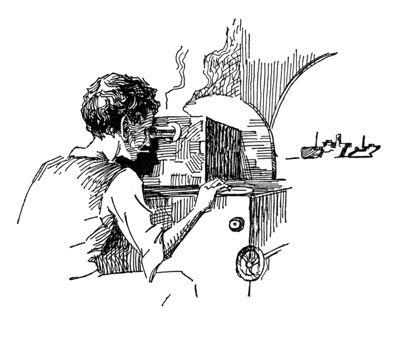
In 1928, when Whiting wrote a semi-fictionalized account of his wartime experience in Convoy: A Story of the War at Sea, it included an entire chapter about Mackay and his camouflage school. It also features a pen-and-ink drawing by Whiting (reproduced above) of a ship camoufleur looking at a camouflaged ship model in a testing theatre. In a different later source (from a 1932 issue of The Literary Digest), Whiting states that during the war he designed “camouflage for Army transports and supply ships.” In that case, it seems likely that he also worked with Frederick A. Pawla (1876-1964), who, as the head camouflage for the AEF Embarkation Service, oversaw the camouflage of “many of the army transports, particularly cargo carriers.” We have previously blogged about Pawla here and here.


On page 242 of Whiting’s book titled Convoy, there is an offhand reference to ship camouflage which may be relevant, or maybe not. The sentence reads: “The Monodoc, looking, in her camouflage, like an intoxicated snake, lay at anchor in the river.” The book’s text, as mentioned earlier is a book of fiction, based on fact. So perhaps we shouldn’t surprised that there doesn’t seem to have been a WWI American ship named Monodoc (altought there were ships named Monadnock). Maybe he simply invented the name.

In the same book, on page 80, Whiting provides some insight into an on-going conflict between Mackay’s camouflage team (affilidated with the US Shipping Board) and the US Navy’s own official Camouflage Section, which had been given the authority to originate all ship camouflage schemes, both Navy and civilian, which was greatly resented by those who were loyal to Mackay.

As Whiting alludes to in his book, Mackay’s camouflage school may not have been unauthorized by the Navy, and was thus conducted “quietly.” But, as he also implies, Mackay’s men also side-stepped strict compliance with the Navy’s regulations by claiming that the schemes that they were given required alteration to make them fit the vessels they were required to apply them to.


Here is the dialogue from Whiting’s book—

“I thought these [ship camouflage] designs were made in Washington, under the Navy Department.”

“Yep, that’s the theory. Those Johnnies think we only put their patterns on the steamers, but, b-bless you, the plans we get from there only fit half the shapes in this town. We have to camouflage every darned thing from a tanker to a barge.”

“And so your chief [William Andrew Mackay] is quietly evolving his own school for camoufleurs?”

“That’s it. The queerist lot of wights are working here, scraped up from the corners of Bohemia. But they work; Mackay is a hustler.”

“Drives you, does he?”

“No, he innoculates us; he has more ideas than all your admirals put together. And the boys are simply nuts about him.”


A small selection of other illustrations by Whiting, including book covers and an interior illustrations, are also featured in this post.

RELATED LINKS    

Dazzle Camouflage: What is it and how did it work? /  Nature, Art, and Camouflage / Art, Women's Rights, and Camouflage /  Embedded Figures, Art, and Camouflage / Art, Gestalt, and Camouflage /  Optical science meets visual art /  Disruption versus dazzle / Chicanery and conspicuousness /  Under the big top at Sims' circus

Sunday, May 12, 2024

camouflage / his master looks exactly like our egg man

Above W. Heath Robinson, "Camouflage vs. camouflage" from his invention series. Public domain. 

•••

John Lewis (who was himself a WWII camoufleur), Heath Robinson: Artist and Comic Genius (New York: Harper and Row, 1973), p 36—

When working in the garden he [British illustrator W. Heath Robinson] was in the habit of wearing the most dreadful old clothes and because of this was more than once mistaken for the gardener. On one occasion an artist dressed in a pale violet-grey suit, with a black velvet collar, called on the Robinsons. He saw Will digging in the garden and shouted across to him: “Is your master in, my man?” “I’Il go and see,” muttered Will and disappeared indoors, only to appear a moment later in a tidier jacket and with his hair brushed, to make himself known to the other artist. What the outcome of this was, I do not know. In his autobiography he tells this tale and gives the unnamed visitor the soubriquet of Renée de Boudoir.

•••

Max Eastman, Great Companions (New York: Farrar Straus and Cudahy, 1942)—

[In his later life, American philosopher John Dewey] moved out on Long Island, and preserved his contact with reality by raising eggs and vegetables and selling them to the neighbors… [He received an urgent order one day] from a wealthy neighbor for a dozen eggs, and the children being in school, he himself took the eggs over in a basket. Going by force of habit to the front door, he was told brusquely that deliveries were made in the rear. He trotted obediently around to the back door, feeling both amused and happy. Some time later, he was giving a talk to the women's club of the neighborhood, and his wealthy customer, when he got up to speak, exclaimed in a loud whisper: "Why, he looks exactly like our egg man!"  

Friday, May 3, 2024

he only wants the photograph, not the painting itself

The American painter Albert Sterner (1863-1946) was the father of architect Harold Sterner (1895-1976), who, during World War I, was assigned—as were Thomas Hart Benton and Louis Bouché—to make records of all camouflaged ships that entered various harbors (New York harbor in his case). The father was a friend of sculptor William Zorach, who recalled the following story in his autobiography—

William Zorach, Art Is My Life: The autobiography of William Zorach. Cleveland OH: World Publishing, 1967, p 131—

When the man [who had asked about his portraiture] came over to see Sterner, he told him his work was very expensive. That didn't bother the man and Sterner painted the portrait. The man studied it and was satisfied.    

He asked, “Can you tell me where I can get his photographed? I would like camouflageabout two hundred and fifty prints.”

Sterner said, "Peter Juley does all my photography. He'll be glad to do it and you will be well satisfied.”

He said, “Will you arrange to have two hundred and fifty prints made and have them sent to my office?”

Sterner said, "Certainly. And where shall I send the painting?”

“Oh,” he said, “you keep the painting. I don’t want the painting. I just want the photographs.”

So Sterner said, "What's the idea?"

The man said, "You know, I'm a broker and I want to send these photographs around to my clients so they can see I'm a very good looking and upright gentleman and they'll be glad to have me handle their business."

Friday, March 29, 2024

unheralded accomplishments of Walter Tandy Murch

Monograph on Walter Tandy Murch (2021)
Recently I became aware of the paintings of an extraordinary Canadian-born artist named Walter Tandy Murch (1907-1967). I am amazed to think that I had never heard of him before. I am drawn to his work in part because it has so much to do with styles and “ways of seeing” that I myself feel compatible with.

His work has the seemingly effortless charm of collages and assemblages, in which familiar components are recognizable—up to a point—yet disarmingly strange and beclouded. His paintings are not collages of course. They are unforced yet purposeful patterns of paint. The mystery that they induce comes partly from the struggle between the clarity of the thing portrayed—a bowler hat, gears and scientific tools, the backside of a manikin—and a half-rhyming, impending surrounding that threatens to merge. But it doesn’t.

Murch’s very finest works traverse a tight rope on the cusp of genuinely excellent gallery art (not easily found at the moment) and the best magazine illustration. Somehow he excelled at both, and we should not be surprised to find that his work remains formidable whether mounted on a gallery wall, or printed in full color on a magazine cover. Among his most powerful paintings are works that were commissioned as illustrations for the covers of Fortune Magazine and Scientific American.

Walter Tandy Murch / Cover Illustration
In researching Murch’s origins, I was more than pleased to find that he was student of Arthur Lismer (of the Canadian Group of Seven), one of my favorite painters, and one whose well-known works include a masterful depiction of the RMS Olympic, dressed in dazzle camouflage. As in Murch’s own paintings, Lismer is good at inviting us to participate in hide-and-seek. Murch moved from Canada in 1927 to New York, where he later studied with Arshile Gorky, another favorite artist of mine, who taught civilian camouflage during World War II. He was also greatly interested in the dream-like box collages of Joseph Cornell, of whom he painted a portrait in 1941.

While he was always prolific, Murch was never widely known, perhaps in part because he dared to be a “fine artist” when exhibiting at the Betty Parsons Gallery, and yet to apply the very same skills in illustration, advertising, graphic design, restaurant murals, the design of department store windows, and teaching. He lived for only sixty years. In the year before he died, his work was exhibited in a major retrospective at the Rhode Island School of Design. In 2021, Rizzoli USA published a full-color book about his life and work, titled Walter Tandy Murch: Paintings and Drawings, 1925-1967. At the top of this post is the cover.

Walter Tandy Murch / painting
Those who are immersed in vision and art—whether fine art or design—are nearly always prone to be devotees of cinema. I certainly fall within that group. Among the films that I admire are The Conversation, The English Patient, Julia, The Godfather series, and many more. That said, as I was basking in the pleasure of having found the artist Walter Tandy Murch, imagine my further exhuberance when I also learned that Murch’s son is the celebrated filmmaker and sound designer Walter Scott Murch. Among his many remarkable films are the few that I have listed above, but there are many more of equal or greater distinction.

RELATED LINKS    

Dazzle Camouflage: What is it and how did it work?

 Nature, Art, and Camouflage

 Art, Women's Rights, and Camouflage

 Embedded Figures, Art, and Camouflage

 Art, Gestalt, and Camouflage

 Optical science meets visual art

 Disruption versus dazzle

 Chicanery and conspicuousness

 Under the big top at Sims' circus