Showing posts with label books. Show all posts

Wednesday, January 7, 2026

Camouflage Exhibit at Spy Museum Opens in March

Exhibition Catalog Cover
I am pleased that I was asked to write the introduction to the catalog for a major upcoming exhibition at the International Spy Museum in Washington DC. Titled Camouflage: Designed to Deceive, the exhibit opens on March 1, 2026, and will remain on view for three years.

The catalog / book can be preordered at online book sites, and tickets are available in advance on the museum's website.

Monday, November 18, 2024

scout's oath / true boys do not chew gum in classroom

CAMOUFLAGE in The Clinton County Times (Lockhaven PA), December 6, 1918—

Long before the word was used there were boys who practiced camouflage. When a boy in school gets a book up before his face apparently to study, but in reality to chew gum, he is guilty of camouflage. Camouflage is used when a boy who has not looked at his lesson attempts to make an impressive recitation, or when he looks straight at the teacher while his mind is traveling off to the baseball ground. In war, camouflage has its place, but it has no place in the life of a true boy.

Friday, August 18, 2023

Art and Camouflage books / discount and free shipping

Above and below: Limited supply remaining of new, mint condition, signed first edition copies of three books by author and designer Roy R. Behrens: FALSE COLORS: Art, Design and Modern Camouflage (2002); CAMOUPEDIA: A Compedium of Research on Art, Architecture and Camouflage (2009); and SHIP SHAPE: A Dazzle Camouflage Sourcebook (2012). Available now as bundle for $60.00 (save $27.95 off list price of $87.95) with free shipping at <https://www.ebay.com/itm/294588563287>.

“[False Colors] is the definitive text on, but also the best possible introduction to, the 'social history' of military camouflage and the key role that artists played in its development. Roy Behrens writes beautifully and with complete authority. As a biologist, this is the book that broadened my horizons from an academic interest in animal camouflage to the broader context in which contemporary theories of camouflage evolved.” —Innes Cuthill, Professor of Behavioral Ecology, University of Bristol.

“[Behrens’ False Colors is] simply the best all-around introductory book on camouflage…it is perfect for beginners and a finishing school for veteran camoufleurs.” —Barton Whaley, military deception expert [2013].

“[Behrens’] book False Colors provides a brilliant overview of the subject [of art and camouflage].” —Art Historian Henry Adams, in Art and Antiques [2011].


Saturday, November 19, 2022

Camoufleur John Wilde in Walter SH Hamady's books

Above Page spread from Reeve Lindberg, John's Apples (Perishable Press, 1995), a Walter Hamady letterpress book, with full-color paintings of apples by John Wilde [WILL-dee].

•••

John Wilde: Recent Work, April 10-May 3, 2003. New York: Spanierman Gallery, 2003, p. 4—

His [Wilde’s] art interests developed early, as he recalled in 1986: “I have always loved to draw and paint ever since junior high school in Milwaukee. I was particularly fond of drawing imaginary cities, which I then erased and re-created.” In 1938 Wilde enrolled in the art department at the University of Wisconsin-Madison, where he studied human anatomy with Roland Stebbins and drawing with American Scene painter James Watrous. Shortly after he graduated, in 1942, Wilde was drafted into the army and served four years drawing camouflage and modeling terrain maps for various units (including the Office of Strategic Services, or OSS [precursor to the CIA]), while also meticulously detailing his disgust and dismay with wartime in a 275-page sketchbook. 

•••

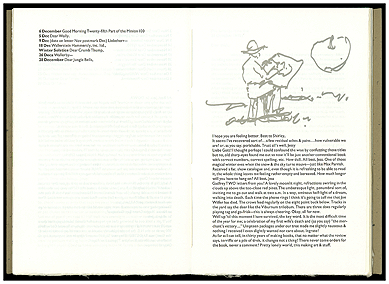
Below Page spread from Walter Hamady and John Wilde, A Hamady Wilde Sampler / Salutations 1995 (Perishable Press, 2001), including a self-portrait drawing by Wilde, presumably painting an apple. And below that, Roy R. Behrens, Mon Dieu. Collage in open-book form (1993). Hamady Collection.
Roy R. Behrens (1993)

Thursday, November 10, 2022

amazing how war finds use for anything—even artists

Gerard Woodward, Vanishing. London: Picador, 2014, p. 466—

Shortly after this, back at the barracks, I was called in to see the major. He said the following: "I've had a request for your transfer, Private Brill. It seems someone somewhere in the higher echelons of command thinks you might have a use. The army is forming a Camouflage Corps, and they have specifically asked for you to be part of it. How does it feel to be loved, eh? Well, I suppose they're looking for anyone with artistic credentials. You used to be an art teacher, didn't you? Amazing, isn't it, how war finds use for anything, even artists? Here's your travel warrant. You'll be leaving tomorrow."

Monday, November 7, 2022

Ding Cong / camouflaged wit and humor from china

Above is his illustration of the following traditional story, as told by Chinese artist Ding Cong (who signed his work as Xiao Ding) (1916-2009).

•••

Ding Cong, Wit and Humor from Ancient China: One Hundred Cartoons. China Books and Periodicals, 1986—

92. Camouflage with Leaves—

A poor man from the state of Chu once read the following in a book: “A mantis camouflaged itself while waiting to pounce on a cicada.” The man then gathered some leaves under a tree and used them to camouflage himself. When he asked his wife if she could identify him she spoke truthfully and said, “Yes, I can.” The man then changed his posture and asked her several more times. Becoming annoyed by this practice, she finally told him that she was unable to identify him. The man was very glad.

Thus camouflaged with leaves the man went to the market and stole things from the open stalls. But he was caught and summoned to the magistrate’s court. After the man confessed, the magistrate burst into laughter and set him free. He found the man’s conduct so inane that he decided not to punish him.

Friday, April 22, 2022

Picasso on camouflage / we originated it with cubism

Cook: The Man Who Taught Gertrude Stein to Drive
Above Roy R. Behrens, Emeritus Professor of Art at the University of Northern Iowa and Independence (Iowa) native has released a new 60-minute online documentary film about Iowa expatriate artist William Edwards Cook, and his close long-term friendship with American writer Gertrude Stein.

•••

Gertrude Stein (speaking in the pretended voice of Alice B. Toklas), The Autobiography of Alice B. Toklas. New York: Harcourt Brace, 1933—

[In 1907, Pablo Picasso went back to Spain for the summer] and he came back with some spanish landscapes and one may say that these landscapes…were the beginning of cubism.…

…In these pictures he first emphasized the way of building in spanish villages, the line of the houses not following the landscape but cutting across and into the landscape, becoming undistinguishable in the landscape by cutting across the landscape. It was the principle of the camouflage the guns and the ships in the war. The first year of the war, Picasso and Eve, with whom he was living then, Gertrude Stein and myself, were walking down the boulevard Raspail a cold winter evening.…All of a sudden down the street came some big cannon, the first any of us had seen painted, that is camouflaged. Pablo stopped, he was spell-bound. C’est nous qui avons fait ça, he said, it is we that have created that, he said. And he was right, he had. From Cézanne through him they had come to that. His foresight was justified.

RELATED LINKS    

Dazzle Camouflage: What is it and how did it work? /  Nature, Art, and Camouflage / Art, Women's Rights, and Camouflage /  Embedded Figures, Art, and Camouflage / Art, Gestalt, and Camouflage /  Optical science meets visual art /  Disruption versus dazzle / Chicanery and conspicuousness /  Under the big top at Sims' circus

Friday, December 17, 2021

suicide of WWI illustrator and ship camouflage artist

Cover design by Arthur Hutchins (1912)
As a civilian working for the Emergency Fleet Corporation during World War I, Boston illustrator Arthur Hutchins was assigned to camouflaging merchant ships. He was already well-known as an illustrator for books and magazines. Among his finest works were the cover and interior illustrations (1912) for the first book authored by American writer Sinclair Lewis (see cover above), who used the pseudonym Tom Graham.

As documented in the newspaper extracts below, Hutchins began to design wartime recruiting posters in 1917, and was assigned to ship camouflage in early 1918. All this was coincident with the Spanish flu pandemic, and apparently he was twice stricken by it, and never quite recovered. As described in the last of the three articles below, he took his own life in late March 1919.

•••

POSTERS TO WIN RECRUITS: Artists-Designers’ League Completes Several in Boston Sunday Post, May 6, 1917, p. 24—

Members of the Artists-Designers’ League have prepared several large posters calling upon ypung men to enlist in the navy. These will soon be placed in conspicuous locations in the city. The posters “speak” to the citizen through their inscriptions, designs and combinations of colors.

While three men prepared the designs, nearly a score of members of the league aided in the painting. The posters are five by seven feet and are stretched on wooden frames.

One poster, which was designed by Arthur Hutchins, is inscribed “The Navy is Your Opportunity. Be a Man and Man the Navy.” The design shows a battleship and a destroyer under full steam. The background is blue…


•••

BOSTON MAN IS WINNER OF POSTER PRIZE in Boston Evening Record, August 16, 1918—

Arthur Hutchins of Boston, connected with the Camouflage Department of the Emergency Fleet Corporation, won the first prize for shipyard and allied industrial works in the recent ship poster competition by the National Service Section of the United States Shipping Board.

In the competiton there were classes for artists and students, sailors and soldiers, shipyard and industrial workers, and school children.

Mr. Hutchins, whose poster was entitled “On the Firing Line,” was awarded the first prize by the decision of several competent judges. The artist, who has exceptional natural talent, chose for his subject a typical shipyard scene, showing two riveteers hard at work on the hull of a steel ship. The technqiue of the drawing is only surpassed by the deep feeling which it embodies. It is a subtle message of appeciation to the hardworking shipbuilder, who will look upon it often in his daily coming and going from the shipyard where these posters are to be placed. It is a man’s recognition of what his fellowmen are doing in the great fight. It cannot but bring encouragement to those sturdy laborers who inspired it.

The artistic ability of Mr. Hutchins covers large fields. He has made art his business for many years and has contributed much to the books and magazines of this country. He studied at the Boston School of the Museum of Fine Arts.…


•••

MARINE PAINTER TAKES HIS OWN LIFE: Arthur Hutchins Overworked for Government Camouflaging Vessels, in the Boston Herald, March 27, 1919, p. 7—

Arthur Hutchins, well-known painter of marine subjects who directed the work of camouflaging government vessels in this district for more than a year of the war, was found dead yesterday with a revolver bullet wound in his head at his studio, 252 Dorchester Avenue, Dorchester. The police stated that he undoubtedly ended his own life, as he had been suffering recently frm the effects of two attacks of influenza and from the arduous labor he performed for the government.

He worked unceasingly in the camouflaging of ships, and his nervous system became affected. After receiving his discharge from the service a few months ago, he visited Provincetown and New Hampshire in search of health, and on Monday evening he left home, Vassal Street, Wollaston, leaving the impression that he was again going to New Hampshire. After his departure his wife discovered that a revolver was missing from the house.

Yesterday his body was discovered on a couch in the studio, with the revolver lying near. The police believe he has been dead since Monday night.

He was born in Maine thirty-two years ago. His artistic productions have been frequently reproduced in the National Magazine and the National Sportsman, and he won a government prize for a Liberty poster design during the war. Surviving him besides his widow, are two children.

See also <https://youtu.be/2NJcvEmEg_o>

Monday, June 7, 2021

The Anatomy of Color, and Nature's Colorful Palette

I am a decade past retirement age. Despite repeated half-hearted attempts to downsize my possessions, I still have a too-large collection of books. Many of them are exquisite, all but perfectly conceived, designed, and printed. How will I ever part with them? At last I’ve reached a compromise (or so I thought): Short of discarding the finest books, I have pledged to refrain from collecting significant new ones.

But I’ve fallen short of that as well. In recent months, I could not resist buying copies of two magnificent volumes, a misstep no doubt but one I am certain I’ll never regret. They are two stunning clothboard books about color (sorry, e-book editions will not suffice), both by British color expert Patrick Baty. One is titled The Anatomy of Color: The Story of Heritage Paints and Pigments (Thames and Hudson, 2017), and the other (only recently released) is all about color in nature, and—by implication, if not openly discussed—the role of color in camouflage. Produced by Baty and four contributors (Elaine Charwat, Peter Davidson, André Karticzek, and Giulia Simonini), it is titled Nature’s Palette: A Color Reference System from the Natural World (Princeton University Press, 2021).

Both volumes are simply astounding in every regard. Reproduced at top is a page of bird feathers from the volume on color in nature. Each book is 300 pages or more, and while this page is especially striking, there are many more examples, page after page, that are equally unforgettable.

mimicry, empathy, brevity, closure and camouflage

 Monroe Books in Berlin, Germany has recently published a book of camouflage-related essays and artworks titled Mimicry-Empathy, edited by German artist Susanne Bürner. Shown above is the front cover. On the back cover (below) is a list of those whose work is included.

Among the essays is our latest, titled "Simpatico on the patio: Empathic art, mimicry, and camouflage." That essay, which deals with the functional link between empathy, closure, and camouflage, is also available online here.  


Friday, April 2, 2021

camouflage / a dance of beatings the boy endured

Above Roy R. Behrens, Papa's Waltz (© 2021). Digital montage.

•••

Yesterday, I put up this blog post and montage (above) on The Poetry of Sight, my more generic blog about vision, design, and the creative process. But it occurs to me that it might also be appropriate to repost it here, since Theodore Roethke's language has everything to do with camouflage, with concealed and embedded components.

•••

The title of the montage reproduced above (I sometimes call them “visual poems”) is intended as an homage to what some people regard as Theodore Roethke’s finest work, a sixteen-line autobiographical poem, titled “My Papa’s Waltz” (c1942). It is beautifully constructed, filled with engagement and gesture—and is yet at the same time disturbing in its beneath-the-surface suggestions.

Roethke, as a poet should, makes apt use of figures of speech, and we (the readers) are left to decide what to make of it. Does “papa’s waltz” simply describe an innocent dance, in which an inebriated father is engaged in ritualistic fun with his son, a small boy. Or, as certain components suggest, is it not a literal waltz, but instead a frightening memory of dance-like beatings the boy endured at the hands of a drunken parent?

You must read the entire poem, which is available online at the website of the Poetry Foundation. At the same, it also helps to read the article about this poem on Wikipedia, and to learn about the life of Theodore Roethke.